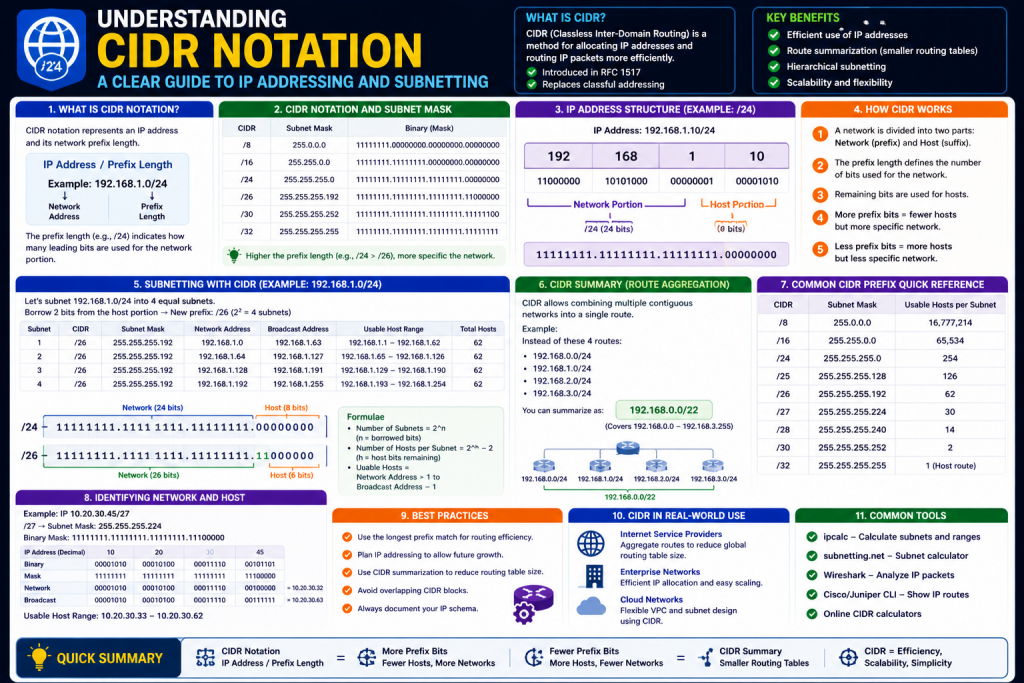
Classless Inter-Domain Routing, commonly known as CIDR, is one of the most important concepts in modern computer networking. It was introduced as a solution to the limitations of the original class-based IP addressing system, which struggled to keep up with the rapid expansion of the internet. As more devices began connecting to networks across the world, the need for a more flexible and efficient way to allocate IP addresses became obvious.
CIDR provides that flexibility by allowing network administrators to divide IP address space based on actual requirements rather than fixed classes. This makes it possible to use address space more efficiently, reduce waste, and improve routing performance. Understanding CIDR is essential for anyone working in IT networking or preparing for certification exams such as Network+ or CCNA.
In simple terms, CIDR allows networks to be divided into smaller, manageable segments called subnets. These subnets help organize devices, improve performance, and enhance security. Without CIDR, managing modern networks would be far more complex and inefficient.
What is CIDR Notation
CIDR notation is a shorthand method used to represent an IP address along with its network prefix. It combines the address and a suffix that indicates how many bits are used to define the network portion.
A typical example looks like this:
192.168.1.0/24
The number after the slash is the key element. It tells you how many bits from the beginning of the address are reserved for the network. Since IPv4 addresses are 32 bits long, this number can range from 0 to 32.
CIDR notation simplifies the way networks are described. Instead of writing out subnet masks separately, everything is included in a single expression. This makes it easier to read, configure, and manage network settings.
Structure of an IPv4 Address
To fully understand CIDR, it is important to understand how IPv4 addresses are structured. An IPv4 address consists of 32 bits divided into four equal parts called octets. Each octet contains 8 bits and is typically written in decimal form.
For example:
192.168.1.1
Each of these numbers represents a value between 0 and 255. This is because 8 bits can represent 256 different values, ranging from 0 to 255.
Behind the scenes, this address is stored in binary format:
11000000.10101000.00000001.00000001
Although binary is what computers use internally, decimal notation is used because it is easier for humans to read and understand.
Understanding Network and Host Portions
One of the most important aspects of CIDR notation is how it divides an IP address into two parts: the network portion and the host portion.
The network portion identifies the overall network, while the host portion identifies individual devices within that network. The CIDR suffix determines where this division occurs.
For example, in the address:
192.168.1.0/24
The first 24 bits are used for the network. This means the remaining 8 bits are used for hosts. All devices within this network will share the same first three octets, while the last octet will vary.
This structure allows multiple devices to exist within the same network while still having unique identifiers.
How CIDR Suffix Works
The CIDR suffix is essential for determining how many addresses are available in a network. It defines how many bits are fixed for the network and how many are flexible for hosts.
To calculate the number of available host addresses, subtract the CIDR suffix from 32. The result is the number of bits available for hosts.
For example:
32 minus 24 equals 8
This means there are 8 bits available for host addresses. To find the total number of addresses, raise 2 to the power of the number of host bits.
2 raised to the power of 8 equals 256
This means the network contains 256 total IP addresses.
Understanding IP Address Ranges
Each CIDR block defines a range of IP addresses. In the case of:
192.168.1.0/24
The range starts at 192.168.1.0 and ends at 192.168.1.255
Within this range, certain addresses have special purposes. The first address is the network address, and the last address is the broadcast address. These cannot be assigned to devices.
This leaves 254 usable addresses for hosts.
Understanding these ranges is crucial when designing networks, as it ensures that enough addresses are available for all devices.
Binary Fundamentals in Networking
Binary numbers play a central role in networking and CIDR notation. Each bit in an IP address represents a power of 2, and the combination of bits determines the final value.
For example, the binary number:
11000000
Can be converted to decimal by calculating:
1 times 2 to the power of 7 equals 128
1 times 2 to the power of 6 equals 64
Adding these together gives 192
This process is repeated for each octet in an IP address.
Understanding binary is essential for subnetting, calculating address ranges, and interpreting CIDR notation.
Converting Decimal to Binary
The reverse process, converting decimal to binary, is also important. This is done using repeated division by 2 and recording the remainders.
For example, converting 192:
192 divided by 2 equals 96 remainder 0
96 divided by 2 equals 48 remainder 0
48 divided by 2 equals 24 remainder 0
24 divided by 2 equals 12 remainder 0
12 divided by 2 equals 6 remainder 0
6 divided by 2 equals 3 remainder 0
3 divided by 2 equals 1 remainder 1
1 divided by 2 equals 0 remainder 1
Reading the remainders from bottom to top gives 11000000
This binary representation is what computers actually use when processing network data.
Why CIDR Replaced Classful Addressing
Before CIDR, IP addresses were divided into classes such as Class A, Class B, and Class C. Each class had a fixed size, which often led to inefficient use of address space.
For example, a company that needed a few hundred addresses would have to use a Class B network, which provides tens of thousands of addresses. This resulted in significant waste.
CIDR replaced this system by allowing variable-length subnet masks. This means networks can be sized according to actual needs, improving efficiency and reducing waste.
Benefits of CIDR Notation
CIDR provides several important advantages in networking.
It allows efficient use of IP address space, ensuring that addresses are not wasted. This is especially important given the limited number of IPv4 addresses.
It simplifies routing by enabling route aggregation. Multiple networks can be represented as a single entry in a routing table, reducing complexity.
It improves network organization by allowing administrators to design networks that match real-world requirements.
It also supports scalability, making it easier to expand networks as needed.
CIDR and Routing Efficiency
Routing is the process of sending data from one network to another. Routers use routing tables to determine the best path for data.
CIDR helps reduce the size of these tables by allowing multiple networks to be grouped together. This process is known as route summarization.
Smaller routing tables mean faster processing and more efficient data transmission. This is especially important in large networks such as the internet.
Relationship Between CIDR and Subnetting
CIDR and subnetting are closely related concepts. Subnetting involves dividing a network into smaller segments, while CIDR provides the notation used to describe those segments.
By adjusting the CIDR suffix, administrators can create subnets of different sizes. This allows for better resource allocation and improved network performance.
For example, a department with many devices can be assigned a larger subnet, while smaller departments can use smaller subnets.
Practical Importance of CIDR
In real-world networking, CIDR is used in many different scenarios. It is commonly seen in router configurations, firewall rules, and cloud networking setups.
Internet service providers use CIDR to allocate IP address blocks to customers. Large organizations use it to design internal networks.
Understanding CIDR is essential for troubleshooting network issues, planning network expansions, and ensuring efficient operation.
Preparing for Networking Certifications
CIDR is a key topic in many networking certification exams. Candidates are expected to understand how to calculate address ranges, determine subnet sizes, and interpret CIDR notation.
Practicing these skills is essential for success. Working through examples, performing calculations, and analyzing network diagrams can help reinforce understanding.
Building Confidence with CIDR
Learning CIDR can seem challenging at first, especially due to the involvement of binary math. However, with practice, it becomes much easier.
Breaking problems into smaller steps, using visual aids, and practicing regularly can help build confidence.
Over time, CIDR calculations become second nature, allowing you to quickly analyze and design networks.
Expanding on CIDR Fundamentals
Building on the foundational understanding of CIDR notation, it is important to explore how CIDR is applied in more advanced networking scenarios. While the basic concept explains how IP addresses are divided, the real power of CIDR comes from how it enables flexible subnetting, efficient routing, and scalable network design.
CIDR is not just a notation format. It is a complete approach to structuring networks in a way that aligns with real-world needs. Instead of forcing networks into rigid boundaries, CIDR allows administrators to create networks that match the number of devices, departments, or services they need to support.
This flexibility is what makes CIDR a core concept in both small business networks and massive global infrastructures.
Understanding Subnetting in Depth
Subnetting is the process of dividing a larger network into smaller, more manageable sub-networks. These smaller segments are called subnets. CIDR notation plays a central role in defining these subnets.
When a network is subnetted, some of the bits that were originally used for hosts are borrowed and used to create additional network segments. This reduces the number of hosts per subnet but increases the number of available subnets.
For example, starting with a /24 network, you can create multiple smaller networks such as /25, /26, or /27. Each increase in the CIDR suffix reduces the number of host bits and increases the number of subnets.
Subnetting allows organizations to isolate traffic, improve performance, and enhance security by separating different parts of a network.
Role of Subnet Masks
A subnet mask is closely related to CIDR notation. It is a 32-bit number that separates the network portion of an IP address from the host portion.
For example, a /24 CIDR notation corresponds to the subnet mask:
255.255.255.0
In binary form, this mask looks like:
11111111.11111111.11111111.00000000
The ones represent the network portion, and the zeros represent the host portion.
Subnet masks are used by devices to determine whether a destination IP address is on the same network or a different one. This helps devices decide whether to send data directly or forward it to a router.
Creating Smaller Subnets
One of the most practical skills in networking is the ability to create smaller subnets from a larger network. This is done by increasing the CIDR suffix.
For example, if you start with:
192.168.1.0/24
You can divide it into two /25 subnets:
192.168.1.0/25
192.168.1.128/25
Each of these subnets contains 128 total addresses, with 126 usable host addresses.
If you divide further into /26 subnets, you get four networks:
192.168.1.0/26
192.168.1.64/26
192.168.1.128/26
192.168.1.192/26
Each subnet now contains 64 total addresses, with 62 usable hosts.
This process can continue depending on how small the network needs to be.
Understanding Variable Length Subnet Masking
Variable Length Subnet Masking, often referred to as VLSM, is an advanced technique that allows different subnets within the same network to have different sizes.
Instead of dividing a network into equal parts, VLSM allows you to allocate larger subnets where needed and smaller subnets where fewer devices are present.
For example, a company might assign a /25 subnet to a large department and a /28 subnet to a smaller team. This ensures that IP addresses are used efficiently without wasting space.
VLSM is only possible because of CIDR. Without CIDR’s flexible notation, all subnets would need to be the same size.
Calculating Subnets and Hosts
When working with CIDR, it is essential to understand how to calculate both the number of subnets and the number of hosts.
The number of hosts in a subnet is calculated using the formula:
2 raised to the power of host bits minus 2
The subtraction accounts for the network and broadcast addresses.
For example, in a /26 network:
32 minus 26 equals 6 host bits
2 raised to the power of 6 equals 64
64 minus 2 equals 62 usable hosts
The number of subnets depends on how many bits are borrowed from the host portion.
These calculations are fundamental for designing networks that meet specific requirements.
CIDR and Route Aggregation
One of the most powerful features of CIDR is route aggregation, also known as supernetting. This technique allows multiple smaller networks to be combined into a single larger network representation.
For example, instead of listing several individual /24 networks, a router can use a single /22 block to represent them all.
This reduces the number of entries in routing tables, making routing more efficient. Smaller routing tables mean faster lookups and better performance.
Route aggregation is especially important for internet service providers, which manage large numbers of IP address blocks.
Hierarchical Network Design
CIDR supports hierarchical network design, which is a structured approach to organizing networks. In this model, networks are divided into layers such as core, distribution, and access.
Each layer serves a specific purpose, and CIDR helps define the boundaries between them.
For example, a large organization might have a /16 block assigned to it. This block can then be divided into smaller subnets for different regions, departments, or services.
This hierarchical structure makes networks easier to manage and scale.
CIDR in Routing Tables
Routing tables are used by routers to determine how to forward data packets. Each entry in a routing table includes a destination network and a corresponding CIDR notation.
When a packet arrives, the router compares the destination IP address to the entries in the table. It selects the route with the longest matching prefix.
This process is known as longest prefix matching. It ensures that the most specific route is chosen, leading to more accurate routing decisions.
CIDR makes this process efficient by allowing networks to be represented in a compact form.
Broadcast Domains and Network Segmentation
Subnetting with CIDR helps control broadcast domains. A broadcast domain is a group of devices that receive broadcast messages sent by any device within the group.
Large broadcast domains can lead to network congestion and reduced performance. By dividing a network into smaller subnets, broadcast traffic is limited to each subnet.
This improves overall network efficiency and reduces unnecessary traffic.
Network segmentation also enhances security by isolating different parts of the network. Sensitive systems can be placed in separate subnets, reducing the risk of unauthorized access.
CIDR in Cloud Networking
CIDR is widely used in cloud computing environments. Cloud providers require users to define virtual networks using CIDR blocks.
For example, when creating a virtual network, you might specify a CIDR block such as 10.0.0.0/16. This block can then be divided into smaller subnets for different services.
Understanding CIDR is essential for designing cloud architectures that are scalable, secure, and efficient.
Improper use of CIDR in cloud environments can lead to overlapping address spaces, connectivity issues, and wasted resources.
Common Subnet Sizes and Their Uses
Different CIDR blocks are commonly used for different purposes.
A /24 network is often used in small networks because it provides 254 usable addresses.
A /16 network is suitable for larger organizations, offering over 65,000 addresses.
Smaller subnets such as /30 are often used for point-to-point connections between routers, where only two usable addresses are needed.
Choosing the right subnet size is important for balancing efficiency and scalability.
CIDR and Private IP Addressing
CIDR is commonly used with private IP address ranges. These ranges are reserved for internal use and are not routable on the public internet.
Examples include:
10.0.0.0/8
172.16.0.0/12
192.168.0.0/16
These ranges can be subnetted using CIDR to create internal networks of various sizes.
Private addressing combined with CIDR allows organizations to build large internal networks without consuming public IP addresses.
Avoiding Common Mistakes
While CIDR is powerful, it can also lead to mistakes if not used correctly.
One common mistake is choosing a subnet that is too small, leading to a shortage of IP addresses.
Another mistake is overlapping CIDR blocks, which can cause routing conflicts and connectivity issues.
It is also important to account for future growth when designing networks. Allocating slightly larger subnets can prevent the need for redesign later.
Careful planning and accurate calculations are essential when working with CIDR.
Practical Examples for Practice
Practicing CIDR calculations is one of the best ways to build confidence.
For example, consider the network:
192.111.1.0/16
This network has 16 bits for the network and 16 bits for hosts. This results in:
2 raised to the power of 16 equals 65,536 total addresses
Subtracting 2 gives 65,534 usable host addresses.
Working through examples like this helps reinforce understanding and improves speed when solving problems.
CIDR and Network Growth
As networks grow, CIDR makes it easier to expand without major redesigns. Additional subnets can be created from existing address space, and route aggregation can be used to keep routing tables manageable.
This flexibility allows network administrators to plan for future growth while still maintaining efficient use of available IP addresses. Instead of being locked into rigid class-based boundaries, CIDR enables more precise allocation, ensuring that organizations only use what they actually need.
As a result, network performance can improve because routers process fewer routes, reducing overhead and speeding up decision-making. CIDR also supports hierarchical network design, where larger networks are divided into smaller, structured segments. This organization not only enhances scalability but also improves security and troubleshooting, as issues can be isolated within specific subnets. Furthermore, CIDR plays a crucial role in conserving IPv4 address space, which has become increasingly limited over time.
Another important advantage is its compatibility with modern routing protocols, which rely heavily on route summarization to optimize performance across large-scale environments. By using CIDR effectively, organizations can adapt to changing demands, integrate new technologies, and maintain a more organized and efficient network infrastructure without constant reconfiguration or disruption.
This scalability is one of the reasons CIDR remains a cornerstone of modern networking.
Organizations can start with a modest network and gradually expand as needed, all while maintaining efficiency and organization.
Preparing for Advanced Networking Concepts
A strong understanding of CIDR is essential before moving on to more advanced topics such as dynamic routing protocols, network security, and cloud architecture.
Many advanced concepts build directly on CIDR principles, including route summarization, access control lists, and network address translation.
By mastering CIDR, you create a solid foundation for further learning and professional growth in networking.
This flexibility allows network administrators to plan for future growth while still maintaining efficient use of available IP addresses. Instead of being locked into rigid class-based boundaries, CIDR enables more precise allocation, ensuring that organizations only use what they actually need.
As a result, network performance can improve because routers process fewer routes, reducing overhead and speeding up decision-making. CIDR also supports hierarchical network design, where larger networks are divided into smaller, structured segments. This organization not only enhances scalability but also improves security and troubleshooting, as issues can be isolated within specific subnets. Furthermore, CIDR plays a crucial role in conserving IPv4 address space, which has become increasingly limited over time.
Another important advantage is its compatibility with modern routing protocols, which rely heavily on route summarization to optimize performance across large-scale environments. By using CIDR effectively, organizations can adapt to changing demands, integrate new technologies, and maintain a more organized and efficient network infrastructure without constant reconfiguration or disruption.
Revisiting the Importance of CIDR in Modern Networks
As networks continue to grow in size and complexity, the importance of CIDR notation becomes even more evident. CIDR is not just a foundational concept learned for exams; it is actively used in nearly every aspect of real-world networking. From enterprise infrastructures to cloud deployments and internet backbone routing, CIDR plays a critical role in ensuring efficient communication.
The flexibility that CIDR provides allows organizations to design networks that are scalable, organized, and efficient. Without it, managing IP address space would be significantly more difficult, especially in environments where thousands or even millions of devices are connected.
CIDR allows network engineers to think strategically about how address space is allocated, ensuring that networks remain adaptable as demands change over time.
CIDR in Enterprise Network Design
In enterprise environments, CIDR is used to structure networks in a logical and hierarchical way. Large organizations typically divide their networks into multiple segments based on departments, locations, or functions.
For example, a company might allocate one CIDR block for its headquarters, another for branch offices, and additional blocks for data centers or specialized services. Each of these blocks can then be further subnetted to meet specific requirements.
This structured approach simplifies management and troubleshooting. If a problem occurs within a specific subnet, it can be isolated without affecting the rest of the network. CIDR makes this level of organization possible by providing precise control over address allocation.
Route Summarization in Practice
Route summarization is one of the most valuable applications of CIDR in large-scale networks. It allows multiple smaller networks to be combined into a single summary route, reducing the number of entries in routing tables.
For instance, instead of maintaining separate routes for multiple adjacent networks, a router can represent them using a single CIDR block. This reduces memory usage and improves routing efficiency.
In internet routing, this concept is essential. Internet service providers rely heavily on route summarization to manage the vast number of networks connected to the global internet. Without CIDR, routing tables would become unmanageable.
The ability to summarize routes also improves convergence times, meaning networks can adapt more quickly to changes such as link failures or topology updates.
CIDR and Longest Prefix Matching
Routers use a technique called longest prefix matching to determine the best path for a packet. When multiple routes match a destination IP address, the router selects the one with the most specific prefix.
For example, if a router has entries for both a /16 network and a /24 network, and a packet matches both, the /24 route will be chosen because it is more specific.
CIDR enables this behavior by allowing prefixes of varying lengths. This ensures that traffic is routed as efficiently as possible, based on the most precise information available.
Understanding longest prefix matching is essential for troubleshooting routing issues and designing efficient network paths.
CIDR in Internet Service Provider Networks
Internet service providers rely on CIDR to allocate address space to customers and manage large-scale networks. They receive large blocks of IP addresses and divide them into smaller segments for distribution.
These allocations are carefully planned to ensure efficient use of address space while maintaining the ability to summarize routes. ISPs must balance the need for flexibility with the need to keep routing tables manageable.
CIDR also enables hierarchical addressing, where global networks are divided into regional and local segments. This structure mirrors the organization of the internet itself, making it easier to manage and scale.
CIDR and IPv6 Addressing
While CIDR was originally developed for IPv4, its principles are equally important in IPv6. In fact, CIDR is even more critical in IPv6 due to the vastly larger address space.
IPv6 addresses are 128 bits long, which means the CIDR suffix can range from 0 to 128. This allows for an enormous number of possible subnet combinations.
In IPv6, CIDR is used to define network prefixes, often with standard allocations such as /64 for individual subnets. These larger address spaces simplify some aspects of network design but still rely on CIDR for structure and organization.
Understanding how CIDR applies to IPv6 is essential for future-proofing networking skills.
Security Benefits of CIDR-Based Design
CIDR also plays a role in network security. By dividing networks into smaller subnets, administrators can control access more effectively and limit the spread of potential threats.
For example, sensitive systems such as databases or internal services can be placed in separate subnets with restricted access. Firewalls and access control lists can then be configured based on CIDR blocks.
This segmentation reduces the risk of unauthorized access and makes it easier to enforce security policies. If a security issue arises, it can be contained within a specific subnet rather than affecting the entire network.
CIDR-based segmentation is a key component of modern network security strategies.
CIDR in Cloud and Virtual Environments
In cloud computing, CIDR is used extensively to define virtual networks and subnets. When deploying resources in the cloud, users must specify CIDR blocks to allocate address space.
For example, a cloud network might use a CIDR block such as 10.0.0.0/16, which is then divided into smaller subnets for application tiers, databases, and other services.
Proper CIDR planning is crucial in cloud environments. Overlapping CIDR blocks can cause connectivity issues, especially when connecting multiple networks or integrating with on-premises systems.
Cloud providers often require careful CIDR design to ensure scalability and avoid conflicts. This makes a strong understanding of CIDR essential for cloud architects and engineers.
Managing Large-Scale Networks
As networks grow, managing IP address space becomes increasingly complex. CIDR helps address this challenge by providing a structured approach to allocation and organization.
Large organizations often maintain detailed IP address management systems that track CIDR blocks, subnets, and assigned addresses. This ensures that address space is used efficiently and prevents conflicts.
CIDR also simplifies network expansion. New subnets can be created from existing blocks, and route summarization can be used to keep routing tables manageable.
This scalability is one of the key reasons CIDR remains relevant in modern networking.
Troubleshooting with CIDR Knowledge
Understanding CIDR is invaluable when troubleshooting network issues. Many problems, such as connectivity failures or routing errors, can be traced back to incorrect CIDR configurations.
For example, if two networks have overlapping CIDR ranges, devices may not be able to communicate properly. Similarly, incorrect subnet masks can lead to misrouted traffic.
By analyzing CIDR notation and understanding how networks are structured, administrators can quickly identify and resolve these issues.
CIDR knowledge also helps when interpreting routing tables, firewall rules, and network diagrams.
CIDR and Network Automation
As networking becomes more automated, CIDR continues to play a key role. Automation tools often rely on CIDR notation to define network configurations programmatically.
For example, scripts and infrastructure-as-code templates use CIDR blocks to create and manage networks. This ensures consistency and reduces the risk of human error.
Automation also allows for dynamic allocation of subnets, making it easier to scale networks in response to changing demands.
A solid understanding of CIDR is essential for working with these modern tools and technologies.
Planning for Future Growth
One of the most important aspects of CIDR-based design is planning for future growth. Networks rarely remain static, and it is important to allocate address space in a way that allows for expansion.
This often involves reserving unused portions of a CIDR block for future use. By doing so, organizations can add new subnets without disrupting existing configurations.
Proper planning also reduces the need for costly and complex network redesigns. CIDR makes it possible to build networks that can evolve over time while maintaining efficiency and organization.
Real-World Scenario Applications
In real-world scenarios, CIDR is used in a wide variety of ways. For example, a company might use CIDR to separate internal networks from guest networks, ensuring that visitors cannot access sensitive resources.
Another example is in data centers, where different services are placed in separate subnets to optimize performance and security.
In telecommunications, CIDR is used to manage large pools of IP addresses and ensure efficient routing across vast networks.
These practical applications highlight the versatility and importance of CIDR in modern networking.
Common Challenges and Best Practices
While CIDR offers many benefits, it also presents challenges. Poor planning can lead to inefficient use of address space, routing issues, or security vulnerabilities.
To avoid these problems, it is important to follow best practices. These include documenting all CIDR allocations, avoiding overlapping ranges, and planning for future growth.
Regular audits of network configurations can also help identify potential issues before they become serious problems.
By following these practices, organizations can maximize the benefits of CIDR while minimizing risks.
Mastering CIDR for Professional Growth
For networking professionals, mastering CIDR is a key step toward career advancement. It is a fundamental skill that underpins many advanced topics, including routing protocols, network security, and cloud architecture.
A strong understanding of CIDR allows professionals to design efficient IP addressing schemes, which is essential for building scalable and well-structured networks. Without this knowledge, it becomes difficult to manage address allocation effectively or troubleshoot connectivity issues in complex environments.
In real-world scenarios, CIDR knowledge is frequently applied when configuring routers, setting up firewalls, or working with virtual networks in cloud platforms. It also plays an important role in subnetting strategies, enabling professionals to divide networks logically based on departments, services, or security requirements. This level of control helps improve both performance and security by limiting unnecessary traffic and isolating sensitive resources.
Additionally, many industry certifications and job roles expect a solid grasp of CIDR concepts, making it a valuable asset for career growth. Employers often look for candidates who can optimize network resources and implement efficient routing practices. By mastering CIDR, networking professionals not only strengthen their technical foundation but also increase their ability to design modern, flexible infrastructures that can adapt to evolving business and technological demands.
Employers expect network engineers to understand CIDR and apply it effectively in real-world scenarios. This makes it an essential area of study for anyone pursuing a career in IT networking.
Continuous practice, hands-on experience, and real-world application are the best ways to develop expertise in CIDR.
Conclusion
CIDR notation is a cornerstone of modern networking, providing the flexibility and efficiency needed to manage IP address space in an ever-growing digital world. From its role in subnetting and route summarization to its applications in cloud computing and network security, CIDR is deeply embedded in every aspect of network design and operation.
By understanding CIDR, network professionals gain the ability to design scalable, organized, and efficient networks. This knowledge not only improves technical skills but also enhances problem-solving abilities, making it easier to troubleshoot issues and adapt to new challenges.
As technology continues to evolve, the principles of CIDR will remain relevant, supporting the growth of networks and the expansion of the internet. Mastering CIDR is not just about passing exams; it is about building a strong foundation for a successful career in networking.
Continue exploring the technologies and certification concepts that matter most to you.