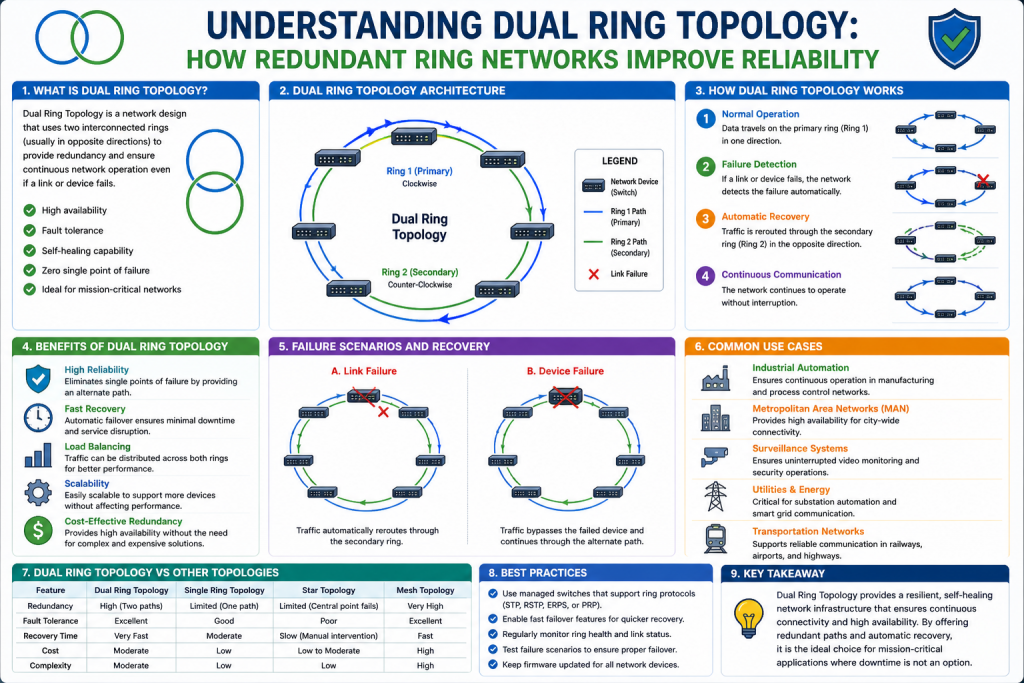
Dual ring topology is a network design that consists of two interconnected circular data paths, allowing information to travel between devices in a structured and reliable manner. Unlike a single ring network, where data moves in only one direction, this topology introduces a second ring that carries data in the opposite direction. This dual-path structure creates a more resilient communication system capable of maintaining operations even when part of the network fails.
At its core, the concept revolves around redundancy. The primary ring is responsible for normal data transmission, while the secondary ring acts as a backup. If the primary ring experiences a disruption, such as a cable failure or device malfunction, the system automatically redirects traffic through the secondary ring. This ensures continuity and minimizes downtime, which is especially important in environments where uninterrupted communication is critical.
The design of dual ring topology makes it particularly useful in systems that require high reliability. By having two separate paths for data transmission, it reduces the risk of complete network failure and enhances overall performance stability.
What is Network Topology and Why It Matters
Network topology refers to the arrangement of devices and connections within a computer network. It defines how different components such as computers, servers, switches, and routers are linked together and how data flows between them. The structure of a network plays a crucial role in determining its efficiency, scalability, and fault tolerance.
There are several types of network topologies, each designed to meet specific requirements. Some common examples include star, bus, mesh, and ring topologies. Each of these has its own strengths and weaknesses, depending on factors such as network size, cost, and desired performance.
Choosing the right topology is an important decision for network engineers. It involves evaluating the physical layout of the environment, the number of devices that need to be connected, and the level of reliability required. A well-designed topology can improve communication speed, simplify troubleshooting, and ensure that the network remains operational even in the event of failures.
Dual ring topology stands out among these options because of its ability to combine structured communication with built-in redundancy. It offers a balance between simplicity and reliability, making it a practical choice for certain types of networks.
Exploring the Concept of Ring Networks
A ring network is a type of topology in which each device is connected to exactly two other devices, forming a closed loop. Data travels from one device to the next in a sequential manner until it reaches its destination. This creates a predictable and organized flow of information.
In traditional ring networks, data typically moves in a single direction. Each device receives data from one neighbor and passes it along to the next. This method ensures that all devices have equal access to the network and reduces the likelihood of data collisions.
However, this design also has limitations. One of the main drawbacks is that a failure in any part of the ring can disrupt the entire network. If a single device or connection is broken, the loop is interrupted, and communication cannot continue. This vulnerability makes single ring networks less suitable for environments where reliability is a top priority.
To address this issue, the concept of dual ring topology was developed. By adding a second ring, the network gains an alternative path for data transmission, significantly improving its resilience.
How Dual Ring Topology Differs from Single Ring Design
The primary difference between a single ring and a dual ring topology lies in the presence of an additional communication path. In a single ring, all devices rely on one loop for data transmission. If that loop fails, the entire network is affected.
In contrast, dual ring topology introduces a second loop that operates alongside the first. These two rings are interconnected and typically transmit data in opposite directions. This arrangement allows the network to continue functioning even if one ring becomes unavailable.
The secondary ring serves as a failover mechanism. Under normal conditions, it may remain idle or carry minimal traffic. However, when a failure is detected in the primary ring, the network automatically switches to the secondary ring. This process happens quickly and does not require manual intervention.
This added layer of redundancy makes dual ring topology more reliable than its single-ring counterpart. It ensures that communication can continue without interruption, even in the face of hardware or connection issues.
The Role of Data Flow in Dual Ring Systems
Data flow is a fundamental aspect of any network, and in dual ring topology, it is carefully managed to ensure efficiency and reliability. Each ring in the topology has a specific direction of data transmission. The primary ring typically carries data in one direction, while the secondary ring carries it in the opposite direction.
When a device wants to send data, it places the information onto the ring. The data then travels from one device to the next until it reaches its intended recipient. Each device along the path checks whether the data is meant for it. If not, it simply passes the data along to the next device.
This sequential flow of data ensures that communication is orderly and predictable. It also reduces the chances of data collisions, as devices take turns transmitting information.
In the event of a failure, the direction of data flow can be reversed or redirected through the secondary ring. This flexibility allows the network to adapt to changing conditions and maintain continuous communication.
Components That Form Dual Ring Topology
Dual ring topology is made up of several key components that work together to create a functional network. Each of these elements plays a specific role in ensuring smooth and reliable communication.
The primary ring is the main pathway for data transmission. It connects all devices in a circular loop and handles the majority of network traffic. This ring is responsible for normal communication between nodes.
The secondary ring provides a backup path. It mirrors the structure of the primary ring but operates in the opposite direction. Its main purpose is to take over when the primary ring fails, ensuring that data can still be transmitted.
Nodes, or devices, are the endpoints in the network. These can include computers, servers, printers, or any device with a network interface. Each node is connected to two other nodes, forming part of both rings.
Tokens are used to manage access to the network. A token is a special signal that grants a device permission to transmit data. This helps prevent multiple devices from sending data at the same time, reducing the risk of collisions.
Additional networking equipment, such as switches and routers, may be used to manage data flow and connect the network to other systems. These devices help ensure that data is directed to the correct destination and that communication remains efficient.
Token Passing and Controlled Communication
Token passing is an important mechanism in ring-based networks, including dual ring topology. It is used to control which device can send data at any given time. This method ensures that communication remains orderly and efficient.
In a token-based system, a small data packet called a token circulates around the network. When a device receives the token, it is allowed to transmit data. Once it has finished sending its information, it passes the token to the next device in the ring.
This process continues in a loop, giving each device an opportunity to communicate. Because only one device can hold the token at a time, the chances of data collisions are significantly reduced.
Token passing also ensures fairness. Every device gets a turn to transmit data, preventing any single device from dominating the network. This balanced approach contributes to the overall stability of the system.
In dual ring topology, token passing can operate across both rings, depending on the configuration. This adds an extra layer of control and reliability to the network.
Importance of Redundancy in Network Design
Redundancy is a key principle in network design, and it is central to the concept of dual ring topology. It involves creating backup systems or paths that can take over in case of a failure. This ensures that the network remains operational even when problems occur.
In a dual ring system, redundancy is achieved through the use of two interconnected rings. If the primary ring fails, the secondary ring provides an alternative route for data transmission. This eliminates the single point of failure that exists in a single ring network.
The ability to switch between rings automatically is one of the most valuable features of this topology. It allows the network to respond quickly to disruptions without requiring manual intervention.
Redundancy not only improves reliability but also enhances user experience. By minimizing downtime, it ensures that services remain available and that communication is not interrupted.
Why Dual Ring Topology is Still Relevant Today
Despite the evolution of networking technologies, dual ring topology continues to be relevant in certain applications. Its simplicity and reliability make it a practical choice for networks that require consistent performance and minimal downtime.
The structured nature of the topology makes it easy to understand and implement. It provides a clear path for data transmission and includes built-in mechanisms for handling failures. This combination of features makes it suitable for environments where stability is more important than scalability.
While modern networks often use more advanced topologies, the principles behind dual ring topology remain important. Understanding how it works provides valuable insight into concepts such as redundancy, fault tolerance, and controlled communication.
These concepts are fundamental to network design and are used in many different types of systems. By studying dual ring topology, one can gain a deeper understanding of how networks are built to handle real-world challenges.
Foundation for Advanced Networking Concepts
Learning about dual ring topology provides a strong foundation for exploring more complex networking concepts. It introduces key ideas such as structured communication, redundancy, and fault tolerance, which are essential for designing reliable networks.
As networks continue to grow and evolve, the need for dependable communication systems becomes increasingly important. Concepts like dual ring topology help engineers develop solutions that can handle high demands and unexpected failures.
By understanding the strengths and limitations of this topology, it becomes easier to evaluate other network designs and choose the most appropriate one for a given situation. This knowledge is valuable for anyone involved in networking, from beginners to experienced professionals.
Dual ring topology may not be the most widely used design today, but its influence can still be seen in many modern systems. Its emphasis on reliability and structured communication continues to shape the way networks are designed and implemented.
How Dual Ring Topology Works in Real-Time Environments
Dual ring topology operates through a continuous flow of data across two interconnected circular paths. These rings are designed to function together, ensuring that communication remains uninterrupted even when unexpected issues arise. In a typical setup, all devices are connected to both rings, allowing them to send and receive data through either path depending on the network’s condition.
Under normal circumstances, the primary ring handles the entire data transmission process. Information travels in a single direction from one node to the next, following a predictable path. Each device receives the incoming data, checks whether it is the intended recipient, and then forwards it to the next device if necessary. This structured movement ensures that data reaches its destination efficiently.
The secondary ring, in most cases, remains inactive or lightly utilized during normal operations. Its main role is to act as a standby path that becomes active when the primary ring encounters a failure. This design ensures that there is always an alternative route available for data transmission.
The network continuously monitors the health of the primary ring. If a break in the connection or a malfunctioning device is detected, the system quickly reroutes data through the secondary ring. This automatic failover process allows the network to maintain communication without requiring manual intervention.
Mechanisms Behind Automatic Failover
One of the defining features of dual ring topology is its ability to automatically switch between rings when a problem occurs. This process, known as failover, is critical for maintaining network reliability.
Failover is typically managed by protocols or hardware mechanisms that monitor the status of the network. These systems detect disruptions such as signal loss, broken cables, or inactive nodes. Once a fault is identified, the network takes immediate action to redirect traffic.
The redirection process involves reversing the flow of data or switching to the secondary ring entirely. Because the secondary ring operates in the opposite direction, it can bypass the faulty segment of the primary ring. This ensures that data can still travel between devices without interruption.
After the issue is resolved, the network may switch back to the primary ring. This restoration process is often seamless, allowing normal operations to resume without noticeable disruption to users.
The efficiency of this mechanism is one of the reasons why dual ring topology is considered highly reliable. It provides a built-in solution for handling failures, reducing the impact of unexpected problems.
Redundancy and Fault Tolerance in Depth
Redundancy is a fundamental concept in dual ring topology. It refers to the presence of multiple pathways for data transmission, ensuring that the network can continue functioning even if one path fails.
In a single ring network, there is only one route for data to travel. If that route is broken, communication stops completely. Dual ring topology eliminates this vulnerability by introducing a second path.
Fault tolerance is closely related to redundancy. It describes the network’s ability to continue operating despite failures. In a dual ring system, fault tolerance is achieved through the automatic switching between rings.
This capability is especially important in environments where downtime can have serious consequences. For example, industrial systems, communication networks, and critical infrastructure rely on continuous operation. Even a brief interruption can lead to significant issues.
By providing an alternative path for data, dual ring topology ensures that these systems remain operational. This makes it a valuable choice for applications that require high levels of reliability.
High Availability and Continuous Operation
High availability is another key advantage of dual ring topology. It refers to the network’s ability to remain accessible and functional for as much time as possible.
In a dual ring system, high availability is achieved through the combination of redundancy and fault tolerance. Because there are always at least two possible paths for data transmission, the network can continue operating even when one path is compromised.
This level of availability is particularly important for organizations that depend on constant connectivity. Services such as online platforms, communication systems, and industrial processes require uninterrupted access to data.
Dual ring topology supports these requirements by minimizing downtime. The automatic failover mechanism ensures that disruptions are handled بسرعة and efficiently, allowing the network to maintain its performance.
In addition, the structured nature of the topology makes it easier to identify and address issues. This further contributes to the overall reliability of the system.
Load Distribution and Network Efficiency
While dual ring topology is primarily designed for reliability, it can also support efficient data distribution. In some configurations, both rings can be used simultaneously to handle network traffic.
This approach, often referred to as an active-active configuration, allows data to be transmitted in both directions at the same time. By distributing the load across two paths, the network can reduce congestion and improve performance.
In a standard setup, however, only one ring is actively used for data transmission. The secondary ring remains available as a backup. This ensures that the network maintains its redundancy while still operating efficiently.
The ability to adapt to different configurations makes dual ring topology flexible. Network engineers can choose how to utilize the rings based on specific requirements, balancing performance and reliability.
This adaptability is one of the reasons why dual ring topology has remained relevant despite the development of newer network designs.
Monitoring and Maintenance in Dual Ring Networks
Effective monitoring is essential for maintaining the performance of a dual ring network. The system must continuously check the status of its components to detect potential issues before they escalate.
Monitoring tools track various aspects of the network, including signal strength, data flow, and device activity. These tools help identify problems such as broken connections or malfunctioning nodes.
When an issue is detected, the network’s failover mechanism is triggered. This ensures that communication continues while the problem is being addressed.
Maintenance in dual ring topology involves ensuring that both rings are functioning correctly. This includes checking cables, verifying connections, and updating network configurations as needed.
Because the topology involves two interconnected rings, maintenance can be more complex compared to simpler designs. However, this complexity is offset by the increased reliability and fault tolerance it provides.
Advantages of Dual Ring Topology
Dual ring topology offers several advantages that make it a valuable choice for certain types of networks. These benefits are largely related to its ability to maintain reliable communication.
One of the most significant advantages is redundancy. The presence of two rings ensures that there is always an alternative path for data transmission. This reduces the risk of complete network failure.
Another important benefit is fault tolerance. The network can continue operating even when one part of the system fails. This is achieved through the automatic failover mechanism.
High availability is also a key advantage. The network remains operational for longer periods, minimizing downtime and ensuring continuous access to data.
In addition, the structured nature of the topology makes data transmission predictable. This can improve efficiency and simplify network management.
These advantages make dual ring topology particularly suitable for environments where reliability is a top priority.
Challenges in Implementing Dual Ring Topology
Despite its many benefits, dual ring topology also presents certain challenges. One of the main issues is complexity. The presence of two interconnected rings requires careful planning and management.
Setting up the network involves connecting each device to two separate paths. This increases the amount of cabling and hardware required. As a result, the initial cost of implementation can be higher compared to simpler topologies.
Maintenance can also be more demanding. Ensuring that both rings are functioning properly requires regular monitoring and troubleshooting.
Another challenge is scalability. As more devices are added to the network, the length of the rings increases. This can lead to higher latency, as data must travel through more nodes to reach its destination.
These challenges mean that dual ring topology is not always the best choice for large or rapidly growing networks. However, for smaller systems that require high reliability, it remains an effective solution.
Performance Considerations in Larger Networks
As the size of a dual ring network increases, performance can be affected. The time it takes for data to travel from one device to another depends on the number of nodes in the ring.
In larger networks, data may need to pass through many devices before reaching its destination. This can introduce delays and reduce overall efficiency.
To address this issue, network engineers may implement optimization techniques. These can include segmenting the network or using additional hardware to manage data flow.
Despite these measures, scalability remains a limitation of dual ring topology. It is best suited for networks where the number of devices is relatively stable and manageable.
Understanding these performance considerations is important when deciding whether to use this topology.
Real-World Applications of Dual Ring Topology
Dual ring topology is commonly used in environments where reliability and continuous operation are essential. These include industrial systems, transportation networks, and communication infrastructure.
In such settings, even a brief interruption in communication can have serious consequences. Dual ring topology provides the necessary redundancy to ensure that these systems remain operational.
It is also used in certain types of local area networks where fault tolerance is a priority. The ability to maintain communication despite failures makes it a practical choice for these applications.
Although newer technologies have introduced alternative approaches, dual ring topology continues to be used in scenarios where its specific advantages are needed.
Understanding Its Role in Modern Networking
While modern networks often use more advanced designs, the principles behind dual ring topology remain relevant. Concepts such as redundancy, fault tolerance, and structured communication are still widely used.
Dual ring topology serves as an important example of how these principles can be implemented. It demonstrates how a network can be designed to handle failures and maintain performance.
By studying this topology, network professionals can gain a deeper understanding of how to build reliable systems. This knowledge can then be applied to more complex and modern network designs.
The continued relevance of dual ring topology highlights the importance of foundational concepts in networking. Even as technology evolves, these core ideas remain essential for creating effective communication systems.
Limitations of Dual Ring Topology in Modern Networks
While dual ring topology offers strong reliability and fault tolerance, it is not without its limitations. One of the most significant challenges is its complexity. The presence of two interconnected rings requires careful configuration, monitoring, and maintenance. Each device must be properly connected to both rings, and any misconfiguration can lead to communication issues.
Another limitation is cost. Because the topology requires additional cabling, hardware, and setup time, the initial investment can be higher compared to simpler network designs. Organizations with limited budgets may find it difficult to justify these costs, especially if their network does not require high levels of redundancy.
Scalability is also a concern. As more devices are added to the network, the length of the rings increases. This can lead to higher latency, as data must pass through more nodes before reaching its destination. In large-scale environments, this delay can impact overall performance and efficiency.
Maintenance becomes more challenging as the network grows. Troubleshooting issues in a dual ring system can be time-consuming, especially when dealing with multiple interconnected components. Ensuring that both rings are functioning properly requires continuous monitoring and regular updates.
Despite these limitations, dual ring topology remains a valuable option for certain applications. Understanding its drawbacks helps in making informed decisions about when and where to use it.
Risk of Complete Network Failure
Although dual ring topology is designed to provide redundancy, it is still possible for the network to experience a complete failure under certain conditions. This can occur if both rings are disrupted at the same time.
Such situations are rare but not impossible. For example, a major hardware failure, environmental damage, or power outage could affect both rings simultaneously. When this happens, the network loses its ability to reroute data, resulting in a complete loss of communication.
The likelihood of this type of failure increases as the network becomes more complex. More devices and connections mean more potential points of failure. While redundancy reduces risk, it does not eliminate it entirely.
To mitigate this risk, additional measures can be implemented. These may include backup power systems, redundant hardware, and advanced monitoring tools. By combining dual ring topology with other protective strategies, organizations can further enhance network reliability.
Comparing Dual Ring Topology with Other Network Designs
Dual ring topology is just one of many network configurations available. Each topology has its own strengths and weaknesses, making it suitable for different scenarios. Comparing dual ring topology with other designs helps highlight its unique characteristics.
In a star topology, all devices are connected to a central hub or switch. This design is simple and easy to manage. If one device fails, it does not affect the rest of the network. However, if the central hub fails, the entire network goes down. Dual ring topology, on the other hand, does not rely on a single central point, making it more resilient in that regard.
Bus topology uses a single communication line to connect all devices. It is cost-effective and easy to set up, but it lacks redundancy. A break in the main cable can disrupt the entire network. Dual ring topology addresses this issue by providing an alternative path for data.
Mesh topology connects each device to multiple other devices, creating multiple pathways for data transmission. This design offers high reliability and fault tolerance but can be complex and expensive to implement. Dual ring topology provides a simpler alternative with built-in redundancy, though it may not offer the same level of flexibility as a full mesh network.
Tree topology combines elements of star and bus designs, creating a hierarchical structure. It is scalable and organized but can be affected by failures in higher-level nodes. Dual ring topology avoids this hierarchy, relying instead on a circular structure for communication.
These comparisons show that dual ring topology occupies a middle ground. It offers more reliability than simpler designs while avoiding the extreme complexity of more advanced configurations.
Practical Use Cases for Dual Ring Topology
Dual ring topology is commonly used in environments where reliability and continuous operation are essential. One of its primary applications is in industrial systems. Manufacturing plants, for example, rely on consistent communication between machines and control systems. Any interruption can disrupt production and lead to significant losses.
Transportation systems also benefit from dual ring topology. Railway networks, traffic control systems, and airport operations require constant data exchange. The ability to maintain communication even during failures makes dual ring topology a suitable choice for these applications.
Telecommunications infrastructure is another area where this topology is used. Service providers need to ensure that their networks remain operational at all times. Dual ring topology helps achieve this by providing redundancy and fault tolerance.
In addition, it can be found in certain local area networks where uptime is critical. Organizations that depend on uninterrupted access to data may choose this topology to ensure reliability.
These use cases highlight the importance of dual ring topology in real-world scenarios. Its ability to maintain communication under challenging conditions makes it a valuable tool in network design.
Hardware and Infrastructure Considerations
Implementing dual ring topology requires careful planning of hardware and infrastructure. Each device in the network must be equipped with the necessary interfaces to connect to both rings. This often involves using network interface cards that support multiple connections.
In addition to interface capability, attention must be given to the physical layout of the network. Devices need to be positioned in a way that supports efficient cabling and minimizes signal interference. Proper cable management becomes essential, as two separate ring paths must be maintained without overlap or confusion. Using high-quality cables and connectors also helps ensure stable data transmission and reduces the chances of signal degradation over time.
Another important consideration is compatibility between hardware components. All devices, switches, and network interfaces must support the same communication standards and protocols to function correctly within the dual ring structure. Inconsistent hardware can lead to bottlenecks or communication failures.
Environmental factors should not be overlooked either. Temperature, humidity, and power stability can all impact network performance. Installing equipment in controlled environments and using surge protection or backup power supplies can help maintain consistent operation.
Finally, proper testing and validation are necessary before deploying the network fully. Running simulations or pilot setups allows engineers to identify potential weaknesses and correct them early, ensuring a smoother and more reliable implementation.
Cabling is another important factor. The network requires two separate paths for data transmission, which means additional cables must be installed. These cables must be arranged in a way that maintains the integrity of both rings.
Switches and routers may also be used to manage data flow and connect the network to external systems. These devices help ensure that data is routed efficiently and reaches the correct destination.
Power supply is a critical consideration as well. To maintain continuous operation, the network may require backup power systems. This ensures that devices remain functional even during power outages.
Proper planning and implementation of these components are essential for the success of a dual ring network. Any weaknesses in the infrastructure can affect performance and reliability.
Managing Network Growth and Expansion
Expanding a dual ring network requires careful consideration. Adding new devices involves integrating them into both rings, which can be more complex than simply connecting them to a central hub.
As the network grows, the length of the rings increases. This can lead to higher latency, as data must travel through more nodes. The increased number of connections also raises the likelihood of faults, making maintenance more challenging.
To manage growth effectively, network engineers may divide the network into smaller segments or use additional technologies to optimize performance. These strategies help maintain efficiency while accommodating new devices.
Despite these challenges, dual ring topology can still support moderate growth if properly managed. Understanding its limitations allows for better planning and more effective expansion strategies.
Real-World Applications and Practical Relevance
Dual ring topology is commonly used in environments where reliability is critical. Industrial systems are a prime example. Manufacturing processes rely on continuous communication between machines, and any interruption can disrupt operations.
Transportation systems also benefit from this topology. Railway signaling, traffic management, and airport systems require constant data exchange. Dual ring topology ensures that these systems remain operational even during failures.
Telecommunication networks use similar principles to maintain service availability. The ability to reroute data quickly is essential for providing uninterrupted connectivity to users.
In addition, some organizations use dual ring topology in local networks where uptime is a priority. These applications highlight its practical value in scenarios where reliability cannot be compromised.
Future Relevance of Dual Ring Concepts
While newer network designs have emerged, the principles behind dual ring topology remain important. Concepts such as redundancy, fault tolerance, and structured communication continue to influence modern networking.
Even in advanced systems, the idea of having multiple paths for data transmission is widely used. Technologies such as redundant links and failover mechanisms are built on the same foundational concepts.
Learning about dual ring topology provides insight into how networks can be designed to handle failures and maintain performance. This knowledge is valuable for understanding both traditional and modern network systems.
Conclusion
Dual ring topology represents a reliable and structured approach to network design. By using two interconnected rings, it provides redundancy and ensures that communication can continue even when part of the network fails. This makes it particularly useful in environments where uptime and stability are essential.
Throughout its design, the topology emphasizes fault tolerance, controlled data flow, and automatic recovery from failures. These features make it a strong choice for specific applications, even though it may not be suitable for all network types.
At the same time, it comes with challenges such as higher cost, increased complexity, and limited scalability. Understanding these limitations is important when deciding whether to implement this topology in a real-world scenario.
Despite the evolution of networking technologies, dual ring topology remains an important concept. It demonstrates how thoughtful design can improve reliability and ensure continuous communication. By studying this topology, one gains a deeper understanding of the principles that drive modern network systems and the importance of building resilient infrastructure.
Continue exploring the technologies and certification concepts that matter most to you.