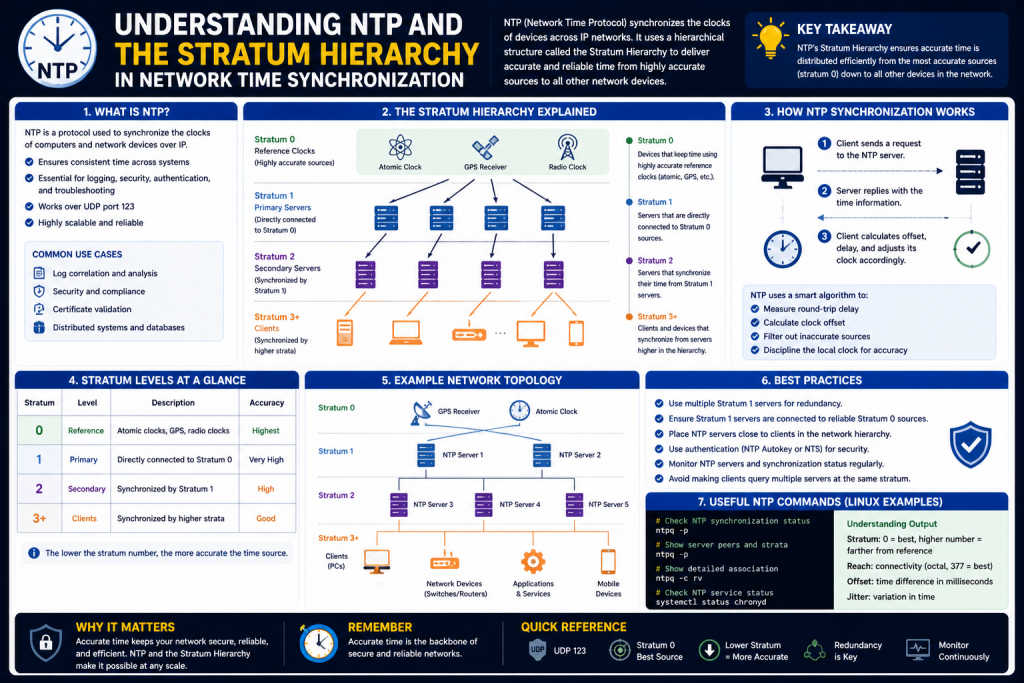
Time plays a fundamental role in computing systems, far beyond simply displaying the current hour to users. In modern networks, accurate and consistent timekeeping is essential for ensuring that systems operate correctly, securely, and efficiently. Every device connected to a network relies on time in some way, whether for processing transactions, recording logs, or coordinating operations with other devices.
When multiple systems interact, even a small difference in time can lead to serious issues. For example, if one server records an event before another server even thinks it happened, troubleshooting becomes confusing and unreliable. In distributed environments such as cloud computing platforms or enterprise networks, synchronized time is critical for maintaining order and consistency.
Without proper time synchronization, systems may experience failures in authentication, inconsistencies in data processing, and errors in scheduled operations. This is why protocols designed specifically for time synchronization are an essential part of networking infrastructure.
The Evolution and Purpose of Network Time Protocol
The Network Time Protocol, commonly known as NTP, is one of the oldest protocols still in use today. It was introduced in 1979 with the goal of synchronizing clocks across computer systems connected through networks. Over the decades, it has evolved to become highly reliable, scalable, and capable of maintaining precise time across vast and complex environments.
The primary purpose of NTP is to ensure that all devices in a network share a common understanding of time. It achieves this by allowing systems to communicate with dedicated time servers that provide accurate time information. These servers are often connected to highly precise sources such as atomic clocks or satellite-based systems.
NTP operates using a client-server model. A client device sends a request to a time server, and the server responds with the current time along with additional data that helps the client determine how accurate that time is. The client then adjusts its own clock accordingly.
One of the key strengths of NTP is its ability to compensate for network delays. Since data takes time to travel across networks, NTP calculates the delay between sending a request and receiving a response. By factoring in this delay, it ensures that the synchronized time remains as accurate as possible.
Why Accurate Time Matters in IT Systems
Accurate timekeeping is critical for a wide range of applications in information technology. One of the most important areas is security. Many security mechanisms rely on time-based validation, including SSL certificates and authentication tokens. If a system’s clock is out of sync, it may reject valid certificates or accept expired ones, leading to potential vulnerabilities.
Logging is another area where precise time is essential. System logs are used to track events, diagnose issues, and investigate security incidents. If timestamps are inconsistent across systems, it becomes extremely difficult to reconstruct events accurately.
Scheduled tasks also depend heavily on accurate time. Automated processes such as backups, updates, and batch jobs must run at specific times. If the system clock is incorrect, these tasks may run too early, too late, or not at all.
In financial systems, timing is even more critical. Transactions often require precise timestamps to ensure accuracy and compliance. Even minor discrepancies can lead to significant problems, including financial losses or regulatory issues.
Communication systems also rely on synchronized time to coordinate data transmission. In some cases, timing differences can cause delays, packet loss, or synchronization errors.
Introduction to the NTP Stratum Concept
At the heart of NTP lies the concept of stratum. The term stratum refers to the level or layer within a hierarchical system used to organize time sources. This hierarchy ensures that time is distributed efficiently and accurately across networks.
Each level in the stratum hierarchy represents the distance from the original reference clock. The closer a device is to the reference clock, the lower its stratum number and the more accurate its time is considered to be.
The stratum system provides a structured way to manage time synchronization. Instead of all devices attempting to connect directly to a single time source, the hierarchy distributes the load across multiple levels. This improves scalability and reduces the risk of overloading any single server.
How the Stratum Hierarchy Works
The NTP stratum hierarchy is designed to create a chain of time synchronization. At the top of the hierarchy are the most accurate time sources, and each subsequent level receives time from the level above it.
As time moves down the hierarchy, each level acts as both a client and a server. It receives time from a higher level and then distributes that time to lower levels. This creates a cascading effect that allows accurate time to reach a large number of devices.
Although each step introduces a small potential for inaccuracy, the differences are typically negligible. Even devices several levels removed from the primary source can maintain time accuracy within milliseconds.
The hierarchical design also ensures redundancy. If one path to the time source becomes unavailable, devices can use alternative paths to maintain synchronization.
Primary Time Sources and Their Role
The most accurate time sources are located at the top of the hierarchy. These sources are known for their precision and reliability, often using advanced technology to maintain exact time.
Atomic clocks are one of the most precise timekeeping devices available. They measure time based on the vibrations of atoms, providing an extremely stable and accurate reference. Another common source is the Global Positioning System, which uses satellite signals to deliver precise timing information.
These primary sources are not directly accessed by most devices. Instead, they are connected to specialized servers that distribute their time to the rest of the network.
Distribution of Time Across Networks
Once time is obtained from primary sources, it must be distributed to other devices. This is where the stratum hierarchy becomes essential. By organizing servers into different levels, NTP ensures that time can be shared efficiently without overwhelming any single source.
Devices typically do not rely on a single server. Instead, they communicate with multiple servers to compare time data and select the most accurate result. This approach increases reliability and helps prevent errors caused by faulty or delayed responses.
The distribution process is continuous. Devices regularly update their clocks to maintain synchronization, ensuring that time remains consistent even as network conditions change.
The Balance Between Accuracy and Scalability
One of the key challenges in time synchronization is balancing accuracy with scalability. While it is desirable for all devices to have the most accurate time possible, it is not practical for every device to connect directly to the highest-level sources.
The stratum hierarchy addresses this challenge by allowing time to flow through multiple levels. Lower-level servers provide a practical balance, offering high accuracy while supporting a large number of clients.
This design makes NTP suitable for both small networks and large-scale global systems. It can adapt to different environments while maintaining consistent performance.
Reliability and Fault Tolerance in NTP
Reliability is a critical aspect of any network protocol, and NTP is designed with this in mind. The hierarchical structure provides built-in fault tolerance, allowing systems to continue functioning even when some components fail.
Clients are usually configured to use multiple servers. If one server becomes unavailable, the client can switch to another without losing synchronization. This redundancy ensures that timekeeping remains consistent even in the face of network disruptions.
The protocol also includes mechanisms for detecting and filtering out inaccurate time sources. By comparing data from multiple servers, NTP can identify inconsistencies and choose the most reliable option.
Preparing for Deeper Exploration of Stratum Levels
Understanding the basic concept of NTP and the role of the stratum hierarchy provides a strong foundation for exploring more advanced topics. The structure of the hierarchy, the behavior of different stratum levels, and the processes involved in synchronization all contribute to the effectiveness of NTP.
In the next section, the focus will shift to a detailed examination of the individual stratum levels. Each level plays a specific role in the hierarchy, and understanding these roles is key to mastering NTP and its applications in real-world networks.
By building on the concepts introduced here, it becomes easier to appreciate how NTP achieves precise and reliable time synchronization across diverse and complex environments.
Overview of the NTP Stratum Hierarchy
The NTP stratum hierarchy is the structural backbone of how time synchronization is distributed across networks. It is designed as a layered system where each level represents a degree of separation from the original and most accurate time source. This hierarchy allows millions of devices across the world to maintain synchronized time without overwhelming any single resource.
The hierarchy is composed of multiple levels, typically ranging from stratum 0 to stratum 15. Each level has a specific role in receiving, maintaining, and distributing time information. The system is carefully designed to ensure both accuracy and scalability, which are essential for modern computing environments.
As one moves higher in the stratum number, the distance from the original time source increases. Although this introduces slight variations in accuracy, the differences are generally so small that they do not affect normal computing operations. The hierarchy ensures that even devices far removed from the primary source can still maintain reliable time synchronization.
Stratum 0: The Ultimate Time Reference
Stratum 0 represents the most precise timekeeping sources available. These are not traditional network servers but specialized hardware devices that provide extremely accurate time measurements. They serve as the foundation of the entire NTP hierarchy.
Examples of stratum 0 sources include atomic clocks and satellite-based timing systems. Atomic clocks are capable of maintaining time with extraordinary precision by measuring the oscillations of atoms. Satellite systems, such as those used in global navigation networks, also provide highly accurate time signals that can be used for synchronization.
These devices are not directly accessible over standard networks. Instead, they are physically connected to stratum 1 servers, which act as intermediaries between these precise sources and the rest of the network.
Stratum 1: Primary Time Servers
Stratum 1 servers are directly connected to stratum 0 devices. Because of this direct connection, they are considered highly accurate and serve as the primary time servers in the NTP hierarchy. They are responsible for distributing time to lower-level servers and clients.
These servers are typically maintained by government organizations, research institutions, universities, and large technology companies. Due to their importance, they are often equipped with redundant hardware and robust security measures to ensure reliability.
Stratum 1 servers are not meant to handle requests from every device on the internet. Instead, they provide time to secondary servers, which then distribute it further. This layered approach prevents excessive load on primary servers and ensures efficient time distribution.
Stratum 2: Secondary Time Servers
Stratum 2 servers receive time from stratum 1 servers and act as intermediaries in the hierarchy. They are commonly used in enterprise networks and are often the primary time source for client devices such as computers, routers, and switches.
These servers play a crucial role in reducing the load on stratum 1 servers. By acting as a buffer layer, they allow a large number of devices to synchronize time without directly accessing the primary sources.
Stratum 2 servers are generally very accurate, with time differences typically within milliseconds of the original source. This level of accuracy is sufficient for most applications, including business operations, logging, and security processes.
Organizations often deploy their own stratum 2 servers within their networks. These internal servers synchronize with external stratum 1 servers and then provide time to all devices within the organization. This setup improves performance and reduces dependency on external networks.
Stratum 3 and Lower Levels
Stratum 3 servers receive time from stratum 2 servers and continue the process of distributing time further down the hierarchy. This pattern continues with stratum 4, stratum 5, and so on, up to a maximum of stratum 15.
Each level represents an additional step away from the primary time source. While this may introduce small variations in accuracy, the differences are typically negligible for most use cases.
Devices at higher stratum levels still maintain a high degree of accuracy, often within acceptable limits for general computing tasks. However, for applications requiring extremely precise timing, lower stratum levels are preferred.
The existence of multiple levels allows the system to scale effectively. Large networks can support thousands or even millions of devices without overloading any single server.
Stratum 16 and Unsynchronized State
Stratum 16 is a special designation within the NTP system. It indicates that a device is not synchronized with any reliable time source. Devices in this state should not be used as time references for other systems.
When a device cannot reach any valid NTP server or loses synchronization, it may temporarily enter this state. During this time, it relies on its internal clock, which may gradually drift away from accurate time.
Administrators must monitor for this condition and ensure that devices regain synchronization as soon as possible. Persistent stratum 16 status may indicate network issues, configuration errors, or server failures.
How Time Flows Through the Hierarchy
Time synchronization in NTP follows a top-down approach. It begins with stratum 0 sources, which provide the most accurate time. This time is passed to stratum 1 servers, which then distribute it to stratum 2 servers, and so on.
Each server in the hierarchy acts as both a client and a server. It receives time from a higher-level source and then provides that time to lower-level devices. This dual role is essential for maintaining the flow of time across the network.
The process is continuous, with servers regularly updating their time to ensure accuracy. This ongoing synchronization helps maintain consistency across all levels of the hierarchy.
Server Selection and Preference
When a client device needs to synchronize its clock, it must choose one or more NTP servers. This selection process is based on several factors, including stratum level, network latency, and server reliability.
Clients generally prefer servers with lower stratum numbers because they are closer to the primary time source. However, proximity in terms of network distance can also influence the decision. A nearby stratum 2 server may be more reliable than a distant stratum 1 server.
To improve accuracy, clients often communicate with multiple servers. By comparing the time data received from different sources, the client can identify inconsistencies and select the most reliable time.
Redundancy and Load Distribution
One of the key advantages of the NTP hierarchy is its ability to provide redundancy. By having multiple servers at each level, the system can continue functioning even if some servers fail.
Clients are typically configured with multiple time sources. If one server becomes unavailable, the client can switch to another without losing synchronization. This ensures continuous operation and minimizes the risk of time-related issues.
The hierarchical structure also helps distribute network traffic evenly. Instead of all devices connecting to a single server, requests are spread across multiple servers at different levels. This reduces congestion and improves overall performance.
Accuracy Considerations Across Stratum Levels
While accuracy generally decreases as the stratum number increases, the impact is usually minimal. Even higher-level servers can maintain time within a few milliseconds of the primary source.
For most applications, this level of accuracy is more than sufficient. However, certain use cases, such as scientific research or high-frequency trading, may require more precise timing. In such cases, lower stratum servers are preferred.
NTP includes mechanisms for measuring and compensating for delays, which helps maintain accuracy across all levels. By continuously adjusting for network conditions, it ensures that time remains consistent.
Real-World Deployment of NTP Hierarchies
In real-world environments, the NTP hierarchy is often implemented in a layered manner. Large organizations may have their own internal time servers that synchronize with external sources. These internal servers then provide time to all devices within the network.
Public NTP servers are also widely available and are commonly used by individuals and small organizations. These servers are maintained by various institutions and provide reliable time synchronization services.
Cloud providers and data centers often implement complex NTP architectures to ensure high availability and accuracy. These setups may include multiple layers of servers, redundancy mechanisms, and advanced monitoring systems.
Importance of Proper Configuration
Proper configuration of NTP servers and clients is essential for maintaining accurate time. Incorrect settings can lead to synchronization issues, reduced accuracy, or even complete failure of the system.
Administrators must carefully select time sources, configure server preferences, and ensure that network connectivity is properly established. Regular monitoring is also important to detect and resolve issues promptly.
Using trusted and reliable servers is critical. Connecting to unreliable or malicious servers can result in incorrect time synchronization, which may have serious consequences.
Preparing for Synchronization and Troubleshooting
Understanding the hierarchy is only one part of mastering NTP. The actual process of synchronization involves several steps and requires careful management to ensure accuracy and reliability.
In addition, troubleshooting plays a vital role in maintaining a healthy NTP environment. Identifying and resolving issues quickly can prevent disruptions and maintain system integrity.
The next section will focus on how NTP synchronization works in practice, along with common troubleshooting techniques and important security considerations. By combining this knowledge with an understanding of the hierarchy, it becomes possible to implement and manage NTP effectively in any network environment.
Introduction to the NTP Synchronization Process
The Network Time Protocol is not a one-time configuration that sets the system clock and then becomes inactive. Instead, it is a continuous and dynamic process that constantly works in the background to maintain accurate time across devices. Synchronization involves a series of steps that allow a client device to communicate with one or more time servers, calculate differences, and adjust its internal clock accordingly.
This process is essential because system clocks are not perfectly accurate on their own. Over time, they tend to drift due to hardware limitations, temperature variations, and other environmental factors. NTP corrects this drift by regularly updating the system time using reliable external sources.
Understanding how this synchronization process works provides insight into why NTP is so reliable and widely used in modern networks.
Initial Startup and Client Initialization
The synchronization process begins when a device boots up or when the NTP service is started manually. At this stage, the client prepares itself to communicate with configured time servers. The device may already have a rough estimate of the current time based on its internal clock, but this time is often not accurate enough for reliable operation.
During initialization, the client reads its configuration settings, which typically include a list of NTP servers. These servers may be defined manually by a system administrator, assigned through network configuration protocols, or selected from publicly available server pools.
Once the client identifies its time sources, it begins the process of establishing communication with them.
Selecting Appropriate Time Servers
Choosing the right time servers is a critical step in the synchronization process. A client device does not blindly trust any single server. Instead, it evaluates multiple servers based on factors such as stratum level, network latency, and historical reliability.
Lower stratum servers are generally preferred because they are closer to the original time source and therefore more accurate. However, proximity in terms of network distance also plays a role. A nearby server with slightly higher stratum may provide better performance than a distant server with a lower stratum.
Clients often maintain a list of multiple servers to ensure redundancy. By communicating with several sources, the client can compare responses and select the most accurate and reliable time.
Sending Time Synchronization Requests
After selecting servers, the client sends time synchronization requests. These requests include timestamps that indicate when the request was sent according to the client’s internal clock. This information is crucial for calculating network delays and determining the accuracy of the response.
The communication takes place over UDP port 123, which is specifically designated for NTP traffic. Because UDP is a connectionless protocol, it allows for fast and efficient communication, although it does not guarantee delivery. NTP compensates for this by sending multiple requests and using statistical methods to ensure accuracy.
Each request is part of a larger process aimed at gathering enough data to make a reliable adjustment to the system clock.
Server Response and Time Data Exchange
When a server receives a request, it responds with its current time along with additional metadata. This metadata includes information such as the server’s stratum level, precision, and timestamps indicating when the request was received and when the response was sent.
These timestamps allow the client to calculate the round-trip delay, which is the time it takes for a request to travel to the server and back. By analyzing this delay, the client can estimate how much of the time difference is due to network latency.
The exchange of time data between client and server is fundamental to achieving accurate synchronization. It ensures that the client does not simply adopt the server’s time blindly but instead adjusts it based on calculated differences.
Calculating Time Offset and Delay
Once the client receives responses from one or more servers, it begins the process of calculating the time offset. The offset represents the difference between the client’s clock and the server’s clock.
This calculation takes into account the round-trip delay to ensure that the result reflects the actual time difference rather than network-related delays. NTP uses sophisticated algorithms to perform these calculations, often averaging multiple results to improve accuracy.
In addition to offset, the client also evaluates the quality of each server’s response. Responses that appear inconsistent or unreliable may be discarded to prevent incorrect synchronization.
Adjusting the Local System Clock
After determining the correct time offset, the client adjusts its internal clock. This adjustment is not always immediate. In many cases, the clock is gradually corrected to avoid sudden jumps in time, which could disrupt running processes.
For example, if the system clock is slightly behind, it may be sped up temporarily until it aligns with the correct time. Similarly, if it is ahead, it may be slowed down. This gradual adjustment ensures smooth operation and prevents issues that could arise from abrupt changes.
In cases where the time difference is very large, the system may perform a direct correction, but this is typically done with caution.
Continuous Synchronization and Drift Correction
NTP operates continuously to maintain accurate time. Even after the initial synchronization, the client periodically communicates with servers to update its clock. This ongoing process ensures that any drift in the system clock is corrected promptly.
The frequency of these updates may vary depending on the system configuration and network conditions. Over time, the client may adjust how often it communicates with servers based on the stability of its clock.
This continuous synchronization is what allows NTP to maintain high levels of accuracy over long periods.
Common Causes of NTP Issues
Despite its reliability, NTP can encounter problems that affect its performance. One common issue is network connectivity failure. If the client cannot reach the configured servers, it will be unable to synchronize its clock.
Another issue is incorrect configuration. If the server addresses are wrong or if the client is configured to use unreliable servers, synchronization may fail or produce inaccurate results.
Firewall restrictions can also interfere with NTP communication. Since NTP uses UDP port 123, any firewall blocking this port will prevent the client from communicating with servers.
Time drift can become significant if synchronization is not maintained regularly. This can lead to noticeable discrepancies over time.
Troubleshooting NTP Synchronization Problems
Troubleshooting NTP issues involves a systematic approach. The first step is to verify network connectivity. Ensuring that the client can reach the server is essential for successful synchronization.
Next, administrators should check the configuration settings to ensure that valid and reliable servers are being used. Incorrect configurations are a common source of problems.
Examining system logs can provide valuable insights into synchronization attempts and errors. Logs often contain detailed information that can help identify the root cause of issues.
It is also important to verify firewall settings and ensure that UDP port 123 is open. Without proper access, communication with NTP servers cannot occur.
Using diagnostic commands can help determine the current synchronization status and identify any issues with server communication.
Security Risks Associated with NTP
While NTP is generally safe, it can be exploited if not properly secured. One potential risk is unauthorized access to NTP servers. Attackers may attempt to manipulate time settings, which can disrupt system operations and compromise security mechanisms.
In addition to direct manipulation, attackers can exploit NTP through amplification attacks, where misconfigured servers are used to overwhelm a target system with large volumes of traffic. This type of attack can lead to denial-of-service conditions, making systems or networks unavailable. Another concern is time spoofing, where a malicious actor sends false time information to a client. If successful, this can cause systems to accept incorrect timestamps, leading to failures in authentication, logging inaccuracies, and potential data corruption.
Improperly secured NTP configurations can also expose sensitive infrastructure. Open or publicly accessible NTP servers without restrictions may allow attackers to gather information about the network or use the server as part of a larger attack strategy.
To reduce these risks, organizations should implement authentication mechanisms, restrict access to trusted clients, and disable unnecessary features such as monlist queries. Regular monitoring of NTP traffic and logs can help detect suspicious activity early. By applying proper security practices, administrators can ensure that NTP remains a reliable and safe component of the network.
Another risk is the use of malicious or unreliable servers. If a client synchronizes with an untrusted source, it may receive incorrect time information, leading to errors and vulnerabilities.
Distributed denial-of-service attacks can also target NTP servers, overwhelming them with traffic and disrupting synchronization services.
Best Practices for Securing NTP
To mitigate these risks, several best practices should be followed. One of the most important steps is to use trusted and well-known time servers. This reduces the risk of receiving incorrect time data.
Access to NTP services should be restricted to authorized devices. Implementing access controls helps prevent unauthorized synchronization attempts.
Keeping NTP software up to date is also essential. Updates often include security patches that address known vulnerabilities.
Network segmentation can further enhance security by isolating NTP traffic from other network activities. This reduces the potential impact of attacks.
Monitoring NTP activity can help detect unusual behavior and respond to potential threats promptly.
Understanding RTC and Its Relationship with NTP
The real-time clock is a hardware component that keeps track of time even when the system is powered off. It provides a basic time reference that the system uses during startup.
In addition to maintaining time during shutdown, the real-time clock is powered by a small battery located on the motherboard, commonly known as the CMOS battery. This allows it to continue functioning independently of the main power supply. Without this battery, the system would lose track of time every time it is turned off, requiring manual correction during each startup.
The RTC plays an important role during the boot process. When a computer starts, the operating system reads the time stored in the RTC to initialize system time. Although this initial time may not be perfectly accurate due to gradual drift, it provides a necessary baseline before more precise synchronization methods, such as network-based protocols, take over.
Over time, the RTC can become slightly inaccurate due to hardware limitations and environmental factors like temperature changes. This drift is usually small but can accumulate if not corrected. That is why systems rely on synchronization services to regularly adjust the clock and maintain accuracy.
Overall, the real-time clock acts as a dependable starting point for timekeeping, ensuring that systems have a consistent reference even before network synchronization begins.
However, the RTC is not highly accurate and can drift over time. This is where NTP becomes important. After the system starts, NTP takes over and synchronizes the clock with external time sources.
The RTC and NTP work together to ensure accurate timekeeping. The RTC provides an initial estimate, and NTP refines and maintains that time.
In some cases, administrators may need to manually adjust the RTC if it becomes significantly out of sync. However, once NTP is functioning correctly, it handles most time adjustments automatically.
Practical Importance of NTP in Modern Networks
NTP is a foundational component of modern networking. Its role extends across various domains, including security, data management, communication, and system administration.
Beyond these core functions, accurate time synchronization also plays a critical role in distributed computing environments such as cloud platforms and microservices architectures. In these systems, multiple servers work together to process requests, and consistent timestamps are essential for maintaining data integrity and ensuring proper sequencing of operations. Without synchronized time, debugging issues across distributed systems would become extremely complex and error-prone.
In cybersecurity, NTP helps ensure the reliability of audit trails. When investigating incidents or breaches, security professionals rely on precise timestamps to reconstruct events and identify the root cause. Even minor discrepancies in time can lead to confusion or incorrect conclusions. Additionally, technologies such as multi-factor authentication and token-based systems depend heavily on accurate time to validate user access.
In communication networks, synchronized time supports protocols that require coordination between devices, such as VoIP and streaming services. Accurate timing helps reduce latency, improve quality, and maintain seamless communication.
Furthermore, system administrators depend on NTP to automate routine tasks like backups, updates, and monitoring processes. By ensuring all systems operate on the same timeline, NTP simplifies management and enhances overall network reliability and performance.
In large-scale environments such as data centers and cloud platforms, NTP ensures that thousands of devices operate in harmony. Without synchronized time, these systems would struggle to function effectively.
Even in smaller networks, NTP provides essential benefits by maintaining consistency and reliability.
Conclusion
NTP stratum and the synchronization process together form a robust system for maintaining accurate time across networks. The hierarchical structure ensures that time is distributed efficiently, while the synchronization process continuously corrects any deviations.
Through careful server selection, precise calculations, and ongoing adjustments, NTP achieves a high level of accuracy that meets the needs of modern computing environments. Its ability to handle network delays, provide redundancy, and maintain consistency makes it an indispensable tool.
Understanding how NTP works, including its synchronization process, troubleshooting methods, and security considerations, is essential for anyone involved in networking or system administration. By applying this knowledge, it becomes possible to build and maintain reliable systems that depend on accurate time.
In a world where digital systems are interconnected and constantly evolving, the importance of precise timekeeping cannot be overstated. NTP remains a critical technology that ensures everything runs smoothly, quietly working behind the scenes to keep systems synchronized and dependable.
Continue exploring the technologies and certification concepts that matter most to you.