In today’s digital world, users expect fast, reliable, and secure access to applications and websites. Whether someone is checking email, streaming content, logging into an account, or completing an online purchase, a complex system operates behind the scenes to make that interaction smooth. This system is not random or unstructured; instead, it follows carefully designed architectural models that organize how data flows and how different components interact.
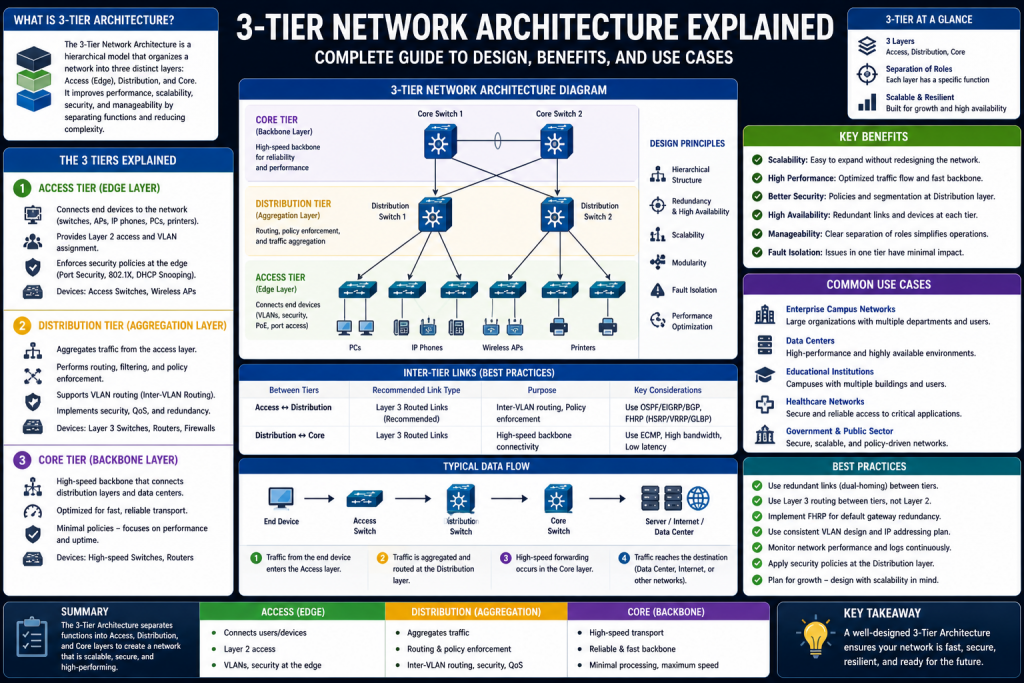
One of the most widely adopted models for building modern applications and networks is the 3-tier network architecture. This design approach separates the system into three distinct layers, each responsible for a specific function. By dividing responsibilities, the architecture improves performance, simplifies management, and enhances security.
At a high level, the 3-tier architecture separates the user interface, application processing, and data storage into independent layers. These layers communicate with one another in a structured way, ensuring that each part of the system performs its role efficiently without interfering with others.
Understanding this architecture is essential for anyone studying networking, software development, or IT infrastructure. It forms the backbone of many modern systems and provides a strong foundation for scalable and secure application design.
The Evolution of Network Architecture
Before the introduction of layered architectures, many systems were built using a monolithic design. In such systems, all components—including the user interface, logic, and data storage—were tightly integrated into a single unit. While this approach worked for small-scale applications, it quickly became inefficient as systems grew larger and more complex.
In monolithic systems, even a small change required modifying the entire application. This made updates risky and time-consuming. Additionally, scaling the system to handle more users often required upgrading the entire infrastructure, which was costly and inefficient.
To overcome these limitations, developers and network engineers began adopting layered architectures. The idea was simple: separate different functions into distinct layers so they could be managed independently. This led to the development of two-tier and eventually three-tier architectures.
The 3-tier model became especially popular because it offered a balanced approach between simplicity and functionality. It provided clear separation while still maintaining efficient communication between layers.
Defining the 3-Tier Architecture
The 3-tier network architecture is a design model that divides an application into three logical layers. Each layer has a specific responsibility and interacts with the others in a controlled manner.
The three tiers are:
- The client tier, also known as the presentation layer
- The application tier, also called the logic layer
- The database tier, often referred to as the data layer
This separation allows each tier to operate independently while still contributing to the overall functionality of the system.
The architecture is considered “logical” rather than “physical” because the layers do not necessarily have to be on separate physical machines. However, in many real-world implementations, they are often distributed across different servers to improve performance and reliability.
Understanding Logical Separation
Logical separation is a key concept in 3-tier architecture. It means that each layer performs a distinct role and does not interfere with the responsibilities of other layers.
For example, the client tier is responsible for displaying information and capturing user input, but it does not process complex logic or store data. Similarly, the database tier manages data but does not interact directly with the user.
This separation ensures that changes in one layer do not disrupt the entire system. If developers need to update the application logic, they can do so without modifying the user interface or database structure.
Logical separation also improves clarity. Each layer has a well-defined purpose, making it easier for teams to design, develop, and maintain the system.
Overview of the Three Tiers
Each tier in the architecture plays a vital role in delivering a complete user experience. While they work together, their responsibilities are clearly defined.
The client tier acts as the interface between the user and the system. It focuses on presentation and interaction.
The application tier serves as the processing engine. It handles logic, decision-making, and communication between layers.
The database tier acts as the storage system. It manages all data operations, ensuring information is stored securely and retrieved efficiently.
By organizing the system into these layers, the architecture ensures that each component can perform its function without unnecessary complexity.
The Client Tier in Detail
The client tier is the most visible part of the system. It is where users interact with applications, whether through a web browser, mobile app, or desktop software.
This layer is responsible for presenting information in a user-friendly format. It determines how content is displayed, how users navigate the system, and how they interact with various features.
The client tier uses front-end technologies to create visual elements such as buttons, menus, forms, and layouts. These elements are designed to provide a smooth and intuitive user experience.
In addition to displaying information, the client tier also collects user input. When a user types data, clicks a button, or submits a form, the client layer captures this input and sends it to the application tier for processing.
Key Responsibilities of the Client Tier
The client tier performs several important functions that contribute to the overall system:
- It displays data in an organized and visually appealing way
- It captures user actions and inputs
- It sends requests to the application tier
- It receives responses and presents them to the user
Despite its importance, the client tier remains relatively lightweight. It does not handle heavy processing or data storage, which allows it to operate efficiently even on devices with limited resources.
The Application Tier in Detail
The application tier is the core of the system’s functionality. It acts as an intermediary between the client and database layers, processing requests and determining how the system should respond.
When the client tier sends a request, the application tier analyzes it and applies the necessary logic. This may involve validating user input, performing calculations, or retrieving data from the database.
For example, if a user attempts to log in, the application tier checks whether the provided credentials meet the required criteria. It then communicates with the database to verify the information and decides whether to grant access.
This layer is responsible for enforcing business rules and ensuring that all operations follow the intended logic.
Core Functions of the Application Tier
The application tier handles a wide range of tasks, including:
- Processing incoming requests from the client tier
- Applying business logic and decision-making rules
- Communicating with the database tier to retrieve or store data
- Sending processed responses back to the client tier
Because this layer handles critical operations, it must be designed to handle high volumes of traffic efficiently. Developers often implement techniques such as load balancing and caching to improve performance.
The Database Tier in Detail
The database tier is responsible for storing and managing all data used by the system. It acts as the central repository where information is saved, updated, and retrieved.
This layer uses database management systems to organize data in a structured format. It ensures that information is stored accurately and can be accessed quickly when needed.
Whenever the application tier needs data, it sends a request to the database tier. The database processes the request and returns the required information.
For instance, when a user logs into an application, their credentials are checked against data stored in the database. If the information matches, access is granted.
Importance of the Database Tier
The database tier plays a critical role in maintaining the integrity and reliability of the system. Its responsibilities include:
- Storing large volumes of data securely
- Ensuring data consistency and accuracy
- Providing fast and efficient data retrieval
- Supporting backup and recovery processes
Because this layer contains sensitive information, it is typically protected with strict security measures and limited access controls.
Interaction Between the Three Tiers
Although each tier has its own responsibilities, they work together to deliver a seamless experience. Communication between layers follows a structured flow.
When a user interacts with the client tier, their request is sent to the application tier. The application layer processes the request and may communicate with the database tier to retrieve or store data. Once the operation is complete, the response is sent back through the application tier to the client tier.
This step-by-step process ensures that each layer performs its function without overlapping responsibilities.
Example of a Typical Workflow
To better understand how the system operates, consider a simple login process.
A user enters their username and password into a login form. The client tier captures this input and sends it to the application tier.
The application tier processes the request and sends a query to the database tier to verify the credentials. The database checks whether the provided information matches stored records and returns the result.
The application tier interprets the response and determines whether the login attempt is successful. It then sends the result back to the client tier, which displays the appropriate message to the user.
This entire process happens within seconds, demonstrating the efficiency of the 3-tier architecture.
Benefits of Using a Layered Approach
The 3-tier architecture offers several advantages that make it a preferred choice for modern systems.
One major benefit is improved organization. By separating responsibilities, the system becomes easier to understand and manage.
Another advantage is flexibility. Developers can update or modify one layer without affecting the others, reducing the risk of system-wide issues.
The architecture also supports scalability. Each tier can be expanded independently to handle increased demand, ensuring efficient use of resources.
Introduction to Practical Implementation
After understanding the structure and components of the 3-tier network architecture, the next step is to explore how it works in real-world environments. While the concept may seem straightforward, its true value becomes clear when applied to actual systems that handle thousands or even millions of user interactions daily.
Modern applications rely heavily on this architecture because it provides a balance between performance, scalability, and security. From online learning platforms to banking systems and e-commerce applications, the 3-tier model supports a wide range of use cases.
In this section, we will examine how the three tiers operate together in practical scenarios, explore the key benefits of this architecture, and understand why organizations continue to adopt it as a standard design approach.
How the 3-Tier Architecture Functions in Practice
In real-world environments, the interaction between the three tiers is continuous and highly optimized. Each user action triggers a sequence of operations that move across the layers in a predictable manner.
When a user performs an action such as opening a page, submitting a form, or requesting data, the request begins at the client tier. This request is then forwarded to the application tier, which processes it and determines the appropriate response. If the request involves data storage or retrieval, the application tier communicates with the database tier.
Once the database completes its task, the result is sent back to the application tier. The application layer processes the result and prepares a response, which is then delivered to the client tier for display.
This flow ensures that each layer focuses on its specific role, resulting in efficient processing and minimal delays.
End-to-End Example of User Interaction
To better understand the workflow, consider a scenario where a user signs up for an account on an online platform.
The process begins when the user fills out a registration form. The client tier captures the entered information and sends it to the application tier. The application layer validates the data to ensure it meets required criteria, such as proper email format and password strength.
Once validation is complete, the application tier sends the data to the database tier for storage. The database stores the new user information and confirms that the operation was successful.
The application tier then generates a response indicating that the account has been created successfully. This response is sent back to the client tier, which displays a confirmation message to the user.
Although this process appears simple from the user’s perspective, it involves multiple coordinated steps across all three tiers.
Handling Complex Operations
In more advanced scenarios, the architecture supports complex operations involving multiple requests and responses. For example, when a user interacts with a dynamic application that includes features such as notifications, recommendations, or analytics, the application tier may perform several operations simultaneously.
The application layer may retrieve data from multiple sources, apply algorithms, and combine results before sending a response to the client tier. Meanwhile, the database tier ensures that all data transactions are processed accurately and efficiently.
This ability to handle complex workflows makes the 3-tier architecture suitable for enterprise-level applications.
Key Benefits of the 3-Tier Architecture
The popularity of the 3-tier model is largely due to the advantages it offers. These benefits address many of the challenges associated with traditional system designs.
One of the most significant advantages is scalability. Each tier can be scaled independently based on demand, allowing organizations to allocate resources efficiently.
Another important benefit is flexibility. Developers can update or modify one layer without affecting the others, making it easier to introduce new features or improvements.
Security is also enhanced through the separation of layers. By restricting direct access to critical components, the architecture reduces the risk of unauthorized access.
Independent Scalability Across Tiers
Scalability is essential for modern applications, especially those that experience fluctuating traffic levels. The 3-tier architecture allows each layer to scale independently, ensuring optimal performance under varying conditions.
For instance, if an application experiences a surge in user activity, additional resources can be allocated to the application tier to handle increased processing demands. Similarly, the database tier can be upgraded to manage larger volumes of data.
This targeted approach to scaling reduces costs and improves efficiency. Instead of upgrading the entire system, organizations can focus on specific areas that require improvement.
Flexibility in System Development
Flexibility is another major advantage of the 3-tier model. Because each layer operates independently, development teams can work on different parts of the system simultaneously.
For example, front-end developers can improve the user interface without modifying the application logic. At the same time, back-end developers can optimize database queries or enhance processing capabilities.
This separation simplifies development workflows and reduces the likelihood of conflicts between different components.
Enhanced Security Through Layered Access
Security is a critical concern for any system that handles sensitive data. The 3-tier architecture addresses this concern by introducing multiple layers of protection.
Users interact only with the client tier, which acts as a barrier between external users and internal systems. The application tier further validates and filters requests before they reach the database tier.
This layered approach ensures that even if one layer is compromised, the other layers remain protected. Access controls can be implemented at each tier to restrict unauthorized actions.
Improved Performance and Reliability
Performance is another area where the 3-tier architecture excels. By distributing tasks across multiple layers, the system can handle requests more efficiently.
The client tier focuses on user interaction, the application tier handles processing, and the database tier manages data operations. This division of labor reduces bottlenecks and ensures smoother operation.
Reliability is also improved because each layer can be monitored and maintained independently. If an issue occurs in one tier, it can be addressed without affecting the entire system.
Real-World Applications of 3-Tier Architecture
The 3-tier model is widely used across various industries. Its versatility makes it suitable for different types of applications.
In e-commerce platforms, the client tier displays product listings and user interfaces, the application tier processes orders and payments, and the database tier stores product information and transaction records.
In online learning systems, the client tier provides access to courses and content, the application tier manages user progress and interactions, and the database tier stores user data and course materials.
Financial systems also rely on this architecture to handle transactions securely. The separation of layers ensures that sensitive financial data is protected while maintaining efficient processing.
Application in Web-Based Systems
Web applications are one of the most common use cases for the 3-tier architecture. When a user accesses a website, the browser acts as the client tier. The web server functions as the application tier, and the database server handles data storage.
This structure allows websites to handle large numbers of users while maintaining performance and security. It also enables developers to update different parts of the system without disrupting the entire application.
Supporting Modern Technologies
The 3-tier architecture is compatible with modern technologies such as cloud computing and virtualization. Organizations can deploy each tier on separate virtual machines or cloud services, improving flexibility and scalability.
Cloud platforms allow resources to be adjusted dynamically based on demand. This ensures that applications can handle traffic spikes without performance issues.
Virtualization further enhances efficiency by allowing multiple instances of each tier to run on shared hardware.
Challenges in Implementation
While the 3-tier architecture offers many benefits, it also comes with challenges. One of the main challenges is increased complexity compared to simpler models.
Managing multiple layers requires careful planning and coordination. Each tier must be properly configured to ensure smooth communication and efficient operation.
Another challenge is latency. Since requests must pass through multiple layers, delays can occur if the system is not optimized properly.
However, these challenges can be addressed through proper design, monitoring, and optimization techniques.
Balancing Complexity and Performance
To achieve the best results, organizations must balance complexity and performance. This involves selecting appropriate technologies, optimizing communication between layers, and ensuring that each tier is properly scaled.
Load balancing, caching, and efficient database design can help reduce latency and improve overall performance.
By carefully managing these factors, organizations can fully leverage the benefits of the 3-tier architecture.
Introduction to Implementation Strategy
Designing a 3-tier network architecture is not just about understanding its structure; it is about implementing it effectively in real-world environments. While the separation of client, application, and database tiers provides a strong foundation, the success of this architecture depends on how well each layer is configured, secured, and optimized.
Organizations that adopt this model must carefully plan how the tiers interact, how resources are allocated, and how performance is maintained under varying workloads. Without proper planning, even a well-designed architecture can face issues such as slow response times, security vulnerabilities, or inefficient resource utilization.
This section focuses on best practices that help ensure a successful deployment of the 3-tier architecture. It also explores strategies for optimization, monitoring, and long-term maintenance.
Designing for Scalability and Growth
One of the primary reasons for adopting a 3-tier architecture is its ability to scale. However, scalability does not happen automatically; it must be built into the design from the beginning.
Each tier should be designed with future growth in mind. This means selecting technologies and configurations that allow resources to be expanded without significant restructuring. For example, application servers should support horizontal scaling, where additional servers can be added to handle increased traffic.
Similarly, the database tier should be capable of handling growing volumes of data. Techniques such as replication and partitioning can be used to distribute data across multiple systems, improving both performance and reliability.
Planning for scalability ensures that the system can adapt to increased demand without compromising performance.
Load Balancing for Efficient Traffic Distribution
Load balancing is a critical component of a well-functioning 3-tier architecture. It ensures that incoming requests are distributed evenly across available resources, preventing any single server from becoming overwhelmed.
In the client tier, load balancers can distribute user requests across multiple front-end servers. This improves responsiveness and reduces the risk of downtime.
At the application tier, load balancing helps manage processing workloads. By distributing tasks across multiple application servers, the system can handle higher volumes of requests efficiently.
Load balancing also contributes to fault tolerance. If one server fails, the load balancer can redirect traffic to other available servers, ensuring uninterrupted service.
Optimizing the Application Tier
The application tier plays a central role in processing requests and coordinating communication between layers. Optimizing this tier is essential for maintaining overall system performance.
One effective strategy is to implement caching. By storing frequently accessed data temporarily, the application tier can reduce the number of requests sent to the database. This improves response times and reduces the load on the database layer.
Another important practice is code optimization. Efficient algorithms and well-structured code can significantly improve processing speed. Developers should also minimize unnecessary operations and ensure that resources are used effectively.
Additionally, asynchronous processing can be used for tasks that do not require immediate responses. This allows the system to handle multiple operations simultaneously without slowing down user interactions.
Database Tier Optimization Techniques
The database tier is often the most resource-intensive part of the system. Proper optimization is essential to ensure fast and reliable data access.
Indexing is one of the most effective techniques for improving database performance. By creating indexes on frequently queried fields, the system can retrieve data more quickly.
Query optimization is another important factor. Poorly written queries can slow down the entire system. Developers should ensure that queries are efficient and avoid unnecessary complexity.
Data normalization and proper schema design also contribute to better performance. Organizing data logically reduces redundancy and improves consistency.
In addition, backup and recovery strategies must be implemented to protect data from loss. Regular backups ensure that the system can recover quickly in case of failures.
Ensuring Strong Security Across All Tiers
Security is a fundamental requirement in any network architecture. The 3-tier model provides a strong foundation for implementing layered security measures.
At the client tier, secure communication protocols should be used to protect data transmitted between users and the system. This prevents unauthorized access and ensures data integrity.
The application tier should include validation mechanisms to verify user input and prevent malicious activity. Authentication and authorization controls must be enforced to restrict access to sensitive functions.
The database tier should be protected with strict access controls. Only authorized systems and users should be allowed to interact with the database. Encryption can be used to protect sensitive data both in transit and at rest.
By implementing security measures at each layer, organizations can reduce the risk of breaches and protect critical information.
In addition to these core protections, continuous monitoring plays an important role in maintaining security across all tiers. Security logs should be regularly analyzed to detect unusual activity or potential threats before they escalate into serious incidents. Intrusion detection and prevention systems can also be integrated to identify and block suspicious behavior in real time. Regular security audits help ensure that all configurations remain aligned with best practices and compliance requirements.
Another important aspect is patch management. Keeping all systems and software components up to date reduces vulnerabilities that attackers could exploit. Organizations should also implement role-based access control to ensure that users only have access to the resources necessary for their responsibilities. When combined, these layered defenses create a robust security environment that significantly strengthens the overall resilience of the 3-tier architecture.
Monitoring and Performance Management
Continuous monitoring is essential for maintaining the health of a 3-tier system. Without proper monitoring, issues may go unnoticed until they affect users.
Monitoring tools can track key performance metrics such as response times, server load, and database activity. These metrics provide valuable insights into how the system is performing.
Alerts can be configured to notify administrators of potential issues, such as high traffic levels or server failures. This allows problems to be addressed before they escalate.
Performance management also involves analyzing trends and identifying areas for improvement. Regular reviews help ensure that the system remains efficient and responsive.
Handling Traffic Spikes and Demand Surges
Modern applications often experience sudden increases in traffic due to events such as promotions, product launches, or seasonal trends. The 3-tier architecture must be prepared to handle these spikes without degradation in performance.
Auto-scaling is a key strategy for managing demand surges. This involves automatically adjusting resources based on current traffic levels. For example, additional application servers can be deployed during peak periods and removed when demand decreases.
This dynamic adjustment helps ensure that applications remain responsive even during unexpected spikes in usage. Instead of relying on fixed infrastructure, auto-scaling allows systems to react in real time, which improves both efficiency and cost management. It prevents over-provisioning during low traffic periods and avoids performance bottlenecks during high demand.
In addition, auto-scaling can be configured based on different performance metrics such as CPU usage, memory consumption, or request latency. When these metrics exceed predefined thresholds, new resources are automatically added to handle the load. Similarly, when demand drops, unnecessary resources are released, ensuring optimal utilization of infrastructure.
Another important advantage of auto-scaling is improved user experience. Users are less likely to face delays or downtime because the system adapts quickly to changing conditions. It also supports business continuity during sudden traffic events such as product launches or promotional campaigns.
When combined with load balancing, auto-scaling becomes even more effective. Load balancers distribute traffic across newly added resources, ensuring smooth and even performance across the system.
Caching and content delivery strategies can also help reduce the load on servers. By serving frequently accessed content from optimized locations, the system can handle more users efficiently.
Planning for traffic spikes ensures that users continue to experience smooth performance even during high-demand periods.
Change Management and Version Control
Managing changes in a 3-tier architecture requires careful coordination. Updates to one layer should not disrupt the functionality of others.
Version control systems play a crucial role in tracking changes and maintaining consistency. By keeping records of modifications, developers can quickly identify and resolve issues.
Change management processes should include testing and validation before deployment. This ensures that updates do not introduce errors or vulnerabilities.
In addition to these practices, clear communication between teams is essential when managing changes across different tiers. Since each layer may be handled by separate teams or specialists, coordination helps ensure that updates align with overall system requirements.
Proper documentation also plays an important role, as it provides a reference for system configurations, dependencies, and previous changes, making it easier to understand how different components interact.
Another key aspect is the use of staging environments where updates can be tested in conditions similar to the live system. This allows teams to identify potential issues before deployment and reduces the risk of system failures.
Automated testing tools can further enhance this process by quickly validating functionality across all tiers. By combining structured change management, thorough testing, and effective communication, organizations can maintain stability while continuously improving their systems.
Furthermore, implementing rollback strategies is critical in case an update does not perform as expected. A rollback plan allows teams to revert to a previous stable version quickly, minimizing downtime and user impact. Continuous integration and continuous deployment practices can also streamline the update process by automating builds, tests, and deployments.
Regular audits and reviews of system changes help ensure compliance with organizational policies and security standards. Over time, these disciplined approaches create a more resilient and adaptable system that can evolve without sacrificing reliability or performance.
Documenting changes is also important. Keeping track of what was changed, why it was changed, and who made the change helps maintain accountability and transparency.
Disaster Recovery and Fault Tolerance
No system is immune to failures, which is why disaster recovery planning is essential. The 3-tier architecture supports fault tolerance by allowing redundancy at each layer.
Backup systems can be implemented to ensure that data is not lost in case of failures. Replication techniques can be used to maintain copies of data across multiple locations.
Failover mechanisms allow the system to switch to backup resources automatically when a failure occurs. This minimizes downtime and ensures continuity of service.
Regular testing of disaster recovery plans is necessary to ensure that they function as expected.
Common Mistakes to Avoid
While implementing a 3-tier architecture, organizations often make mistakes that can affect performance and reliability.
One common mistake is underestimating resource requirements. Insufficient resources can lead to bottlenecks and slow performance.
Another issue is poor communication between layers. If interfaces between tiers are not well-defined, it can lead to errors and inefficiencies.
Neglecting security is also a major risk. Failing to implement proper security measures can expose the system to threats.
Overcomplicating the design can create unnecessary complexity. It is important to strike a balance between functionality and simplicity.
By avoiding these mistakes, organizations can ensure a smoother implementation.
Future Trends in 3-Tier Architecture
As technology continues to evolve, the 3-tier architecture is also adapting to new trends. Integration with cloud computing, containerization, and microservices is becoming increasingly common.
While some modern systems move toward more distributed architectures, the core principles of the 3-tier model remain relevant. The idea of separating presentation, logic, and data continues to provide a strong foundation for system design.
This separation not only improves clarity in how systems are built, but also allows teams to specialize in different areas without interfering with one another’s work. Front-end developers can focus on enhancing user experience, while back-end developers refine application logic, and database administrators ensure efficient data management.
In addition, this structured approach makes troubleshooting much easier. When an issue arises, teams can quickly identify which layer is responsible and resolve the problem without affecting the entire system. This reduces downtime and improves overall reliability. The separation also supports better testing practices, as each layer can be tested independently before being integrated into the full system.
Furthermore, even in highly distributed or microservices-based environments, the fundamental idea of separating concerns still applies. Many modern architectures simply extend or refine the same concept introduced by the 3-tier model. As a result, understanding this architecture provides a solid foundation for adapting to newer technologies and evolving system designs, making it a timeless and valuable approach in the field of networking and software development.
Organizations are also focusing on automation and intelligent scaling to improve efficiency. These advancements enhance the capabilities of the 3-tier architecture while maintaining its fundamental structure.
Conclusion
The 3-tier network architecture remains one of the most effective models for designing scalable, secure, and efficient systems. By separating the client, application, and database layers, it provides a clear structure that simplifies development and management.
Successful implementation requires careful planning, optimization, and ongoing maintenance. From load balancing and caching to security and monitoring, each aspect plays a critical role in ensuring system performance.
Despite the challenges, the benefits of this architecture far outweigh its complexities. It enables organizations to build systems that can handle growing demands while maintaining reliability and security.
As technology continues to advance, the 3-tier model will continue to evolve, but its core principles will remain essential. Understanding and applying these principles allows organizations to create robust systems that meet the needs of modern users while preparing for future growth.
Continue exploring the technologies and certification concepts that matter most to you.