In the world of modern networking, the foundation of any reliable system begins with the physical infrastructure that carries data. Among the most important decisions is choosing between fiber optic and copper cabling. This choice directly affects network speed, scalability, reliability, and overall cost. Whether for a small office, a growing business, or a large enterprise, understanding these technologies is essential for building an efficient and future-ready network.
Copper cabling has been the traditional solution for decades. It is widely used due to its affordability, simplicity, and compatibility with many devices. Fiber optic cabling, however, represents a newer and more advanced approach. By using light to transmit data instead of electrical signals, fiber offers significantly higher performance and longer transmission distances.
Each option has its place, and neither is universally better than the other. The key lies in understanding their characteristics and aligning them with specific network requirements. This section explores copper cabling in detail, including its history, types, strengths, and limitations.
The Evolution of Copper Cabling
Copper cabling has a long-standing role in communication systems. Its origins can be traced back to early telegraph networks, where electrical signals were transmitted over long distances using simple copper wires. Over time, this technology evolved into telephone systems and eventually into the Ethernet networks that power today’s digital communication.
Advancements in engineering have significantly improved copper cabling over the years. Modern cables are designed with precision to reduce interference, enhance signal quality, and support higher data rates. Techniques such as twisting wire pairs and adding shielding have allowed copper cables to remain relevant even as network demands have increased.
Despite the rise of fiber optics, copper continues to be widely used due to its practicality. It is easy to install, cost-effective, and compatible with existing infrastructure. These qualities make it a preferred choice for many organizations, especially in environments where extreme performance is not required.
How Copper Cabling Works
Copper cables transmit data in the form of electrical signals. These signals travel through conductive metal wires, carrying information from one device to another. The most common form used in networking is twisted pair cabling, where pairs of wires are twisted together to reduce interference.
The twisting helps minimize crosstalk, which occurs when signals from one wire interfere with another. Additional shielding can be added to further protect against external electromagnetic interference. While these techniques improve performance, they do not eliminate interference entirely.
Because copper relies on electrical signals, it is inherently affected by environmental factors. Nearby electrical equipment, power lines, and even lighting systems can introduce noise into the signal. This can lead to reduced speeds or data errors if not properly managed.
Common Types of Copper Ethernet Cables
Copper Ethernet cables are categorized into different types, each designed for specific performance levels. These categories help users choose the right cable based on speed, distance, and environmental conditions.
Category 5e Cabling
Category 5e, often referred to as Cat5e, is one of the most commonly used types of Ethernet cable. It supports data speeds of up to 1 gigabit per second over distances of up to 100 meters. This makes it suitable for home networks and small office setups.
Cat5e is popular because of its affordability and ease of installation. It provides reliable performance for everyday applications such as browsing, file sharing, and video streaming. However, it offers limited protection against interference, which can be a drawback in electrically noisy environments.
Despite its limitations, Cat5e remains a practical choice for networks that do not require high bandwidth or advanced performance.
Category 6 Cabling
Category 6, or Cat6, offers improved performance compared to Cat5e. It supports higher data rates and provides better resistance to interference. This is achieved through tighter twisting of wire pairs and improved internal design.
Cat6 can handle speeds of up to 10 gigabits per second, although this is typically limited to shorter distances. For standard network lengths, it delivers consistent and reliable performance.
This type of cable is often used in offices and environments where higher data throughput is required. It strikes a balance between cost and performance, making it a popular upgrade from older cabling systems.
Category 6a Cabling
Category 6a, known as Cat6a, builds on the capabilities of Cat6 by offering enhanced shielding and improved performance over longer distances. It supports 10 gigabit speeds up to 100 meters, making it suitable for high-performance applications.
The added shielding helps reduce interference and ensures stable data transmission. This makes Cat6a a good choice for environments with high levels of electromagnetic noise.
However, the improved performance comes at a higher cost. Cat6a cables are thicker and less flexible, which can make installation more challenging. Despite this, many organizations choose Cat6a for its reliability and future-proofing potential.
Category 7 Cabling
Category 7, or Cat7, represents one of the highest levels of copper cabling performance. It offers strong shielding and excellent resistance to interference, making it ideal for demanding environments.
Cat7 supports high-speed data transmission and maintains performance even in areas with significant electrical noise. This makes it suitable for industrial settings, data centers, and specialized applications.
The downside of Cat7 is its cost and complexity. It is more expensive than other copper options and may require specialized connectors and installation techniques. As a result, it is not commonly used in standard office environments.
Factors Influencing Copper Cable Selection
Choosing the right copper cable involves evaluating several important factors. One of the most critical considerations is bandwidth. Networks that handle large volumes of data or support high-performance applications require cables with higher capacity.
Distance is another key factor. Copper cables have limitations in how far they can transmit data without signal degradation. For longer runs, higher-quality cables or alternative technologies may be needed.
Environmental conditions also play a significant role. Areas with high electromagnetic interference require cables with better shielding to maintain signal integrity. Ignoring these conditions can lead to performance issues and increased maintenance costs.
Budget constraints often influence decision-making as well. While higher-category cables offer better performance, they also come at a higher price. Balancing cost with performance requirements is essential for making an informed choice.
The Role of Cost and Practicality
One of the main advantages of copper cabling is its affordability. Compared to fiber optics, copper cables are generally less expensive to purchase and install. This makes them an attractive option for small businesses and organizations with limited budgets.
Installation is also simpler with copper. It does not require specialized tools or highly trained technicians. This reduces labor costs and makes it easier to deploy or expand a network.
Maintenance and troubleshooting are more straightforward as well. Because copper cabling is widely understood and used, finding support and replacement parts is relatively easy.
These practical benefits make copper a reliable choice for many standard networking applications, even as newer technologies become available.
Understanding Interference and Signal Limitations
One of the biggest challenges with copper cabling is interference. Electrical signals can be disrupted by nearby devices, leading to reduced performance or data errors. This is particularly problematic in environments with heavy machinery or complex electrical systems.
Shielding and cable design can help mitigate these issues, but they cannot eliminate them entirely. As network demands increase, the impact of interference becomes more noticeable.
Another limitation is signal attenuation, which refers to the weakening of a signal as it travels through the cable. Over long distances, this can result in slower speeds or loss of connectivity. This is why copper cables have defined maximum lengths for optimal performance.
These limitations highlight the importance of careful planning when using copper cabling. Understanding the environment and network requirements helps ensure reliable performance.
Future-Proofing with Copper Cabling
As technology continues to evolve, network demands are increasing rapidly. Applications such as cloud computing, video conferencing, and smart devices require more bandwidth and faster speeds than ever before.
Future-proofing involves selecting cabling that can support these growing demands. While lower-category cables may be sufficient today, they may become a limitation in the future.
Higher-category cables like Cat6a and Cat7 provide additional capacity, making them better suited for long-term use. Investing in these options can reduce the need for costly upgrades later.
However, future-proofing should be approached carefully. Choosing the most advanced option is not always necessary. Instead, the goal is to find a balance between current needs and anticipated growth.
Advantages of Copper Cabling
Copper cabling offers several advantages that contribute to its continued popularity. It is cost-effective, easy to install, and widely compatible with existing systems. These qualities make it a practical choice for many networking scenarios.
It also provides reliable performance for short to medium distances. For most office environments, copper cables deliver sufficient speed and stability.
Another advantage is accessibility. Because copper technology is well-established, there is a large pool of professionals who can install and maintain it. This reduces dependency on specialized expertise.
These strengths ensure that copper remains a viable option even as newer technologies emerge.
Limitations of Copper Cabling
Despite its advantages, copper cabling has several limitations. Its susceptibility to interference can affect performance in certain environments. This makes it less suitable for areas with high electrical noise.
Distance limitations are another concern. Copper cables are not ideal for long-distance communication, as signal quality degrades over extended lengths.
Heat generation can also be an issue in high-density installations. Electrical resistance within the cables can lead to increased temperatures, which may impact performance and durability.
Additionally, copper cables are bulkier and heavier than fiber optic cables. This can make installation more challenging, especially in spaces with limited capacity.
Setting the Stage for Fiber Optics
While copper cabling remains a strong contender for many applications, its limitations have led to the development of alternative technologies. Fiber optic cabling addresses many of these challenges by using light instead of electricity to transmit data.
This fundamental difference allows fiber to achieve higher speeds, longer distances, and greater resistance to interference. As network demands continue to grow, fiber is becoming increasingly important in modern infrastructure.
Understanding copper cabling provides a solid foundation for comparing it with fiber optics. Each technology has its own role, and the choice between them depends on specific needs and constraints.
In the next section, the focus shifts to fiber optic cabling, exploring how it works, its types, and the advantages it offers over traditional copper solutions.
Introduction to Fiber Optic Cabling
Fiber optic cabling represents a major advancement in the way data is transmitted across networks. Unlike traditional copper cables that rely on electrical signals, fiber optics use pulses of light to carry information. This fundamental difference allows fiber cables to achieve significantly higher speeds, longer transmission distances, and improved reliability in challenging environments.
As modern networks continue to evolve, the demand for faster and more efficient data transmission has grown rapidly. Applications such as cloud computing, streaming services, artificial intelligence, and large-scale data centers require infrastructure that can handle massive amounts of information without delays or interruptions. Fiber optic cabling has become a key solution for meeting these demands.
While fiber offers many advantages, it also comes with its own set of challenges, including higher costs and more complex installation processes. Understanding how fiber works and the different types available is essential for making informed networking decisions.
How Fiber Optic Cabling Works
Fiber optic cables transmit data using light signals instead of electricity. At the core of each fiber cable is a thin strand of glass or plastic known as the core. Surrounding the core is a layer called the cladding, which reflects light back into the core and ensures that the signal remains contained within the cable.
When data is sent through a fiber cable, it is converted into light pulses by a transmitter. These pulses travel through the core by reflecting off the cladding in a process known as total internal reflection. At the receiving end, the light signals are converted back into electrical signals that devices can understand.
Because light travels faster and experiences less resistance than electrical signals, fiber optic cables can transmit data at much higher speeds. They are also less affected by environmental interference, making them more reliable in many situations.
Key Components of Fiber Optic Systems
A fiber optic network consists of several important components that work together to ensure efficient data transmission. The cable itself is only one part of the system.
Transmitters are responsible for converting electrical signals into light signals. These devices use lasers or light-emitting diodes to generate the light pulses that travel through the fiber.
Receivers perform the opposite function, converting light signals back into electrical signals. This allows the data to be processed by computers and other network devices.
Connectors and splices are used to join fiber cables together. These connections must be precise, as even small misalignments can result in signal loss.
Amplifiers may be used in long-distance fiber networks to boost the signal and maintain its strength over extended distances. These components are especially important in large-scale networks such as those used by internet service providers.
Types of Fiber Optic Cabling
Fiber optic cables are generally divided into two main categories: single-mode fiber and multi-mode fiber. Each type has its own characteristics, advantages, and ideal use cases.
Single-Mode Fiber
Single-mode fiber is designed for high-performance, long-distance communication. It has a very small core, which allows light to travel in a single path or mode. This reduces signal distortion and enables data to be transmitted over extremely long distances without significant loss.
Because of its design, single-mode fiber can support very high data rates. It is commonly used in telecommunications networks, large data centers, and connections between cities or even continents.
One of the key advantages of single-mode fiber is its ability to maintain signal integrity over long distances. It can transmit data over tens or even hundreds of kilometers with minimal degradation. This makes it ideal for backbone infrastructure and long-haul communication.
However, single-mode fiber is more expensive than other options. The equipment required to transmit and receive signals is also more costly, and installation requires specialized skills. These factors can make it less practical for smaller networks.
Multi-Mode Fiber
Multi-mode fiber is designed for shorter-distance communication. It has a larger core than single-mode fiber, allowing multiple light paths or modes to travel through the cable simultaneously. While this increases the amount of data that can be transmitted, it also introduces more signal distortion over longer distances.
Because of this limitation, multi-mode fiber is typically used for connections within buildings or across campuses. It is well-suited for linking servers, switches, and other network devices in relatively close proximity.
Multi-mode fiber is generally less expensive than single-mode fiber, both in terms of cabling and equipment. It is also easier to install, making it a popular choice for local area networks.
Although it does not match the performance of single-mode fiber over long distances, multi-mode fiber still offers significant advantages over copper cabling in terms of speed and reliability.
Comparing Single-Mode and Multi-Mode Fiber
The choice between single-mode and multi-mode fiber depends on several factors, including distance, bandwidth requirements, and budget.
Single-mode fiber excels in long-distance applications where maintaining signal quality is critical. It provides higher bandwidth and lower signal loss, making it suitable for large-scale networks.
Multi-mode fiber, on the other hand, is more practical for shorter distances. It offers good performance at a lower cost and is easier to work with in typical building environments.
Organizations often choose a combination of both types, using single-mode fiber for long-distance connections and multi-mode fiber for internal networking.
Advantages of Fiber Optic Cabling
Fiber optic cabling offers several key advantages that make it an attractive choice for modern networks. One of the most significant benefits is its high bandwidth capacity. Fiber can support extremely fast data transmission speeds, making it ideal for applications that require large amounts of data to be transferred quickly.
Another major advantage is its ability to transmit data over long distances without significant signal loss. This makes fiber the preferred choice for connecting remote locations and building large-scale network infrastructure.
Fiber is also immune to electromagnetic interference. Because it uses light instead of electricity, it is not affected by nearby electrical devices or radio signals. This ensures consistent performance even in environments with high levels of interference.
Additionally, fiber optic cables are lighter and thinner than copper cables. This makes them easier to install in tight spaces and reduces the overall weight of the network infrastructure.
Security is another important benefit. Fiber cables are more difficult to tap into without detection, making them a safer option for transmitting sensitive data.
Limitations of Fiber Optic Cabling
Despite its many advantages, fiber optic cabling is not without its drawbacks. One of the primary challenges is cost. Fiber cables and the associated equipment are generally more expensive than copper alternatives.
Installation is also more complex. Working with fiber requires specialized tools and trained technicians. Improper handling can damage the cable or reduce its performance.
Fiber cables are also more fragile than copper cables. While they are durable in many respects, the glass core can be damaged if the cable is bent too sharply or handled roughly.
Another consideration is compatibility. Existing network infrastructure may be designed for copper cabling, and upgrading to fiber may require significant changes.
These limitations mean that fiber is not always the best choice for every situation. Careful planning is required to determine whether the benefits outweigh the costs.
Fiber Optics in Modern Networking
Fiber optic technology plays a critical role in today’s digital world. It is used in a wide range of applications, from internet backbones and telecommunications networks to data centers and enterprise systems.
Internet service providers rely on fiber to deliver high-speed connections to homes and businesses. Large organizations use fiber to connect multiple locations and support high-performance applications.
Data centers depend on fiber for fast and reliable communication between servers and storage systems. As data volumes continue to grow, the importance of fiber in these environments will only increase.
Fiber is also essential for emerging technologies such as 5G networks, smart cities, and the Internet of Things. These applications require fast, reliable, and scalable infrastructure, making fiber an ideal solution.
Installation and Maintenance Considerations
Installing fiber optic cabling requires careful planning and precision. Unlike copper cables, which can be installed with basic tools, fiber installation involves specialized equipment and techniques.
Technicians must ensure that cables are properly aligned and connected to minimize signal loss. Splicing fiber cables requires a high level of accuracy, as even small errors can impact performance.
Maintenance is also an important consideration. While fiber cables are generally reliable, they can be affected by physical damage or improper handling. Regular inspections and proper cable management help ensure long-term performance.
Despite these challenges, the benefits of fiber often justify the investment, particularly in environments where performance and reliability are critical.
Preparing for the Future with Fiber
As technology continues to advance, the demand for faster and more efficient networks will only increase. Fiber optic cabling provides the scalability needed to support future innovations.
Organizations that invest in fiber infrastructure are better positioned to adapt to changing requirements. Whether it is supporting new applications or expanding network capacity, fiber offers the flexibility needed for growth.
While the initial cost may be higher, the long-term benefits of fiber often outweigh the investment. By providing high performance, reliability, and scalability, fiber optic cabling plays a vital role in the future of networking.
This deeper understanding of fiber technology sets the stage for comparing it directly with copper cabling and determining which option is best suited for specific use cases.
Direct Comparison Between Fiber and Copper
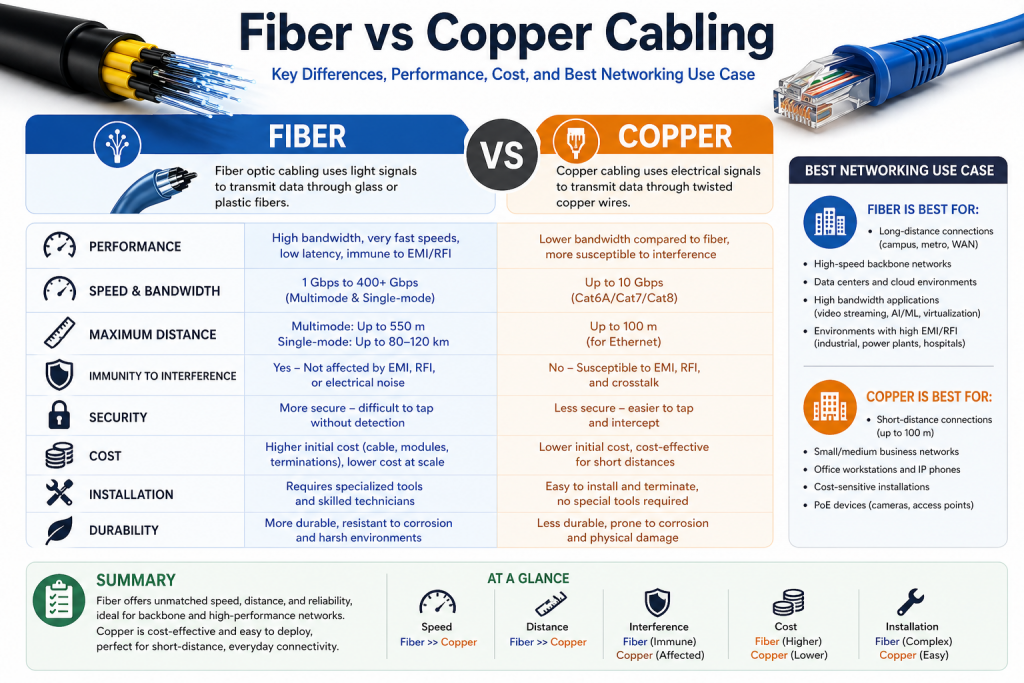
When deciding between fiber optic and copper cabling, it is essential to evaluate how each performs across several key areas. These include speed, distance, interference resistance, cost, installation complexity, and long-term scalability. Each technology has strengths that make it suitable for specific scenarios, and understanding these differences allows for better planning and implementation.
Copper cabling relies on electrical signals to transmit data, while fiber uses light. This difference has a major impact on performance. Fiber can achieve significantly higher speeds because light travels faster and encounters less resistance than electrical signals. Copper, while capable of delivering strong performance in short distances, faces limitations as network demands increase.
Distance is another major differentiator. Copper cables are typically limited to around 100 meters for optimal performance. Beyond this range, signal degradation becomes a serious concern. Fiber optic cables, especially single-mode, can transmit data over kilometers without noticeable loss, making them ideal for large-scale networks and long-distance communication.
Interference also plays a critical role. Copper cables are vulnerable to electromagnetic interference from nearby devices, power lines, and other environmental factors. Fiber, on the other hand, is immune to such interference because it does not use electrical signals. This makes fiber more reliable in environments with heavy machinery or complex electrical systems.
Performance and Bandwidth Considerations
One of the most important factors in choosing a cabling solution is performance. Modern networks require high bandwidth to support applications such as video streaming, cloud computing, virtual meetings, and large-scale data processing.
Fiber optic cabling provides unmatched bandwidth capabilities. It can handle extremely high data rates, making it suitable for environments where performance is critical. Data centers, internet service providers, and large enterprises rely heavily on fiber to maintain fast and efficient operations.
Copper cabling, while capable of supporting high speeds, has limitations. Advanced categories like Cat6a and Cat7 can handle significant bandwidth, but they still fall short of fiber in terms of scalability. As network demands grow, copper may struggle to keep up without frequent upgrades.
Latency is another aspect of performance. Fiber typically offers lower latency due to the speed of light transmission. This is particularly important for applications that require real-time data processing, such as online gaming, financial trading systems, and remote operations.
Cost Analysis and Budget Considerations
Cost is often one of the most influential factors in network design. Copper cabling is generally more affordable in terms of both materials and installation. This makes it an attractive option for small businesses, residential setups, and organizations with limited budgets.
Fiber optic cabling, in contrast, requires a higher initial investment. The cables themselves are more expensive, and the equipment needed to transmit and receive light signals adds to the cost. Installation also requires specialized tools and trained professionals, further increasing expenses.
However, it is important to consider long-term costs rather than focusing solely on initial investment. Fiber’s higher capacity and scalability can reduce the need for future upgrades. In many cases, the long-term savings and performance benefits outweigh the upfront expense.
Organizations must evaluate their current needs and future growth plans when making a decision. A lower initial cost may lead to higher expenses later if the network needs to be upgraded or replaced.
Installation and Ease of Use
Ease of installation is another key factor that differentiates copper from fiber. Copper cabling is relatively simple to install. It can be cut, terminated, and connected using basic tools, and many technicians are familiar with the process. This simplicity reduces installation time and labor costs.
Fiber optic installation is more complex. It requires precision and specialized equipment to ensure proper alignment and signal transmission. Splicing fiber cables is a delicate process that demands expertise. Even minor errors can lead to signal loss or reduced performance.
Handling fiber cables also requires care. They are more fragile than copper cables and can be damaged if bent or handled improperly. This makes installation and maintenance more challenging.
Despite these challenges, advancements in technology are making fiber installation more accessible. Pre-terminated cables and improved tools are helping reduce complexity, making it easier for organizations to adopt fiber solutions.
Durability and Environmental Factors
Durability is an important consideration, especially in environments where cables may be exposed to physical stress or harsh conditions. Copper cables are generally robust and can withstand rough handling. They are less likely to break under pressure, making them suitable for environments where durability is a priority.
Fiber optic cables, while strong in many respects, have a delicate core made of glass. This makes them more susceptible to damage if bent too sharply or subjected to excessive force. Proper installation and handling are essential to maintain their integrity.
Environmental conditions also affect performance. Copper cables can be impacted by temperature changes and electromagnetic interference. Fiber cables are more resistant to environmental factors, including moisture and temperature variations.
This resilience makes fiber a better choice for outdoor installations and industrial environments where conditions may be less predictable.
Security and Data Protection
Security is a growing concern in modern networks. Protecting sensitive data from unauthorized access is a top priority for organizations.
Fiber optic cables offer a higher level of security compared to copper. Because they transmit data using light, they are more difficult to tap into without detection. Any attempt to intercept the signal typically results in noticeable disruption.
Copper cables, on the other hand, are easier to tap into. Electrical signals can be intercepted using relatively simple tools, making them less secure for sensitive data transmission.
For organizations that handle confidential information, such as financial institutions or government agencies, fiber provides an added layer of protection.
Scalability and Future Growth
Scalability is essential for networks that are expected to grow over time. As new devices, applications, and technologies are introduced, the network must be able to handle increased demand.
Fiber optic cabling is highly scalable. Its high bandwidth capacity allows it to support future advancements without requiring significant upgrades. This makes it a long-term solution for growing organizations.
Copper cabling, while sufficient for current needs, may become a limitation as demands increase. Upgrading copper infrastructure can be costly and disruptive, especially in large networks.
Planning for scalability involves anticipating future requirements and choosing a solution that can accommodate growth. Fiber’s ability to handle high data volumes makes it a strong candidate for future-proofing network infrastructure.
Use Cases for Copper Cabling
Copper cabling remains a practical choice for many applications. It is commonly used in residential networks, small offices, and environments where distances are short and performance requirements are moderate.
Within buildings, copper is often used to connect devices such as computers, printers, and switches. It is also suitable for structured cabling systems where cost and simplicity are important considerations.
For organizations with limited budgets or straightforward networking needs, copper provides a reliable and cost-effective solution.
Use Cases for Fiber Optic Cabling
Fiber optic cabling is ideal for applications that require high performance, long-distance communication, and reliability. It is widely used in data centers, telecommunications networks, and large enterprise environments.
Fiber is also essential for connecting multiple buildings within a campus or linking remote locations. Its ability to transmit data over long distances without signal loss makes it indispensable for these scenarios.
In addition, fiber is increasingly being used in residential broadband connections, providing high-speed internet access to homes and businesses.
As technology continues to evolve, the role of fiber in networking is expected to expand further.
Hybrid Approaches in Modern Networks
In many cases, the best solution is not choosing one technology over the other but combining both. Hybrid networks use fiber for long-distance and high-performance connections, while copper is used for shorter, local connections.
This approach allows organizations to maximize efficiency by deploying each type of cable where it performs best. For example, fiber can serve as the backbone that links buildings, floors, or data centers, ensuring fast and reliable data transfer across large distances. Meanwhile, copper cabling can connect end-user devices such as computers, printers, and access points within a limited range.
A hybrid design also helps control costs, as fiber is used strategically where its advantages are most needed, while copper provides an economical solution for everyday connectivity. This balance reduces unnecessary spending without compromising overall network performance. Additionally, hybrid networks offer flexibility, making it easier to expand or upgrade specific parts of the infrastructure without overhauling the entire system.
As organizations grow and their data demands increase, this combination provides a scalable and practical solution that adapts to changing requirements while maintaining stability and efficiency.
This approach allows organizations to take advantage of the strengths of each technology while minimizing their weaknesses. For example, fiber can be used as the backbone of a network, connecting buildings or data centers, while copper is used to connect individual devices within those locations.
Hybrid solutions provide flexibility and cost efficiency, making them a popular choice in modern network design.
Decision-Making Strategies
Choosing between fiber and copper requires careful evaluation of several factors. Organizations must consider their current needs, future growth plans, budget constraints, and environmental conditions.
In addition to these core elements, it is also important to assess the types of applications that will run on the network, such as cloud services, video conferencing, or data-intensive workloads. The physical layout of the infrastructure, including distance between devices and available space for cabling, can influence the decision as well
. Maintenance requirements and the availability of skilled technicians should also be taken into account to ensure long-term reliability and efficient network performance.
A clear understanding of network requirements is essential. This includes analyzing data usage, performance expectations, and potential challenges.
Consulting with networking professionals can also provide valuable insights. Their expertise can help identify the most suitable solution and ensure proper implementation.
Ultimately, the goal is to create a network that is reliable, efficient, and capable of supporting future demands.
Conclusion
The choice between fiber optic and copper cabling is a fundamental decision in network design. Each technology offers unique advantages and is suited to different applications. Copper cabling remains a cost-effective and practical solution for short-distance connections and standard networking needs. Its ease of installation and widespread compatibility make it a reliable choice for many environments.
Fiber optic cabling, on the other hand, provides superior performance, longer transmission distances, and greater resistance to interference. It is the preferred option for high-speed networks, large-scale infrastructure, and applications that demand reliability and scalability.
Rather than viewing these technologies as competitors, it is more useful to see them as complementary solutions. Many modern networks successfully combine both fiber and copper to achieve optimal performance and cost efficiency.
As technology continues to advance, the importance of choosing the right cabling will only increase. By understanding the strengths and limitations of each option, organizations can build networks that not only meet current needs but also adapt to future challenges.
Continue exploring the technologies and certification concepts that matter most to you.