Systems engineering is one of the most important roles in modern IT environments. Almost every organization today depends on complex digital infrastructure that must remain stable, secure, and available at all times. Systems engineers are the professionals responsible for making sure this happens.
They manage servers, cloud platforms, operating systems, and networks that keep business applications running. When systems go down, businesses can lose revenue, customers, and trust. Because of this responsibility, systems engineers are highly valued across industries.
This guide explains what systems engineers do, how much they earn, and what factors influence their salaries. It also breaks down real-world responsibilities and how the role fits into modern IT infrastructure.
Understanding the Role of a Systems Engineer
A systems engineer is responsible for designing, building, maintaining, and optimizing IT infrastructure. This includes both physical and virtual systems that support applications, services, and data flow within an organization.
Their work ensures that users can access applications without interruption and that systems perform efficiently under different workloads. They also make sure infrastructure remains secure and scalable as business needs grow.
Unlike basic IT support roles that focus on fixing individual user problems, systems engineers work at a deeper level. They manage the entire environment that supports those users and applications.
They often deal with servers, cloud environments, operating systems, virtualization platforms, and storage systems. In many companies, they also work closely with network engineers, cybersecurity teams, and software developers.
Core Responsibilities of Systems Engineers
The responsibilities of a systems engineer are broad and can vary depending on the size of the organization. However, most systems engineers perform a combination of the following tasks.
They install and configure operating systems and server environments. This includes both Windows Server and Linux distributions. Proper configuration is essential for performance, security, and reliability.
They maintain and monitor infrastructure systems. This involves checking system health, analyzing performance metrics, and ensuring that all components are functioning correctly.
They manage virtual machines and cloud environments. Many organizations now use cloud platforms for scalability and flexibility, so systems engineers often work with services like AWS, Azure, or Google Cloud.
They write scripts to automate repetitive tasks. Automation is a key part of modern systems engineering because it reduces manual work and improves consistency.
They troubleshoot system failures and respond to incidents. When systems fail, engineers must quickly identify the cause and restore services to minimize downtime.
They implement security updates and patches. Keeping systems secure is a critical responsibility, especially in industries that handle sensitive data.
They collaborate with other IT teams to support infrastructure projects. This may include system upgrades, migrations, or new deployments.
These responsibilities require both technical knowledge and problem-solving skills. Systems engineers must understand how different technologies interact within a larger ecosystem.
How Systems Engineering Differs From Other IT Roles
Systems engineering is often confused with other IT roles such as network administration, DevOps engineering, or IT support. While there is overlap, each role has distinct responsibilities.
IT support typically focuses on end-user issues such as software problems or device troubleshooting. Network engineers focus on connectivity, routers, switches, and communication between systems.
Systems engineers work at a broader level, managing the infrastructure that supports both networks and applications. They often bridge the gap between hardware, software, and cloud environments.
In some organizations, systems engineers may also take on DevOps responsibilities, especially when automation and continuous deployment are involved. However, their primary focus remains system stability and infrastructure performance.
Average Salary of a Systems Engineer
Systems engineering is considered a well-paying career in the IT industry. Salaries vary depending on experience, location, and technical expertise.
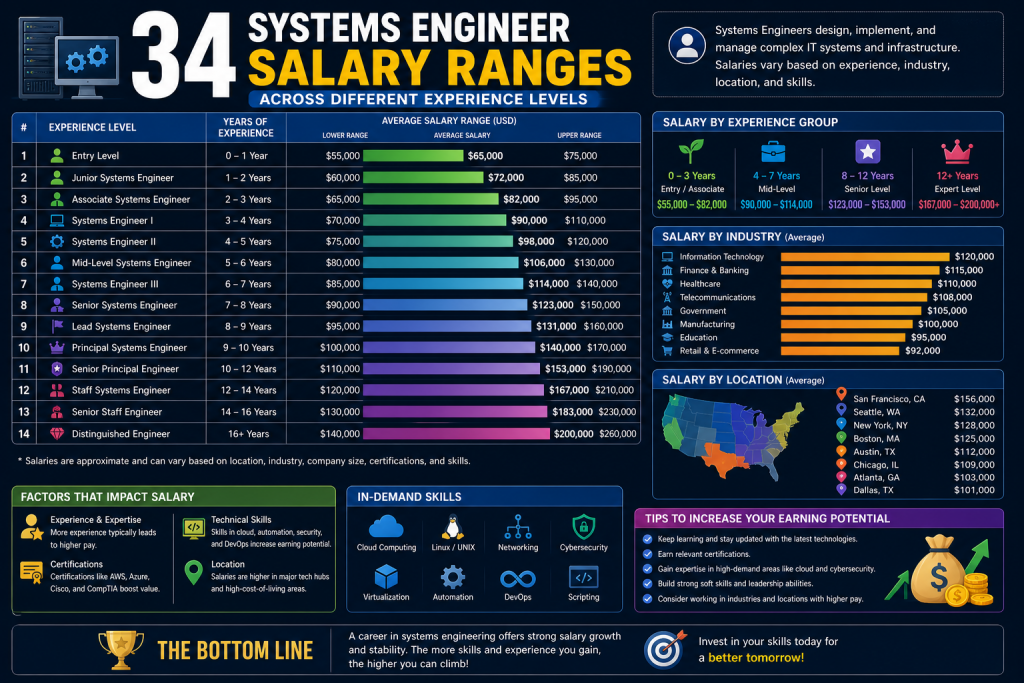
On average, systems engineers earn around 127,000 dollars per year in the United States. However, this number represents a midpoint rather than a fixed value.
Entry-level engineers typically earn less, while experienced professionals in senior or specialized roles earn significantly more.
Salary ranges are usually divided into three levels based on experience.
Entry-level systems engineers with zero to two years of experience generally earn between 65,000 and 85,000 dollars annually. These roles focus on learning foundational skills and handling basic infrastructure tasks.
Mid-level systems engineers with three to five years of experience typically earn between 85,000 and 110,000 dollars per year. At this stage, professionals take on more responsibility and work more independently.
Senior systems engineers with more than six years of experience often earn between 110,000 and 145,000 dollars or more. These professionals handle complex systems, lead projects, and contribute to infrastructure strategy.
In highly specialized environments, salaries can go even higher, especially when cloud architecture or cybersecurity expertise is involved.
Why Systems Engineers Are in High Demand
The demand for systems engineers continues to grow as organizations rely more heavily on digital infrastructure.
Businesses today operate in hybrid environments that combine on-premises systems with cloud platforms. Managing these environments requires skilled engineers who understand both traditional IT systems and modern cloud technologies.
As companies expand their digital operations, the need for reliable and scalable infrastructure increases. Systems engineers ensure that applications remain available and that performance meets business requirements.
Another reason for high demand is the increasing complexity of IT systems. Modern environments involve multiple technologies working together, including virtualization, automation tools, and distributed cloud services.
This complexity makes systems engineers essential for maintaining stability and efficiency.
Key Skills Required for Systems Engineers
Systems engineers need a combination of technical and analytical skills to succeed in their roles.
They must understand operating systems such as Windows Server and Linux. These platforms form the foundation of most enterprise environments.
They need knowledge of virtualization technologies such as VMware and Hyper-V. Virtualization allows organizations to run multiple systems on a single physical machine.
They should be familiar with cloud platforms like AWS, Azure, or Google Cloud. Cloud computing is now a major part of most IT infrastructures.
They must have scripting skills in languages such as PowerShell, Bash, or Python. These skills help automate tasks and improve efficiency.
They should understand networking basics such as IP addressing, DNS, and routing. Even though they are not network engineers, systems engineers must understand how systems communicate.
They also need problem-solving skills to diagnose and resolve system issues quickly.
Importance of Automation in Systems Engineering
Automation has become one of the most important aspects of systems engineering.
In large environments, manually managing systems is inefficient and error-prone. Automation allows engineers to perform repetitive tasks more quickly and accurately.
Tasks such as software updates, configuration management, and system provisioning can be automated using scripts and tools.
This not only saves time but also improves system consistency and reduces the risk of human error.
Engineers who understand automation tools are often more valuable to employers because they help reduce operational costs and improve system reliability.
The Role of Cloud Computing
Cloud computing has transformed the systems engineering profession.
Instead of managing physical servers, many organizations now rely on cloud platforms for infrastructure needs. This shift has changed the skill requirements for systems engineers.
They now need to understand cloud architecture, resource management, and cloud-based networking.
Cloud platforms offer scalability, flexibility, and cost efficiency. Systems engineers are responsible for managing these environments and ensuring they are optimized for performance.
As cloud adoption continues to grow, cloud expertise is becoming one of the most important skills in the field.
How Experience Impacts Salary
Experience plays a major role in determining salary levels for systems engineers.
At the beginning of their careers, engineers focus on learning and supporting existing systems. Their responsibilities are limited, and they work under supervision.
As they gain experience, they begin managing more complex systems and take ownership of infrastructure components.
Mid-level engineers often handle system design tasks, automation projects, and independent troubleshooting.
Senior engineers are responsible for large-scale systems, strategic planning, and team leadership.
With each level of experience, both responsibility and salary increase significantly.
Industry Influence on Pay
The industry in which a systems engineer works also affects salary levels.
Industries that depend heavily on uptime and security tend to offer higher compensation. These include finance, healthcare, and technology sectors.
Organizations in these industries require highly reliable systems and are willing to pay more for skilled engineers.
On the other hand, public sector organizations or smaller businesses may offer lower salaries but provide more stability and predictable workloads.
Overview of Systems Engineering Careers
Systems engineering is a critical and evolving field within IT. It combines technical expertise, problem-solving ability, and continuous learning.
The role offers strong salary potential and long-term career growth. As technology continues to evolve, systems engineers will remain essential for managing complex infrastructure environments.
Understanding responsibilities, required skills, and salary expectations helps professionals make informed decisions about their career path and future growth opportunities.
Introduction
Systems engineering is not a static profession. It evolves continuously as infrastructure shifts from traditional on-premises environments to hybrid and cloud-based systems. Because of this, the skills required to succeed in this field are also constantly changing.
Professionals who want to grow in systems engineering must go beyond basic system administration. They need to understand automation, cloud platforms, security principles, virtualization, and modern infrastructure design.
This section focuses on the skills, tools, technologies, and certifications that influence both career growth and salary potential for systems engineers. It also explains how these elements connect directly to real-world job expectations.
The Expanding Skill Set of a Systems Engineer
Modern systems engineers are expected to handle much more than basic server management. Their skill set must cover multiple layers of IT infrastructure.
At the foundation, they need a strong understanding of operating systems. This includes both Windows Server environments and Linux distributions. These systems form the backbone of most enterprise infrastructures.
Beyond operating systems, systems engineers must understand how different components interact within a networked environment. This includes knowledge of networking fundamentals such as IP addressing, DNS resolution, routing, and firewall behavior.
As systems become more complex, engineers also need to understand virtualization technologies. Virtual machines allow organizations to run multiple systems on a single physical server, improving efficiency and reducing costs.
Cloud computing has become another essential skill area. Most organizations now use at least one major cloud platform, and systems engineers must be able to manage resources in these environments effectively.
Scripting and automation are also critical. Engineers who can automate repetitive tasks are more efficient and valuable to organizations. This includes writing scripts to manage deployments, monitor systems, and handle configuration tasks.
Finally, problem-solving and analytical thinking remain core skills. Systems engineers must be able to diagnose issues quickly and identify the root cause of system failures.
Operating Systems as the Foundation of Systems Engineering
Operating systems are at the center of all infrastructure environments. Systems engineers must be comfortable working in both Windows and Linux environments.
Windows Server is widely used in enterprise environments, especially in organizations that rely on Microsoft services. Systems engineers working in these environments must understand Active Directory, group policies, and server roles.
Linux is equally important, especially in cloud and DevOps environments. Many servers, applications, and cloud services run on Linux-based systems. Engineers must be able to navigate the command line, manage permissions, and configure services.
Understanding both operating systems gives systems engineers flexibility and increases their job opportunities. Employers often prefer candidates who can work across multiple platforms.
Virtualization and Its Role in Modern Infrastructure
Virtualization has transformed how organizations manage infrastructure. Instead of relying on physical servers for every application, companies can now run multiple virtual machines on a single physical host.
Systems engineers are responsible for creating, managing, and optimizing these virtual environments. This includes allocating resources, ensuring performance stability, and managing storage and network configurations.
Technologies such as VMware and Hyper-V are commonly used in enterprise environments. These platforms allow engineers to create scalable and efficient infrastructure setups.
Virtualization also plays a key role in disaster recovery and testing environments. Engineers can quickly create backups, replicate systems, and restore environments when needed.
Understanding virtualization is essential for systems engineers because it directly impacts system performance, scalability, and cost efficiency.
Cloud Computing and Its Impact on Systems Engineering
Cloud computing has become one of the most important developments in IT infrastructure. It allows organizations to store data, run applications, and manage systems without relying entirely on physical hardware.
Systems engineers now spend a significant portion of their time working with cloud platforms. These platforms provide scalable infrastructure that can be adjusted based on demand.
Common cloud platforms include AWS, Microsoft Azure, and Google Cloud. Each platform offers a wide range of services, including virtual machines, storage systems, networking tools, and automation features.
Systems engineers must understand how to deploy and manage resources in these environments. They also need to ensure security, optimize performance, and control costs.
Cloud computing has also introduced new concepts such as infrastructure as code. This approach allows engineers to define and manage infrastructure using code rather than manual configuration.
As more organizations move to the cloud, systems engineers with cloud expertise are becoming increasingly valuable.
Automation as a Key Career Advantage
Automation is one of the most important skills in modern systems engineering. It allows engineers to reduce manual work, increase efficiency, and improve system reliability.
Instead of performing repetitive tasks manually, engineers can write scripts or use automation tools to handle them automatically.
Common automation tools include Ansible, Terraform, and Puppet. These tools help manage infrastructure configuration and deployment in a consistent and repeatable way.
Scripting languages such as PowerShell, Bash, and Python are also widely used. These languages allow engineers to automate system administration tasks such as user management, software installation, and system monitoring.
Automation not only saves time but also reduces the risk of human error. This leads to more stable and predictable systems.
Employers highly value engineers who can implement automation because it directly improves operational efficiency.
Monitoring and System Management Tools
Monitoring is a critical part of systems engineering. Engineers must continuously track system performance to ensure everything is functioning properly.
Monitoring tools provide real-time insights into server health, application performance, and network activity.
Common tools include Zabbix, Nagios, Prometheus, and SolarWinds. These platforms help engineers detect issues before they become major problems.
System management tools are also used to deploy updates, manage configurations, and maintain compliance across large environments.
Microsoft System Center Configuration Manager is one example of a widely used management tool in enterprise environments.
These tools allow systems engineers to maintain control over complex infrastructure and ensure consistent performance across systems.
Security Responsibilities in Systems Engineering
Security is a major concern in all IT environments. Systems engineers play an important role in maintaining system security and protecting sensitive data.
They are responsible for applying security patches, managing user permissions, and configuring firewalls.
They also help enforce security policies and ensure compliance with organizational standards.
In many cases, systems engineers work closely with cybersecurity teams to identify vulnerabilities and implement protective measures.
As cyber threats continue to grow, security knowledge is becoming increasingly important for systems engineers.
The Role of Certifications in Career Growth
Certifications are not always required for systems engineering roles, but they can significantly improve career opportunities and salary potential.
They demonstrate technical knowledge and validate practical skills.
One of the most common entry-level certifications is CompTIA Server+. This certification covers basic server management, hardware, and troubleshooting concepts.
Cloud certifications are also highly valuable. Microsoft Azure Administrator and AWS SysOps Administrator certifications are widely recognized in the industry.
These certifications validate an engineer’s ability to manage cloud environments and are often required for cloud-focused roles.
Linux certifications such as Red Hat Certified System Administrator or Linux+ are also important for engineers working in open-source environments.
VMware certifications are useful for professionals working with virtualization technologies.
Certifications help engineers stand out in competitive job markets and often lead to higher-paying opportunities.
How Tools Influence Salary Growth
The tools a systems engineer knows how to use can directly impact salary levels.
Engineers who only understand basic system administration tools may remain in lower salary ranges.
However, those who master advanced tools such as cloud platforms, automation frameworks, and monitoring systems often earn significantly more.
Organizations are willing to pay higher salaries for engineers who can manage complex environments efficiently.
Tool expertise also increases job mobility, allowing engineers to move into higher-paying roles more easily.
Career Progression in Systems Engineering
Systems engineering offers a clear career progression path.
At the early stage, professionals focus on learning core systems and handling basic tasks under supervision.
As they gain experience, they begin managing more complex systems and working independently on infrastructure projects.
Mid-level engineers often take ownership of system components and contribute to design decisions.
Senior engineers handle large-scale infrastructure, lead projects, and mentor junior team members.
Some engineers eventually move into specialized roles such as cloud architecture, DevOps engineering, or infrastructure consulting.
Others move into leadership positions such as IT manager or technical architect.
Career progression depends not only on experience but also on continuous learning and skill development.
Importance of Continuous Learning
Systems engineering is a field that changes rapidly. New technologies, tools, and methodologies are constantly being introduced.
Engineers who continue learning throughout their careers are more likely to advance and increase their salaries.
Staying updated with cloud technologies, automation tools, and security practices is essential.
Continuous learning ensures that systems engineers remain relevant in a competitive job market.
Systems engineering is a long-term career path that rewards continuous learning, adaptability, and technical depth. While earlier sections covered responsibilities, salary ranges, tools, and certifications, this section focuses on real-world factors that influence long-term career growth, how professionals can increase their earning potential, and where the field is heading in the future.
Systems engineers do not remain at the same level throughout their careers. Their value increases as they gain experience with complex infrastructure, modern cloud systems, automation, and enterprise-scale environments. Understanding how to grow strategically in this field is key to maximizing both career opportunities and salary progression.
How Experience Shapes Long-Term Salary Growth
Experience is one of the strongest factors influencing how much a systems engineer earns over time. However, it is not just about the number of years spent in the industry. It is about the depth and variety of experience gained during those years.
Early in a career, systems engineers typically focus on learning environments and handling routine infrastructure tasks. This includes basic server maintenance, user support, system monitoring, and troubleshooting common issues.
As engineers gain more experience, their responsibilities expand significantly. They begin working on system design, infrastructure planning, and automation projects. At this stage, they are expected to handle more complex environments and solve problems independently.
In later stages of their careers, systems engineers often take on leadership responsibilities. They may design entire infrastructure architectures, manage enterprise systems, and guide technical teams. At this level, decision-making becomes just as important as technical execution.
This progression shows that salary growth is directly linked to the ability to handle increasing levels of responsibility and complexity.
The Role of Industry in Salary Differences
Industry choice plays a major role in determining salary levels for systems engineers. Some industries consistently offer higher compensation due to the critical nature of their systems and the sensitivity of the data they manage. For example, financial institutions require extremely stable and secure infrastructure because even a few minutes of downtime can result in significant financial loss. As a result, they invest heavily in experienced systems engineers who can maintain high availability and strict security standards.
Similarly, the healthcare industry places strong emphasis on reliable systems because patient data, medical records, and hospital operations depend on uninterrupted access to digital platforms. Systems engineers working in this sector often deal with compliance requirements and strict regulatory frameworks, which increases the complexity of their work and the value of their expertise.
Technology companies also tend to offer higher salaries because their entire business depends on scalable and high-performance infrastructure. These organizations often operate at a global level, requiring engineers to manage distributed systems, cloud environments, and large-scale applications.
In contrast, industries such as education or smaller public sector organizations may offer lower salaries, but they often provide more predictable workloads and stable working conditions. Overall, the industry you choose can significantly influence both your earning potential and the level of technical responsibility you handle.Financial services is one of the highest-paying sectors because it requires extremely reliable and secure systems. Even minor downtime can result in significant financial loss, so companies invest heavily in skilled engineers.
Healthcare is another industry where systems engineers are highly valued. Hospitals and healthcare organizations rely on stable systems for patient data, medical records, and critical operations.
Technology companies, especially those working with cloud platforms and large-scale infrastructure, also offer competitive salaries. These organizations depend on systems engineers to maintain high-performance environments.
Government and education sectors tend to offer lower salaries in comparison. However, these roles often provide more stability and predictable workloads.
Understanding industry differences helps professionals choose career paths that align with both their interests and financial goals.
Geographic Location and Remote Work Impact
Location has traditionally been a major factor in salary differences for systems engineers. Large metropolitan areas with strong technology industries usually offer higher salaries due to increased demand and higher living costs.
Cities with established tech ecosystems tend to provide more opportunities for senior-level roles and specialized positions. However, these locations often come with higher expenses related to housing, transportation, and daily living.
Mid-sized cities offer a more balanced approach. While salaries may be slightly lower, the cost of living is also reduced, which can result in better overall financial comfort.
In recent years, remote work has changed how location affects salary. Many companies now hire systems engineers remotely, allowing professionals to earn competitive salaries while living in lower-cost regions.
This shift has created new opportunities for engineers who want flexibility without sacrificing income potential.
The Growing Importance of Cloud Expertise
Cloud computing has fundamentally changed systems engineering. Most organizations now rely on cloud platforms for hosting applications, managing data, and scaling infrastructure.
As a result, systems engineers are expected to understand cloud environments in detail. This includes managing virtual machines, storage systems, networking configurations, and identity services. In modern IT infrastructure, cloud platforms have become the backbone of most enterprise systems, so engineers must be able to operate confidently within these environments. They are responsible for provisioning and scaling virtual machines based on workload demands, ensuring that storage resources are allocated efficiently, and maintaining network connectivity between different cloud services.
In addition to these core responsibilities, systems engineers must also understand how identity and access management works in cloud ecosystems. This includes controlling user permissions, securing sensitive data, and ensuring that only authorized users can access critical systems. Security and compliance are major concerns in cloud environments, so engineers must follow strict policies and best practices when configuring services.
Another important aspect is monitoring and optimization. Cloud environments require continuous performance tracking to ensure systems are running efficiently and cost-effectively. Engineers often analyze usage patterns and make adjustments to improve performance while reducing unnecessary expenses. They may also work with automation tools to simplify resource management and improve scalability.
Overall, cloud expertise is not just a technical skill but a core requirement for modern systems engineers working in enterprise-level infrastructure environments.
Cloud expertise is no longer optional. It is a core requirement for many modern systems engineering roles.
Professionals who specialize in cloud platforms often have higher earning potential. This is because cloud environments are complex and require advanced knowledge to manage effectively.
Cloud skills also open the door to specialized roles such as cloud architect or cloud infrastructure engineer, which often come with significantly higher salaries.
Automation and Its Impact on Career Advancement
Automation continues to be one of the most important factors in systems engineering career growth.
Organizations increasingly expect engineers to reduce manual work and improve efficiency through automation. This includes automating system deployments, configuration management, monitoring, and maintenance tasks.
Engineers who understand automation tools and scripting languages are able to deliver more value to their organizations. This often leads to faster promotions and higher salary increases.
Automation also reduces operational risk. By minimizing human error, systems become more reliable and easier to manage at scale.
In modern IT environments, automation is closely tied to DevOps practices, where development and operations work together to streamline software delivery and infrastructure management.
Leadership and Senior-Level Responsibilities
As systems engineers progress in their careers, they often transition into leadership roles. These roles require more than just technical knowledge.
Senior systems engineers are expected to make architectural decisions, guide infrastructure strategy, and oversee complex projects.
They may also be responsible for mentoring junior engineers and helping teams adopt best practices.
In some organizations, senior engineers act as technical advisors to management, helping shape long-term IT strategy.
Leadership roles often come with significantly higher salaries because they combine technical expertise with strategic decision-making.
Specialization as a Career Strategy
One of the most effective ways to increase earning potential in systems engineering is through specialization.
Instead of focusing on general infrastructure tasks, many engineers choose to specialize in a specific area.
Cloud specialization is one of the most common paths. Engineers in this area focus on designing and managing cloud-native environments.
Security specialization is another high-value path. These engineers focus on protecting systems, managing vulnerabilities, and ensuring compliance.
Automation and DevOps specialization is also growing rapidly. Engineers in this area focus on streamlining infrastructure through code and continuous deployment systems.
Specialization allows engineers to become experts in high-demand areas, which often leads to higher salaries and better job opportunities.
The Value of Cross-Functional Skills
Systems engineers who develop cross-functional skills often have more career flexibility.
Understanding networking, cybersecurity, and software development allows engineers to work more effectively across different teams.
This type of versatility is highly valued in modern IT environments where collaboration between teams is essential.
Cross-functional knowledge also helps engineers move into hybrid roles such as DevOps engineering or infrastructure architecture.
These roles often combine responsibilities from multiple disciplines and offer higher compensation.
Common Career Challenges in Systems Engineering
While systems engineering is a rewarding career, it also comes with challenges.
One of the most common challenges is handling on-call responsibilities. Many systems engineers are required to respond to incidents outside of normal working hours.
This can lead to stress and work-life balance issues if not managed properly.
Another challenge is keeping up with rapidly changing technologies. New tools, platforms, and practices are constantly being introduced.
Engineers must continuously learn to stay relevant in the field.
Complex system environments can also be difficult to manage, especially in large organizations with multiple interconnected systems.
Despite these challenges, many professionals find systems engineering rewarding due to its technical depth and career growth potential.
Future Outlook of Systems Engineering
The future of systems engineering is closely tied to the evolution of cloud computing, automation, and artificial intelligence.
As organizations continue to move toward cloud-native infrastructure, the demand for skilled systems engineers is expected to remain strong.
Automation will continue to reduce manual tasks, allowing engineers to focus more on design, optimization, and strategic planning.
Artificial intelligence and machine learning may also play a role in system monitoring and predictive maintenance.
However, human expertise will remain essential for decision-making, system design, and problem-solving.
The role of systems engineers will likely shift toward more strategic and architectural responsibilities over time.
Salary Growth Strategies
There are several practical ways systems engineers can increase their salaries over time.
One of the most effective strategies is continuous skill development. Learning new technologies and staying updated with industry trends is essential.
Gaining certifications in cloud platforms, security, and automation can also significantly improve earning potential.
Taking on more responsibility within an organization can lead to faster promotions and higher compensation.
Switching industries or companies is another common strategy for salary growth. Many professionals see significant salary increases when moving to more competitive organizations.
Building expertise in high-demand areas such as cloud computing and automation can also lead to better-paying roles.
Final Thoughts on Career Development
Systems engineering is a career that rewards both technical skill and continuous learning.
While entry-level positions provide a solid foundation, long-term success depends on the ability to adapt to new technologies and take on increasing responsibility. In the early stages of a systems engineering career, professionals usually focus on learning core infrastructure concepts, understanding how systems interact, and gaining hands-on experience with basic troubleshooting. However, this stage is only the beginning, and real career growth happens when engineers start expanding beyond routine tasks.
As technology continues to evolve, systems engineers must stay updated with changes in cloud platforms, automation tools, security practices, and infrastructure management techniques. Organizations are no longer relying on static systems; instead, they operate in dynamic environments where scalability, reliability, and speed are essential. This means engineers must continuously improve their knowledge to remain effective.
Taking on increasing responsibility is equally important. Engineers who volunteer for complex projects, participate in system migrations, or lead small infrastructure improvements often gain valuable experience faster than those who remain limited to basic tasks. Over time, this helps them move into mid-level and senior positions where decision-making becomes a key part of the role.
Adaptability also plays a major role in long-term success. Engineers who can quickly learn new tools and adjust to changing environments are more likely to grow into higher-paying roles and leadership positions within the field.
Professionals who invest in cloud computing, automation, and specialization are more likely to advance quickly and achieve higher salaries.
The field offers strong long-term stability, especially as organizations continue to rely on complex digital infrastructure.
Conclusion
Systems engineering remains one of the most important and stable careers in the IT industry. It combines technical expertise, problem-solving ability, and strategic thinking.
Salary levels in this field are influenced by multiple factors including experience, industry, location, and technical specialization. However, the most important factor in long-term success is continuous skill development.
As technology continues to evolve, systems engineers who stay updated with cloud computing, automation, and modern infrastructure practices will remain in high demand.
This career offers strong growth potential, competitive salaries, and opportunities to work on complex and impactful systems.
Continue exploring the technologies and certification concepts that matter most to you.