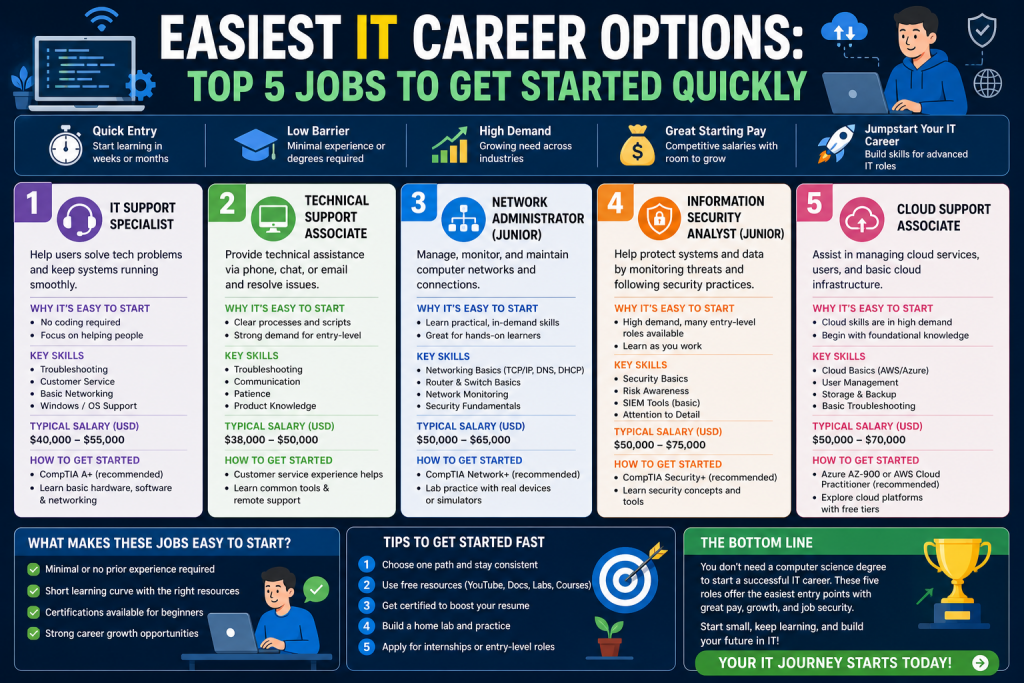
The information technology industry continues to expand rapidly as more businesses move toward digital operations, cloud systems, and data-driven decision-making. This growth has created a wide range of career opportunities, especially for individuals who are new to the field or looking to transition from another profession. While IT is often considered highly technical, there are several roles that are more accessible because they offer structured learning paths, entry-level openings, and clear career progression.
In today’s job market, many organizations are actively hiring for positions that do not require years of prior experience. Instead, they focus on skills, certifications, and practical understanding of systems. This makes IT one of the most flexible industries for beginners who are willing to learn and develop their abilities over time.
The following section introduces one of the most common and approachable entry points into the IT industry. This role is widely available across industries and serves as the foundation for many successful IT careers.
Help Desk Technician (First and Second Line Support)
Help desk technician roles are often considered the starting point for many IT professionals. These positions focus on providing technical assistance to employees or customers who are experiencing issues with hardware, software, or network systems. Because nearly every organization relies on technology, help desk jobs exist in almost every industry, including education, healthcare, finance, retail, and government sectors.
The main responsibility of a help desk technician is to respond to user problems and provide solutions in a timely manner. These issues may include problems such as forgotten passwords, software errors, system crashes, printer malfunctions, or connectivity issues. Technicians typically work through a ticketing system where users submit their problems, and each issue is tracked until it is resolved.
A major part of the job involves troubleshooting. This means identifying the cause of a problem and applying the correct solution. Sometimes the issue is simple, such as restarting a device or resetting a password. In other cases, it may require more detailed investigation, including checking system logs or coordinating with higher-level IT teams.
Communication plays a very important role in this position. Help desk technicians must be able to explain technical concepts in a simple and understandable way. Many users are not familiar with IT systems, so patience and clarity are essential. A technician must remain calm and professional even when dealing with frustrated or stressed users.
In addition to problem-solving and communication, organization skills are also important. Technicians often handle multiple requests at the same time, so they must prioritize tasks based on urgency and impact. Keeping accurate records of issues and solutions helps improve future troubleshooting and ensures consistent service delivery.
Help desk roles are divided into different levels. First-line support usually deals with basic and common issues. These technicians are the first point of contact for users and resolve problems that can be handled quickly. If the issue is more complex, it is escalated to second-line support, where technicians have more advanced technical knowledge and access to deeper system configurations.
Second-line support technicians handle more challenging problems that require deeper investigation. They may work on network issues, system errors, or software conflicts that cannot be resolved at the first level. This stage of support often involves closer collaboration with system administrators, network engineers, and other IT specialists.
One of the most important advantages of starting in a help desk role is the learning opportunity it provides. Because technicians are exposed to a wide variety of technical issues, they develop a broad understanding of IT systems. This experience helps them build a strong foundation for future career growth.
Help desk positions also provide exposure to different technologies and tools. Technicians may work with operating systems, enterprise software, cloud platforms, and network tools. This exposure helps individuals identify areas of interest and decide which IT specialization they want to pursue in the future.
Another key benefit is career progression. Many senior IT professionals begin their careers in help desk roles. After gaining experience, individuals often move into positions such as system administrator, network technician, IT support specialist, or cybersecurity analyst. The skills learned in help desk roles are highly transferable and valuable in almost every area of IT.
While the job may seem basic at first, it is actually a critical part of any organization’s IT structure. Without help desk teams, businesses would struggle to maintain productivity and resolve technical issues efficiently. This makes the role both important and in high demand.
Salary levels for help desk technicians vary depending on location, experience, and company size. Entry-level positions typically offer modest salaries, but there is significant potential for growth as skills improve. With additional certifications and experience, technicians can quickly move into higher-paying roles.
Certifications can play an important role in advancing within this career path. Many employers value certifications that demonstrate technical knowledge and practical skills. These certifications help individuals stand out in the job market and increase their chances of promotion.
Overall, help desk technician roles offer one of the most accessible entry points into the IT industry. They provide hands-on experience, exposure to real-world technical problems, and a clear path for career development. For individuals who are just starting their IT journey, this role serves as a strong foundation for future opportunities.
Cloud Support Associate
As more companies move their operations to cloud platforms, cloud support roles have become increasingly important. Cloud support associates assist in managing and maintaining cloud-based systems that host applications, data, and services. These roles are ideal for individuals who are interested in modern IT infrastructure and want to work with scalable and flexible technologies.
Cloud computing allows organizations to store and access data over the internet rather than relying on local servers. This shift has transformed the IT industry and created a high demand for professionals who understand cloud environments. Cloud support associates play a key role in ensuring these systems operate smoothly and efficiently.
The responsibilities in this role include monitoring cloud performance, resolving technical issues, and assisting in the deployment of applications. Cloud support professionals also help configure virtual machines, manage storage resources, and ensure that systems remain secure and stable.
Security is a major aspect of cloud computing. Cloud support associates must ensure that data is protected from unauthorized access and that systems follow proper security protocols. This includes managing user permissions, configuring firewalls, and monitoring for unusual activity.
One of the reasons this role is considered accessible is that many cloud providers offer beginner-friendly certifications and training programs. These resources allow individuals to learn cloud fundamentals without needing advanced technical backgrounds. With consistent practice and hands-on experience, beginners can quickly build confidence in cloud technologies.
Cloud support roles also involve collaboration with other IT teams. Professionals often work alongside developers, system administrators, and network engineers to ensure that applications run efficiently. Communication and teamwork are important because cloud environments are complex and involve multiple systems working together.
Another important aspect of this role is problem-solving. Cloud systems can experience performance issues, configuration errors, or connectivity problems. Cloud support associates must be able to identify the cause of these issues and apply appropriate solutions quickly.
The demand for cloud professionals continues to grow as businesses adopt digital transformation strategies. This makes cloud support roles highly stable and promising for long-term career growth. With experience, individuals can progress into roles such as cloud engineer, cloud architect, or DevOps specialist.
Cloud support is not limited to a single platform. Professionals often work with multiple cloud providers and tools, gaining a broad understanding of the industry. This versatility makes them valuable assets to any organization.
For beginners, this role offers a combination of technical learning, practical experience, and career advancement opportunities. It is an excellent entry point for anyone interested in modern IT infrastructure and cloud technologies.
Data Analyst
A data analyst plays a very important role in today’s digital world. Every organization collects large amounts of data from customers, systems, and operations. However, raw data has no value unless it is organized, interpreted, and transformed into meaningful insights. This is where data analysts come in.
The main responsibility of a data analyst is to examine datasets and identify patterns, trends, and relationships. These insights help businesses make informed decisions. For example, a company may want to understand which products are selling the most, what customer behavior looks like, or how operational performance can be improved. A data analyst helps answer these questions using structured data analysis techniques.
One of the key aspects of this role is data collection. Analysts gather information from different sources such as databases, spreadsheets, customer records, and online platforms. Once the data is collected, it must be cleaned and organized. Data cleaning is an important step because raw data often contains errors, missing values, or inconsistencies.
After preparing the data, analysts use tools and techniques to explore it. They may use spreadsheets for basic analysis or more advanced tools like SQL for database queries. Programming languages such as Python are also commonly used for deeper analysis and automation. These tools allow analysts to process large datasets efficiently.
Visualization is another important part of the job. Data analysts often present their findings using charts, graphs, and dashboards. This helps non-technical stakeholders understand complex information easily. Visualization tools allow businesses to see trends at a glance and make faster decisions.
In many organizations, data analysts work closely with management teams. Their insights are used to guide business strategies, improve customer experiences, and optimize operations. Because of this, communication skills are just as important as technical skills in this role.
One reason this career is considered accessible is that it does not always require advanced programming knowledge at the beginning. Many beginners start with basic tools and gradually learn more advanced techniques over time. There are also many online courses and certifications available that help individuals enter this field.
As experience increases, data analysts can move into more advanced roles such as senior analyst, business intelligence specialist, or data scientist. These positions involve deeper analysis, predictive modeling, and more complex problem-solving.
Data analysis is used in almost every industry. For example, in retail, analysts study buying patterns. In healthcare, they analyze patient data. In finance, they evaluate risks and investments. This wide applicability makes the role highly stable and in demand.
Overall, the data analyst role is ideal for individuals who enjoy working with numbers, patterns, and problem-solving. It offers strong career growth and serves as a foundation for many advanced data-related careers.
Information Security Analyst
As technology becomes more advanced, the risk of cyber threats also increases. Organizations face constant challenges from hackers, malware, phishing attacks, and data breaches. To protect their systems, companies rely on information security analysts.
The primary responsibility of an information security analyst is to protect an organization’s digital assets. This includes networks, systems, applications, and sensitive data. These professionals work to prevent unauthorized access and ensure that security systems are functioning properly.
One of the main tasks in this role is monitoring systems for suspicious activity. Analysts use security tools to track network traffic, detect unusual behavior, and identify potential threats. If a security issue is detected, they must respond quickly to minimize damage.
Another important responsibility is implementing security measures. This includes configuring firewalls, setting up encryption systems, and managing access controls. These measures help prevent unauthorized users from accessing sensitive information.
Information security analysts also conduct regular risk assessments. This involves identifying weaknesses in systems and evaluating potential threats. By understanding these risks, organizations can strengthen their defenses before attacks occur.
Incident response is another critical part of the job. When a security breach happens, analysts must investigate the issue, determine how it occurred, and take steps to resolve it. They also work on preventing similar incidents in the future by improving security protocols.
Documentation and reporting are also important responsibilities. Analysts must record security incidents, system changes, and risk assessments. These reports help management understand the organization’s security posture and make informed decisions.
This career requires strong analytical thinking and attention to detail. Security analysts must be able to identify patterns in data and recognize unusual behavior. They also need to stay updated on the latest cyber threats and security technologies.
One of the reasons this role is considered accessible is that there are many entry-level certifications available. These certifications help beginners understand cybersecurity fundamentals and build practical skills. With consistent learning and hands-on practice, individuals can gradually enter the field.
The demand for cybersecurity professionals continues to grow rapidly. As more businesses move online, the need for strong security measures becomes even more important. This makes information security one of the most stable and high-demand IT careers.
With experience, professionals can advance into roles such as security engineer, penetration tester, security architect, or chief information security officer. These positions involve more responsibility and higher levels of expertise.
Overall, information security analysis is a highly rewarding career for individuals interested in protecting systems, solving complex problems, and working in a constantly evolving environment.
Business Intelligence Developer
Business intelligence developers play a key role in helping organizations make sense of their data. While data analysts focus on interpreting data, business intelligence developers focus on building the systems that make data analysis possible.
Modern organizations collect data from many sources, including sales systems, customer interactions, websites, and internal operations. However, this data is often stored in different formats and locations. Business intelligence developers design systems that bring all this data together in a structured and usable way.
One of the main responsibilities of this role is building data pipelines. These pipelines collect data from multiple sources, transform it into a usable format, and store it in databases or data warehouses. This process ensures that data is accurate, consistent, and ready for analysis.
Another important responsibility is creating dashboards and reports. These tools allow managers and executives to view important business metrics in real time. Dashboards often include charts, graphs, and visual indicators that make it easy to understand performance trends.
Business intelligence developers also work with SQL and database systems. They write queries to extract data and ensure that information is delivered efficiently. Strong database knowledge is essential in this role because most BI systems rely heavily on structured data.
In addition to technical skills, this role requires strong communication abilities. BI developers often work with business teams to understand their reporting needs. They must translate business requirements into technical solutions that provide accurate insights.
Data modeling is another important aspect of this job. Developers design how data is structured and stored so that it can be accessed quickly and efficiently. Good data models improve system performance and make reporting more accurate.
This role is considered accessible because many tools used in business intelligence are user-friendly and supported by training programs. Beginners can start with basic reporting tools and gradually learn more advanced concepts like data warehousing and ETL processes.
Business intelligence developers play a critical role in decision-making. Their work helps organizations identify opportunities, reduce costs, and improve performance. Without proper data systems, businesses would struggle to make informed decisions.
As professionals gain experience, they can move into senior BI roles, data architecture, or analytics leadership positions. These careers involve designing large-scale data systems and guiding enterprise-level data strategies.
Overall, business intelligence development is a highly valuable career path for individuals who enjoy working with data systems, problem-solving, and supporting business decisions through technology.
How These IT Roles Connect in Real Work Environments
Although each IT job has its own focus, they are not isolated from one another. In real organizations, these roles often work together as part of a larger system. For example, a help desk technician may receive a user complaint about slow system performance. If the issue is related to cloud infrastructure, it may be escalated to a cloud support specialist. If the issue involves data access or reporting errors, it might be passed to a data analyst or business intelligence developer.
Similarly, if a security breach is suspected, the incident will involve cybersecurity professionals who investigate the issue and work alongside system administrators and cloud engineers to resolve it. This interconnected structure shows that IT careers are not separate paths but part of a larger ecosystem where collaboration is essential. In most real-world environments, no single IT role operates in isolation because modern systems are highly integrated and depend on multiple technologies working together. For example, a small security issue in a cloud system may require coordination between cloud engineers, security analysts, and network teams to identify the root cause and apply a proper fix.
This level of collaboration improves efficiency and reduces downtime, as each specialist brings unique knowledge to the problem. System administrators may focus on internal infrastructure, while cloud engineers handle external hosting environments, and cybersecurity experts ensure that vulnerabilities are properly addressed. Communication between these teams is critical to ensure that issues are resolved quickly and effectively.
In addition, this interconnected structure helps professionals learn from each other. Working in cross-functional teams exposes individuals to different technologies and problem-solving approaches. Over time, this broad exposure helps IT professionals develop a more complete understanding of how entire systems operate, making them more valuable and versatile in their careers.
Understanding how these roles connect helps beginners see the bigger picture of IT operations. It also makes it easier to choose a specialization because each role provides exposure to different parts of the system. Many professionals start in one area and gradually move into another based on their interests and experience.
Career Growth and Skill Progression in IT
One of the strongest advantages of working in IT is the clear career progression path. Unlike some industries where growth is uncertain, IT offers structured advancement based on skills, certifications, and experience. This means that individuals can plan their careers in a more predictable and goal-oriented way. As professionals gain hands-on experience, they naturally move from basic support roles into more specialized and higher-paying positions. Each stage builds on the previous one, allowing continuous improvement without needing to restart or switch fields entirely.
Another important aspect of IT career progression is the ability to specialize. After gaining foundational experience, professionals can choose a specific area such as networking, cybersecurity, cloud computing, data analytics, or software development. Specialization not only increases expertise but also opens doors to better job opportunities and higher salaries. Employers value professionals who have deep knowledge in a particular domain because they can solve more complex problems efficiently.
Additionally, career growth in IT is closely tied to continuous learning. New technologies are introduced regularly, and professionals who keep updating their skills remain competitive in the job market. Many organizations also support employee development through training programs and certification sponsorships. This creates an environment where motivated individuals can steadily move upward into senior, lead, or managerial roles over time.Most professionals begin in entry-level roles such as technical support or junior analyst positions. These roles focus on building foundational knowledge, including troubleshooting, communication, and basic system understanding. Over time, as individuals gain confidence and experience, they move into more specialized roles.
For example, a help desk technician may advance to system administrator or network support specialist. From there, they might move into cloud engineering, cybersecurity, or infrastructure management. Each step requires additional learning and often involves certifications or hands-on experience.
Similarly, someone starting as a data analyst may progress into senior analytics roles, business intelligence architecture, or data science. These roles require deeper knowledge of data systems, programming, and statistical modeling.
In cybersecurity, entry-level analysts often move into penetration testing, security engineering, or risk management roles. With enough experience, they may eventually become security managers or chief information security officers responsible for entire organizational security strategies.
Cloud computing professionals may begin in support roles and progress to cloud engineering, DevOps, or cloud architecture. These advanced positions involve designing complex systems and managing large-scale infrastructure.
The key idea is that IT careers are built step by step. Each role adds new skills and prepares individuals for the next level of responsibility. Continuous learning is essential, but it also leads to long-term stability and growth.
Importance of Certifications and Practical Learning
Certifications play a major role in helping individuals enter and grow in IT careers. They provide structured learning paths and validate technical knowledge to employers. Many beginners use certifications as a way to build credibility when they do not yet have professional experience. They act as proof that a candidate has invested time in learning core concepts and understands how to apply them in practical scenarios. This is especially important in IT, where hands-on skills often matter more than formal degrees.
Another important benefit of certifications is that they help learners follow a clear roadmap instead of studying random topics. Most certification programs are designed in a step-by-step manner, starting from basic concepts and gradually moving toward advanced topics. This structure makes it easier for beginners to stay focused and measure their progress over time. It also reduces confusion about what to learn next, which is a common challenge for new learners in the IT field.
Certifications also improve confidence during job interviews. When candidates are familiar with industry-standard tools and concepts, they can answer technical questions more effectively. Employers often prefer certified candidates because it reduces training time and shows commitment to the profession. In many cases, certifications can help candidates stand out even when they have limited work experience, making them a valuable investment for long-term career growth.
For example, entry-level IT support certifications help individuals understand troubleshooting, hardware basics, and operating systems. Cloud certifications introduce learners to platforms like AWS and Azure. Cybersecurity certifications focus on risk management, threat detection, and security fundamentals.
However, certifications alone are not enough. Practical experience is equally important. Employers look for individuals who can apply knowledge in real situations. This is why hands-on practice, labs, internships, and real-world projects are highly valuable.
Many professionals combine both approaches. They study theoretical concepts through certifications and then reinforce their learning through practice. This combination increases job readiness and improves confidence when working in real environments.
The Role of Soft Skills in IT Careers
While technical knowledge is important, soft skills are equally critical in IT roles. Communication, teamwork, problem-solving, and adaptability play a major role in career success.
In help desk and support roles, communication is essential because technicians must explain technical issues in simple terms. In cloud and infrastructure roles, teamwork is important because systems are managed by multiple teams working together. In data and business intelligence roles, communication helps translate complex data into meaningful insights for decision-makers. In cybersecurity, attention to detail and critical thinking are crucial for identifying threats and responding effectively.
Problem-solving is one of the most important skills across all IT careers. Whether it is fixing a system error, analyzing data trends, or securing a network, IT professionals constantly face challenges that require logical thinking and structured solutions.
Adaptability is also important because technology changes rapidly. New tools, platforms, and threats emerge regularly. Professionals who are willing to learn and adapt stay relevant and continue growing in their careers.
Why These IT Jobs Are Considered Easy to Enter
The term “easy” in this context does not mean these jobs require no effort. Instead, it refers to accessibility. These roles are easier to enter compared to highly specialized positions because they have clear learning paths and do not always require advanced degrees or long years of experience.
Many organizations are open to hiring beginners in these roles because they value potential and willingness to learn. Entry-level positions often include training programs, mentorship, and gradual responsibility increases. This approach benefits both the employer and the employee. Companies can shape new hires according to their internal systems and processes, while beginners get the opportunity to learn in a structured and supportive environment without needing to be fully experienced from day one.
Training programs in IT roles are often designed to cover both technical and practical knowledge. New employees are introduced to the tools, platforms, and workflows used within the organization. This helps them understand how daily tasks are performed and how different systems interact with each other. Instead of being overwhelmed with complex responsibilities, beginners are usually given simpler tasks at first, allowing them to build confidence step by step.
Mentorship is another important aspect of entry-level IT roles. Experienced professionals guide newcomers by answering questions, reviewing their work, and helping them improve their problem-solving skills. This direct support speeds up learning and helps reduce mistakes. It also creates a more comfortable working environment where beginners feel encouraged to ask questions and develop their skills without hesitation.
Gradual responsibility increase is a key part of career development in IT. As employees gain experience and demonstrate competence, they are assigned more complex tasks. This progression allows individuals to grow at a steady pace without being overwhelmed. Over time, they move from basic support duties to more advanced technical responsibilities.
In addition, organizations benefit from this system because it helps build a skilled workforce internally. Instead of hiring highly experienced professionals for every role, companies can develop talent from within. This reduces hiring costs and improves employee retention, as individuals are more likely to stay with a company that invests in their growth.
Another reason these jobs are accessible is the availability of learning resources. Online courses, certification programs, and practice labs make it easier for individuals to build skills independently. This has significantly lowered the barrier to entry in IT compared to traditional career paths.
Additionally, the global demand for IT professionals ensures that opportunities remain available across different regions and industries. Almost every organization relies on technology, which means IT skills are always needed.
Long-Term Opportunities in IT Careers
IT is not just about entry-level jobs. It offers long-term career stability and growth opportunities. As professionals gain experience, they can move into leadership, architecture, and strategic roles.
For example, experienced cloud engineers may become cloud architects responsible for designing enterprise-level systems. Data professionals may transition into data science or analytics leadership roles. Cybersecurity experts may move into executive positions overseeing entire security operations.
There are also opportunities to specialize in niche areas such as artificial intelligence, machine learning, automation, and advanced network engineering. These fields are growing rapidly and offer high salaries and strong career prospects. As technology continues to evolve, organizations are increasingly relying on specialized IT professionals who can design intelligent systems, improve efficiency, and solve complex technical challenges that go beyond traditional IT support or administration roles.
Artificial intelligence and machine learning, for example, focus on building systems that can learn from data and make decisions with minimal human intervention. These technologies are widely used in industries such as healthcare, finance, e-commerce, and transportation. Professionals in this field work on developing algorithms, training models, and improving system accuracy over time. Because of the complexity involved, this specialization requires strong analytical thinking and a solid understanding of mathematics and programming.
Automation is another rapidly growing area in IT. It focuses on reducing manual work by using scripts, tools, and software systems to perform repetitive tasks automatically. This helps organizations save time, reduce errors, and increase productivity. IT professionals working in automation often design workflows that connect different systems and ensure smooth operations across departments.
Advanced network engineering is also a highly specialized field that deals with designing and managing large-scale network infrastructures. This includes ensuring high-speed connectivity, maintaining system reliability, and securing communication channels between different locations. Network engineers play a crucial role in keeping businesses connected and operational at all times.
What makes these specialized fields particularly attractive is their long-term career potential. As companies continue to adopt advanced technologies, the demand for skilled professionals in these areas is expected to grow significantly. This creates opportunities for higher salaries, leadership roles, and involvement in cutting-edge projects that shape the future of technology.
Another long-term benefit of IT careers is flexibility. Many roles now offer remote or hybrid work options. This allows professionals to work from different locations and maintain a better work-life balance.
Challenges in IT Careers
Although IT offers many opportunities, it also comes with challenges. One of the main challenges is continuous learning. Technology changes quickly, and professionals must constantly update their skills to stay relevant. New tools, programming languages, cloud platforms, and security threats are introduced regularly, which means that knowledge can become outdated if it is not refreshed. This creates an ongoing responsibility for IT professionals to keep learning throughout their careers rather than relying only on what they studied in the beginning.
Another challenge is the pressure to solve problems quickly. In many IT roles, especially in support, cloud operations, or cybersecurity, systems must remain functional at all times. Even a small technical issue can affect a large number of users or disrupt business operations. Because of this, professionals are often required to respond quickly, think logically under pressure, and find solutions without delay. This can sometimes create a stressful working environment, particularly during system outages or security incidents.
Workload management can also be challenging in IT careers. Many professionals handle multiple tasks at the same time, such as troubleshooting issues, attending meetings, and maintaining systems. Prioritizing tasks correctly becomes very important to ensure that urgent problems are resolved first while routine tasks are also completed on time.
Another difficulty is adapting to rapidly evolving security threats. Cyberattacks are becoming more advanced, and IT professionals must stay updated on new attack methods and prevention techniques. This requires constant awareness and regular training to ensure systems remain protected.
Despite these challenges, they also contribute to professional growth. Overcoming difficult technical problems helps individuals develop stronger analytical skills and confidence. It also prepares them for more advanced roles where decision-making and responsibility are greater. In the long run, these challenges shape more skilled and experienced IT professionals.
Another challenge is problem complexity. As individuals move into higher-level roles, the problems they face become more complex and require deeper technical understanding.
Stress can also be a factor, especially in roles like cybersecurity or system administration where issues must be resolved quickly to prevent disruptions.
However, these challenges are balanced by strong career rewards, job stability, and growth opportunities.
Conclusion
The IT industry offers one of the most accessible and rewarding career paths for individuals entering the workforce or switching careers. Roles such as help desk technician, cloud support associate, data analyst, information security analyst, and business intelligence developer provide strong entry points into the field.
Each of these careers offers structured learning paths, hands-on experience, and opportunities for long-term growth. While they may start at an entry level, they all lead to advanced and specialized positions over time.
The key to success in IT is continuous learning, practical experience, and the ability to adapt to changing technologies. Certifications, hands-on practice, and strong communication skills all contribute to building a successful career.
Ultimately, IT is not just about technology—it is about solving problems, improving systems, and helping organizations operate more efficiently. With dedication and consistent effort, anyone can build a strong and stable career in this field and progress toward advanced roles with higher responsibility and better opportunities.
Continue exploring the technologies and certification concepts that matter most to you.