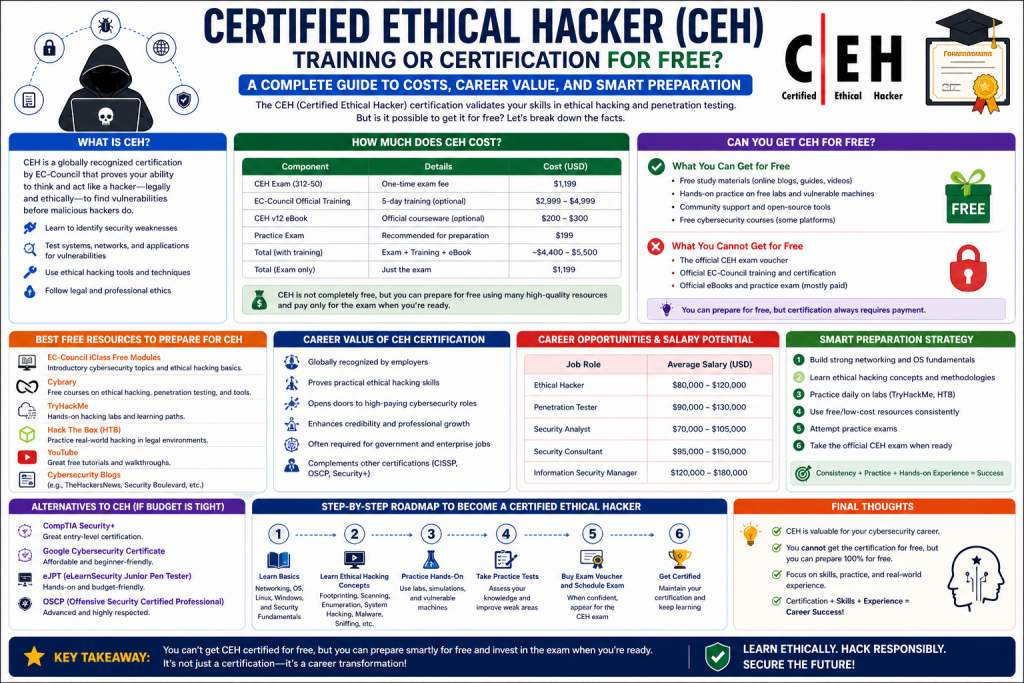
For many aspiring cybersecurity professionals, the Certified Ethical Hacker (CEH) credential is one of the most recognizable certifications in the security industry. The name itself carries significant weight because it immediately communicates specialized offensive security knowledge, penetration testing awareness, and practical understanding of how attackers think. For beginners and experienced IT professionals alike, CEH often appears to be an exciting gateway into ethical hacking, cybersecurity analysis, or security administration. However, one of the first questions many candidates ask is whether CEH training or certification can actually be obtained for free.
The straightforward answer is no—the official CEH certification exam itself is not free. Earning the credential through legitimate channels requires paying exam fees, eligibility costs, and often training expenses. Yet that answer alone does not tell the full story. While the exam has unavoidable costs, there are many ways to dramatically reduce the total financial burden through free study resources, scholarship opportunities, employer sponsorships, and strategic preparation.
Understanding the CEH as both a financial investment and a professional asset is essential before committing your time and money. Unlike casual online certificates or entry-level badges, CEH is often pursued with specific career objectives in mind. Candidates typically want stronger resumes, better-paying cybersecurity roles, compliance with government workforce standards, or validation of security expertise. Because of this, the CEH should be evaluated not only by its price but by its potential return on investment.
Cybersecurity certifications frequently function like career accelerators, but only when aligned with your goals. Spending over a thousand dollars may seem steep initially, but if the certification helps secure a role with significantly higher salary potential, expanded responsibilities, or government eligibility, the investment may become worthwhile. On the other hand, for some candidates, lower-cost alternatives might offer better immediate value.
This is why CEH is often described as a business decision rather than just an educational choice. You are not merely buying an exam—you are potentially purchasing access to broader job markets, improved professional credibility, and career advancement opportunities.
Why CEH Is So Popular Despite Its High Price
The CEH has built strong brand recognition over the years, partly because of EC-Council’s global marketing and partly because “ethical hacker” is a compelling professional label. In a field where many certifications use technical acronyms unfamiliar to recruiters, hiring managers, or HR departments, CEH instantly sounds practical and specialized.
This recognition matters because many employers use certifications as filtering tools during recruitment. Human resources departments may not always understand the technical differences between certifications, but they often recognize the CEH brand. As a result, it can help candidates pass resume screenings more effectively than lesser-known alternatives.
The CEH also aligns with certain workforce frameworks, including roles recognized in government and defense sectors. For candidates seeking opportunities tied to compliance-based hiring structures, certifications like CEH may offer additional legitimacy.
However, popularity alone should not justify the expense. Many candidates pursue CEH because of the title without fully understanding the financial commitment involved. The certification can be expensive, especially for self-funded individuals early in their careers. This is why understanding total cost is critical.
Breaking Down the Financial Investment
The total cost of obtaining CEH certification depends on multiple factors, and this complexity often confuses candidates. Unlike some certifications with one transparent exam fee, CEH expenses can vary based on training choices, exam delivery methods, and candidate eligibility.
A major factor is whether you qualify through professional experience or require official training. Candidates with verified security experience may bypass mandatory training, while those without qualifying experience may need to purchase official EC-Council courses, significantly increasing costs.
Additional variables include application fees, exam vouchers, retake costs, remote proctoring charges, and optional study materials. Depending on your path, costs can range from relatively manageable to financially burdensome.
For example, some candidates may only need eligibility approval and an exam voucher, while others may spend thousands on bundled training packages. This difference can dramatically affect affordability.
Retake costs are another critical consideration. Cybersecurity exams are challenging, and failing can substantially increase total investment. Because CEH passing thresholds vary, candidates should budget not only for first-attempt success but also for potential second attempts.
This makes preparation strategy especially important. Spending more upfront on effective preparation may actually save money by reducing retake risk.
Official Training vs. Independent Preparation
One of the biggest cost decisions involves whether to purchase official training or prepare independently.
Official training offers structured coursework, EC-Council-aligned content, exam-focused material, and simplified eligibility. For some learners, especially those new to cybersecurity, this structure can be valuable. It may also reduce uncertainty by ensuring your studies align with the exam blueprint.
However, official training is expensive. For self-funded learners, the price may be prohibitive.
Independent preparation can significantly lower costs, but it demands discipline. Candidates choosing this route often rely on books, labs, community resources, practice exams, video platforms, and self-created study schedules. While this approach may reduce financial pressure, it also requires stronger self-management.
The right choice depends on your experience level, learning style, and financial situation. A candidate with networking, systems administration, or prior security knowledge may succeed with self-study, while complete beginners may benefit more from structured instruction.
Importantly, “free” in this context usually means reducing preparation costs—not avoiding certification fees entirely.
The Role of Free Resources in CEH Success
Although CEH certification itself is not free, a substantial amount of study support can be accessed at no cost. This is where strategic learners can significantly improve affordability.
Free resources may include:
- Introductory cybersecurity courses
- YouTube technical walkthroughs
- Ethical hacking lab demonstrations
- Community forums
- Practice quizzes
- Reddit study groups
- GitHub repositories
- Blog articles
- Readiness assessments
These resources can help candidates build foundational knowledge before investing in paid materials.
However, free resources vary widely in quality. Some may be outdated, inaccurate, or too shallow for CEH-level preparation. Therefore, candidates should prioritize reputable sources and use free materials primarily for reinforcement rather than sole exam preparation.
A practical strategy is to use free resources to build conceptual understanding, then selectively invest in targeted materials for weak areas.
Scholarships, Discounts, and Sponsorship Opportunities
Another often-overlooked path to reducing CEH costs is financial assistance.
Students, veterans, workforce development participants, and employees may have access to scholarships, grants, or reimbursement programs. Some organizations recognize cybersecurity workforce shortages and support certification pathways.
Employer sponsorship is especially powerful. Many companies view cybersecurity certification as an investment in internal security capability. If your role touches security, compliance, networking, or IT operations, your employer may partially or fully fund certification.
Educational institutions may also provide discounted vouchers or training access through partnerships.
Seasonal promotions can further reduce costs. Certification providers occasionally offer discounts during awareness campaigns, promotional periods, or strategic sales windows.
Candidates who plan ahead often save substantially compared to those who purchase impulsively.
Is CEH Worth the Money?
Determining whether CEH is worth its price depends heavily on your career path.
For aspiring penetration testers, SOC analysts, security administrators, and compliance-aligned professionals, CEH may offer meaningful value. It can strengthen resumes, improve confidence, and support professional branding.
For highly technical practitioners focused on advanced offensive security, some alternative certifications may provide stronger practical depth. Yet CEH’s recognition still makes it relevant in many hiring contexts.
The certification’s value is often highest when used strategically:
- Career changers entering cybersecurity
- IT professionals moving into security
- Government or defense candidates
- Professionals needing HR-recognized certifications
- Candidates seeking structured knowledge validation
The ROI equation should include salary growth, opportunity access, and marketability—not just exam cost.
Opportunity Cost and Strategic Career Planning
Money is only one side of CEH investment. Time is equally important.
Preparing for CEH may require months of study. That time could otherwise be spent pursuing different certifications, building hands-on labs, or gaining practical experience.
This is why comparing CEH to alternatives matters. Some professionals may benefit more from certifications focused on networking, blue-team operations, or cloud security depending on their goals.
CEH is best viewed as one tool in a larger strategy—not a guaranteed ticket to success.
Candidates should ask:
- Does this align with my target job?
- Will employers I want recognize it?
- Is there a lower-cost alternative?
- Can I realistically pass without overspending?
Thoughtful planning prevents costly missteps.
The Psychology Behind Certification Investment
Many candidates underestimate the emotional side of certification spending. A high-cost certification can create pressure, urgency, and fear of failure.
This can be both motivating and risky.
Some learners perform better when financially invested, while others may rush or burn out. Recognizing your learning psychology is important. Certification should be approached strategically, not emotionally.
The goal is not simply to “buy” credibility but to genuinely build competence.
Building Long-Term Value Beyond the Exam
The best CEH candidates do more than pass a test—they use the certification journey to develop lasting skills.
Studying ethical hacking concepts can strengthen understanding of:
- Attack surfaces
- Vulnerability assessment
- Reconnaissance
- Security controls
- Web vulnerabilities
- Wireless threats
- Cloud concerns
- Cryptography fundamentals
This broader knowledge can improve both offensive and defensive capabilities.
When approached properly, CEH preparation becomes more than exam prep—it becomes professional development.
The Bottom Line Before You Start
The CEH cannot truly be obtained for free in official form, but smart candidates can absolutely reduce costs through planning, free resources, scholarships, discounts, and strategic preparation.
The biggest mistake is assuming the most expensive path is automatically the best. Likewise, assuming free resources alone are enough can also be dangerous.
Success usually comes from balance:
- Use free tools wisely
- Invest where necessary
- Focus on blueprint alignment
- Seek employer or scholarship help
- Treat certification like a career asset
For many, CEH can open valuable doors. But like any major investment, its true value depends on how strategically you pursue it.
Meeting CEH Requirements and Understanding Eligibility Pathways
Before committing money, time, or study effort toward the Certified Ethical Hacker credential, candidates must understand one critical reality: not everyone can simply register for the CEH exam immediately. EC-Council established specific eligibility pathways, and these pathways can significantly affect both the total cost and the practical accessibility of the certification.
For many aspiring ethical hackers, this stage becomes the first major obstacle. While the CEH is marketed broadly, official eligibility standards mean candidates generally follow one of two routes: qualifying through documented information security experience or purchasing authorized training. Understanding these options is essential because they shape the financial strategy behind the certification.
The first route is often more cost-effective for experienced professionals. Candidates with at least two years of verified information security experience may be able to apply directly for exam eligibility. This option can save substantial money by bypassing mandatory training packages. However, proving relevant experience is not always simple. Applicants may need documentation, employer verification, and clear demonstration that their professional background aligns with acceptable security-related work.
For candidates already working in system administration, network defense, vulnerability management, SOC operations, or related cybersecurity positions, this route can be ideal. It rewards prior experience and lowers financial barriers.
The second route is more straightforward but usually far more expensive: enrolling in official EC-Council training. This path is often the primary option for beginners, career changers, or individuals without qualifying professional backgrounds. While training may simplify eligibility, it adds significant cost and can dramatically increase the total price of certification.
This distinction matters because early-career professionals are often the most financially constrained. Ironically, those who may benefit most from a recognizable credential often face the highest relative costs.
Why Early-Career Candidates Face Greater Financial Pressure
One of the less discussed realities of CEH is how differently it affects candidates depending on where they are in their careers.
Established IT professionals may already have salaries, employer reimbursement programs, or enough security experience to avoid expensive training pathways. They can often approach CEH as a manageable professional development expense.
Beginners, however, frequently encounter multiple challenges at once:
- Limited income
- No employer sponsorship
- Minimal professional security experience
- Greater need for structured training
- Higher uncertainty about passing
This creates a difficult paradox. Entry-level learners often see CEH as a way to break into cybersecurity, yet the certification’s structure can make entry financially harder.
This is why cost reduction strategies are so important for newer candidates. Without careful planning, some learners may overspend on expensive training before confirming whether CEH is even the right fit for their goals.
For many beginners, the smarter path may involve first building foundational skills in networking, operating systems, and security fundamentals before pursuing CEH.
Building a Foundation Before CEH
A common mistake among aspiring ethical hackers is jumping directly into CEH preparation without sufficient baseline knowledge.
Ethical hacking is not magic—it builds on understanding how systems, networks, protocols, applications, and defenses actually work. Without that foundation, CEH concepts can feel overwhelming.
Candidates often benefit from strengthening knowledge in areas such as:
- TCP/IP networking
- Operating systems
- Linux basics
- Windows administration
- Web technologies
- Security fundamentals
- Common vulnerabilities
- Scripting basics
By improving these areas first, learners may reduce the amount of paid CEH-specific training needed later.
This is where free or lower-cost learning becomes especially valuable. Instead of immediately paying premium certification prices, candidates can first use affordable resources to develop practical readiness.
This staged approach can transform CEH from an intimidating investment into a more calculated next step.
Creating a Cost-Efficient CEH Preparation Strategy
Reducing CEH expenses requires more than simply hunting for discounts. The most effective strategy is designing a preparation model that minimizes waste while maximizing pass probability.
A smart CEH plan often includes several phases.
First comes assessment. Candidates should honestly evaluate current experience, technical gaps, and familiarity with ethical hacking topics. This helps determine whether self-study is realistic or structured training is necessary.
Second comes foundational preparation. This may include free labs, technical communities, reading, and skill-building before paying for official exam pathways.
Third comes blueprint-focused study. Once a candidate decides to pursue CEH, preparation should align tightly with official exam objectives.
Fourth comes exam execution. Scheduling should happen only when readiness is high enough to reduce retake risk.
This process may take longer than impulsive enrollment, but it often saves significant money.
The Importance of the Exam Blueprint
One of the most underutilized tools in CEH preparation is the official exam blueprint.
Many candidates make the mistake of studying broadly without understanding exactly how the exam is structured. The blueprint offers strategic clarity by defining what topics are emphasized and where candidates should focus energy.
This matters because CEH covers wide subject areas. Without structured prioritization, candidates can waste time overstudying niche topics while neglecting heavily weighted concepts.
A blueprint-first approach improves efficiency by helping learners:
- Prioritize high-impact domains
- Identify weaknesses
- Allocate study hours intelligently
- Reduce unnecessary material overload
- Improve confidence
Certification success often depends less on studying everything and more on studying strategically.
Hands-On Practice: The Difference Between Memorization and Competence
Ethical hacking cannot be mastered through passive reading alone.
One of the strongest criticisms of certification culture is that some learners pursue badges without developing practical capability. While CEH includes theoretical and scenario-based knowledge, real value emerges when candidates pair study with hands-on practice.
Practical exposure helps transform abstract concepts into usable understanding.
Examples include:
- Network scanning
- Enumeration
- Basic exploitation labs
- Password security exercises
- Vulnerability scanning
- Web application testing
- Wireless assessments
Hands-on learning does not always require expensive enterprise tools. Home labs, virtual machines, legal training environments, and guided labs can provide substantial skill development.
This is especially important because practical familiarity often improves exam comprehension. Scenario-based questions become easier when concepts are experienced, not just memorized.
Learning from Community Knowledge
Another powerful way to reduce CEH costs is leveraging cybersecurity communities.
Online forums, technical discussions, GitHub repositories, peer groups, and certification communities often contain valuable insights on:
Study strategies
Resource recommendations
Practice methods
Exam experiences
Common mistakes
Motivation support
Community learning can provide perspective that official materials may not. Candidates often discover which resources are genuinely useful versus unnecessarily expensive. In many cases, experienced learners openly share which books aligned best with exam objectives, which practice labs offered the strongest hands-on value, and which paid subscriptions were not worth the money. This shared experience can prevent new candidates from making costly mistakes, especially when budgets are limited. Peer communities can also help learners stay accountable through study groups, challenge discussions, and collaborative problem-solving. For those studying independently, this sense of connection can reduce isolation and maintain motivation during long preparation periods.
However, community information should be filtered carefully. Not all advice is accurate, and exam integrity should always be respected. Some online discussions may include outdated blueprint references, exaggerated claims, or unethical shortcuts that do more harm than good. Candidates should verify recommendations across multiple credible sources and prioritize legal, ethical study practices. The best use of community knowledge is strategic guidance—not shortcut seeking. When approached thoughtfully, cybersecurity communities can function like an informal advisory network, helping candidates save money, improve preparation quality, and make smarter certification decisions.
Managing Risk: Retakes, Burnout, and Overconfidence
One of the most expensive CEH mistakes is poor timing.
Scheduling the exam too early can lead to failure, retake fees, and discouragement. Waiting too long can lead to burnout, procrastination, or knowledge decay.
Candidates must balance confidence with realism.
Overconfidence is particularly dangerous in cybersecurity certifications because familiarity with terminology does not always equal exam readiness.
Effective readiness indicators include:
- Consistent practice exam performance
- Blueprint confidence
- Time management skills
- Practical understanding
- Ability to interpret scenario questions
The goal is not perfection but calculated readiness.
Comparing CEH to Other Career Investments
A major part of cost control is evaluating CEH against alternatives.
For some professionals, CEH may be highly strategic. For others, certifications focused on networking, cloud, defensive operations, or vendor-specific technologies may offer stronger immediate returns.
This comparison should include:
- Cost
- Employer recognition
- Career alignment
- Skill development
- Practical relevance
- Salary impact
CEH should fit into a broader professional roadmap rather than functioning as a random prestige purchase.
The Resume Value of CEH
Despite debates around practical depth, CEH remains a recognizable resume asset.
Its value often lies in visibility. Recruiters, HR teams, and compliance-oriented hiring systems frequently recognize CEH more easily than niche certifications.
For job seekers, this recognition can matter.
CEH may improve competitiveness for roles involving:
- Security operations
- Vulnerability management
- Security administration
- Compliance environments
- Government-aligned hiring pathways
While certification alone rarely guarantees employment, strategic branding matters.
Salary Considerations and Career ROI
One of the primary reasons candidates pursue CEH is earning potential.
Ethical hacking, cybersecurity analysis, and security-focused technical roles often command competitive salaries, particularly when paired with experience. While salary outcomes vary by geography, specialization, and market demand, cybersecurity remains one of the more financially promising IT sectors.
However, candidates should avoid simplistic assumptions. CEH itself does not automatically produce a six-figure salary.
Real salary growth depends on:
- Experience
- Practical capability
- Communication skills
- Geographic market
- Technical specialization
- Continuous learning
CEH can support opportunity, but long-term earnings come from broader professional development.
Certification as Leverage, Not Destination
A powerful perspective shift is viewing CEH not as the finish line but as leverage.
The certification can:
- Validate learning
- Open interviews
- Build credibility
- Strengthen confidence
- Support transitions
But true cybersecurity success requires continuous evolution.
Technology changes rapidly. Attack methods evolve. Cloud shifts infrastructure. AI reshapes defense and offense. Professionals who stop at certification often stagnate.
The most successful CEH candidates use the process as a launchpad for deeper growth.
Strategic Patience Pays Off
Pursuing CEH impulsively can be expensive. Pursuing it strategically can be transformative.
Candidates who save money usually do so by:
- Building fundamentals first
- Using free resources intelligently
- Seeking sponsorship
- Timing purchases
- Avoiding unnecessary bundles
- Preparing deeply before testing
The certification world often pressures learners into urgency, but thoughtful pacing often creates better outcomes.
Preparing for Long-Term Cybersecurity Growth
CEH may be one certification, but the broader journey includes building a portfolio of skills that remain relevant over time.
Long-term growth may involve:
- Security operations
- Penetration testing
- Cloud security
- Governance
- Incident response
- Threat intelligence
- Advanced offensive security
Seen this way, CEH is not merely an exam expense—it can become one strategic milestone in a much larger cybersecurity career path.
For those willing to plan carefully, manage costs wisely, and commit to genuine learning, CEH can provide real value without unnecessary financial strain.
Free Study Resources for CEH Preparation Without Overspending
Although the Certified Ethical Hacker credential itself cannot be officially earned for free, one of the smartest ways to reduce its financial burden is by maximizing the wide range of no-cost or low-cost educational resources available before purchasing expensive training packages or exam vouchers. For many candidates, especially those early in their careers, the difference between spending strategically and overspending often comes down to preparation efficiency.
Free resources should not be viewed as a complete replacement for all official materials, but they can absolutely serve as a powerful foundation. When used correctly, they can strengthen understanding, reveal weaknesses, improve technical vocabulary, and build confidence before major financial commitments.
A strong free-preparation approach often begins with conceptual learning. Candidates can use publicly available cybersecurity videos, introductory penetration testing walkthroughs, Linux tutorials, networking refreshers, and security-focused labs to establish technical literacy. Since CEH covers broad security concepts rather than only one narrow technical specialty, building this broad knowledge base is essential.
Video platforms can help visual learners understand topics such as reconnaissance, scanning, system vulnerabilities, and common attack methodologies. Blogs and cybersecurity articles often provide breakdowns of tools, concepts, and real-world attack examples. GitHub repositories may include labs, scripts, or educational notes that strengthen hands-on understanding.
Forums and online communities also play a major role. Discussion groups can help learners compare resources, identify common exam pitfalls, and avoid wasting money on ineffective materials. Some candidates discover better study plans through community insight than through costly trial and error.
However, candidates must approach free resources critically. Cybersecurity evolves rapidly, and outdated material can create confusion. Verification is essential. Learners should compare multiple reputable sources, prioritize current information, and avoid assuming that free always means comprehensive.
The most effective strategy is blending free foundational learning with focused exam-oriented preparation later.
Using Practical Labs to Build Real Ethical Hacking Skills
One of the greatest dangers in certification preparation is becoming overly theoretical. Reading about hacking techniques is useful, but cybersecurity professionals gain true confidence when they apply concepts in controlled environments.
Hands-on labs can dramatically improve CEH readiness while also creating genuine skill development beyond exam success.
Practical environments may include:
- Virtual machines
- Home labs
- Practice networks
- Sandbox environments
- Legal capture-the-flag platforms
- Vulnerability labs
These environments allow learners to experience scanning, reconnaissance, exploitation concepts, defensive controls, and troubleshooting in ways passive study cannot replicate.
For example, understanding how port scanning works conceptually is useful, but actually performing scans in a lab environment can strengthen retention far more effectively. Similarly, learning web vulnerabilities through direct interaction often creates deeper understanding than memorization alone.
Hands-on learning also supports long-term employability. Employers increasingly value practical capability, not just certifications. A CEH candidate who combines certification study with applied practice is often better positioned for interviews, technical conversations, and workplace problem-solving.
The best candidates treat CEH not merely as an exam to pass but as an opportunity to build practical cybersecurity fluency.
Scholarships, Grants, and Sponsored Opportunities
Many candidates underestimate how often outside funding opportunities can reduce certification costs.
Scholarships are not always widely advertised, but students, military personnel, veterans, career transitioners, and workforce development participants may find programs that offset costs. Certain cybersecurity initiatives exist specifically to address workforce shortages, and these may include training assistance.
Military-affiliated pathways can be particularly valuable. Veterans and service members may have access to cybersecurity funding options unavailable to the general public.
Corporate sponsorship is another major opportunity. Many organizations actively invest in employee development because cybersecurity knowledge strengthens internal defense. If your job intersects with networking, IT support, system administration, compliance, or infrastructure, requesting certification support may be worthwhile.
Employer reimbursement can transform CEH from a major personal expense into a strategic workplace investment.
Academic institutions may also offer certification discounts through partnerships, bundled programs, or workforce initiatives.
The key is proactive research. Many people pay full price simply because they never investigate alternatives.
Timing Your Investment Strategically
One overlooked factor in reducing CEH cost is timing.
Certification providers, training platforms, and educational vendors occasionally run promotions, awareness campaigns, or limited-time discounts. Strategic buyers who monitor these windows can save meaningful amounts.
Examples may include:
- Cybersecurity Awareness Month promotions
- Holiday sales
- End-of-year discounts
- Student campaigns
- Partner bundles
This does not mean candidates should impulsively buy every discounted package. Savings only matter if the purchase aligns with your readiness and goals.
Buying expensive training too early can lead to wasted access time or motivation decline. Buying too late can delay career plans.
Timing works best when paired with readiness. Build knowledge first, monitor opportunities second, and purchase strategically.
The Hidden Cost of Poor Planning
When discussing CEH affordability, many focus only on visible fees. But hidden costs can be equally damaging.
These include:
Retake fees
Burnout
Wasted study subscriptions
Poor-quality materials
Delayed career movement
Opportunity cost
A poorly planned certification attempt may cost more than simply choosing the right path initially.
For example, rushing into an exam before mastering the blueprint can trigger retake expenses. Buying multiple overlapping study platforms can inflate costs unnecessarily. Spending months on inefficient resources may delay more valuable skill development.
This is why planning is often the greatest money-saving strategy of all. A strategic approach means evaluating not only what you spend, but why you are spending it. Many candidates fall into the trap of purchasing premium resources simply because they appear comprehensive, only to discover later that much of the material overlaps or does not match their learning style. Others underestimate the emotional cost of repeated failure, which can reduce confidence, motivation, and long-term momentum. Burnout itself can become expensive when frustration leads to abandoning the certification entirely after substantial investment. Additionally, poor planning can affect career timing. Delaying certification due to inefficient preparation may postpone promotions, salary increases, or entry into cybersecurity roles. Every extra month spent on the wrong resources or ineffective study habits can represent lost professional opportunity. Careful budgeting, resource comparison, realistic scheduling, and honest self-assessment can dramatically reduce these hidden costs, transforming CEH preparation from a financial burden into a disciplined career investment.
Career Benefits Beyond the Credential
The CEH’s true value often extends beyond the certification itself.
For many professionals, preparing for CEH improves understanding of cybersecurity frameworks, attack lifecycles, risk awareness, and defensive thinking. These competencies may strengthen broader IT careers even before certification is achieved.
Potential benefits include:
- Resume differentiation
- Interview confidence
- Security vocabulary
- Better understanding of attacker methodology
- Improved defensive awareness
- Stronger compliance positioning
This broader perspective matters because not every CEH candidate becomes a penetration tester. Many apply CEH knowledge in adjacent roles like systems administration, blue-team security, governance, or network engineering.
The certification journey can therefore enhance multiple professional pathways.
When CEH May Not Be the Best First Step
Despite its recognition, CEH is not universally the best starting point.
Some candidates may benefit more from first mastering:
- Networking
- Operating systems
- Security fundamentals
- Help desk experience
- Cloud basics
Without these foundations, CEH may feel overwhelming or less practical.
For example, someone without networking knowledge may struggle with many CEH concepts because attack methodology often depends on infrastructure understanding.
This is why self-awareness matters. Certification should match readiness, not aspiration alone.
Choosing CEH too early can create frustration. Choosing it strategically can create momentum.
Balancing Brand Recognition with Practical Growth
The CEH brand carries weight, but branding should not overshadow capability.
Cybersecurity hiring increasingly values practical proof: labs, projects, home environments, and demonstrated understanding.
Therefore, CEH candidates should strive for both:
- Credential recognition
- Real skill growth
A balanced strategy might involve certification plus:
- Home labs
- GitHub projects
- Security blogs
- Tool practice
- Community engagement
This creates stronger professional identity than certification alone.
Long-Term Learning After CEH
Cybersecurity does not stop after one certification.
Threats evolve constantly. Cloud systems reshape architecture. AI influences both attackers and defenders. Compliance standards shift. Security professionals who remain static often fall behind.
Candidates should view CEH as an early or mid-stage milestone, not a permanent endpoint.
Future growth may include:
- Cloud security
- Threat hunting
- Incident response
- Malware analysis
- Governance
- Offensive specialization
- Security automation
This perspective makes CEH more valuable because it becomes part of an evolving strategy rather than a one-time badge.
Psychological Resilience and Certification Success
A less discussed factor in certification journeys is mindset.
CEH can feel intimidating due to cost, breadth, and reputation. Candidates may fear failure because financial stakes feel high.
Managing this pressure is important.
Successful learners often focus on progress over perfection. They break preparation into manageable phases, reinforce weak points, practice consistently, and avoid comparing themselves excessively to others.
Cybersecurity is a field built on continuous learning. Certification should support confidence, not destroy it.
Patience, discipline, and strategic consistency often outperform frantic overcommitment.
Building a Personal Cybersecurity Roadmap
Rather than asking only “Can I get CEH for free?” a more strategic question may be:
“How can I build cybersecurity credibility as cost-effectively as possible?”
This broader mindset encourages smarter decisions.
A roadmap might include:
- Free foundational learning
- Networking knowledge
- Security basics
- Practical labs
- Affordable study tools
- Scholarship exploration
- CEH pursuit
- Advanced specialization
This layered strategy often produces better long-term outcomes than chasing one expensive credential immediately.
The Financial Reality: CEH Is an Investment, Not a Shortcut
Ultimately, CEH should be understood as an investment. Like college courses, professional licenses, or specialized technical tools, it costs money because it is positioned as a career asset.
The goal is not to eliminate all spending but to maximize return while minimizing unnecessary expense.
Smart candidates often save money not because CEH becomes free, but because they:
- Avoid overpriced pathways
- Use free prep wisely
- Seek funding help
- Time purchases
- Reduce retake risk
- Build foundations first
This is how CEH becomes more financially manageable.
Conclusion
The Certified Ethical Hacker certification is not free, and there is no legitimate shortcut around official exam and eligibility costs. However, that does not mean the path must be financially overwhelming. With careful planning, free educational resources, scholarships, employer sponsorship, strategic timing, and disciplined preparation, candidates can significantly reduce the total cost while still building meaningful cybersecurity skills.
The smartest approach is to treat CEH as both a professional milestone and a strategic business decision. Rather than focusing solely on the exam price, evaluate the bigger picture: career goals, skill development, resume impact, opportunity access, and long-term earning potential.
For some, CEH will be a powerful investment that strengthens cybersecurity credibility and opens new doors. For others, it may be one step among many in a broader technical journey.
What matters most is not whether CEH can be earned for free, but whether you can pursue it intelligently, affordably, and in a way that creates lasting professional value. When approached strategically, CEH can become far more than an expensive certification—it can serve as a catalyst for career transformation, deeper technical capability, and stronger positioning in one of the world’s fastest-growing industries.
Continue exploring the technologies and certification concepts that matter most to you.