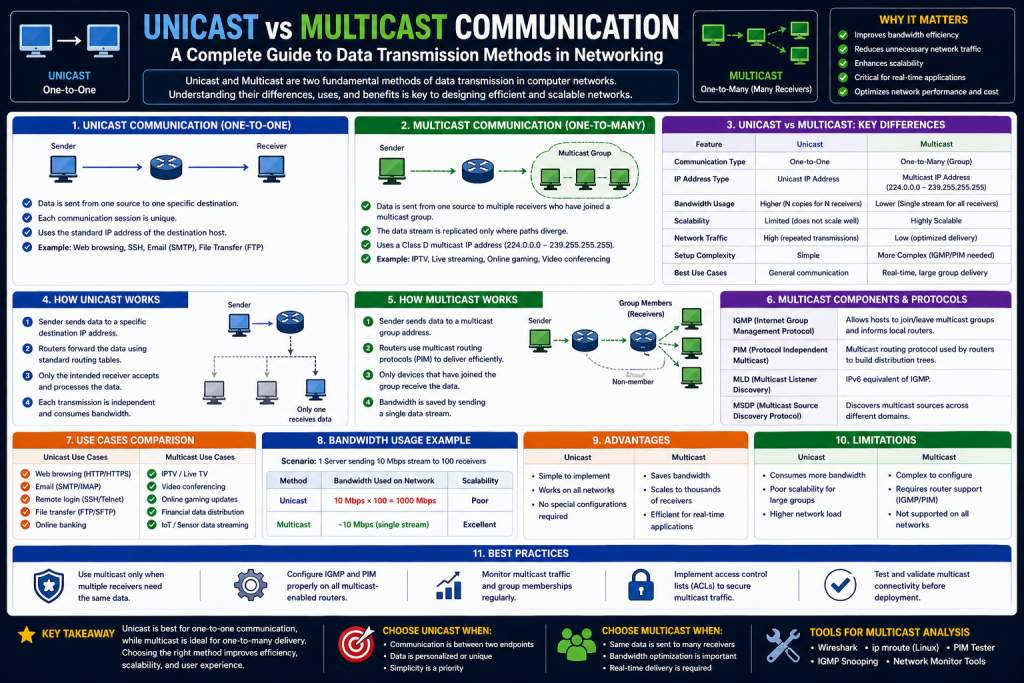
In modern digital systems, communication between devices is the foundation of everything from browsing websites to streaming videos and making voice calls. Networks rely on structured methods to ensure that data travels efficiently, accurately, and in a way that meets the needs of different applications. Among these methods, unicast and multicast play a central role in determining how information is delivered.
These two communication models define how data flows between a sender and one or more receivers. Although they may seem similar at first glance, they are designed for very different purposes. Understanding how they work helps in choosing the right approach for specific networking scenarios, improving performance, and managing resources effectively.
To fully appreciate their importance, it is necessary to look beyond the basic definitions and consider how data actually behaves inside a network. Every time information is sent, whether it is a simple message, a video stream, or a file transfer, the network must decide how that data will travel. This decision directly impacts speed, reliability, and efficiency. Unicast and multicast provide two distinct paths for handling this process, each optimized for different types of communication needs.
In a unicast model, the focus is on precision and control. Data is treated as a private exchange between two endpoints. This means that the sender has full control over how the data is transmitted, and the receiver can expect a consistent and reliable flow of information. This approach is especially valuable in situations where accuracy is critical, such as financial transactions, secure communications, or interactive applications. Because each connection is independent, the system can ensure that data is delivered correctly, even if it requires retransmitting lost packets or correcting errors.
On the other hand, multicast shifts the focus from precision to efficiency. Instead of treating each receiver as a separate destination, it groups multiple receivers together and delivers a shared stream of data. This approach is particularly useful when the same information needs to reach many users at the same time. Rather than duplicating the data for each recipient, multicast reduces redundancy by sending a single stream that can be distributed across the network. This not only saves bandwidth but also reduces the workload on the sender.
Another important aspect to consider is how these models affect network resources. Networks have limited capacity, and efficient resource management is essential to maintain performance. Unicast can consume significant bandwidth when the number of recipients increases, as each connection requires its own stream. This can lead to congestion and slower performance if not managed properly. Multicast, by contrast, is designed to conserve bandwidth by minimizing duplication. This makes it a better choice for large-scale distribution, where efficiency is more important than individual control.
Latency is also influenced by the choice of communication model. In unicast, latency can increase as more connections are added, because the sender must handle each stream separately. In multicast, a single stream is shared among all receivers, which can result in more consistent delivery times. This is particularly beneficial for real-time applications, where delays can affect the user experience.
The choice between unicast and multicast also depends on the level of reliability required. Unicast typically includes mechanisms for ensuring that data is delivered correctly and in order. This makes it suitable for applications where even small errors cannot be tolerated. Multicast, however, often sacrifices some reliability in favor of efficiency. It does not always guarantee that every packet will reach every receiver, but this trade-off is acceptable in scenarios where occasional data loss does not significantly impact the overall experience.
Scalability is another key factor. As networks grow and the number of users increases, the ability to handle additional load becomes critical. Unicast can struggle to scale efficiently because each new recipient adds to the overall demand on the system. Multicast is inherently more scalable, as adding more receivers does not require additional streams from the sender. This makes it well suited for applications that need to support large audiences.
In addition to these technical considerations, understanding these communication models also helps in designing better systems and applications. Developers and network engineers can choose the most appropriate method based on the specific requirements of their projects. By aligning the communication model with the intended use case, it is possible to achieve a balance between performance, efficiency, and reliability.
Ultimately, unicast and multicast are not competing solutions but complementary tools. Each has its own strengths and ideal use cases. A clear understanding of how they function allows for more informed decisions, leading to improved network performance and a better overall user experience.
To visualize these concepts, imagine everyday transportation. If one person needs to travel to a destination, they can use a private car and go directly there. This represents unicast communication. On the other hand, if many people need to go to the same place, using a bus is more efficient. This represents multicast communication. Both methods are useful, but each is suited to a different situation.
As networks continue to grow in size and complexity, selecting the right communication method becomes increasingly important. The choice between unicast and multicast affects bandwidth usage, reliability, scalability, and overall network efficiency.
Understanding Unicast Communication
Unicast communication is the most widely used method in networking. It involves a direct connection between a single sender and a single receiver. In this model, data is sent from one device to another specific device, with no sharing of that data stream with others.
Each data packet in unicast communication contains a unique destination address. This ensures that the information reaches only the intended recipient. Because of this precise targeting, unicast is often used in scenarios where privacy and accuracy are important.
Most common internet activities rely on unicast. When a user opens a website, their device sends a request to a server, and the server responds directly to that device. This exchange is exclusive and tailored to the user’s request. Similarly, sending emails, transferring files, and making voice or video calls typically use unicast communication.
Unicast operates using protocols that emphasize reliability. These protocols ensure that data is delivered correctly and completely. If any part of the data is lost during transmission, it can be resent. This makes unicast a dependable choice for applications where data integrity is critical.
Key Characteristics of Unicast
Unicast communication has several defining characteristics that make it suitable for one-to-one interactions. One of the most important features is its point-to-point nature. Data travels directly from the sender to the receiver without being distributed to other devices. This creates a dedicated communication path.
Another important characteristic is precise addressing. Each packet includes the exact destination address, allowing the network to route it accurately. This ensures that the data reaches the correct device without confusion.
Reliability is another major feature of unicast. Many unicast protocols include mechanisms to confirm delivery. If a packet does not arrive, it can be retransmitted. This process ensures that the complete message is received without errors.
Unicast also supports ordered delivery. Data packets are sent and received in a specific sequence, which allows the receiving device to reconstruct the original information correctly. This is especially important for applications like file transfers and web browsing, where missing or out-of-order data can cause problems.
Another characteristic is resource allocation. In unicast communication, network resources such as bandwidth are dedicated to a single communication session. While this ensures quality and consistency, it can become inefficient when the same data needs to be sent to multiple recipients.
Advantages of Unicast Communication
Unicast offers several advantages that make it essential in many networking scenarios. One of its strongest benefits is reliability. Because data delivery is verified, users can trust that their information will arrive intact.
Another advantage is precision. Data is sent only to the intended recipient, which enhances both efficiency and security. This makes unicast ideal for private communications and sensitive data transfers.
Unicast also provides consistent performance. Since the communication path is dedicated, it is easier to manage delays and maintain a stable connection. This is particularly important for applications that require real-time interaction.
Additionally, unicast supports error handling. If something goes wrong during transmission, the system can detect the issue and correct it by resending the data. This ensures a high level of accuracy.
Limitations of Unicast Communication
Despite its strengths, unicast has limitations that become apparent in large-scale scenarios. The most significant limitation is scalability. When the same data needs to be delivered to many recipients, unicast requires separate transmissions for each one.
This can lead to increased bandwidth usage and higher processing demands on the sender. For example, if a server needs to send the same video stream to hundreds or thousands of users, it must create a separate stream for each user. This can quickly overwhelm network resources.
Another limitation is inefficiency in group communication. Since each recipient receives a separate copy of the data, there is a lot of duplication. This makes unicast less suitable for applications that involve large audiences.
Understanding Multicast Communication
Multicast communication is designed to overcome the limitations of unicast in scenarios where data needs to be shared with multiple recipients. Instead of sending separate copies of the same data, multicast allows a single stream to be distributed to many devices at once.
In multicast, devices join a specific group to receive data. The sender transmits data to the group address, and the network delivers it to all devices that are part of that group. This approach reduces redundancy and improves efficiency.
Multicast is commonly used in situations where the same information needs to reach multiple users simultaneously. Examples include live video streaming, online broadcasts, and large-scale announcements.
Unlike unicast, multicast does not focus on individual delivery. Instead, it prioritizes efficient distribution to a group of recipients. This makes it particularly useful in environments where bandwidth conservation is important.
Key Characteristics of Multicast
Multicast communication has several unique characteristics that distinguish it from unicast. One of the most important is group-based delivery. Data is sent to a group address rather than individual addresses, allowing multiple devices to receive the same transmission.
Efficiency is another defining feature. Multicast reduces bandwidth usage by sending a single stream of data that is shared among all recipients. The network creates copies of the data only when necessary, such as when the path to receivers splits.
Multicast also relies on special addressing. Instead of using unique addresses for each device, it uses group addresses that represent multiple receivers. Devices join or leave these groups based on their interest in the data.
Another characteristic is its relaxed approach to reliability. Multicast does not guarantee that every packet will reach every receiver. It also does not ensure that packets will arrive in the correct order. This trade-off allows for greater efficiency but reduces accuracy.
Advantages of Multicast Communication
Multicast offers several advantages, especially in large-scale communication scenarios. The most significant benefit is efficiency. By sending a single stream of data, multicast minimizes bandwidth usage and reduces network congestion.
Another advantage is scalability. Multicast can support a large number of receivers without placing additional strain on the sender. This makes it ideal for applications involving many users.
Multicast also enables simultaneous delivery. All recipients receive the data at roughly the same time, which is important for real-time applications like live streaming.
Additionally, multicast reduces duplication. Instead of sending multiple copies of the same data, it distributes a single stream, making better use of network resources.
Limitations of Multicast Communication
While multicast is efficient, it has some limitations. One of the main drawbacks is the lack of reliability. Unlike unicast, multicast does not guarantee that all data will be delivered successfully.
Another limitation is the absence of packet ordering. Data may arrive out of sequence, which can cause issues for applications that require precise timing or structure.
Multicast also requires network support and configuration. Not all networks are designed to handle multicast traffic, and setting it up can be more complex than using unicast.
Finally, multicast may not be suitable for applications that require individual communication or strict data accuracy. In such cases, unicast remains the better choice.
Detailed Comparison of Unicast and Multicast
Building on the foundational understanding of unicast and multicast communication, it is important to explore how these two models differ in deeper technical and practical terms. While both are designed to move data across networks, their behavior, efficiency, and suitability vary significantly depending on the context in which they are used.
At a high level, unicast focuses on direct and reliable communication between a single sender and a single receiver. Multicast, in contrast, is designed to efficiently distribute the same data to multiple receivers simultaneously. This distinction influences how networks handle addressing, bandwidth, latency, reliability, and scalability.
A detailed comparison allows us to understand not just what these methods are, but how they behave under different conditions and why one may be preferred over the other in specific scenarios.
Transmission Model Differences
One of the most fundamental differences between unicast and multicast lies in their transmission models. Unicast uses a one-to-one model, where each communication session is independent. If a sender needs to communicate with multiple receivers, it must establish separate connections for each one.
This means that if a server is sending the same data to ten users using unicast, it will create ten individual streams. Each stream is handled separately, even if the content is identical. This approach ensures precision but increases resource consumption.
Multicast uses a one-to-many or many-to-many model. Instead of creating separate streams, the sender transmits a single stream to a group address. The network then distributes this data to all devices that have joined the group. This significantly reduces duplication and improves efficiency.
The difference in transmission models has a direct impact on how networks scale and how resources are utilized. Unicast is straightforward and predictable, while multicast introduces shared delivery mechanisms that optimize large-scale distribution.
Addressing Mechanisms
Addressing plays a critical role in how data is routed across a network. In unicast communication, each device has a unique address. Data packets include the destination address, allowing routers and switches to deliver them directly to the intended recipient.
This method is simple and precise. It ensures that data reaches exactly one device and no others. It also makes troubleshooting easier, as each communication path is clearly defined.
Multicast uses a different approach. Instead of targeting individual devices, it uses group addresses. These addresses represent a collection of devices that are interested in receiving a specific type of data.
Devices join or leave multicast groups dynamically. When a device joins a group, it signals the network that it wants to receive data sent to that group address. The network then ensures that the data is delivered to all members of the group.
This group-based addressing system allows multicast to scale efficiently, but it also requires additional protocols and coordination to manage group membership.
Bandwidth Utilization
Bandwidth usage is one of the most important factors when comparing unicast and multicast. Unicast can become inefficient when the same data needs to be sent to multiple recipients. Each recipient requires a separate stream, which increases the total amount of data transmitted across the network.
For example, sending a high-quality video stream to one hundred users using unicast would require one hundred separate streams. This can quickly consume available bandwidth and lead to congestion.
Multicast addresses this issue by sending a single stream that is shared among all recipients. The network replicates the data only when necessary, such as when paths diverge. This reduces the total amount of data transmitted and makes more efficient use of bandwidth.
As a result, multicast is particularly well suited for applications involving large audiences. It minimizes duplication and ensures that network resources are used effectively.
Reliability and Error Handling
Reliability is another key area where unicast and multicast differ significantly. Unicast is designed with reliability in mind. Many unicast protocols include mechanisms for error detection, acknowledgment, and retransmission.
When data is sent using unicast, the receiving device confirms whether it has received the data correctly. If any packets are lost or corrupted, they can be resent. This ensures that the complete message is delivered accurately.
Multicast, on the other hand, does not typically include these reliability mechanisms. It does not guarantee that all packets will reach every receiver. There is also no built-in system for retransmitting lost data.
This trade-off allows multicast to achieve greater efficiency, but it also means that it is less suitable for applications where data accuracy is critical. In many multicast use cases, occasional data loss is acceptable, especially in real-time applications like live streaming.
Packet Ordering and Data Integrity
In addition to reliability, packet ordering is another important consideration. Unicast ensures that data packets arrive in the correct sequence. This is essential for applications where the order of information matters, such as file transfers or database transactions.
The receiving device uses sequence information to reconstruct the original data exactly as it was sent. This guarantees data integrity and consistency.
Multicast does not provide the same level of control over packet ordering. Packets may arrive out of sequence or be delayed due to network conditions. While some applications can handle this variability, others may experience issues.
For example, in a live video stream, minor disruptions may not significantly affect the viewing experience. However, in applications requiring precise data synchronization, multicast may not be suitable without additional mechanisms.
Latency Considerations
Latency refers to the time it takes for data to travel from the sender to the receiver. In unicast communication, latency can vary depending on the number of connections and the network load. As the number of recipients increases, the sender must handle more streams, which can introduce delays.
Multicast can offer lower latency in scenarios involving multiple receivers. Since a single stream is distributed to all recipients, the data can reach them more quickly and consistently. This makes multicast advantageous for real-time applications where timing is important.
However, latency in multicast can still be affected by network configuration and routing efficiency. Proper setup is required to ensure optimal performance.
Scalability and Network Growth
Scalability is a major factor in modern networking. As the number of devices and users increases, the communication method must be able to handle the growth without degrading performance.
Unicast does not scale well for large audiences. Each additional recipient requires a new stream, which increases the load on the sender and the network. This can lead to bottlenecks and reduced performance.
Multicast is designed to scale efficiently. Adding more receivers does not significantly increase the load on the sender, as the same stream is shared among all participants. This makes multicast ideal for applications that need to support large numbers of users.
However, scalability in multicast depends on network support. Not all networks are configured to handle multicast traffic, which can limit its adoption.
Network Infrastructure Requirements
Unicast communication works on virtually all networks without special configuration. It is supported by default in most networking environments, making it easy to implement and manage.
Multicast, however, requires additional support from network infrastructure. Routers and switches must be capable of handling multicast traffic and managing group memberships. Protocols are used to coordinate this process and ensure that data is delivered correctly.
This added complexity can make multicast more challenging to deploy, especially in environments where network devices are not configured for it.
Security Considerations
Security is another important aspect of network communication. In unicast, data is sent directly between two devices, which makes it easier to control access and apply security measures.
Encryption and authentication can be applied to ensure that only the intended recipient can access the data. This makes unicast suitable for sensitive communications.
Multicast presents additional challenges for security. Since data is sent to a group, it is more difficult to ensure that only authorized devices receive it. Managing access control and encryption in multicast environments requires careful planning.
Despite these challenges, multicast can still be secured using appropriate techniques, but it often requires more effort compared to unicast.
Performance Trade-offs
The choice between unicast and multicast often involves trade-offs between performance factors. Unicast offers high reliability, precise delivery, and strong control over data transmission. However, it can be inefficient when dealing with multiple recipients.
Multicast offers efficiency, scalability, and reduced bandwidth usage. However, it sacrifices some reliability and control in the process.
Understanding these trade-offs is essential for selecting the right communication method. The decision depends on the specific requirements of the application, including the number of recipients, the importance of data accuracy, and the available network resources.
Practical Implications
In real-world scenarios, the differences between unicast and multicast have significant implications. Network administrators must consider how data is distributed, how resources are used, and how performance is affected.
For applications that require reliable, one-to-one communication, unicast remains the preferred choice. For applications that involve distributing the same data to many users, multicast provides a more efficient solution.
In some cases, a combination of both methods may be used to achieve the desired balance between reliability and efficiency.
delivered in sequence and with minimal loss, providing a smooth communication experience.
Online gaming also relies heavily on unicast communication. In multiplayer games, each player interacts with a central server. The server sends updates to each player individually, ensuring that their actions and game states are accurately reflected. This direct communication is essential for maintaining fairness and responsiveness.
Unicast is also used in secure communications such as virtual private networks. In these scenarios, data is transmitted between two endpoints in a secure and encrypted manner. The direct nature of unicast makes it suitable for maintaining confidentiality and protecting sensitive information.
Practical Use Cases of Multicast Communication
Multicast communication is designed for scenarios where the same data needs to be delivered to multiple recipients simultaneously. Its efficiency and scalability make it ideal for large-scale distribution, especially when bandwidth conservation is important.
One of the most prominent use cases of multicast is live streaming. When a live event is broadcast to many viewers, multicast allows the server to send a single stream of data that is distributed to all participants. This reduces the load on the server and the network, making it possible to support a large audience.
Another common application is in corporate environments. Organizations often use multicast to distribute announcements, training sessions, or internal broadcasts to employees. Instead of sending separate streams to each employee, a single stream is shared across the network.
Multicast is also used in software distribution. When updates need to be delivered to many devices, multicast allows them to be sent simultaneously. This reduces network congestion and speeds up the update process.
In surveillance systems, multicast is used to stream video from multiple cameras to monitoring stations. The same video feed can be viewed by multiple users without requiring separate transmissions for each one.
Multicast is also useful in data replication. In distributed systems, data may need to be synchronized across multiple locations. Multicast enables efficient distribution of updates, ensuring that all systems receive the same information.
Choosing Between Unicast and Multicast
Selecting the appropriate communication method depends on several factors. Each method has strengths and limitations, and the choice should be based on the specific requirements of the application and the network environment.
One of the most important considerations is the number of recipients. If data needs to be sent to a single device, unicast is the obvious choice. If the same data needs to be delivered to many devices, multicast becomes more efficient.
Another factor is reliability. If data accuracy is critical and packet loss cannot be tolerated, unicast is preferred. Its ability to confirm delivery and retransmit lost data ensures that the message is received correctly.
Bandwidth usage is also a key consideration. In networks with limited resources, multicast can help reduce congestion by minimizing duplicate transmissions. This is especially important for high-volume data such as video streams.
Latency requirements also play a role. In real-time applications, multicast can provide faster delivery to multiple recipients. However, unicast may offer more consistent performance for individual connections.
Network infrastructure is another factor to consider. Unicast works in almost all environments without special configuration. Multicast requires support from network devices and proper configuration, which may not always be available.
Security requirements must also be taken into account. If data needs to be kept private and secure, unicast provides a more controlled environment. Multicast can be secured, but it requires additional measures to ensure that only authorized devices receive the data.
Performance and Efficiency Considerations
Performance is a critical factor in networking, and the choice between unicast and multicast can have a significant impact on how efficiently a network operates. Each method offers advantages depending on the situation.
Unicast provides consistent performance for individual connections. Since each communication session is separate, it is easier to manage quality and ensure reliable delivery. However, as the number of connections increases, performance can degrade due to increased resource usage.
Multicast improves efficiency by reducing duplication. A single stream of data is shared among multiple recipients, which reduces bandwidth consumption. This makes it possible to support large-scale applications without overwhelming the network.
However, multicast performance depends heavily on network configuration. If the network is not optimized for multicast traffic, it may not perform as expected. Proper setup and management are essential to achieve the desired results.
Balancing performance and efficiency requires a clear understanding of the application’s needs. In some cases, a hybrid approach may be used, combining elements of both unicast and multicast to achieve optimal results.
Challenges in Real-World Implementation
While both unicast and multicast offer clear benefits, implementing them in real-world networks can present challenges. These challenges often arise from the complexity of modern networks and the need to balance multiple factors.
One of the major challenges is network design and architecture. Modern networks are no longer simple, single-location systems. They often span multiple geographic locations, include cloud environments, and integrate a variety of devices with different capabilities. Designing a network that efficiently supports both unicast and multicast traffic requires careful planning. Administrators must ensure that routing paths are optimized, bandwidth is properly allocated, and infrastructure components can handle the expected load.
Another important challenge is hardware and device compatibility. While unicast is universally supported across all networking devices, multicast requires specific capabilities in routers and switches. Not all network equipment is configured to handle multicast traffic by default. In some cases, older hardware may not support multicast efficiently, leading to performance issues or the need for costly upgrades. Ensuring that all components in the network can properly process multicast traffic is essential for successful deployment.
Configuration complexity is also a significant concern. Unicast communication is relatively straightforward to set up, as it relies on well-established protocols and simple addressing. Multicast, however, requires additional configuration steps. Network administrators must enable multicast routing, configure group management protocols, and ensure that traffic is forwarded only to devices that have joined specific groups. Mistakes in configuration can lead to issues such as unnecessary traffic flooding or failure to deliver data to intended recipients.
Scalability introduces another layer of difficulty. While multicast is designed to scale efficiently, managing large multicast groups can become complex. Tracking group membership, ensuring efficient data distribution, and maintaining performance across a growing number of users requires careful monitoring and management. In unicast systems, scaling often leads to increased resource consumption, which can strain servers and network infrastructure.
Security is another critical challenge. In unicast communication, securing data is relatively straightforward because it involves a direct connection between two endpoints. Encryption and authentication can be applied to ensure that only the intended recipient can access the data. In multicast, however, data is distributed to a group, making access control more complicated. Ensuring that only authorized devices can join a multicast group and receive data requires additional security mechanisms. Without proper controls, there is a risk of unauthorized access or data leakage.
Network monitoring and troubleshooting also become more complex when both unicast and multicast are in use. Identifying issues in unicast communication is often easier because each connection is independent. In multicast environments, a single issue can affect multiple receivers simultaneously. Diagnosing problems such as packet loss, latency, or misconfigured group memberships requires specialized tools and expertise.
Bandwidth management is another area where challenges can arise. While multicast is more efficient in terms of bandwidth usage, improper configuration can lead to unnecessary traffic being sent across the network. This can happen if multicast traffic is not properly restricted to interested devices. In unicast, bandwidth consumption increases with the number of connections, which can lead to congestion if not managed carefully.
Finally, integration with modern technologies presents its own set of challenges. As networks incorporate cloud services, virtualization, and software-defined networking, ensuring compatibility with both unicast and multicast becomes more complex. Some cloud environments have limited support for multicast, requiring alternative approaches or hybrid solutions.
Addressing these challenges requires a combination of proper planning, skilled management, and the use of appropriate tools. By understanding the potential difficulties and preparing for them, organizations can successfully implement both unicast and multicast communication in a way that maximizes performance and efficiency.
One challenge with unicast is scalability. As the number of users increases, the demand on network resources grows. This can lead to congestion and reduced performance, especially in high-traffic environments.
Multicast, while efficient, introduces complexity in network configuration. Devices must support multicast protocols, and administrators must ensure that group membership is managed correctly. This can require additional expertise and effort.
Another challenge is compatibility. Not all applications and devices are designed to work with multicast. This can limit its use in certain environments.
Security is also a concern. Ensuring that data is protected and accessible only to authorized users requires careful planning. Both unicast and multicast have their own security considerations that must be addressed.
Despite these challenges, both methods remain essential tools in modern networking. With proper planning and implementation, their benefits can be fully realized.
Future Trends in Network Communication
As technology continues to evolve, the importance of efficient communication methods is increasing. The growth of streaming services, cloud computing, and connected devices is driving demand for scalable and efficient data distribution.
Multicast is expected to play a larger role in supporting large-scale applications. As networks become more advanced, support for multicast is improving, making it easier to deploy and manage.
Unicast will continue to be essential for personalized and secure communication. Its reliability and simplicity ensure that it remains a fundamental part of network design.
Emerging technologies may also introduce new approaches that combine the strengths of both methods. These hybrid solutions aim to provide the reliability of unicast with the efficiency of multicast.
Understanding current methods provides a strong foundation for adapting to these future developments. As networks evolve, the principles of unicast and multicast will remain relevant.
Conclusion
Unicast and multicast communication represent two distinct approaches to data transmission, each designed to meet different needs. Unicast focuses on direct, reliable communication between a single sender and a single receiver. It ensures accuracy, ordered delivery, and strong control over data flow, making it ideal for applications that require precision and security.
Multicast, in contrast, is designed for efficiency and scalability. By delivering a single stream of data to multiple recipients, it reduces bandwidth usage and supports large-scale distribution. While it sacrifices some reliability and control, it excels in scenarios where reaching many users simultaneously is the primary goal.
The choice between these methods depends on factors such as the number of recipients, the importance of data accuracy, available network resources, and the specific requirements of the application. In many cases, both methods are used together to achieve the best balance of performance and efficiency.
By understanding how unicast and multicast work, their strengths and limitations, and their practical applications, it becomes possible to design networks that are both efficient and reliable. This knowledge is essential for managing modern communication systems and adapting to the ever-growing demands of digital connectivity.
Continue exploring the technologies and certification concepts that matter most to you.