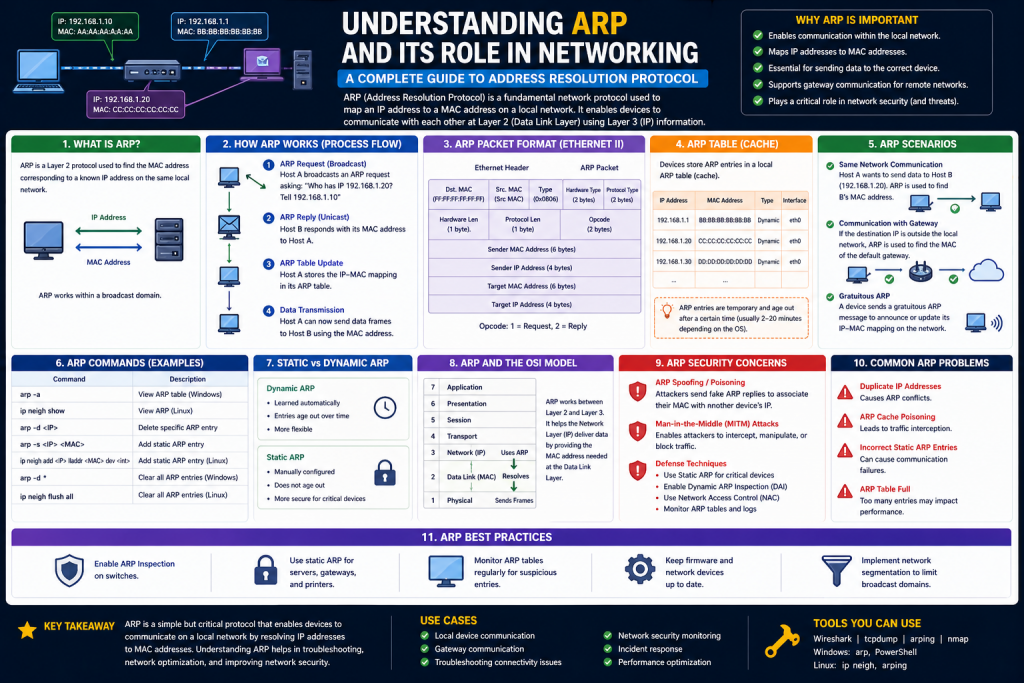
The modern internet is built on a vast collection of interconnected systems, devices, and protocols that work together to move data from one point to another. Every time you open a website, send a message, or stream a video, a series of processes take place behind the scenes to ensure that your data reaches its intended destination. While many users are familiar with terms like IP address or Wi-Fi, there are several lesser-known protocols that are just as important for communication to function correctly.
One such protocol is ARP, or Address Resolution Protocol. It plays a fundamental role in enabling devices within a local network to communicate effectively. Without ARP, even the simplest interactions between devices on the same network would not be possible.
To understand why ARP is so important, it is necessary to first explore how devices identify each other and how data is delivered across a network. Communication in networking relies on multiple layers, each with its own responsibilities. At higher levels, logical addressing is used to identify devices, while at lower levels, physical addressing ensures that data reaches the correct hardware. ARP exists at the intersection of these two concepts, making it a key component in the networking process.
Understanding IP Addresses and MAC Addresses
Before diving deeper into ARP, it is important to understand the two types of addresses it works with: IP addresses and MAC addresses. These addresses serve different purposes, but both are essential for communication.
An IP address is a logical address assigned to a device on a network. It acts as an identifier that allows devices to locate each other across networks. IP addresses can be assigned dynamically through services like DHCP or configured manually as static addresses. They are similar to mailing addresses in the real world, helping route data to the correct destination.
However, IP addresses alone are not sufficient for actual data transmission within a local network. When data is sent across a network, it is encapsulated into frames that must be delivered to a specific hardware interface. This is where MAC addresses come into play.
A MAC address, or Media Access Control address, is a unique identifier assigned to a network interface card. Unlike IP addresses, MAC addresses are usually fixed and embedded into the hardware during manufacturing. They operate at a lower level of the networking model and are used to deliver data directly between devices on the same network.
The key difference between these two types of addresses is that IP addresses are used for identifying devices logically across networks, while MAC addresses are used for delivering data physically within a local network. This distinction creates a challenge: how does a device translate a known IP address into the corresponding MAC address needed for actual communication?
This is the problem that ARP is designed to solve.
What is ARP and Why It Matters
ARP, or Address Resolution Protocol, is responsible for mapping IP addresses to MAC addresses. It acts as a bridge between the logical and physical layers of networking, ensuring that devices can communicate effectively within a local network.
When a device wants to send data to another device, it typically knows the destination IP address. However, to deliver the data on the local network, it needs the destination’s MAC address. ARP provides a way to discover this information.
Without ARP, a device would not be able to determine where to send its data at the hardware level. This would make local communication impossible, even if the devices were connected to the same network.
ARP operates at the data link layer, which is often referred to as Layer 2 in the OSI model. Its role is limited to local network communication, meaning it is only used when devices are within the same subnet. It does not handle routing or communication across different networks.
Despite its limited scope, ARP is essential for everyday networking. Whether you are using a home network, a corporate environment, or a data center, ARP is constantly working in the background to ensure that devices can find each other and exchange data.
The Relationship Between ARP and the OSI Model
To fully appreciate ARP’s role, it helps to understand where it fits within the OSI model. The OSI model is a conceptual framework used to describe how different networking functions are organized into layers.
ARP operates primarily at Layer 2, the data link layer, but it interacts closely with Layer 3, the network layer. The network layer is responsible for logical addressing and routing, which is where IP addresses come into play. The data link layer, on the other hand, is responsible for physical addressing and the actual delivery of data frames.
Because ARP translates IP addresses into MAC addresses, it effectively connects these two layers. It takes information from the network layer and prepares it for use at the data link layer.
This cross-layer functionality is what makes ARP so unique. It is not confined strictly to one layer but instead serves as a bridge that allows the networking process to function smoothly.
Without ARP, there would be a disconnect between logical addressing and physical delivery. Devices would know where to send data in theory but would not be able to deliver it in practice.
How Devices Communicate Within a Local Network
When two devices are connected to the same local network, they can communicate directly without the need for routing. However, even in this scenario, certain steps must be followed to ensure that data reaches the correct destination.
Suppose one device wants to send data to another device on the same network. The sending device knows the destination IP address, but it does not yet know the MAC address. Before it can transmit the data, it must resolve this information.
This is where ARP comes into play. The device uses ARP to discover the MAC address associated with the destination IP. Once the MAC address is known, the device can construct a data frame and send it directly to the recipient.
This process happens quickly and automatically, often without the user being aware of it. However, it is a critical step in ensuring successful communication.
It is also worth noting that this process is only necessary for local communication. If the destination device is on a different network, the sending device does not need to know its MAC address. Instead, it sends the data to a router, which then forwards it toward the destination.
The Role of ARP in Everyday Networking
ARP is used constantly in everyday networking scenarios. For example, when you connect your computer to a home network and try to access another device, ARP is used to resolve the necessary addresses.
Even when accessing the internet, ARP still plays a role. While your device does not need the MAC address of a remote server, it does need the MAC address of the local router. ARP is used to obtain this information so that the data can be sent to the router, which then handles further routing.
In corporate environments, ARP is equally important. Devices within the same network rely on ARP to communicate with servers, printers, and other resources. Without ARP, these interactions would not be possible.
Because ARP operates behind the scenes, it is often overlooked. However, its importance cannot be overstated. It is a foundational component of networking that enables devices to function as part of a cohesive system.
The Importance of ARP Caching
One of the key features of ARP is its use of caching. When a device resolves an IP address to a MAC address, it stores this information in a local table known as the ARP cache.
The ARP cache helps improve efficiency by reducing the need for repeated address resolution. Instead of sending a new ARP request every time it needs to communicate with a device, the system can simply look up the information in its cache.
This not only speeds up communication but also reduces network traffic. Without caching, networks would be flooded with ARP requests, leading to unnecessary overhead and potential performance issues.
However, ARP cache entries are not permanent. They expire after a certain period of time to ensure that outdated information is removed. This is important because network configurations can change, and devices may join or leave the network.
The expiration time for ARP cache entries varies depending on the operating system and device settings. In most cases, entries remain valid for a few minutes before being refreshed.
Limitations and Scope of ARP
While ARP is essential for local communication, it has certain limitations. One of the most important limitations is that it only works within a single network or subnet.
ARP cannot be used to resolve addresses across different networks. Instead, routing protocols are used to handle communication between networks. ARP plays a supporting role by helping devices communicate with their local gateway.
Another limitation is that ARP does not include built-in security mechanisms. It assumes that all devices on the network are trustworthy, which can lead to vulnerabilities. This aspect becomes particularly important when discussing security concerns, which are explored in later sections.
Despite these limitations, ARP remains a simple and effective solution for address resolution. Its design allows it to perform its وظیفه efficiently without adding unnecessary complexity.
Why ARP is Still Relevant Today
Even with advancements in networking technology, ARP continues to be widely used. It remains a fundamental part of IPv4 networking and is supported by virtually all devices.
Although newer protocols like IPv6 use different mechanisms for address resolution, ARP is still deeply embedded in existing infrastructure. Many networks around the world rely on it for daily operations.
Understanding ARP is therefore essential for anyone studying networking or working in IT. It provides insight into how devices communicate at a fundamental level and helps build a strong foundation for more advanced concepts.
In real-world scenarios, knowledge of ARP can also assist in troubleshooting network issues. Problems such as connectivity failures or slow communication may sometimes be related to ARP-related issues, such as incorrect cache entries.
How ARP Works in Practice
Understanding the concept of ARP is only the first step. To truly appreciate its importance, it is necessary to examine how it functions in real-world networking environments. ARP operates through a clearly defined process that allows devices to discover the physical address associated with a known IP address. This process is known as ARP resolution, and it is fundamental to communication within local networks.
Whenever a device needs to send data to another device on the same network, it must ensure that the data is delivered to the correct hardware interface. Even though the sending device may already know the destination IP address, it cannot proceed without the corresponding MAC address. ARP provides the mechanism to obtain this information quickly and efficiently.
The process is simple in design but highly effective in execution. It involves checking stored information, broadcasting requests when necessary, and updating internal tables to improve performance over time. These steps happen rapidly, often without any noticeable delay for the user.
The ARP Resolution Process
The ARP resolution process is the core function of the Address Resolution Protocol. It allows a device to map a known IP address to a MAC address so that communication can take place at the data link layer.
The process begins when a device determines that it needs to communicate with another device on the same network. This typically happens when an application generates data that must be sent to a specific destination. The networking stack identifies the destination IP address and prepares to deliver the data.
Before sending the data, the device checks whether it already knows the MAC address associated with the destination IP. This check is performed using the ARP cache, which stores previously resolved mappings. If the required information is already available, the device can skip the resolution process and proceed with data transmission.
If the mapping is not found, the device initiates ARP resolution. It creates an ARP request packet containing its own IP and MAC address, along with the target IP address for which it is seeking the MAC address. This request is then broadcast to all devices on the local network.
The broadcast nature of the ARP request is important. Since the sending device does not yet know which device owns the target IP address, it must send the request to every device in the network segment. Each device that receives the request examines it to determine whether the target IP matches its own.
Only the device with the matching IP address responds. This response is called an ARP reply, and it is sent directly back to the requesting device. The reply contains the MAC address associated with the target IP address, allowing the requesting device to complete the resolution process.
Once the reply is received, the requesting device stores the mapping in its ARP cache and proceeds to send the data using the newly discovered MAC address.
ARP Request in Detail
The ARP request is the first step in the resolution process. It is a broadcast message sent to all devices within the local network. This broadcast ensures that the request reaches the device that owns the target IP address.
The request contains several key pieces of information. It includes the sender’s IP address and MAC address, which identify the device making the request. It also includes the target IP address, which indicates the address being resolved. However, the target MAC address field is left empty because that is the information being sought.
When the request is transmitted, it is encapsulated in a frame and sent to the broadcast MAC address, which ensures that all devices on the network receive it. This method is efficient because it guarantees that the correct device will see the request, even though the sender does not know its exact location.
Every device on the network processes the request upon receiving it. Most devices quickly determine that the target IP does not match their own and discard the request. This filtering process happens automatically and does not significantly impact performance.
The device that recognizes the target IP address prepares to respond. It constructs an ARP reply containing the necessary information to complete the resolution process.
ARP Reply in Detail
The ARP reply is the second step in the resolution process. Unlike the request, which is broadcast, the reply is sent directly to the requesting device. This direct communication ensures that only the intended recipient processes the response.
The reply includes the MAC address associated with the target IP address. It also includes the IP and MAC address of the responding device, allowing the requester to verify the mapping.
When the requesting device receives the reply, it extracts the MAC address and updates its ARP cache. This allows it to send data directly to the destination without needing further resolution.
The ARP reply completes the resolution process, enabling the devices to communicate at the data link layer. This interaction happens quickly, often within milliseconds, ensuring minimal delay in data transmission.
The Role of the ARP Cache
The ARP cache is a critical component of the protocol. It serves as a temporary storage area for IP-to-MAC address mappings that have been recently resolved. By storing this information, the cache reduces the need for repeated ARP requests.
Whenever a device successfully resolves an address, it adds the mapping to its ARP cache. Future communications with the same destination can then use this cached information, avoiding the overhead of broadcasting new requests.
The cache improves network efficiency by minimizing unnecessary traffic. Without it, every communication would require a new ARP request and reply, leading to increased congestion and slower performance.
However, the ARP cache is not permanent. Entries are assigned a lifetime, after which they expire and are removed. This ensures that outdated information does not remain in the system. If a device’s MAC address changes or it leaves the network, the cache will eventually discard the old mapping.
Different systems have different cache timeout values. Some devices may refresh entries frequently, while others retain them for longer periods. Network administrators can often adjust these settings to balance performance and accuracy.
ARP in Local vs Remote Communication
ARP is specifically designed for use within a local network. When two devices are in the same subnet, ARP is used to resolve the MAC address of the destination device directly.
However, when a device needs to communicate with a destination outside its local network, the process changes. Instead of resolving the MAC address of the remote device, the sending device resolves the MAC address of its default gateway, typically a router.
The router then takes responsibility for forwarding the data toward its final destination. At each step along the path, ARP may be used again within each local network segment to resolve addresses.
This distinction is important because it highlights the limited scope of ARP. It does not handle end-to-end communication across the internet. Instead, it plays a supporting role by ensuring that data can be delivered within each local segment of the network.
ARP and Network Efficiency
One of the reasons ARP has remained in use for so long is its efficiency. The protocol is simple, requiring only a small number of messages to resolve addresses. This simplicity allows it to operate quickly and reliably.
The use of broadcasting ensures that requests reach their intended target, while the use of caching minimizes repeated work. Together, these features create a balance between reliability and performance.
However, there are trade-offs. Broadcasting can generate additional traffic, especially in large networks. To mitigate this, network designers often use segmentation techniques such as VLANs to limit the scope of broadcasts.
Despite these challenges, ARP continues to perform well in most environments. Its design is well-suited to the needs of local communication, making it a reliable component of network infrastructure.
Handling ARP Cache Expiration
ARP cache entries are not permanent. Each entry has a lifetime, after which it is removed from the cache. This expiration process ensures that the cache remains accurate and up to date.
When an entry expires, the next attempt to communicate with that destination will trigger a new ARP resolution process. This allows the device to obtain the most current mapping information.
Cache expiration is important in dynamic environments where devices may frequently join or leave the network. Without expiration, outdated mappings could lead to communication failures or inefficiencies.
Some systems also allow manual management of the ARP cache. Administrators can view, add, or remove entries as needed. This can be useful for troubleshooting or for implementing specific network configurations.
Practical Example of ARP in Action
Consider a simple scenario in a home network. A laptop wants to send a file to a printer connected to the same network. The laptop knows the printer’s IP address but does not yet know its MAC address.
The laptop checks its ARP cache and finds no entry for the printer. It then sends an ARP request to the network, asking for the MAC address associated with the printer’s IP.
The printer receives the request, recognizes its IP address, and sends an ARP reply containing its MAC address. The laptop receives the reply, stores the mapping in its cache, and proceeds to send the file.
This entire process happens quickly and seamlessly, allowing the user to complete the task without any awareness of the underlying operations.
Limitations of ARP Operation
While ARP is effective, it does have limitations. Its reliance on broadcasting can create overhead in larger networks. Additionally, it does not include mechanisms for verifying the authenticity of responses, which can lead to security vulnerabilities.
Another limitation is its dependency on IPv4. In newer networking environments that use IPv6, a different protocol is used for address resolution. However, ARP remains widely used in IPv4 networks, which continue to dominate many environments.
Despite these limitations, ARP’s simplicity and effectiveness make it a reliable solution for address resolution within local networks.
ARP Security Risks and Vulnerabilities
While ARP is essential for enabling communication within local networks, it was designed in a time when network security was not a primary concern. As a result, the protocol lacks built-in mechanisms to verify the authenticity of messages. This absence of validation makes ARP vulnerable to various types of attacks, the most notable being ARP spoofing.
ARP operates on trust. When a device sends an ARP request, it assumes that any reply it receives is legitimate. There is no authentication process to confirm whether the response actually came from the correct device. This design choice simplifies the protocol and keeps it efficient, but it also opens the door for malicious activity.
Attackers can exploit this weakness by sending false ARP messages to other devices on the network. These fake messages can manipulate the ARP cache of target devices, causing them to associate incorrect MAC addresses with specific IP addresses. Once this happens, network traffic can be redirected, intercepted, or disrupted entirely.
Understanding these vulnerabilities is critical for anyone managing or studying networks. Without proper awareness and protection, ARP-related attacks can compromise data integrity, confidentiality, and availability.
What is ARP Spoofing
ARP spoofing, also known as ARP cache poisoning, is a technique used by attackers to deceive devices on a network. The goal is to trick devices into sending data to the attacker instead of the intended recipient.
In a typical ARP spoofing attack, the attacker listens for ARP requests on the network. When a request is broadcast, the attacker quickly sends a forged ARP reply. This reply contains false information, usually mapping the attacker’s MAC address to the IP address of another device, such as a gateway or server.
Because ARP does not verify responses, the receiving device accepts the fake reply and updates its ARP cache. From that point on, any data intended for the legitimate device is sent to the attacker instead.
This manipulation allows the attacker to position themselves between communicating devices. Once in this position, they can monitor, modify, or block traffic as they see fit.
ARP spoofing is particularly dangerous because it can be carried out silently. Users may not notice any immediate signs of the attack, especially if the attacker forwards the intercepted traffic to its original destination after inspecting it.
How ARP Spoofing Attacks Work
To understand the mechanics of ARP spoofing, it is helpful to break down the attack process step by step. The attack begins when an attacker gains access to the same local network as the target devices. This could be a public Wi-Fi network, a corporate LAN, or even a home network.
Once connected, the attacker monitors network traffic for ARP requests. These requests provide valuable information about the devices on the network and their IP addresses.
When a device broadcasts an ARP request, the attacker responds with a forged reply. This reply falsely claims that the attacker’s MAC address corresponds to the requested IP address. For example, the attacker might pretend to be the network’s default gateway.
The target device receives the fake reply and updates its ARP cache. As a result, it begins sending traffic intended for the gateway to the attacker instead.
In many cases, the attacker also sends forged ARP replies to the gateway, tricking it into associating the attacker’s MAC address with the target device’s IP. This creates a two-way deception, allowing the attacker to intercept communication in both directions.
With this setup, the attacker can act as a man-in-the-middle. They receive data from one device, inspect or modify it, and then forward it to the intended recipient. This process continues as long as the ARP cache remains poisoned.
Man-in-the-Middle Attacks Using ARP
One of the most common uses of ARP spoofing is to perform man-in-the-middle attacks. In this type of attack, the attacker secretly intercepts communication between two devices.
Once the attacker is positioned between the devices, they gain access to all transmitted data. This can include sensitive information such as login credentials, personal messages, and session data.
If the data is not encrypted, the attacker can read it directly. Even if encryption is used, the attacker may still attempt to manipulate the communication or exploit weaknesses in the encryption process.
Man-in-the-middle attacks can have serious consequences. They can lead to identity theft, data breaches, and unauthorized access to systems. Because ARP spoofing can be performed without detection, it is a powerful tool for attackers.
In addition to intercepting data, attackers may also modify it. For example, they could alter messages, inject malicious code, or redirect users to fraudulent websites. These actions can further compromise the security of the network and its users.
Denial-of-Service Through ARP Manipulation
Another potential outcome of ARP spoofing is a denial-of-service condition. Instead of redirecting traffic to themselves, an attacker may provide invalid or non-existent MAC addresses in their forged replies.
When devices update their ARP cache with these incorrect mappings, they attempt to send data to addresses that do not exist. As a result, the data is never delivered, and communication is disrupted.
This type of attack can affect individual devices or entire network segments, depending on how it is executed. It can cause significant downtime and interfere with critical operations.
Denial-of-service attacks using ARP are relatively simple to perform, making them a common threat in unsecured networks. Preventing such attacks requires proper monitoring and security measures.
Why ARP is Vulnerable
The primary reason ARP is vulnerable is its lack of authentication. The protocol does not include any mechanism to verify the identity of the sender. This means that any device on the network can send ARP replies, regardless of whether they are legitimate.
Additionally, ARP allows unsolicited replies. A device can send an ARP reply even if no request was made. This behavior can be exploited by attackers to inject false information into the network.
Another contributing factor is the reliance on caching. While caching improves performance, it also provides a target for attackers. Once a malicious entry is stored in the ARP cache, it remains active until it expires or is removed.
These design choices make ARP simple and efficient, but they also create opportunities for exploitation. Addressing these vulnerabilities requires additional security measures beyond the protocol itself.
Preventing ARP Spoofing Attacks
Although ARP itself does not provide security features, there are several methods that can be used to protect networks from ARP spoofing attacks. These methods involve a combination of configuration, monitoring, and advanced networking technologies.
One common approach is the use of static ARP entries. By manually configuring IP-to-MAC mappings for critical devices, administrators can prevent these entries from being altered by malicious ARP replies. This is particularly useful for devices such as routers and servers.
However, static entries are not practical for all devices, especially in large or dynamic networks. Maintaining a large number of static mappings can be time-consuming and difficult to manage.
Another approach is to use network monitoring tools. These tools can detect unusual ARP activity, such as multiple IP addresses being associated with a single MAC address. When suspicious behavior is detected, administrators can take action to investigate and mitigate the threat.
Monitoring tools provide visibility into network activity, making it easier to identify potential attacks. They can also generate alerts, allowing administrators to respond quickly.
Advanced Security Features in Network Devices
Modern networking equipment often includes built-in security features designed to address ARP vulnerabilities. One such feature is Dynamic ARP Inspection, commonly found in managed switches.
Dynamic ARP Inspection works by validating ARP packets against a trusted database of IP-to-MAC mappings. If a packet does not match the expected information, it is discarded. This prevents malicious ARP replies from being accepted by devices on the network.
Another feature is ARP guard, which can restrict ARP traffic based on predefined rules. For example, it can limit which devices are allowed to send ARP replies or enforce consistency in address mappings.
These features provide an additional layer of protection, helping to secure networks against ARP-based attacks. However, they require proper configuration and management to be effective.
The Role of Encryption in Mitigating Risks
While ARP spoofing can intercept network traffic, the use of encryption can reduce the impact of such attacks. Encrypted protocols, such as HTTPS, ensure that data remains unreadable to attackers even if it is intercepted.
Encryption does not prevent ARP spoofing itself, but it protects the confidentiality of the data being transmitted. This makes it more difficult for attackers to extract useful information.
In addition to encryption, secure authentication methods can help prevent unauthorized access. Even if an attacker intercepts credentials, additional security measures such as multi-factor authentication can limit their ability to exploit the data.
Best Practices for Network Security
Protecting a network from ARP-related threats requires a comprehensive approach. Administrators should implement a combination of technical controls and best practices to reduce risk.
Segmenting the network into smaller sections can limit the scope of potential attacks. By reducing the number of devices in each segment, administrators can minimize broadcast traffic and improve security.
Regularly updating network devices and software is also important. Security updates often include fixes for known vulnerabilities and improvements to existing protections.
User awareness plays a role as well. Educating users about the risks of unsecured networks and encouraging the use of secure connections can help reduce exposure to attacks.
By combining these strategies, organizations can create a more secure networking environment and reduce the likelihood of ARP-related incidents.
Conclusion
ARP is a fundamental protocol that enables communication within local networks by mapping IP addresses to MAC addresses. While it is simple and efficient, its lack of built-in security makes it vulnerable to attacks such as ARP spoofing.
These vulnerabilities can lead to serious consequences, including data interception, unauthorized access, and denial-of-service conditions. Understanding how these attacks work is essential for identifying and mitigating risks.
Fortunately, there are several methods available to protect networks. From static ARP entries and monitoring tools to advanced switch features and encryption, administrators have multiple options for enhancing security.
Despite its limitations, ARP remains an essential part of networking. By combining a strong understanding of its operation with effective security practices, it is possible to maintain both efficient communication and a secure network environment.
Continue exploring the technologies and certification concepts that matter most to you.