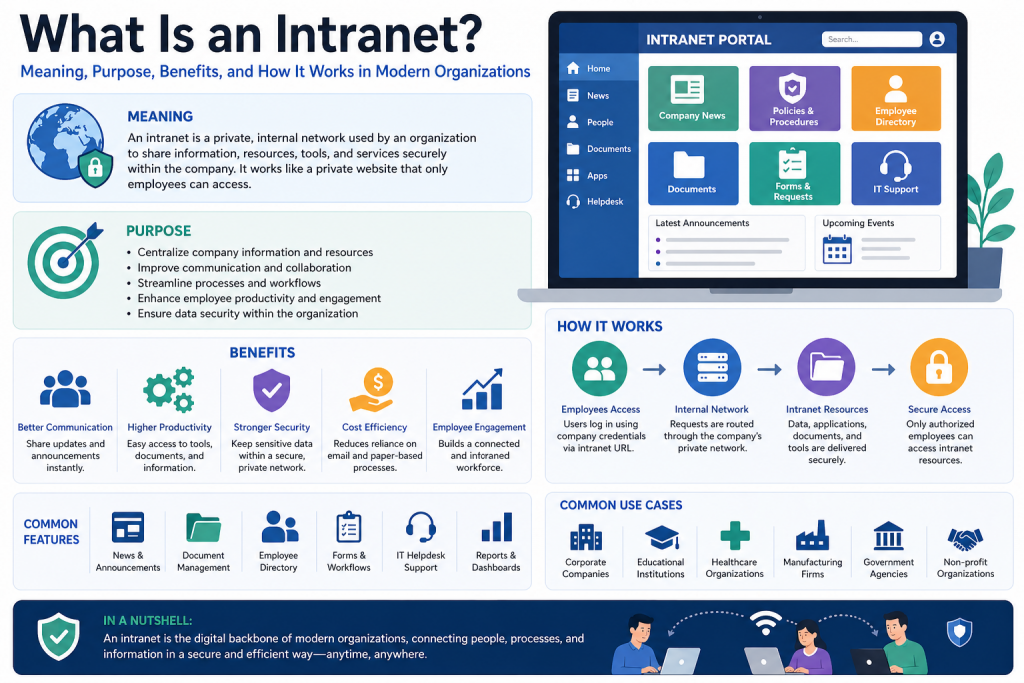
An intranet is a private, internal network designed to serve the needs of a specific organization. It uses the same foundational technologies as the public internet, such as web browsers, servers, and communication protocols, but access is restricted to authorized users only. This controlled access makes it an ideal environment for securely sharing information, managing resources, and enabling collaboration among employees.
At its core, an intranet functions as a centralized digital space where people within an organization can interact, communicate, and perform their daily tasks. It can host a wide range of tools and resources, including document repositories, internal applications, communication platforms, and workflow systems. Because it is privately managed, organizations have complete control over how the intranet is structured, what features it includes, and how it evolves over time.
Intranets are not limited to large corporations. Businesses of all sizes, educational institutions, healthcare providers, and government agencies use intranets to streamline operations and improve internal communication. As organizations grow and become more complex, the need for a unified platform that connects people and information becomes increasingly important.
The Meaning Behind Intranet vs Internet
The distinction between an intranet and the internet lies primarily in their scope and accessibility. The prefix intra means within, indicating that an intranet operates inside a single organization. In contrast, the prefix inter means between, reflecting the internet’s role as a global network that connects millions of devices and systems across the world.
An intranet is confined to a defined group of users, typically employees or members of an organization. Access is usually controlled through login credentials, virtual private networks, or other authentication mechanisms. This ensures that sensitive information remains protected and is only available to those who need it.
The internet, on the other hand, is open and accessible to anyone with a connection. While this openness enables global communication and information sharing, it also introduces security risks. Intranets mitigate these risks by operating within a controlled environment, allowing organizations to implement strict security measures and maintain data privacy.
Despite these differences, intranets often rely on internet technologies. For example, employees may access the intranet through a web browser, and the system may use standard protocols such as HTTP or HTTPS. This combination of familiar technology and restricted access makes intranets both powerful and user-friendly.
The Evolution of Intranets Over Time
Intranets have undergone significant transformation since their early days. Initially, they were simple systems designed to store and distribute information. Employees could log in to view documents, read company announcements, or access basic resources. These early intranets were often static and lacked interactive features.
As technology advanced, intranets began to incorporate more dynamic capabilities. The introduction of databases, content management systems, and web applications allowed organizations to create more sophisticated platforms. Employees could not only access information but also contribute content, collaborate on projects, and interact with one another.
The rise of cloud computing further accelerated the evolution of intranets. Modern intranets are often cloud-based, enabling access from anywhere with an internet connection. This has been particularly important in supporting remote work and distributed teams. Employees are no longer tied to a physical office; they can connect to the intranet from home, while traveling, or from different geographic locations.
Today’s intranets are highly interactive and integrated systems. They combine communication tools, collaboration platforms, and business applications into a single unified environment. This transformation has turned intranets into essential components of the modern digital workplace.
The Role of Intranets in the Digital Workplace
The concept of the digital workplace revolves around using technology to create a more flexible, efficient, and connected work environment. Intranets play a central role in this concept by acting as the primary hub for digital activities within an organization.
A well-designed intranet brings together various tools and resources into one cohesive platform. Employees can access emails, chat systems, project management tools, and document libraries without needing to switch between multiple applications. This integration reduces complexity and improves productivity.
Intranets also support collaboration by enabling teams to work together in real time. Whether it is sharing documents, participating in discussions, or managing tasks, the intranet provides the infrastructure needed for seamless teamwork. This is especially valuable in organizations with remote or hybrid work models.
Another important aspect of the digital workplace is accessibility. Intranets ensure that employees can access the information and tools they need regardless of their location. This flexibility enhances efficiency and allows organizations to adapt to changing work environments.
Key Components of an Intranet
An intranet typically consists of several key components that work together to support organizational needs. One of the most important components is the content management system. This system allows administrators to create, organize, and manage content such as documents, policies, and announcements.
Communication tools are another essential component. These may include messaging systems, discussion forums, and news feeds. They enable employees to share information, ask questions, and stay informed about company updates.
Collaboration tools are also integral to modern intranets. Features such as document sharing, version control, and project management systems allow teams to work together efficiently. These tools help streamline workflows and ensure that everyone is on the same page.
In addition, intranets often include user management and access control systems. These systems define who can access specific information and what actions they can perform. This ensures that sensitive data is protected while still allowing employees to perform their tasks effectively.
Benefits of Using an Intranet
Organizations implement intranets for a variety of reasons, all of which contribute to improved efficiency and productivity. One of the most significant benefits is enhanced communication. Intranets provide a centralized platform where employees can receive updates, share information, and engage in discussions. This reduces reliance on fragmented communication channels and ensures that important messages reach the intended audience.
Another major benefit is centralized information management. Instead of storing data across multiple systems, an intranet consolidates information into a single location. This makes it easier for employees to find what they need and reduces the risk of duplication or inconsistency.
Intranets also promote collaboration. By providing tools for sharing documents, managing projects, and communicating in real time, they enable teams to work together more effectively. This leads to faster decision-making and improved outcomes.
Security is another important advantage. Since intranets are private networks, organizations can implement strict security measures to protect sensitive information. This includes authentication, encryption, and access control mechanisms.
Finally, intranets support organizational alignment. By providing a shared platform for communication and information, they help ensure that everyone is working toward the same goals. This alignment improves overall performance and contributes to the success of the organization.
Customization and Flexibility
One of the defining characteristics of an intranet is its ability to be customized. Unlike public platforms, which must cater to a broad audience, intranets can be tailored to meet the specific needs of an organization.
Customization can take many forms. Organizations can design the layout and structure of the intranet to reflect their workflows and processes. They can also choose which tools and features to include, ensuring that the system supports their unique requirements.
Flexibility is equally important. As organizations grow and evolve, their intranet must be able to adapt. This may involve adding new features, integrating with other systems, or scaling to accommodate more users. A flexible intranet ensures that the platform remains relevant and effective over time.
Supporting Remote and Hybrid Work
The shift toward remote and hybrid work has highlighted the importance of intranets. When employees are not physically present in the same location, maintaining communication and collaboration becomes more challenging.
Intranets address this challenge by providing a virtual workspace where employees can connect and collaborate. They enable real-time communication, document sharing, and access to resources, regardless of location.
This capability is particularly valuable for organizations with distributed teams. It ensures that all employees have equal access to information and opportunities, fostering a sense of inclusion and engagement.
Challenges and Considerations
While intranets offer many benefits, they also present certain challenges. One common issue is user adoption. If employees find the intranet difficult to use or irrelevant to their needs, they may avoid using it altogether. This undermines the effectiveness of the system.
To address this challenge, organizations must prioritize usability and user experience. The intranet should be intuitive, easy to navigate, and aligned with the needs of its users. Training and support can also help encourage adoption.
Another challenge is maintaining content quality. An intranet is only as useful as the information it contains. Organizations must ensure that content is accurate, up-to-date, and well-organized. This requires ongoing management and oversight.
Security is another important consideration. While intranets are inherently more secure than public networks, they are not immune to threats. Organizations must implement robust security measures and regularly update them to address new risks.
The Growing Importance of Intranets
As technology continues to evolve, the importance of intranets is expected to grow. Organizations are increasingly relying on digital tools to manage their operations and connect their workforce. Intranets provide the foundation for these tools, enabling seamless integration and collaboration.
Emerging technologies such as artificial intelligence and automation are also influencing the development of intranets. These technologies can enhance functionality, improve user experience, and provide valuable insights into organizational performance.
Intranets are no longer just internal networks; they are strategic assets that support the overall goals of an organization. By investing in a well-designed intranet, organizations can improve efficiency, foster collaboration, and create a more connected and productive workforce.
Designing and Selecting an Effective Intranet System
Designing an intranet requires more than technical expertise. It involves understanding how people work, how they interact with information, and what they need to perform their roles efficiently. An effective intranet is not simply a collection of tools and pages; it is a carefully structured environment that supports productivity, communication, and collaboration.
One of the most fundamental principles of intranet design is usability. If users cannot easily navigate the system or find what they are looking for, the intranet will fail regardless of how powerful its features are. Usability focuses on making the experience intuitive, reducing complexity, and ensuring that users can complete tasks with minimal effort.
Another key principle is accessibility. An intranet should be available to all authorized users, regardless of their location or device. This means designing for different screen sizes, ensuring compatibility with mobile devices, and supporting users with varying levels of technical expertise.
Consistency is also essential. A consistent design across pages and features helps users build familiarity and confidence. When navigation menus, layouts, and naming conventions are predictable, users can move through the intranet more efficiently.
User-Centric Design Approach
A user-centric approach places the needs and behaviors of users at the center of the design process. Instead of building an intranet based solely on technical possibilities, organizations must consider how employees will actually use the system in their daily work.
This begins with understanding user roles. Different employees have different responsibilities, and their interactions with the intranet will vary accordingly. For example, a manager may need access to performance dashboards and reports, while a new employee may rely on onboarding materials and training resources. Designing with these roles in mind ensures that the intranet delivers relevant content and functionality to each user.
User feedback is another critical component. Gathering input from employees during the design and development process helps identify pain points and areas for improvement. Continuous feedback also allows organizations to refine the intranet over time, ensuring that it remains aligned with user needs.
Personalization plays a significant role in user-centric design. Modern intranets often provide personalized dashboards that display relevant information based on the user’s role, preferences, and activity. This reduces information overload and helps users focus on what matters most.
Simplicity and Intuitive Navigation
Simplicity is one of the most powerful design principles. An intranet does not need to be complex to be effective. In fact, excessive complexity can hinder usability and discourage adoption.
Clear navigation is essential for maintaining simplicity. Users should be able to locate information quickly without having to search through multiple layers of menus. This can be achieved through logical categorization, descriptive labels, and well-organized content structures.
Search functionality is another important aspect of navigation. A robust search system allows users to find information quickly, even if they are not familiar with the structure of the intranet. Features such as filters, keywords, and predictive search can enhance the user experience.
Visual design also contributes to simplicity. Clean layouts, readable fonts, and appropriate use of whitespace make the intranet more approachable and easier to use. Visual hierarchy helps guide users’ attention to important elements, improving overall usability.
Structuring Content for Efficiency
Content organization is a critical factor in intranet effectiveness. Poorly organized content can lead to confusion, wasted time, and frustration. On the other hand, well-structured content improves efficiency and enhances the user experience.
Information should be grouped into logical categories that reflect how users think and work. For example, content can be organized by department, function, or project. Clear naming conventions and consistent labeling help users understand where to find specific information.
Metadata and tagging can further improve content organization. By assigning tags to documents and pages, organizations can make it easier for users to locate relevant information through search and filtering.
Content governance is also important. This involves defining processes for creating, reviewing, and updating content. Regular maintenance ensures that information remains accurate and relevant, preventing the intranet from becoming cluttered with outdated material.
Balancing Features and Functionality
Modern intranets offer a wide range of features, from communication tools to advanced analytics. While these features can enhance productivity, adding too many can overwhelm users and reduce usability.
Organizations must carefully evaluate which features are truly necessary. Each feature should serve a clear purpose and contribute to the overall goals of the intranet. Unnecessary tools can create confusion and increase the learning curve for users.
Integration is another important consideration. Instead of adding standalone features, organizations can integrate existing tools and systems into the intranet. This creates a unified environment where users can access multiple services from a single platform.
Performance should not be overlooked. An intranet must be responsive and reliable. Slow loading times or frequent errors can frustrate users and discourage usage. Optimizing performance ensures a smooth and efficient experience.
Choosing the Right Intranet Software
Selecting an intranet software solution is a critical decision that can have long-term implications for an organization. The right choice can enhance productivity and collaboration, while the wrong choice can lead to inefficiencies and wasted resources.
One of the first factors to consider is ease of use. The software should be intuitive and user-friendly, allowing employees to quickly adapt to the system. A complicated interface can hinder adoption and reduce the effectiveness of the intranet.
Scalability is another key consideration. As organizations grow, their intranet must be able to accommodate an increasing number of users, data, and functionalities. A scalable solution ensures that the system can evolve alongside the organization.
Compatibility with existing systems is also important. The intranet should integrate seamlessly with other tools and applications used by the organization. This reduces redundancy and improves efficiency.
Customization and Adaptability
Customization allows organizations to tailor the intranet to their specific needs. This includes modifying the layout, adding custom features, and configuring workflows.
A customizable intranet ensures that the system aligns with the organization’s processes and culture. It also allows for flexibility in adapting to changing requirements.
Adaptability is closely related to customization. As business needs evolve, the intranet must be able to adapt without requiring a complete overhaul. This may involve adding new features, updating existing ones, or integrating new technologies.
Collaboration Tools and Capabilities
Collaboration is a central function of modern intranets. Effective collaboration tools enable employees to work together efficiently, regardless of their location.
Document sharing is one of the most important collaboration features. It allows users to upload, edit, and share files with colleagues. Version control ensures that everyone is working with the most up-to-date information.
Real-time communication tools, such as chat and video conferencing, facilitate instant interaction. These tools help teams coordinate tasks, discuss ideas, and resolve issues .
Project management features provide structure to collaborative efforts. They allow teams to assign tasks, track progress, and manage deadlines. This improves accountability and ensures that projects stay on track.
Mobile Accessibility and Remote Use
In today’s work environment, employees often need to access the intranet from various devices, including smartphones and tablets. Mobile accessibility is therefore a crucial consideration.
A mobile-friendly intranet ensures that users can access information and perform tasks on the go. Responsive design allows the interface to adapt to different screen sizes, providing a consistent experience across devices.
Remote access is equally important. Employees working from home or traveling must be able to connect to the intranet securely. Technologies such as secure login systems and encrypted connections help protect data while enabling remote access.
Security and Data Protection
Security is a fundamental aspect of intranet design and selection. Organizations must protect sensitive information from unauthorized access and potential threats.
Authentication mechanisms verify the identity of users before granting access. This may include passwords, multi-factor authentication, or biometric methods.
Access control systems define what users can see and do within the intranet. Role-based access ensures that employees only have access to the information necessary for their roles.
Data encryption protects information during transmission and storage. This reduces the risk of data breaches and ensures compliance with security standards.
Regular security audits and updates are essential for maintaining a secure intranet. As threats evolve, organizations must continuously improve their security measures.
Evaluating Cost and Return on Investment
Implementing an intranet involves costs, including software, development, maintenance, and training. Organizations must evaluate these costs in relation to the benefits provided by the system.
A well-designed intranet can deliver significant value by improving productivity, reducing communication barriers, and enhancing collaboration. These benefits can lead to cost savings and increased efficiency.
Return on investment should be measured not only in financial terms but also in terms of employee satisfaction and organizational performance. An effective intranet contributes to a more engaged and productive workforce.
Implementation and Deployment Considerations
The process of implementing an intranet requires careful planning and execution. This includes defining objectives, selecting the appropriate technology, and designing the system.
Training is an important part of deployment. Employees must understand how to use the intranet effectively. Providing training sessions, tutorials, and support resources can facilitate adoption.
Change management is another critical factor. Introducing a new intranet may require changes in workflows and habits. Clear communication and support can help employees transition smoothly.
Testing and feedback are essential before full deployment. Identifying and addressing issues early ensures a more successful implementation.
Continuous Improvement and Maintenance
An intranet is not a one-time project; it requires ongoing maintenance and improvement. Regular updates ensure that the system remains relevant and effective.
Monitoring usage and performance can provide insights into how the intranet is being used. This information can guide improvements and enhancements.
User feedback should be continuously collected and analyzed. This helps identify areas for improvement and ensures that the intranet meets evolving needs.
Content maintenance is also important. Keeping information up to date ensures that users can rely on the intranet as a trusted source of information.
The Role of Intranets in Internal Communication
Communication is one of the most critical elements of any successful organization, and intranets play a central role in enabling efficient and structured communication. Traditional communication methods such as emails, printed memos, and meetings often lead to delays, misinterpretation, or information overload. An intranet addresses these issues by providing a centralized platform where information can be shared quickly and consistently.
Through an intranet, organizations can distribute announcements, updates, and important messages to all employees in real time. This ensures that everyone has access to the same information, reducing misunderstandings and improving alignment across teams. Instead of relying on fragmented communication channels, employees can turn to the intranet as a single, reliable source of truth.
Intranets also support two-way communication. Employees are not just passive recipients of information; they can actively participate by sharing feedback, asking questions, and contributing ideas. This interactive communication model fosters a more open and transparent workplace culture.
Intranet as a Central Communication Hub
A well-implemented intranet acts as a communication hub that integrates multiple tools and channels into one cohesive system. Rather than switching between different applications for messaging, announcements, and collaboration, employees can access everything within a single interface.
News feeds and announcement sections allow organizations to broadcast important updates. These features can be customized to target specific groups or departments, ensuring that information is relevant to the audience. This targeted communication reduces noise and helps employees focus on what matters most.
Messaging and chat tools enable instant communication between individuals and teams. These tools are particularly useful for quick discussions, problem-solving, and coordination. They complement formal communication channels by providing a more flexible and immediate way to interact.
Discussion forums and comment sections further enhance communication by encouraging dialogue. Employees can engage in conversations, share insights, and collaborate on ideas. This creates a sense of community and promotes knowledge sharing across the organization.
Real-Time Communication and Information Sharing
One of the most significant advantages of intranets is their ability to support real-time communication. In fast-paced work environments, timely information is essential for making informed decisions and responding to changes.
Real-time updates ensure that employees are always aware of the latest developments. Whether it is a policy change, project update, or urgent announcement, the intranet allows organizations to communicate instantly. This reduces delays and helps teams stay aligned.
Document sharing is another key aspect of real-time collaboration. Employees can upload, edit, and share files with their colleagues, ensuring that everyone has access to the most current version. Version control features prevent confusion and maintain consistency.
Notifications and alerts keep users informed about important events and updates. These features ensure that critical information is not overlooked, even in busy work environments.
Enhancing Employee Engagement Through Intranets
Employee engagement is a crucial factor in organizational success. Engaged employees are more productive, motivated, and committed to their work. Intranets contribute to engagement by providing a platform for interaction, recognition, and participation.
One way intranets enhance engagement is by giving employees a voice. Features such as surveys, polls, and feedback forms allow employees to express their opinions and share their ideas. This involvement fosters a sense of ownership and belonging.
Recognition programs can also be integrated into the intranet. Highlighting achievements, celebrating milestones, and acknowledging contributions help boost morale and create a positive work environment. Employees feel valued when their efforts are recognized.
Social features, such as profiles and activity feeds, encourage interaction among employees. These features help build relationships and strengthen the sense of community within the organization.
Breaking Down Organizational Silos
In many organizations, information is often confined within specific departments or teams. This creates silos that hinder collaboration and limit the flow of knowledge. Intranets play a vital role in breaking down these barriers.
By providing a centralized platform for information sharing, intranets enable employees to access resources across departments. This promotes transparency and encourages collaboration between different teams.
Cross-functional collaboration becomes easier when employees can communicate and share information without restrictions. This leads to more innovative solutions and better decision-making.
Intranets also help standardize processes and information. When everyone has access to the same resources and guidelines, it reduces inconsistencies and improves efficiency.
Knowledge Management and Information Accessibility
Knowledge management is a key function of modern intranets. Organizations generate vast amounts of information, and managing this knowledge effectively is essential for success.
An intranet serves as a centralized repository where employees can store and access information. This includes documents, policies, training materials, and best practices. Having a single source of information reduces confusion and ensures consistency.
Search functionality plays a critical role in knowledge management. Employees should be able to find information quickly and easily. Advanced search features, such as filters and keywords, improve the accuracy and efficiency of searches.
Organizing content logically is equally important. Clear categories, tags, and metadata help users navigate the system and locate relevant information. Well-structured content enhances usability and saves time.
Knowledge management also involves maintaining and updating information. Regular reviews ensure that content remains accurate and relevant. Outdated information can lead to errors and inefficiencies.
Intranet Security and Risk Management
Security is a fundamental aspect of intranet management. While intranets are private networks, they are not immune to threats. Organizations must implement robust security measures to protect sensitive information and maintain trust.
Authentication is the first line of defense. Users must verify their identity before accessing the intranet. This can be achieved through passwords, multi-factor authentication, or biometric methods.
Access control is another critical component. Role-based access ensures that users can only access the information relevant to their responsibilities. This minimizes the risk of unauthorized access and data breaches.
Encryption protects data during transmission and storage. By converting information into a secure format, encryption prevents unauthorized parties from accessing sensitive data.
Regular security audits and monitoring are essential for identifying vulnerabilities and addressing potential threats. Organizations must stay vigilant and adapt to evolving security challenges.
Role-Based Access and Permissions
Role-based access control is a key feature of intranet security. It allows organizations to define different levels of access based on user roles.
For example, managers may have access to confidential reports and administrative tools, while general employees may only access standard resources. This ensures that sensitive information is protected while still enabling employees to perform their tasks effectively.
Permissions can be customized to provide granular control over access. Organizations can define who can view, edit, or share specific content. This level of control enhances both security and efficiency.
Properly managed permissions also improve collaboration. When users have the appropriate level of access, they can work together without unnecessary restrictions or delays.
Supporting Decision-Making and Productivity
Intranets contribute significantly to decision-making and productivity. By providing access to accurate and up-to-date information, they enable employees to make informed decisions.
Data integration is a key factor in this process. Intranets can integrate with other systems, such as analytics tools and business applications, to provide comprehensive insights. This helps organizations analyze performance and identify opportunities for improvement.
Workflow automation is another feature that enhances productivity. Automated processes reduce manual effort and minimize errors. Employees can focus on strategic tasks rather than routine activities.
Task management tools help teams organize their work and track progress. Clear visibility into tasks and deadlines improves accountability and ensures that projects are completed on time.
The Future of Intranets and Digital Workplaces
The future of intranets is closely tied to advancements in technology. As organizations continue to embrace digital transformation, intranets will evolve to meet new demands and expectations.
Artificial intelligence is expected to play a significant role in the future of intranets. AI-powered features can personalize content, automate tasks, and provide intelligent recommendations. This enhances the user experience and improves efficiency.
Automation will continue to streamline workflows and reduce manual effort. Advanced automation tools can handle complex processes, allowing employees to focus on higher-value activities.
Virtual and augmented reality may also become part of the intranet experience. These technologies could enable immersive collaboration and training environments, transforming how employees interact with information and each other.
Integration with emerging technologies will further enhance the capabilities of intranets. As new tools and platforms become available, intranets will serve as the central hub that connects them all.
Adapting to Changing Work Environments
The modern workplace is constantly evolving, and intranets must adapt to these changes. Remote and hybrid work models are becoming more common, requiring flexible and accessible solutions.
As organizations embrace distributed teams, employees are no longer confined to a single physical office. This shift has increased the demand for intranets that can be accessed securely from any location, whether at home, on the road, or in different regional offices. A modern intranet must therefore support seamless connectivity across devices, including laptops, tablets, and smartphones, ensuring that employees can stay productive regardless of where they are working.
In addition to accessibility, flexibility in functionality is equally important. Employees need tools that allow them to collaborate in real time, share updates instantly, and manage tasks efficiently. Features such as cloud-based document storage, integrated communication platforms, and synchronized workflows help bridge the gap between remote and in-office teams. These capabilities ensure that distance does not become a barrier to teamwork or performance.
Another key aspect of adapting to modern work environments is maintaining a sense of connection and organizational culture. When employees work remotely, they may feel isolated or disconnected from their colleagues. Intranets can address this by providing social features, team spaces, and regular updates that keep everyone engaged and informed. By fostering communication and collaboration, intranets help organizations maintain unity and productivity even in a rapidly changing workplace landscape.
Intranets provide the infrastructure needed to support these work models. Employees can access information, communicate with colleagues, and collaborate on projects from anywhere. This flexibility is essential for maintaining productivity and engagement.
Organizations must also consider the changing expectations of employees. Users expect intuitive interfaces, fast performance, and seamless integration with other tools. Meeting these expectations is crucial for ensuring adoption and satisfaction.
Continuous improvement is key to adapting to change. Organizations must regularly evaluate their intranet and make updates based on user feedback and technological advancements.
Conclusion
Intranets have become indispensable tools for modern organizations, serving as the foundation for communication, collaboration, and knowledge management. They provide a centralized platform that connects employees, resources, and processes, enabling organizations to operate more efficiently and effectively.
By enhancing communication, intranets ensure that information flows seamlessly across the organization. They foster engagement by giving employees a voice and creating opportunities for interaction and recognition. At the same time, they support knowledge management by organizing and preserving valuable information.
Security remains a critical aspect of intranet management, with features such as authentication, access control, and encryption protecting sensitive data. These measures ensure that organizations can maintain trust while enabling collaboration.
As technology continues to evolve, intranets will play an even greater role in shaping the future of work. Innovations such as artificial intelligence, automation, and immersive technologies will expand their capabilities and transform how organizations operate.
Ultimately, a well-designed intranet is more than just a network. It is a strategic asset that empowers employees, improves productivity, and drives organizational success in an increasingly digital world.
Continue exploring the technologies and certification concepts that matter most to you.