In the modern digital era, the demand for fast, reliable, and high-capacity data transmission has reached unprecedented levels. From streaming high-definition content and running cloud-based applications to supporting large enterprise infrastructures, networks are expected to deliver consistent performance without interruption. At the center of this technological ecosystem lies fiber optic cabling, a medium that has revolutionized how data is transmitted across short and long distances.
Fiber optic cables use light signals instead of electrical currents to transmit information. This fundamental difference gives fiber a massive advantage over traditional copper-based cabling systems. Light travels faster and experiences significantly less signal loss, which allows fiber optic networks to achieve higher speeds and longer transmission distances. These advantages make fiber the backbone of modern communication systems, including internet infrastructure, telecommunications networks, and data centers.
As fiber technology has evolved, different types of cables have been developed to meet varying performance needs. Among these, multi-mode fiber is widely used for shorter-distance applications due to its cost-effectiveness and efficiency. However, even within multi-mode fiber, there are several categories that differ in terms of performance and capability. These categories are known as OM1, OM2, OM3, and OM4.
Understanding the differences between these fiber types is essential for anyone involved in network design, implementation, or maintenance. Each type has its own strengths and limitations, and choosing the right one can significantly impact the performance and scalability of a network.
The Basics of Multi-Mode Fiber
Before diving into the specific categories of fiber, it is important to understand what multi-mode fiber is and how it works. Multi-mode fiber is designed to carry multiple light signals, or modes, simultaneously through a single strand of fiber. This is achieved by using a larger core diameter compared to single-mode fiber.
The larger core allows multiple light paths to travel through the fiber at the same time. While this increases the amount of data that can be transmitted, it also introduces a phenomenon known as modal dispersion. Modal dispersion occurs when different light signals take slightly different paths through the fiber and arrive at the destination at different times. This can cause signal distortion and limit the effective bandwidth and distance of the cable.
Despite this limitation, multi-mode fiber remains a popular choice for many applications, especially within buildings or campus environments where distances are relatively short. It is also generally less expensive than single-mode fiber, making it an attractive option for organizations looking to balance performance and cost.
The different categories of multi-mode fiber, including OM1, OM2, OM3, and OM4, are designed to address the challenges of modal dispersion and improve overall performance. Each new generation introduces enhancements in materials and manufacturing techniques, resulting in better bandwidth and longer transmission distances.
Historical Development of Fiber Types
The development of fiber optic technology has been driven by the need for faster and more efficient data transmission. In the early days of networking, data rates were relatively low, and the limitations of early fiber types were not as significant. However, as technology advanced and data demands increased, the need for improved fiber performance became evident.
OM1 and OM2 were among the first widely adopted multi-mode fiber types. They were designed to support the networking requirements of their time, which were significantly lower than today’s standards. These cables were commonly used in local area networks and early data center environments.
As network speeds increased and applications became more demanding, OM1 and OM2 began to show their limitations. This led to the development of OM3 and OM4, which offer significantly improved performance. These newer fiber types are capable of supporting much higher data rates and longer transmission distances, making them suitable for modern networking environments.
Understanding the historical context of these fiber types helps explain why some are considered outdated while others are still widely used. It also highlights the importance of selecting the right fiber type based on current and future networking needs.
Overview of OM1 Fiber
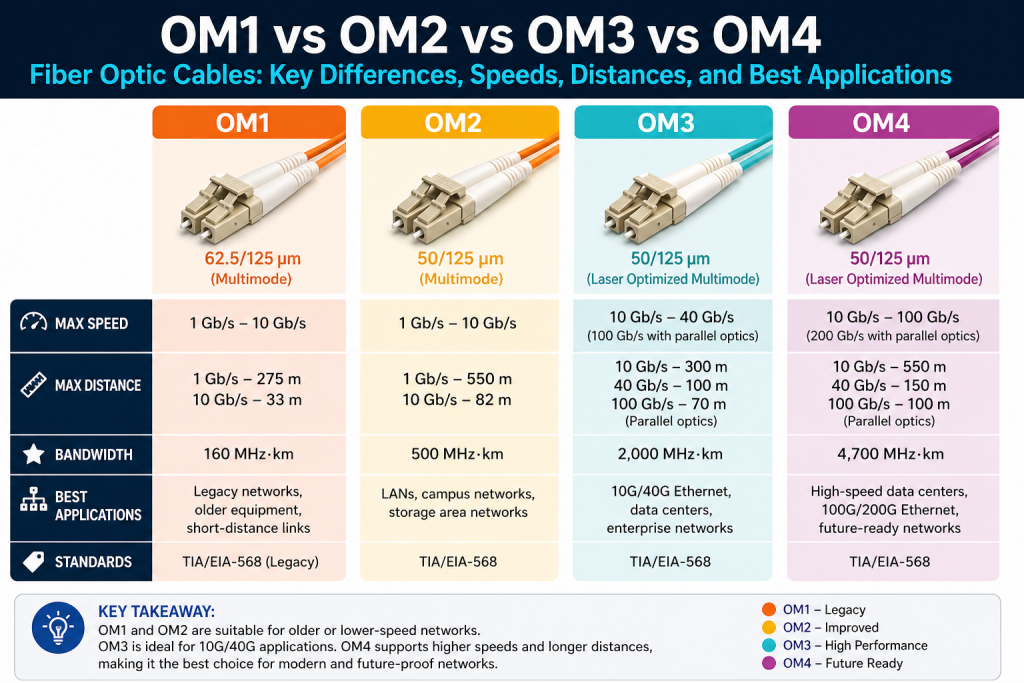
OM1 fiber represents one of the earliest generations of multi-mode fiber. It is characterized by a relatively large core diameter, typically around 62.5 microns. This larger core allows more light modes to propagate through the fiber, which can be beneficial for certain applications. However, it also increases the level of modal dispersion, which limits the cable’s performance.
In practical terms, OM1 fiber is capable of supporting data rates up to 10 gigabits per second, but only over very short distances. For example, at 10 gigabits per second, the maximum distance is typically around 33 meters. At lower data rates, such as 100 megabits per second or 1 gigabit per second, the cable can support longer distances, but these speeds are no longer sufficient for many modern applications.
OM1 fiber was widely used in the past for applications such as building networks and early data centers. However, its limitations make it unsuitable for most modern deployments. As a result, it is now considered obsolete and is rarely used in new installations.
Despite this, OM1 fiber can still be found in many legacy systems. Organizations that have older infrastructure may continue to use OM1 cables, especially if their performance requirements are relatively low. However, as these systems are upgraded, there is often a need to replace OM1 with more advanced fiber types.
Overview of OM2 Fiber
OM2 fiber was developed as an improvement over OM1, offering better performance while maintaining a similar level of cost and complexity. One of the key differences between OM1 and OM2 is the core diameter. OM2 typically has a smaller core size of 50 microns, which helps reduce modal dispersion and improve signal quality.
This improvement allows OM2 to support higher data rates over longer distances compared to OM1. For example, OM2 can support 10 gigabits per second over distances of up to approximately 82 meters. While this is a significant improvement over OM1, it is still limited compared to newer fiber types.
OM2 fiber was commonly used in enterprise networks and data centers during its peak adoption period. It provided a good balance between performance and cost, making it a popular choice for many organizations.
However, like OM1, OM2 has become less relevant in modern networking environments. The increasing demand for higher bandwidth and longer transmission distances has led to the adoption of more advanced fiber types such as OM3 and OM4.
Limitations of OM1 and OM2 in Modern Networks
As network technology has evolved, the limitations of OM1 and OM2 have become more apparent. One of the main challenges is their inability to support high-speed data transmission over long distances. This makes them unsuitable for many modern applications, such as high-performance computing, cloud services, and large-scale data centers.
Another limitation is their lack of scalability. Networks are constantly growing and evolving, and the infrastructure must be able to support future expansion. Using outdated fiber types can create bottlenecks that limit the ability to upgrade network performance.
In addition, modern networking standards and best practices no longer recommend the use of OM1 and OM2 for new installations. This means that organizations using these fiber types may face compatibility issues when integrating new equipment or technologies.
These limitations highlight the importance of transitioning to more advanced fiber types that can meet the demands of modern networking environments.
Identifying OM1 and OM2 in Existing Installations
For organizations with existing fiber infrastructure, it is important to be able to identify the type of fiber being used. This is especially relevant when planning upgrades or troubleshooting network issues.
One common method of identification is by examining the color of the cable jacket. OM1 and OM2 fibers typically have an orange outer jacket, which distinguishes them from newer fiber types. While this is not always a definitive indicator, it is a useful starting point.
Documentation and installation records can also provide valuable information about the type of fiber used. In some cases, specialized testing equipment may be required to accurately determine the characteristics of the fiber.
Understanding the existing infrastructure is a critical step in planning any network upgrade. It allows organizations to assess the limitations of their current setup and make informed decisions about future improvements.
The Importance of Backward Compatibility
When upgrading a network, backward compatibility is often a key consideration. Organizations may not be able to replace all of their existing infrastructure at once, so new components must be able to work with older systems.
In the case of fiber optic networks, this means ensuring that newer equipment can operate with older fiber types such as OM1 and OM2. While this is often possible, it can result in reduced performance due to the limitations of the older fiber.
Network designers must carefully evaluate the trade-offs between maintaining compatibility and achieving optimal performance. In some cases, it may be necessary to prioritize critical connections for upgrades while leaving less important links unchanged.
This approach allows organizations to gradually transition to more advanced fiber types without disrupting their operations.
The Role of Fiber in Modern Infrastructure
Fiber optic technology plays a vital role in supporting modern digital infrastructure. It enables high-speed communication between devices, supports large-scale data processing, and provides the foundation for advanced technologies such as cloud computing and the Internet of Things.
As the demand for data continues to grow, the importance of reliable and high-performance networking solutions will only increase. Fiber optic cabling is uniquely positioned to meet these demands, offering the speed, capacity, and reliability required for modern applications.
Within this context, understanding the different types of fiber and their capabilities is essential. It allows organizations to design networks that are not only efficient but also scalable and future-ready.
Preparing for the Next Generation of Fiber
The limitations of OM1 and OM2 have paved the way for the development of more advanced fiber types. OM3 and OM4 represent the next generation of multi-mode fiber, offering significantly improved performance in terms of bandwidth and distance.
These newer fiber types are designed to support the high-speed, high-capacity networks of today and tomorrow. They incorporate advanced materials and manufacturing techniques that reduce modal dispersion and improve signal quality.
As organizations continue to upgrade their networks, the transition to OM3 and OM4 is becoming increasingly common. This shift reflects the need for infrastructure that can keep pace with the rapid growth of data and technology.
In the next part, the focus will move to OM3 fiber, exploring its features, advantages, and the role it plays in modern networking environments.
Introduction to Modern Multi-Mode Fiber Advancements
As networking demands have grown more complex and data-intensive, the need for higher-performing cabling solutions has driven significant innovation in fiber optic technology. While earlier multi-mode fiber types such as OM1 and OM2 laid the groundwork for fiber adoption, their limitations in bandwidth and distance made them insufficient for modern environments. This gap led to the development of OM3 fiber, a major advancement that redefined what multi-mode fiber could achieve.
OM3 fiber represents a turning point in the evolution of fiber optics. It was specifically engineered to support higher data rates over longer distances while maintaining the cost advantages associated with multi-mode fiber. With the rise of virtualization, cloud computing, and high-density data centers, OM3 quickly became a preferred choice for organizations seeking reliable and scalable networking solutions.
Understanding OM3 fiber involves more than just recognizing its performance improvements. It requires an exploration of the technological advancements that made those improvements possible, as well as the practical applications that benefit from them.
What is OM3 Fiber Optic Cable
OM3 fiber is a type of laser-optimized multi-mode fiber designed to support high-speed data transmission using vertical-cavity surface-emitting lasers. Unlike earlier fiber types that were primarily optimized for LED light sources, OM3 is specifically built to handle laser-based transmission, which offers greater efficiency and precision.
One of the defining characteristics of OM3 fiber is its improved core quality. While it maintains the standard 50-micron core diameter found in OM2, the internal structure of the fiber is manufactured with much tighter tolerances. This results in better control of light propagation and significantly reduces modal dispersion.
Modal dispersion, which was a major limitation in earlier fiber types, occurs when different light modes travel at varying speeds and arrive at the destination at different times. By minimizing this effect, OM3 fiber can maintain signal integrity over longer distances, allowing for higher data rates without significant degradation.
OM3 fiber is typically identified by its aqua-colored outer jacket, which distinguishes it from older orange OM1 and OM2 cables. This color coding helps technicians quickly identify the type of fiber during installation and maintenance.
Performance Characteristics of OM3 Fiber
The performance improvements offered by OM3 fiber are substantial compared to its predecessors. One of the most notable enhancements is its ability to support significantly higher bandwidths. OM3 fiber can handle data rates of up to 100 gigabits per second, making it suitable for high-performance networking environments.
In addition to higher bandwidth, OM3 also supports longer transmission distances. For example, it can carry 10 gigabits per second over distances of up to 300 meters. At 40 and 100 gigabits per second, the maximum distance is typically around 100 meters. These capabilities make OM3 a versatile option for a wide range of applications.
Another important performance factor is its compatibility with modern networking equipment. Many high-speed transceivers and switches are designed to work optimally with OM3 fiber, ensuring efficient data transmission and minimal signal loss.
The combination of high bandwidth, extended distance, and compatibility with modern technologies makes OM3 a practical and reliable choice for organizations looking to upgrade their networks.
Advantages of OM3 Over Earlier Fiber Types
OM3 fiber offers several advantages over OM1 and OM2, making it a superior option for most modern networking applications. One of the most significant benefits is its ability to support higher data rates. This is essential in environments where large volumes of data need to be transmitted quickly and efficiently.
Another advantage is its improved transmission distance. The reduced modal dispersion allows OM3 to maintain signal quality over longer distances, which is particularly important in large buildings or campus networks.
OM3 also provides better scalability. As network demands increase, the ability to support higher speeds without replacing existing cabling becomes a major advantage. This makes OM3 a more future-ready solution compared to older fiber types.
Additionally, OM3 fiber is more energy-efficient when used with laser-based transmission systems. This can lead to lower operational costs over time, especially in large-scale deployments.
Applications of OM3 Fiber in Modern Networks
OM3 fiber is widely used in a variety of networking environments due to its balance of performance and cost. One of the most common applications is in data centers, where high-speed connections between servers, storage systems, and networking equipment are essential.
In data centers, OM3 is often used for interconnecting racks and rows of equipment. Its ability to support high data rates over moderate distances makes it ideal for these types of connections. It ensures that data can move بسرعة between systems without creating bottlenecks.
Campus networks are another area where OM3 fiber is frequently used. In these environments, buildings may be spread across a large area, requiring connections that can cover longer distances than traditional copper cables can handle. OM3 provides the necessary reach and bandwidth to connect these locations effectively.
Large wireless deployments also benefit from OM3 fiber. In places such as airports, stadiums, and large office complexes, numerous access points need to be connected to the network. OM3 allows these connections to maintain high performance even when spread across wide areas.
Enterprise networks, healthcare facilities, and educational institutions also rely on OM3 fiber to support their networking needs. Its versatility and reliability make it a popular choice across many industries.
Cost Considerations for OM3 Fiber
While OM3 fiber offers significant performance improvements, it is also more expensive than older fiber types such as OM1 and OM2. The advanced materials and manufacturing processes required to produce OM3 contribute to its higher cost.
However, when evaluating cost, it is important to consider the long-term benefits. The increased bandwidth and scalability of OM3 can reduce the need for future upgrades, which can offset the initial investment. In many cases, the total cost of ownership is lower when using OM3 compared to repeatedly upgrading lower-performance cabling.
Organizations must carefully assess their budget and performance requirements when choosing a fiber type. For environments that require high-speed connectivity and moderate distances, OM3 often provides the best balance between cost and performance.
Compatibility and Integration
One of the key advantages of OM3 fiber is its compatibility with a wide range of networking equipment. Modern switches, routers, and transceivers are often designed to work with OM3, ensuring optimal performance.
OM3 is also backward compatible with older multi-mode fiber types, although performance will be limited by the weakest component in the system. This allows organizations to gradually upgrade their infrastructure without needing to replace all existing cabling at once.
Integration with existing systems is typically straightforward, but it requires careful planning to ensure that all components work together effectively. Proper installation and testing are essential to achieve the desired performance.
Limitations of OM3 Fiber
Despite its many advantages, OM3 fiber is not without limitations. One of the primary constraints is its maximum transmission distance at higher data rates. While it performs well up to 100 meters at 100 gigabits per second, longer distances may require more advanced fiber types.
Another limitation is its scalability compared to newer options such as OM4. While OM3 can support many current applications, future technologies may demand even higher bandwidth and longer distances than it can provide.
In environments where extremely high performance is required, OM3 may not be sufficient. In such cases, organizations may need to consider upgrading to more advanced fiber types.
The Role of OM3 in Network Design
OM3 fiber plays a critical role in modern network design. It provides a reliable and cost-effective solution for high-speed data transmission over moderate distances. Network architects often choose OM3 for its balance of performance, cost, and scalability.
When designing a network, it is important to consider factors such as distance, data rate requirements, and future growth. OM3 is well-suited for environments where these factors align with its capabilities.
Proper planning and implementation are essential to maximize the benefits of OM3 fiber. This includes selecting the right components, ensuring proper installation, and conducting thorough testing.
Preparing for Higher Performance Needs
As technology continues to advance, the demand for even higher performance networking solutions is expected to grow. While OM3 meets many current requirements, organizations must also consider future needs when designing their infrastructure.
This is where OM4 fiber comes into play. Building on the foundation established by OM3, OM4 offers even greater bandwidth and longer transmission distances. It is designed to support the next generation of high-speed networking applications.
Understanding the capabilities and limitations of OM3 provides a solid foundation for exploring more advanced fiber types. In the next part, the focus will shift to OM4, examining how it further enhances performance and supports future-ready network designs.
Introduction to OM4 Fiber and Next-Level Performance
As network technologies continue to evolve, the demand for higher speeds, lower latency, and greater scalability has pushed fiber optic innovation even further. While OM3 fiber brought significant improvements over earlier generations, it was not the endpoint of development. The introduction of OM4 fiber marked another major advancement in multi-mode fiber technology, offering even greater bandwidth and extended transmission distances.
OM4 fiber is designed to meet the needs of modern and future networking environments, where data traffic continues to grow at an exponential rate. From hyperscale data centers to high-performance computing environments, OM4 provides the performance required to handle massive volumes of data efficiently. It builds upon the strengths of OM3 while addressing its limitations, making it one of the most capable multi-mode fiber types available today.
Understanding OM4 is essential for anyone planning to design or upgrade a network with long-term performance in mind. It represents not just an incremental improvement, but a significant leap in capability that enables organizations to stay ahead of growing technological demands.
What is OM4 Fiber Optic Cable
OM4 fiber is an advanced form of laser-optimized multi-mode fiber that offers superior performance compared to OM3. Like OM3, it uses a 50-micron core, but the quality of the glass and the precision of the manufacturing process are further enhanced. These improvements result in even lower modal dispersion and better control of light transmission.
The reduced modal dispersion allows OM4 to support higher data rates over longer distances without significant signal degradation. This makes it particularly well-suited for high-speed networking applications where maintaining signal integrity is critical.
OM4 fiber is typically identified by its aqua-colored jacket, although some variants may use a violet or magenta color to distinguish them from OM3. These color differences help technicians quickly identify the cable type during installation and maintenance.
In terms of design, OM4 is optimized for use with laser-based transmission systems, which provide greater efficiency and precision compared to older LED-based systems. This optimization is a key factor in its enhanced performance capabilities.
Performance Capabilities of OM4 Fiber
OM4 fiber offers a substantial increase in performance compared to OM3. One of its most notable features is its ability to support extremely high data rates. OM4 can handle speeds of up to 400 gigabits per second, making it suitable for the most demanding networking environments.
In addition to higher speeds, OM4 also supports longer transmission distances. For example, it can carry 10 gigabits per second over distances of up to 550 meters, which is a significant improvement over OM3. At 100 and 400 gigabits per second, OM4 can typically support distances of around 125 meters.
These performance characteristics make OM4 an ideal choice for applications that require both high bandwidth and extended reach. It provides the flexibility needed to design networks that can handle current demands while also accommodating future growth.
Another important aspect of OM4 performance is its ability to maintain signal quality under heavy data loads. This reliability is essential in environments where downtime or data loss can have serious consequences.
Advantages of OM4 Over OM3
While OM3 is already a high-performance fiber type, OM4 takes things a step further. One of the primary advantages of OM4 is its increased bandwidth capacity. This allows it to support higher data rates without requiring additional infrastructure.
Another key advantage is its extended transmission distance. This is particularly beneficial in large facilities or campus environments where connections may need to span greater distances. With OM4, fewer repeaters or additional equipment are required, simplifying network design.
OM4 also offers better future-proofing. As technology continues to advance, networks will require higher speeds and greater capacity. Installing OM4 fiber ensures that the infrastructure is ready to support these future requirements without the need for costly upgrades.
In addition, OM4 provides improved performance in high-density environments, such as data centers. Its ability to handle large volumes of data efficiently makes it a reliable choice for critical applications.
Applications of OM4 Fiber
OM4 fiber is used in a wide range of applications where high performance is essential. One of the most common uses is in data center backbones. These are the main pathways that connect different parts of the data center, and they require high-speed, high-capacity connections.
In large-scale data centers, OM4 is often used to connect servers, storage systems, and networking equipment. Its ability to support high data rates over moderate distances makes it ideal for these environments.
Campus networks also benefit from OM4 fiber. In situations where multiple buildings need to be connected, OM4 provides the necessary bandwidth and distance to ensure reliable communication.
High-performance computing environments, such as research institutions and financial organizations, also rely on OM4 fiber. These environments require fast and reliable data transfer to support complex calculations and real-time processing.
OM4 is also used in large wireless deployments, where numerous access points need to be connected to a central network. Its performance ensures that these connections can handle high levels of traffic without degradation.
Cost and Investment Considerations
One of the main factors to consider when choosing OM4 fiber is cost. OM4 is generally more expensive than OM3 due to its advanced materials and manufacturing processes. This higher initial investment can be a concern for organizations with limited budgets.
However, it is important to look beyond the upfront cost and consider the long-term benefits. OM4’s higher performance and scalability can reduce the need for future upgrades, which can result in significant cost savings over time.
In addition, the ability to support higher data rates and longer distances can improve overall network efficiency. This can lead to better performance and reduced operational costs, making OM4 a worthwhile investment in many cases.
Organizations must carefully evaluate their current and future needs when deciding whether to invest in OM4. For environments that require the highest levels of performance, the benefits often outweigh the costs.
OM3 vs OM4 Key Differences
When comparing OM3 and OM4, three main factors stand out: bandwidth, distance, and cost. OM4 offers higher bandwidth and longer transmission distances, making it the more capable option. However, this comes at a higher cost.
For shorter distances and moderate performance requirements, OM3 may be sufficient. It provides a good balance between cost and capability, making it a popular choice for many applications.
On the other hand, OM4 is better suited for environments that require maximum performance or where future scalability is a priority. Its enhanced capabilities make it a more future-ready solution.
The choice between OM3 and OM4 ultimately depends on the specific needs of the network. Factors such as distance, data rate requirements, and budget all play a role in the decision-making process.
Factors to Consider When Choosing Fiber Type
Selecting the right fiber type involves evaluating several important factors. One of the most critical considerations is network requirements. This includes the data rates that need to be supported and the distances over which data must be transmitted.
In addition to speed and distance, it is also important to consider the type of applications that will run on the network. For example, environments that rely heavily on cloud computing, virtualization, or real-time communication tools such as video conferencing and VoIP require consistent high bandwidth and low latency. These types of workloads can quickly expose the limitations of lower-grade fiber, making it essential to choose a cable that can handle peak demand without performance drops.
Another key aspect is the physical layout of the network. The design of a building, campus, or data center can influence the choice of fiber type. Longer cable runs between floors, departments, or buildings may require higher-performance fiber such as OM3 or OM4 to maintain signal quality. In contrast, shorter connections within a single room or rack may not require the same level of performance, allowing for more cost-effective options.
Future growth should also be taken into account when evaluating network requirements. Organizations rarely maintain static networks; instead, they expand over time as new users, devices, and services are added. Choosing a fiber type that not only meets current needs but also supports future upgrades can prevent costly replacements later. This forward-thinking approach is especially important in rapidly evolving industries where technology adoption is accelerating.
Environmental factors can also play a role in decision-making. Conditions such as temperature variations, electromagnetic interference, and physical stress on cables can impact performance and durability. While fiber is generally resistant to interference, proper installation and protection are still necessary to ensure long-term reliability.
By carefully analyzing these factors, organizations can select a fiber solution that delivers optimal performance, supports future expansion, and aligns with both technical and budgetary requirements.
Another important factor is future scalability. Networks are constantly evolving, and it is important to choose a solution that can accommodate future growth. OM4 offers greater scalability, making it a strong candidate for long-term deployments.
Budget is also a key consideration. While OM4 provides superior performance, it may not be necessary for all applications. Organizations must balance performance needs with financial constraints to make the best decision.
Environmental factors, such as the physical layout of the network and potential interference, should also be taken into account. These factors can influence the choice of fiber and the overall design of the network.
The Role of Fiber in Future Networking
As technology continues to advance, the importance of fiber optic cabling will only increase. Emerging technologies such as artificial intelligence, 5G, and the Internet of Things are expected to generate massive amounts of data. Supporting these technologies will require high-performance networking solutions.
These innovations are not only increasing the volume of data being created but also changing how quickly that data needs to be processed and delivered. Artificial intelligence applications rely on real-time data analysis to make decisions, which demands ultra-low latency and extremely fast data transfer speeds. Similarly, 5G networks are designed to support millions of connected devices simultaneously, from smartphones to smart infrastructure, all requiring seamless and uninterrupted connectivity. The Internet of Things further expands this demand by connecting everyday objects such as sensors, vehicles, and appliances to the network, creating a constant flow of information.
Fiber optic cabling plays a critical role in enabling this ecosystem by providing the bandwidth and reliability needed to handle such intense workloads. Unlike traditional copper cables, fiber can transmit data over long distances without significant signal loss, ensuring consistent performance even under heavy demand. This makes it an ideal solution for backbone networks, data centers, and edge computing environments where speed and efficiency are essential.
In addition, the scalability of fiber optic networks allows organizations to expand their infrastructure as demand grows. Instead of replacing existing cabling, many fiber systems can support upgrades simply by changing the transmission equipment. This flexibility reduces long-term costs and minimizes disruption during network expansion.
As digital transformation continues across industries, from healthcare and education to finance and manufacturing, the reliance on high-speed connectivity will only deepen. Fiber optic technology provides the foundation needed to support these advancements, ensuring that networks remain capable of meeting both current and future demands.
Fiber optic technology is uniquely suited to meet these demands. Its ability to provide high-speed, high-capacity connections makes it an essential component of future networks.
OM4, in particular, is well-positioned to support these advancements. Its high bandwidth and extended reach make it capable of handling the increasing demands of modern and future applications.
Investing in advanced fiber infrastructure today can help organizations prepare for the challenges of tomorrow. It ensures that networks remain efficient, reliable, and scalable as technology continues to evolve.
Conclusion
Fiber optic cabling has transformed the way data is transmitted, enabling the high-speed, high-capacity networks that power today’s digital world. Within the realm of multi-mode fiber, the progression from OM1 and OM2 to OM3 and OM4 reflects the ongoing evolution of technology to meet growing demands.
OM1 and OM2, while important in the early days of networking, are now largely obsolete due to their limitations in bandwidth and distance. OM3 introduced significant improvements, making it a widely used solution for modern networks. OM4 builds upon these advancements, offering even greater performance and scalability.
Choosing between OM3 and OM4 depends on a variety of factors, including network requirements, budget, and future growth plans. While OM3 provides a cost-effective solution for many applications, OM4 offers the highest level of performance and is better suited for environments that demand maximum capability.
Ultimately, understanding the differences between these fiber types allows organizations to make informed decisions when designing or upgrading their networks. By selecting the right fiber, they can ensure reliable performance, support future growth, and maximize the value of their investment.
Continue exploring the technologies and certification concepts that matter most to you.