Modern organizations operate in a business environment defined by constant transformation. Companies are under pressure to launch products faster, adapt to customer feedback quickly, improve internal operations continuously, and respond to changing markets with speed and precision. Traditional project management methods, while still valuable in many industries, are often too rigid for organizations that need flexibility and iterative development. This shift has fueled the widespread adoption of agile methodologies across technology, healthcare, finance, manufacturing, education, and even government sectors.
As agile practices become deeply integrated into business operations, employers are increasingly looking for professionals who can successfully manage agile projects, lead adaptive teams, and deliver value in dynamic environments where priorities, technologies, and customer expectations can shift rapidly. Organizations no longer view agility solely as a project methodology; instead, it is often treated as a strategic capability that supports innovation, resilience, and competitive responsiveness. This shift has created growing demand for individuals who not only understand agile principles but can also apply them effectively across departments, products, and transformation initiatives.
As a result, certifications that validate agile expertise have gained significant importance in hiring, promotion, and leadership development decisions. Among these, the PMI Agile Certified Practitioner (PMI-ACP) has emerged as one of the most recognized and respected credentials due to its broad framework coverage, professional credibility, and emphasis on practical experience. Unlike certifications focused narrowly on a single methodology, PMI-ACP demonstrates proficiency across multiple agile approaches, including Scrum, Kanban, Lean, and hybrid models. This versatility can make certified professionals more attractive to organizations navigating complex delivery systems. For employers, PMI-ACP may signal that a candidate possesses not only technical agile knowledge but also the leadership mindset, adaptability, and strategic awareness required to succeed in modern business ecosystems. For professionals, it can provide a competitive edge in an increasingly agile-driven global workforce.
The PMI-ACP certification is offered by the Project Management Institute (PMI), an organization already known globally for setting project management standards. Unlike certifications focused solely on one agile framework, PMI-ACP validates broad agile knowledge across multiple approaches, including Scrum, Kanban, Lean, and hybrid strategies. This flexibility makes it particularly appealing for professionals who want to demonstrate practical, cross-functional agile capabilities.
For many aspiring project managers, Scrum Masters, Agile Coaches, Product Owners, and delivery leaders, the key question is straightforward: Is the PMI-ACP certification truly worth the investment of time, money, and effort?
Answering this question requires examining not just the exam itself, but the broader career opportunities, salary potential, professional credibility, eligibility requirements, and long-term strategic value associated with becoming PMI-ACP certified.
The Evolution of Agile and Why Certification Matters
Agile began as a response to the limitations of heavily structured project models. Businesses realized that long planning cycles and inflexible project phases often delayed innovation. Agile frameworks introduced principles centered on collaboration, iterative delivery, continuous feedback, and rapid adaptation.
Today, agile is no longer limited to software development. Enterprises use agile in product design, digital transformation, operations management, customer experience programs, and strategic planning. As agile expands, organizations need professionals who not only understand agile terminology but can also implement agile values effectively across teams and departments.
This is where certification becomes important.
Employers often receive applications from candidates who claim agile experience, but without standardized validation, assessing expertise can be difficult. Certifications provide a measurable benchmark. PMI-ACP stands out because it demonstrates not only agile knowledge but also real-world experience and structured learning.
For hiring managers, PMI-ACP can serve as evidence that a candidate understands agile beyond theory. It suggests familiarity with practical delivery models, stakeholder collaboration, leadership strategies, and adaptive project execution.
For professionals, certification offers a competitive edge. In crowded job markets, credentials can differentiate one candidate from another, especially when both have similar work histories.
What Makes PMI-ACP Different from Other Agile Certifications
The agile certification market includes many options, such as Certified ScrumMaster (CSM), Professional Scrum Master (PSM), SAFe certifications, and other specialized credentials. PMI-ACP distinguishes itself in several important ways.
First, PMI-ACP is methodology-diverse. Instead of focusing solely on Scrum, it includes knowledge of multiple agile philosophies and delivery methods. This broader scope can be highly valuable in organizations that use blended or hybrid project models.
Second, PMI-ACP requires documented agile project experience before certification. This requirement increases its credibility because it is not designed purely for beginners without practical exposure.
Third, PMI’s reputation as a leading project management authority adds prestige to the certification. For professionals already familiar with PMI through PMP or CAPM pathways, PMI-ACP can align well with broader project career goals.
This combination of flexibility, rigor, and institutional recognition makes PMI-ACP particularly useful for professionals seeking broader career mobility rather than narrow framework specialization.
Why PMI-ACP Demand Continues to Rise
Several workplace trends are contributing to the increased value of PMI-ACP certification.
Enterprise Agile Transformation
Large organizations are moving beyond isolated agile teams and adopting enterprise-wide agile operating models. This requires leaders who understand scaling, collaboration, and adaptive governance.
Hybrid Project Management Growth
Many companies use a combination of agile and traditional project management. Professionals who can bridge both worlds are especially valuable.
Digital Transformation
As companies modernize systems and customer experiences, agile becomes central to innovation delivery.
Remote and Distributed Teams
Agile frameworks often support continuous communication and flexibility, which are essential in remote environments.
Product-Centric Business Models
Organizations increasingly prioritize product lifecycle management over one-time project delivery, creating demand for agile practitioners.
Because of these trends, professionals with PMI-ACP certification may find themselves better positioned for both immediate job opportunities and future leadership roles.
Career Paths Supported by PMI-ACP Certification
PMI-ACP is not tied to one single job title. Instead, it supports a wide variety of career directions.
Common career roles include:
- Agile Project Manager
- Scrum Master
- Product Owner
- Agile Coach
- Program Manager
- Delivery Manager
- Transformation Lead
- Business Analyst in Agile Environments
- Product Development Manager
- Agile Consultant
This versatility is one of PMI-ACP’s major strengths. Rather than confining a professional to one framework, it supports career progression across multiple agile ecosystems.
For example, someone beginning as a Scrum team facilitator may later move into enterprise agile coaching, portfolio management, or strategic delivery oversight.
Salary Potential and Financial Return
One of the biggest reasons professionals pursue certification is increased earning potential.
While salary varies by geography, industry, and experience level, agile-certified professionals often command stronger compensation than peers without formal credentials. This is especially true in industries where agile maturity is considered a competitive advantage.
Higher salaries may result from:
- Greater credibility during hiring
- Qualification for leadership positions
- Improved promotion opportunities
- Expanded consulting possibilities
- Increased access to enterprise transformation roles
The PMI-ACP certification can also support freelance or contract work, where credentials often help secure trust quickly with clients or organizations.
When evaluating return on investment, professionals should compare certification costs with potential salary growth over multiple years. Even modest salary increases may outweigh exam and training costs quickly.
Who Benefits Most from PMI-ACP?
Not every professional will gain equal value from this certification. PMI-ACP tends to provide the strongest return for certain groups.
Early-Career Agile Professionals
Those already working in agile teams but lacking formal credentials can use PMI-ACP to validate experience and strengthen advancement potential.
Mid-Career Project Managers
Traditional project managers transitioning toward agile roles may use PMI-ACP to modernize their qualifications.
Scrum Masters Seeking Broader Recognition
Professionals with Scrum-only backgrounds may benefit from PMI-ACP’s wider methodology coverage.
Consultants and Coaches
Those advising organizations on process improvement can leverage PMI-ACP to boost authority.
PMP Holders Expanding Skill Sets
Experienced project managers can complement traditional expertise with agile validation.
When PMI-ACP May Not Be the Best Fit
Although valuable, PMI-ACP is not universally ideal.
Professionals in heavily regulated sectors with little agile adoption may see limited immediate benefit.
Similarly, complete beginners with no project or agile experience may struggle to meet eligibility requirements or fully capitalize on certification value.
In such cases, foundational certifications or practical experience may be better first steps.
Strategic Career Positioning
A common comparison is PMI-ACP versus PMP.
PMP is broader in overall project management and often emphasizes predictive planning.
PMI-ACP is specialized in agile adaptability.
For many professionals, the choice is not either/or but rather sequencing. PMI-ACP can serve as an accessible agile-focused credential, while PMP may later support executive-level project leadership.
This layered strategy can create powerful long-term career flexibility.
Professional Credibility Beyond Job Hunting
Certification value extends beyond securing employment.
PMI-ACP can also improve:
- Internal organizational credibility
- Leadership confidence
- Team trust
- Client perception
- Cross-functional communication
Being certified may also enhance your ability to contribute meaningfully to agile transformation discussions, process redesign, and innovation initiatives.
The Learning Journey Itself
Preparing for PMI-ACP often deepens knowledge significantly, even before passing the exam.
Candidates typically strengthen understanding of:
- Agile principles
- Team dynamics
- Stakeholder engagement
- Continuous improvement
- Value delivery
- Risk adaptation
- Iterative planning
This learning can immediately improve workplace effectiveness, regardless of certification outcome.
The Broader Professional Landscape
As organizations prioritize resilience and speed, certifications that validate adaptability are becoming more relevant.
PMI-ACP aligns with broader shifts toward:
- Change management
- Product thinking
- Continuous delivery
- Organizational agility
This means the certification’s value may extend beyond current job roles into future strategic business trends.
Long-Term Value Considerations
The true worth of PMI-ACP often depends on how professionals use it.
Certification alone does not guarantee career transformation. However, when combined with practical experience, networking, ongoing education, and strong performance, it can significantly enhance trajectory.
Professionals who actively apply agile principles, pursue leadership opportunities, and continue skill development often see the strongest returns.
Understanding the Commitment Behind PMI-ACP Certification
While the PMI Agile Certified Practitioner certification can offer strong professional advantages, earning it requires more than simply registering for an exam. PMI-ACP is designed to validate real-world agile competence, which means candidates must meet eligibility requirements, complete formal training, prepare strategically, and maintain the credential over time.
For many professionals, this structure is one of the reasons PMI-ACP holds weight in the job market. It is not just a theoretical exam or a short online badge. PMI expects candidates to demonstrate prior agile exposure, educational investment, and a commitment to ongoing professional development.
Understanding these requirements in detail is essential before deciding whether the certification aligns with your goals. Beyond passing the exam, candidates should think of PMI-ACP as a career-building process that combines experience, education, and discipline.
Who Can Apply for PMI-ACP?
PMI designed the certification for professionals who already have some level of agile project experience. This distinguishes PMI-ACP from beginner-focused certifications that may not require any hands-on exposure.
To qualify, candidates generally need a secondary degree, such as a high school diploma, GED, associate degree, or global equivalent. This educational baseline makes the certification accessible to a broad professional audience without requiring a university degree.
However, education alone is not enough.
Applicants must also complete 28 contact hours of formal training in agile practices. This training must focus on agile frameworks, methodologies, and practical implementation. The purpose is to ensure candidates have structured exposure to agile principles before attempting certification.
In addition, PMI requires agile project experience. Candidates typically qualify through one of several pathways, such as:
- Recent agile project experience over a defined period
- Agile experience combined with a recognized agile degree or accreditation
- Agile experience paired with a third-party agile certification
- Active PMP certification combined with agile eligibility
This flexible structure allows professionals from different backgrounds to qualify while still maintaining meaningful standards.
Why Experience Requirements Matter
The agile industry contains many professionals with theoretical knowledge but limited practical implementation experience. PMI’s experience requirements help distinguish PMI-ACP holders from candidates who may only understand terminology.
This requirement increases employer trust because certified individuals are more likely to have encountered:
- Sprint planning challenges
- Team communication barriers
- Stakeholder expectation shifts
- Delivery obstacles
- Product reprioritization
- Continuous feedback cycles
In practice, agile environments are rarely textbook-perfect. Real-world experience helps candidates understand how frameworks function under pressure, uncertainty, and changing priorities.
For professionals considering PMI-ACP, this means documenting your experience carefully is a critical step.
The 28 Hours of Agile Training: More Than a Checkbox
Many candidates initially view the mandatory agile education requirement as a procedural hurdle. In reality, quality training can become one of the most valuable parts of the certification journey.
Effective PMI-ACP preparation courses often cover:
- Agile Manifesto principles
- Scrum framework
- Kanban systems
- Lean methodologies
- Extreme Programming concepts
- Stakeholder engagement
- Team empowerment
- Risk management in agile environments
- Adaptive planning
- Value-driven delivery
This broad scope reflects PMI-ACP’s emphasis on agile versatility rather than narrow framework specialization.
Choosing the right training provider can significantly affect exam readiness. Some courses focus heavily on memorization, while stronger programs emphasize practical understanding and situational application.
For many professionals, this training also exposes gaps in their current work practices, improving immediate job performance even before certification.
What Candidates Should Expect
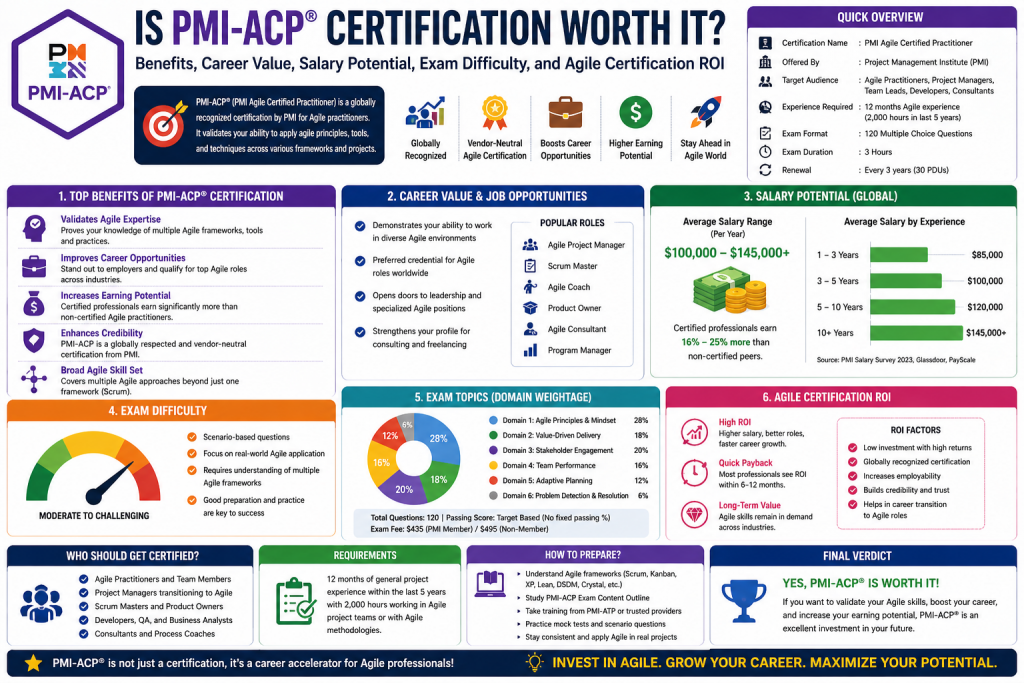
The PMI-ACP exam is designed to test both conceptual understanding and practical application. It includes 120 multiple-choice questions, delivered over 180 minutes.
The exam structure requires candidates to maintain focus for a sustained period while navigating situational and principle-based questions. This is not merely a memory test. PMI emphasizes interpretation, decision-making, and agile judgment.
Questions often challenge candidates to evaluate scenarios involving:
- Team conflict
- Delivery prioritization
- Stakeholder communication
- Leadership behavior
- Product quality
- Process adaptation
- Agile principles in action
Because agile is rooted in mindset as much as mechanics, many exam questions test whether candidates truly understand agile philosophy.
The Four Core Knowledge Areas
PMI organizes the exam into four primary domains, each reflecting a major dimension of agile competence.
Mindset
This domain focuses on agile principles, values, and philosophy. Candidates must understand the reasoning behind agile, not just ceremonies or tools.
Leadership
This area evaluates servant leadership, team support, conflict resolution, and collaborative decision-making.
Product
This domain explores delivering customer value, backlog prioritization, product evolution, and adaptive requirements.
Delivery
This section emphasizes execution, iteration, quality, metrics, and sustainable project progression.
Together, these domains ensure PMI-ACP candidates are assessed holistically.
The Shift from Memorization to Applied Thinking
One common challenge for candidates is underestimating the exam’s situational complexity.
Many professionals assume reading definitions of Scrum, Kanban, or Lean is enough. In reality, PMI-ACP often tests judgment under changing conditions.
For example, a question may ask how an agile leader should respond when customer priorities shift late in a sprint or when team velocity declines unexpectedly.
Success depends on understanding:
- Agile values
- Team autonomy
- Customer collaboration
- Incremental delivery
- Sustainable pace
This means practice exams are essential, but they should be paired with conceptual mastery.
Budgeting Beyond the Exam Fee
Certification costs extend beyond the registration price.
The exam fee itself varies depending on PMI membership status, with members generally receiving discounted rates. This can make PMI membership strategically worthwhile for some candidates.
However, candidates should also budget for:
- Training programs
- Practice exams
- Study guides
- Flashcards
- Retake fees if necessary
- PMI membership dues
- Continuing education costs
When evaluating cost, professionals should think in terms of total investment rather than exam registration alone.
For serious candidates, investing in high-quality preparation often reduces long-term costs by improving first-attempt success probability.
Is It Worth Considering?
PMI membership can reduce exam fees and offer access to educational resources, networking communities, and professional tools.
Potential benefits include:
- Lower certification pricing
- Access to PMI publications
- Career development resources
- Local chapter networking
- PDU opportunities
For professionals planning to pursue multiple PMI credentials or remain active in project leadership communities, membership may offer added value.
How to Build an Effective Study Plan
Preparing for PMI-ACP requires structure.
A successful study strategy often includes:
Foundational Learning
Start with agile principles, frameworks, and terminology.
Framework Comparison
Understand differences between Scrum, Kanban, Lean, and hybrid approaches.
Scenario Practice
Use practice questions to build situational judgment.
Time Management
Simulate full-length exam sessions to improve pacing.
Weakness Review
Identify recurring knowledge gaps and reinforce them.
Many candidates benefit from studying over several weeks or months rather than cramming.
Common Preparation Mistakes
Several avoidable mistakes can reduce success rates:
Over-Focusing on Scrum Alone
PMI-ACP covers broader agile methodologies.
Ignoring Agile Philosophy
Mindset matters as much as mechanics.
Skipping Practice Exams
Without scenario repetition, real exam questions may feel unfamiliar.
Underestimating Time Pressure
Three hours can feel shorter than expected.
Passive Study
Reading alone is often insufficient without active testing.
Maintaining PMI-ACP Certification
Certification does not end after passing.
PMI-ACP holders must earn Professional Development Units over each certification cycle to maintain active status.
This maintenance process encourages continued learning and ensures certification holders remain aligned with evolving practices.
PDUs may come from:
- Courses
- Conferences
- Webinars
- Teaching
- Professional contribution
This ongoing requirement supports long-term professional growth.
How PMI-ACP Preparation Can Improve Your Current Career Immediately
Even before certification, preparing for PMI-ACP can improve workplace performance.
Candidates often report stronger capabilities in:
- Sprint planning
- Team communication
- Prioritization
- Customer alignment
- Agile coaching
- Delivery improvement
This means certification preparation itself can generate returns before credential completion.
Psychological Preparation: Confidence and Mindset
Exam success also depends on confidence.
Candidates should approach PMI-ACP as a professional validation process rather than an academic obstacle.
Key mindset strategies include:
- Focus on understanding, not memorization
- Practice calm under time pressure
- Learn agile values deeply
- Prioritize consistency over intensity
Because PMI-ACP tests adaptive thinking, a calm analytical mindset often improves outcomes.
Choosing Between Self-Study and Structured Courses
Some professionals succeed through independent study, while others benefit from instructor-led programs.
Self-Study Advantages
- Lower cost
- Flexible scheduling
- Personalized pacing
Structured Course Advantages
- Guided curriculum
- Accountability
- Practice resources
- Expert explanations
The best choice depends on prior experience, discipline, and learning style.
Global Recognition and Professional Portability
PMI’s global presence gives PMI-ACP value across industries and regions.
This can be especially helpful for professionals seeking:
- International opportunities
- Remote leadership roles
- Consulting engagements
- Cross-industry transitions
Because agile is increasingly universal, broad certification recognition can enhance career mobility.
PMI-ACP in the Bigger Career Picture
Earning the PMI Agile Certified Practitioner credential is not simply about passing an exam or adding another certification to your résumé. Its real value becomes clearer when viewed through the lens of long-term career strategy, where credentials are evaluated not only by immediate job prospects but also by how effectively they position professionals for future relevance and leadership. Agile is no longer limited to software teams or startup environments. It has become a core operational philosophy for organizations seeking speed, flexibility, innovation, and customer-centric delivery across sectors such as healthcare, finance, manufacturing, education, and public services. As industries continue to evolve, PMI-ACP can represent more than technical knowledge—it can symbolize adaptability, leadership readiness, and professional modernization.
It signals that a professional understands how to navigate uncertainty, lead iterative progress, and contribute to environments where change is constant. This broader significance can make PMI-ACP particularly valuable for individuals who want to remain competitive in markets increasingly shaped by digital transformation and operational agility. Beyond methodology, it reflects a willingness to embrace continuous improvement, collaborative problem-solving, and strategic responsiveness. For employers, this may indicate a candidate prepared not just to manage projects, but to help organizations evolve. For professionals, it can serve as both a validation of current expertise and a strategic investment in sustained career growth, resilience, and leadership potential in an increasingly adaptive business world.
However, not every professional will benefit equally from this certification. The return on investment depends on career stage, industry direction, existing credentials, and long-term goals. For some, PMI-ACP can accelerate advancement dramatically. For others, it may serve better as a complementary credential rather than a primary career asset.
Understanding who should pursue PMI-ACP, when it offers the most value, and how it fits into broader professional development is essential before making the investment.
Ideal Candidates for PMI-ACP Certification
PMI-ACP is most beneficial for professionals who either work directly in agile environments or intend to transition into roles where agile expertise is increasingly expected.
Early-Career Agile Practitioners
Professionals who already participate in agile teams but have limited formal recognition often benefit substantially. These individuals may be serving as junior Scrum facilitators, project coordinators, product support specialists, or team contributors. PMI-ACP can formalize their practical knowledge and help validate capabilities beyond day-to-day experience.
For this group, certification often serves as a credibility multiplier. It may improve visibility for promotion, leadership opportunities, or movement into specialized agile positions.
Mid-Level Project Managers Transitioning from Traditional Models
Many experienced project managers built careers around predictive planning or waterfall methodologies. As organizations adopt agile frameworks, these professionals may face pressure to modernize their skill sets.
PMI-ACP offers a structured way to bridge this gap. It demonstrates that a project manager can evolve beyond rigid planning and adapt to iterative, collaborative delivery systems.
For these professionals, PMI-ACP can function as a reinvention tool, helping preserve career relevance in changing markets.
Scrum Masters Seeking Broader Validation
Scrum-specific certifications can be valuable, but they may signal specialization in one framework rather than broader agile fluency. PMI-ACP expands beyond Scrum into Kanban, Lean, and hybrid practices, which can increase versatility.
Scrum Masters who want to pursue larger enterprise leadership roles may find PMI-ACP particularly useful because it broadens perceived strategic capability.
Consultants and Agile Coaches
For consultants, credibility often determines opportunity. Clients and employers frequently assess not just experience, but formal validation. PMI-ACP can strengthen trust, especially when consulting across industries with varying agile maturity levels.
Product and Delivery Leaders
Professionals involved in product development, customer value optimization, and iterative delivery can use PMI-ACP to reinforce their expertise in adaptive leadership.
Industries Where PMI-ACP Can Deliver Strongest Value
While agile originated largely in software development, PMI-ACP’s usefulness now extends far beyond technology.
Technology and Software
This remains the most obvious environment, with roles in product delivery, SaaS operations, DevOps collaboration, and software transformation.
Healthcare
Healthcare organizations increasingly use agile for digital systems, process improvement, and patient experience innovation.
Finance
Banks, fintech firms, and insurance organizations often adopt agile for compliance modernization, digital products, and operational efficiency.
Manufacturing
Lean and agile principles often overlap in manufacturing transformation efforts.
Education
Agile frameworks are increasingly applied to institutional change and digital learning initiatives.
Government and Public Sector
Many agencies now seek adaptive delivery models for modernization programs.
This broad relevance enhances PMI-ACP’s strategic flexibility.
When PMI-ACP May Offer Limited Immediate Benefit
Although PMI-ACP is valuable, it is not universally necessary.
Professionals in Static Operational Roles
If your role has little connection to project delivery, team leadership, or organizational transformation, PMI-ACP may have limited immediate relevance.
Highly Specialized Technical Experts
Professionals whose advancement depends more on deep technical specialization than delivery management may see stronger ROI from domain-specific certifications.
Traditional Industries with Minimal Agile Adoption
Some sectors still rely heavily on predictive project structures. In such environments, PMI-ACP may provide future value but not immediate leverage.
This does not mean the certification lacks worth—it simply means strategic timing matters.
Strategic Positioning
A major decision professionals face is whether PMI-ACP is the right agile certification compared with alternatives.
Compared to Scrum-Focused Certifications
PMI-ACP is broader and often more versatile, while Scrum certifications may be faster to obtain for narrowly defined roles.
Compared to SAFe
SAFe may be more enterprise-scaling focused, while PMI-ACP often offers broader methodology balance.
Compared to PMP
PMP is often stronger for comprehensive project leadership, but PMI-ACP can be more agile-specific and accessible for adaptive roles.
Many professionals ultimately use PMI-ACP as part of a layered credential strategy rather than a standalone endpoint.
The Long-Term Career Benefits Beyond Salary
Salary often drives certification decisions, but long-term value includes several less obvious advantages.
Professional Identity Evolution
Certification can reposition how employers and peers perceive you—not just as a worker, but as a practitioner of recognized standards.
Leadership Development
Agile leadership emphasizes collaboration, empowerment, and adaptability, all of which can strengthen management capabilities.
Strategic Mobility
PMI-ACP may support transitions between industries, departments, or business functions.
Resilience in Changing Markets
Professionals who demonstrate adaptive methodologies may remain more relevant during economic or technological shifts.
PMI-ACP as a Career Insurance Strategy
One overlooked advantage is that PMI-ACP may function as professional future-proofing in a rapidly changing business environment where adaptability is becoming a core requirement rather than an optional skill. As organizations modernize, digitize operations, and prioritize faster innovation cycles, professionals without agile literacy may face increasing barriers to advancement, relevance, or even role security. Companies are increasingly seeking leaders and contributors who can operate effectively in iterative, collaborative, and customer-focused systems. PMI-ACP can help reduce the risk of professional obsolescence by signaling adaptability, continuous learning, and readiness to work within modern delivery ecosystems. This can be especially valuable in industries undergoing digital transformation, where traditional management approaches are being supplemented—or replaced—by more agile frameworks.
For professionals whose careers began before agile became mainstream, this is particularly important. Many experienced managers possess strong leadership foundations but may risk being perceived as outdated if they lack formal agile credibility. PMI-ACP can serve as a bridge between established expertise and modern operational expectations, allowing seasoned professionals to remain competitive while preserving the value of their prior experience.
Rather than abandoning traditional strengths, certification can help reposition them for hybrid leadership roles that require both strategic oversight and agile fluency. In this sense, PMI-ACP is not only a certification for current opportunity—it can also be a proactive investment in long-term career resilience, relevance, and adaptability.
Networking and Professional Ecosystem Benefits
PMI’s broader ecosystem can also create indirect advantages.
Certification may improve access to:
- PMI communities
- Professional chapters
- Industry events
- Leadership opportunities
- Continuing education ecosystems
These relationships can contribute to career growth beyond the credential itself.
Potential Challenges After Certification
Certification is not a magic solution.
Professionals may still face challenges such as:
- Limited practical authority in current roles
- Organizational resistance to agile
- Need for stronger soft skills
- Competition from experienced practitioners
PMI-ACP can open doors, but sustained advancement depends on performance, leadership, and execution.
How to Maximize PMI-ACP After Earning It
To gain full value, professionals should actively apply the credential.
Leverage It Internally
Use certification to pursue promotions, leadership opportunities, or transformation initiatives.
Update Professional Branding
Optimize résumés, profiles, and interviews around agile capability.
Continue Learning
Combine PMI-ACP with leadership development, domain expertise, or additional certifications.
Build Practical Results
Certification becomes far more powerful when paired with measurable outcomes.
The Psychological Value of Certification
For many professionals, certification also boosts confidence by providing structured proof that their knowledge, skills, and practical understanding meet recognized industry standards. This psychological benefit can be highly valuable, especially for individuals transitioning into agile roles, seeking promotions, or moving into leadership positions where credibility matters. Structured learning and formal validation can improve decision-making by reinforcing best practices, expanding strategic thinking, and strengthening problem-solving approaches in dynamic environments.
Certification can also enhance communication by giving professionals greater confidence when discussing methodologies, leading teams, presenting ideas, or engaging with stakeholders. Increased self-assurance often influences willingness to lead, take initiative, and pursue higher-responsibility roles that may have previously felt out of reach. While confidence alone does not guarantee career advancement, it can significantly shape how professionals approach opportunity, respond to challenges, and position themselves for growth.
Those who feel validated are often more proactive in applying for leadership roles, participating in transformation initiatives, or contributing to organizational strategy. However, certification becomes far more powerful when paired with measurable outcomes. Employers and clients are often most impressed not by credentials alone, but by demonstrated success—such as improved team performance, faster delivery cycles, stronger stakeholder satisfaction, or successful project transformations. When certification-backed confidence is combined with real-world achievements, it creates a compelling professional narrative that can drive long-term career progression.
Should PMI-ACP Be a Short-Term or Long-Term Goal?
This depends on your trajectory.
Short-Term Value
- Career transition
- Promotion preparation
- Agile role qualification
Long-Term Value
- Enterprise leadership
- Consulting
- Transformation management
- Broader PMI credential pathways
For many, PMI-ACP is both a near-term accelerator and a long-term strategic asset.
The Future of Agile and PMI-ACP Relevance
Agile itself continues to evolve. Artificial intelligence, product ecosystems, distributed teams, and digital acceleration are changing how organizations operate.
Yet the core principles of adaptability, customer focus, iterative learning, and responsiveness remain highly relevant.
Because PMI-ACP emphasizes these enduring principles rather than one narrow toolset, it may retain strategic value even as specific frameworks evolve.
Common Misconceptions About PMI-ACP
“It’s Only for IT”
False. Agile now spans many sectors.
“It Replaces Experience”
False. Certification enhances experience but does not replace it.
“It’s Just Scrum”
False. PMI-ACP covers broader methodologies.
“It Guarantees a Higher Salary”
False. It can improve opportunity, but execution still matters.
Understanding these realities helps set realistic expectations.
Building a Sustainable Agile Career
PMI-ACP should ideally be viewed as one component of a broader career system.
To sustain momentum, professionals should combine:
PMI-ACP should ideally be viewed as one component of a broader career system rather than the final destination in professional development. While certification can establish credibility and validate agile knowledge, building a sustainable and successful agile career requires a more strategic, multidimensional approach. Agile environments are constantly evolving, and long-term growth depends on how effectively professionals apply, expand, and adapt their skills over time.
To sustain momentum, professionals should combine formal certification with practical leadership experience, strong communication abilities, industry-specific expertise, continuous education, and strategic networking. Practical leadership allows individuals to move beyond theory by guiding teams, solving delivery challenges, and managing real organizational change.
Communication skills are essential because agile success often depends on collaboration, stakeholder alignment, negotiation, and team empowerment. Industry expertise strengthens value by connecting agile frameworks to real business objectives within specific sectors. Continuous education ensures professionals remain relevant as agile methodologies, technologies, and market demands evolve. This may include advanced certifications, workshops, mentorship, or specialization in transformation strategy. Strategic networking further supports long-term career resilience by opening access to mentors, partnerships, and emerging opportunities.
Together, these elements create a balanced professional ecosystem that supports advancement, adaptability, and leadership. Rather than relying solely on certification, professionals who integrate multiple career-building pillars often achieve stronger credibility, broader influence, and more sustainable long-term success in agile and project leadership fields.
- Certification
- Practical leadership
- Communication skills
- Industry expertise
- Continuous education
- Strategic networking
This integrated approach often produces stronger outcomes than certification alone.
Conclusion: Final Verdict on Whether PMI-ACP Is Worth It
PMI-ACP can absolutely be worth the investment for professionals whose careers intersect with agile delivery, adaptive leadership, product management, or organizational transformation. Its value lies not only in immediate employability but also in long-term strategic positioning.
For early-career professionals, it can validate capability and accelerate advancement. For experienced project managers, it can modernize expertise. For consultants and transformation leaders, it can strengthen credibility. For organizations increasingly prioritizing agility, it can signal readiness for modern business challenges.
However, the certification’s true worth depends on alignment. PMI-ACP is most powerful when it supports a clear professional direction rather than serving as a generic résumé addition.
In the end, PMI-ACP is not simply about certification—it is about demonstrating that you understand how modern teams deliver value in uncertain, fast-changing environments. For professionals committed to that future, PMI-ACP can be far more than worthwhile. It can be
Continue exploring the technologies and certification concepts that matter most to you.