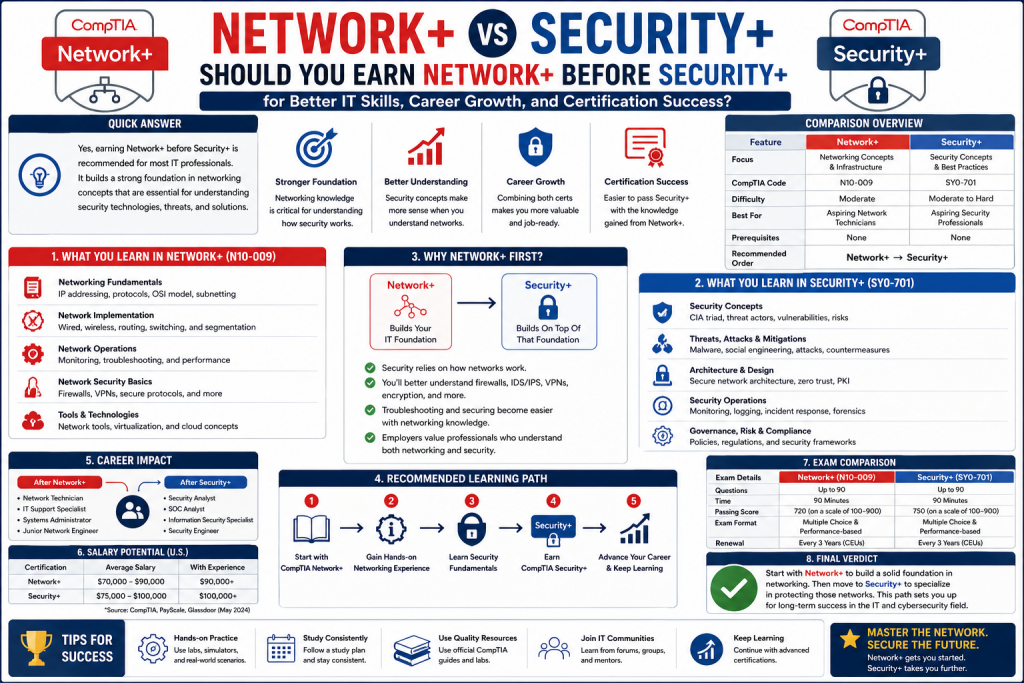
Network+ vs Security+: Should You Earn Network+ Before Security+ for Better IT Skills, Career Growth, and Certification Success?

One of the most common questions aspiring IT professionals ask is whether they should pursue CompTIA Network+ before earning Security+. At first glance, this may seem like a straightforward certification order question, but in reality, the answer depends heavily on your career ambitions, technical background, and long-term goals in information technology.

Both certifications are highly respected, vendor-neutral credentials that validate foundational knowledge, but they serve different purposes. Network+ focuses primarily on networking principles, infrastructure, protocols, troubleshooting, and connectivity. Security+, on the other hand, emphasizes cybersecurity concepts such as threat management, identity security, cryptography, risk mitigation, and incident response.

Because cybersecurity relies heavily on networking, many professionals assume Network+ should always come first. However, this is not universally true. While understanding networking fundamentals can absolutely strengthen your cybersecurity skills, some learners may benefit more from prioritizing Security+ depending on their target job roles.

The real challenge is understanding which certification aligns with your current position and where you want your career to go. For someone entering systems administration, networking support, or infrastructure management, Network+ often provides the stronger initial foundation. For someone aiming directly for security operations, compliance, or entry-level cyber defense, Security+ may provide faster access to relevant opportunities.

This decision becomes even more important when considering time, exam costs, and study energy. Certifications require commitment, and choosing the right path can improve both confidence and employability. Instead of simply asking which certification is “better,” a smarter question is: which certification is better for you right now?

To answer that, it’s important to understand what each certification teaches, what employers expect, and how your career path influences the value of each credential.

Understanding What Network+ Actually Teaches

CompTIA Network+ is often considered one of the best foundational certifications for anyone entering IT infrastructure. It is designed to validate your understanding of how networks function, how devices communicate, and how enterprise environments connect users, systems, and services.

At its core, Network+ teaches the language of networking. You’ll learn how routers, switches, access points, firewalls, and cabling systems work together to build functional digital environments. You’ll also gain exposure to protocols such as TCP/IP, DNS, DHCP, and routing concepts that support communication across local and global networks.

This knowledge matters because networking is one of the core pillars of modern IT. Nearly every role—whether cloud, security, systems administration, or DevOps—interacts with networking in some way. If you don’t understand how systems communicate, troubleshooting becomes difficult and security analysis becomes incomplete.

Network+ also introduces concepts like:

Network architecture
This includes LANs, WANs, cloud networking, virtualization, and hybrid infrastructures.

Protocols and ports
Understanding communication standards and services is essential for both support and security roles.

Troubleshooting methodology
You learn how to identify connectivity issues, performance bottlenecks, and infrastructure failures.

Security basics
Although not a cybersecurity certification, Network+ includes foundational security concepts like segmentation, access control, and secure network design.

This certification is especially valuable because it develops broad technical literacy. Instead of focusing only on one specialty, it teaches how IT systems connect and operate together.

For many beginners, this makes Network+ a strong first certification because it creates context. Security concepts often make more sense when you first understand what is being protected. Firewalls, VPNs, intrusion detection systems, and segmentation strategies all depend on networking knowledge.

Without networking fundamentals, Security+ topics can feel abstract. For example, it’s easier to understand a man-in-the-middle attack if you already understand packet flow and communication paths.

This is why many educators and employers view Network+ as a practical stepping stone, especially for learners with limited IT exposure.

Understanding What Security+ Actually Covers

Security+ takes a broader IT foundation and narrows it into cybersecurity-specific knowledge. It focuses on protecting systems, networks, and data from evolving threats.

Unlike Network+, which emphasizes operational infrastructure, Security+ emphasizes defense.

This certification covers:

Threats, attacks, and vulnerabilities
You’ll study malware, ransomware, phishing, social engineering, insider threats, and advanced attack methods.

Identity and access management
This includes authentication models, authorization controls, privilege management, and zero trust concepts.

Risk management
Security+ teaches governance, compliance, policies, and security frameworks.

Cryptography and PKI
You’ll learn encryption standards, certificates, secure communications, and data integrity principles.

Incident response
This includes detection, containment, recovery, and forensic awareness.

Security+ is often viewed as the entry point into cybersecurity because it validates broad security awareness across enterprise environments.

For learners pursuing careers in:

  • Security analyst
  • SOC analyst
  • Cybersecurity specialist
  • Information assurance
  • Compliance analyst
  • Junior penetration tester

Security+ can often provide more direct career relevance than Network+.

Additionally, Security+ is frequently requested for government and defense-related roles because it aligns with baseline security requirements.

However, Security+ assumes a degree of comfort with networking concepts. While there are no strict prerequisites, many exam objectives become easier if you already understand networking.

For example, topics like secure network architecture, VPNs, IDS/IPS systems, and segmentation are more manageable when networking basics are already familiar.

This doesn’t mean you must earn Network+ first, but it does mean skipping networking fundamentals could increase study difficulty.

The Biggest Factor in Certification Order

Your intended career path should heavily influence whether you pursue Network+ or Security+ first.

If your primary goal is cybersecurity, Security+ may offer quicker alignment with job descriptions. Many security-focused entry roles explicitly mention Security+ because it demonstrates awareness of current threat landscapes and security best practices.

Examples include:

  • Junior security analyst
  • Security administrator
  • Information security coordinator
  • Compliance technician

In these roles, Security+ can immediately strengthen your resume.

However, if your career interests include:

  • Network administrator
  • Systems administrator
  • IT support specialist
  • Infrastructure technician
  • NOC technician

Then Network+ may provide more practical and immediate value.

Networking remains one of the most transferable technical skills in IT. Even cloud environments, cybersecurity frameworks, and virtualization all rely on network understanding.

A useful way to think about this is:

Network+ teaches how systems connect.
Security+ teaches how systems are protected.

If you want to protect systems effectively, eventually you’ll need both perspectives. But your immediate job target determines which one creates faster opportunities.

Why Beginners Often Benefit from Network+ First

For complete beginners, Network+ often serves as a smoother educational progression.

This is because networking creates foundational technical context.

Learning security concepts without understanding networking can feel like trying to secure a building without knowing its doors, windows, or floor plan.

Network+ helps new learners understand:

  • IP addressing
  • Routing
  • Switching
  • Wireless standards
  • Subnetting
  • Infrastructure models

Once these concepts become familiar, Security+ builds naturally on top of them.

For example:

Understanding firewalls is easier when you understand ports and protocols.
Understanding DDoS attacks is easier when you understand traffic flow.
Understanding segmentation is easier when you understand network architecture.

This layered learning process often reduces frustration and improves retention.

For career changers or non-technical beginners, Network+ can also build confidence because it introduces broader IT concepts before narrowing into cybersecurity specialization.

When Security+ First Might Make More Sense

Despite the advantages of Network+, there are many situations where Security+ first is the smarter choice.

If you already have:

  • Help desk experience
  • Basic networking knowledge
  • Academic IT coursework
  • Exposure to enterprise systems

Then you may not need Network+ as your first formal credential.

Security+ may accelerate your move into more specialized roles faster.

This is especially true if your desired industry emphasizes security compliance, governance, or policy-heavy work.

Additionally, some employers value Security+ more because cybersecurity is often seen as a business priority. Organizations increasingly face ransomware, regulatory pressure, and security breaches, making security awareness highly marketable.

For these candidates, Security+ can sometimes create stronger immediate ROI.

What Hiring Managers Often Look For

Hiring managers rarely evaluate certifications in isolation. They evaluate whether your credentials align with role requirements.

A systems administrator hiring manager may prioritize Network+ because infrastructure management is central.

A cybersecurity hiring manager may prioritize Security+ because it validates risk and defense knowledge.

This is why job board research is so useful. Reviewing listings for your target roles can reveal patterns.

If most desired jobs mention:

  • TCP/IP
  • Routing
  • Infrastructure support

Network+ may deserve priority.

If listings emphasize:

  • SIEM
  • Risk management
  • Threat analysis
  • Incident response

Security+ may be more strategic.

The best certification order is often determined less by theory and more by hiring demand.

Certification Pathways and Long-Term Strategy

Many professionals eventually earn both certifications because together they create a balanced skill set.

A common roadmap is:

A+ → Network+ → Security+

This path works well because:

A+ builds hardware and operating system fundamentals
Network+ builds communication and infrastructure understanding
Security+ builds protection and risk awareness

However, this is not mandatory.

Some learners successfully go directly to Security+ and later backfill networking knowledge.

The ideal path depends on:

  • Existing knowledge
  • Learning style
  • Budget
  • Job urgency
  • Career specialization

The key is not perfection—it’s progression.

Building a Competitive Edge Beyond Certification

Certifications alone are rarely enough. Employers increasingly value practical skills, labs, and problem-solving ability.

Regardless of which certification you choose first, strengthen it with:

  • Home labs
  • Virtual machines
  • Practice exams
  • Wireshark
  • Active Directory basics
  • Firewall simulations

Hands-on experience transforms certifications from theoretical achievements into practical value.

This matters because employers often ask not only what you know, but how you apply it.

Difficulty, Knowledge Overlap, and Real-World Value

After understanding the foundational purpose of Network+ and Security+, the next major step is comparing how these certifications differ in complexity, technical depth, and practical application. While both are considered entry-to-intermediate level credentials, they challenge learners in very different ways.

One of the biggest misconceptions is that Security+ is simply the “next version” of Network+. In reality, they are separate certifications with overlapping concepts but different professional priorities. Network+ is infrastructure-centered, while Security+ is defense-centered. This distinction influences how difficult each exam feels depending on your background.

For someone with networking experience, Security+ may feel like a natural progression because many core concepts—ports, protocols, network architecture, segmentation, and secure communication—are already familiar. But for someone entering cybersecurity from a non-technical path, Security+ can feel overwhelming due to the volume of unfamiliar technical language.

Likewise, Network+ can be deceptively difficult because it demands understanding of multiple technical systems at once. Candidates must become comfortable with subnetting, routing, wireless standards, troubleshooting, infrastructure design, and performance optimization. This breadth can feel broad and technical, especially for beginners.

The difficulty question often comes down to this:

Network+ challenges your technical systems understanding.
Security+ challenges your risk and security understanding.

If you naturally think in terms of infrastructure, troubleshooting, and connectivity, Network+ may feel easier. If you think in terms of threats, controls, policies, and security frameworks, Security+ may align better.

However, from a purely educational perspective, many learners find Network+ slightly more foundational because it teaches how environments function before focusing on how they are protected.

Exam Structure and Learning Commitment

When deciding which certification to pursue first, it’s important to understand that both certifications require serious study commitment.

Network+ typically emphasizes:

  • Networking concepts
  • Infrastructure
  • Network operations
  • Security fundamentals
  • Troubleshooting

Security+ typically emphasizes:

  • Threats and vulnerabilities
  • Security architecture
  • Security operations
  • Governance and compliance
  • Program management

Because Security+ includes policy, governance, and strategic security principles, some learners assume it is less technical. That assumption can be misleading. Security+ may involve fewer routing calculations than Network+, but it often requires broader conceptual thinking about enterprise defense.

For example, instead of simply understanding how a VPN works, Security+ expects you to know why it should be deployed, how it supports confidentiality, and where it fits into risk management strategy.

This broader business-security alignment makes Security+ highly valuable in modern organizations where cybersecurity decisions increasingly involve operational governance.

Study time for either certification varies, but many learners benefit from:

  • 2–3 months of focused preparation for experienced IT learners
  • 4–6 months for beginners

If networking concepts are completely new, Network+ may require more time due to technical mechanics like subnetting and troubleshooting methodology.

Why Networking Knowledge Strengthens Security Careers

Even if your primary goal is cybersecurity, networking knowledge remains one of the most valuable long-term advantages.

Cybersecurity professionals are tasked with protecting systems, but systems don’t operate in isolation. Data travels across networks, endpoints communicate through protocols, cloud systems rely on connectivity, and attackers exploit communication weaknesses.

Without networking knowledge, security can become superficial.

Consider common security tasks:

Analyzing suspicious traffic
This requires understanding ports, protocols, and packet behavior.

Investigating lateral movement
This depends on understanding internal network design.

Securing cloud deployments
This requires knowledge of segmentation, gateways, and connectivity models.

Implementing Zero Trust
This relies on identity, segmentation, and communication control.

Network+ can provide the networking literacy needed to perform these tasks more effectively.

This is why many cybersecurity professionals eventually realize that networking is not optional—it is foundational.

Some of the strongest security analysts are professionals who understand both networking and security deeply. They can interpret attack patterns faster, design stronger controls, and communicate more effectively with infrastructure teams.

Why Security Knowledge Is Becoming Essential Across All IT Roles

At the same time, cybersecurity is no longer a niche specialization. Security awareness is increasingly essential across nearly all IT disciplines.

A network administrator who doesn’t understand security risks may configure functional but vulnerable systems.

A systems administrator without security awareness may maintain infrastructure but fail to protect it.

A cloud engineer without security principles may deploy scalable environments that expose critical assets.

This shift is one reason Security+ has gained so much popularity. It is not only for aspiring security analysts—it can strengthen virtually any IT role.

Security+ teaches professionals to think proactively about:

  • Risk
  • Access control
  • Threat surfaces
  • Governance
  • Defensive architecture

This mindset can improve career resilience because cybersecurity concerns now affect nearly every business technology decision.

In practical terms, Security+ often helps professionals become more strategically valuable, while Network+ often makes them more technically grounded.

The Salary and Career Mobility Perspective

Many candidates ask whether one certification leads to higher salary potential.

The answer depends less on the certification itself and more on the career path it supports.

Network+ often supports roles such as:

  • Network support specialist
  • IT technician
  • Systems administrator
  • NOC analyst
  • Infrastructure support

Security+ often supports roles such as:

  • Security analyst
  • Security administrator
  • Compliance specialist
  • SOC analyst
  • Junior cybersecurity consultant

Cybersecurity roles often have stronger salary growth potential due to market demand, but they can also be more competitive and may require broader practical experience.

This means Security+ may provide higher long-term upside for certain learners, but only if paired with relevant skills.

Network+ may sometimes lead to lower initial salaries compared to specialized security roles, but it often provides broader technical flexibility. Networking expertise can lead into cloud, DevOps, infrastructure architecture, and eventually security engineering.

This broader adaptability can create excellent long-term career resilience.

Rather than viewing one as “better,” it is more accurate to view them as different accelerators.

Network+ can accelerate technical foundation.
Security+ can accelerate security specialization.

The Role of CompTIA’s Recommended Path

CompTIA generally recommends learners move from foundational IT knowledge toward specialized certifications.

A common progression includes:

  • A+
  • Network+
  • Security+

This structure exists for educational reasons, not strict necessity.

Each step layers complexity:

A+ introduces device and operating system fundamentals.
Network+ introduces communication systems.
Security+ introduces protection strategies.

For complete beginners, this sequence often reduces cognitive overload because each certification builds context for the next.

However, learners are not required to follow this path. Career changers with prior technical experience may skip directly to Security+.

For example:

A military veteran transitioning into cybersecurity may prioritize Security+ due to compliance relevance.
A help desk technician with networking exposure may move directly into Security+.
A business graduate entering IT governance may choose Security+ first.

The key is recognizing that certification pathways should support career outcomes—not simply follow default recommendations.

Which Should You Choose First?

To better understand decision-making, consider these common scenarios.

Complete Beginner With No IT Experience
Network+ often makes more sense first because it builds broad technical understanding.

Help Desk Professional With Basic Technical Exposure
Security+ may be reasonable if cybersecurity is the goal.

Aspiring Systems Administrator
Network+ usually provides more immediate relevance.

Government or Compliance-Oriented Cybersecurity Candidate
Security+ may provide faster role alignment.

Long-Term IT Generalist
Network+ first, followed by Security+, often creates balanced capability.

These examples highlight that there is no one-size-fits-all answer.

How Employers Interpret Multiple Certifications

Earning both certifications can significantly strengthen your professional profile.

Together, they signal:

  • Technical infrastructure literacy
  • Security awareness
  • Broad foundational competence
  • Professional commitment

This combination can be especially valuable for roles that bridge teams, such as:

  • Security engineer
  • Network security specialist
  • Cloud security analyst
  • Systems engineer

In these hybrid environments, employers often appreciate professionals who understand both system functionality and defense.

Having both certifications can also improve promotion potential because you are less likely to be siloed into one narrow skill category.

Avoiding Common Mistakes When Choosing

Many learners make avoidable mistakes when selecting their certification path.

Mistake 1: Following hype instead of goals
Security is popular, but popularity does not always equal fit.

Mistake 2: Ignoring learning style
Some learners need infrastructure fundamentals before abstract security frameworks.

Mistake 3: Chasing salary without skills
A certification without practical understanding rarely creates sustainable advancement.

Mistake 4: Underestimating networking
Even security-heavy careers benefit enormously from networking competence.

Mistake 5: Overthinking perfect order
Progress matters more than perfection.

A strong certification strategy is one that supports action.

Building Skills Beyond the Exam Objectives

Whether you choose Network+ or Security+ first, certifications should be paired with practical development.

Recommended hands-on activities include:

For Network+

  • Build home labs
  • Practice subnetting
  • Configure routers
  • Study Wireshark
  • Explore DNS and DHCP

For Security+

  • Study SIEM basics
  • Practice vulnerability scanning
  • Learn IAM principles
  • Explore encryption tools
  • Review incident response scenarios

These practical exercises dramatically improve retention and employability.

Certification Strategy, Skill Stacking, and Making the Right Choice Between Network+ and Security+

Choosing whether to earn Network+ before Security+ is not just about passing an exam—it is about building a sustainable professional roadmap. Certifications should never be viewed as isolated achievements. Instead, they should be treated as strategic career tools that help shape your technical identity, open opportunities, and position you for future specialization.

By the time many learners ask whether Network+ or Security+ should come first, they are often really asking a bigger question:

“What kind of IT professional do I want to become?”

This is the most important question because your answer influences not only which certification you should prioritize, but also how you should continue learning beyond those credentials.

Some professionals want to become cybersecurity analysts. Others aim for systems engineering, cloud administration, network architecture, or compliance leadership. Each path values networking and security differently, which is why understanding the broader career implications of each certification is essential.

The strongest IT professionals often do not simply collect certifications randomly. They stack them intentionally. Each certification builds on previous knowledge and supports increasingly advanced responsibilities.

For example:

A support technician may begin with A+, then Network+, then Security+, eventually moving into cloud or security operations.

A networking professional may pursue Network+, CCNA, then security certifications to transition into network security engineering.

A cybersecurity-focused candidate may earn Security+ first, then deepen technical credibility through networking, cloud, or specialized defensive certifications.

The goal is not simply earning certifications—it is designing capability.

The Difference Between Foundational Knowledge and Specialized Knowledge

One of the biggest mistakes new IT professionals make is confusing foundational knowledge with specialization.

Foundational certifications build broad competence. They teach you how systems, networks, and technology ecosystems operate.

Specialized certifications build focused expertise. They teach you how to perform within specific domains such as security, cloud, penetration testing, or infrastructure engineering.

Network+ is primarily foundational. It creates understanding of communication systems and operational environments.

Security+ sits between foundational and specialized. It introduces cybersecurity as a professional discipline while still maintaining broad enterprise applicability.

This distinction matters because specialization without foundation can create knowledge gaps.

For example, someone may understand phishing awareness and password policy from Security+ but struggle to analyze firewall placement, segmentation strategy, or suspicious traffic patterns without networking knowledge.

Likewise, someone may understand routing and switching from Network+ but lack governance, risk, or security control awareness.

This is why many successful professionals eventually combine both.

A well-built career often starts broad, then narrows strategically.

Why the IT Industry Increasingly Rewards Cross-Functional Skills

Modern IT environments are no longer divided into perfectly isolated departments. Networking, security, cloud, systems administration, and compliance increasingly overlap.

A cloud administrator may need security expertise.
A network engineer may need automation skills.
A security analyst may need cloud networking literacy.
A systems administrator may need zero trust awareness.

This convergence means professionals who understand multiple disciplines often become more valuable than those who only understand one.

Network+ and Security+ together can represent this versatility.

For example:

A network professional with security knowledge can better design resilient architectures.

A security professional with networking knowledge can better detect and respond to attacks.

A systems administrator with both can better support enterprise modernization.

This versatility matters because businesses increasingly prioritize professionals who can solve interconnected problems.

When ransomware affects infrastructure, networking and security are both involved.
When cloud misconfiguration exposes data, systems and security overlap.
When compliance frameworks require segmentation, governance and networking converge.

This trend means your certification path should not just prepare you for your first job—it should prepare you for adaptability.

The Role of Certification in Career Switching

Many learners pursuing Network+ or Security+ are not traditional IT students. They may be changing careers from retail, education, military service, business operations, or unrelated technical roles. This career transition trend has become increasingly common as technology expands into nearly every industry and more professionals recognize the stability, flexibility, and advancement opportunities available in IT. For these individuals, certifications often serve as structured entry points into a field that may otherwise feel overwhelming or inaccessible.

For career changers, certifications can provide more than knowledge—they can offer credibility. Someone moving from customer service into IT support, for example, may use Network+ to demonstrate foundational technical competence even without formal industry experience. Likewise, a professional transitioning from law enforcement or military operations into cybersecurity may use Security+ to validate baseline security awareness and align with security-focused opportunities. These certifications can help bridge the perception gap between previous experience and future potential.

Career changers often bring valuable transferable skills as well, such as communication, leadership, problem-solving, discipline, and project coordination. These qualities can significantly strengthen technical careers when paired with certifications and practical learning. However, success usually requires more than passing an exam. Building labs, practicing troubleshooting, and understanding real-world applications can make the transition smoother. For nontraditional learners, Network+ or Security+ can become powerful launchpads—helping transform existing professional strengths into a new, strategically aligned IT career.

For career switchers, certification order can be especially important because each credential shapes how quickly employers perceive you as credible.

Network+ can be highly effective for career changers because it demonstrates operational technical literacy. It signals that you understand the mechanics of IT environments.

Security+ can be powerful for career changers targeting cybersecurity because it aligns with a fast-growing market and may appear more strategically relevant.

However, career changers should be realistic: certifications alone rarely replace practical skills.

A candidate transitioning into cybersecurity with only Security+ but no labs, networking knowledge, or technical practice may struggle in interviews.

Similarly, a candidate with Network+ but no troubleshooting experience may appear theoretical.

For this reason, career changers benefit most when certification is paired with demonstrable practice.

Examples include:

  • Building home labs
  • Simulating enterprise environments
  • Practicing ticket workflows
  • Learning SIEM tools
  • Exploring virtual networking

The certification opens the door, but practical confidence helps you walk through it.

How Learning Style Should Influence Certification Order

Different learners absorb information differently.

Some people learn best by understanding systems first.
Others learn best by focusing on goals and context.

If you prefer structured technical mechanics, Network+ may feel more intuitive because it teaches infrastructure logic.

If you are motivated by real-world threat defense, Security+ may feel more engaging.

This matters because motivation affects completion.

Many learners abandon certification paths not because they are incapable, but because their first certification did not match how they learn.

For example:

A learner fascinated by cybersecurity headlines may become disengaged if forced into networking details without context.

A technically curious learner may become overwhelmed by governance-heavy security objectives without infrastructure understanding.

Choosing the right first certification can improve retention because it aligns with your curiosity.

Beyond Network+ and Security+: What Comes Next?

A smart long-term strategy considers what certifications these credentials can support later.

After Network+, common next steps include:

  • CCNA
  • Linux+
  • Cloud certifications
  • Systems administration pathways

After Security+, common next steps include:

  • CySA+
  • PenTest+
  • CASP+
  • Security analyst roles
  • Governance and compliance pathways

This matters because your first certification can influence your momentum.

Network+ may naturally lead toward infrastructure, networking, and cloud architecture.

Security+ may naturally lead toward SOC analysis, compliance, and advanced cybersecurity.

However, these are not rigid lanes. Many professionals cross between them.

For example:

A Network+ learner may discover a passion for security.
A Security+ learner may realize networking depth is essential.

Career growth often becomes nonlinear.

Certifications vs Capability

Employers value certifications differently depending on maturity and role complexity.

For entry-level roles, certifications often help prove initiative and baseline knowledge.

For mid-level roles, employers increasingly care about application.

For senior roles, strategic thinking often outweighs entry-level certifications.

This means Network+ or Security+ can absolutely help launch your career—but neither should become your final destination.

The most competitive professionals eventually combine:

  • Certifications
  • Experience
  • Projects
  • Communication
  • Adaptability

A hiring manager may initially notice your certification, but your ability to explain troubleshooting, security decisions, and business impact often determines hiring success.

The Importance of Avoiding Certification Collecting Without Direction

Some professionals fall into the trap of collecting certifications without strategic purpose.
This can create résumé clutter without real depth.
A better strategy is certification alignment.

Ask:
Does this certification support my target role?
Does it fill a knowledge gap?
Does it improve practical capability?
Does it strengthen my credibility in a desired domain?

For example:
Network+ before Security+ often makes sense if networking is your weak point.
Security+ before advanced cybersecurity certifications often makes sense because it builds baseline security literacy.

Certifications should solve career problems—not just decorate a résumé.

This distinction is critical because employers increasingly look beyond the number of certifications listed on a résumé. They want evidence that your credentials represent useful, applicable knowledge rather than random exam success. A long list of unrelated certifications may appear impressive at first glance, but without a clear progression, it can signal uncertainty or lack of direction. Strategic certification planning demonstrates intentional career development. It shows that you understand where you are, where you want to go, and which skills are necessary to bridge that gap.

For instance, someone pursuing cloud security may benefit more from mastering networking and security fundamentals before jumping into specialized cloud certifications. Likewise, a systems administrator may gain more practical value from infrastructure-focused certifications before pursuing governance-heavy security paths. Each certification should ideally act as a building block, strengthening your technical ecosystem. The goal is not to collect the most badges—it is to build a skill set that improves performance, credibility, and employability. When certifications align with real professional objectives, they become career accelerators rather than résumé fillers.

Creating Your Personalized Decision Framework

To choose effectively, consider five questions:

  1. What role do I want in the next 12–24 months?
    Networking, systems, support, or security?
  2. How strong is my current technical foundation?
    Beginner or experienced?
  3. Which topics feel more intuitive right now?
    Infrastructure or defense?
  4. What do target job listings prioritize?
    Look for patterns.
  5. Do I need immediate employability or long-term strategic growth?
    Short-term opportunities may influence sequencing.

This framework can reduce confusion dramatically.

Balancing Speed vs Depth

One of the most practical realities is that learners often want the fastest route into IT.

Security+ can sometimes feel faster because cybersecurity demand is high.

But speed without depth can become fragile.

A Security+ learner without networking confidence may secure interviews but struggle with technical implementation.

Network+ may sometimes feel slower because it is foundational, but that foundation can create stronger long-term adaptability.

The ideal balance is often:

Build enough depth to remain credible.
Build enough speed to remain competitive.

The Real Answer: It’s About Sequencing, Not Superiority

The debate between Network+ and Security+ often assumes one must be universally better.
That mindset is flawed.
The better question is:
Which certification creates the most strategic next step for me?

For some:
Network+ first, Security+ second.

For others:
Security+ first, Network+ later.

For many:
Both.

The sequence matters more than the superiority.

Your decision should be based on your current knowledge, career direction, and the type of roles you want to pursue. If you are completely new to IT, Network+ often provides a clearer understanding of how devices, protocols, infrastructure, and troubleshooting all work together. This can make future security concepts significantly easier to grasp because cybersecurity often depends on understanding what you are protecting in the first place. On the other hand, if you already have hands-on technical experience or are targeting a cybersecurity-specific role, Security+ may offer a more direct path toward relevant job opportunities.

It is also important to recognize that certifications are not endpoints—they are stepping stones. Choosing one first does not mean rejecting the other forever. In fact, many successful professionals earn both over time because combining networking and security knowledge creates broader technical strength. Employers increasingly value adaptable professionals who understand infrastructure and defense. Rather than focusing on which certification is “best,” focus on which one best aligns with your immediate goals while supporting your long-term growth in the evolving IT industry.

Conclusion: Your Best Certification Path Depends on Your Destination

There is no single universal answer to whether you should earn Network+ before Security+ because careers in IT are not one-size-fits-all.

If you are brand new to technology, Network+ often provides the stronger technical base. It teaches how systems connect, communicate, and function, making future security concepts easier to understand.

If your immediate goal is cybersecurity and you already possess technical fundamentals, Security+ may accelerate your path into security-focused opportunities more quickly.

For many professionals, the strongest long-term strategy is earning both—building networking literacy first or alongside security awareness to create balanced capability.

Network+ helps you understand the architecture.
Security+ helps you protect it.

Together, they create a stronger professional foundation than either alone for many career paths.

Ultimately, your career goals should guide your decision—not hype, assumptions, or generic advice.

Choose the certification that best supports where you are now, while also preparing you for where you want to go next.In IT, the most successful professionals are rarely those who simply chase certifications—they are the ones who strategically build knowledge, apply it consistently, and evolve with the industry.