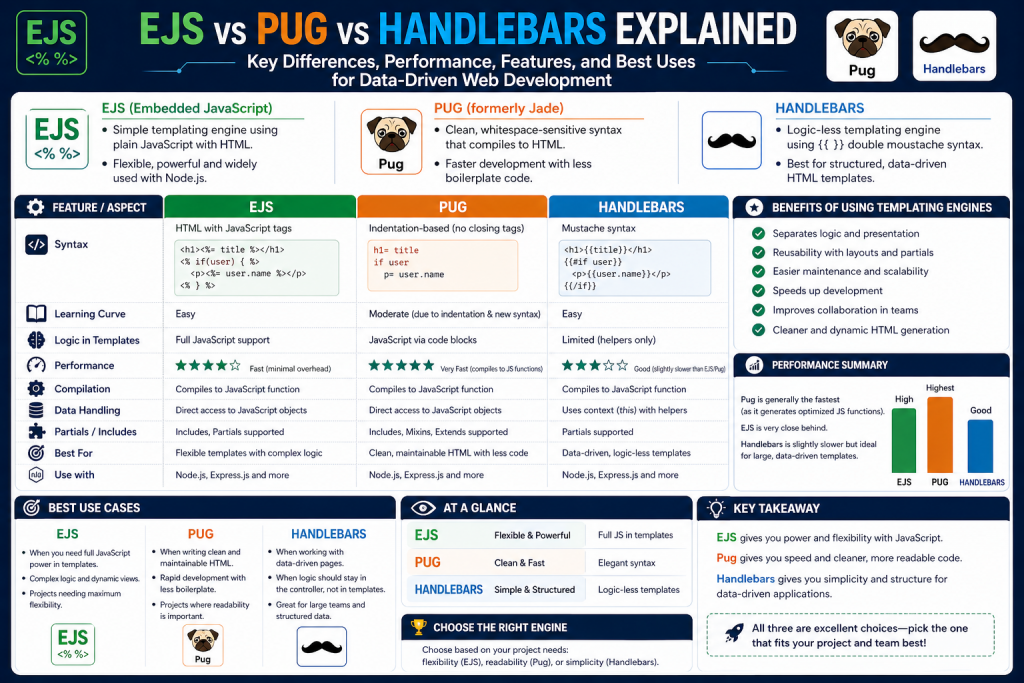
Building modern websites often involves working with dynamic data rather than static content. Whether it is user profiles, product listings, dashboards, or blogs, developers need a way to combine data with HTML efficiently. This is where templating engines become essential. They allow developers to generate HTML dynamically by embedding data into predefined structures.
JavaScript templating engines are especially popular in server-side development environments like Node.js. They simplify the process of rendering views and help maintain a clear structure in applications. Instead of manually constructing HTML strings or duplicating code, developers can use templates to create reusable layouts and components.
Among the many templating engines available, EJS, Pug, and Handlebars are widely used and frequently compared. Each offers a unique approach to handling templates, which leads to different developer experiences and outcomes. Some prioritize simplicity, others focus on minimalism, and some emphasize structure and maintainability.
Understanding how these engines differ is crucial for selecting the right one for your project. While they all achieve the same fundamental goal, their design philosophies influence how you write, organize, and maintain your code.
Overview of EJS, Pug, and Handlebars
EJS, short for Embedded JavaScript, is a templating engine that allows developers to write standard HTML and embed JavaScript directly within it. It is known for being simple and flexible, making it a popular choice for beginners and those who prefer a straightforward approach.
Pug, previously known as Jade, takes a completely different route. It replaces traditional HTML syntax with a cleaner, indentation-based format. This results in shorter and more readable templates, although it requires developers to learn a new way of writing markup.
Handlebars, on the other hand, are designed around the idea of keeping templates clean and separating logic from presentation. It uses a syntax based on double curly braces to insert data into HTML. This approach encourages developers to keep their templates simple and move logic into external helpers or controllers.
These three engines represent different philosophies in web development. EJS offers maximum flexibility, Pug focuses on concise syntax, and Handlebars promotes maintainability and structure.
Why Template Engines Matter for Data-Backed Websites
Data-backed websites rely heavily on dynamic content. Every time a user interacts with the application, data is fetched, processed, and displayed. Without templating engines, managing this process would be cumbersome and error-prone.
Template engines help by providing a structured way to inject data into HTML. They also make it easier to reuse layouts and components, which improves consistency across the application. For example, navigation bars, headers, and footers can be defined once and reused in multiple pages.
Another benefit is improved readability. Instead of mixing logic and markup in complex ways, templating engines provide clear boundaries. This makes the code easier to understand and maintain, especially in large projects.
Performance is also an important factor. Many templating engines support features like precompilation, which reduces the time required to render pages. This is particularly useful for high-traffic websites where efficiency matters.
Overall, templating engines play a key role in modern web development by simplifying the process of building dynamic and scalable applications.
Syntax and Structure in EJS
EJS is often described as the most familiar templating engine because it closely resembles standard HTML. Developers can write regular HTML and insert JavaScript wherever needed using special delimiters.
This approach makes EJS easy to understand. You do not need to learn a new syntax or adjust your mindset significantly. If you already know how to write HTML and JavaScript, you can start using EJS almost immediately.
The ability to embed JavaScript directly into templates gives EJS a high level of flexibility. You can use loops, conditionals, and variables without restrictions. This makes it suitable for a wide range of applications, from simple pages to more complex interfaces.
However, this flexibility can also become a drawback. When too much logic is placed inside templates, the code can become difficult to read and maintain. It is easy to lose track of where presentation ends and logic begins.
Despite this, many developers appreciate the control that EJS provides. It allows them to handle dynamic content without needing additional abstractions or tools.
Syntax and Structure in Pug
Pug introduces a completely different way of writing templates. Instead of using HTML tags, it relies on indentation to define the structure of the document. This results in a more concise and visually clean format.
One of the main advantages of Pug is that it reduces repetition. Developers do not need to write closing tags or unnecessary elements, which makes templates shorter and easier to manage. This can significantly improve productivity once you become comfortable with the syntax.
The indentation-based structure also enhances readability. It is easier to see the hierarchy of elements, which can help prevent errors and improve organization.
Pug also supports advanced features like mixins, which allow developers to create reusable components. This promotes modular design and makes it easier to maintain large applications.
However, the learning curve can be challenging for those who are used to traditional HTML. Even small mistakes in indentation can lead to unexpected results. Debugging can also be more complex because the syntax is less familiar.
Despite these challenges, many developers find Pug to be a powerful and efficient tool once they master it.
Syntax and Structure in Handlebars
Handlebars takes a balanced approach by combining HTML with a simple templating syntax. It uses double curly braces to insert dynamic data into templates, making it easy to identify placeholders.
One of the defining features of Handlebars is its emphasis on keeping templates logic-free. Instead of embedding complex JavaScript directly into the template, developers are encouraged to use helpers and partials.
This separation of concerns leads to cleaner and more maintainable code. Templates remain focused on presentation, while logic is handled elsewhere in the application.
Handlebars also support reusable components through partials. This allows developers to define common elements once and reuse them across multiple templates.
While this approach improves organization, it can feel restrictive for some developers. Tasks that would be simple in EJS may require additional setup in Handlebars. Writing custom helpers can add complexity, especially for beginners.
Even so, Handlebars is widely appreciated for its clarity and consistency. It is particularly useful in large projects where maintaining a clean structure is essential.
Comparing Readability Across the Three Engines
Readability is an important factor when working with templates, especially in collaborative environments. Each of these engines offers a different level of readability depending on the developer’s perspective.
EJS is easy to read for those familiar with HTML and JavaScript. However, templates can become cluttered if too much logic is included.
Pug offers excellent readability once you understand its syntax. The clean and minimal structure makes it easy to follow, but it may be confusing for newcomers.
Handlebars provides a good balance by keeping templates simple and organized. The use of placeholders makes it clear where data is being inserted, and the separation of logic improves overall clarity.
Ultimately, the best choice depends on your familiarity and preferences. What feels readable to one developer may not be as intuitive for another.
Learning Curve and Developer Experience
The ease of learning a templating engine can have a significant impact on development speed and productivity. Each of these tools offers a different experience for beginners and experienced developers alike.
EJS is widely considered the easiest to learn. Its familiar syntax allows developers to start building templates with minimal effort. This makes it a popular choice for beginners and small projects.
Pug requires more time to learn due to its unique syntax. Developers need to adapt to its indentation-based structure, which can be challenging at first. However, the effort pays off in the long run with cleaner and more efficient code.
Handlebars fall somewhere in between. It introduces new concepts like helpers and partials but remains close enough to HTML to be approachable. This makes it a good option for developers who want structure without too much complexity.
Practical Considerations When Choosing a Template Engine
When deciding between EJS, Pug, and Handlebars, it is important to consider the specific needs of your project. Factors such as team size, project complexity, and personal preferences all play a role.
For small projects or quick prototypes, EJS is often the most practical choice. Its simplicity allows developers to focus on functionality without worrying about additional abstractions.
For projects that require clean and concise templates, Pug offers a powerful solution. Its minimal syntax can improve productivity and reduce code duplication.
For larger applications or team-based projects, Handlebars provides a structured approach that improves maintainability. Its emphasis on separation of concerns makes it easier to manage complex codebases.
Understanding Performance in Template Engines
When building data-driven websites, performance is always an important consideration. Developers often wonder whether their choice of templating engine will significantly impact how fast pages load and render. While EJS, Pug, and Handlebars all perform well in most situations, they differ slightly in how they process templates and deliver output.
Template engines generally work by combining a template file with data and producing HTML as the final output. This process can happen at runtime or after precompilation. The efficiency of this process depends on how the engine parses templates, how much logic is included, and whether caching or precompilation is used.
In practice, the performance differences between these engines are usually small for typical applications. However, in high-traffic systems or applications with complex rendering needs, even minor differences can become noticeable.
Understanding how each engine handles rendering helps developers make better decisions, especially when scalability is a concern.
Performance Characteristics of EJS
EJS is known for its straightforward rendering process. Since it allows direct embedding of JavaScript into templates, it does not require complex parsing rules. This simplicity contributes to its consistent and reliable performance.
When a request is made, EJS processes the template and executes any embedded JavaScript. This makes it flexible, but it also means that rendering can become slower if the template contains heavy logic or large loops.
One of the strengths of EJS is its ability to integrate easily with caching mechanisms. By caching compiled templates, developers can reduce repeated processing and improve response times. This is particularly useful for applications with frequently accessed pages.
However, because EJS templates often include logic, there is a risk of performance degradation if too much processing is done within the template itself. Best practices suggest keeping templates focused on presentation and moving heavy logic to the backend.
Overall, EJS performs well for most use cases and is more than capable of handling small to medium-sized applications efficiently.
Performance Characteristics of Pug
Pug is often considered one of the fastest templating engines due to its efficient parsing and compilation process. Its syntax is designed to be minimal, which reduces the amount of work needed to convert templates into HTML.
One key advantage of Pug is its ability to precompile templates into JavaScript functions. Once compiled, these functions can be reused, resulting in faster rendering times. This makes Pug a strong choice for applications where performance is critical.
Because Pug encourages cleaner and more structured templates, it often results in less clutter and fewer unnecessary operations. This contributes to better performance, especially in larger applications.
However, like any tool, Pug is not immune to performance issues. Complex templates with heavy logic can still slow down rendering. Additionally, debugging performance problems can be more challenging due to its abstract syntax.
Despite these considerations, Pug remains a highly efficient option, particularly for developers who value speed and concise code.
Performance Characteristics of Handlebars
Handlebars takes a slightly different approach by focusing on simplicity and separation of concerns. It is designed to minimize logic within templates, which can lead to more predictable performance.
One of the key features of Handlebars is its support for precompilation. Templates can be compiled into JavaScript functions before being used, reducing the overhead during runtime. This makes it a strong contender for performance-sensitive applications.
Because Handlebars limits the amount of logic in templates, it reduces the risk of performance bottlenecks caused by complex operations. Instead, most processing is handled in the application code, which can be optimized more easily.
However, this approach can also introduce additional steps in development. Developers may need to create helpers for tasks that would be handled directly in other engines. While this improves maintainability, it can add some overhead in terms of development effort.
In terms of performance, Handlebars is reliable and consistent, especially when used with precompiled templates and efficient data handling.
Flexibility and Control in EJS
Flexibility is one of the defining characteristics of EJS. By allowing developers to embed JavaScript directly into templates, it provides complete control over how data is processed and displayed.
This makes EJS highly adaptable to different types of applications. Whether you need simple conditional rendering or complex data transformations, EJS can handle it without requiring additional tools.
Developers can also use features like partials and includes to create reusable components. This helps reduce duplication and maintain consistency across templates.
However, this level of flexibility can be a double-edged sword. Without proper discipline, templates can become cluttered with logic, making them harder to read and maintain.
For this reason, many developers recommend using EJS in a structured way, keeping logic minimal within templates and relying on backend code for processing.
Flexibility and Structure in Pug
Pug offers a different kind of flexibility. Instead of allowing unrestricted logic, it provides built-in features that encourage structured and organized templates.
One of the standout features of Pug is its support for mixins. Mixins allow developers to define reusable blocks of code that can be included in multiple places. This makes it easier to build modular templates and maintain consistency.
Pug also supports template inheritance, which allows developers to create base layouts and extend them in other templates. This is particularly useful for large applications with shared components.
While Pug does allow logic within templates, it encourages a cleaner and more organized approach compared to EJS. This helps maintain readability and reduces the risk of overly complex templates.
The trade-off is that Pug may feel less flexible for developers who prefer complete control. Its structured approach requires following certain patterns, which may not suit every workflow.
Flexibility and Maintainability in Handlebars
Handlebars are designed with maintainability in mind. Its philosophy revolves around keeping templates simple and moving logic outside of them.
This approach limits flexibility within the template itself but improves overall code organization. Developers use helpers to handle logic, which keeps templates focused on displaying data.
Handlebars also support partials, which allow for reusable components. This is especially useful in large applications where consistency is important.
By enforcing a clear separation between logic and presentation, Handlebars makes it easier to maintain and scale applications. Teams can work on different parts of the codebase without interfering with each other.
However, this structure can feel restrictive in some cases. Tasks that are straightforward in EJS may require additional setup in Handlebars. Developers need to weigh the benefits of maintainability against the potential increase in complexity.
Real-World Use Cases for EJS
EJS is commonly used in applications where simplicity and speed of development are important. It is a popular choice for small to medium-sized projects, prototypes, and applications with straightforward requirements.
Because it integrates easily with Node.js and frameworks like Express, EJS is often used in server-side rendering. Developers can quickly set up routes and render dynamic content without much configuration.
EJS is also suitable for projects where developers want full control over templates. Its flexibility allows for rapid experimentation and customization.
However, for larger applications, developers need to be cautious about maintaining clean and organized templates. Without proper structure, the flexibility of EJS can lead to messy code.
Real-World Use Cases for Pug
Pug is often chosen for projects that prioritize clean and concise code. Its syntax reduces repetition and makes templates easier to manage, especially in applications with many views.
It is particularly useful in projects where developers value readability and efficiency. Once the syntax is mastered, Pug allows for faster development and cleaner codebases.
Pug is also well-suited for applications with complex layouts. Its support for mixins and template inheritance makes it easy to build reusable components and maintain consistency.
However, teams need to ensure that all members are comfortable with Pug’s syntax. The learning curve can slow down onboarding for new developers.
Real-World Use Cases for Handlebars
Handlebars is widely used in applications that require a clear separation between logic and presentation. It is a strong choice for large-scale projects and team environments.
Its structured approach makes it easier to maintain code over time. Developers can focus on writing clean templates while handling logic in separate files.
Handlebars is also commonly used in frontend frameworks and libraries, making it a versatile option for both server-side and client-side rendering.
Because of its emphasis on maintainability, Handlebars is often preferred in projects where long-term scalability is a priority.
Comparing Scalability Across the Three Engines
Scalability is an important consideration for data-driven websites. As applications grow, the ability to maintain and expand the codebase becomes critical.
EJS can scale effectively if used with proper structure and discipline. However, its flexibility requires careful management to prevent code from becoming difficult to maintain.
Pug offers good scalability through its clean syntax and reusable components. Its structured approach helps keep templates organized, even as the application grows.
Handlebars excels in scalability due to its emphasis on separation of concerns. By keeping templates simple and logic external, it creates a more maintainable and scalable architecture.
The Importance of Community and Ecosystem Support
When choosing a templating engine, technical features like syntax and performance are only part of the equation. Another critical factor is the strength of the community and ecosystem surrounding the tool. A strong community means better documentation, more tutorials, faster issue resolution, and a wider range of plugins or extensions.
For developers, especially those working on real-world projects with deadlines, having access to reliable support resources can make a significant difference. Whether it is troubleshooting an error, learning best practices, or integrating additional functionality, a well-established ecosystem can save both time and effort.
EJS, Pug, and Handlebars all have active communities, but they differ slightly in size, focus, and available resources. Understanding these differences can help you choose a tool that aligns with your development workflow and long-term needs.
Community Support for EJS
EJS has been around for a long time and has built a solid reputation within the Node.js ecosystem. Because of its simplicity and familiarity, it is widely used in educational materials, beginner tutorials, and smaller projects.
One of the biggest advantages of EJS is the availability of learning resources. From documentation to blog posts and video tutorials, there is no shortage of content to help developers get started. This makes it particularly appealing for beginners who need guidance and examples.
The community around EJS is practical and solution-oriented. Many developers share code snippets and solutions for common problems, which can be helpful when building applications quickly.
However, compared to newer tools or frameworks, EJS may not always be the center of innovation. While it remains reliable and widely used, it does not evolve as rapidly as some other technologies. Despite this, its stability is often seen as a strength rather than a limitation.
Community Support for Pug
Pug has a dedicated and enthusiastic community that appreciates its clean syntax and efficient design. Developers who use Pug often value readability and minimalism, and this is reflected in the resources and discussions available online.
The ecosystem around Pug includes plugins, integrations, and tools that enhance its functionality. It is commonly used with Node.js frameworks, and many developers share best practices for building scalable applications with it.
Documentation for Pug is generally well-structured, although beginners may find it slightly more challenging to follow due to the unique syntax. Once familiar with the format, however, developers can benefit from a wide range of examples and guides.
Pug’s community may not be as large as some alternatives, but it is active and supportive. Developers who choose Pug often stay committed to it because of its efficiency and clean coding style.
Community Support for Handlebars
Handlebars has one of the strongest communities among templating engines. It is widely used in both frontend and backend development, which contributes to its popularity and extensive support network.
One of the key strengths of Handlebars is its comprehensive documentation. It clearly explains concepts like helpers, partials, and template inheritance, making it easier for developers to understand and implement.
Because Handlebars emphasizes structure and maintainability, it is often used in professional environments and large-scale applications. This has led to the development of numerous tools and libraries that extend its capabilities.
The community is also very active in sharing solutions, best practices, and real-world examples. This makes it easier for developers to solve problems and learn advanced techniques.
Overall, Handlebars offers a robust ecosystem that supports both beginners and experienced developers.
Integration with Node.js and Frameworks
All three templating engines integrate well with Node.js, making them suitable for server-side rendering. However, the ease of integration and level of customization can vary depending on the engine.
EJS is known for its seamless integration with frameworks like Express. Setting it up is straightforward, and developers can start rendering templates with minimal configuration. This simplicity makes it a popular choice for quick projects and prototypes.
Pug also integrates smoothly with Node.js frameworks. Its support for template inheritance and mixins makes it a powerful tool for building structured applications. Developers can create reusable layouts and components with ease.
Handlebars often require a bit more setup, especially when working with helpers and partials. However, this extra effort results in a more organized and maintainable codebase. It is commonly used with libraries like express-handlebars, which simplify integration and provide additional features.
Each engine works well within the Node.js ecosystem, but the choice depends on how much structure and customization you need.
Template Reusability and Component Design
Reusability is a key aspect of modern web development. Being able to create components and reuse them across multiple templates helps reduce duplication and improve consistency.
EJS supports reusability through partials and includes. Developers can break templates into smaller pieces and reuse them as needed. While this approach is effective, it relies on manual organization and discipline.
Pug takes reusability further with its mixin system. Mixins allow developers to define reusable blocks of code that can accept parameters. This makes it easier to build dynamic components and maintain consistency across the application.
Handlebars also support reusability through partials. In addition, its helper system allows developers to create reusable logic that can be applied across templates. This combination makes it a strong choice for component-based design.
Each engine provides tools for reusability, but they differ in how structured and flexible those tools are.
Debugging and Error Handling
Debugging is an important part of development, and the ease of identifying and fixing errors can impact productivity.
EJS is relatively easy to debug because it uses standard JavaScript syntax. Developers can quickly identify issues by examining the code and using familiar debugging tools.
Pug can be more challenging to debug due to its abstract syntax. Errors related to indentation or structure may not always be immediately clear. Developers need to pay close attention to formatting and follow best practices to avoid issues.
Handlebars offer a balanced debugging experience. Its templates are simple and focused, which makes it easier to identify problems. However, issues in helpers or external logic may require additional investigation.
Choosing a templating engine with a comfortable debugging experience can save time and reduce frustration during development.
When to Choose EJS
EJS is a strong choice for developers who want simplicity and flexibility. It is ideal for projects where quick development is important and where developers prefer working directly with JavaScript.
Since EJS closely resembles standard HTML with embedded JavaScript, it allows developers to start building dynamic templates without needing to learn a completely new syntax. This familiarity can significantly reduce development time, especially for beginners or teams working under tight deadlines.
Another advantage of EJS is the level of control it provides. Developers can use full JavaScript within templates to handle conditions, loops, and data manipulation. This makes it highly adaptable for a wide range of use cases, from simple web pages to more dynamic applications. It also integrates smoothly with Node.js frameworks like Express, making it a convenient option for server-side rendering.
EJS supports features like partials and includes, which help in creating reusable components and maintaining consistency across pages. However, because it allows logic inside templates, developers need to be mindful of keeping code organized. Overusing logic in templates can make them harder to read and maintain. When used with proper structure and discipline, EJS remains a powerful and efficient tool for building dynamic websites.
It works well for small to medium-sized applications, prototypes, and learning environments. Developers who are new to templating engines often find EJS to be the easiest starting point.
However, for larger projects, it is important to maintain discipline and avoid placing too much logic inside templates.
When to Choose Pug
Pug is best suited for developers who value clean and concise code. Its syntax reduces repetition and makes templates easier to manage once mastered.
Instead of writing long blocks of traditional HTML with opening and closing tags, Pug allows developers to express the same structure in a much shorter and more readable way. This can significantly improve development speed, especially in projects that involve complex layouts or repeated UI components.
Another advantage of Pug is its strong focus on structure through indentation. This makes the hierarchy of elements visually clear, helping developers quickly understand how different parts of a template relate to each other. As a result, maintaining and updating templates becomes more straightforward over time. Pug also supports powerful features like mixins, which enable reusable and customizable components, reducing duplication across files.
However, the initial learning curve can be challenging, particularly for those who are used to standard HTML syntax. Developers need to pay close attention to indentation, as even small mistakes can cause errors. Despite this, once the syntax becomes familiar, many developers find Pug to be highly efficient and enjoyable to work with, especially in projects that prioritize clean, maintainable code.
It is a good option for projects with complex layouts and a need for reusable components. Developers who are comfortable with its syntax can benefit from increased productivity and improved readability.
Pug may not be the best choice for beginners or teams that need quick onboarding, but it can be highly effective in the right environment.
When to Choose Handlebars
Handlebars is an excellent choice for large-scale applications and team-based projects. Its emphasis on separation of concerns helps maintain a clean and organized codebase.
By keeping logic out of templates and focusing only on presentation, it ensures that developers can clearly distinguish between how data is processed and how it is displayed. This structure becomes especially valuable when multiple developers are working on the same project, as it reduces confusion and makes collaboration smoother.
Another key strength of Handlebars is its use of helpers and partials. Helpers allow developers to define reusable logic outside the template, while partials make it easy to reuse common UI components like headers, footers, and navigation sections. This modular approach not only improves code reusability but also ensures consistency across the application.
Handlebars also promotes better long-term maintenance. Since templates remain simple and uncluttered, it is easier to update the user interface without affecting the underlying logic. This is particularly useful in large applications that evolve over time. While it may require a bit more setup initially compared to simpler engines, the benefits of structure, clarity, and scalability make Handlebars a reliable and efficient choice for complex projects
It is particularly useful when long-term maintainability and scalability are priorities. By keeping logic outside templates, it reduces complexity and improves collaboration.
Handlebars may require more setup compared to EJS, but the benefits in structure and organization often outweigh the initial effort.
Final Comparison and Decision-Making
At this stage, the differences between EJS, Pug, and Handlebars become clear. Each engine has its own strengths and is designed for different types of projects.
and development styles. The choice between them is not about selecting the most powerful tool overall, but rather identifying which one aligns best with your workflow, team structure, and long-term goals.
For example, EJS appeals to developers who prefer flexibility and direct control. Its ability to embed JavaScript within templates makes it highly adaptable, especially for projects that require quick development and frequent updates. On the other hand, Pug stands out for its clean and minimal syntax, allowing developers to write less code while maintaining a clear structure. This can significantly improve productivity once the syntax is fully understood.
Handlebars, meanwhile, focuses on maintainability and organization. By separating logic from presentation, it helps keep templates clean and easier to manage, particularly in large applications or collaborative environments. This makes it a strong option for projects that are expected to scale over time.
Ultimately, understanding these differences allows developers to make more informed decisions, ensuring the chosen templating engine supports both immediate needs and future growth.
EJS offers simplicity and flexibility, making it easy to start and adapt to various use cases.
Pug provides a clean and efficient syntax that reduces code repetition and improves readability.
Handlebars focus on structure and maintainability, making it ideal for larger and more complex applications.
The decision ultimately depends on your priorities. If you want quick results and minimal learning curve, EJS is a strong choice. If you prefer concise code and efficiency, Pug is worth considering. If you value organization and scalability, Handlebars is likely the best fit.
Conclusion
Choosing the right templating engine is not about finding a universal winner but about selecting the tool that best matches your project’s needs and your development style. EJS, Pug, and Handlebars each offer unique advantages that make them suitable for different scenarios.
EJS stands out for its simplicity and flexibility, allowing developers to work quickly and efficiently. Pug excels in providing a clean and concise syntax that reduces clutter and improves readability. Handlebars shines in maintaining structure and separation of concerns, making it ideal for larger and team-based projects.
In real-world development, the differences in performance between these engines are often minimal. What matters more is how well the tool fits into your workflow and how effectively it supports your project’s growth.
By understanding the strengths and limitations of each option, you can make an informed decision and build data-driven websites with confidence.
Continue exploring the technologies and certification concepts that matter most to you.