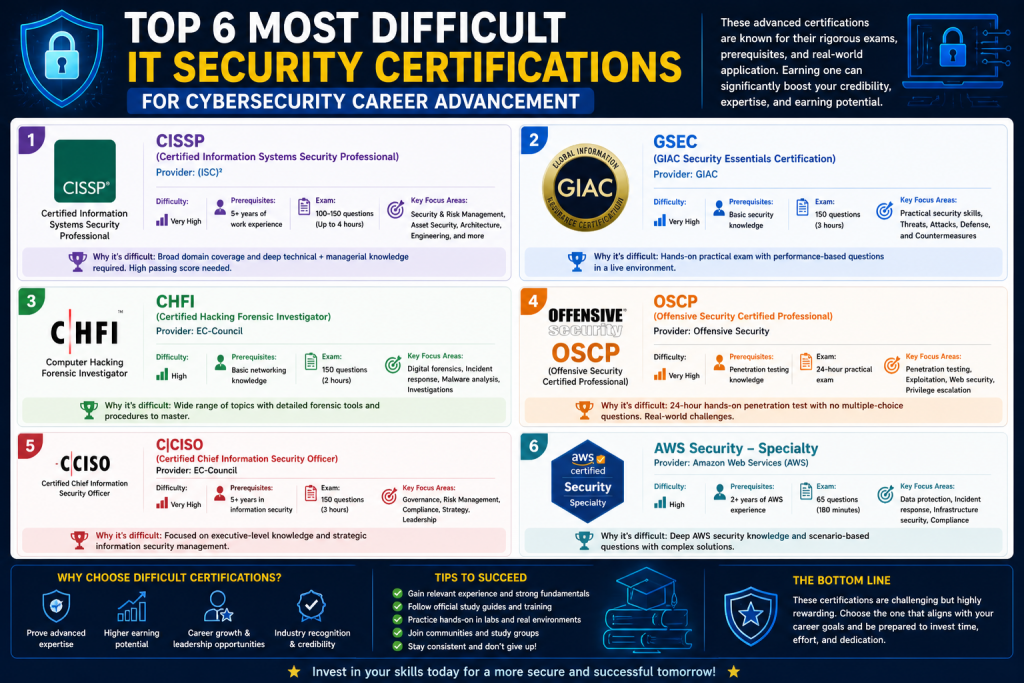
The world of information security is one of the most demanding sectors in modern technology. As organizations continue to face increasingly sophisticated cyber threats, the value of highly skilled cybersecurity professionals has grown dramatically. Certifications have become one of the most recognized ways to validate expertise, but not all certifications are created equal. Some are foundational and designed for newcomers, while others represent the highest levels of technical mastery, strategic thinking, governance expertise, or offensive security capability.
Among the many credentials available, a select group has earned a reputation for being exceptionally difficult. These certifications are not simply hard because of exam length or technical complexity. Their difficulty often stems from a combination of extensive prerequisite knowledge, real-world experience requirements, practical performance-based assessments, broad domain coverage, and ongoing professional obligations after certification.
For aspiring cybersecurity leaders, architects, penetration testers, or elite infrastructure defenders, pursuing one of these advanced certifications can be transformative. However, understanding why they are considered difficult is essential before committing the time, effort, and financial investment required.
This guide explores what makes top-tier IT security certifications so challenging and begins with some of the most respected and difficult certifications in the industry today.
Why Certain IT Security Certifications Are Considered Exceptionally Difficult
The difficulty of a cybersecurity certification is not based solely on whether candidates pass or fail. Instead, several factors contribute to its reputation.
One major factor is the depth of knowledge required. Advanced security certifications often cover multiple disciplines, including network security, governance, cryptography, incident response, cloud security, risk management, compliance, architecture, and penetration testing. Candidates are expected not only to understand concepts but to apply them under pressure.
Another critical factor is experience. Many top certifications are intentionally designed for seasoned professionals rather than beginners. This means candidates are often expected to possess years of hands-on security experience before even qualifying for full certification.
Performance-based testing also dramatically increases difficulty. Traditional multiple-choice exams may assess knowledge, but practical lab environments require candidates to actively configure systems, exploit vulnerabilities, troubleshoot infrastructure, or design solutions in real time.
Time pressure adds another layer. Some exams last several hours, while others extend nearly an entire day. Maintaining concentration, accuracy, and strategic thinking over such long periods is itself a professional challenge.
Finally, maintenance requirements can make a certification more demanding over the long term. Continuing education, endorsement processes, annual fees, and recertification obligations mean earning the credential is only part of the journey.
AWS Certified Security – Specialty: Advanced Cloud Security Expertise in a Shared Responsibility Era
As cloud adoption has accelerated globally, cloud security has become one of the most critical specializations in cybersecurity. Organizations increasingly rely on cloud platforms for mission-critical operations, data storage, software deployment, and global scalability. This dependence has made cloud security professionals indispensable, especially those who can secure large-scale Amazon Web Services environments.
The AWS Certified Security – Specialty certification is widely regarded as one of the more challenging cloud-focused security certifications due to its combination of technical breadth and platform-specific depth.
This certification requires candidates to understand the AWS shared responsibility model, which is foundational but often misunderstood. Professionals must know exactly where AWS responsibility ends and customer responsibility begins across infrastructure, identity, application security, logging, encryption, and network controls.
Candidates are tested on identity and access management architecture, including advanced policy implementation, least privilege design, federation, role delegation, and secure account structures. This often requires practical familiarity with IAM policies beyond theoretical knowledge.
Data protection is another significant challenge. Encryption in transit and at rest, key management systems, certificate handling, tokenization, and compliance controls all play a central role in exam preparation.
Incident response in AWS introduces additional complexity. Professionals must understand how to detect suspicious activity using cloud-native tools, automate remediation, secure workloads, and investigate threats across distributed environments.
Infrastructure security also plays a major role. This includes network segmentation, VPC security, logging strategies, secure internet gateways, WAF deployment, DDoS protections, and monitoring integrations.
The exam is difficult not because it is impossible, but because it assumes candidates already possess substantial real-world security knowledge plus strong AWS operational experience. For many professionals, the challenge lies in merging enterprise security principles with cloud-native implementation.
Because cloud security failures can expose millions of records, organizations place high value on professionals who hold this credential. Successfully earning it demonstrates practical ability to secure one of the world’s largest cloud ecosystems.
CompTIA Advanced Security Practitioner (CASP+): Enterprise-Level Security Beyond Fundamentals
CompTIA certifications are often associated with entry-level or intermediate IT knowledge, but CASP+ breaks that expectation entirely. CASP+ is a highly advanced certification designed for experienced security practitioners responsible for implementing complex enterprise security solutions.
Unlike managerial credentials that focus heavily on governance, CASP+ emphasizes practical decision-making at an enterprise level. It is designed for professionals who actively architect, engineer, and integrate security controls across business environments.
One reason CASP+ is so difficult is its broad coverage. Candidates must master security architecture, security operations, engineering, cryptography, governance, risk, and compliance. This breadth means professionals cannot rely on narrow specialization alone.
Security architecture requires candidates to understand how to build resilient enterprise systems that align with organizational objectives while maintaining confidentiality, integrity, and availability. This includes zero trust, segmentation, secure hybrid environments, and resilience planning.
Operations content includes incident response, monitoring, threat management, and technical troubleshooting. Security engineering introduces cryptographic models, secure protocol design, hardware protections, and systems integration.
Governance and compliance demand strategic understanding of regulatory frameworks and enterprise risk management, forcing candidates to bridge technical expertise with business realities.
CASP+ is often considered difficult because it blends technical implementation with strategic application. Candidates cannot simply memorize definitions; they must evaluate scenarios and determine the most effective security response based on organizational priorities.
Another challenge is that CASP+ often attracts professionals comparing it to more famous certifications like CISSP. While CISSP may dominate management circles, CASP+ can be equally demanding for technical practitioners due to its architecture-heavy orientation.
For cybersecurity professionals seeking to prove advanced operational capability without shifting entirely into governance, CASP+ represents a serious professional milestone.
Certified Information Security Manager (CISM): Security Leadership, Governance, and Strategic Risk Management
While many difficult certifications focus on technical mastery, CISM is difficult for a different reason: it requires professionals to think like organizational security leaders.
The Certified Information Security Manager credential is specifically designed for professionals responsible for overseeing enterprise security governance, program development, risk strategy, and incident management. Rather than emphasizing technical exploitation or system configuration, CISM demands executive-level understanding.
Many technically skilled professionals find CISM difficult because it shifts focus from solving technical issues to aligning security with business objectives.
Information security governance forms a foundational domain. Candidates must understand policy development, leadership frameworks, strategic alignment, organizational structures, and long-term program oversight.
Risk management requires deep understanding of enterprise threats, vulnerabilities, business impact analysis, resource prioritization, and governance structures. Security professionals must think beyond technology to organizational continuity.
Information security program development introduces another level of complexity. Building and maintaining enterprise-wide security initiatives requires budgeting, resource management, metrics, maturity models, and leadership communication.
Incident management in CISM is not limited to technical response. Instead, it examines how organizations prepare, structure, govern, and optimize incident handling as part of broader resilience.
The experience requirements themselves create exclusivity. CISM is intended for seasoned professionals with significant managerial exposure, making it inaccessible to many early-career candidates.
Its difficulty lies in translating security expertise into business governance. Candidates must answer from a leadership perspective, often prioritizing governance, policy, and organizational outcomes over purely technical fixes.
For professionals pursuing roles such as security manager, governance lead, or chief information security officer, CISM is often one of the most strategically valuable certifications available.
The Real Meaning of Difficulty in Cybersecurity Certification
Difficulty should not be misunderstood as a barrier designed to exclude candidates. Instead, it often reflects the seriousness of the responsibilities associated with the credential.
When a professional secures cloud systems, governs enterprise risk, architects security frameworks, or protects national infrastructure, the consequences of failure can be catastrophic. Difficult certifications help validate readiness for these responsibilities.
Advanced certifications also test more than knowledge. They evaluate discipline, persistence, analytical thinking, stress tolerance, and the ability to synthesize years of practical experience into reliable decision-making.
For some candidates, the greatest challenge is technical complexity. For others, it is breadth, management focus, or endurance. This is why no single certification is universally the hardest for everyone.
A penetration tester may find governance-heavy exams frustrating, while a security executive may struggle more with technical lab environments. Difficulty is often shaped by professional background.
Choosing the Right Difficult Certification for Your Career Goals
Not every cybersecurity professional needs the same certification path. Selecting the right advanced credential depends on your intended role.
If your goal is cloud security leadership, AWS Security Specialty may offer specialized value.
If you want enterprise architecture and implementation credibility, CASP+ may align better.
If your ambition is governance, leadership, and strategic risk oversight, CISM may be the strongest fit.
Understanding this alignment prevents wasted effort and ensures that the difficulty you embrace directly contributes to long-term career growth.
Building Toward Elite Security Credentials
One common mistake professionals make is pursuing advanced certifications too early. Foundational knowledge remains essential.
Networking, operating systems, security principles, scripting, compliance, and infrastructure design often form the base required to succeed later.
Progression matters. Building practical experience before attempting elite certifications can significantly improve both pass rates and professional outcomes.
The most successful candidates often combine study resources, labs, mentorship, enterprise experience, and strategic planning over months or even years.
Elite Credentials That Test Technical Mastery, Strategic Thinking, and Professional Endurance
As cybersecurity continues to evolve into one of the most critical professional fields in the digital era, advanced certifications have become powerful indicators of expertise, credibility, and readiness for high-level responsibilities. While many security professionals begin their careers with foundational certifications, the true challenge often begins when pursuing elite credentials that are recognized globally for their complexity and rigor.
Some certifications are difficult because they demand strategic leadership and governance expertise. Others are difficult because they require broad technical knowledge across enterprise systems. But a select few stand apart because they test candidates at the highest level of real-world performance, practical security implementation, or interdisciplinary mastery.
Among the most respected and feared certifications in cybersecurity are the Certified Information Systems Security Professional (CISSP), Cisco Certified Internetwork Expert (CCIE) Security, and Offensive Security Certified Professional (OSCP). Each represents a distinct path within cybersecurity, yet all share one defining characteristic: they are extraordinarily challenging.
This section explores why these certifications consistently rank among the toughest in IT security and why earning one can dramatically reshape a cybersecurity professional’s career trajectory.
Certified Information Systems Security Professional (CISSP)
For decades, CISSP has been considered one of the most prestigious and difficult certifications in information security. Widely recognized across government agencies, multinational corporations, defense organizations, and consulting firms, CISSP is often viewed as a benchmark for advanced security competence.
Its reputation stems not only from brand recognition but from the extraordinary breadth of knowledge it requires across nearly every major domain of cybersecurity. CISSP is designed to validate that a professional can think beyond isolated technical issues and understand security as an integrated business, operational, and governance discipline. Candidates are expected to demonstrate competence in risk management, security architecture, network security, identity systems, software security, operations, compliance, and strategic policy development. This broad scope makes CISSP particularly valuable for professionals moving into leadership, architecture, or enterprise-wide security roles. Unlike highly specialized certifications that focus on one technical niche, CISSP emphasizes the ability to connect multiple disciplines into cohesive security strategies that protect organizations at scale. Its experience requirements further reinforce its prestige, as it is generally pursued by seasoned professionals rather than newcomers. Employers often view CISSP holders as individuals capable of balancing technical security with organizational priorities, regulatory obligations, and long-term resilience planning. Because of this, CISSP frequently serves as a gateway to senior-level positions such as security architect, security consultant, governance director, or chief information security officer, making it one of the most career-defining certifications in the cybersecurity industry.
Unlike certifications focused solely on technical implementation, CISSP is difficult because it demands comprehensive understanding across a vast range of cybersecurity disciplines.
Breadth Across Eight Security Domains
One of the biggest reasons CISSP is so challenging is the enormous breadth of material candidates must master. The certification spans multiple domains that collectively represent nearly every major area of information security.
These domains typically include:
Security and risk management
Asset security
Security architecture and engineering
Communication and network security
Identity and access management
Security assessment and testing
Security operations
Software development security
This breadth means candidates must understand governance, architecture, engineering, legal frameworks, policy structures, operations, and software-related security concerns.
For many candidates, CISSP is less about extreme technical depth in one niche and more about strategic mastery across an entire profession.
Experience Requirements Increase Difficulty
CISSP is not intended for beginners. Candidates are generally expected to demonstrate years of relevant professional security experience before obtaining full certification.
This requirement ensures that certification holders are not simply skilled exam takers but experienced professionals who understand how security principles function in operational environments.
Even candidates who pass the exam without sufficient experience may remain in an associate status until requirements are met.
Adaptive Testing and Strategic Complexity
The exam itself presents a unique challenge. Computerized adaptive testing means questions can adjust based on performance, creating psychological pressure.
Questions are often scenario-driven and deliberately nuanced. Instead of asking purely technical questions, CISSP frequently evaluates judgment, prioritization, governance alignment, and strategic best practices.
Candidates often struggle because multiple answers may seem technically plausible, but only one aligns best with enterprise-wide security priorities.
Long-Term Commitment
Passing the exam is not the end. CISSP holders must maintain continuing education requirements and annual commitments to retain active status.
This ongoing obligation reinforces CISSP’s reputation as a professional standard rather than a one-time academic achievement.
Why CISSP Matters
CISSP is especially valuable for professionals seeking roles in leadership, architecture, consulting, or strategic security oversight.
Its difficulty reflects the reality that modern security leaders must understand not only technical systems but also policy, governance, business continuity, and enterprise resilience.
CCIE Security: One of the Most Technically Demanding Security Certifications Ever Created
Cisco certifications have long held prestige in networking, but CCIE Security exists at an entirely different level. This certification is often considered one of the hardest infrastructure security credentials in the world because it combines theoretical knowledge with brutal practical execution.
What makes CCIE Security especially formidable is that it does not simply test whether a candidate understands security concepts—it demands the ability to apply those concepts across highly complex enterprise infrastructures under intense pressure. Candidates must possess deep expertise in advanced routing, secure segmentation, identity services, VPN technologies, threat detection systems, automation, policy enforcement, and large-scale architecture design. The certification path requires mastering not only individual technologies but also how those technologies interact in real-world enterprise ecosystems where performance, resilience, and security must coexist.
The practical lab component is particularly notorious because it simulates the challenges faced by elite-level security engineers who must troubleshoot, configure, and optimize mission-critical systems with precision. Even minor configuration mistakes can create cascading failures, making attention to detail essential. This combination of strategic design knowledge and hands-on execution is what separates CCIE Security from many other certifications. It is often pursued by professionals aiming for top-tier engineering, consulting, or architecture roles where secure network design is central to business continuity. For many, earning CCIE Security is less about passing an exam and more about proving mastery over one of the most technically demanding disciplines in cybersecurity.
CCIE Security is designed for professionals responsible for securing complex enterprise environments through advanced network architecture, infrastructure defense, and operational excellence.
The Two-Step Challenge
The path to CCIE Security is notoriously difficult because candidates must first pass a qualifying core exam and then complete one of the most demanding practical lab exams in IT.
The written component evaluates deep understanding of security technologies, infrastructure models, protocols, and design principles.
The practical lab exam is where CCIE Security becomes legendary.
The 8-Hour Lab Exam
Few certification experiences match the mental and technical demands of an eight-hour lab environment.
Candidates must configure, troubleshoot, optimize, and secure highly complex infrastructures under severe time constraints.
This requires:
Advanced network segmentation
Identity services implementation
Threat defense systems
Secure routing and switching
VPN deployment
Policy enforcement
Endpoint integration
Automation and orchestration
The exam tests not just knowledge but endurance, troubleshooting under pressure, and flawless execution.
Why It Is So Difficult
CCIE Security is unforgiving because small mistakes can derail large portions of the exam.
Professionals must combine broad Cisco ecosystem knowledge with precision implementation.
It is not enough to know concepts. Candidates must operationalize them rapidly and accurately.
Prestige Through Scarcity
The number of CCIE Security-certified professionals worldwide has historically remained relatively limited compared to broader certifications.
This scarcity contributes to its prestige.
Organizations often view CCIE Security holders as elite-level experts capable of designing and defending mission-critical infrastructure.
Career Impact
CCIE Security can open doors to senior network security engineering, architecture, consulting, and infrastructure leadership roles.
For professionals deeply invested in enterprise networking and Cisco ecosystems, few certifications offer similar technical credibility.
Offensive Security Certified Professional (OSCP): Practical Offensive Security at Its Most Demanding
If CISSP represents strategic breadth and CCIE Security represents infrastructure mastery, OSCP represents practical offensive capability.
OSCP is one of the most feared and respected certifications in penetration testing because it emphasizes hands-on exploitation rather than theoretical understanding.
This certification has become a benchmark for ethical hackers, penetration testers, red teamers, and offensive security specialists.
A Performance-Based Philosophy
OSCP is difficult primarily because it focuses on doing rather than knowing.
Candidates are placed in controlled environments where they must identify vulnerabilities, exploit systems, escalate privileges, pivot, and document findings.
This mirrors real penetration testing far more closely than traditional exams.
The Long Practical Exam
The exam duration itself is a major challenge.
Candidates face nearly 24 hours of technical testing, requiring extreme endurance, time management, persistence, and troubleshooting capability.
This is not simply an exam. It is a sustained offensive operation under pressure.
Required Skills
Successful OSCP candidates typically need proficiency in:
Network enumeration
Vulnerability assessment
Exploitation methodologies
Privilege escalation
Web application testing
Scripting basics
Report writing
Adaptability
Because environments vary, memorization alone is insufficient. Candidates must think critically, adapt quickly, and solve unfamiliar challenges.
Psychological Intensity
OSCP is notorious for its mental demands.
Fatigue, frustration, dead ends, and time pressure can overwhelm even technically skilled professionals.
Persistence is often as important as technical expertise.
The “Try Harder” Culture
One defining characteristic of OSCP is its emphasis on persistence and independent problem-solving.
Candidates are often expected to push through obstacles without excessive hand-holding, reflecting real-world offensive security demands.
Professional Value
OSCP is highly respected because it proves practical capability.
For organizations hiring penetration testers or red team professionals, OSCP often signals that a candidate can perform beyond theoretical knowledge.
Comparing CISSP, CCIE Security, and OSCP
Although all three certifications are difficult, they represent different dimensions of expertise.
CISSP focuses on enterprise-wide strategic mastery.
CCIE Security emphasizes technical implementation and infrastructure excellence.
OSCP validates practical offensive security execution.
This distinction matters because “difficulty” depends partly on career alignment.
A governance-focused professional may struggle more with OSCP’s technical demands.
A penetration tester may find CISSP’s governance-heavy framework less intuitive.
A cloud architect may find CCIE Security’s infrastructure depth outside their primary expertise.
Why Advanced Certifications Demand More Than Knowledge
At the highest levels, cybersecurity certifications increasingly measure judgment, resilience, and practical maturity.
These exams often test:
Decision-making under pressure
Real-world implementation
Strategic prioritization
Cross-domain understanding
Mental endurance
Continuous learning commitment
This is why elite certifications are often career-defining.
Common Mistakes Candidates Make
Many professionals underestimate advanced certifications because of prior exam success.
Relying only on memorization
Ignoring hands-on labs
Neglecting time management
Underestimating business context
Skipping foundational experience
These mistakes can significantly reduce success rates.
Preparing for High-Level Security Certifications
Success usually requires a layered strategy:
Structured study plans
Official objectives review
Hands-on lab environments
Scenario practice
Peer communities
Practical work experience
Mental endurance preparation
The most successful candidates often approach preparation like a long-term professional project rather than a short-term academic task.
The Role of Certification in Cybersecurity Career Growth
While certifications alone do not guarantee expertise, difficult certifications often accelerate opportunity because they validate discipline and competence.
They can support advancement into roles such as:
Chief Information Security Officer
Security Architect
Red Team Specialist
Enterprise Security Consultant
Cloud Security Leader
Network Security Architect
Governance Director
Long-Term Career Value, Certification Strategy, Professional Growth, and How to Choose the Right Elite Cybersecurity Path
Earning one of the world’s most difficult IT security certifications is often seen as a defining professional milestone. However, while much attention is placed on exam difficulty, technical complexity, and pass rates, the broader significance of advanced cybersecurity certifications extends far beyond the exam itself. These credentials can influence career trajectory, salary potential, specialization opportunities, industry credibility, and leadership advancement for years or even decades.
For cybersecurity professionals, choosing to pursue a highly difficult certification should never be based solely on prestige. The real value lies in how well a certification aligns with long-term career objectives, technical interests, organizational demands, and evolving industry trends. A penetration tester, governance leader, cloud architect, or network security engineer may all pursue “difficult” certifications, but the right path for each can look dramatically different.
A professional focused on offensive security may benefit far more from hands-on certifications that validate exploitation, adversary simulation, and vulnerability discovery than from governance-heavy credentials designed for executive oversight. Likewise, a security leader responsible for enterprise risk, policy, compliance, and board-level communication may gain greater long-term value from management-oriented certifications than from deeply technical lab-based exams. This distinction is critical because cybersecurity is no longer a single-track profession. It has evolved into a broad ecosystem of specialties, each with unique skill requirements and professional expectations. Choosing the wrong advanced certification can lead to wasted time, financial cost, and professional frustration if it does not support actual career progression. Professionals should evaluate where they want to be in five or ten years, what type of work they find most engaging, and which certifications are most respected within their intended niche. The strongest certification strategy is one built not around popularity, but around precision—matching certification difficulty to the exact expertise, credibility, and strategic direction a professional wants to develop over time.
This final section examines the strategic value of elite IT security certifications, the sacrifices required to earn them, common career outcomes, mistakes professionals make when choosing advanced certifications, and how cybersecurity practitioners can build a sustainable roadmap toward high-level expertise.
Why Advanced IT Security Certifications Matter Beyond the Exam
Many professionals initially pursue certifications to improve job prospects, gain credibility, or increase salary. While these are legitimate benefits, elite cybersecurity certifications often serve a deeper purpose.
At senior levels, certifications can become professional signals that communicate trustworthiness, specialization, discipline, and readiness for complex responsibilities. Employers, government agencies, consulting firms, and enterprise organizations often use advanced credentials as indicators of capability when evaluating candidates for leadership, architecture, or mission-critical security positions.
These certifications matter because cybersecurity increasingly operates at the intersection of business continuity, national security, compliance, digital transformation, and organizational resilience.
A cloud security expert may protect globally distributed systems.
A governance leader may define enterprise-wide security frameworks.
A penetration tester may identify vulnerabilities before malicious actors exploit them.
A network architect may secure critical infrastructure supporting thousands or millions of users.
The higher the responsibility, the greater the value of recognized professional validation.
Salary Potential and Market Demand
One of the biggest motivations behind pursuing difficult certifications is financial advancement. Although certification alone does not guarantee salary growth, advanced credentials often correlate with higher compensation due to specialized skill validation.
Professionals holding certifications such as CISSP, CISM, CCIE Security, AWS Security Specialty, or OSCP often compete for higher-paying roles because these credentials demonstrate capabilities that are difficult to replace.
Key Salary Influencers Include:
Experience level
Industry sector
Government or defense clearance
Cloud specialization
Offensive security capability
Management responsibilities
Geographic demand
Enterprise scale
For example, cloud security and governance roles may command substantial salaries due to strategic business impact, while OSCP-certified professionals may benefit from specialized offensive security demand.
However, salary outcomes depend heavily on applying the certification effectively rather than treating it as a standalone achievement.
The Hidden Costs of Difficult Certifications
Advanced certifications can be transformative, but they often require significant sacrifices.
Time Investment
Preparing for elite certifications can take months or even years depending on prior experience.
CISSP may require broad domain study.
OSCP often requires deep lab immersion.
CCIE Security can demand extensive infrastructure practice.
CISM may require strategic mindset shifts.
Financial Cost
Training courses, official materials, practice labs, exam fees, travel expenses, and retake costs can create substantial financial burdens.
Opportunity Cost
Time spent preparing may reduce availability for family, leisure, or other professional opportunities.
Mental Burnout
High-level preparation often includes frustration, fatigue, imposter syndrome, and repeated exposure to difficult material.
Understanding these hidden costs is essential before beginning the journey.
Choosing Certifications Based on Career Direction
A common mistake professionals make is pursuing prestigious certifications without considering alignment.
Difficulty does not automatically equal usefulness.
For Technical Security Engineers
Certifications like CASP+, CCIE Security, or AWS Security Specialty may align well with implementation-heavy careers.
For Governance and Leadership Professionals
CISSP and CISM may provide stronger strategic and managerial relevance.
For Offensive Security Specialists
OSCP may offer better penetration testing credibility than governance-focused credentials.
For Cloud-Focused Professionals
Cloud-specialized certifications may outperform traditional infrastructure certifications in relevance.
Strategic alignment ensures that the immense effort required produces meaningful professional return.
The Difference Between Prestige and Practical Relevance
Some certifications are globally prestigious, but prestige alone should not drive decision-making.
A highly respected certification outside your specialization may offer less value than a moderately prestigious credential directly aligned with your role.
For example:
A red team professional may gain more from OSCP than CISM.
A CISO candidate may benefit more from CISM than OSCP.
A cloud architect may prioritize AWS Security Specialty over CCIE Security.
This distinction helps professionals avoid certification misalignment.
Building a Long-Term Cybersecurity Certification Roadmap
Elite certifications are rarely best pursued in isolation. Instead, successful professionals often build layered certification paths.
Foundational Stage
Networking
Systems administration
Basic security principles
Cloud fundamentals
Scripting
Intermediate Stage
Security operations
Architecture
Incident response
Platform specialization
Advanced Stage
Leadership
Governance
Offensive specialization
Cloud security mastery
Enterprise architecture
This progression improves both confidence and success probability.
Certification Maintenance and Continuing Education
Some professionals underestimate the responsibility that comes after certification.
Many advanced credentials require:
Continuing professional education credits
Annual fees
Periodic renewals
Governance adherence
Ethics commitments
This maintenance ensures ongoing professional relevance but also requires sustained engagement.
For professionals who dislike ongoing obligations, this factor may influence certification choice.
Industry Perception and Professional Credibility
Certifications can significantly affect how peers, recruiters, and leadership perceive a professional.
An advanced credential can:
Enhance consulting credibility
Support leadership promotion
Improve contract eligibility
Strengthen speaking authority
Increase trust in strategic discussions
However, credibility depends on combining certification with demonstrated competence. Certifications without practical skill may attract scrutiny rather than respect.
The Psychological Transformation of Advanced Certification Preparation
One overlooked benefit of difficult certifications is how preparation itself can transform professional capability.
Preparing for elite certifications often improves:
Analytical discipline
Strategic thinking
Technical precision
Decision-making under pressure
Time management
Self-directed learning
Even before passing, many candidates become stronger professionals simply through the process.
Common Reasons Candidates Fail
Understanding failure patterns can be just as valuable as understanding content.
Frequent Pitfalls Include:
Choosing a certification too advanced for current skill level
Ignoring hands-on practice
Over-relying on memorization
Underestimating strategic domains
Poor time management
Burnout
Lack of exam-specific preparation
Failure is often less about intelligence and more about strategy mismatch.
Balancing Certifications with Real-World Experience
Certifications are powerful, but they should complement—not replace—practical experience.
Real-world environments introduce:
Organizational politics
Legacy systems
Budget constraints
Human error
Compliance pressures
Incident unpredictability
Professionals who combine certification with practical implementation often outperform those who focus exclusively on either one.
The Future of Difficult IT Security Certifications
Cybersecurity is changing rapidly, and certification ecosystems continue to evolve.
Emerging Trends Include:
Cloud-native security
AI security
Zero trust architecture
Supply chain defense
Identity-centric frameworks
Operational technology security
As these domains expand, future “most difficult” certifications may increasingly emphasize hybrid expertise across technical, strategic, and cloud ecosystems.
Professionals should remain adaptable rather than assuming one certification will define an entire career.
How to Know You Are Ready for an Elite Certification
Before pursuing a difficult certification, professionals should evaluate:
Do I have sufficient foundational knowledge?
Does this align with my career direction?
Am I prepared for the time and financial commitment?
Do I need practical labs or governance study?
Will this credential meaningfully improve my trajectory?
Strategic honesty can prevent wasted effort.
The Role of Discipline Over Raw Intelligence
One of the biggest myths surrounding difficult certifications is that only exceptionally gifted professionals succeed.
In reality, discipline often matters more.
Consistent study
Incremental improvement
Practical repetition
Resilience after setbacks
Long-term planning
Many successful candidates are not necessarily the most naturally gifted—they are often the most persistent.
Conclusion: Elite IT Security Certifications Are Professional Investments, Not Just Exams
The world’s most difficult IT security certifications represent far more than academic hurdles. They are strategic investments in expertise, credibility, specialization, and professional transformation.
Whether pursuing CISSP for enterprise leadership, CISM for governance mastery, CASP+ for advanced architecture, AWS Security Specialty for cloud defense, CCIE Security for infrastructure excellence, or OSCP for offensive security, each path demands extraordinary commitment.
These certifications require time, money, discipline, and often years of preparation. But for professionals whose goals align with the credential, the rewards can be substantial: stronger career mobility, increased earning potential, expanded authority, and the confidence to operate at the highest levels of cybersecurity.
The key is not choosing the hardest certification simply because it is difficult. The true strategy is choosing the certification whose difficulty directly supports your long-term mission.
In cybersecurity, the most valuable certification is not necessarily the one that impresses everyone—it is the one that transforms you into the professional your career truly requires.
Continue exploring the technologies and certification concepts that matter most to you.