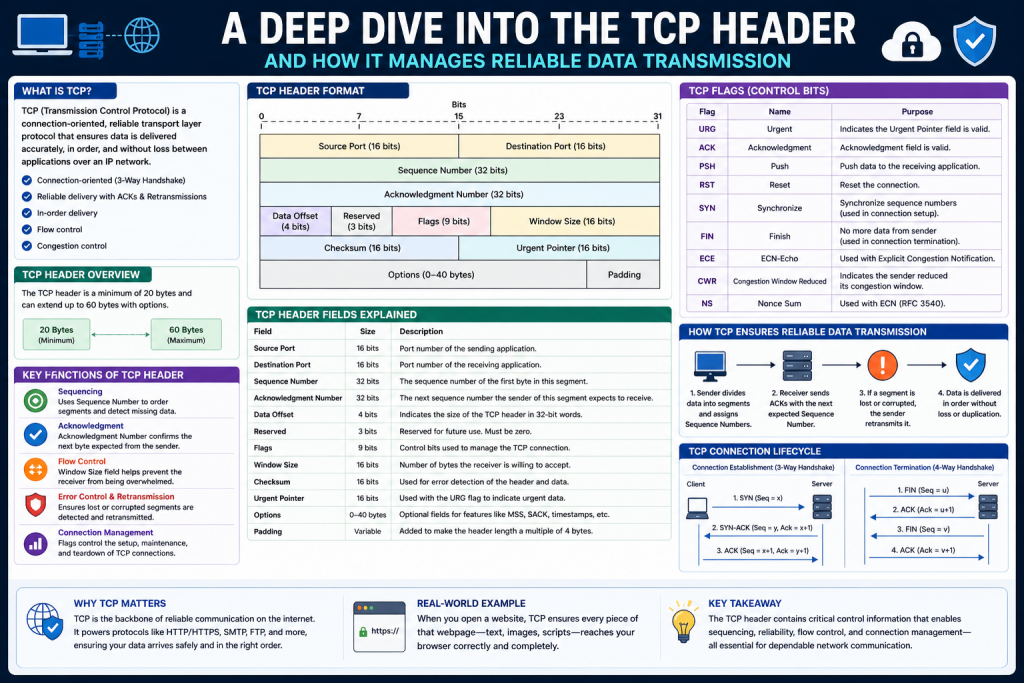
In today’s interconnected world, networks serve as the backbone of communication between devices, applications, and users. Whether accessing a website, sending an email, or streaming content, data must travel across complex networks in a reliable and structured way. This is where the Transmission Control Protocol, commonly referred to as TCP, plays a critical role.
TCP is one of the core protocols within the broader TCP/IP model, which defines how data is transmitted across networks. Unlike simpler protocols that send data without guarantees, TCP is designed to ensure that communication between devices is accurate, complete, and properly ordered. It establishes a connection before data transmission begins and maintains that connection until all data has been successfully delivered.
At the center of TCP’s reliability lies the TCP header. This component carries the instructions and metadata required to manage the entire communication process. Without it, data packets would lack the structure and control necessary for dependable delivery.
What is a TCP Header
A TCP header is a structured segment of information attached to every TCP packet. It appears at the beginning of a TCP segment and precedes the actual data being transmitted. This header contains multiple fields, each responsible for a specific function in ensuring smooth communication between sender and receiver.
The TCP header acts like a control mechanism that guides packets through the network. While the payload contains the actual message or data, the header ensures that the message reaches the correct destination, arrives in order, and remains intact during transmission.
The size of a TCP header can vary depending on the presence of optional fields. However, it always follows a format that is aligned in 32-bit increments. The minimum size is 20 bytes, but it can grow when additional features are required.
This flexible structure allows TCP to adapt to different networking needs while maintaining consistency in how packets are processed and interpreted.
Structure of a TCP Segment
A TCP segment is made up of two main parts: the header and the payload. The header contains control information, while the payload carries the actual data being transmitted.
The placement of the header at the beginning of the segment is intentional. It allows networking devices such as routers, switches, and receiving systems to quickly read and interpret the necessary information without needing to examine the entire packet.
Each field within the TCP header has a defined position and size. This structured layout ensures that devices can process packets efficiently and consistently. By reading the header fields, devices can determine where the packet came from, where it is going, how it should be handled, and whether it has been transmitted correctly.
This organization is essential for maintaining the speed and reliability of network communication, especially in large and complex networks.
Core Purpose of the TCP Header
The TCP header serves multiple purposes, all of which contribute to reliable and efficient data transmission. One of its primary roles is to provide addressing information. It identifies both the source and destination applications using port numbers, ensuring that data is delivered to the correct endpoints.
Another important function is sequencing. When large amounts of data are transmitted, they are divided into smaller packets. Each packet is assigned a sequence number, allowing the receiver to reconstruct the original data in the correct order.
Acknowledgement is another key feature enabled by the TCP header. The receiving device sends acknowledgment numbers back to the sender, confirming which data has been successfully received. This feedback mechanism allows the sender to detect missing packets and retransmit them as needed.
Flow control is also managed through the TCP header. It ensures that the sender does not overwhelm the receiver by sending too much data at once. By regulating the rate of transmission, TCP maintains a balance between performance and stability.
Error detection is achieved through the use of a checksum. This value is calculated based on the contents of the packet and included in the header. When the packet reaches its destination, the receiver recalculates the checksum to verify data integrity.
Together, these functions make the TCP header an essential component of reliable networking.
Key Fields in the TCP Header
The TCP header consists of several fields, each designed to perform a specific task. Understanding these fields provides insight into how TCP manages communication.
The source port field identifies the application that initiated the data transfer. It acts as a return address, allowing the receiver to send responses back to the correct application.
The destination port field specifies the intended recipient application. It ensures that the data is delivered to the correct process on the receiving device.
The sequence number is used to keep track of the order of data. Each segment is assigned a unique number, allowing the receiver to arrange packets correctly even if they arrive out of order.
The acknowledgment number indicates the next expected sequence number. It confirms that previous data has been received successfully.
The data offset field specifies the size of the TCP header. This helps the receiver determine where the header ends and where the payload begins.
Reserved bits are included for future use. Although they are typically set to zero, they provide flexibility for future enhancements to the protocol.
Control flags are used to manage the state of the connection. These flags indicate actions such as starting a connection, acknowledging data, or terminating communication.
The window size field controls the flow of data. It specifies how much data the receiver can handle at a given time, preventing congestion and ensuring efficient transmission.
The checksum field is used for error detection. It verifies that the data has not been altered during transmission.
The urgent pointer is used to identify urgent data within a packet. It allows certain data to be prioritized for immediate processing.
Optional fields provide additional capabilities. These may include features such as timestamps or maximum segment size, which can enhance performance and functionality.
How TCP Establishes a Connection
Before data transmission begins, TCP establishes a connection between the sender and the receiver. This process is known as the three-way handshake and is essential for ensuring that both sides are ready to communicate.
The process begins when the sender sends a packet with a synchronization flag. This packet includes an initial sequence number, which will be used to track the data.
The receiver responds with a packet that acknowledges the sender’s sequence number and includes its own sequence number. This confirms that the receiver is ready to establish a connection.
Finally, the sender sends an acknowledgment to confirm the receiver’s sequence number. Once this exchange is complete, the connection is established, and data transmission can begin.
The TCP header plays a central role in this process. The control flags and sequence numbers are used to coordinate the handshake and ensure that both sides are synchronized.
Ensuring Data Integrity and Accuracy
One of the most important aspects of TCP is its ability to ensure data integrity. This means that the data received is exactly the same as the data that was sent.
The checksum field in the TCP header is used to detect errors. When a packet is created, a checksum value is calculated based on its contents. This value is included in the header.
When the packet reaches its destination, the receiver calculates the checksum again. If the calculated value matches the one in the header, the data is considered valid. If not, the packet is discarded.
In addition to error detection, TCP uses acknowledgments and retransmissions to ensure accuracy. If a packet is lost or corrupted, the sender will retransmit it until it is successfully received.
This combination of mechanisms ensures that data is delivered reliably, even in the presence of network issues.
Role of Flow Control in TCP Communication
Flow control is a critical feature that prevents the sender from overwhelming the receiver. Without it, a fast sender could flood a slower receiver with data, leading to packet loss and reduced performance.
The window size field in the TCP header is used to manage flow control. It specifies the amount of data that the receiver can accept at a given time.
As the receiver processes data, it updates the window size and communicates this information to the sender. This allows the sender to adjust its transmission rate accordingly.
This dynamic adjustment ensures that data is transmitted efficiently without causing congestion or overload.
Importance of Sequencing and Order
In many applications, the order of data is just as important as the data itself. For example, when loading a webpage or streaming a video, data must be processed in the correct sequence to function properly.
TCP ensures proper ordering through the use of sequence numbers. Each packet is assigned a unique number, allowing the receiver to arrange them correctly.
If packets arrive out of order, the receiver temporarily stores them until the missing packets arrive. This ensures that the data is processed in the correct sequence.
This mechanism is essential for maintaining the integrity and usability of transmitted data.
Practical Importance of the TCP Header
The TCP header is not just a theoretical concept; it has practical implications for everyday networking tasks. It plays a crucial role in ensuring that applications function correctly and efficiently.
For network engineers, understanding the TCP header is essential for troubleshooting and optimization. By analyzing header fields, engineers can identify issues such as packet loss, latency, and congestion.
The TCP header also plays a role in network security. By examining header information, it is possible to detect unusual patterns or potential threats.
In addition, the TCP header supports advanced features that improve performance. For example, optional fields can be used to implement selective acknowledgments or adjust segment sizes.
These capabilities make the TCP header a powerful tool for managing network communication.
Deep Dive into TCP Header Fields and Control Mechanisms
Building on the foundational concepts, a deeper exploration of the TCP header reveals how each field works together to support reliable communication. While the earlier overview introduced the key fields, understanding their behavior in real-world networking scenarios provides greater clarity into how TCP maintains stability, accuracy, and efficiency.
Each field in the TCP header is carefully designed to address a specific challenge in data transmission. When combined, they create a system that can adapt to network congestion, detect errors, manage sessions, and ensure that communication remains consistent even in unpredictable conditions.
The TCP header is not just a static structure. It is dynamic in how it is used, with values changing throughout the life of a connection. These changes reflect the ongoing interaction between sender and receiver as they coordinate data exchange.
Source and Destination Ports in Detail
The source and destination port numbers serve as communication endpoints for applications. While IP addresses identify devices on a network, port numbers identify specific processes or services running on those devices.
When a client initiates a connection, it typically uses a temporary source port, often referred to as an ephemeral port. The destination port, on the other hand, is usually associated with a well-known service such as web traffic or email.
This pairing of source and destination ports creates a unique session between two applications. Even if multiple connections exist between the same devices, different port combinations allow them to be distinguished from one another.
Port numbers also play a role in security and traffic management. Firewalls and network monitoring tools often use port-based rules to allow or block specific types of traffic.
Sequence Numbers and Data Tracking
Sequence numbers are one of the most critical components of the TCP header. They enable TCP to track every byte of data transmitted during a session.
When a connection is established, an initial sequence number is chosen. From that point onward, each byte of data is assigned a sequence value. This allows the receiver to identify the correct order of packets, even if they arrive out of sequence.
In real-world networks, packets may take different routes to reach their destination. This can result in packets arriving at different times or in a different order than they were sent. Sequence numbers solve this problem by allowing the receiver to reorder the data correctly.
They also help detect missing packets. If there is a gap in the sequence numbers, the receiver knows that some data has not been received and can request retransmission.
Acknowledgment Numbers and Feedback Mechanism
In real-world networking environments, the TCP header is not just a static structure carrying predefined fields. Instead, it behaves dynamically, constantly adapting to changing network conditions, application demands, and system capabilities. Every field within the header participates in a continuous exchange of information between sender and receiver, enabling communication to remain stable even under challenging conditions.
As data travels across networks, it may encounter congestion, delays, packet loss, or varying bandwidth availability. The TCP header helps manage these uncertainties by providing real-time feedback mechanisms. For example, acknowledgement numbers and window sizes continuously change to reflect the current state of communication. This dynamic behavior ensures that TCP connections remain resilient and responsive.
The interaction between TCP headers across multiple packets forms a feedback loop. Each packet carries updated information that influences the behavior of subsequent packets. This ongoing adjustment is what allows TCP to maintain reliability while still achieving reasonable performance.
TCP Header and Congestion Control Strategies
One of the most important challenges in networking is congestion. When too much data is sent across a network, it can overwhelm routers and links, leading to delays and packet loss. TCP addresses this issue through congestion control mechanisms, many of which rely heavily on information contained in the TCP header.
At the beginning of a connection, TCP uses a strategy known as slow start. During this phase, the sender gradually increases the rate of data transmission. The acknowledgement numbers received from the receiver help determine how quickly this rate should grow.
As the connection progresses, TCP transitions into congestion avoidance. In this phase, the sender increases its transmission rate more cautiously. If signs of congestion appear, such as missing acknowledgments or duplicate acknowledgments, the sender reduces its transmission rate.
The TCP header plays a key role in detecting these signals. For example, repeated acknowledgment numbers may indicate that a packet has been lost. This triggers retransmission and a reduction in the sending rate.
Through these mechanisms, TCP achieves a balance between maximizing throughput and preventing network overload.
Role of TCP Header in Performance Optimization
The TCP header is also central to optimizing network performance. By adjusting parameters such as window size and utilizing optional features, TCP can improve efficiency and reduce latency.
One important optimization technique involves the use of larger window sizes. In high-bandwidth or long-distance networks, small window sizes can limit performance. TCP addresses this limitation through window scaling, which allows for significantly larger data transfers without waiting for acknowledgments.
Another optimization involves timestamps. By including timing information in the TCP header, systems can measure round-trip time more accurately. This helps improve retransmission timing and reduces unnecessary delays.
Selective acknowledgment is another feature that enhances performance. Instead of acknowledging only the last received packet, the receiver can inform the sender about specific segments that have been successfully received. This allows the sender to retransmit only the missing data, rather than entire sequences.
These optimizations demonstrate how the TCP header can be leveraged to improve both speed and efficiency in data transmission.
TCP Header in Error Handling and Recovery
Error handling is a fundamental aspect of TCP communication, and the TCP header provides the tools needed to detect and recover from errors.
The checksum field is the first line of defense against data corruption. It ensures that any changes to the packet during transmission are detected. If a packet fails the checksum test, it is discarded, and the sender will eventually retransmit it.
Sequence numbers and acknowledgment numbers work together to identify missing or out-of-order packets. When the receiver detects a gap in the sequence numbers, it knows that some data has not been received. It can then signal the sender to retransmit the missing packets.
In addition to standard retransmission, TCP uses advanced techniques such as fast retransmission. This method allows the sender to detect packet loss more quickly based on duplicate acknowledgments, rather than waiting for a timeout.
These mechanisms ensure that errors are handled efficiently, minimizing their impact on overall communication.
Security Implications of TCP Header Fields
The TCP header also plays a role in network security. While it is primarily designed for communication, its fields can be analyzed to detect suspicious activity or potential threats.
For example, unusual patterns in control flags may indicate malicious behavior. A sudden surge of connection requests with synchronization flags could suggest a denial-of-service attack. Similarly, unexpected reset flags might indicate attempts to disrupt established connections.
Port numbers can also provide insight into network activity. Unauthorized access attempts often target specific ports associated with common services. Monitoring these ports can help identify potential security risks.
In addition, certain TCP options can be used to enhance security. For instance, timestamps can help protect against replay attacks by ensuring that packets are processed in the correct time sequence.
Understanding how TCP header fields relate to security allows network professionals to detect and respond to threats more effectively.
Analyzing TCP Headers Using Network Tools
To fully understand TCP behavior, it is often necessary to analyze real network traffic. Various tools are available that allow users to capture and inspect TCP headers in detail.
Packet analysis tools provide a graphical interface for examining each field within the TCP header. Users can view sequence numbers, acknowledgment numbers, flags, and other details for individual packets.
Command-line tools offer a more lightweight approach, allowing users to filter and analyze traffic based on specific criteria. These tools are particularly useful for quick diagnostics and real-time monitoring.
Network scanning tools can also provide insights into TCP header behavior. By probing devices and analyzing their responses, users can gather information about open ports, supported features, and potential vulnerabilities.
Through these tools, network engineers can gain a deeper understanding of how TCP operates in practice and identify areas for improvement.
TCP Header and Troubleshooting Network Issues
Troubleshooting network problems often involves analyzing TCP headers. By examining the values of different fields, it is possible to identify the root cause of many common issues.
For example, repeated retransmissions may indicate packet loss due to network congestion or faulty hardware. Delayed acknowledgments might suggest latency issues or inefficient configurations.
Abnormal window sizes can point to problems with flow control, while unexpected flag combinations may indicate misconfigurations or protocol violations.
By interpreting TCP header data, engineers can diagnose issues more accurately and implement effective solutions.
This analytical approach is essential for maintaining reliable network performance and ensuring that applications function as expected.
Interaction Between TCP Header and Modern Applications
Modern applications rely heavily on TCP for communication, and the TCP header plays a crucial role in supporting their functionality.
Web browsers, email clients, file transfer applications, and cloud services all depend on TCP to deliver data reliably. The TCP header ensures that this data is transmitted accurately and efficiently.
As applications become more complex, the demands on TCP also increase. Features such as real-time communication, streaming, and large-scale data transfers require advanced handling of network traffic.
The TCP header supports these requirements through its flexible design and optional features. By adjusting parameters and utilizing advanced options, TCP can meet the needs of a wide range of applications.
This adaptability is one of the reasons why TCP remains a fundamental protocol in modern networking.
Evolution and Future of TCP Header Design
Although TCP has been in use for decades, it continues to evolve to meet the demands of modern networks. The design of the TCP header reflects this adaptability.
New features and enhancements are often introduced through optional fields, allowing TCP to support emerging technologies without breaking compatibility with existing systems.
For example, improvements in congestion control algorithms and performance optimization techniques have been integrated into TCP over time. These enhancements rely on the information carried in the TCP header.
As networks continue to grow in complexity, the TCP header will likely play an even more important role in managing communication. Future developments may introduce new fields or options to address challenges such as increased bandwidth demands, security threats, and the need for lower latency.
This ongoing evolution ensures that TCP remains relevant in an ever-changing technological landscape.
Practical Importance for Networking Professionals
For networking professionals, a deep understanding of the TCP header is essential. It provides the foundation for analyzing, optimizing, and securing network communication.
By studying TCP header fields, professionals can gain insights into how data flows through a network. This knowledge is invaluable for tasks such as performance tuning, capacity planning, and troubleshooting.
In addition, understanding TCP headers is important for software developers who work on networked applications. It allows them to design systems that interact efficiently with the underlying network infrastructure.
Whether working in system administration, cybersecurity, or software development, the ability to interpret TCP headers is a valuable skill.
acknowledgments, and control flags, the TCP header coordinates every aspect of communication between devices.
Its dynamic nature allows it to adapt to changing network conditions, enabling TCP to handle congestion, recover from errors, and optimize performance. At the same time, its structured design ensures consistency and compatibility across different systems and applications.
Data Offset and Header Length Interpretation
The data offset field specifies the size of the TCP header. This is important because the header can vary in length due to optional fields.
The value of the data offset is expressed in 32-bit words. By reading this field, the receiver can determine where the header ends and where the payload begins.
This information is essential for correctly interpreting the packet. Without it, the receiver would not be able to distinguish between control information and actual data.
The flexibility of the header length allows TCP to include additional features when needed, without disrupting the overall structure of the protocol.
Reserved Bits and Future Enhancements
The reserved field in the TCP header is set aside for future use. Although these bits are typically set to zero, they provide a mechanism for extending the protocol without requiring a complete redesign.
As networking technologies evolve, new features and capabilities may be introduced. The reserved bits ensure that there is space available for these enhancements.
This forward-thinking design reflects the adaptability of TCP and its ability to remain relevant in changing technological environments.
Control Flags and Connection Management
Control flags are essential for managing the state of a TCP connection. Each flag represents a specific control signal that influences how the connection is established, maintained, and terminated.
The synchronization flag is used during the connection setup process. It helps establish initial sequence numbers and synchronize communication between devices.
The acknowledgment flag indicates that the acknowledgment field is valid. It is used throughout the communication process to confirm the receipt of data.
The finish flag signals the termination of a connection. It indicates that a device has finished sending data and wishes to close the session.
The reset flag is used to abruptly terminate a connection. This may occur in response to an error or unexpected condition.
The push flag instructs the receiver to process data immediately, rather than waiting for additional data to arrive.
The urgent flag indicates that the packet contains urgent data. This data is given priority and processed ahead of other information.
Together, these flags provide a flexible mechanism for controlling communication and responding to different network conditions.
Window Size and Flow Control Mechanics
The window size field is a key component of TCP’s flow control mechanism. It determines how much data the sender can transmit before needing to wait for an acknowledgment.
This field reflects the capacity of the receiver’s buffer. By adjusting the window size, the receiver can control the rate at which data is sent.
For example, if the receiver is processing data slowly, it can reduce the window size to limit incoming traffic. Conversely, if it can handle more data, it can increase the window size to improve throughput.
This dynamic adjustment helps prevent congestion and ensures efficient use of network resources.
In modern networks, techniques such as window scaling may be used to support larger window sizes, enabling higher performance over long-distance connections.
Checksum and Error Detection Process
The checksum field is used to detect errors in transmitted data. It is calculated by the sender based on the contents of the header and payload.
When the packet arrives at the receiver, the checksum is recalculated. If the result matches the original value, the data is considered intact. If not, the packet is discarded.
This mechanism provides a basic level of error detection. While it does not correct errors, it ensures that corrupted data is not processed.
Combined with retransmission mechanisms, the checksum helps maintain the integrity of data transmission.
Urgent Pointer and Priority Data Handling
The urgent pointer is used in conjunction with the urgent flag to indicate the presence of high-priority data. It specifies the position within the segment where urgent data ends.
This feature allows certain data to be processed immediately, without waiting for the rest of the packet stream.
Although not commonly used in many modern applications, the urgent pointer remains an important part of the TCP header’s design.
It demonstrates the protocol’s ability to handle different types of data with varying levels of priority.
TCP Options and Extended Capabilities
The options field in the TCP header provides additional functionality beyond the standard fields. These options are not always present, but when used, they enhance the performance and capabilities of TCP.
One common option is the maximum segment size, which defines the largest amount of data that can be transmitted in a single segment. This helps optimize performance by reducing fragmentation.
Another important option is the timestamp, which can be used to measure round-trip time and improve retransmission accuracy.
Selective acknowledgment is another advanced feature that allows the receiver to inform the sender about specific segments that have been received. This reduces unnecessary retransmissions and improves efficiency.
Window scaling is also implemented through options, allowing for larger window sizes and better performance in high-bandwidth environments.
These optional features demonstrate the flexibility of the TCP header and its ability to adapt to different networking conditions.
TCP Connection Lifecycle and Header Interaction
The TCP header is actively involved throughout the entire lifecycle of a connection. From establishment to termination, its fields are used to coordinate communication between devices.
During connection setup, control flags and sequence numbers are used to synchronize both sides. As data is transmitted, sequence and acknowledgment numbers track progress and ensure reliability.
Flow control mechanisms adjust transmission rates based on network conditions. Error detection ensures that only valid data is processed.
When communication is complete, control flags are used to gracefully terminate the connection. This ensures that all data has been delivered and that resources are properly released.
This continuous interaction highlights the importance of the TCP header in managing every aspect of communication.
Handling Packet Loss and Retransmission
In real-world networks, packet loss is inevitable. TCP addresses this challenge through retransmission mechanisms.
When a packet is sent, the sender starts a timer. If an acknowledgment is not received within a specified time, the packet is retransmitted.
Sequence numbers and acknowledgment numbers play a crucial role in this process. They allow the sender to identify which packets need to be resent.
Fast retransmission techniques may also be used. These rely on duplicate acknowledgments to detect packet loss more quickly, reducing delays.
This ability to recover from packet loss is a key factor in TCP’s reliability.
Congestion Control and Adaptive Behavior
TCP includes mechanisms to manage network congestion. These mechanisms adjust the rate of data transmission based on network conditions.
The TCP header provides the information needed to implement these strategies. For example, acknowledgement patterns can indicate congestion, prompting the sender to reduce its transmission rate.
Techniques such as slow start and congestion avoidance help maintain a balance between performance and stability.
By adapting to changing conditions, TCP ensures efficient use of network resources while minimizing the risk of overload.
Real-World Applications of TCP Header Analysis
Understanding TCP header fields is essential for network analysis and troubleshooting. By examining header information, engineers can diagnose issues such as latency, packet loss, and misconfigured systems.
Tools that capture and analyze network traffic allow users to inspect TCP headers in detail. This provides valuable insights into how data is being transmitted and where problems may be occurring.
For example, repeated retransmissions may indicate network congestion or hardware issues. Abnormal flag patterns may suggest misconfigurations or potential security threats.
By interpreting TCP header data, engineers can make informed decisions to optimize performance and improve reliability.
orld networking environments, the TCP header is not just a static structure carrying predefined fields. Instead, it behaves dynamically, constantly adapting to changing network conditions, application demands, and system capabilities. Every field within the header participates in a continuous exchange of information between sender and receiver, enabling communication to remain stable even under challenging conditions.
As data travels across networks, it may encounter congestion, delays, packet loss, or varying bandwidth availability. The TCP header helps manage these uncertainties by providing real-time feedback mechanisms. For example, acknowledgement numbers and window sizes continuously change to reflect the current state of communication. This dynamic behavior ensures that TCP connections remain resilient and responsive.
The interaction between TCP headers across multiple packets forms a feedback loop. Each packet carries updated information that influences the behavior of subsequent packets. This ongoing adjustment is what allows TCP to maintain reliability while still achieving reasonable performance.
TCP Header and Congestion Control Strategies
One of the most important challenges in networking is congestion. When too much data is sent across a network, it can overwhelm routers and links, leading to delays and packet loss. TCP addresses this issue through congestion control mechanisms, many of which rely heavily on information contained in the TCP header.
At the beginning of a connection, TCP uses a strategy known as slow start. During this phase, the sender gradually increases the rate of data transmission. The acknowledgement numbers received from the receiver help determine how quickly this rate should grow.
As the connection progresses, TCP transitions into congestion avoidance. In this phase, the sender increases its transmission rate more cautiously. If signs of congestion appear, such as missing acknowledgments or duplicate acknowledgments, the sender reduces its transmission rate.
The TCP header plays a key role in detecting these signals. For example, repeated acknowledgment numbers may indicate that a packet has been lost. This triggers retransmission and a reduction in the sending rate.
Through these mechanisms, TCP achieves a balance between maximizing throughput and preventing network overload.
Role of TCP Header in Performance Optimization
The TCP header is also central to optimizing network performance. By adjusting parameters such as window size and utilizing optional features, TCP can improve efficiency and reduce latency.
One important optimization technique involves the use of larger window sizes. In high-bandwidth or long-distance networks, small window sizes can limit performance. TCP addresses this limitation through window scaling, which allows for significantly larger data transfers without waiting for acknowledgments.
Another optimization involves timestamps. By including timing information in the TCP header, systems can measure round-trip time more accurately. This helps improve retransmission timing and reduces unnecessary delays.
Selective acknowledgment is another feature that enhances performance. Instead of acknowledging only the last received packet, the receiver can inform the sender about specific segments that have been successfully received. This allows the sender to retransmit only the missing data, rather than entire sequences.
These optimizations demonstrate how the TCP header can be leveraged to improve both speed and efficiency in data transmission.
TCP Header in Error Handling and Recovery
Error handling is a fundamental aspect of TCP communication, and the TCP header provides the tools needed to detect and recover from errors.
The checksum field is the first line of defense against data corruption. It ensures that any changes to the packet during transmission are detected. If a packet fails the checksum test, it is discarded, and the sender will eventually retransmit it.
Sequence numbers and acknowledgment numbers work together to identify missing or out-of-order packets. When the receiver detects a gap in the sequence numbers, it knows that some data has not been received. It can then signal the sender to retransmit the missing packets.
In addition to standard retransmission, TCP uses advanced techniques such as fast retransmission. This method allows the sender to detect packet loss more quickly based on duplicate acknowledgments, rather than waiting for a timeout.
These mechanisms ensure that errors are handled efficiently, minimizing their impact on overall communication.
Security Implications of TCP Header Fields
The TCP header also plays a role in network security. While it is primarily designed for communication, its fields can be analyzed to detect suspicious activity or potential threats.
For example, unusual patterns in control flags may indicate malicious behavior. A sudden surge of connection requests with synchronization flags could suggest a denial-of-service attack. Similarly, unexpected reset flags might indicate attempts to disrupt established connections.
Port numbers can also provide insight into network activity. Unauthorized access attempts often target specific ports associated with common services. Monitoring these ports can help identify potential security risks.
In addition, certain TCP options can be used to enhance security. For instance, timestamps can help protect against replay attacks by ensuring that packets are processed in the correct time sequence.
Understanding how TCP header fields relate to security allows network professionals to detect and respond to threats more effectively.
Analyzing TCP Headers Using Network Tools
To fully understand TCP behavior, it is often necessary to analyze real network traffic. Various tools are available that allow users to capture and inspect TCP headers in detail.
Packet analysis tools provide a graphical interface for examining each field within the TCP header. Users can view sequence numbers, acknowledgment numbers, flags, and other details for individual packets.
Command-line tools offer a more lightweight approach, allowing users to filter and analyze traffic based on specific criteria. These tools are particularly useful for quick diagnostics and real-time monitoring.
Network scanning tools can also provide insights into TCP header behavior. By probing devices and analyzing their responses, users can gather information about open ports, supported features, and potential vulnerabilities.
Through these tools, network engineers can gain a deeper understanding of how TCP operates in practice and identify areas for improvement.
TCP Header and Troubleshooting Network Issues
Troubleshooting network problems often involves analyzing TCP headers. By examining the values of different fields, it is possible to identify the root cause of many common issues.
For example, repeated retransmissions may indicate packet loss due to network congestion or faulty hardware. Delayed acknowledgments might suggest latency issues or inefficient configurations.
Abnormal window sizes can point to problems with flow control, while unexpected flag combinations may indicate misconfigurations or protocol violations.
By interpreting TCP header data, engineers can diagnose issues more accurately and implement effective solutions.
This analytical approach is essential for maintaining reliable network performance and ensuring that applications function as expected.
Interaction Between TCP Header and Modern Applications
Modern applications rely heavily on TCP for communication, and the TCP header plays a crucial role in supporting their functionality.
Web browsers, email clients, file transfer applications, and cloud services all depend on TCP to deliver data reliably. The TCP header ensures that this data is transmitted accurately and efficiently.
As applications become more complex, the demands on TCP also increase. Features such as real-time communication, streaming, and large-scale data transfers require advanced handling of network traffic.
The TCP header supports these requirements through its flexible design and optional features. By adjusting parameters and utilizing advanced options, TCP can meet the needs of a wide range of applications.
This adaptability is one of the reasons why TCP remains a fundamental protocol in modern networking.
Evolution and Future of TCP Header Design
Although TCP has been in use for decades, it continues to evolve to meet the demands of modern networks. The design of the TCP header reflects this adaptability.
New features and enhancements are often introduced through optional fields, allowing TCP to support emerging technologies without breaking compatibility with existing systems.
For example, improvements in congestion control algorithms and performance optimization techniques have been integrated into TCP over time. These enhancements rely on the information carried in the TCP header.
As networks continue to grow in complexity, the TCP header will likely play an even more important role in managing communication. Future developments may introduce new fields or options to address challenges such as increased bandwidth demands, security threats, and the need for lower latency.
This ongoing evolution ensures that TCP remains relevant in an ever-changing technological landscape.
Practical Importance for Networking Professionals
For networking professionals, a deep understanding of the TCP header is essential. It provides the foundation for analyzing, optimizing, and securing network communication.
By studying TCP header fields, professionals can gain insights into how data flows through a network. This knowledge is invaluable for tasks such as performance tuning, capacity planning, and troubleshooting.
In addition, understanding TCP headers is important for software developers who work on networked applications. It allows them to design systems that interact efficiently with the underlying network infrastructure.
Whether working in system administration, cybersecurity, or software development, the ability to interpret TCP headers is a valuable skill.
Conclusion
The TCP header is a cornerstone of reliable network communication. It serves as the control center for every TCP segment, carrying the information needed to establish connections, manage data flow, detect errors, and ensure accurate delivery.
Throughout its structure, each field plays a specific role in maintaining the integrity and efficiency of data transmission. From source and destination ports to sequence numbers, acknowledgments, and control flags, the TCP header coordinates every aspect of communication between devices.
Its dynamic nature allows it to adapt to changing network conditions, enabling TCP to handle congestion, recover from errors, and optimize performance. At the same time, its structured design ensures consistency and compatibility across different systems and applications.
In practical terms, the TCP header is essential for the functioning of modern networks. It supports everything from basic web browsing to complex cloud services, making it a critical component of the digital world.
For anyone involved in networking, understanding the TCP header is not just beneficial but necessary. It provides the knowledge needed to analyze network behavior, troubleshoot issues, and design efficient systems.
As technology continues to evolve, the TCP header will remain a vital part of network communication, adapting to new challenges and supporting the ever-growing demand for reliable and efficient data exchange.
Continue exploring the technologies and certification concepts that matter most to you.