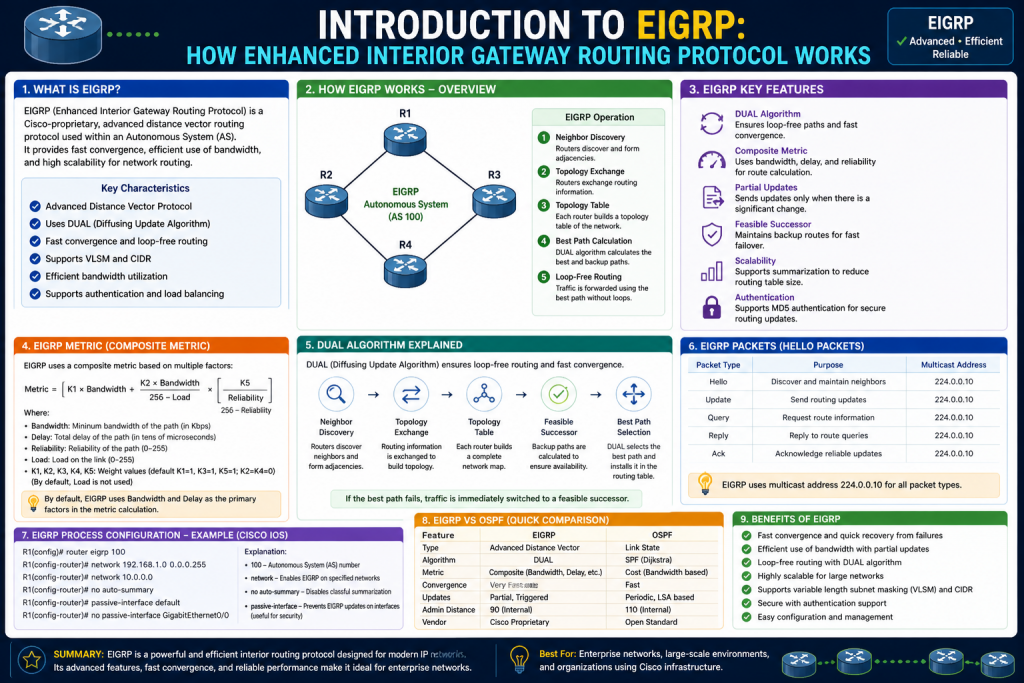
Enhanced Interior Gateway Routing Protocol, commonly known as EIGRP, is a dynamic routing protocol used in computer networking to enable routers to share information about network paths efficiently. It was originally developed by Cisco as an improvement over the older Interior Gateway Routing Protocol. Over time, EIGRP evolved into a highly efficient and flexible routing protocol that supports modern networking requirements.
EIGRP is often described as an advanced distance-vector or hybrid routing protocol because it combines the simplicity of distance-vector protocols with some of the advanced features of link-state protocols. This unique combination allows it to perform well in both small and large network environments.
In a network, routers need to know the best path to send data packets from one location to another. EIGRP helps routers make these decisions automatically by exchanging routing information and continuously updating their knowledge of the network. This ensures that data takes the most efficient path, reducing delays and improving overall performance.
Evolution from Earlier Routing Protocols
Before EIGRP, routing protocols such as RIP and IGRP were widely used. While these protocols served their purpose, they had several limitations. RIP, for example, had a maximum hop count limit, which restricted the size of networks it could support. IGRP improved on this by offering better scalability and more advanced metrics, but it still had slower convergence times and less flexibility.
EIGRP was introduced to overcome these limitations. It retained some of the strengths of IGRP while introducing new features that improved performance, scalability, and reliability. One of the key advantages of EIGRP is its ability to quickly adapt to changes in the network, which is essential in modern environments where network conditions can change frequently.
Another important aspect of EIGRP’s evolution is its transition from a Cisco-proprietary protocol to an open standard. This change allowed other vendors to implement EIGRP in their devices, making it more widely accessible and useful in multi-vendor environments.
Hybrid Nature of EIGRP
EIGRP is often referred to as a hybrid routing protocol because it combines characteristics of both distance-vector and link-state routing protocols. This hybrid nature is one of the reasons why EIGRP is so efficient and powerful.
Distance-vector protocols typically share routing information with their immediate neighbors and rely on simple metrics such as hop count. Link-state protocols, on the other hand, build a complete map of the network and use more complex algorithms to determine the best path.
EIGRP takes a balanced approach by maintaining detailed information about routes while still using efficient update mechanisms. This allows it to make intelligent routing decisions without consuming excessive resources.
The hybrid design also enables EIGRP to achieve fast convergence, meaning it can quickly adapt to network changes and find alternative routes when needed. This is especially important in large networks where downtime can have significant consequences.
Key Features of EIGRP
EIGRP includes several features that make it stand out from other routing protocols. One of its most notable features is fast convergence. Convergence refers to the time it takes for all routers in a network to have a consistent view of the network topology. EIGRP achieves fast convergence through its advanced algorithms and efficient update mechanisms.
Another important feature is its efficient use of bandwidth. Unlike some older protocols that send full routing updates at regular intervals, EIGRP sends only partial updates when changes occur. This reduces unnecessary traffic and conserves bandwidth.
EIGRP also supports multiple network layer protocols, including IPv4 and IPv6. This makes it versatile and suitable for modern networks that may use different addressing schemes.
In addition, EIGRP supports variable-length subnet masking and classless routing. This allows for more efficient use of IP address space and greater flexibility in network design.
Another key feature is its ability to maintain backup routes. These backup routes are calculated in advance, allowing the network to quickly switch to an alternative path if the primary route fails. This improves reliability and reduces downtime.
Core Components of EIGRP Operation
EIGRP relies on several core components to perform its functions effectively. These components work together to ensure efficient routing and reliable communication between routers.
One of the main components is the Diffusing Update Algorithm. This algorithm is responsible for calculating the best path to a destination and ensuring that the network remains free of routing loops. It also enables fast convergence by quickly recalculating routes when changes occur.
Another important component is the Reliable Transport Protocol. This protocol ensures that EIGRP messages are delivered reliably between routers. It manages packet delivery and retransmissions, ensuring that critical information is not lost.
Protocol-dependent modules are also a key part of EIGRP. These modules allow EIGRP to support multiple network protocols by handling each one separately. This modular design improves flexibility and scalability.
Neighbor relationships are another essential component. Routers use hello packets to discover other EIGRP routers on the network. Once discovered, they establish neighbor relationships and begin exchanging routing information.
Importance of Neighbor Relationships
Neighbor relationships play a crucial role in the operation of EIGRP. Without these relationships, routers would not be able to exchange routing information effectively.
When a router starts up, it sends hello packets to a specific multicast address. These packets are used to discover other routers running EIGRP on the same network segment. If another router receives the hello packet and meets the necessary requirements, it responds, and a neighbor relationship is established.
Once neighbors are established, the routers begin sharing routing information. This includes details about available routes, network topology, and metrics. The continuous exchange of this information ensures that all routers have an up-to-date view of the network.
Maintaining neighbor relationships is also important for detecting network changes. If a router stops receiving hello packets from a neighbor, it assumes that the neighbor is no longer reachable and updates its routing information accordingly.
EIGRP Metrics and Path Selection
EIGRP uses a composite metric to determine the best path to a destination. This metric is based on several factors, including bandwidth and delay. These factors are combined to create a single value that represents the cost of a route.
Bandwidth refers to the capacity of a link, while delay represents the time it takes for data to travel across the link. By considering both factors, EIGRP can make more informed decisions about which path to use.
Additional factors such as reliability and load can also be included in the metric calculation, although they are not used by default. This flexibility allows network administrators to customize routing behavior based on specific requirements.
The use of a composite metric is one of the reasons why EIGRP is able to provide more efficient routing compared to protocols that rely on a single metric.
Advantages of Using EIGRP
EIGRP offers several advantages that make it a popular choice for network administrators. One of its main advantages is its fast convergence, which minimizes downtime and ensures that the network can quickly adapt to changes.
Another advantage is its efficient use of bandwidth. By sending only partial updates, EIGRP reduces unnecessary traffic and improves overall network performance.
EIGRP also provides high scalability, making it suitable for both small and large networks. Its ability to handle complex topologies and multiple routes makes it ideal for enterprise environments.
Reliability is another key advantage. The use of backup routes ensures that data can still be transmitted even if the primary path fails.
Finally, EIGRP is relatively easy to configure compared to some other advanced routing protocols. This makes it accessible to network administrators with varying levels of experience.
Role of EIGRP in Modern Networks
In today’s networking environment, efficiency and reliability are more important than ever. EIGRP plays a vital role in meeting these requirements by providing fast and intelligent routing.
It is commonly used in enterprise networks where performance and uptime are critical. Its ability to quickly adapt to changes ensures that users experience minimal disruption.
EIGRP is also used in environments that require redundancy and load balancing. By supporting multiple paths, it allows traffic to be distributed across the network, reducing congestion and improving performance.
In addition, EIGRP’s support for both IPv4 and IPv6 makes it suitable for modern networks that are transitioning to newer technologies.
Why Learn EIGRP
Understanding EIGRP is important for anyone interested in networking, especially those working with Cisco equipment. It provides a strong foundation for learning more advanced networking concepts and technologies.
Knowledge of EIGRP can also be valuable for career development. Many organizations use EIGRP in their networks, and having expertise in this protocol can open up job opportunities in network administration and engineering.
Learning EIGRP also helps in understanding how routing protocols work in general. The concepts of metrics, convergence, and neighbor relationships are fundamental to many other protocols as well.
By mastering EIGRP, network professionals can design and manage efficient networks that meet the demands of modern applications and users.
Understanding How EIGRP Operates in a Network
EIGRP operates by enabling routers to exchange routing information in a structured and efficient way. Instead of flooding the entire network with unnecessary updates, it focuses on sharing only relevant information with directly connected neighbors. This selective communication approach reduces bandwidth consumption and improves overall performance.
When a router running EIGRP becomes active, it begins by identifying neighboring routers. It then forms relationships with those neighbors and starts exchanging routing information. Each router builds its own understanding of the network based on the information received, allowing it to determine the best path for forwarding data packets.
The process is continuous, meaning routers are always monitoring the network for changes. If a link fails or a new route becomes available, EIGRP quickly recalculates paths and updates only the affected parts of the network. This dynamic adaptability is one of the reasons EIGRP is highly efficient in real-world environments.
EIGRP Tables and Their Functions
EIGRP uses multiple tables to store and organize routing information. These tables allow routers to make informed decisions and maintain accurate knowledge of the network.
The neighbor table is the first and most fundamental table. It contains information about all directly connected EIGRP neighbors. This includes details such as the neighbor’s address, the interface used to reach it, and the time since the last communication. The neighbor table is essential for maintaining stable relationships between routers.
The topology table is where EIGRP stores all learned routes. It includes both the best routes and backup routes. Each entry in this table contains detailed information about the destination network, the metric, and the next-hop router. This table acts as a database of all possible paths within the network.
The routing table is derived from the topology table. It contains only the best routes that the router will use to forward traffic. By selecting the most efficient paths, the routing table ensures optimal data transmission.
These three tables work together to provide a comprehensive and efficient routing system.
Diffusing Update Algorithm and Its Role
The Diffusing Update Algorithm, commonly known as DUAL, is the core mechanism that drives EIGRP. It is responsible for calculating the best path to each destination and ensuring that the network remains free of routing loops.
DUAL works by evaluating all available routes and selecting the one with the lowest metric as the primary route. It also identifies backup routes, known as feasible successors, which can be used if the primary route fails.
One of the key advantages of DUAL is its ability to achieve fast convergence. When a network change occurs, DUAL quickly recalculates routes without requiring a complete network update. This minimizes disruption and ensures that data continues to flow smoothly.
DUAL also ensures loop-free routing by applying strict conditions when selecting backup routes. This prevents data packets from circulating endlessly within the network.
Reliable Transport Protocol in EIGRP
EIGRP uses the Reliable Transport Protocol to manage the delivery of its messages. This protocol ensures that important information is delivered reliably while minimizing unnecessary retransmissions.
Unlike traditional transport protocols, RTP is specifically designed for EIGRP. It supports both reliable and unreliable communication, depending on the type of packet being sent.
For example, update packets require reliable delivery because they contain critical routing information. RTP ensures that these packets are acknowledged and retransmitted if necessary.
On the other hand, hello packets do not require acknowledgments. They are sent periodically to maintain neighbor relationships, and losing a single hello packet does not significantly impact the network.
This flexible approach allows EIGRP to balance reliability and efficiency.
EIGRP Packet Types and Their Purpose
EIGRP uses several types of packets to perform its functions. Each packet type serves a specific purpose in maintaining the network.
Hello packets are used for neighbor discovery and maintenance. They are sent at regular intervals to ensure that neighboring routers are still reachable.
Update packets carry routing information. They are sent only when changes occur, which reduces unnecessary traffic.
Query packets are used when a router needs additional information about a route. These packets are sent to neighbors to request details about alternative paths.
Reply packets are responses to query packets. They provide the requested information and help the router determine the best path.
By using these different packet types, EIGRP ensures efficient communication and accurate routing.
Neighbor Discovery and Adjacency Formation
Neighbor discovery is the first step in EIGRP operation. Routers send hello packets to a multicast address to identify other EIGRP routers on the same network segment.
When a router receives a hello packet, it checks whether the sender meets the necessary criteria. This includes matching autonomous system numbers, compatible configurations, and similar parameters.
If the criteria are met, the routers establish a neighbor relationship. This relationship is also known as an adjacency.
Once adjacencies are formed, routers begin exchanging routing information. This exchange is essential for building the topology table and maintaining an up-to-date view of the network.
The stability of these relationships is crucial. If a router stops receiving hello packets from a neighbor, it assumes that the neighbor is no longer reachable and updates its routing information accordingly.
Basic EIGRP Configuration Process
Configuring EIGRP on a router involves several key steps. These steps ensure that the routing protocol is properly enabled and functioning.
The first step is to enable EIGRP by specifying an autonomous system number. This number identifies the routing domain and must be consistent across all routers that need to communicate.
Next, network statements are configured to define which interfaces will participate in EIGRP. These statements determine where EIGRP will operate and which networks will be advertised.
After configuration, the router begins sending hello packets and forming neighbor relationships automatically.
It is important to repeat this configuration on all routers within the network to ensure proper communication.
Verifying EIGRP Configuration
After configuring EIGRP, it is essential to verify that it is working correctly. Verification helps identify any issues and ensures that the network is functioning as expected.
One common method is to check the neighbor table. This confirms that routers have successfully established relationships.
Another method is to examine the topology table. This provides insight into all available routes and backup paths.
The routing table can also be checked to ensure that the best routes are being used for forwarding traffic.
These verification steps are crucial for maintaining a stable and efficient network.
Metrics Used in EIGRP
EIGRP uses a composite metric to determine the best path to a destination. This metric is based on several factors, with bandwidth and delay being the most important.
Bandwidth represents the capacity of a link, while delay measures the time it takes for data to travel across the network. These values are combined to calculate the overall cost of a route.
Additional factors such as reliability and load can also be included, although they are not used by default.
The use of multiple metrics allows EIGRP to make more accurate routing decisions compared to protocols that rely on a single metric.
Route Selection Process
The route selection process in EIGRP involves choosing the best path based on the calculated metric. The route with the lowest metric is selected as the primary route.
In addition to the primary route, EIGRP identifies feasible successors. These are backup routes that meet specific conditions and can be used immediately if the primary route fails.
This approach ensures that the network can quickly recover from failures without significant delays.
The route selection process is continuous, meaning that EIGRP constantly evaluates the network and updates routes as needed.
Advanced EIGRP Configuration Features
EIGRP provides several advanced configuration options that allow network administrators to optimize performance.
Route summarization is one such feature. It allows multiple routes to be combined into a single summary route, reducing the size of routing tables and improving efficiency.
Authentication is another important feature. It ensures that only trusted routers can exchange routing information, enhancing security.
Stub routing is used to limit the amount of routing information shared with certain routers. This reduces resource usage and improves performance in smaller network segments.
These advanced features make EIGRP highly adaptable to different network environments.
Managing Bandwidth and Traffic Efficiency
One of the strengths of EIGRP is its ability to manage bandwidth efficiently. By sending updates only when necessary, it minimizes unnecessary traffic.
EIGRP also supports load balancing, allowing traffic to be distributed across multiple paths. This reduces congestion and improves overall performance.
Administrators can further optimize bandwidth usage by adjusting metrics and configuration settings.
Efficient bandwidth management is essential for maintaining a high-performing network, especially in large environments.
Security Considerations in EIGRP
Security is an important aspect of any routing protocol. EIGRP includes features that help protect routing information from unauthorized access.
Authentication ensures that only trusted routers can participate in the routing process. This prevents malicious devices from injecting false routing information.
Proper configuration and monitoring are also important for maintaining security. Administrators should regularly review logs and ensure that all devices are configured correctly.
By implementing these measures, organizations can protect their networks from potential threats.
Importance of Proper Configuration and Monitoring
Proper configuration is critical for the successful operation of EIGRP. Even small misconfigurations can lead to significant issues, such as routing loops or connectivity problems.
Regular monitoring is equally important. It allows administrators to detect and resolve issues before they impact the network.
Monitoring tools can provide valuable insights into network performance, helping administrators make informed decisions.
By combining proper configuration with continuous monitoring, organizations can ensure that their networks remain stable and efficient.
Enhancing Network Performance with EIGRP
EIGRP is designed not only to provide efficient routing but also to optimize overall network performance. One of its strengths lies in its ability to intelligently utilize available resources. By dynamically adapting to network conditions, EIGRP ensures that data is transmitted using the most efficient paths.
Unlike static routing, where paths are manually configured and remain fixed, EIGRP continuously evaluates the network. This allows it to adjust routes in real time, ensuring optimal performance even as network conditions change. This adaptability is especially important in modern networks, where traffic patterns can vary significantly throughout the day.
Another key aspect of EIGRP performance is its ability to minimize unnecessary communication. Instead of flooding the network with frequent updates, it sends information only when changes occur. This reduces overhead and allows the network to operate more efficiently.
Load Balancing Strategies in EIGRP
Load balancing is a critical feature that helps distribute traffic across multiple paths, preventing congestion and improving overall network efficiency. EIGRP supports both equal-cost and unequal-cost load balancing, making it more flexible than many other routing protocols.
Equal-cost load balancing allows traffic to be split evenly across multiple paths that have the same metric. This ensures that no single path becomes overloaded while others remain underutilized. By distributing traffic evenly, the network can achieve better performance and reduced latency.
Unequal-cost load balancing is a unique feature of EIGRP. It allows traffic to be shared across paths with different metrics, provided they fall within a defined range. This is controlled using a parameter that determines how much variance is acceptable between routes.
This flexibility allows EIGRP to make better use of available network resources. Even paths that are not the absolute best can still contribute to traffic distribution, improving efficiency and resilience.
Fast Convergence and Network Stability
One of the most important characteristics of any routing protocol is how quickly it can respond to changes in the network. EIGRP excels in this area through its fast convergence capabilities.
When a network change occurs, such as a link failure, EIGRP quickly recalculates routes and updates only the affected parts of the network. This minimizes disruption and ensures that data continues to flow without significant delays.
A key factor in this process is the use of feasible successors. These are backup routes that have already been calculated and stored in the topology table. When the primary route fails, EIGRP can immediately switch to a feasible successor without needing to perform a full recalculation.
Another mechanism that improves convergence is query scoping. This technique limits the number of routers involved in route recalculations, reducing the time required to find alternative paths.
Together, these features ensure that EIGRP maintains a stable and reliable network environment.
Reducing Network Complexity with Route Summarization
As networks grow larger, managing routing information can become increasingly complex. EIGRP addresses this challenge through route summarization.
Route summarization involves combining multiple routes into a single summary route. This reduces the size of routing tables and simplifies the overall network structure.
By summarizing routes, routers have fewer entries to process, which improves performance and reduces memory usage. It also enhances stability by limiting the impact of network changes.
For example, if several subnets share a common prefix, they can be represented as a single summary route. This makes the network easier to manage and reduces the amount of routing information that needs to be exchanged.
Route summarization is particularly useful in large enterprise networks where scalability is a major concern.
EIGRP Stub Routing for Efficient Design
In some network environments, not all routers need to have full knowledge of the entire network. EIGRP provides a feature called stub routing to address this scenario.
Stub routers are configured to share limited routing information with their neighbors. This reduces the amount of data they need to process and improves overall efficiency.
Stub routing is especially useful in branch offices or remote locations where resources may be limited. By restricting the flow of routing information, it prevents these routers from becoming overwhelmed.
This approach also improves convergence times by reducing the scope of route queries. When a network change occurs, fewer routers need to be involved in the recalculation process.
Troubleshooting EIGRP Neighbor Issues
One of the most common challenges in EIGRP networks is the failure to establish neighbor relationships. Without these relationships, routers cannot exchange routing information.
There are several factors that can cause neighbor issues. One of the most common is a mismatch in autonomous system numbers. All routers participating in EIGRP must use the same AS number to form neighbor relationships.
Another potential issue is incorrect IP addressing or subnet configuration. Routers must be on the same network segment to communicate effectively.
Configuration mismatches, such as differences in timers or authentication settings, can also prevent neighbor formation. Ensuring that all parameters are consistent across routers is essential.
By systematically checking these factors, administrators can quickly identify and resolve neighbor issues.
Addressing Route Flapping and Instability
Route flapping occurs when routes repeatedly appear and disappear in the routing table. This can cause instability and degrade network performance.
There are several possible causes of route flapping. Physical link issues, such as unstable connections, are a common factor. Configuration errors can also contribute to the problem.
One effective way to address route flapping is through route summarization. By simplifying the routing table, it reduces the frequency of updates and improves stability.
Another approach is to use filtering mechanisms to control which routes are advertised. This prevents unnecessary updates and helps stabilize the network.
Monitoring network performance and identifying patterns can also help pinpoint the root cause of route flapping.
Resolving Inconsistent Routing Tables
Inconsistent routing tables can lead to inefficient routing and connectivity issues. This occurs when different routers have conflicting information about the best paths.
One common cause is inconsistent metric values. If routers calculate metrics differently, they may select different routes as the best path.
To resolve this issue, administrators should ensure that all routers use consistent configurations and parameters. This includes verifying bandwidth and delay settings.
Another potential cause is network topology changes that have not been properly propagated. Reviewing logs and recent changes can help identify the source of the problem.
Ensuring a loop-free topology is also critical. Routing loops can cause packets to circulate indefinitely, leading to performance issues.
Monitoring and Maintaining EIGRP Networks
Effective network management requires continuous monitoring and maintenance. EIGRP networks are no exception.
Monitoring tools can provide valuable insights into network performance, including traffic patterns, route changes, and potential issues. These tools help administrators detect problems early and take corrective action.
Regular maintenance tasks include reviewing configurations, updating software, and verifying network stability. Keeping the network environment up to date ensures optimal performance.
Documentation is also important. Maintaining accurate records of network configurations and changes helps streamline troubleshooting and future planning.
By adopting a proactive approach to monitoring and maintenance, organizations can ensure the long-term reliability of their EIGRP networks.
Real-World Applications of EIGRP
EIGRP is widely used in real-world networking environments due to its flexibility and efficiency. It is particularly well-suited for enterprise networks that require high performance and reliability.
In large organizations, EIGRP is used to manage complex network infrastructures with multiple interconnected sites. Its ability to quickly adapt to changes ensures minimal downtime and consistent performance.
EIGRP is also commonly used in virtual private network deployments. In these environments, it helps manage dynamic routing across multiple locations, ensuring secure and efficient communication.
Another important application is in data centers, where high availability is critical. EIGRP’s support for load balancing and fast convergence makes it an ideal choice for these environments.
Integration with Other Routing Protocols
Modern networks often use multiple routing protocols to meet different requirements. EIGRP can integrate with other protocols through a process known as route redistribution.
Route redistribution allows routers to exchange routing information between different protocols. This enables seamless communication between different parts of the network.
For example, a network may use EIGRP internally while relying on another protocol for external connectivity. By redistributing routes, the network can function as a unified system.
This capability makes EIGRP highly versatile and suitable for hybrid network environments.
Supporting Large-Scale Network Designs
As networks continue to grow, scalability becomes increasingly important. EIGRP is designed to support large-scale networks with complex topologies.
Its architecture allows it to handle an increasing number of routes, devices, and connections without significantly impacting performance. This makes it highly suitable for enterprise environments where networks are constantly expanding due to new branches, remote users, and cloud integrations.
One of the reasons EIGRP scales effectively is its use of efficient update mechanisms. Instead of sending complete routing tables, it shares only incremental updates when changes occur. This reduces processing overhead on routers and conserves bandwidth, which becomes critical as the network grows larger. Additionally, features like route summarization help condense routing information, making routing tables smaller and easier to manage.
EIGRP also supports hierarchical network design, allowing administrators to divide networks into manageable segments. This improves organization and reduces the complexity of troubleshooting and maintenance. Its ability to maintain backup routes further enhances scalability by ensuring quick recovery from failures without requiring extensive recalculations.
Overall, EIGRP’s design ensures that even as networks expand in size and complexity, performance remains stable, reliable, and efficient.
Its efficient use of bandwidth, fast convergence, and support for multiple routes make it well-suited for large environments. It can handle thousands of routes without significant performance degradation.
Hierarchical design principles can be applied to EIGRP networks to further improve scalability. By organizing the network into logical segments, administrators can simplify management and improve performance.
EIGRP’s flexibility allows it to adapt to different network designs, making it a valuable tool for modern networking.
Future Relevance of EIGRP
Despite the emergence of newer technologies, EIGRP remains relevant in many networking environments. Its reliability and efficiency continue to make it a preferred choice for organizations using Cisco-based infrastructure.
One of the key reasons for its continued use is its ability to deliver fast convergence, which ensures minimal disruption during network failures or topology changes. This capability is especially important in enterprise environments where downtime can lead to significant operational and financial losses.
Another factor contributing to its relevance is its efficient use of bandwidth. EIGRP minimizes unnecessary traffic by sending updates only when changes occur, rather than broadcasting full routing tables at regular intervals. This makes it well-suited for networks where bandwidth optimization is critical. Additionally, its support for both IPv4 and IPv6 allows organizations to operate in mixed environments and gradually transition to modern addressing schemes without replacing their routing protocol.
EIGRP also provides flexibility through features such as unequal-cost load balancing and route summarization, which enhance performance and simplify network management. Its relatively straightforward configuration and strong integration with Cisco tools further make it a practical choice for network administrators who require a balance between performance, scalability, and ease of use.
As networks evolve, EIGRP continues to adapt by supporting modern features such as IPv6 and enhanced security mechanisms. This ensures that it remains a viable option for future deployments.
Understanding EIGRP also provides a strong foundation for learning other routing protocols. Many of the concepts used in EIGRP are applicable to other technologies, making it a valuable skill for network professionals.
Conclusion
EIGRP stands out as a powerful and efficient routing protocol that combines the strengths of multiple approaches to deliver high performance and reliability. Its ability to provide fast convergence, intelligent route selection, and flexible load balancing makes it an essential tool in modern networking.
Through features such as feasible successors, route summarization, and stub routing, EIGRP ensures that networks remain stable and efficient even under changing conditions. Its advanced troubleshooting capabilities and support for integration with other protocols further enhance its usefulness.
In real-world applications, EIGRP proves its value by supporting large-scale enterprise networks, virtual environments, and data centers. Its adaptability and scalability allow it to meet the demands of complex network infrastructures.
For network professionals, mastering EIGRP is an important step toward understanding how modern routing works. It provides the knowledge and skills needed to design, optimize, and maintain reliable networks.
Overall, EIGRP continues to be a relevant and dependable choice for organizations seeking efficient and scalable routing solutions in an ever-evolving technological landscape.
Continue exploring the technologies and certification concepts that matter most to you.