Understanding how data moves across networks is one of the most important foundations in networking. At first glance, the process can seem complicated, filled with technical jargon and multiple technologies working together. However, the OSI model simplifies this complexity by breaking network communication into clearly defined layers, each responsible for a specific function.
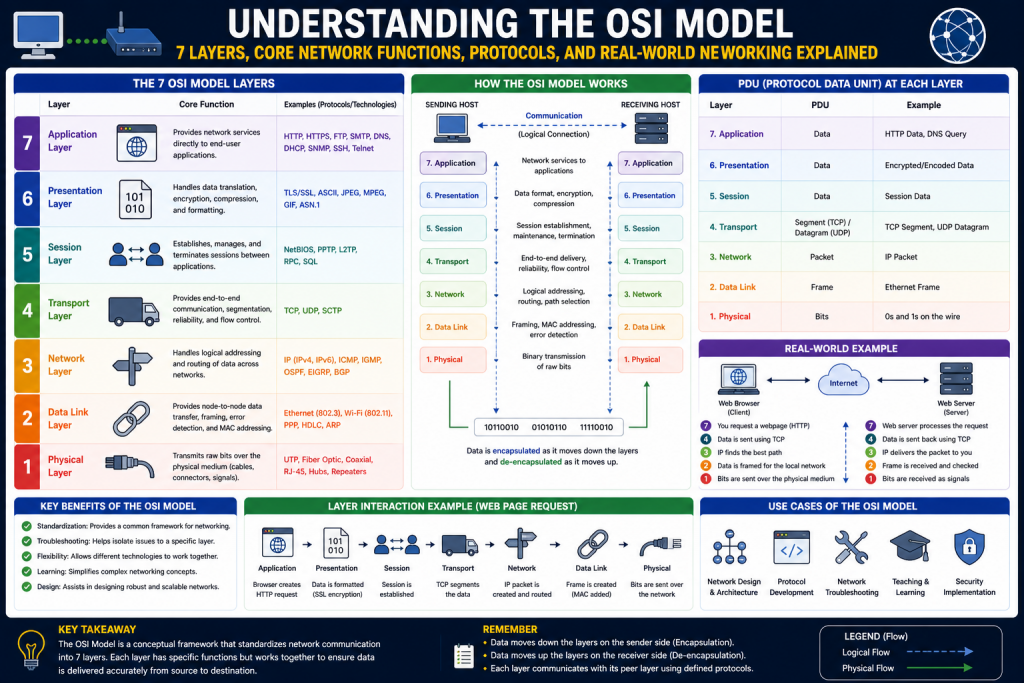
The OSI (Open Systems Interconnection) model is a conceptual framework that organizes network communication into seven layers. These layers work together in a structured way to ensure that data can travel from one device to another, regardless of differences in hardware, software, or location. By separating responsibilities into layers, the OSI model provides clarity, flexibility, and a standard approach to networking.
This part focuses on building a strong foundation by exploring the purpose of the OSI model and examining the first three layers, which are responsible for the physical transmission and movement of data across networks.
Introduction to the OSI Model
The OSI model was developed to create a universal standard for network communication. Before its introduction, different systems often struggled to communicate because they followed incompatible rules and protocols. The OSI model addressed this issue by defining a structured approach that all systems could follow.
It divides communication into seven layers, each performing a unique role while interacting with the layers above and below it. This layered design allows network engineers to understand, design, and troubleshoot systems more effectively.
The seven layers of the OSI model are:
Physical Layer
Data Link Layer
Network Layer
Transport Layer
Session Layer
Presentation Layer
Application Layer
Each layer handles a specific aspect of communication, from transmitting raw signals to delivering data to applications used by end users.
Purpose and Benefits of the OSI Model
The OSI model provides several important benefits that make it a fundamental concept in networking.
One of its primary advantages is standardization. By defining how communication should occur, the OSI model ensures that devices from different manufacturers can work together seamlessly. This is essential in modern networks, where equipment from multiple vendors is often used.
Another key benefit is simplified troubleshooting. When a problem occurs, it can be traced to a specific layer. For example, if there is a hardware issue, the problem is likely in the Physical Layer. If data is not being routed correctly, the issue may lie in the Network Layer. This structured approach makes diagnosing and resolving issues much more efficient.
The OSI model also supports modular design. Each layer can evolve independently, allowing new technologies to be introduced without disrupting the entire system. This flexibility has helped networks grow and adapt over time.
Overview of Data Flow in the OSI Model
Data communication in the OSI model follows a step-by-step process. When a user sends data, it moves down through the layers, starting from the Application Layer and ending at the Physical Layer. At each stage, the data is modified and prepared for transmission.
Once the data reaches the destination, it travels back up through the layers in reverse order. Each layer processes the data, removing the information added during transmission and preparing it for the next layer.
This process ensures that data is delivered accurately and in a format that the receiving system can understand.
The Physical Layer
The Physical Layer is the lowest layer of the OSI model and serves as the foundation for all network communication. It is responsible for transmitting raw bits across a physical medium, such as cables, fiber optics, or wireless signals.
At this stage, data is represented as electrical pulses, light signals, or radio waves. The Physical Layer does not interpret the data; it simply ensures that bits are transmitted from one device to another.
This layer defines the physical characteristics of the network, including cable types, connectors, signal levels, and transmission speeds. It also determines how devices are physically connected.
For example, Ethernet cables, USB connections, and wireless signals all operate at this layer. If a cable is damaged or a connection is loose, communication will fail at the Physical Layer.
The reliability of this layer is critical because all higher layers depend on it. Without a stable physical connection, no data can be transmitted.
Key Functions of the Physical Layer
The Physical Layer performs several essential functions that enable data transmission.
It defines how bits are represented as signals. This includes determining voltage levels, timing, and signal encoding methods. These specifications ensure that devices can interpret signals correctly.
It also establishes the data transmission rate, which determines how quickly data can be sent. Faster transmission rates allow for more efficient communication.
Another important function is synchronization. Devices must be synchronized to ensure that bits are sent and received at the correct times. Without synchronization, data could become corrupted.
The Physical Layer also handles the physical topology of the network, which refers to how devices are arranged and connected. Common topologies include bus, star, and ring configurations.
The Data Link Layer
The Data Link Layer builds on the Physical Layer by organizing raw bits into structured units called frames. It is responsible for ensuring reliable communication between devices on the same network segment.
This layer adds important information to each frame, including source and destination addresses. These addresses, known as MAC addresses, uniquely identify devices on a network.
The Data Link Layer ensures that data is delivered accurately by detecting and correcting errors. If a frame is corrupted during transmission, the layer can request that it be resent.
Another important function is controlling access to the network medium. In networks where multiple devices share the same connection, rules are needed to prevent collisions and ensure smooth communication.
Sublayers of the Data Link Layer
The Data Link Layer is divided into two sublayers, each with specific responsibilities.
The Logical Link Control sublayer manages communication between devices and ensures that data is properly synchronized. It acts as an interface between the Data Link Layer and the Network Layer.
The Media Access Control sublayer handles addressing and determines how devices access the physical medium. It ensures that only one device transmits data at a time, preventing collisions.
Together, these sublayers ensure that data is transmitted efficiently and without errors within a local network.
Importance of Error Detection and Control
Error detection is one of the most critical functions of the Data Link Layer. During transmission, data can become corrupted due to interference, noise, or hardware issues.
To address this, the Data Link Layer uses techniques such as checksums and cyclic redundancy checks to verify data integrity. If an error is detected, the frame is discarded, and a request is sent to retransmit it.
This process ensures that only accurate data is passed to higher layers, maintaining the reliability of communication.
The Network Layer
The Network Layer is responsible for routing data between different networks. While the Data Link Layer handles communication within a single network, the Network Layer ensures that data can travel across multiple interconnected networks.
At this layer, data is organized into packets, which include logical addressing information. The most common type of address used here is the IP address.
The Network Layer determines the best path for data to travel from the source to the destination. This process is known as routing and is carried out by devices such as routers.
Routing and Path Selection
Routing is a key function of the Network Layer. When data is sent across networks, it may pass through multiple intermediate devices. The Network Layer analyzes available paths and selects the most efficient route.
This decision is based on factors such as network congestion, distance, and reliability. If a particular path becomes unavailable, the Network Layer can reroute data through an alternative path.
This flexibility ensures that communication remains uninterrupted even in complex network environments.
Packet Handling and Fragmentation
Another important function of the Network Layer is packet handling. Data is divided into packets, each containing a portion of the overall message along with addressing information.
If a packet is too large for a network segment, it can be broken into smaller pieces, a process known as fragmentation. These fragments are then reassembled at the destination.
This capability allows data to be transmitted efficiently across networks with different size limitations.
Interaction Between Layers 1 to 3
The first three layers of the OSI model work together to ensure that data is transmitted and routed effectively.
The Physical Layer handles the actual transmission of signals. The Data Link Layer organizes these signals into frames and ensures accurate delivery within a local network. The Network Layer takes these frames, converts them into packets, and routes them across multiple networks.
This collaboration allows data to move seamlessly from one device to another, even across vast distances and complex infrastructures.
The Role of Lower Layers in Network Communication
The lower layers of the OSI model form the backbone of network communication. They handle the fundamental tasks required to move data from one point to another.
Without these layers, higher-level functions such as reliable delivery, session management, and application interaction would not be possible. They provide the foundation upon which the entire networking process is built.
Understanding these layers is essential for anyone working in networking, as they are involved in nearly every aspect of communication.
Preparing for Higher-Level Functions
Once data has been transmitted and routed by the lower layers, it is passed to the upper layers for further processing. These layers handle tasks such as ensuring reliable delivery, managing communication sessions, and formatting data for applications.
The transition from the lower layers to the upper layers represents a shift from physical transmission to logical communication and user interaction.
In the next section, the focus will move to the Transport and Session layers, where data reliability and communication management become the primary concerns.
Understanding the Transport and Session Layers in the OSI Model
In the previous section, the focus was on the foundational layers of the OSI model that handle the physical transmission and routing of data. Once data has successfully traveled across networks through the Physical, Data Link, and Network layers, it reaches a stage where reliability, order, and communication management become essential. This is where the Transport and Session layers come into play.
These layers form a bridge between the lower-level network operations and the higher-level processes that interact with applications. They ensure that data is delivered accurately, in the correct sequence, and within a controlled communication environment. Without these layers, network communication would be unreliable and chaotic, making it difficult for applications to function properly.
This section explores Layer 4, the Transport Layer, and Layer 5, the Session Layer, in depth, highlighting their roles, functions, and importance in modern networking.
Role of the Transport Layer in Network Communication
The Transport Layer is responsible for end-to-end communication between devices. While the Network Layer ensures that packets reach the correct destination, the Transport Layer ensures that the data is delivered completely, accurately, and in the correct order.
This layer acts as a quality control system for data transmission. It takes the data received from higher layers, breaks it into smaller segments, and ensures that these segments are delivered reliably to the destination.
One of the most important aspects of the Transport Layer is its ability to provide either reliable or fast communication, depending on the needs of the application. This flexibility allows different types of applications to function efficiently, whether they require strict accuracy or high speed.
Segmentation and Reassembly of Data
Data transmitted across networks is often too large to be sent as a single unit. The Transport Layer divides this data into smaller segments before sending it across the network. This process is known as segmentation.
Each segment is assigned a sequence number, which allows the receiving system to reassemble the data in the correct order. Even if segments arrive out of sequence, the Transport Layer can rearrange them properly.
At the destination, the Transport Layer collects all incoming segments and reconstructs the original data. This process ensures that the data delivered to higher layers is complete and accurate.
Segmentation improves efficiency by allowing multiple segments to travel independently across the network. It also enhances reliability, as lost segments can be retransmitted without affecting the entire data set.
Flow Control and Data Management
Flow control is another critical function of the Transport Layer. It ensures that data is transmitted at a rate that the receiving system can handle. Without flow control, a fast sender could overwhelm a slower receiver, leading to data loss or system instability.
The Transport Layer monitors the capacity of the receiving system and adjusts the transmission rate accordingly. This dynamic adjustment helps maintain a smooth and stable communication process.
In addition to flow control, the Transport Layer manages buffering, which temporarily stores data during transmission. Buffering helps handle variations in data flow and prevents congestion.
These mechanisms work together to ensure that data is delivered efficiently without overloading network resources.
Error Detection and Correction
Errors can occur during data transmission due to noise, interference, or network issues. The Transport Layer plays a key role in detecting and correcting these errors.
It uses techniques such as checksums to verify the integrity of each segment. If an error is detected, the affected segment is retransmitted.
This process ensures that the data received is identical to the data sent. Reliable error detection and correction are essential for applications that require high accuracy, such as file transfers and financial transactions.
Connection-Oriented and Connectionless Communication
The Transport Layer supports two types of communication: connection-oriented and connectionless.
Connection-oriented communication establishes a connection between the sender and receiver before data transmission begins. This connection ensures that data is delivered reliably and in order. It also allows for error checking, flow control, and retransmission of lost data.
Connectionless communication, on the other hand, does not establish a formal connection. Data is sent without prior coordination, which makes the process faster but less reliable. There is no guarantee that data will arrive or that it will be in the correct order.
The choice between these two methods depends on the requirements of the application. Some applications prioritize reliability, while others prioritize speed.
Understanding Transmission Control Protocol
Transmission Control Protocol, commonly known as TCP, is a connection-oriented protocol used at the Transport Layer. It is designed to provide reliable communication between devices.
TCP establishes a connection through a process known as a handshake. Once the connection is established, data is transmitted in segments, each of which is acknowledged by the receiver.
If a segment is lost or corrupted, TCP retransmits it. This ensures that all data arrives intact and in the correct order.
TCP also includes flow control and congestion control mechanisms. These features help manage network traffic and prevent overload.
Because of its reliability, TCP is widely used for applications such as web browsing, email, and file transfers.
Understanding User Datagram Protocol
User Datagram Protocol, or UDP, is a connectionless protocol that operates at the Transport Layer. Unlike TCP, UDP does not establish a connection before transmitting data.
This makes UDP faster and more efficient, as it eliminates the overhead associated with connection setup and management. However, it does not guarantee delivery, order, or error correction.
UDP is commonly used in applications where speed is more important than reliability. Examples include video streaming, online gaming, and voice communication.
In these applications, occasional data loss is acceptable, as it does not significantly impact the overall experience.
Comparing TCP and UDP
TCP and UDP serve different purposes and are suited to different types of applications.
TCP is ideal for situations where accuracy and reliability are critical. It ensures that data is delivered completely and in order, making it suitable for tasks such as downloading files or sending emails.
UDP, on the other hand, is better suited for real-time applications that require low latency. It allows data to be transmitted quickly, even if some packets are lost.
The Transport Layer provides the flexibility to choose the appropriate protocol based on the specific needs of the application.
Port Numbers and Application Identification
The Transport Layer uses port numbers to identify specific applications or services on a device. Each application is assigned a unique port number, which allows data to be directed to the correct destination.
For example, web servers typically use port 80 for HTTP and port 443 for secure HTTPS communication. Email services and file transfer protocols also use specific port numbers.
When data arrives at a device, the Transport Layer examines the port number and delivers the data to the appropriate application.
This process ensures that multiple applications can communicate simultaneously without interference.
Role of the Session Layer in Communication
The Session Layer is responsible for managing communication sessions between applications. A session is a continuous exchange of information between two systems.
This layer establishes, maintains, and terminates sessions. It ensures that communication is organized and that both parties remain synchronized throughout the interaction.
The Session Layer acts as a coordinator, overseeing the flow of data and ensuring that communication proceeds smoothly from start to finish.
Establishing and Maintaining Sessions
Before data can be exchanged, a session must be established. The Session Layer initiates this process by setting up the parameters for communication.
Once the session is established, the layer maintains it by monitoring the interaction between the systems. It ensures that both sides remain connected and that data is exchanged without interruption.
If a disruption occurs, the Session Layer can attempt to recover the session and resume communication.
Synchronization and Checkpointing
Synchronization is an important function of the Session Layer. It ensures that both systems remain aligned during communication.
One way this is achieved is through checkpointing. Checkpoints are markers inserted into the data stream that indicate progress. If a failure occurs, communication can resume from the last checkpoint rather than starting over.
This feature is particularly useful for long data transfers, as it saves time and resources.
Session Termination and Graceful Closure
When communication is complete, the Session Layer is responsible for terminating the session. This process involves closing the connection in an orderly manner.
A graceful termination ensures that all data has been transmitted and that both systems are aware that the session has ended. This prevents data loss and ensures a clean conclusion to the interaction.
Interaction Between Transport and Session Layers
The Transport and Session layers work closely together to provide reliable and organized communication.
The Transport Layer ensures that data is delivered accurately and efficiently, while the Session Layer manages the overall communication process.
Together, they create a stable environment in which applications can exchange data without concern for underlying network complexities.
Importance of Reliable Communication
Reliable communication is essential for many modern applications. Whether it is transferring files, conducting financial transactions, or accessing online services, users expect data to be delivered accurately and without interruption.
The Transport and Session layers play a critical role in meeting these expectations. They provide the mechanisms needed to ensure that data is transmitted correctly and that communication sessions are properly managed.
Preparing for Upper Layers
As data moves beyond the Session Layer, it enters the Presentation and Application layers. These layers focus on formatting data, ensuring compatibility, and providing services to end users.
The work performed by the Transport and Session layers ensures that data reaches these upper layers in a reliable and organized manner.
This sets the stage for meaningful interaction between applications and users, completing the journey of data through the OSI model.
Understanding the Presentation and Application Layers in the OSI Model
As data moves upward through the OSI model, it transitions from being a structured stream of packets and segments into meaningful information that applications and users can understand. After passing through the Transport and Session layers, where reliability and communication management are handled, data reaches the topmost layers of the model. These layers are responsible for formatting, interpreting, and delivering data to end-user applications.
The Presentation Layer and the Application Layer play a crucial role in making network communication usable. Without them, data would remain in a raw or incompatible format, making it impossible for software and users to interact effectively. These layers ensure that data is readable, secure, and accessible, bridging the gap between technical network processes and real-world applications.
This section explores Layer 6 and Layer 7 of the OSI model in detail, along with alternative models and a final conclusion that ties all seven layers together.
Role of the Presentation Layer in Data Processing
The Presentation Layer is responsible for preparing data for use by the Application Layer. It acts as a translator, ensuring that data sent from one system can be understood by another, even if the systems use different formats or encoding methods.
This layer focuses on how data is represented rather than how it is transmitted. It ensures that the structure and format of the data are compatible between the sender and the receiver.
The Presentation Layer is essential because different systems may store and process data in different ways. Without a standard method of translation, communication between these systems would be unreliable or impossible.
Data Translation and Format Conversion
One of the primary functions of the Presentation Layer is data translation. It converts data from one format into a standard format that can be understood by the receiving system.
For example, one system may use a specific character encoding format, while another system uses a different one. The Presentation Layer ensures that the data is converted appropriately so that it appears correctly on both systems.
This function is especially important in environments where multiple platforms and technologies interact. It ensures that differences in internal data representation do not interfere with communication.
Data Encryption and Decryption
Security is a critical concern in modern networks, and the Presentation Layer plays a key role in protecting data during transmission. It is responsible for encrypting data before it is sent and decrypting it when it is received.
Encryption transforms readable data into an unreadable format, ensuring that unauthorized users cannot access sensitive information. Decryption reverses this process, restoring the original data so that it can be used by the receiving application.
This function is essential for secure communication, especially in applications such as online banking, email, and secure web browsing.
Data Compression and Efficiency
Another important function of the Presentation Layer is data compression. Compression reduces the size of the data being transmitted, which improves efficiency and reduces the time required for transmission.
By minimizing the amount of data sent across the network, compression helps conserve bandwidth and improve performance. This is particularly important for large files, multimedia content, and real-time applications.
At the receiving end, the Presentation Layer decompresses the data, restoring it to its original form.
Ensuring Data Compatibility Across Systems
The Presentation Layer ensures that data remains consistent and usable across different systems. It handles differences in data representation, encoding, and structure, allowing diverse systems to communicate effectively.
This compatibility is crucial in today’s interconnected world, where devices and applications from different vendors must work together seamlessly.
By standardizing data formats and handling conversions, the Presentation Layer simplifies communication and reduces the complexity of application development.
Role of the Application Layer in Networking
The Application Layer is the topmost layer of the OSI model and is closest to the end user. It provides the interface through which applications access network services.
This layer does not include the applications themselves but rather the protocols and services that allow applications to communicate over a network. It acts as a bridge between user-facing software and the underlying network infrastructure.
The Application Layer enables functions such as web browsing, email communication, file transfers, and remote access.
Application Layer Services and Functions
The Application Layer provides a wide range of services that support network communication. These services include identifying communication partners, determining resource availability, and managing data exchange.
It ensures that applications can request and receive data from the network without needing to understand the complexities of lower layers.
For example, when a user opens a web browser and enters a website address, the Application Layer initiates the process of retrieving the requested content.
Common Application Layer Protocols
Several widely used protocols operate at the Application Layer, each serving a specific purpose.
HTTP is used for transferring web pages and enabling web browsing. It allows browsers to request and receive content from web servers.
FTP is used for transferring files between systems. It provides a reliable method for uploading and downloading data.
SMTP is used for sending email messages, while other protocols handle email retrieval.
DNS is responsible for translating human-readable domain names into IP addresses, allowing users to access websites using familiar names instead of numerical addresses.
These protocols provide the foundation for many of the services that users rely on daily.
Interaction Between Application and Presentation Layers
The Application and Presentation layers work closely together to ensure that data is both usable and properly formatted.
The Application Layer generates or requests data, while the Presentation Layer ensures that the data is in the correct format for transmission. At the receiving end, the Presentation Layer processes the data before passing it to the Application Layer.
This collaboration ensures that applications receive data in a form they can interpret and use effectively.
End-to-End Data Flow Across All Layers
To fully understand the OSI model, it is important to consider how all seven layers work together during data transmission.
When a user sends data, it starts at the Application Layer and moves downward through the Presentation, Session, Transport, Network, Data Link, and Physical layers. Each layer adds specific information and prepares the data for the next stage.
At the destination, the process is reversed. Data moves upward through the layers, with each layer removing the information added during transmission and processing the data accordingly.
This step-by-step process ensures that data is delivered accurately and in a usable format.
Alternatives to the OSI Model
While the OSI model is widely used as a teaching and reference tool, other models also describe network communication.
One of the most well-known alternatives is the TCP/IP model. This model simplifies the OSI structure into four layers: Application, Transport, Internet, and Network Access.
The TCP/IP model is more closely aligned with real-world networking protocols and is widely used in practice. It combines several OSI layers into broader categories, making it more streamlined.
Another alternative is the DoD model, which also consists of four layers and has historical significance as the foundation for early internet development.
Although these models differ in structure, they share the same fundamental goal of explaining how data moves across networks.
Comparing OSI and TCP/IP Models
The OSI and TCP/IP models serve similar purposes but differ in their approach.
The OSI model provides a more detailed and structured framework with seven distinct layers. It is often used for learning and understanding network concepts.
The OSI and TCP/IP models serve similar purposes but differ in their approach. The OSI model provides a more detailed and structured framework with seven distinct layers. It is often used for learning and understanding network concepts. Its clear separation of responsibilities allows learners and professionals to analyze each stage of communication individually, making it easier to identify where specific processes occur and how different technologies interact within a network.
In contrast, the TCP/IP model simplifies networking into four layers, combining several OSI layers into broader categories. This makes it more practical and closely aligned with real-world implementations, as most modern networks, including the internet, are built using TCP/IP protocols. While it lacks the granular detail of the OSI model, its streamlined structure allows for easier deployment and faster understanding of how actual network communication functions.
Another key difference lies in their design philosophy. The OSI model was developed as a theoretical framework before widespread implementation, whereas the TCP/IP model evolved from real-world networking practices. This gives TCP/IP a more practical orientation, while the OSI model remains a valuable educational and reference tool.
Together, both models complement each other. The OSI model helps in conceptual understanding and troubleshooting, while the TCP/IP model provides insight into how networks operate in practice.
The TCP/IP model, on the other hand, is more practical and closely aligned with actual network implementations. It simplifies the process by combining layers and focusing on essential functions.
Despite these differences, both models complement each other and are valuable for understanding network communication.
Importance of Upper Layers in User Experience
The Presentation and Application layers play a crucial role in shaping the user experience. They ensure that data is not only transmitted but also presented in a meaningful and accessible way.
These layers act as the final bridge between complex network processes and the human interaction with digital systems. Without them, users would receive raw, unstructured data that would be difficult or impossible to interpret.
The Presentation Layer focuses on how data is formatted, ensuring that text, images, audio, and video appear correctly on different devices and platforms. It handles tasks such as encoding, encryption, and compression, which directly impact how quickly and securely information is delivered. For example, when streaming a video or opening a document, the Presentation Layer ensures that the content is displayed properly regardless of the device being used.
The Application Layer, on the other hand, provides the interface through which users interact with network services. It enables applications like web browsers, email clients, and messaging platforms to function smoothly. This layer ensures that user requests are translated into network actions and that responses are delivered in a user-friendly format.
Together, these layers make digital communication intuitive and efficient, allowing users to access information, communicate, and perform tasks without needing to understand the underlying technical complexities.
Without these layers, users would not be able to interact with applications, view web pages, or communicate effectively.
They enable the functionality that users expect from modern networks, making them an essential part of the OSI model.
Conclusion
The OSI model provides a comprehensive framework for understanding how network communication works. By dividing the process into seven layers, it simplifies complex interactions and makes it easier to design, manage, and troubleshoot networks.
Each layer has a specific role, from transmitting raw signals at the Physical Layer to delivering data to applications at the Application Layer. The lower layers focus on moving data across networks, while the upper layers ensure that the data is usable and meaningful.
Together, these layers create a complete system that supports reliable, efficient, and secure communication. The structured approach of the OSI model allows different technologies and devices to work together seamlessly, forming the backbone of modern networking.
Even with the existence of alternative models like TCP/IP, the OSI model remains an essential tool for learning and understanding network concepts. Its layered design continues to provide valuable insights into how data travels from one system to another.
For students, professionals, and anyone interested in networking, mastering the OSI model is a crucial step toward understanding the technology that powers today’s connected world.
Continue exploring the technologies and certification concepts that matter most to you.