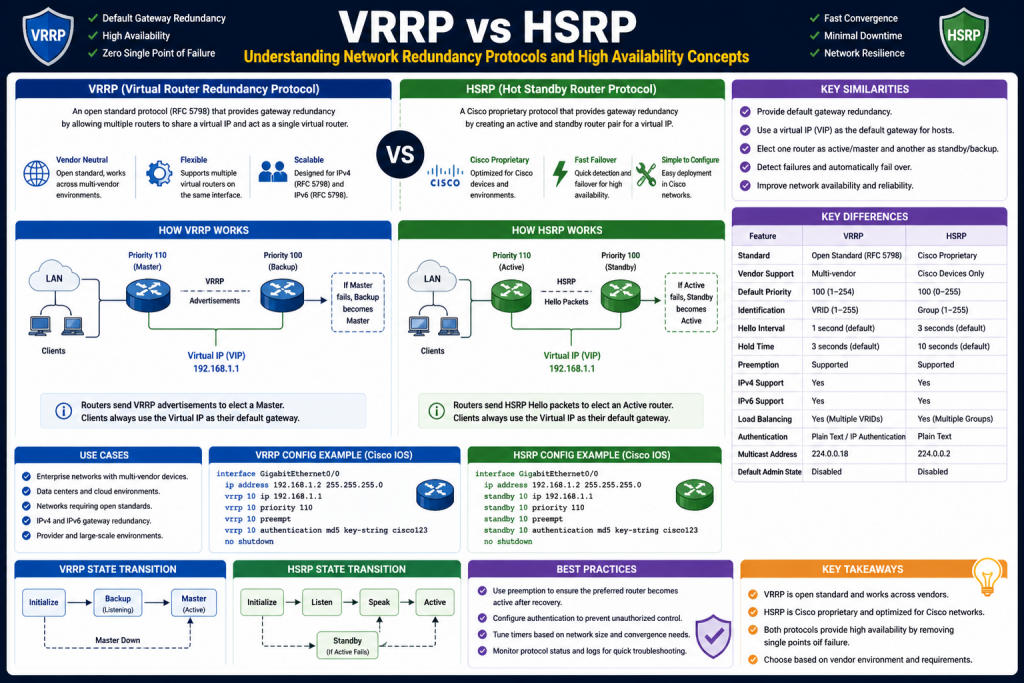
In today’s interconnected world, network availability is one of the most critical requirements for any organization. Businesses depend on stable and continuous connectivity for communication, cloud computing, financial transactions, and access to essential services. Even a short interruption can result in lost productivity, dissatisfied users, and financial losses. Because of this, network engineers focus heavily on designing systems that can withstand failures without affecting users.
One of the most vulnerable points in a network is the default gateway. This is typically a router that connects a local network to external networks such as the internet or other internal segments. If this router fails, devices on the network may lose access to everything beyond their local environment. To prevent this single point of failure, redundancy protocols are used.
Gateway redundancy protocols allow multiple routers to work together as if they were a single device. They provide automatic failover, meaning that if one router stops functioning, another router can immediately take over its responsibilities. Among the most widely used protocols for this purpose are Virtual Router Redundancy Protocol and Hot Standby Router Protocol.
Both of these protocols are designed to improve network reliability by ensuring that there is always an available gateway. While they achieve similar outcomes, they differ in their structure, implementation, and capabilities. Understanding how these protocols work is essential for anyone involved in network design or administration.
The Concept of a Default Gateway in Networking
Before diving into redundancy protocols, it is important to understand the role of a default gateway. In a network, devices communicate directly with other devices within the same subnet. However, when they need to reach devices outside their local network, they rely on a gateway.
The default gateway acts as a bridge between the local network and external networks. It is responsible for forwarding packets to their destination beyond the local subnet. Without a functioning gateway, devices cannot access the internet or communicate with other networks.
In most networks, the default gateway is a router interface with a specific IP address. All hosts are configured to send their outbound traffic to this address. While this setup works under normal conditions, it creates a single point of failure. If the router goes down, all communication beyond the local network stops.
Redundancy protocols address this issue by introducing a virtual gateway. Instead of relying on a single physical router, multiple routers share a virtual IP address. This ensures that even if one router fails, another can continue handling traffic without requiring changes on the client devices.
Overview of Gateway Redundancy Protocols
Gateway redundancy protocols are designed to provide high availability and fault tolerance at the network layer. They allow multiple routers to cooperate and present themselves as a single logical gateway to the network.
These protocols work by assigning roles to routers within a group. Typically, one router is responsible for actively forwarding traffic, while others remain on standby. The standby routers continuously monitor the active router’s status. If the active router fails, one of the standby routers takes over almost instantly.
The key benefit of this approach is transparency. From the perspective of network devices, nothing changes. They continue to send traffic to the same gateway IP address, unaware that a different physical router is now handling their requests.
Two of the most commonly used gateway redundancy protocols are Virtual Router Redundancy Protocol and Hot Standby Router Protocol. Each has its own characteristics, advantages, and limitations, which influence how and where it is used.
Understanding Virtual Router Redundancy Protocol
Virtual Router Redundancy Protocol is an open standard designed to provide automatic failover for default gateways. Because it is not tied to any specific vendor, it can be implemented on devices from different manufacturers. This makes it a flexible option for networks that use a mix of hardware.
The core idea behind this protocol is the creation of a virtual router. This virtual router has its own IP address, which is used by hosts as their default gateway. Multiple physical routers are configured to support this virtual router, forming a redundancy group.
Within this group, one router is designated as the master. The master router is responsible for forwarding traffic sent to the virtual IP address. The other routers act as backups and are ready to take over if the master fails.
The selection of the master router is based on priority values. Each router is assigned a priority, and the one with the highest value becomes the master. This allows administrators to control which router should handle traffic under normal conditions.
How VRRP Establishes a Virtual Gateway
The process of creating a virtual gateway involves assigning a shared IP address to the redundancy group. This IP address is configured on all routers participating in the group, but only the master router actively uses it.
When a host on the network needs to send traffic outside its subnet, it sends packets to the virtual IP address. The master router receives these packets and forwards them to their destination.
To ensure proper communication, the master router responds to address resolution requests using its own MAC address. This allows devices to associate the virtual IP address with a physical interface.
If the master router fails, one of the backup routers takes over the virtual IP address. It begins responding to requests and forwarding traffic, ensuring continuity of service.
This seamless transition is one of the key strengths of the protocol. Users typically experience little to no disruption during the failover process.
Communication Between VRRP Routers
Routers in a VRRP group must constantly communicate to maintain synchronization. This is achieved through the use of advertisement messages. These messages are sent at regular intervals by the master router to inform the backups that it is still active.
The backup routers listen for these advertisements. If they stop receiving them, they assume that the master router has failed. After a short delay, one of the backup routers takes over as the new master.
The timing of these messages is critical. Shorter intervals allow for faster detection of failures but may increase network overhead. Longer intervals reduce overhead but may result in slower failover.
The protocol uses multicast communication to send these messages. This allows all routers in the group to receive updates simultaneously without requiring individual connections.
Failover Process in VRRP
Failover is the process by which a backup router takes over when the master router fails. This process is designed to be fast and efficient, minimizing the impact on network users.
When a backup router detects the absence of advertisement messages, it starts a timer. If the timer expires without receiving any updates, it assumes that the master is down.
The backup router with the highest priority then becomes the new master. It takes over the virtual IP address and begins handling traffic.
To ensure that devices on the network update their address mappings, the new master may send gratuitous address resolution messages. These messages inform hosts that the MAC address associated with the virtual IP has changed.
This allows traffic to be redirected to the new master without requiring manual intervention.
Benefits of Using VRRP
One of the main advantages of VRRP is its compatibility with multiple vendors. Since it is an open standard, it can be used in networks that include equipment from different manufacturers. This flexibility makes it a popular choice for diverse environments.
Another significant benefit is improved network availability. By providing automatic failover, VRRP ensures that there is always a functioning gateway available. This reduces downtime and enhances reliability.
VRRP can also support load distribution in certain configurations. By creating multiple redundancy groups, traffic can be spread across different routers. This helps balance the load and improve performance.
The protocol is also relatively easy to configure. Network administrators can set up redundancy groups, assign priorities, and adjust timing settings without excessive complexity.
Limitations of VRRP
Despite its advantages, VRRP has some limitations. One of the main requirements is that all routers in a redundancy group must be on the same subnet. This ensures that they can communicate directly with hosts on the network.
This requirement can limit flexibility in certain network designs. For example, it may not be suitable for environments where routers are located in different physical locations.
Another limitation is the reliance on multicast communication. Networks must be configured to support multicast traffic, which may require additional setup.
Failover time, while fast, is not instantaneous. Some applications may experience brief interruptions during the transition.
Security is also a consideration. Without proper configuration, unauthorized devices could potentially join a VRRP group. This makes it important to implement security measures to protect the network.
Introduction to Hot Standby Router Protocol
Hot Standby Router Protocol is another solution designed to provide gateway redundancy. Unlike VRRP, it is a proprietary protocol developed specifically for Cisco devices.
HSRP operates in a similar way by creating a virtual gateway shared among multiple routers. One router is designated as the active router, while others remain in standby mode.
The active router is responsible for forwarding traffic sent to the virtual IP address. The standby routers monitor the active router and are ready to take over if it fails.
This protocol is widely used in networks that rely on Cisco hardware. It offers reliable performance and integrates well with other Cisco technologies.
Basic Operation of HSRP
In an HSRP group, routers are assigned priorities that determine their roles. The router with the highest priority becomes the active router. The next highest becomes the standby router.
The active router sends periodic hello messages to inform other routers that it is functioning properly. These messages are used to maintain communication and detect failures.
If the standby router stops receiving hello messages, it assumes that the active router has failed. It then takes over as the new active router.
Like VRRP, HSRP uses a virtual IP address as the default gateway for hosts. This allows devices to continue sending traffic without needing to update their configuration.
The protocol also uses a state-based system to manage router roles. Routers transition through different states as they join the group and respond to changes in network conditions.
Importance of Redundancy Protocols in Modern Networks
Redundancy protocols play a crucial role in ensuring network stability. As organizations become more dependent on digital services, the need for reliable connectivity continues to grow.
These protocols help eliminate single points of failure, ensuring that networks can continue operating even when hardware issues occur. They also reduce the need for manual intervention, allowing systems to recover automatically.
By implementing redundancy protocols, network administrators can improve performance, enhance reliability, and provide a better experience for users. Whether using VRRP or HSRP, the goal remains the same: to keep the network running smoothly under all conditions.
Core Functional Differences Between VRRP and HSRP
Although both VRRP and HSRP are designed to provide gateway redundancy, their internal operations and design philosophies introduce several important differences. These differences affect how each protocol behaves in real-world scenarios and influence which one is more suitable for a particular network.
One of the most fundamental differences lies in standardization. VRRP is an open standard protocol, meaning it can be implemented by multiple vendors. HSRP, on the other hand, is proprietary and designed specifically for Cisco devices. This distinction alone often determines which protocol is used, especially in environments that rely on hardware from different manufacturers.
Another major difference is terminology and role assignment. In VRRP, routers are classified as master and backup. In HSRP, they are referred to as active and standby. While the concept is similar, the internal logic and state transitions differ slightly.
The way each protocol handles IP addressing is also distinct. VRRP typically allows the master router to use its real interface IP as the virtual IP. HSRP always uses a separate virtual IP address that is different from the physical IP addresses of the routers.
These structural differences may seem minor, but they have practical implications for configuration, troubleshooting, and overall network behavior.
Router Election and Priority Handling
Both VRRP and HSRP rely on priority values to determine which router becomes the primary device. However, the details of how these priorities are used differ between the two protocols.
In VRRP, each router is assigned a priority value ranging from 0 to 255. The router with the highest priority becomes the master. A priority of 255 is reserved for the router that owns the virtual IP address, ensuring that it always becomes the master if available.
In HSRP, routers are also assigned priority values, typically ranging from 0 to 255, with a default value of 100. The router with the highest priority becomes the active router. If priorities are equal, the router with the highest IP address is selected.
Preemption behavior is another area where differences appear. In VRRP, preemption is enabled by default. This means that if a higher-priority router comes online after a failure, it will automatically take back the master role.
In HSRP, preemption is not enabled by default. Administrators must explicitly configure it if they want higher-priority routers to reclaim the active role after recovering from a failure.
This difference can impact network stability. In some environments, frequent role changes may not be desirable, so administrators must carefully configure preemption settings based on their needs.
Failover Timing and Convergence Speed
Failover speed is a critical factor in network redundancy. The faster a backup router can take over, the less noticeable the disruption will be to users.
VRRP typically has a faster convergence time due to its shorter default advertisement intervals. It sends advertisement messages every second by default, allowing backup routers to detect failures quickly.
HSRP, in its default configuration, uses longer hello and hold timers. Hello messages are usually sent every three seconds, and the hold timer is set to ten seconds. This means that failover may take slightly longer compared to VRRP.
However, HSRP timers can be tuned to achieve faster convergence. By adjusting hello and hold intervals, administrators can reduce failover time significantly. Some advanced configurations even allow sub-second failover.
Despite this flexibility, VRRP is often considered faster out of the box, while HSRP requires tuning to match similar performance levels.
Differences in Virtual IP Address Handling
The handling of virtual IP addresses is another important distinction between the two protocols. In VRRP, the virtual IP address can be the same as the physical IP address of the master router. This simplifies configuration and reduces the need for additional IP addresses.
In HSRP, the virtual IP address is always separate from the physical IP addresses of the routers. Each router has its own unique IP, and the group shares an additional virtual IP used by hosts as the default gateway.
This difference affects how networks are designed and configured. VRRP’s approach can be more straightforward, especially in smaller networks where IP address management is a concern.
HSRP’s method, while requiring more IP addresses, provides greater separation between physical and virtual configurations. This can make troubleshooting easier in some cases, as each router maintains its own identity alongside the shared gateway.
Load Balancing and Traffic Distribution
Load balancing is an important consideration in network design, especially in environments with high traffic volumes. The ability to distribute traffic across multiple routers can improve performance and prevent bottlenecks.
VRRP supports load balancing through multiple group configurations. By assigning different virtual IP addresses to different groups, traffic can be distributed across multiple routers. Some implementations also allow the master router to alternate responses to address resolution requests, effectively splitting traffic between routers.
HSRP does not provide true load balancing in its basic form. Instead, it supports load sharing. This is achieved by configuring different hosts to use different default gateways. While this distributes traffic, it does not provide automatic failover for all hosts if one router fails.
Because of this limitation, load sharing in HSRP is often avoided. If one router goes down, only the hosts configured to use the other router will continue functioning properly. This can create inconsistencies in network access.
To address this limitation, Cisco introduced another protocol called Gateway Load Balancing Protocol. This protocol combines redundancy with true load balancing, similar to VRRP’s capabilities.
Authentication and Security Features
Security is an important aspect of any network protocol. Both VRRP and HSRP include mechanisms to prevent unauthorized devices from participating in redundancy groups, but their approaches differ.
VRRP has limited built-in authentication capabilities. Some implementations support simple authentication methods, but these are not always robust. As a result, additional security measures such as network segmentation and access control lists are often required.
HSRP provides stronger authentication options, particularly in newer versions. It supports message authentication using more secure methods, helping to protect against spoofing and unauthorized participation.
The level of security required depends on the network environment. In highly secure environments, administrators must carefully configure authentication settings and implement additional safeguards regardless of the protocol used.
Multicast and Communication Methods
Both protocols rely on multicast communication to exchange status information between routers. However, they use different multicast addresses and message formats.
VRRP uses a standardized multicast address to send advertisement messages. This allows all routers in the group to receive updates efficiently.
HSRP uses its own multicast address and communication format. Because it is proprietary, its implementation is tightly integrated with Cisco devices.
The use of multicast requires proper configuration of network infrastructure. Switches and routers must be configured to allow multicast traffic to pass between devices. Failure to do so can prevent redundancy protocols from functioning correctly.
Scalability and Deployment Considerations
Scalability is an important factor when choosing a redundancy protocol. Networks vary in size and complexity, and the chosen solution must be able to accommodate growth.
VRRP is highly scalable due to its open standard nature. It can be deployed across a wide range of devices and network sizes. This makes it suitable for both small businesses and large enterprises.
HSRP is also scalable but is limited to Cisco environments. For organizations that rely entirely on Cisco hardware, this is not a limitation. In fact, it can be an advantage due to tight integration and consistent behavior.
Deployment complexity is another consideration. VRRP is generally straightforward to configure, especially in simple networks. HSRP, while also relatively easy to set up, may require additional configuration for advanced features such as preemption and timer tuning.
Administrators must consider their network requirements, hardware compatibility, and future growth when choosing between these protocols.
Interoperability and Vendor Support
Interoperability is a key advantage of VRRP. Because it is an open standard, it can be used in networks that include devices from multiple vendors. This allows organizations to avoid vendor lock-in and choose hardware based on performance, cost, and features.
HSRP, being proprietary, does not offer this level of interoperability. It is limited to Cisco devices, which can be a drawback in mixed environments.
However, in networks that are already standardized on Cisco hardware, HSRP can provide a seamless and well-supported solution. Cisco devices are optimized to work with HSRP, offering reliable performance and advanced features.
The choice between interoperability and vendor-specific optimization is an important factor in protocol selection.
Operational Behavior in Real-World Scenarios
In real-world deployments, the behavior of redundancy protocols can vary based on network conditions and configuration.
VRRP is often preferred in environments where flexibility and vendor diversity are important. It provides reliable failover and can be adapted to a wide range of scenarios.
HSRP is commonly used in enterprise networks that rely on Cisco infrastructure. Its integration with Cisco devices allows for advanced features and consistent performance.
Both protocols require careful configuration and monitoring to ensure optimal performance. Factors such as timer settings, priority values, and network topology can all influence how the protocol behaves during normal operation and failure conditions.
Understanding these differences helps network administrators design more resilient systems and make informed decisions about which protocol to use.
Advanced Features and Enhancements in Gateway Redundancy
As networks continue to evolve, redundancy protocols have also been enhanced to support more complex and demanding environments. While the primary purpose of both VRRP and HSRP is to provide failover, modern implementations include additional features that improve performance, scalability, and reliability.
One of the most important enhancements is tracking. Both protocols allow routers to monitor the status of interfaces or other network conditions. For example, a router can track the status of its uplink connection to the internet. If that connection fails, the router can reduce its priority, allowing another router with a working uplink to take over.
This feature ensures that failover decisions are based not only on the health of the router itself but also on the availability of critical network paths. Without tracking, a router might remain active even if it has lost connectivity to external networks, resulting in traffic blackholing.
Another advanced feature is object tracking, which allows routers to monitor multiple conditions simultaneously. These conditions can include interface states, routing protocols, or even specific network paths. By combining these checks, administrators can create more intelligent and responsive failover mechanisms.
Both protocols also support customization of timers. Adjusting hello intervals and hold times allows administrators to fine-tune failover speed and network overhead. Faster timers improve responsiveness but may increase CPU and bandwidth usage, while slower timers reduce overhead but delay failover.
These enhancements make VRRP and HSRP more adaptable to modern network requirements, where high availability must be balanced with performance and efficiency.
Gateway Load Balancing Protocol and Its Role
While VRRP provides some load distribution capabilities and HSRP primarily focuses on redundancy, there is another protocol designed specifically to combine both functions more effectively. Gateway Load Balancing Protocol addresses the limitations of HSRP by introducing true load balancing alongside redundancy.
This protocol allows multiple routers to actively participate in forwarding traffic. Instead of having one active router and others on standby, all routers can share the load. This is achieved by assigning a single virtual IP address and multiple virtual MAC addresses.
When hosts send address resolution requests for the gateway, the protocol responds with different MAC addresses for different hosts. This distributes traffic evenly across all participating routers. At the same time, redundancy is maintained, as other routers can take over if one fails.
This approach improves resource utilization and increases overall network throughput. It is particularly useful in environments with high traffic volumes, where a single active router may become a bottleneck.
However, like HSRP, this protocol is proprietary and limited to specific hardware environments. This means that its use is typically restricted to networks that rely on a single vendor.
Design Considerations for Implementing Redundancy Protocols
Choosing and implementing a redundancy protocol requires careful planning. Network administrators must consider several factors to ensure that the chosen solution meets their requirements.
One of the first considerations is network topology. Both VRRP and HSRP require that participating routers be on the same subnet. This ensures that they can communicate directly with hosts and with each other. In more complex networks, this requirement may influence how VLANs and subnets are designed.
Another important factor is hardware compatibility. In multi-vendor environments, VRRP is often the preferred choice due to its open standard nature. In contrast, HSRP and related protocols are more suitable for environments that use specific vendor hardware.
Performance requirements also play a significant role. Networks with high traffic volumes may benefit from load balancing capabilities, while smaller networks may only require basic failover functionality.
Administrators must also consider failover speed. Applications such as voice and video communication are sensitive to delays, so faster failover times are essential. This may require tuning protocol timers and optimizing network configurations.
Security is another critical consideration. Proper authentication and access controls must be implemented to prevent unauthorized devices from participating in redundancy groups. This helps protect the network from potential attacks or misconfigurations.
Configuration Best Practices for Reliable Operation
Proper configuration is essential for ensuring that redundancy protocols function correctly. Even minor misconfigurations can lead to unexpected behavior or reduced reliability.
One best practice is to assign appropriate priority values to routers. The primary router should have the highest priority, while backup routers should have lower values. This ensures that the desired router becomes active under normal conditions.
Enabling preemption should be carefully considered. While it allows higher-priority routers to reclaim their role after recovering from a failure, it can also lead to frequent role changes if the network is unstable. Administrators must evaluate whether preemption is beneficial for their specific environment.
Timer settings should be optimized based on network requirements. Shorter timers improve failover speed but increase overhead. Longer timers reduce overhead but may delay failover. Finding the right balance is key to achieving optimal performance.
Interface and object tracking should be implemented to enhance failover decisions. By monitoring critical network paths, routers can make more informed decisions about when to relinquish their role.
Regular testing is also important. Simulating failures and observing how the network responds helps identify potential issues before they affect users. This proactive approach ensures that redundancy mechanisms work as expected when needed.
Common Misconfigurations and Their Impact
Despite their benefits, redundancy protocols can cause issues if not configured correctly. Understanding common mistakes can help prevent problems and improve network stability.
One common misconfiguration is assigning equal priority values without considering tie-breaking rules. This can lead to unexpected router selection and inconsistent behavior.
Another issue is failing to enable preemption when it is required. Without preemption, a lower-priority router may remain active even after a higher-priority router comes back online. This can result in suboptimal performance.
Incorrect timer settings can also cause problems. If timers are too aggressive, routers may frequently switch roles due to temporary network fluctuations. If they are too slow, failover may take longer than desired.
Improper network design can also impact redundancy. If routers are not properly connected to the same subnet, failover may not work as expected. Ensuring proper connectivity is essential for reliable operation.
Security misconfigurations can expose the network to risks. Without proper authentication, unauthorized devices could join the redundancy group and disrupt operations.
By understanding these common pitfalls, administrators can take steps to avoid them and ensure smooth operation.
Real-World Use Cases of VRRP and HSRP
Redundancy protocols are used in a wide range of real-world scenarios. Their ability to maintain connectivity makes them essential in both small and large networks.
In enterprise environments, these protocols are used to ensure continuous access to critical applications. Employees rely on network connectivity for communication, data access, and collaboration. Redundancy protocols help prevent disruptions that could impact productivity.
In data centers, redundancy is even more critical. Servers and applications must remain accessible at all times. By implementing redundancy protocols, data centers can ensure that traffic continues to flow even if a router fails.
Service providers also use these protocols to maintain reliable connections for their customers. Any downtime can affect thousands of users, making redundancy essential for maintaining service quality.
Educational institutions, healthcare facilities, and government organizations also benefit from these protocols. In these environments, reliable connectivity is essential for delivering services and supporting operations.
Future Trends in Network Redundancy
As technology continues to advance, network redundancy is evolving to meet new challenges. Modern networks are becoming more complex, with the introduction of virtualization, cloud computing, and software-defined networking.
These changes are influencing how redundancy is implemented. Traditional protocols like VRRP and HSRP are being integrated with newer technologies to provide more flexible and scalable solutions.
Automation is playing an increasingly important role. Network management tools can monitor conditions and adjust configurations automatically, reducing the need for manual intervention.
Another trend is the use of distributed architectures. Instead of relying on a single gateway, traffic can be distributed across multiple paths, improving resilience and performance.
Security is also becoming a greater focus. As networks become more connected, protecting redundancy mechanisms from attacks is essential.
Despite these changes, the core principles of redundancy remain the same. Ensuring continuous connectivity and minimizing downtime will always be a priority in network design.
Choosing Between VRRP and HSRP in Practice
Selecting the right protocol depends on several factors, including network environment, hardware, and specific requirements.
In environments with equipment from multiple vendors, VRRP is often the preferred choice due to its compatibility. It allows organizations to build flexible networks without being tied to a single vendor.
In networks that rely on specific vendor hardware, HSRP may be more suitable. Its integration with vendor devices provides reliable performance and access to advanced features.
Performance requirements also influence the decision. Networks that require load balancing may benefit from solutions that support traffic distribution, while those focused on redundancy may prioritize simplicity.
Administrative expertise is another consideration. Network teams familiar with a particular vendor’s ecosystem may find it easier to work with proprietary protocols.
Ultimately, both protocols provide reliable redundancy. The choice depends on how well each protocol aligns with the network’s design and operational goals.
Conclusion
Network reliability is a fundamental requirement in modern computing environments. As organizations continue to depend on digital systems, ensuring uninterrupted connectivity becomes increasingly important. Redundancy protocols such as VRRP and HSRP play a vital role in achieving this goal.
Both protocols are designed to eliminate single points of failure by allowing multiple routers to function as a single gateway. They provide automatic failover, ensuring that network services remain available even when hardware issues occur.
While they share a common purpose, their differences in design, implementation, and capabilities make each one suitable for specific scenarios. VRRP offers flexibility and interoperability, making it ideal for multi-vendor environments. HSRP provides tight integration with specific hardware, offering a reliable solution for networks built around that ecosystem.
Advanced features such as tracking, timer customization, and load balancing further enhance their capabilities. These features allow network administrators to tailor redundancy mechanisms to meet the unique needs of their environments.
Proper planning, configuration, and testing are essential for successful implementation. By understanding how these protocols work and avoiding common misconfigurations, administrators can build resilient networks that deliver consistent performance.
As networks continue to evolve, redundancy will remain a key component of reliable infrastructure. Whether using VRRP, HSRP, or other solutions, the objective is the same: to keep networks running smoothly and ensure that users remain connected at all times.
Continue exploring the technologies and certification concepts that matter most to you.