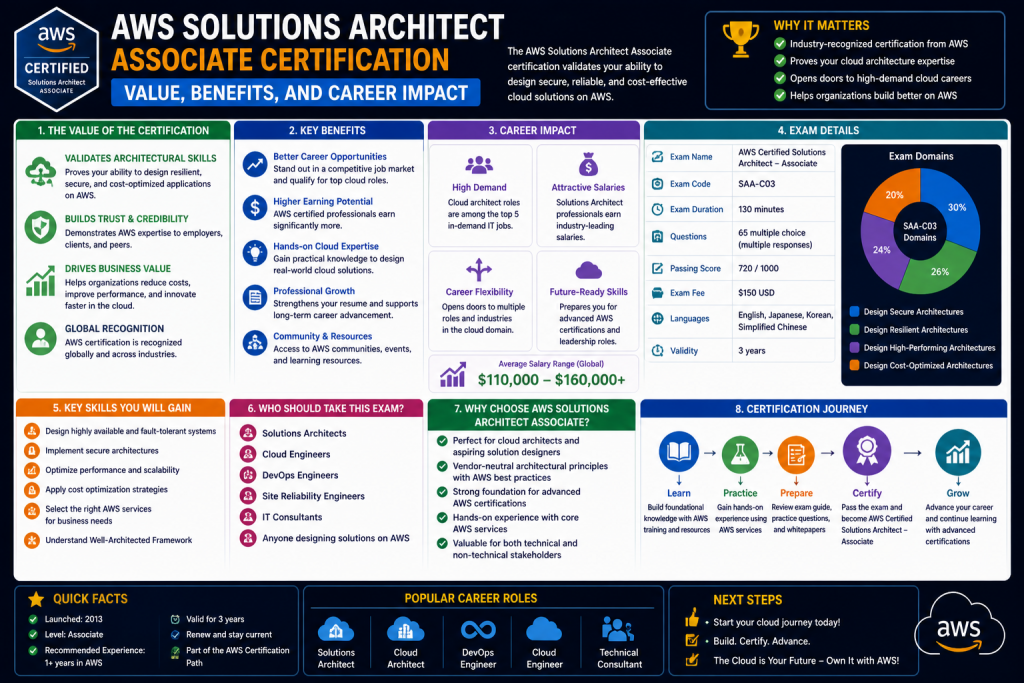
Cloud computing has become the backbone of modern technology infrastructure. Organizations no longer rely solely on physical servers located in on-premises data centers. Instead, they leverage cloud platforms to build scalable, flexible, and cost-efficient systems that can adapt to changing demands. This shift has transformed the IT landscape and created a strong demand for professionals who understand how to design and manage cloud-based solutions.
Amazon Web Services is one of the leading cloud providers in the world. It offers a vast range of services that enable businesses to store data, run applications, analyze information, and scale operations globally. From startups to large enterprises, organizations depend on AWS to deliver reliable and high-performing systems.
As the adoption of cloud technologies continues to grow, so does the need for skilled professionals who can work with these platforms effectively. Certifications have become a common way for individuals to demonstrate their expertise and stand out in a competitive job market. Among these certifications, the AWS Solutions Architect – Associate holds a prominent position.
This certification is designed to validate a candidate’s ability to design and deploy applications on AWS. It focuses on practical skills and real-world scenarios, making it highly relevant for professionals who want to build a career in cloud computing.
Understanding the AWS Solutions Architect – Associate Certification
The AWS Solutions Architect – Associate certification is a professional credential that demonstrates a candidate’s ability to design distributed systems using AWS services. It is not just about knowing individual services but about understanding how to combine them into effective solutions.
A certified solutions architect is expected to analyze requirements, choose appropriate services, and design systems that meet specific needs. This includes ensuring that the system is reliable, secure, scalable, and cost-effective. These are critical factors that every organization must consider when building cloud-based applications.
The certification is often considered a mid-level credential. While there are no strict prerequisites, it is recommended for individuals who already have some experience working with AWS. This ensures that candidates are familiar with the platform and can handle the practical aspects of the exam.
Earning this certification involves passing a single exam known as SAA-C03. The exam tests a wide range of skills, including architectural design, service selection, and problem-solving. It is designed to assess whether a candidate can apply their knowledge in real-world scenarios.
Why AWS Skills Are in High Demand
The demand for AWS skills is driven by the widespread adoption of cloud computing across industries. Businesses are constantly looking for ways to improve efficiency, reduce costs, and deliver better services to their customers. Cloud platforms like AWS provide the tools needed to achieve these goals.
One of the main reasons AWS is so popular is its scalability. Organizations can start with minimal resources and scale up as their needs grow. This flexibility makes it an attractive option for businesses of all sizes.
Another factor is reliability. AWS operates a global network of data centers, ensuring that applications remain available even in the event of failures. This level of reliability is essential for mission-critical systems.
Security is also a key consideration. AWS provides a wide range of tools and features to help organizations protect their data and applications. Professionals who understand how to use these tools effectively are highly valued.
As more companies move to the cloud, the need for skilled AWS professionals continues to increase. This makes certifications like the AWS Solutions Architect – Associate a valuable asset for anyone looking to advance their career.
Core Responsibilities of an AWS Solutions Architect
A solutions architect plays a critical role in designing and implementing cloud-based systems. Their primary responsibility is to ensure that the architecture of a system meets the organization’s requirements.
This involves analyzing business needs and translating them into technical solutions. A solutions architect must understand both the technical and business aspects of a project. This allows them to design systems that not only work well but also align with organizational goals.
One of the key responsibilities is selecting the right AWS services for a given task. AWS offers a wide range of services, each with its own strengths and use cases. A solutions architect must know when and how to use these services effectively.
Another important responsibility is ensuring system reliability. This includes designing systems that can handle failures and continue to operate without disruption. Techniques such as redundancy and load balancing are commonly used to achieve this.
Security is also a major concern. A solutions architect must ensure that the system is protected against threats and that sensitive data is handled securely. This involves implementing access controls, encryption, and other security measures.
Cost management is another critical aspect. Organizations want to minimize expenses while maintaining performance and reliability. A solutions architect must design systems that use resources efficiently and avoid unnecessary costs.
Key Concepts Covered in the Certification
The AWS Solutions Architect – Associate certification focuses on several key concepts that are essential for designing effective cloud solutions. These concepts form the foundation of the exam and are critical for real-world applications.
One of the main concepts is resilience. This refers to the ability of a system to recover from failures and continue operating. In AWS, this often involves using multiple availability zones and implementing failover mechanisms.
Performance is another important concept. Systems must be able to handle varying levels of demand without compromising speed or efficiency. This requires careful selection of services and configurations.
Security is a fundamental aspect of cloud architecture. Candidates must understand how to protect data and applications using AWS tools and best practices. This includes managing user permissions and securing network communications.
Cost optimization is also a key focus. AWS operates on a pay-as-you-go model, which means that costs can quickly add up if resources are not managed properly. Candidates must learn how to design systems that balance performance and cost.
Scalability is another critical concept. Systems should be able to grow and adapt as demand increases. AWS provides tools such as auto scaling to help achieve this.
Structure and Format of the Exam
The AWS Solutions Architect – Associate exam is designed to test practical knowledge and problem-solving skills. It consists of multiple-choice and multiple-response questions that are based on real-world scenarios.
Candidates are presented with situations that require them to design or improve a system. They must analyze the requirements and choose the best solution from a set of options. This format ensures that the exam tests not only knowledge but also the ability to apply that knowledge.
The exam covers a wide range of topics, including compute, storage, networking, and security. It also includes questions on cost optimization and performance improvement.
Time management is an important factor during the exam. Candidates must read and understand each question carefully while ensuring that they complete the exam within the allotted time.
Preparation is key to success. Candidates should practice with sample questions and gain hands-on experience with AWS services. This helps build confidence and improves problem-solving skills.
Recommended Experience and Preparation
Although there are no formal prerequisites for the AWS Solutions Architect – Associate certification, AWS recommends having at least one year of hands-on experience with the platform. This recommendation is based on the practical nature of the exam.
Hands-on experience allows candidates to understand how AWS services work in real-world scenarios. It also helps them become familiar with common challenges and how to address them.
Preparation typically involves a combination of studying and practice. Candidates should review AWS documentation, take online courses, and work on practical projects. This helps reinforce theoretical knowledge and build practical skills.
Practice exams are also a valuable resource. They help candidates understand the format of the exam and identify areas where they need improvement.
Consistency is important during preparation. Regular study sessions and hands-on practice can significantly improve a candidate’s chances of success.
The Importance of Architectural Thinking
One of the key aspects of the AWS Solutions Architect – Associate certification is the emphasis on architectural thinking. This involves understanding how different components of a system interact and how to design systems that meet specific requirements.
Architectural thinking goes beyond simply knowing how individual services work. It requires the ability to see the bigger picture and understand how each component contributes to the overall system. For example, choosing a compute service is not just about performance, but also about how it integrates with storage, networking, and security layers. This holistic approach ensures that systems are not only functional but also efficient and maintainable.
Another important element is the ability to make trade-offs. In real-world scenarios, there is rarely a perfect solution. Architects must balance factors such as cost, performance, scalability, and security. Developing this mindset helps professionals evaluate multiple approaches and select the one that best aligns with business goals.
Architectural thinking also encourages planning for future growth. Instead of designing systems only for current needs, professionals learn to anticipate changes and build flexible architectures that can adapt over time. This forward-looking perspective is essential in dynamic environments where requirements can evolve rapidly.
Architectural thinking goes beyond technical knowledge. It requires a strategic approach to problem-solving. A solutions architect must consider factors such as performance, security, cost, and scalability when designing a system.
This type of thinking is essential for building effective cloud solutions. It allows professionals to create systems that are not only functional but also efficient and reliable.
The certification helps develop these skills by focusing on real-world scenarios. Candidates learn how to analyze requirements and make informed decisions.
Benefits of Earning the Certification
Earning the AWS Solutions Architect – Associate certification offers several benefits. One of the most significant is career advancement. Certified professionals are often more attractive to employers and may have access to better job opportunities.
In today’s competitive job market, having a recognized certification can help candidates stand out among a large pool of applicants. Employers often use certifications as a benchmark to quickly assess a candidate’s knowledge and commitment to their field. When a candidate holds this certification, it signals that they have invested time and effort into developing their cloud skills and have met a recognized industry standard.
Career advancement is not limited to securing a new job; it also includes growth within a current role. Many professionals find that earning this certification opens doors to promotions or expanded responsibilities. For example, someone working as a system administrator may transition into a cloud-focused role or begin contributing to architectural decisions. This shift can lead to more strategic involvement in projects and greater visibility within the organization.
Another important benefit is increased earning potential. Certified professionals often command higher salaries compared to their non-certified peers. Organizations are willing to invest in individuals who can design efficient, scalable, and secure systems, as these skills directly impact business performance and cost management.
The certification also enhances professional credibility. Colleagues, managers, and clients are more likely to trust the expertise of someone who has demonstrated their skills through a rigorous certification process. This trust can lead to greater influence in decision-making and more opportunities to lead projects.
Additionally, the certification can expand professional networks. Being part of a community of AWS-certified professionals allows individuals to connect with others in the industry, share knowledge, and discover new opportunities. This network can be valuable for career growth and continuous learning.
The certification also helps build confidence. It validates a candidate’s skills and demonstrates their ability to work with AWS. This can be particularly valuable for individuals who are new to cloud computing.
Another benefit is the opportunity to learn. Preparing for the certification exposes candidates to a wide range of AWS services and concepts. This knowledge can be applied in real-world scenarios.
The certification can also lead to higher earning potential. Many organizations are willing to pay a premium
Career Impact of the AWS Solutions Architect – Associate Certification
The AWS Solutions Architect – Associate certification plays a significant role in shaping the careers of IT professionals who are working with or transitioning into cloud technologies. As organizations increasingly migrate their infrastructure to the cloud, the demand for individuals who can design and manage cloud-based systems continues to grow. This certification acts as a strong signal to employers that a candidate possesses the necessary skills to contribute effectively in a cloud-focused environment.
One of the most noticeable impacts of earning this certification is improved job prospects. Employers often look for candidates who have verified knowledge of AWS because it reduces the risk associated with hiring. When a candidate holds this certification, it demonstrates that they have a structured understanding of cloud architecture and are capable of making informed decisions. This can lead to more interview opportunities and a competitive edge in the job market.
Another important aspect is career progression. Many professionals start their careers in roles such as system administrators or support engineers. Over time, they may want to move into more advanced positions that involve designing systems rather than just maintaining them. The AWS Solutions Architect – Associate certification provides a pathway for this transition. It equips individuals with the knowledge needed to take on more strategic responsibilities.
In addition to job opportunities, the certification can also influence salary potential. Cloud professionals are among the higher-paid roles in the IT industry, and having a recognized certification can further increase earning potential. Employers are often willing to offer higher salaries to individuals who can demonstrate expertise in designing scalable and efficient cloud solutions.
The certification also enhances professional credibility. It shows that an individual is committed to learning and staying updated with industry trends. This can be particularly valuable in environments where continuous improvement and innovation are encouraged. Colleagues and managers may be more likely to trust the decisions of someone who has proven their knowledge through certification.
Another benefit is access to a broader range of roles. With this certification, professionals are not limited to a single career path. They can explore opportunities in architecture, DevOps, cloud engineering, and even consulting. This flexibility allows individuals to shape their careers based on their interests and strengths.
AWS Solutions Architect – Associate for Different Job Roles
The value of the AWS Solutions Architect – Associate certification varies depending on the role of the individual, but it consistently provides benefits across multiple positions within the IT field.
For solutions architects, this certification serves as a validation of their core skills. It confirms that they have the ability to design systems that meet business requirements while adhering to best practices. For those who are new to the role, it helps build confidence and provides a structured framework for approaching architectural challenges. For more experienced professionals, it can fill gaps in knowledge and ensure a comprehensive understanding of AWS services.
Network engineers and network architects can also gain significant value from this certification. Traditional networking concepts are still relevant in the cloud, but they are implemented differently. AWS introduces new ways of managing networks, such as virtual private clouds and advanced routing configurations. By earning this certification, network professionals can expand their skill set and remain relevant in a cloud-driven industry.
System administrators often have a broad range of responsibilities, from managing servers to troubleshooting issues. The AWS Solutions Architect – Associate certification helps them move beyond routine tasks and take on more strategic roles. It provides insights into how systems are designed, allowing administrators to contribute to decision-making processes.
Developers who work with cloud-based applications can also benefit. While their primary focus may be on writing code, understanding the underlying architecture is essential for building efficient applications. This certification helps developers design applications that are scalable, reliable, and cost-effective.
Even professionals in non-technical roles, such as project managers or technical consultants, can find value in this certification. It provides a better understanding of cloud capabilities, enabling them to communicate more effectively with technical teams and make informed decisions.
Real-World Applications of AWS Knowledge
One of the strongest arguments in favor of the AWS Solutions Architect – Associate certification is its practical relevance. The skills learned during preparation are directly applicable to real-world scenarios, making the certification more than just a theoretical exercise.
As candidates study for the exam, they are exposed to common architectural patterns that are widely used in modern cloud environments. These patterns are not abstract ideas but proven approaches that organizations rely on every day. For example, concepts such as decoupling applications, designing for failure, and implementing scalable systems are essential in production environments. By understanding these principles, candidates are better prepared to build systems that can handle real business demands.
Another reason the certification is so practical is its focus on scenario-based learning. Instead of simply memorizing definitions, candidates must analyze situations and determine the best solution based on specific requirements. This mirrors the type of decision-making required in real-world roles, where there is rarely a single correct answer. Professionals must weigh factors such as cost, performance, and security before choosing an approach. The exam preparation process helps develop this critical thinking ability.
Hands-on experience is often a key part of preparation, further enhancing its practical value. Many candidates use labs, personal projects, or sandbox environments to experiment with AWS services. This allows them to see how different components interact and to understand the impact of their decisions. For instance, deploying an application, configuring storage, or setting up networking components provides insights that go beyond theory. These experiences make it easier to apply knowledge in a professional setting.
The certification also emphasizes best practices that are directly relevant to real-world operations. These include designing systems that are fault-tolerant, secure, and cost-efficient. In practice, organizations must ensure that their applications remain available even during failures, protect sensitive data from threats, and manage expenses effectively. The knowledge gained during certification preparation equips professionals to address these challenges with confidence.
Another practical benefit is the ability to troubleshoot and optimize systems. As candidates learn about different AWS services, they also gain an understanding of how to identify and resolve issues. This skill is invaluable in real-world environments, where problems can arise unexpectedly and require quick resolution. Being able to diagnose performance bottlenecks or misconfigurations can significantly improve system reliability.
Furthermore, the certification helps bridge the gap between theory and implementation. It encourages candidates to think about how individual services fit into a larger system. This holistic perspective is essential for designing solutions that are both efficient and maintainable. Instead of focusing on isolated components, professionals learn to consider the entire architecture and how each part contributes to overall functionality.
In addition, the knowledge gained is transferable across different projects and industries. Whether working in finance, healthcare, e-commerce, or technology, the core principles of cloud architecture remain the same. This makes the certification valuable for professionals who want flexibility in their careers.
Ultimately, the practical relevance of the AWS Solutions Architect – Associate certification lies in its alignment with real-world needs. It prepares individuals not just to pass an exam, but to perform effectively in their roles. By focusing on applicable skills, hands-on experience, and critical thinking, the certification ensures that candidates are ready to tackle the challenges they will encounter in modern cloud environments.
In real-world environments, organizations often face challenges related to scalability. For example, an e-commerce platform may experience sudden spikes in traffic during sales events. A solutions architect must design a system that can handle these spikes without performance degradation. AWS provides tools such as auto scaling and load balancing to address this challenge, and the certification ensures that candidates know how to use them effectively.
Another common scenario involves data storage and management. Organizations need to store large amounts of data securely and ensure that it is accessible when needed. AWS offers multiple storage options, each suited for different use cases. Understanding how to choose the right storage solution is a key skill tested in the certification.
Disaster recovery is another critical area. Systems must be designed to recover quickly from failures, whether they are caused by hardware issues or external factors. AWS provides features that enable backup and recovery, and the certification teaches candidates how to implement these features.
Security is a constant concern in any IT environment. Organizations must protect their data from unauthorized access and ensure compliance with regulations. The certification covers best practices for securing applications and data in AWS, making it highly relevant for real-world applications.
Cost management is also a practical consideration. Organizations want to maximize the value of their investments in cloud infrastructure. The certification teaches candidates how to design systems that use resources efficiently and avoid unnecessary expenses.
Comparing AWS Solutions Architect – Associate with Other Certifications
When considering whether to pursue the AWS Solutions Architect – Associate certification, it is helpful to compare it with other certifications available in the cloud and IT industry.
Within the AWS certification track, there are multiple levels, including foundational, associate, and professional certifications. The Solutions Architect – Associate sits in the middle, making it suitable for individuals who have some experience but are not yet experts. It provides a balance between depth and accessibility.
Compared to the AWS Cloud Practitioner certification, the Solutions Architect – Associate is more technical and focused on practical skills. The Cloud Practitioner certification is designed for beginners and covers basic concepts, while the Solutions Architect – Associate requires a deeper understanding of AWS services and architecture.
On the other hand, the professional-level certifications are more advanced and require extensive experience. They are designed for individuals who already have a strong foundation and want to specialize further. For many professionals, the Solutions Architect – Associate serves as a stepping stone to these advanced certifications.
There are also certifications from other cloud providers, such as Microsoft Azure and Google Cloud. While these certifications are valuable, the AWS Solutions Architect – Associate is often considered one of the most recognized due to AWS’s market dominance. This recognition can make it more appealing to employers.
However, the choice of certification should depend on individual career goals and the technologies used by the organization. In some cases, it may be beneficial to pursue certifications from multiple providers to broaden one’s skill set.
Challenges and Limitations of the Certification
While the AWS Solutions Architect – Associate certification offers many benefits, it is important to consider its limitations as well. No certification can fully replace real-world experience, and this one is no exception.
One of the primary limitations is that certification exams are structured environments that cannot fully replicate the complexity of real-world systems. In an actual production environment, professionals must deal with unpredictable factors such as sudden traffic spikes, incomplete requirements, legacy system constraints, and unexpected failures. These situations often require creative problem-solving and experience-based judgment, which go beyond what any exam can measure. While the certification prepares candidates to think in architectural terms, it does not expose them to the pressure and ambiguity that often come with real operational responsibilities.
Another limitation is the breadth-over-depth nature of the certification. The AWS Solutions Architect – Associate covers a wide range of services and concepts, but it does not dive deeply into every area. This means that while certified individuals may have a solid general understanding, they might lack advanced expertise in specific domains such as security engineering, large-scale data processing, or complex networking architectures. For roles that require deep specialization, additional learning and experience are necessary.
The certification is also subject to the rapid pace of change in cloud technologies. AWS frequently introduces new services and updates existing ones. As a result, some of the knowledge gained during preparation may become outdated over time. Certified professionals need to continuously update their skills to stay relevant, which requires ongoing effort beyond the initial certification.
Another consideration is that passing the exam does not always guarantee practical competence. Some candidates may rely heavily on exam-focused study methods, such as memorizing practice questions or using shortcuts to pass. While this approach may lead to certification, it can result in gaps in understanding when faced with real-world tasks. Employers are often aware of this possibility, which is why they place significant emphasis on hands-on experience alongside certification.
There is also the challenge of translating theoretical knowledge into practical implementation. Knowing which AWS service to use in a given scenario is one thing, but configuring it correctly, integrating it with other services, and maintaining it over time requires additional skills. These include scripting, monitoring, troubleshooting, and understanding system behavior under different conditions. Certification provides a foundation, but these operational skills are typically developed through experience.
Additionally, the certification may not fully address soft skills that are critical for success in architecture roles. Communication, collaboration, and the ability to understand business requirements are essential for designing effective solutions. A solutions architect must often work with stakeholders who may not have technical backgrounds, requiring the ability to explain complex concepts in simple terms. These skills are not directly tested in the certification but are crucial in real-world scenarios.
Finally, there is the risk of overvaluing certification as a standalone achievement. While it is a strong credential, relying solely on it without gaining practical experience can limit career growth. Professionals who combine certification with hands-on work, continuous learning, and real project experience are far more likely to succeed and stand out in the field.
In summary, the AWS Solutions Architect – Associate certification is a valuable tool for learning and validation, but it is not a complete substitute for real-world experience. Understanding its limitations allows individuals to approach it with realistic expectations and use it as part of a broader strategy for professional development.
One of the main challenges is the breadth of knowledge required. AWS offers a vast number of services, and the exam covers a wide range of topics. This can make preparation overwhelming, especially for individuals who are new to the platform.
Another limitation is that the certification focuses on general architectural principles rather than deep specialization. While this is beneficial for gaining a broad understanding, it may not be sufficient for roles that require expertise in specific areas such as machine learning or advanced networking.
The certification also requires continuous learning. AWS frequently updates its services and introduces new features. Certified professionals must stay updated to ensure that their knowledge remains relevant.
Additionally, passing the exam does not guarantee proficiency. Some individuals may focus on memorizing information rather than truly understanding it. This can limit the practical value of the certification.
Despite these challenges, the certification remains a valuable tool for learning and career development when combined with hands-on experience.
How Employers View the Certification
Employers generally view the AWS Solutions Architect – Associate certification as a strong indicator of a candidate’s capabilities. It demonstrates that the individual has invested time and effort into learning AWS and understands key architectural concepts.
Beyond this, the certification signals that a candidate is familiar with designing scalable, reliable, and cost-effective cloud solutions, which are critical skills in modern IT environments. Hiring managers often associate this credential with practical knowledge of services such as compute, storage, networking, and security within the AWS ecosystem.
In addition, it suggests that the candidate can follow best practices for cloud architecture, including high availability, fault tolerance, and performance optimization. While it may not replace hands-on experience, it often serves as proof of foundational competence and a willingness to stay current with evolving technologies. For entry-level and mid-level roles, it can help candidates stand out in competitive job markets and may even lead to better interview opportunities or salary prospects.
In many job postings, this certification is listed as a preferred or required qualification. This highlights its importance in the industry and its relevance to modern IT roles.
Employers also value the practical skills associated with the certification. They expect certified individuals to be able to design solutions, troubleshoot issues, and make informed decisions. This makes the certification particularly valuable for roles that involve system design and implementation.
However, employers also recognize that certification alone is not enough. They often look for candidates who have hands-on experience and can demonstrate their skills through projects or previous work.
Building Confidence and Professional Growth
One of the less tangible but equally important benefits of the AWS Solutions Architect – Associate certification is the confidence it provides. Preparing for the exam requires a deep understanding of AWS services and architectural principles. This process helps individuals become more comfortable with the platform.
As candidates progress through their preparation, they begin to recognize patterns in how cloud solutions are designed and implemented. What may initially seem complex or overwhelming gradually becomes more intuitive. This growing familiarity reduces hesitation when working with AWS services and allows individuals to approach challenges with a clearer mindset. Instead of second-guessing decisions, they develop the ability to evaluate options and choose appropriate solutions with greater certainty.
Confidence also comes from hands-on practice. As learners experiment with deploying applications, configuring networks, and managing storage, they gain practical experience that reinforces theoretical knowledge. This combination of study and real-world application creates a strong sense of competence. Over time, tasks that once felt difficult become routine, and individuals are more willing to take initiative in their roles.
Additionally, this confidence extends beyond technical skills. It improves communication, enabling professionals to explain architectural decisions more effectively to colleagues, stakeholders, or clients. Being able to clearly justify why a particular solution was chosen builds trust and credibility within a team. Ultimately, the confidence gained through certification preparation empowers individuals to take on more responsibility and pursue advanced opportunities in their careers.
Confidence plays a crucial role in professional growth. When individuals feel confident in their abilities, they are more likely to take on challenging tasks and pursue new opportunities. This can lead to faster career advancement and greater job satisfaction.
The certification also encourages continuous learning. The knowledge gained during preparation often inspires individuals to explore additional topics and pursue further certifications. This mindset is essential in the ever-evolving field of technology.
Another aspect of professional growth is networking. Being part of the AWS-certified community can open doors to new connections and opportunities. Professionals can share knowledge, collaborate on projects, and learn from each other.
Expanding Opportunities in the Cloud Ecosystem
The AWS Solutions Architect – Associate certification opens the door to a wide range of opportunities within the cloud ecosystem. Cloud computing is not limited to a single role or industry, and this certification provides a foundation for exploring various paths.
For example, individuals can move into DevOps roles, where they focus on automating processes and improving collaboration between development and operations teams. The knowledge gained from the certification is highly relevant in this context.
Another opportunity is cloud consulting. Organizations often seek experts who can guide them in adopting cloud technologies. Certified professionals can provide valuable insights and help organizations design effective solutions.
Entrepreneurship is another possibility. With a strong understanding of AWS, individuals can build and deploy their own applications or services. This can lead to new business opportunities and innovative solutions.
The certification also supports remote work opportunities. Many cloud-related roles can be performed remotely, allowing individuals to work for organizations around the world.
Overall, the AWS Solutions Architect – Associate certification serves as a gateway to a dynamic and rapidly growing field. It provides the skills and knowledge needed to succeed in a variety of roles and industries.
Continue exploring the technologies and certification concepts that matter most to you.