Organizations around the world rely on cloud platforms to power applications, manage data, improve scalability, enhance cybersecurity, and accelerate innovation. Among the leading public cloud providers, Google Cloud has carved out a significant role through its advanced infrastructure, data analytics capabilities, artificial intelligence services, and enterprise collaboration tools.
As businesses continue shifting workloads to the cloud, Google Cloud certifications have become valuable credentials for IT professionals seeking to validate their skills, strengthen career opportunities, and demonstrate expertise in one of the fastest-growing cloud ecosystems.
Google’s certification program is designed to support learners and professionals at multiple stages of their careers—from complete beginners exploring cloud concepts to advanced architects designing enterprise-grade systems. Whether you are interested in cloud administration, data analytics, machine learning, collaboration tools, or security engineering, Google offers a certification path aligned with your goals.
This guide explores the foundation of Google Cloud certifications, explains the structure of the certification ecosystem, and provides an in-depth breakdown of entry-level and associate certifications that help build a strong cloud career.
Understanding Google Cloud and Its Certification Ecosystem
Google Cloud is a suite of cloud computing services offered by Google that provides infrastructure, storage, networking, databases, analytics, machine learning, and software productivity tools. It includes services such as Google Compute Engine, Google Kubernetes Engine, BigQuery, Vertex AI, Google Workspace, and many others.
Google Cloud certifications were created to help individuals prove their ability to use these technologies effectively in professional environments. These certifications are recognized globally and are increasingly used by employers to assess technical competency.
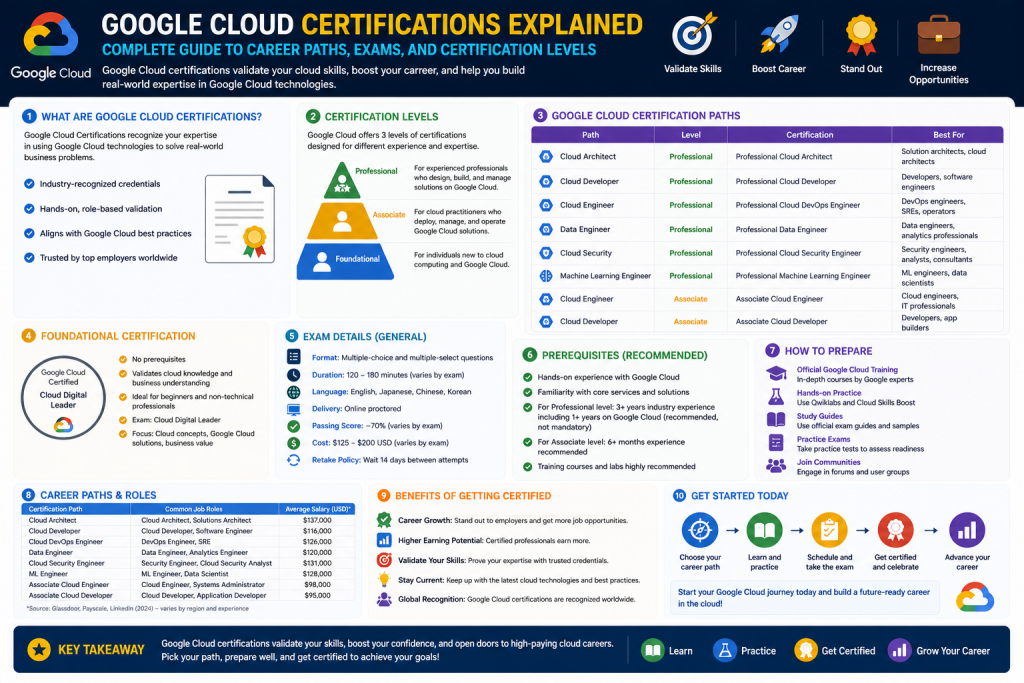
Google’s certification system is structured into three broad levels:
Foundational Level
This level focuses on basic cloud literacy and broad understanding rather than deep technical implementation.
Associate Level
These certifications validate practical technical skills for deploying, managing, and operating Google Cloud solutions.
Professional Level
This advanced tier is intended for experienced professionals who design, secure, optimize, and scale enterprise cloud systems.
Unlike some certification systems that are heavily focused on theory, Google certifications generally emphasize practical application, real-world use cases, and role-specific responsibilities.
Why Google Cloud Certifications Matter
There are several reasons why Google Cloud certifications have become increasingly valuable in today’s job market.
Industry Recognition
Google is one of the world’s largest technology companies, and its certifications carry global credibility.
Career Advancement
Certified professionals often qualify for higher-paying technical roles and more specialized positions.
Skill Validation
Certifications demonstrate measurable proficiency, helping employers assess technical capability more easily.
Competitive Differentiation
In crowded IT job markets, certification can help candidates stand out.
Structured Learning
Certification paths provide a roadmap for mastering cloud technologies in a logical sequence.
As enterprises adopt hybrid and multi-cloud strategies, Google Cloud expertise is especially valuable in data-heavy industries, AI initiatives, and Kubernetes-driven environments.
Google Cloud Certification Categories
Google currently offers certifications across multiple domains to support diverse technical and business roles.
These include:
- Cloud business strategy
- Infrastructure deployment
- Cloud administration
- Workspace management
- Data engineering
- Security engineering
- Application development
- Network architecture
- Machine learning
This broad certification landscape allows candidates to specialize according to their strengths and career ambitions.
Starting with the Right Certification Path
One of the most common questions for beginners is where to start.
The answer depends on your current skill level:
If you are new to cloud: Start with Google Cloud Digital Leader
If you have basic IT experience: Associate Cloud Engineer may be ideal
If you manage collaboration tools: Associate Google Workspace Administrator
If you work with data: Associate Data Practitioner
Choosing the correct starting point can improve learning efficiency and prevent unnecessary frustration.
Google Cloud Digital Certification
The Google Cloud Digital Leader certification serves as the foundational entry point into the Google Cloud ecosystem.
This certification is designed for:
- Business professionals
- Project managers
- Sales teams
- Non-technical stakeholders
- Beginners exploring cloud careers
Its purpose is not to test advanced engineering ability but rather to validate your understanding of cloud concepts and Google Cloud’s role in digital transformation.
What the Digital Leader Certification Covers
The exam focuses on broad strategic and operational topics, including:
Digital Transformation
Understanding how organizations modernize operations using cloud solutions.
Google Cloud Products and Services
Recognizing key offerings such as infrastructure, storage, analytics, and collaboration tools.
Innovation with Data and AI
Understanding Google’s data analytics and artificial intelligence capabilities.
Security and Compliance
Learning the fundamentals of cloud trust, governance, and security principles.
Operational Efficiency
Exploring scalability, flexibility, and cloud-based business optimization.
This certification is ideal for those who need cloud literacy without becoming deeply technical.
Who Should Pursue Google Cloud Digital Leader
This certification is especially useful for:
- Executives
- Product managers
- Sales engineers
- Marketing leaders
- New IT professionals
- Consultants
For technical candidates, it can also serve as an introductory stepping stone before moving into associate-level certifications.
Benefits of the Digital Leader Certification
Low barrier to entry
No prerequisites required.
Business relevance
Excellent for understanding cloud’s strategic impact.
Broad overview
Provides exposure to Google’s ecosystem.
Foundation for future learning
Creates context for deeper technical certifications.
Because it is accessible to beginners, many professionals use this certification to gain confidence before progressing.
Google Associate Cloud Engineer (ACE)
The Associate Cloud Engineer certification is often considered the true technical starting point for aspiring Google Cloud professionals.
This certification is designed for individuals who deploy applications, monitor operations, and manage enterprise solutions using Google Cloud.
It is significantly more technical than Digital Leader and focuses on hands-on cloud implementation.
Core Skills Validated by ACE
The certification emphasizes practical responsibilities such as:
Setting Up Cloud Environments
Creating projects, billing accounts, and configuring services.
Planning Infrastructure
Understanding compute, storage, and networking choices.
Deploying Solutions
Launching workloads and managing cloud resources.
Managing Operations
Monitoring systems, maintaining reliability, and troubleshooting.
Security and Access Management
Implementing IAM roles and securing cloud resources.
Why ACE Is a Popular Starting Point
ACE is often recommended because it bridges theory and real-world cloud administration.
Key advantages include:
Practicality
Strong focus on operational tasks.
Job readiness
Useful for junior cloud engineers and administrators.
Versatility
Covers broad Google Cloud services.
Progression
Acts as a gateway to professional certifications.
Candidates with six months of practical Google Cloud exposure often perform better.
Ideal Roles for Associate Cloud Engineer
This certification supports career paths such as:
- Cloud support associate
- Junior cloud administrator
- DevOps support technician
- Systems administrator
- Infrastructure analyst
Because of its broad technical scope, ACE is frequently considered one of the most career-flexible Google certifications.
Google Associate Google Workspace Administrator
Google Workspace has become central to business communication and collaboration. Organizations rely on Gmail, Docs, Meet, Drive, and administrative controls to support distributed teams.
The Associate Google Workspace Administrator certification validates the skills required to manage and secure these environments.
Key Focus Areas
This certification includes:
User and Organization Management
Managing users, groups, and permissions.
Core Services Administration
Configuring Gmail, Drive, Calendar, and Meet.
Security Controls
Managing authentication, endpoint security, and policy settings.
Compliance
Supporting governance and regulatory requirements.
Troubleshooting
Resolving user issues and service disruptions.
Who Benefits Most from Workspace Certification
This certification is highly relevant for:
- IT administrators
- Help desk specialists
- Collaboration engineers
- Technical support teams
- SaaS administrators
As hybrid work environments expand, Workspace administration skills are increasingly valuable.
Advantages of Workspace Administration Certification
Business relevance
Google Workspace is widely adopted globally.
Operational focus
Useful for immediate IT support roles.
Security integration
Combines collaboration with governance.
Growing demand
Remote work has increased collaboration platform importance.
Google Associate Data Practitioner
Data is one of the most powerful assets in modern organizations. Google’s data infrastructure tools are widely used for analytics, business intelligence, and machine learning preparation.
The Associate Data Practitioner certification supports professionals entering data-focused cloud roles.
Primary Competencies Covered
This certification validates skills in:
Data Preparation
Cleaning and organizing datasets.
Data Ingestion
Moving data into cloud environments.
Pipeline Orchestration
Supporting workflows and automation.
Analysis and Visualization
Interpreting data insights.
Data Security
Managing access and governance.
Who Should Consider Associate Data Practitioner
This certification is valuable for:
- Data analysts
- Junior data engineers
- BI professionals
- Reporting specialists
- Cloud data administrators
It provides a foundation before pursuing more advanced data engineering certifications.
Why Data Certifications Are Growing in Value
Organizations increasingly prioritize data-driven decision-making, making data certifications highly relevant.
Benefits include:
Alignment with analytics trends
Preparation for AI and ML pathways
Business intelligence opportunities
Growing enterprise demand
For professionals seeking future-ready careers, data paths can be especially strategic.
Choosing Between Associate Certifications
When selecting between ACE, Workspace, or Data Practitioner, consider your desired career path.
Choose ACE if:
You want broad cloud engineering exposure.
Choose Workspace if:
You focus on productivity, user support, or collaboration systems.
Choose Data Practitioner if:
You are interested in analytics, pipelines, or cloud data management.
Each certification supports distinct roles while also serving as a stepping stone.
How Google Certifications Build Career Momentum
Google certifications are not merely exam badges—they can function as career accelerators when paired with hands-on practice.
To maximize value:
- Use Google Cloud labs
- Build practical projects
- Practice IAM configuration
- Deploy cloud resources
- Work with datasets
- Explore Workspace admin panels
Real capability plus certification often delivers the best results.
Common Beginner Mistakes
Many candidates fail because they:
Overfocus on memorization
Ignore hands-on labs
Skip IAM concepts
Underestimate billing and deployment topics
Neglect product differences
Google exams often emphasize scenario-based reasoning rather than pure memorization.
Building a Long-Term Google Cloud Career Strategy
A common progression may look like:
Digital Leader → Associate Cloud Engineer → Professional Cloud Architect
Or:
Associate Data Practitioner → Professional Data Engineer
Or:
Workspace Administrator → Security/Compliance specialization
This layered strategy allows growth without overwhelming complexity.
Advanced Career Paths, Specializations, and Enterprise-Level Expertise
After building a strong foundation through entry-level and associate certifications, many IT professionals look toward Google’s professional-level certifications to deepen expertise, specialize in high-demand technical domains, and position themselves for leadership roles. These certifications are designed for experienced practitioners who already understand cloud fundamentals and are ready to architect, secure, optimize, and innovate within enterprise-scale environments.
Google Professional certifications represent a significant leap from foundational knowledge. Instead of focusing primarily on service familiarity or basic deployment, these certifications validate strategic design thinking, operational maturity, troubleshooting ability, scalability planning, and business alignment. They are intended for professionals responsible for making critical infrastructure decisions that impact performance, cost, security, compliance, and innovation.
For organizations investing heavily in Google Cloud, certified professionals often serve as architects, security leaders, data strategists, and AI innovators. For individuals, these certifications can enhance credibility, increase salary potential, and create pathways into highly specialized technical careers.
This section explores Google’s major professional certifications in detail, including role alignment, exam focus, recommended experience, strategic value, and ideal career progression.
Understanding the Purpose of Google Professional Certifications
Professional-level Google certifications are built around job roles rather than broad cloud literacy. They focus on proving that candidates can design and manage complex solutions under real-world conditions.
These certifications generally emphasize:
Cloud architecture
Application modernization
Data processing
Security engineering
Networking
Machine learning
Database optimization
Unlike entry-level exams, professional certifications often require stronger scenario-based reasoning. Candidates must evaluate competing design choices, balance business and technical requirements, optimize reliability, and secure infrastructure while maintaining compliance.
Google recommends multiple years of industry experience for most professional certifications because success typically requires hands-on exposure to enterprise systems.
Google Professional Cloud Architect (PCA)
Among all Google certifications, the Professional Cloud Architect certification is often considered one of the most prestigious and versatile. It is designed for professionals who architect enterprise cloud systems that are scalable, secure, resilient, and cost-effective.
This certification is ideal for:
Cloud architects
Solutions architects
Senior infrastructure engineers
Technical consultants
Enterprise cloud strategists
The PCA certification is often viewed as the flagship Google Cloud credential because it combines technical depth with strategic business alignment.
Core Responsibilities of a Professional Cloud Architect
A certified Professional Cloud Architect is expected to:
Design cloud infrastructure
Plan resource hierarchy
Select appropriate services
Manage deployment strategies
Optimize business processes
Ensure compliance
Support disaster recovery
Balance performance and cost
The certification emphasizes not just technical implementation but also decision-making frameworks.
Key Exam Domains
The exam validates:
Designing and planning cloud architectures
Managing cloud infrastructure
Designing for security and compliance
Analyzing business processes
Managing implementation
Ensuring operational reliability
This broad scope makes PCA highly respected because it requires understanding across multiple domains.
Why PCA Is So Valuable
Several factors contribute to PCA’s strong market value:
Broad technical coverage
Leadership alignment
Architecture credibility
High salary potential
Cross-functional relevance
Many employers see PCA as evidence that a candidate can connect technology with business outcomes.
Challenges of PCA
This certification can be difficult because:
It spans many services
It requires scenario analysis
Business strategy matters
Security is integrated throughout
Cost optimization is heavily tested
Success often requires real-world cloud design experience.
Google Professional Cloud Developer (PCD)
The Professional Cloud Developer certification focuses on developers who build scalable, resilient, cloud-native applications on Google Cloud.
This certification is best suited for:
Software engineers
Application developers
DevOps engineers
Platform engineers
Cloud-native developers
As organizations modernize applications, cloud development skills have become increasingly valuable.
Primary Focus of Professional Cloud Developer
The certification emphasizes:
Designing scalable applications
Building cloud-native services
Deploying applications
Monitoring performance
Integrating cloud services
Managing CI/CD workflows
Candidates must understand how to use Google Cloud tools to create modern software systems.
Key Technical Domains
Important concepts include:
Compute Engine
Cloud Run
App Engine
Kubernetes
Storage integration
Authentication
Logging
Monitoring
The exam tests how well developers can optimize software for reliability and operational efficiency.
Benefits of Professional Cloud Developer Certification
This certification offers:
Stronger cloud software credibility
Application modernization skills
DevOps alignment
Scalable development knowledge
Competitive software career differentiation
It is especially useful for developers transitioning from traditional software roles into cloud engineering.
Google Professional Data Engineer (PDE)
Data engineering is one of Google Cloud’s strongest domains due to its advanced analytics ecosystem. The Professional Data Engineer certification is highly regarded for professionals who design and manage data systems.
This certification is ideal for:
Data engineers
Analytics engineers
BI specialists
Data architects
Big data professionals
Google’s leadership in BigQuery and analytics tools makes this certification especially valuable.
Major Responsibilities of Professional Data Engineers
Certified professionals are expected to:
Design data systems
Build ingestion pipelines
Transform data
Enable analytics
Automate workloads
Deploy machine learning models
Ensure governance
This role often bridges data science, infrastructure, and business intelligence.
Core Technologies Commonly Covered
Candidates frequently work with:
BigQuery
Dataflow
Pub/Sub
Dataproc
Looker
Cloud Storage
AI integrations
Understanding data lifecycle management is essential.
Why PDE Is Financially Attractive
Data remains central to business competitiveness, making this certification especially strategic because:
Analytics demand is rising
Big data infrastructure is expanding
AI relies on quality pipelines
Data governance is increasingly critical
Many organizations prioritize data modernization, creating strong demand.
Google Professional Cloud Security Engineer (PCSE)
Security remains one of the highest-stakes areas in cloud computing. The Professional Cloud Security Engineer certification validates advanced skills for securing Google Cloud systems.
This certification is designed for:
Security engineers
Cloud security architects
Compliance professionals
Risk managers
Infrastructure security specialists
Core Security Domains
The exam focuses on:
Identity and access management
Network security
Data protection
Incident response
Compliance
Monitoring
Threat prevention
Security engineers must secure systems without compromising usability or performance.
Key Security Competencies
Candidates need expertise in:
IAM
Encryption
Key management
Security Command Center
Zero trust
Policy controls
Regulatory frameworks
Because cloud misconfigurations can be catastrophic, this certification often carries strong enterprise value.
Why Security Certifications Matter
Benefits include:
High enterprise demand
Compliance alignment
Risk reduction
Leadership potential
Strong salary positioning
As regulations tighten globally, security expertise becomes even more essential.
Google Professional Cloud Network Engineer (PCNE)
Networking remains foundational to cloud reliability, performance, and security. The Professional Cloud Network Engineer certification focuses on designing, implementing, and managing network architecture within Google Cloud environments. It is specifically built for professionals who understand both traditional networking principles and modern cloud connectivity models. Ideal candidates include network engineers, cloud network architects, infrastructure specialists, and hybrid cloud administrators responsible for ensuring secure, scalable, and resilient communication between cloud resources, on-premises systems, and distributed users. This certification validates expertise in VPC design, load balancing, hybrid connectivity, network security, DNS, and troubleshooting. As enterprises increasingly adopt hybrid and multi-cloud strategies, professionals with advanced Google Cloud networking skills play a critical role in maintaining uptime, optimizing traffic flow, reducing latency, and supporting business continuity.
Key Areas of Focus
The certification emphasizes:
VPC design
Load balancing
Hybrid connectivity
Interconnect
DNS
Network security
Troubleshooting
Networking professionals must ensure connectivity, speed, segmentation, and resilience.
Why Network Engineering Remains Critical
Even as cloud abstracts infrastructure, networking still determines:
Latency
Security boundaries
Service availability
Hybrid cloud success
Scalability
Organizations moving from traditional networking to cloud networking often need certified experts.
Professional Cloud Database Engineer
Database performance directly impacts application speed, reliability, scalability, and overall user experience, making database expertise a critical component of cloud success. This certification is designed for database professionals responsible for deploying, managing, migrating, and optimizing Google Cloud database systems across diverse enterprise environments. It is especially valuable for database administrators, cloud DB architects, performance engineers, and migration specialists who oversee data availability and operational efficiency. Candidates are expected to understand relational and non-relational databases, backup and recovery strategies, replication, high availability, monitoring, and performance tuning. As organizations modernize legacy systems and migrate workloads to the cloud, certified database professionals help ensure seamless transitions, minimize downtime, optimize storage costs, and maintain secure, high-performing data infrastructures that support business-critical applications.
Responsibilities Include
Database migration
Optimization
Availability planning
Backup strategies
Replication
Security
Monitoring
Candidates should understand both relational and non-relational systems.
Strategic Importance of Database Expertise
Databases are mission-critical because:
Poor design causes outages
Data loss risks are severe
Performance affects business continuity
Migration complexity is high
For organizations modernizing legacy systems, database expertise is crucial.
Google Professional Machine Learning Engineer (PMLE)
Machine learning and AI are among Google Cloud’s strongest differentiators. The Professional Machine Learning Engineer certification focuses on designing, deploying, and maintaining AI solutions.
This certification is ideal for:
ML engineers
AI developers
Data scientists
MLOps specialists
Automation architects
What This Certification Covers
Architecting ML solutions
Data preparation
Model training
Deployment
Monitoring
Optimization
MLOps automation
Candidates must understand both machine learning principles and Google’s implementation tools.
Google Cloud AI Ecosystem Knowledge
Key services may include:
Vertex AI
BigQuery ML
TensorFlow integrations
Pipeline orchestration
Model governance
Why Machine Learning Certification Is Growing Rapidly
AI expansion drives demand because:
Businesses seek automation
Generative AI is expanding
Predictive analytics is strategic
ML governance is essential
This certification may become increasingly influential as AI adoption grows.
Comparing Professional Certifications by Career Goal
Choosing the right professional certification depends on your desired specialization.
Choose Professional Cloud Architect if:
You want broad leadership and architecture responsibilities.
Choose Professional Cloud Developer if:
You build cloud-native software systems.
Choose Professional Data Engineer if:
You focus on analytics, pipelines, and big data.
Choose Professional Cloud Security Engineer if:
You prioritize cybersecurity and compliance.
Choose Professional Cloud Network Engineer if:
You specialize in connectivity and infrastructure.
Choose Professional Machine Learning Engineer if:
You work in AI, automation, or advanced analytics.
Building Multi-Certification Career Paths
Many professionals benefit from stacking certifications.
Examples:
ACE → PCA
ACE → PCSE
Data Practitioner → PDE
Developer → ML Engineer
Network Engineer → Security Engineer
This layered strategy can strengthen both breadth and specialization.
Common Mistakes in Professional-Level Preparation
Candidates often struggle because they:
Study services without architecture thinking
Ignore business requirements
Memorize products instead of use cases
Overlook IAM
Neglect cost optimization
Skip scenario-based learning
Professional exams often test judgment, not just facts.
Best Practices for Success
Strong preparation includes:
Hands-on labs
Architecture diagrams
Case study reviews
Service comparisons
Practice exams
Operational troubleshooting
Security reviews
Real implementation experience is often the biggest differentiator.
The Strategic Value of Professional Certifications
Google’s professional certifications do more than prove technical knowledge—they can strategically position professionals for advanced opportunities such as cloud leadership, architectural authority, enterprise consulting, higher compensation, and cross-functional strategy roles. These certifications validate not only service familiarity but also the ability to design, secure, optimize, and manage enterprise-grade cloud environments that directly support business objectives. For many professionals, earning a professional-level Google certification can strengthen credibility when pursuing senior engineering, consulting, or decision-making positions where technical judgment and business alignment are equally important.
Certified individuals are often better equipped to lead digital transformation initiatives, guide cloud migrations, influence infrastructure strategy, and communicate effectively with executives, developers, security teams, and operations departments. This broad relevance can make them valuable contributors in both technical and strategic conversations.
For employers, certified professionals can reduce implementation risk by applying validated best practices, avoiding costly architectural mistakes, and improving deployment efficiency. They can also help organizations strengthen security posture, optimize cloud spending, and improve reliability through better design choices. In highly competitive industries, having certified cloud professionals may improve project outcomes, accelerate modernization efforts, and provide greater confidence when managing large-scale transformations. Ultimately, Google’s professional certifications can serve as both personal career accelerators and organizational assets that contribute to stronger strategic execution.
Google Cloud Certification Costs, Renewal, Salary Potential, Career Value, and Strategic Planning
Google Cloud certifications can provide far more than technical validation—they can influence hiring decisions, shape salary negotiations, support promotions, and help professionals transition into cloud-centric careers. However, earning certifications is only one part of the equation. Professionals also need to understand financial investment, recertification requirements, long-term ROI, market demand, salary trends, and how Google Cloud compares with competing ecosystems like AWS and Microsoft Azure.
A certification should not simply be viewed as an exam to pass. It should be considered a strategic career decision that aligns with professional goals, employer demand, industry specialization, and evolving technology trends.
This section explores the practical realities behind Google Cloud certifications, including what they cost, how often they must be renewed, what kind of salary potential they may support, how they compare to competitors, and how professionals can build a long-term certification strategy.
Understanding Google Cloud Certification Costs
One of the first practical questions candidates ask is how much Google Cloud certifications cost. Google structures certification pricing according to level, making foundational certifications more accessible while professional-level certifications require a greater financial commitment.
Generally, Google Cloud certification exams are divided into three pricing tiers:
Digital Leader exams are typically the least expensive
Associate certifications are moderately priced
Professional certifications are the most expensive
This pricing structure reflects increasing complexity and specialization.
Foundational Certification Investment
The Google Cloud Digital Leader certification is often considered the most budget-friendly entry point. It is designed for broad accessibility and lower technical barriers, making it attractive for:
Beginners
Business professionals
Project managers
Sales teams
Career changers
Because it is relatively affordable, many candidates use it to test whether Google Cloud aligns with their interests before investing in more advanced certifications.
Associate-Level Financial Commitment
Associate certifications such as:
Associate Cloud Engineer
Associate Data Practitioner
Associate Workspace Administrator
These typically cost more than foundational certifications but remain relatively accessible. They are often viewed as strong ROI certifications because they can support practical job opportunities without requiring professional-level complexity.
For many learners, associate certifications offer one of the best balances between:
Cost
Practicality
Marketability
Learning curve
Professional-Level Certification Costs
Professional certifications generally require the largest exam investment. This higher cost reflects:
Greater specialization
Enterprise-level scope
Higher market value
More advanced technical expectations
While the upfront cost may seem significant, many candidates view professional certifications as career investments that can yield strong returns through salary increases or expanded job opportunities.
Hidden Costs Beyond Exam Fees
The exam fee itself is often only part of the total cost. Candidates frequently invest in:
Practice exams
Video training
Hands-on labs
Books
Bootcamps
Cloud sandbox environments
Retake fees
Depending on learning style, preparation expenses can exceed the exam cost itself.
Free and Low-Cost Preparation Resources
Google provides a variety of resources that can reduce overall certification cost:
Official learning paths
Cloud Skills Boost labs
Documentation
Practice questions
Study guides
Community forums
Professionals who are disciplined and self-directed can often lower costs significantly through these tools.
The True ROI of Google Certifications
The value of certification is not solely about passing an exam—it is about whether the credential leads to:
New employment
Promotion
Salary growth
Specialization
Consulting opportunities
Strategic authority
When viewed through this lens, certification cost often becomes secondary to long-term earning power.
Google Certification Renewal and Recertification Requirements
Technology evolves rapidly, and cloud ecosystems change constantly. Google certifications are not lifetime credentials. They expire after a set period to ensure professionals maintain current knowledge.
Why Recertification Exists
Recertification helps ensure:
Current platform knowledge
Updated service awareness
Modern security understanding
Relevance in changing architectures
Because Google frequently updates products, features, and best practices, recertification preserves credibility.
Typical Renewal Cycles
Lower-level certifications often remain valid longer than some professional certifications. Professional certifications generally require more frequent renewal due to:
Rapid platform evolution
Advanced service changes
Security developments
Enterprise modernization
Candidates should verify timelines regularly because certification policies can evolve.
Recertification Strategy Tips
Effective professionals often:
Track expiration dates
Schedule renewal preparation early
Integrate ongoing learning
Use work projects as practice
Review product updates consistently
Waiting until expiration approaches can create unnecessary pressure.
The Career Value of Staying Current
Current certifications signal:
Commitment
Technical relevance
Adaptability
Professional discipline
Expired certifications may still reflect prior knowledge, but active certifications often carry greater hiring value.
Google Cloud Salary Potential
Salary remains one of the most compelling motivators for certification. While certification alone does not guarantee income, it can enhance earning potential by validating in-demand skills.
Compensation depends on factors such as:
Location
Industry
Experience
Role specialization
Company size
Project complexity
Entry-Level Salary Potential
Professionals with foundational or associate certifications may pursue roles such as:
Cloud support associate
Junior administrator
Help desk analyst
Systems support
Data support specialist
These roles may not command top-tier cloud salaries initially, but they can provide important entry points.
Mid-Level and Advanced Salary Potential
Professional certifications often align more directly with higher-paying positions such as:
Cloud architect
Security engineer
Data engineer
Network architect
Machine learning engineer
Cloud consultant
Because these roles support strategic infrastructure, compensation often rises accordingly.
High-Value Certification Domains
Certain Google Cloud specializations may offer especially strong financial upside:
Cloud architecture
Data engineering
Security
Machine learning
These fields align closely with enterprise transformation priorities.
Certification vs Experience in Salary
Certification can strengthen compensation discussions, but employers typically prioritize:
Hands-on implementation
Project success
Business outcomes
Technical depth
The strongest candidates often combine:
Certification
Practical experience
Portfolio projects
Strategic thinking
Google Cloud vs AWS: Strategic Career Comparison
When evaluating Google Cloud certification, many professionals compare it with AWS due to AWS’s dominant market share.
AWS Advantages
AWS often offers:
Broader market share
Larger enterprise footprint
More certification tiers
Higher total job volume
Greater ecosystem maturity
For some candidates, AWS may provide broader general opportunities.
Google Cloud Advantages
Google Cloud often stands out in:
Data analytics
BigQuery
Kubernetes
AI/ML
Modern application architecture
Innovation-heavy sectors
Professionals focused on analytics, machine learning, or containerization may find Google especially attractive.
Which Platform Should You Choose?
Key factors include:
Employer environment
Regional market demand
Personal interests
Industry focus
Career specialization
If your organization uses Google Cloud heavily, Google certifications may provide more immediate relevance than AWS.
Multi-Cloud Strategy
Many professionals increasingly pursue multi-cloud strategies, combining:
Google Cloud
AWS
Azure
This approach can:
Increase flexibility
Expand opportunities
Strengthen consulting credibility
Support hybrid enterprise needs
Google Certification for Career Changers
Google certifications can be especially valuable for career changers moving from:
Traditional IT
Networking
Help desk
Software development
Business analysis
Associate certifications often serve as strong transitional bridges.
Building a Certification Roadmap
A strategic path may look like:
Digital Leader → Associate Cloud Engineer → Professional Cloud Architect
Or:
Associate Data Practitioner → Professional Data Engineer → Machine Learning Engineer
Or:
Workspace Administrator → Security Engineer
Planning ahead can prevent wasted effort.
Common Mistakes in Certification Strategy
Professionals often reduce ROI when they:
Collect certifications without direction
Ignore hands-on practice
Choose credentials misaligned with career goals
Overfocus on exam prep
Neglect specialization
Fail to update skills
Certification should support a larger career strategy, not replace one.
Maximizing Long-Term Certification Value
Best practices include:
Building projects
Documenting achievements
Using labs
Following platform updates
Specializing strategically
Combining cloud with adjacent skills
Complementary skills may include:
Cybersecurity
DevOps
AI
Data governance
Automation
Employer Perception of Google Certifications
Employers often view certifications as signals of:
Learning initiative
Technical baseline
Platform familiarity
Professional discipline
However, hiring decisions often weigh:
Experience
Problem-solving
Communication
Architecture design
Operational maturity
Certification is often most powerful when paired with demonstrated execution.
Freelancing and Consulting Opportunities
Google Cloud certifications can also support:
Freelance architecture
Migration consulting
Security reviews
Data modernization
Training
Cloud assessments
Independent consultants may benefit from certification credibility when building trust.
The Role of Specialization in Future-Proofing Careers
Cloud careers are evolving rapidly. Generalists remain useful, but specialists often command stronger premium opportunities in:
AI
Security
Compliance
Data
Automation
Google’s certification portfolio supports both breadth and specialization.
Long-Term Outlook for Google Cloud Professionals
Google Cloud’s growth in:
AI
Kubernetes
Data platforms
Enterprise modernization
suggests that Google expertise may remain particularly relevant in advanced technology sectors.
As organizations increasingly prioritize:
Automation
Analytics
Scalable infrastructure
Digital transformation
Google-certified professionals may continue seeing opportunity growth.
Creating a Personal Google Certification Success Formula
A practical formula often includes:
Learn fundamentals
Earn targeted certification
Gain hands-on experience
Build projects
Demonstrate outcomes
Specialize strategically
Stay current
This balanced approach often outperforms certification-only strategies.
Should You Pursue Google Cloud Certification?
Google Cloud certifications are often most worthwhile when:
You want cloud-focused career growth
Your employer uses Google Cloud
You work in data or AI
You want architecture credibility
You seek structured learning
You are transitioning into cloud
They may be less immediately impactful if:
Your region has little Google Cloud adoption
Your employer is AWS-exclusive
You avoid practical implementation
Final Strategic Perspective
Google Cloud certification should not be treated as a shortcut, but rather as a strategic tool. The real power of certification lies in combining it with practical ability, business awareness, and continuous adaptation.
Professionals who approach certification thoughtfully often gain:
Better opportunities
Greater credibility
Improved specialization
Expanded earning potential
Long-term career resilience
Conclusion
Google Cloud certifications represent more than a collection of exams—they are structured pathways into one of the world’s most important technology ecosystems. From foundational learning to advanced architecture, security, data engineering, and machine learning, Google provides certification options that support beginners, specialists, and enterprise leaders alike.
Understanding certification costs, renewal cycles, and salary implications is essential for making informed decisions. While certifications require investment, their long-term value often depends on how effectively they are integrated into broader career development.
For some professionals, Google Cloud certification may be the gateway to cloud administration. For others, it may become the foundation for advanced roles in data, security, or artificial intelligence. The strongest outcomes usually come from combining certification with real-world experience, specialization, and continuous learning.
As cloud technology continues evolving, professionals who stay current, strategic, and adaptable are likely to remain competitive. Google Cloud certifications can play a major role in that journey—not as the final destination, but as a meaningful catalyst for long-term career growth.
Continue exploring the technologies and certification concepts that matter most to you.