The internet looks simple from a user’s perspective. You type a website name into a browser, press enter, and the page loads. However, behind this simple action, a complex system is working continuously to make sure your device connects to the correct online destination. One of the most important systems involved in this process is the Domain Name System, commonly known as DNS.
DNS works like a global directory that translates human-friendly website names into machine-readable IP addresses. Computers do not understand names like people do. Instead, they rely on numerical identifiers called IP addresses. Without DNS, users would need to memorize long strings of numbers for every website they want to access. This would make the internet extremely difficult to use.
Every time you visit a website, your device must find the correct IP address associated with that website. This process is called DNS resolution. It is the foundation of how internet browsing works and happens in just a fraction of a second. Even though it is fast, it still involves multiple steps and communication between different systems.
Understanding DNS is important because it affects speed, performance, and reliability of internet access. It also plays a major role in how websites are delivered to users across the world. One of the key elements that improves DNS performance is caching, and this is where Time to Live becomes essential.
How DNS Resolution Works
When you enter a website name into your browser, your device first checks if it already knows the IP address. If it does not, it starts a process to find it. This process involves several layers of communication between different DNS servers.
The first step is usually a request sent to a recursive resolver. This resolver acts like an assistant that handles the entire search process for you. Instead of your device searching everything on its own, the resolver does the heavy work of finding the correct IP address.
If the resolver does not already have the information stored, it begins a search through the DNS hierarchy. The search typically starts with a root server. The root server does not directly provide the IP address but guides the resolver toward the next step.
From there, the request moves to a server responsible for top-level domains. These are the endings of website names such as .com, .org, or .net. The top-level domain server directs the resolver further toward the correct destination.
Next, the request reaches an authoritative DNS server. This server holds the actual information for the domain and provides the correct IP address. Once this address is found, it is sent back through the chain until it reaches your device.
At this point, your browser can connect to the website using the IP address. The entire process happens very quickly, often in milliseconds, but it still involves multiple steps of communication.
The Need for DNS Caching
Although DNS resolution is fast, performing it every single time someone visits a website would create unnecessary delays and heavy network load. To solve this problem, DNS uses a system called caching.
Caching means storing previously retrieved information temporarily so it can be reused later. When DNS information is cached, devices do not need to repeat the full resolution process every time. Instead, they can use stored data to quickly access the same website again.
For example, if you visit a website multiple times in a short period, your device may already have the IP address stored. This allows it to connect directly without going through the full DNS lookup process again. As a result, loading times become much faster.
DNS caching happens at different levels. Your operating system may store DNS information. Your browser may also keep its own cache. Additionally, internet service providers often maintain large DNS caches for many users at once.
Each of these caching layers helps reduce the number of DNS queries sent across the internet. This improves performance, reduces traffic, and makes browsing more efficient for everyone.
However, cached information cannot be stored forever. Websites change over time, and their IP addresses may be updated. If outdated information remains in the cache for too long, it can cause errors or prevent users from reaching the correct destination. This is why caching must be controlled carefully.
Understanding Time to Live in DNS
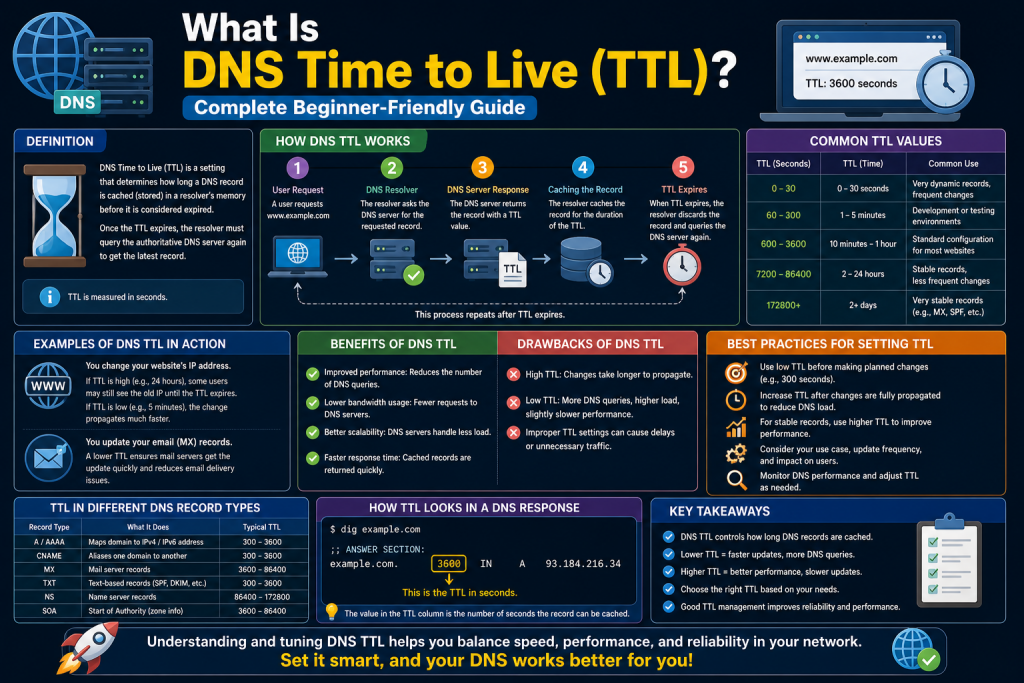
Time to Live is a setting that determines how long DNS information should remain stored in a cache before it is considered outdated. It is one of the most important factors in DNS performance and behavior.
When a DNS record is stored in a cache, it is not kept permanently. Instead, it is assigned a specific time limit. This time limit defines how long the record is valid. Once the time expires, the record is removed and must be refreshed through a new DNS lookup.
Time to Live ensures that DNS systems always balance speed with accuracy. It allows cached data to improve performance while still making sure that outdated information does not stay in the system for too long.
A higher Time to Live value means the information will remain in cache for a longer period. This reduces the number of DNS lookups and improves performance. However, it also means that updates to DNS records may take longer to appear across the internet.
A lower Time to Live value means the information will expire more quickly. This allows changes to spread faster but increases the number of DNS queries, which can slightly reduce performance.
Why Time to Live Is Important
Time to Live plays a critical role in how efficiently the internet operates. It directly affects speed, accuracy, and reliability of DNS resolution.
One of the main benefits of Time to Live is improved performance. By allowing DNS information to be stored temporarily, systems can avoid repeating the same lookup process multiple times. This reduces delay and improves browsing speed.
Another important benefit is reduced network traffic. Without caching, every request would need to travel through multiple DNS servers. This would create a large amount of unnecessary traffic. Time to Live helps reduce this load by allowing cached data to be reused.
Time to Live also helps manage changes in DNS records. Websites often update their infrastructure, change servers, or modify configurations. When changes occur, DNS records need to be updated across the internet. Time to Live determines how quickly these changes are reflected in cached systems.
If the value is too high, outdated information may remain in use longer than desired. If it is too low, systems may spend too much time performing repeated lookups. Finding the right balance is essential for smooth performance.
How Time to Live Affects User Experience
From a user’s perspective, Time to Live has a direct impact on how fast websites load. When DNS information is cached and still valid, websites open almost instantly. This creates a smooth and responsive browsing experience.
However, if cached information has expired, the system must perform a new DNS lookup. This can cause a slight delay in loading the website. While this delay is usually very small, it still affects overall performance.
Time to Live also affects how quickly changes to websites are visible. If a website moves to a new server, users may still be directed to the old server until cached information expires. This is why setting appropriate values is important during updates or migrations.
In general, users benefit most when caching is optimized properly. A well-balanced Time to Live setting ensures fast loading times while still keeping information accurate and up to date.
Different Types of DNS Records and Their Relationship with TTL
DNS does not store only one type of information. It includes different types of records that serve different purposes. Each of these records can have its own Time to Live setting.
One type of record maps a domain name to an IP address. These records are essential for connecting users to websites. Their caching duration determines how long a device can rely on stored IP information before checking again.
Another type of record is used to point one domain name to another. These are often used for flexibility in managing websites. If changes are made to these records, Time to Live controls how quickly those changes are reflected in user systems.
There are also records used for email routing. These records determine how email messages are delivered to the correct mail servers. Time to Live is important here because incorrect or outdated routing can lead to email delivery problems.
Each record type serves a different function, but all of them rely on Time to Live to manage caching behavior. This ensures that all DNS information remains accurate and up to date while still benefiting from performance improvements.
Understanding the Deeper Role of Time to Live in DNS Systems
Time to Live is more than just a simple timer for DNS records. It is a critical mechanism that controls how long information remains valid in caching systems before it must be refreshed. While the basic idea seems simple, its impact on internet performance, stability, and accuracy is significant.
When DNS information is stored in a cache, it is not meant to stay there permanently. Instead, it is given a controlled lifespan. This lifespan ensures that systems use stored data only for a limited time before checking for updated information. This process helps maintain a balance between speed and correctness.
Without Time to Live, cached DNS data could become outdated and cause users to be directed to incorrect destinations. At the same time, without caching, every request would require a full DNS lookup, slowing down internet performance. Time to Live exists to balance these two needs.
How Time to Live Is Applied to DNS Records
Every DNS record includes a Time to Live value. This value is measured in seconds and determines how long a record can remain stored in a cache. Once this time expires, the record is no longer considered valid and must be refreshed.
Different DNS records serve different purposes, but all of them rely on Time to Live to manage their caching behavior. Some records map domain names to IP addresses, while others manage email routing or aliasing. Each type of record can have a different caching duration based on how frequently changes are expected.
For example, records that rarely change can safely use a longer caching duration. This reduces the number of DNS queries and improves performance. On the other hand, records that change frequently require shorter caching durations to ensure updates are reflected quickly.
The flexibility of Time to Live allows system administrators to control how DNS behaves in different situations. It is not a fixed setting but a configurable value that can be adjusted based on specific needs.
The Relationship Between TTL and DNS Propagation
DNS propagation refers to the time it takes for changes in DNS records to spread across all servers and caches on the internet. Time to Live plays a direct role in this process.
When a DNS record is updated, the change does not instantly appear everywhere. Instead, systems that have cached the old record will continue using it until the Time to Live expires. Only after expiration will they request the updated information.
This means that Time to Live directly affects how quickly DNS changes become visible to users. A shorter Time to Live results in faster propagation because cached data expires more quickly. A longer Time to Live slows down propagation because systems continue using stored data for a longer period.
This behavior is important when making changes to infrastructure. If a server is being moved or an IP address is changing, reducing the Time to Live beforehand helps ensure that users transition smoothly to the new configuration.
Performance Benefits of Time to Live
One of the main advantages of Time to Live is improved performance. By allowing DNS data to be cached, systems can avoid repeating the same lookup process multiple times. This reduces delay and improves response time when accessing websites.
When a cached record is still valid, the system can immediately use it without performing a new query. This significantly reduces the time required to load a website. For frequently visited sites, this improvement can be very noticeable.
Caching also reduces the load on DNS servers. Without caching, every request would need to travel through multiple layers of DNS infrastructure. This would create a large amount of unnecessary traffic and increase system load.
By limiting how often queries are repeated, Time to Live helps distribute network load more efficiently. This improves stability and ensures that DNS servers can handle large volumes of traffic without becoming overloaded.
Accuracy and Freshness of DNS Information
While performance is important, accuracy is equally critical. DNS records must reflect the current state of a system. If outdated information is used, users may be directed to incorrect servers or services may fail to load properly.
Time to Live ensures that cached information is not used indefinitely. Once the time limit expires, the system is forced to retrieve updated data. This guarantees that changes eventually reach all users.
However, there is always a trade-off between speed and accuracy. A longer caching duration improves performance but delays updates. A shorter duration improves accuracy but increases system load due to more frequent queries.
Finding the right balance depends on the nature of the system. Stable systems benefit from longer caching durations, while dynamic systems require shorter ones.
TTL in Dynamic and Static Environments
Different environments require different approaches to Time to Live configuration. In static environments where changes are rare, longer caching durations are commonly used. This reduces unnecessary queries and improves efficiency.
In contrast, dynamic environments where changes occur frequently require shorter caching durations. This ensures that updates are quickly reflected across all systems.
For example, systems that frequently change infrastructure or route traffic across multiple servers may use shorter caching durations to maintain flexibility. This allows them to adapt quickly without waiting for cached data to expire naturally.
On the other hand, systems that remain stable for long periods can safely use longer durations without risk of outdated information causing problems.
Impact of TTL on System Transitions and Migrations
Time to Live plays an important role during system migrations and transitions. When a service is moved from one location to another, DNS records must be updated to reflect the change.
However, systems that have already cached the old information will continue using it until the caching duration expires. This can delay the full transition to the new system.
To avoid this issue, administrators often reduce the caching duration before making changes. This ensures that cached records expire quickly, allowing updated information to spread faster.
Once the migration is complete and stable, the caching duration can be increased again to improve performance.
This approach helps minimize disruption during transitions and ensures a smoother user experience.
Load Distribution and Reliability Benefits
Time to Live also contributes to load distribution in DNS systems. When caching is used effectively, repeated queries are reduced, which helps distribute traffic more evenly across servers.
In some configurations, DNS systems may return different IP addresses for the same domain name. This helps distribute user requests across multiple servers. Time to Live determines how long each response is cached before a new one is requested.
Shorter caching durations can improve load balancing accuracy by ensuring that users receive updated routing information more frequently. Longer durations provide stability but may delay adjustments in traffic distribution.
Additionally, caching provides a level of resilience. If a DNS server becomes temporarily unavailable, cached data allows users to continue accessing services without interruption until new information is required.
Challenges and Risks of Misconfigured TTL
Incorrect configuration of Time to Live can lead to several issues. If the value is set too high, outdated information may persist for too long. This can result in users being directed to incorrect servers or experiencing service disruptions.
If the value is set too low, systems may generate excessive DNS queries. This can increase load on DNS infrastructure and slightly reduce performance.
Another common issue is inconsistency. If different records related to the same service have different caching durations, updates may not occur simultaneously. This can lead to partial updates where some systems are using new information while others are still using old data.
Careful planning is required to avoid these problems. Consistent configuration ensures predictable behavior and reduces the risk of errors.
Importance of Monitoring and Adjustment
Time to Live is not a value that should be set once and ignored. It requires monitoring and adjustment based on system behavior and changing requirements.
As systems evolve, their needs may change. A configuration that works well today may not be suitable in the future. Regular evaluation helps ensure that caching settings remain appropriate.
Monitoring performance can help identify whether caching durations are too long or too short. If changes take too long to appear, the duration may need to be reduced. If performance issues arise due to excessive queries, the duration may need to be increased.
Adjustments should always be made carefully, considering both performance and accuracy requirements.
Advanced Role of TTL in Real-World DNS Environments
Time to Live is not only a theoretical concept used in DNS systems but also a practical control mechanism that directly influences how real-world networks behave. In large-scale environments, especially those serving millions of users, even small adjustments to TTL values can significantly impact performance, stability, and user experience.
Modern internet systems rely heavily on distributed infrastructure. This means that DNS information is not stored in a single location but is instead cached across multiple layers, including local devices, internet service providers, and global DNS networks. Time to Live determines how long each of these layers can retain DNS data before requesting updates.
Because of this layered structure, TTL acts as a synchronizing factor. It ensures that all systems eventually refresh their stored data and align with the most current DNS configuration. Without this mechanism, different parts of the internet could operate with conflicting or outdated information.
In high-traffic environments, even a small delay in DNS updates can cause inconsistencies. For example, some users may be directed to a new server while others remain on an older one. Time to Live helps manage this transition by gradually expiring outdated data across all caching layers.
TTL in Large-Scale Network Architectures
In large network infrastructures, DNS is not handled by a single system. Instead, it is distributed across multiple redundant servers designed to handle high volumes of traffic. Each of these servers may cache DNS records independently, depending on their location and role in the network.
Time to Live ensures that all these systems eventually synchronize with updated DNS information. When a change is made to a DNS record, it does not instantly overwrite all cached copies. Instead, each cached entry expires naturally based on its TTL value.
This distributed expiration system helps prevent sudden spikes in traffic. If all systems were forced to update at the same moment, it could create unnecessary load on DNS servers. Instead, TTL allows updates to spread gradually and smoothly.
This behavior is especially important in global networks where users are spread across different regions. Each region may have its own caching systems, and TTL ensures that updates propagate consistently without overwhelming the infrastructure.
Impact of TTL on High Availability Systems
High availability systems are designed to remain accessible even in the event of failures or disruptions. DNS plays a crucial role in maintaining this availability, and TTL directly influences how resilient these systems are.
When a service becomes temporarily unavailable, cached DNS records can still allow users to access previously known routes. This means that even if a DNS server is unreachable, users may still be able to connect using stored information until the TTL expires.
However, this also introduces a delay in recognizing changes. If a server has been moved or replaced, users relying on cached data may continue accessing the old location until the cache is refreshed.
To manage this, system administrators often carefully plan TTL values based on expected failure scenarios and recovery strategies. Shorter TTL values can improve responsiveness during failures, while longer values can enhance stability during normal operation.
TTL and Content Delivery Optimization
Content delivery networks rely heavily on DNS behavior to distribute traffic efficiently across multiple servers. Time to Live plays an important role in determining how often users are directed to different delivery nodes.
When TTL values are configured appropriately, users can be routed to the nearest or most optimal server location. This improves loading speed and reduces latency. However, if TTL values are too long, users may remain connected to less optimal nodes even when better options are available.
On the other hand, shorter TTL values allow more frequent updates to routing decisions. This can improve performance in dynamic environments where server availability and load conditions change frequently.
Balancing TTL in content delivery systems is critical. It must ensure that users consistently receive fast performance while also allowing flexibility in traffic distribution.
Security Implications of TTL
Time to Live also has indirect security implications in DNS systems. While it is not a security feature by itself, it can influence how quickly security-related changes take effect.
For example, if a domain is compromised or its routing is changed for security reasons, DNS records may need to be updated quickly. Shorter TTL values help ensure that outdated or potentially unsafe routes expire faster, reducing exposure to risks.
However, longer TTL values can sometimes provide stability during normal operations, reducing the frequency of DNS changes and minimizing potential attack surfaces related to DNS queries.
In some cases, attackers may attempt to exploit caching behavior by poisoning or manipulating DNS records. Proper TTL configuration, combined with secure DNS practices, helps reduce the effectiveness of such attacks by limiting how long incorrect data can persist.
Troubleshooting TTL-Related Issues
One of the most common challenges in DNS management is troubleshooting issues related to caching and TTL. When changes to DNS records do not appear immediately, TTL is often the reason.
Since cached records remain valid until they expire, users may continue to see old configurations even after updates have been made. This can create confusion during troubleshooting, especially when changes appear to be ignored.
Understanding TTL behavior helps identify whether an issue is caused by caching or by an actual misconfiguration. If a change has been made but is not visible yet, it is often simply a matter of waiting for the cache to expire.
In some cases, manually clearing cached data on local systems or testing from uncached environments can help verify whether changes have been applied correctly.
Tools used for DNS diagnostics often show both cached and authoritative responses. Comparing these results helps determine whether TTL expiration is responsible for delays in updates.
Best Practices for Managing TTL
Effective management of Time to Live requires careful planning based on system requirements and expected behavior. There is no single ideal value that works for all situations. Instead, values must be adjusted based on specific needs.
One best practice is to align TTL values with change frequency. Systems that rarely change should use longer values to reduce unnecessary DNS queries. Systems that change frequently should use shorter values to ensure updates propagate quickly.
Another best practice is consistency. Records that serve the same purpose should generally use similar TTL values. This helps ensure that updates occur uniformly across all related records.
It is also important to adjust TTL values before making major changes. Reducing TTL in advance allows cached data to expire sooner, making transitions smoother. Once changes are fully propagated, TTL can be increased again to improve performance.
Documentation is another important aspect of TTL management. Keeping records of changes helps teams understand why certain values were chosen and how they affect system behavior over time.
TTL in Modern Cloud and Distributed Systems
In modern cloud-based environments, TTL plays an even more important role due to the dynamic nature of infrastructure. Resources such as servers, storage systems, and network routes can change frequently based on demand.
Cloud systems are designed to scale up or down automatically depending on traffic, workload, and application requirements. Because of this constant change, DNS information cannot remain static for long periods. Time to Live helps control how quickly systems adapt to these changes by managing how long outdated routing or addressing information stays in caches.
In these environments, services are often distributed across multiple regions. A single application may run on several servers located in different parts of the world. When user demand increases, additional servers may be added automatically, and when demand decreases, some servers may be removed. TTL ensures that DNS responses eventually reflect these changes so users are directed to available resources.
Without proper TTL configuration, users may continue being routed to servers that no longer exist or are no longer optimal. This can result in failed connections, slower performance, or inconsistent service behavior. By controlling caching duration, cloud systems can ensure that routing updates propagate in a predictable manner.
TTL also plays a key role in load balancing within cloud environments. Many cloud services rely on DNS-based routing to distribute traffic across multiple instances. When TTL values are shorter, systems receive updated routing information more frequently, allowing traffic to be balanced more effectively based on current conditions. This helps prevent overloading specific servers while keeping overall performance stable.
At the same time, cloud providers must carefully balance TTL settings because excessively short values can lead to high DNS query volumes. This increases load on DNS infrastructure and can introduce unnecessary overhead. Therefore, cloud architects often choose TTL values that reflect both performance requirements and operational efficiency.
Another important aspect is failover management. In cloud systems, services are expected to remain available even during failures. If a server goes offline, DNS records may be updated to redirect traffic to healthy instances. TTL determines how quickly this failover becomes effective across all clients and caching layers. Shorter TTL values allow faster recovery, while longer values may delay the transition but provide more stability during normal operation.
TTL also interacts closely with automation and orchestration tools used in cloud environments. When infrastructure changes are triggered automatically, TTL settings are often adjusted temporarily to ensure that updates propagate quickly. After changes stabilize, TTL values may be increased again to improve caching efficiency and reduce query load.
In addition, monitoring systems in cloud environments rely on TTL behavior to detect propagation delays. If cached data remains unchanged longer than expected, it may indicate configuration issues or caching inconsistencies. Engineers use this information to fine-tune system performance and ensure reliable DNS behavior across all regions.
Overall, TTL is a critical component in cloud-based architectures because it directly influences how quickly systems adapt, how efficiently traffic is distributed, and how reliably services remain available during continuous infrastructure changes.
In these environments, DNS is often used to dynamically route traffic to available resources. TTL helps control how quickly these routing decisions are updated across distributed systems.
Short TTL values are commonly used in highly dynamic environments where resources scale up or down frequently. This ensures that DNS responses reflect current system conditions.
However, cloud systems also need to balance this with performance. Excessively short TTL values can increase DNS query load, so careful tuning is required to achieve optimal performance.
Long-Term Impact of TTL on System Design
Over time, TTL becomes an important factor in overall system architecture. It influences how systems are designed, how updates are deployed, and how users experience services.
In modern network design, Time to Live is not treated as a minor configuration detail but as a planning consideration that affects the entire structure of DNS behavior. When architects design systems, they must think about how often information will change and how quickly those changes need to reach users. TTL directly influences these decisions because it controls how long outdated information can remain active in caching systems.
From a design perspective, TTL helps determine how flexible or stable a system should be. Systems that require frequent updates, such as dynamic cloud environments or rapidly scaling services, often depend on shorter caching durations to ensure responsiveness. In contrast, stable systems with predictable configurations can rely on longer caching durations to maximize efficiency and reduce unnecessary network traffic.
TTL also affects how updates are deployed. When changes are planned, such as moving services between servers or modifying infrastructure, administrators must consider how cached data will behave during the transition. Proper TTL planning allows updates to roll out smoothly without causing interruptions or inconsistencies for users. It ensures that outdated records expire at the right time so new configurations become active across the system.
From the user’s perspective, TTL has a direct impact on experience quality. It influences how quickly websites load, how consistently services respond, and how smoothly transitions occur during backend changes. A well-optimized TTL strategy ensures that users benefit from both speed and accuracy without noticing the complexity behind the system.
Beyond these core aspects, TTL also plays a major role in operational planning and cost efficiency. In large-scale environments, unnecessary DNS queries can significantly increase infrastructure load. By tuning TTL values properly, organizations can reduce repeated queries and lower the burden on DNS servers. This leads to more efficient resource usage and better scalability during high-traffic periods.
TTL also supports fault tolerance strategies. In distributed systems, cached DNS data can act as a temporary backup mechanism when parts of the network experience issues. Even if a DNS server becomes temporarily unavailable, cached records allow services to continue functioning until fresh data can be retrieved. This improves overall system resilience and reduces the impact of partial failures.
Additionally, TTL influences monitoring and troubleshooting processes. Engineers often analyze how long records remain cached to identify propagation delays or configuration issues. Incorrect TTL settings can cause confusion during debugging, as outdated data may appear valid from the user side while changes have already been applied at the source.
In large enterprise environments, TTL is also closely tied to automation systems. Automated deployment pipelines often adjust TTL values before rolling out changes and restore them afterward. This ensures smooth transitions while maintaining long-term performance optimization.
Overall, TTL is deeply integrated into system architecture, affecting not only technical performance but also operational efficiency, reliability, and user satisfaction.
Systems with well-planned TTL strategies tend to be more stable, predictable, and efficient. Poorly configured TTL values, on the other hand, can lead to inconsistent behavior, delayed updates, and unnecessary load on infrastructure.
Because of its impact, TTL is often considered during the early stages of system design rather than being treated as an afterthought. It is integrated into performance planning, scalability strategies, and reliability engineering.
Conclusion
Time to Live is a fundamental component of DNS that controls how long information remains valid in caching systems. It plays a critical role in balancing performance, accuracy, and system efficiency across all levels of internet infrastructure.
By determining how long DNS records are stored before being refreshed, TTL ensures that systems can operate quickly while still maintaining up-to-date information. It affects everything from basic website loading speed to large-scale distributed network behavior.
In real-world applications, TTL influences system migrations, load balancing, security responses, and global traffic distribution. It is a key factor in ensuring that DNS systems remain stable and responsive under varying conditions.
Proper configuration and management of TTL values are essential for maintaining reliable and efficient network operations. When used correctly, it enhances performance, supports smooth transitions, and ensures consistent user experience across the internet.
Continue exploring the technologies and certification concepts that matter most to you.