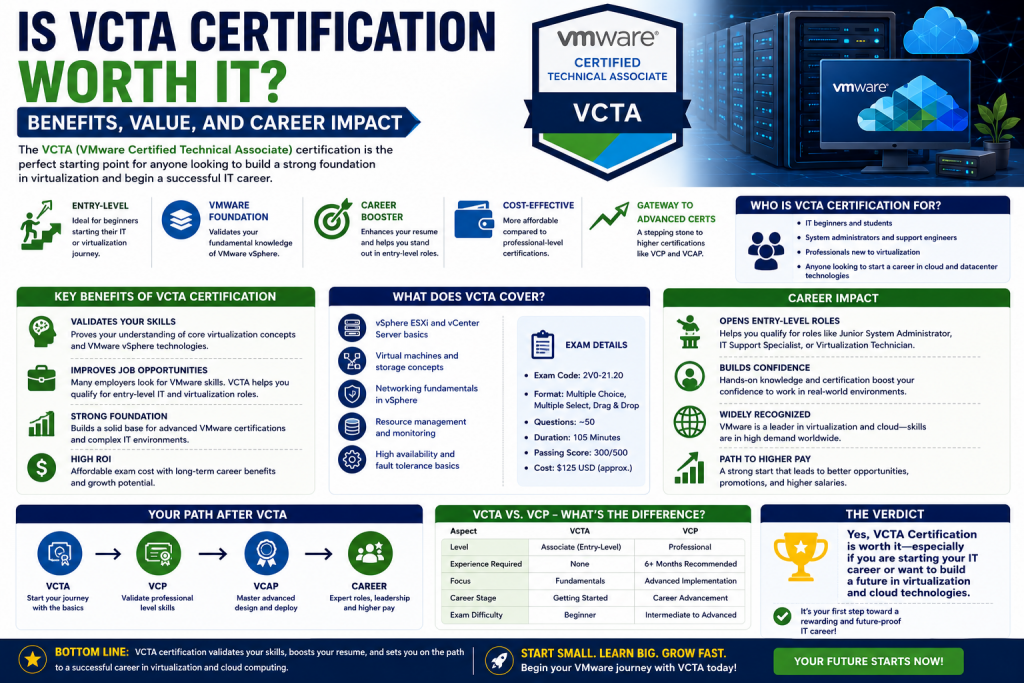
VMware continues to play a significant role in modern IT infrastructures, especially in enterprise environments where virtualization, cloud management, and software-defined data centers are essential. Even though VMware does not always dominate every IT segment, it remains a trusted and widely adopted platform across organizations of different sizes. Because of this strong presence, VMware-related skills continue to be valuable for IT professionals who want to work in systems administration, networking, cloud operations, or cybersecurity.
Over the years, VMware certifications have mainly focused on intermediate and advanced professionals such as system engineers, architects, and experienced administrators. However, a newer certification level was introduced to bridge the gap for beginners and early-career professionals. This certification is designed to help individuals build foundational knowledge of VMware technologies and understand how they are applied in real operational environments. The big question many learners ask is whether this entry-level certification is actually worth pursuing.
Understanding the VCTA Certification
The VMware Certified Technical Associate is designed as an entry-level certification that focuses on foundational operational skills. Unlike advanced VMware certifications that require deep technical expertise, this certification is intended for individuals who are either new to IT or transitioning into VMware-based environments.
The certification is structured into different learning paths depending on specific areas of IT infrastructure. Each path focuses on a particular domain such as data center virtualization, network virtualization, security, cloud automation, digital workspace management, and application modernization. This structure allows learners to specialize based on their career goals and job roles.
Instead of serving as a requirement for higher certifications, it functions independently. It is not mandatory for progressing to more advanced VMware certifications, which makes it flexible and optional. Its primary goal is to validate that an individual understands basic operational tasks and can work effectively within VMware environments at an introductory level.
What You Learn in the Certification
Each specialization focuses on different technical foundations. In virtualization-based learning, candidates are introduced to core concepts such as virtual machines, basic networking within virtual environments, resource management, and troubleshooting fundamentals. This provides a general understanding of how virtual infrastructures operate in enterprise environments.
In the networking-focused path, learners are introduced to VMware’s approach to network virtualization. This includes understanding key terminology, basic architecture, and the role of software-defined networking in modern IT systems. It also covers how network virtualization supports business needs and improves infrastructure flexibility.
For cloud management and automation, the focus shifts toward automation principles and cloud operations. Learners gain exposure to automation tools, infrastructure as code concepts, and the day-to-day tasks involved in managing cloud environments. This helps build awareness of how modern IT operations are increasingly automated.
The digital workspace path introduces endpoint management and virtual desktop environments. It focuses on how users access applications and data securely from different devices. Learners explore basic administration tasks related to workspace environments and user access management.
The application-focused path provides an introduction to container technologies and modern application deployment practices. It includes foundational knowledge of containerization, orchestration concepts, and cloud-native application environments.
The security-focused path introduces VMware’s security solutions and how they integrate into infrastructure environments. It provides awareness of endpoint security, network security features, and basic protection mechanisms used in enterprise systems.
Exam Structure and Requirements
The certification exams are designed to test fundamental understanding rather than advanced technical depth. Each exam includes multiple-choice questions and scenario-based problems that evaluate basic knowledge of VMware technologies.
The duration and number of questions vary depending on the chosen specialization. Some exams are shorter with fewer questions, while others include a broader range of topics and longer time limits. Despite these differences, all exams remain focused on entry-level operational knowledge.
There are no strict prerequisites for attempting the certification. However, having basic knowledge of IT concepts such as networking, operating systems, cloud computing, and system administration is highly beneficial. Individuals who already understand these fundamentals will find the learning process easier and more practical.
Cost and Training Considerations
The certification exam itself is relatively affordable compared to advanced IT certifications. In addition to the exam fee, optional training resources are available for individuals who want structured learning support. These training programs provide access to video lessons, practice material, and guided learning paths.
When combining training costs and exam fees, the total investment remains reasonable for most learners. This makes it accessible for students, entry-level IT professionals, and individuals transitioning into VMware-related roles.
Who Should Consider This Certification
This certification is primarily designed for beginners and early-career IT professionals. It is suitable for individuals who are just entering the technology field or those who want to build a foundation in virtualization and cloud infrastructure.
System administrators who are new to VMware environments can benefit from understanding how virtualization concepts are applied in real-world systems. It helps them connect theoretical IT knowledge with practical enterprise tools.
Network administrators who are expanding their skill set can also gain value from learning VMware networking concepts. Even if they are already experienced in traditional networking, virtualization introduces additional layers of abstraction that are important in modern infrastructure environments.
Cybersecurity professionals may also find value in the security-focused path. Since security roles often involve working across multiple systems and platforms, understanding VMware security tools can help improve overall situational awareness in enterprise environments.
Career Value and Practical Benefits
One of the main benefits of this certification is that it helps learners build confidence in working with VMware technologies. It provides exposure to real-world operational tasks and introduces the terminology used in enterprise environments. It also helps learners understand how different components of virtualization systems interact with each other, such as virtual machines, storage, and networking layers. This practical awareness is important because it bridges the gap between theoretical knowledge and actual IT operations. As learners progress, they become more comfortable navigating VMware interfaces and performing basic administrative actions.
The certification also encourages consistent learning habits by guiding users through structured topics that reflect common workplace scenarios. In addition, it strengthens problem-solving skills by presenting simple operational challenges that mirror tasks performed in real data center environments. This foundation can be especially useful for individuals planning to move into roles such as system administration, cloud support, or IT operations. Overall, it serves as a stepping stone that prepares learners for more advanced certifications and professional responsibilities in virtualization and cloud infrastructure environments.
For beginners, it can serve as a stepping stone into more advanced certifications and roles. It helps create a structured learning path and makes it easier to understand more complex VMware concepts later.
For job seekers, having this certification on a resume can demonstrate commitment to learning virtualization technologies. While it may not be considered advanced, it still shows that the individual has taken initiative to understand industry-relevant tools.
However, for professionals who already have experience with VMware or hold advanced certifications, this entry-level certification may not provide significant additional value. In such cases, focusing on intermediate or advanced certifications would be more beneficial for career growth.
Limitations of the Certification
Although useful for beginners, this certification does have limitations. It does not provide deep technical expertise or advanced problem-solving skills. It is not intended for senior roles or complex infrastructure management tasks.
It should also not be considered a final career achievement but rather an introductory step. Individuals expecting it to significantly boost salary or job position may find that its impact is limited compared to higher-level certifications.
Another limitation is that it is optional and not required for progressing to advanced VMware certifications. This means its value is more educational than structural within certification pathways.
Overall Value Assessment
The value of this certification depends heavily on the learner’s experience level and career goals. For beginners, it offers a structured and accessible way to enter the world of virtualization and cloud technologies. It provides a clear introduction to concepts that are widely used in enterprise IT environments. It also helps learners build confidence by giving them hands-on familiarity with basic VMware tools and workflows. This early exposure can make it easier to understand more advanced topics later and supports a smoother transition into entry-level IT roles or further certification paths.
For professionals transitioning into VMware-based roles, it can help bridge knowledge gaps and build confidence in using VMware tools. It also serves as a useful refresher for foundational concepts.
However, for experienced IT professionals, its value is limited. Those individuals are better suited for more advanced certifications that offer deeper technical knowledge and stronger career impact.
Conclusion
The VMware Certified Technical Associate certification is best viewed as an entry-level learning and validation tool rather than an advanced career milestone. It is designed to introduce foundational VMware concepts and help learners understand how virtualization and cloud technologies operate in real-world environments.
Its affordability, accessibility, and structured learning paths make it a strong option for beginners and those transitioning into IT infrastructure roles. It can provide useful exposure to key technologies and help build confidence in working with enterprise systems.
However, its true value depends on the individual’s current skill level. For newcomers, it is a worthwhile starting point that builds a strong foundation. For experienced professionals, it serves more as a basic overview rather than a career-defining credential.
Continue exploring the technologies and certification concepts that matter most to you.