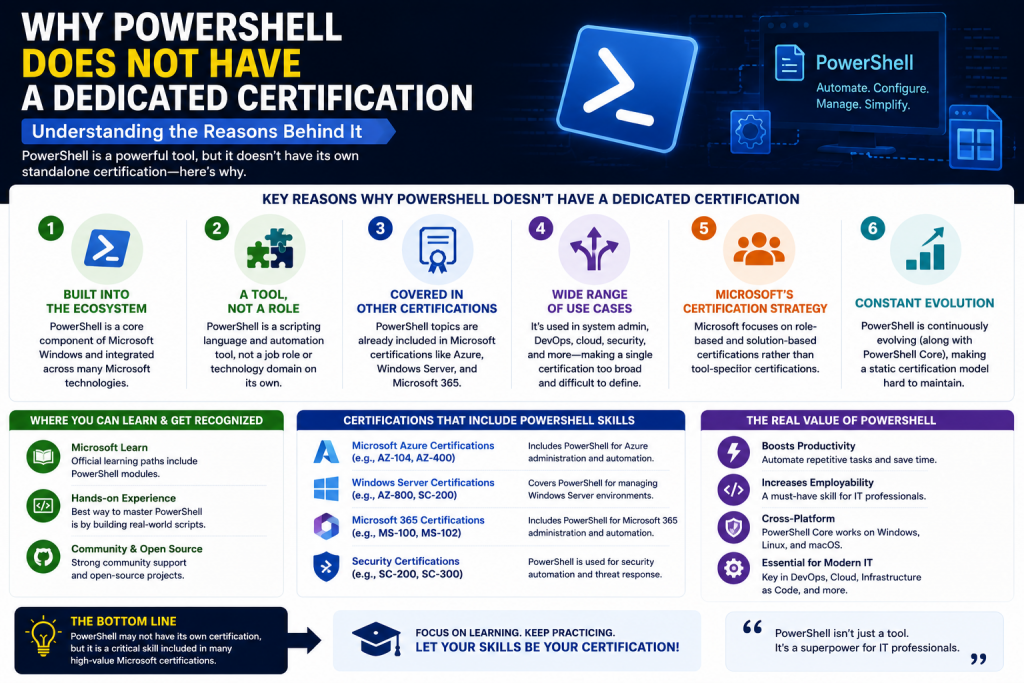
PowerShell has become one of the most valuable tools in modern IT administration. System administrators, cloud engineers, network professionals, and cybersecurity teams use it daily to automate tasks, manage infrastructure, and reduce manual workloads. From resetting user passwords to deploying enterprise-wide configurations, PowerShell plays an important role in almost every Microsoft-based environment.
Despite its widespread adoption and importance, there is still no official standalone PowerShell certification. This raises an interesting question for many IT professionals who want to validate their automation skills and improve their resumes. If PowerShell is such a critical technology, why has no formal certification become an industry standard?
The answer involves several factors, including the nature of PowerShell itself, how Microsoft structures certifications, the role of automation in modern IT, and the challenges of testing scripting knowledge in a standardized way. Although many certification programs include PowerShell-related objectives, no dedicated certification path currently exists that focuses entirely on PowerShell expertise.
Understanding why this gap exists helps explain how the IT industry views scripting, automation, and practical technical skills in today’s rapidly evolving technology landscape.
What Makes PowerShell Different
One of the main reasons there is no dedicated PowerShell certification is because PowerShell is not viewed as a traditional programming language in the same way as Python, Java, or C#. Instead, PowerShell is a task automation framework that combines a command-line shell, scripting capabilities, and administrative tools into one platform.
This distinction matters because certifications are often designed around clearly structured technologies or specialized job roles. PowerShell overlaps with many areas of IT administration rather than existing as a completely separate discipline.
PowerShell can be used for:
- Windows administration
- Active Directory management
- Azure cloud automation
- Microsoft 365 administration
- Server configuration
- Security monitoring
- DevOps automation
- Virtual machine management
- Network administration
Because PowerShell touches so many technologies, Microsoft often integrates PowerShell skills into broader certifications rather than creating a separate credential dedicated only to scripting.
For example, professionals preparing for cloud administration or server management certifications are usually expected to understand PowerShell commands and automation concepts as part of the overall exam objectives. In many ways, PowerShell acts as a supporting skill instead of a standalone specialization.
The Evolution of PowerShell in IT
When PowerShell was first introduced, many administrators relied heavily on graphical user interfaces for daily management tasks. Over time, IT environments became larger and more complex, making manual administration increasingly inefficient.
Organizations began adopting automation to handle repetitive operations faster and more consistently. PowerShell became one of the primary tools for automating Microsoft environments because it allowed administrators to manage systems through scripts and command-line operations.
As cloud computing expanded, PowerShell became even more important. Administrators could automate large-scale deployments, configure cloud resources, and manage hybrid infrastructures using scripts instead of manual configuration processes.
This growth made PowerShell a critical skill for modern IT professionals. However, it also created a challenge for certification developers. PowerShell usage varies dramatically depending on the job role and environment.
A desktop support technician may only use basic commands occasionally, while a cloud engineer may build advanced automation frameworks with thousands of lines of scripting. Designing a certification that accurately measures all these skill levels becomes extremely difficult.
Past Attempts at PowerShell Certification
There have been attempts to create PowerShell certification programs in the past. Some community organizations introduced beta certification projects designed to test practical scripting abilities and automation knowledge.
One notable effort focused on performance-based testing instead of traditional multiple-choice exams. Candidates were required to complete assignments and demonstrate real scripting capabilities.
Although the idea attracted attention from some professionals, it never became widely adopted. Eventually, the initiative was discontinued due to limited participation and the challenges of maintaining a large-scale certification system.
This situation highlighted one of the biggest obstacles facing PowerShell certification development. Testing scripting knowledge effectively is much more complicated than testing memorization-based concepts.
A candidate may understand PowerShell deeply yet approach problems differently than another experienced administrator. Scripts can often achieve the same results using multiple valid methods, making standardized grading difficult.
Unlike fixed-answer technical exams, scripting assessments require more flexible evaluation systems that can measure logic, efficiency, readability, and functionality simultaneously.
Why Microsoft Has Not Created a Dedicated Certification
Microsoft already operates one of the largest certification ecosystems in the technology industry. Their certification programs cover cloud computing, security, server administration, data analysis, artificial intelligence, and many other areas.
Rather than treating PowerShell as an isolated technology, Microsoft includes PowerShell skills within broader role-based certifications. This strategy aligns with how organizations actually use PowerShell in real-world environments.
For example, cloud administrators use PowerShell to manage Azure resources, while security administrators use it to automate security operations. Since PowerShell supports these job roles instead of replacing them, Microsoft may see little need for a separate certification.
Another reason may involve the changing direction of IT certifications overall. Modern certification programs increasingly focus on practical job skills instead of narrow technical specialization.
Employers often care more about whether a professional can manage infrastructure, secure environments, or automate deployments than whether they hold a scripting-only credential.
From Microsoft’s perspective, embedding PowerShell objectives inside role-based certifications may provide better alignment with industry hiring needs.
The Challenge of Measuring Automation Skills
Automation is not always easy to evaluate through traditional testing methods. Multiple-choice exams work well for testing theoretical knowledge, product features, and conceptual understanding, but scripting introduces many variables.
An effective PowerShell certification would likely need to include:
- Live scripting exercises
- Troubleshooting scenarios
- Script debugging tasks
- Automation design challenges
- Real-world administration simulations
Developing and maintaining these performance-based exams would require substantial resources. Testing environments would need to simulate enterprise infrastructures accurately while ensuring fairness and consistency across all candidates.
Additionally, PowerShell evolves constantly. New modules, cloud integrations, security features, and administrative capabilities are added regularly. Certification content would require continuous updates to remain relevant.
This maintenance burden may discourage organizations from investing heavily in a standalone certification path.
The Role of Practical Experience
One reason PowerShell certifications may not have become essential is because employers often prioritize real-world scripting experience over formal credentials.
Hiring managers frequently evaluate PowerShell knowledge through:
- Technical interviews
- Script reviews
- Automation demonstrations
- Troubleshooting exercises
- Portfolio projects
A candidate who can automate onboarding processes, manage cloud resources, or simplify infrastructure management often demonstrates value more effectively than someone who only holds a certification.
In many IT environments, practical automation abilities matter more than exam scores. This reduces industry pressure for creating a dedicated PowerShell credential.
Professionals who use PowerShell regularly naturally build expertise over time through hands-on work rather than formal testing alone.
How PowerShell Skills Are Already Validated
Even without a dedicated certification, many IT certifications indirectly validate PowerShell knowledge. Microsoft exams for Azure, Windows Server, security administration, and cloud engineering frequently include PowerShell-based tasks and objectives.
Candidates preparing for these certifications often spend significant time learning scripting and automation because modern Microsoft technologies rely heavily on PowerShell management.
As a result, employers may already assume that certified administrators possess at least foundational PowerShell knowledge.
This existing overlap reduces the urgency for a separate certification focused entirely on scripting.
At the same time, professionals can showcase their PowerShell abilities through other methods such as:
- GitHub repositories
- Automation projects
- Technical blogs
- Community contributions
- Open-source tools
- Scripting demonstrations
These practical examples often provide stronger evidence of skill than certification credentials alone.
The Importance of the PowerShell Community
The PowerShell community has become one of the technology industry’s strongest collaborative ecosystems. Professionals regularly share scripts, troubleshooting advice, automation ideas, and learning resources.
Forums, online groups, technical blogs, and discussion communities provide valuable support for both beginners and advanced administrators.
This collaborative environment reduces some reliance on formal certification pathways because knowledge sharing happens openly and continuously.
Many professionals learn PowerShell through community interaction rather than structured academic programs. Real-world examples and shared automation solutions often teach practical skills more effectively than theoretical coursework.
If a PowerShell certification were introduced, the community would likely play a major role in preparing candidates and expanding educational resources.
At the same time, some professionals worry that certification-focused learning could encourage memorization instead of creative problem solving. PowerShell’s flexibility is one of its greatest strengths, and overly rigid testing standards might limit innovation.
Would a PowerShell Certification Be Valuable?
A dedicated PowerShell certification could still offer important benefits for many IT professionals.
For beginners, certification could provide:
- Structured learning paths
- Clear skill progression
- Career motivation
- Resume enhancement
- Industry recognition
For employers, certification could help identify candidates with verified scripting knowledge, especially for automation-focused roles.
A standardized certification could also encourage more organizations to prioritize automation training and scripting best practices.
However, the value of such a credential would depend heavily on industry adoption. If employers recognized the certification as meaningful and practical, it could become an important career asset.
If not, it might simply become another optional technical credential with limited hiring impact.
The success of any future PowerShell certification would depend on balancing practical skills, real-world relevance, and industry recognition.
The Future of PowerShell Certifications
As automation continues expanding across IT operations, the demand for scripting skills will likely continue growing. Cloud computing, infrastructure as code, cybersecurity automation, and DevOps practices all rely heavily on scripting technologies like PowerShell.
This increasing dependence on automation may eventually create stronger demand for formal PowerShell validation.
Future certification models could potentially include:
- Performance-based testing
- Cloud automation labs
- Interactive scripting environments
- Real-world troubleshooting simulations
- Scenario-based assessments
Modern testing platforms are becoming more capable of evaluating hands-on technical skills, making advanced scripting certifications more realistic than in the past.
Microsoft may eventually decide that automation deserves its own specialized credential as organizations place greater emphasis on operational efficiency and scalable administration.
Even if no official certification appears soon, PowerShell expertise will remain highly valuable in the IT industry.
Conclusion
The absence of a dedicated PowerShell certification is not because PowerShell lacks importance. In reality, PowerShell has become one of the most influential automation tools in modern IT operations. The real challenge lies in how broad, flexible, and deeply integrated the technology has become across multiple job roles and platforms.
Microsoft currently treats PowerShell as an essential supporting skill within larger certification paths rather than a separate specialization. At the same time, testing scripting abilities through standardized exams presents unique technical and logistical challenges that traditional certification models struggle to address.
Although no official standalone credential exists today, PowerShell skills continue to carry enormous value for administrators, cloud engineers, cybersecurity professionals, and DevOps teams. Practical experience, automation projects, and real-world scripting abilities often provide stronger proof of expertise than certifications alone.
As automation becomes even more central to IT infrastructure management, the possibility of a future PowerShell certification may continue gaining attention. Whether or not such a credential eventually becomes reality, learning PowerShell remains one of the smartest investments IT professionals can make for long-term career growth and technical development.
Continue exploring the technologies and certification concepts that matter most to you.