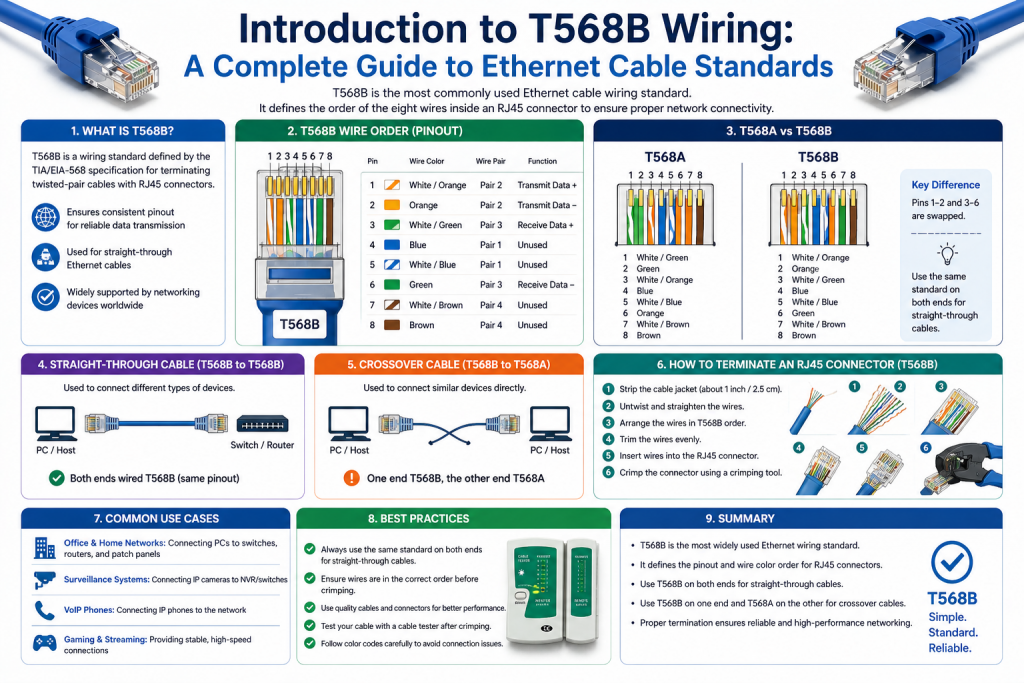
T568B wiring is a standardized method used to arrange and terminate the individual wires inside an Ethernet cable so that network devices can communicate reliably. In modern networking, consistency is essential, and this wiring scheme ensures that every cable follows the same internal structure when connected to connectors such as RJ45 plugs or wall jacks. Without such a standard, different installations could use different wire arrangements, leading to confusion, signal errors, and failed connections.
Ethernet cables are widely used to connect devices such as computers, switches, routers, and patch panels. These cables may look simple from the outside, but internally they are carefully designed to support high-speed data transmission. The T568B standard defines how the internal wires are organized before they are terminated, ensuring that signals are transmitted correctly from one device to another.
The idea behind T568B wiring is not just about organizing wires but about maintaining a consistent structure across all network connections. This consistency allows technicians, engineers, and installers to work with cables confidently, knowing that each properly wired cable will behave the same way in a network environment.
Why Standardization Matters in Networking
In any technical system, standardization plays a crucial role in ensuring compatibility and reliability. Networking is no exception. When multiple devices from different manufacturers are connected in a network, they must all follow the same communication rules. This includes not only how data is transmitted but also how physical connections are made.
Before standardized wiring schemes like T568B were widely adopted, inconsistent cable terminations could cause serious problems. A cable wired one way on one end and another way on the other end could lead to signal mismatches. Devices would fail to communicate, and troubleshooting would become difficult and time-consuming.
T568B eliminates these issues by providing a clear and universally accepted wiring pattern. When all cables in a network follow the same standard, it becomes much easier to install new connections, diagnose problems, and maintain the system over time. Standardization also reduces the likelihood of human error, as technicians can rely on a known pattern rather than guessing or improvising.
Another important benefit of standardization is scalability. As networks grow, additional cables and devices can be added without worrying about compatibility issues. The consistent wiring pattern ensures that new components will integrate smoothly with existing infrastructure.
The Basics of Ethernet Cable Construction
To understand T568B wiring, it is important to first understand how Ethernet cables are constructed. Inside a typical Ethernet cable are eight individual copper wires. These wires are grouped into four pairs, and each pair is twisted together along the length of the cable.
The twisting of the wire pairs is not random. It serves a specific purpose: reducing electromagnetic interference and crosstalk. Crosstalk occurs when signals from one pair of wires interfere with signals in another pair. By twisting the wires together, the interference is minimized, allowing for cleaner and more reliable data transmission.
Each of the four pairs is identified by a color scheme. The colors used are orange, green, blue, and brown. Within each pair, one wire is a solid color, and the other is a white wire with a colored stripe. This color coding helps technicians identify and organize the wires during termination.
In addition to the twisted pairs, many Ethernet cables include a plastic insert or separator. This component helps maintain the spacing between the pairs, further reducing interference and improving performance. The entire assembly is enclosed in a protective outer jacket that shields the wires from physical damage and environmental factors.
Understanding this internal structure is essential because T568B wiring is all about arranging these eight wires in the correct order when connecting them to a connector.
What Termination Means in Ethernet Cabling
Termination is the process of attaching the internal wires of an Ethernet cable to a connector, such as an RJ45 plug or a patch panel jack. Each of the eight wires must be inserted into a specific position within the connector, corresponding to one of the eight pins.
The order in which the wires are placed is critical. Each pin in the connector is associated with a particular function, such as transmitting or receiving data. If the wires are not arranged correctly, the signals will not reach their intended destinations, and communication between devices may fail.
During termination, the outer jacket of the cable is stripped back to expose the twisted pairs. The pairs are then carefully untwisted just enough to arrange the wires in the correct order. It is important to keep the untwisted portion as short as possible to maintain the benefits of the twisting.
Once the wires are arranged according to the chosen standard, they are inserted into the connector and secured in place, usually by crimping. A properly terminated cable ensures that each wire makes a solid connection with the corresponding pin.
T568B provides the exact sequence that must be followed during this process, ensuring that every cable is wired consistently.
The Role of T568B in Network Communication
T568B wiring plays a direct role in how data is transmitted across a network. Ethernet communication relies on specific pairs of wires to send and receive signals. By defining the arrangement of these pairs, T568B ensures that the correct wires are used for each function.
When two devices are connected using a properly wired Ethernet cable, they can exchange data through these wire pairs. The signals travel as electrical impulses along the copper wires, and the receiving device interprets these signals as data.
If the wiring is incorrect, the signals may be sent to the wrong pins or not transmitted at all. This can result in slow connections, intermittent connectivity, or complete communication failure. By following the T568B standard, these issues are avoided.
Another important aspect of T568B is that it supports compatibility with a wide range of networking equipment. Because it is widely used, most devices and pre-made cables are designed with this standard in mind. This makes it a practical choice for many installations.
T568B as Part of Industry Standards
T568B is part of a larger set of standards developed to ensure consistency in telecommunications and networking. These standards define not only wiring patterns but also performance requirements, testing procedures, and installation guidelines.
The full name of the standard is often written as TIA/EIA-568B. This reflects the organizations that developed it. Over time, the shorter term T568B has become more commonly used in everyday discussions.
Being part of an established standard means that T568B is recognized and used globally. This widespread adoption makes it easier for professionals to work across different projects and environments without needing to learn new wiring schemes.
It also means that training materials, tools, and equipment are widely available, further supporting its use in the industry.
Comparison with Other Wiring Standards
While T568B is widely used, it is not the only wiring standard available. Another common standard is T568A. Both standards define how the eight wires in an Ethernet cable should be arranged, but they differ slightly in the positioning of certain wire pairs.
The main difference between T568A and T568B is the placement of the green and orange pairs. In T568A, the green pair comes before the orange pair, while in T568B, the orange pair comes first. Aside from this difference, the rest of the wiring arrangement is the same.
Despite this variation, both standards provide the same level of performance when used correctly. The choice between them often depends on existing infrastructure, regional preferences, or specific project requirements.
What is important is not which standard is chosen but that the same standard is used consistently throughout the network. Mixing standards within a single cable or installation can lead to connectivity issues.
Straight-Through Cabling and Its Importance
When both ends of an Ethernet cable are wired using the same standard, such as T568B, the cable is known as a straight-through cable. This type of cable is the most commonly used in networking.
Straight-through cables are typically used to connect different types of devices, such as a computer to a switch or a router to a patch panel. Because both ends follow the same wiring pattern, each pin connects directly to the corresponding pin on the other end.
This direct connection ensures that the transmit and receive signals are aligned correctly, allowing for smooth communication between devices.
Using T568B for both ends of a cable ensures that the cable functions as intended in most standard networking scenarios. It also simplifies installation, as technicians only need to remember one wiring pattern.
Physical Design Features Supporting T568B
Ethernet cables are designed with several features that support the effectiveness of standards like T568B. One of these features is the twisting of the wire pairs, which helps reduce interference and maintain signal quality.
Another feature is the use of a plastic separator or spline inside the cable. This component keeps the wire pairs separated and maintains their position within the cable. This helps reduce crosstalk and improves overall performance.
The outer jacket of the cable provides protection against physical damage, moisture, and environmental factors. Depending on the type of cable, the jacket may be designed for indoor or outdoor use.
These physical design elements work together with the T568B wiring standard to ensure reliable data transmission. By maintaining the integrity of the wire pairs and their arrangement, the cable can support high-speed communication without significant signal loss.
Practical Importance of Learning T568B
Understanding T568B wiring is an essential skill for anyone working with network infrastructure. Whether installing new cables, repairing existing connections, or troubleshooting network issues, knowledge of this standard is invaluable.
For technicians, being able to quickly identify and apply the correct wiring pattern can save time and prevent costly mistakes. It also ensures that installations meet industry standards and perform reliably.
For students and learners, understanding T568B provides a foundation for more advanced networking concepts. It helps build a deeper understanding of how physical connections support digital communication.
Even for home users, knowing the basics of Ethernet wiring can be useful when setting up or expanding a home network. It allows for greater control and flexibility in managing network connections.
Introduction to T568B Color Coding
The T568B wiring standard is not only about arranging wires but also about understanding how color coding plays a crucial role in maintaining proper communication within a network. Each Ethernet cable contains eight wires grouped into four twisted pairs, and these wires are identified using a specific color scheme. This color coding system is essential because it allows technicians to correctly identify each wire and place it in the proper position during termination.
Color coding ensures that every cable follows a consistent pattern. Without it, distinguishing between wires would be extremely difficult, especially since they are similar in size and material. The use of colors eliminates guesswork and helps maintain accuracy when connecting cables to connectors.
In T568B wiring, the color sequence is carefully defined so that each wire corresponds to a specific pin in the connector. This precise arrangement ensures that signals are transmitted and received correctly, allowing devices to communicate without errors.
Understanding the Four Twisted Pairs
Inside every standard Ethernet cable are four twisted pairs of wires. Each pair consists of two wires that are twisted together along the length of the cable. These pairs are identified by four main colors: orange, green, blue, and brown.
Each pair includes one solid-colored wire and one striped wire. The striped wire is typically white with a colored stripe that matches its pair. For example, the orange pair consists of a solid orange wire and a white wire with an orange stripe.
The twisting of the pairs is a key design feature. It helps reduce electromagnetic interference from external sources and minimizes crosstalk between adjacent pairs. Crosstalk occurs when signals from one pair interfere with another, which can degrade network performance.
By keeping the wires twisted together, the cable maintains signal integrity over longer distances. This design allows Ethernet cables to support high-speed data transmission while minimizing errors.
The T568B Wire Order Explained
The T568B standard defines the exact order in which the eight wires must be arranged when terminating a cable. This order is based on the color coding of the wires and must be followed precisely to ensure proper functionality.
Starting from pin 1 and moving to pin 8 in an RJ45 connector, the T568B wire order is as follows:
white with orange stripe, solid orange, white with green stripe, solid blue, white with blue stripe, solid green, white with brown stripe, solid brown
This sequence ensures that the correct pairs are aligned with the appropriate pins. Each pin has a specific role in transmitting or receiving data, and the arrangement of wires determines how signals flow through the cable.
It is important to maintain this order exactly as specified. Even a small mistake, such as swapping two wires, can disrupt communication and cause network issues.
Pin Assignments and Their Role
Each of the eight wires in an Ethernet cable connects to a corresponding pin in the RJ45 connector. These pins are arranged in a single row, and each one is responsible for carrying a specific part of the data signal.
In Ethernet networking, certain pins are used for transmitting data, while others are used for receiving. The T568B standard ensures that these functions are assigned to the correct wires.
For example, in many Ethernet configurations, pins 1 and 2 are used for transmitting data, while pins 3 and 6 are used for receiving. The remaining pins may be used for additional data channels or other purposes, depending on the network type.
By following the T568B wiring pattern, the correct wires are connected to the appropriate pins, ensuring that data flows smoothly between devices.
Maintaining Pair Integrity During Termination
One of the most important aspects of T568B wiring is maintaining the integrity of the twisted pairs during termination. While it is necessary to untwist the wires slightly to arrange them in the correct order, this should be kept to a minimum.
Excessive untwisting can increase crosstalk and reduce the overall performance of the cable. To avoid this, technicians should only untwist the wires as much as needed to insert them into the connector.
Keeping the twists as close as possible to the point of termination helps preserve the cable’s ability to resist interference. This is especially important in high-speed networks, where signal quality is critical.
Proper technique during termination ensures that the cable performs as expected and meets the required standards.
Internal Cable Components Supporting Performance
In addition to the twisted wire pairs, Ethernet cables often include internal components that enhance performance. One common feature is a plastic separator or spline that runs through the center of the cable.
This separator keeps the wire pairs evenly spaced and prevents them from interfering with each other. By maintaining consistent spacing, the cable reduces crosstalk and improves signal quality.
Another important component is the outer jacket of the cable. This protective layer shields the internal wires from physical damage, moisture, and environmental factors. The jacket also helps maintain the overall structure of the cable.
Some cables are designed for specific environments, such as outdoor installations or areas with high electromagnetic interference. These cables may include additional shielding or thicker jackets to provide extra protection.
The Role of RJ45 Connectors in T568B Wiring
RJ45 connectors are the most commonly used connectors for Ethernet cables. They are designed to accommodate eight wires and provide a secure connection between the cable and a network device.
When using the T568B standard, each wire must be inserted into the correct slot within the RJ45 connector. The connector has eight channels, each corresponding to a pin. The wires must be arranged in the correct order before being inserted.
Once the wires are in place, the connector is crimped using a specialized tool. This process secures the wires and ensures that each one makes proper contact with its corresponding pin.
A properly crimped connector is essential for reliable communication. Poor termination can result in loose connections, signal loss, or complete failure of the cable.
Straight-Through Configuration Using T568B
When both ends of an Ethernet cable are wired using the T568B standard, the cable is known as a straight-through cable. This configuration is the most commonly used in networking.
Straight-through cables are typically used to connect different types of devices, such as a computer to a switch or a router to a patch panel. Because both ends follow the same wiring pattern, each pin on one end connects directly to the corresponding pin on the other end.
This direct alignment ensures that the transmit and receive signals are properly matched, allowing for smooth communication between devices.
Using T568B for both ends of the cable simplifies installation and reduces the risk of errors. It also ensures compatibility with most networking equipment.
Common Mistakes in T568B Wiring
Even though T568B wiring is straightforward, mistakes can still occur during termination. One common error is placing wires in the wrong order. This can happen if the technician is not careful or if the color coding is not followed correctly.
Another mistake is untwisting the wire pairs too much. This can increase interference and reduce the performance of the cable. Keeping the twists intact as much as possible is essential for maintaining signal quality.
Improper crimping is another issue. If the connector is not crimped correctly, the wires may not make proper contact with the pins. This can lead to intermittent connectivity or complete failure.
To avoid these problems, it is important to follow proper procedures and use the right tools. Testing the cable after termination can also help identify and correct any issues.
Importance of Cable Testing and Verification
After terminating a cable using the T568B standard, it is important to test it to ensure that it is working correctly. Cable testers are commonly used for this purpose.
A cable tester checks each wire to confirm that it is connected to the correct pin and that there are no breaks or faults. It can also detect issues such as crossed wires or short circuits.
Testing helps ensure that the cable meets performance standards and will function reliably in a network. It also provides confidence that the installation has been done correctly.
Regular testing is especially important in large networks, where even a single faulty cable can cause significant problems.
Practical Applications of T568B Wiring
T568B wiring is used in a wide range of networking applications. It is commonly found in office environments, data centers, and residential networks. Its widespread use makes it a familiar standard for many technicians.
In office settings, T568B is often used to connect computers to network switches, as well as to link patch panels and other infrastructure components. In data centers, it is used to manage large numbers of connections between servers and networking equipment.
In homes, T568B may be used to create custom Ethernet cables or to install structured cabling systems. Its simplicity and reliability make it a practical choice for both professionals and hobbyists.
Because it is so widely used, many pre-made cables are also wired using the T568B standard. This ensures compatibility with existing installations and reduces the need for custom wiring.
Introduction to T568A and T568B Standards
T568B is widely used in Ethernet networking, but it exists alongside another equally recognized wiring standard known as T568A. Both standards were developed to create uniformity in how network cables are terminated, ensuring that devices can communicate effectively regardless of who installs the wiring. While the two standards are very similar, they differ in one key area: the placement of the green and orange wire pairs.
Understanding both T568A and T568B is important because they are often encountered in different environments. Some networks are built entirely using one standard, while others may involve both standards under specific circumstances. Knowing how these standards relate to each other helps prevent confusion and ensures proper network functionality.
The existence of two standards does not mean one is superior to the other in terms of performance. Both provide the same level of reliability and support for data transmission when used correctly. The key factor is consistency within a network.
Key Differences Between T568A and T568B
The primary difference between T568A and T568B lies in the arrangement of two wire pairs: the green pair and the orange pair. In T568A, the green pair is placed in the first set of pins, while the orange pair comes later. In T568B, this arrangement is reversed, with the orange pair appearing first and the green pair following.
Despite this difference, the blue and brown pairs remain in the same positions in both standards. This means that most of the wiring structure is identical, with only a small variation in the sequence.
This difference may seem minor, but it has a significant impact on how cables function when connected between devices. If both ends of a cable use the same standard, the cable will function as a straight-through cable. If the ends use different standards, the cable becomes a crossover cable.
Understanding this distinction is essential for anyone working with Ethernet cabling, as it directly affects how devices communicate.
Interchangeability and Compatibility Issues
One of the most important points to understand about T568A and T568B is that they are not interchangeable within a single connection unless specifically intended. If one end of a cable is wired using T568A and the other end is wired using T568B, the wiring pattern changes the signal paths between the pins.
In some cases, this mismatch can prevent devices from communicating entirely. In other cases, it may cause intermittent connectivity or reduced performance. These issues can be difficult to diagnose if the wiring standards are not clearly identified.
To avoid these problems, it is essential to use the same standard on both ends of a cable when creating a straight-through connection. This ensures that each wire connects to the correct corresponding pin, allowing signals to travel as intended.
Consistency across an entire network is equally important. Mixing standards in different parts of a network infrastructure, such as patch panels and wall jacks, can lead to confusion and connectivity failures.
Understanding Straight-Through Cables
A straight-through cable is created when both ends of the cable are wired using the same standard, either T568A or T568B. This type of cable is the most commonly used in networking environments.
Straight-through cables are typically used to connect different types of devices. For example, they are used to connect computers to switches, routers to patch panels, and other similar combinations. Because the wiring is identical on both ends, each pin connects directly to its counterpart.
This direct connection ensures that transmit and receive signals are aligned correctly, allowing devices to communicate without issues. Straight-through cables are simple to create and are compatible with most networking equipment.
Using T568B for both ends of a cable is a common practice, especially in environments where T568B has already been established as the standard.
Understanding Crossover Cables
A crossover cable is created when one end of the cable is wired using T568A and the other end is wired using T568B. This configuration swaps the transmit and receive pairs, allowing two similar devices to communicate directly.
Crossover cables were traditionally used to connect devices of the same type, such as two computers or two switches, without the need for an intermediate device like a hub or switch. By crossing the transmit and receive signals, the devices could exchange data directly.
In modern networking, the need for crossover cables has decreased significantly. Many devices now support automatic detection of signal paths, a feature known as auto MDI-X. This allows devices to adjust internally, eliminating the need for a specific cable type.
However, understanding crossover cables remains important, especially when working with older equipment or troubleshooting network issues.
Practical Scenarios for Using T568B
T568B is commonly used in a wide range of networking environments. In commercial settings, it is often the preferred standard due to its widespread adoption and compatibility with existing infrastructure.
In office networks, T568B is used to connect computers, printers, and other devices to network switches. It is also used in structured cabling systems, where multiple cables are organized and managed through patch panels and wall outlets.
In data centers, T568B plays a critical role in managing large numbers of connections between servers and networking equipment. The consistency provided by the standard helps ensure reliable communication and simplifies maintenance.
In residential settings, T568B may be used for home networking installations. Whether connecting a computer to a router or setting up a wired network throughout a house, T568B provides a straightforward and reliable solution.
Importance of Consistency in Network Installations
One of the most important principles in network cabling is consistency. Once a wiring standard is chosen, it should be used throughout the entire network. This applies to all components, including cables, connectors, patch panels, and wall jacks.
Consistency simplifies installation and maintenance. Technicians can quickly identify wiring patterns and diagnose issues without needing to check multiple standards. It also reduces the risk of errors during installation.
Inconsistent wiring can lead to serious problems. For example, if a patch panel is wired using T568A and the connected cables use T568B, the resulting mismatch can prevent devices from communicating. Troubleshooting such issues can be time-consuming and complex.
By maintaining a consistent standard, network administrators can ensure reliable performance and avoid unnecessary complications.
Government and Industry Preferences
In some environments, specific wiring standards are required for compliance and uniformity. For example, certain government installations mandate the use of T568A to ensure consistency across all facilities.
This requirement is not based on performance differences but on the need for a uniform approach. By using a single standard, organizations can avoid confusion and ensure that all installations follow the same guidelines.
In the private sector, the choice between T568A and T568B is often based on existing infrastructure or organizational preference. Many organizations continue to use T568B because it aligns with their current systems and practices.
Understanding these preferences is important for anyone working in networking, as it helps ensure that installations meet the required standards.
Troubleshooting Wiring Issues
When network problems occur, incorrect wiring is often a possible cause. Understanding T568B and its relationship to T568A can help identify and resolve these issues.
Common symptoms of wiring problems include no connectivity, slow network speeds, and intermittent connections. These issues may result from incorrect wire placement, poor termination, or mismatched standards.
Troubleshooting typically involves checking the wiring at both ends of the cable to ensure that it follows the correct standard. Cable testers can be used to verify continuity and detect faults such as crossed wires or open connections.
By systematically checking each component, technicians can identify the source of the problem and correct it. Knowledge of wiring standards is essential for this process.
Evolution of Networking and Reduced Need for Crossover
Advancements in networking technology have reduced the reliance on specific cable types. Features like auto MDI-X allow devices to automatically detect and adjust for different wiring configurations.
This means that in many cases, a standard straight-through cable can be used even when connecting similar devices. The devices themselves handle the necessary adjustments internally.
Despite these advancements, the underlying principles of T568B wiring remain relevant. Understanding how cables are structured and how signals are transmitted is still important for installation, troubleshooting, and system design.
Even as technology evolves, the need for proper wiring practices continues to be a fundamental aspect of networking.
Real-World Importance of T568B Knowledge
Knowledge of T568B wiring is valuable for a wide range of professionals, including network technicians, system administrators, and IT support staff. It is also useful for students and anyone interested in learning about networking.
Having a solid understanding of this wiring standard allows professionals to perform installations with confidence and accuracy. Instead of relying solely on pre-made cables, they can create custom cables tailored to specific network requirements, which is especially useful in complex environments. This skill also helps reduce costs, as organizations can produce their own cables rather than purchasing them in large quantities.
For troubleshooting, T568B knowledge becomes even more important. When connectivity issues arise, professionals can quickly inspect cable terminations, verify wire order, and identify faults such as miswiring or poor connections. This leads to faster problem resolution and less network downtime.
Students and beginners benefit by building a strong foundation in networking concepts. Learning how physical connections work makes it easier to understand more advanced topics like data transmission, switching, and network design. It also provides practical, hands-on experience that is highly valued in technical careers.
Overall, understanding T568B wiring enhances technical skills, improves efficiency, and supports long-term growth in the field of networking.
In real-world scenarios, the ability to create and repair Ethernet cables can save time and resources. Instead of relying on pre-made cables, technicians can customize cables to fit specific requirements.
Understanding T568B also helps in diagnosing network issues. By recognizing the correct wiring pattern, technicians can quickly identify errors and implement solutions.
This practical knowledge contributes to more efficient and reliable network operations.
Conclusion
T568B wiring is a foundational element of Ethernet networking, providing a standardized method for arranging and terminating the wires داخل network cables. Its relationship with T568A highlights the importance of consistency and understanding in network design and installation.
While both standards offer the same level of performance, the key to successful networking lies in using one standard consistently across all connections. Whether creating straight-through cables or understanding crossover configurations, knowledge of T568B ensures that devices can communicate effectively.
Consistency not only improves performance but also simplifies maintenance and troubleshooting over time. When every cable in a network follows the same wiring pattern, it becomes much easier to identify faults, replace damaged cables, or expand the network without introducing errors. Network technicians can quickly trace connections and verify installations without needing to check multiple wiring schemes. This reduces downtime and improves overall efficiency.
In addition, consistent wiring supports long-term scalability. As networks grow and new devices are added, having a uniform standard ensures seamless integration. There is no need to reconfigure existing connections or worry about compatibility issues. This is especially important in larger environments where hundreds or even thousands of cables may be in use.
Following a single standard also improves documentation and organization. Clear labeling and predictable wiring patterns make it easier for teams to collaborate and manage infrastructure. Over time, this structured approach contributes to a more stable, reliable, and professional network environment.
As networking technology continues to evolve, the principles behind T568B remain essential. From installation to troubleshooting, this standard plays a critical role in maintaining reliable and efficient communication systems.
Continue exploring the technologies and certification concepts that matter most to you.