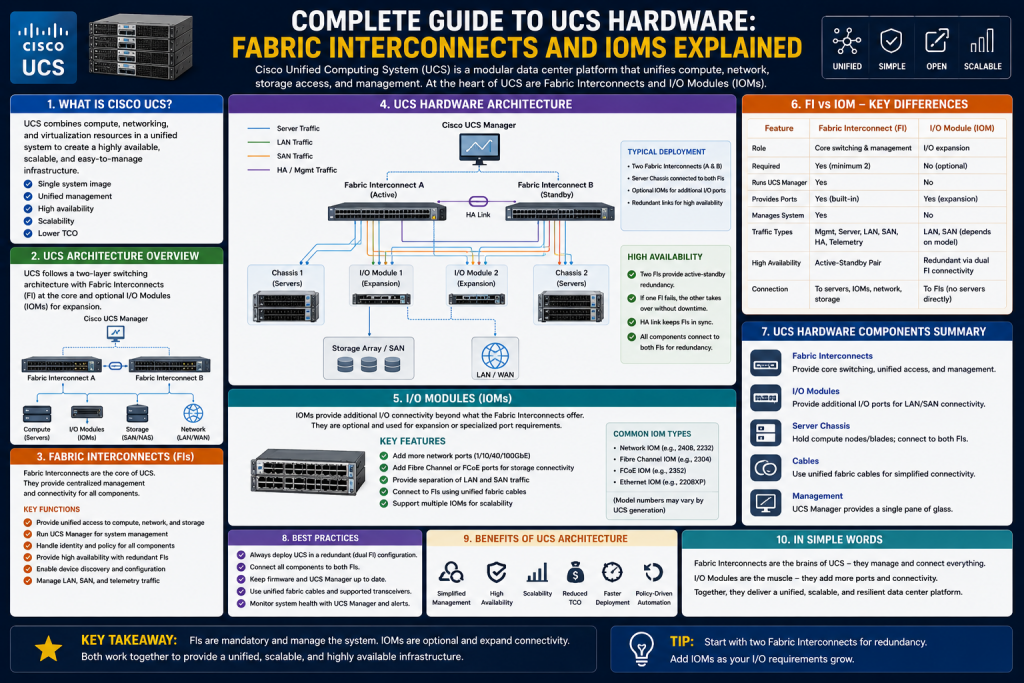
Modern data centers rely heavily on highly efficient and tightly integrated networking systems to handle increasing demands for performance, scalability, and reliability. One of the key innovations in this space is the concept of a unified computing architecture, where compute, storage, and networking are managed as a single system rather than separate components. Within this architecture, two essential components play a central role in connectivity and communication: fabric interconnects and I/O modules, often referred to as fabric extenders.
To understand how these elements work, it is important to first understand the idea of a network fabric and how it forms the foundation of modern enterprise computing environments.
Understanding the Concept of a Network Fabric
A network fabric can be thought of as a highly interconnected communication system where multiple devices are linked together in a structured and redundant way. Instead of relying on a simple linear connection between devices, a fabric creates multiple pathways for data to travel. This design improves performance, increases resilience, and reduces the risk of downtime.
In a fabric-based design, servers, switches, and storage systems are interconnected in such a way that there are often multiple active paths between them. This interconnected structure ensures that if one path fails, another can immediately take over without disrupting services. The overall appearance of these interconnections resembles a woven material, which is why the term “fabric” is used.
This approach is especially common in modern data centers where virtualization, cloud computing, and high-performance applications require constant and uninterrupted connectivity.
What Are Fabric Interconnects
Fabric interconnects are specialized networking devices that act as the central point of communication within a unified computing system. They serve as the bridge between compute resources such as servers and the external network infrastructure.
At a basic level, a fabric interconnect performs a similar role to a traditional network switch. However, it is designed specifically for environments where computing and networking are tightly integrated. Instead of simply forwarding traffic, it also handles centralized management of connected devices.
One of the most important features of fabric interconnects is their role in simplifying network architecture. In traditional environments, each server connects individually to network switches, which then connect to the broader network. This creates complexity in configuration, monitoring, and troubleshooting.
With fabric interconnects, many of these responsibilities are centralized. Servers connect directly to the fabric interconnect, which then manages communication to the rest of the network. This reduces cabling complexity and makes the entire system easier to manage.
Another key advantage is redundancy. Fabric interconnects are typically deployed in pairs, ensuring that if one device fails, the other can continue handling traffic without interruption. This high-availability design is essential in environments where downtime is unacceptable.
Fabric interconnects also play a major role in policy-based management. Instead of configuring each server individually, administrators can define network policies at the fabric level. These policies are then automatically applied to all connected devices, ensuring consistency and reducing administrative workload.
Role of Fabric Interconnects in Unified Systems
In a unified computing environment, fabric interconnects act as the backbone of both network connectivity and system management. They provide a single point through which all data traffic flows between servers and external networks. This centralized role allows administrators to simplify configuration, monitoring, and troubleshooting across the entire infrastructure. Instead of managing multiple independent switches, they can control network behavior from a unified interface. Fabric interconnects also support high availability through redundant configurations, ensuring continuous operation even during hardware failures. Additionally, they improve performance by efficiently handling large volumes of traffic and enabling consistent policy enforcement across all connected devices in the system.
These devices are designed to handle high bandwidth requirements, making them suitable for data-intensive applications. Since they are optimized for unified environments, they are also capable of supporting both Ethernet and storage traffic over the same infrastructure.
Another important function is virtualization support. Fabric interconnects are designed to work seamlessly with virtualized environments, allowing multiple virtual machines to operate efficiently across shared physical resources.
Understanding IOMs or Fabric Extenders
IOMs, commonly known as fabric extenders, are another critical component in unified computing systems. They function as remote extensions of fabric interconnects, helping distribute network connectivity closer to the servers.
A fabric extender does not operate as an independent switch. Instead, it acts as an extension of the fabric interconnect, forwarding traffic back to it for processing and decision-making. This architecture reduces the need for complex switching logic at the edge of the network.
In a typical setup, fabric extenders are installed within the server chassis. They provide network connectivity directly to individual servers, ensuring that each server can communicate efficiently with the fabric interconnect.
One of the key advantages of this design is simplification. Since fabric extenders do not require independent configuration or management, they significantly reduce operational complexity. All configuration is handled centrally through the fabric interconnect.
How Fabric Extenders Work in Practice
Fabric extenders serve as intermediary devices between servers and fabric interconnects. When a server sends data, the fabric extender receives it and forwards it to the fabric interconnect. The interconnect then determines how and where the data should be routed.
This process is transparent to the server, which operates as if it is directly connected to a standard network switch. However, behind the scenes, the fabric extender and fabric interconnect work together to manage traffic efficiently.
In most deployments, fabric extenders are deployed in pairs to ensure redundancy. Each server connects to multiple fabric extenders, ensuring continuous connectivity even if one path fails.
This architecture eliminates the need for traditional top-of-rack switching in many cases, reducing hardware requirements and simplifying cabling.
Advantages of Using Fabric Interconnects and Fabric Extenders
One of the primary advantages of this architecture is centralized management. Instead of configuring multiple switches and network devices individually, administrators can manage the entire network from a single point.
Another benefit is scalability. As organizations grow, additional servers can be added without significantly increasing network complexity. Fabric extenders allow new devices to be integrated quickly, while fabric interconnects handle the increased traffic load.
Reliability is also greatly improved. Redundant connections at multiple levels ensure that there is no single point of failure. If one component fails, traffic is automatically rerouted through alternative paths.
Performance is another key advantage. Because fabric interconnects are designed specifically for high-speed data center environments, they can handle large volumes of traffic with low latency.
Additionally, the architecture supports virtualization efficiently. Virtual machines can move between physical servers without requiring major network reconfiguration, making workload balancing more flexible.
Difference Between Traditional Networking and Fabric-Based Design
In traditional networking setups, each server connects to one or more switches, which are independently configured and managed. This approach can become complex as the number of devices increases.
In contrast, fabric-based designs simplify this structure by introducing centralized control through fabric interconnects. Instead of managing multiple switches, administrators manage a unified system.
Fabric extenders further reduce complexity by eliminating the need for intelligent switching at the edge. They simply extend the reach of the fabric interconnect, making the entire system easier to scale and maintain.
Challenges and Considerations
While fabric-based architectures provide many operational and technical benefits, they also introduce certain design and management considerations that organizations must carefully evaluate before implementation.
One of the primary concerns is the reliance on central fabric interconnects. These devices serve as the core communication point for the entire system, meaning a large portion of network traffic depends on their availability. If a fabric interconnect fails and proper redundancy is not in place, it can lead to significant disruptions across connected servers and services. Although most deployments address this risk through paired or redundant configurations, it still requires careful planning and validation to ensure uninterrupted operation under failure conditions.
Another important factor is the initial cost of deployment. Fabric-based systems are designed to simplify long-term operations and reduce administrative overhead, but this efficiency often comes with higher upfront investment. Specialized hardware, integrated management capabilities, and supporting components such as fabric extenders contribute to the overall cost. For smaller environments or organizations with limited budgets, this initial expense can be a barrier compared to more traditional networking approaches that rely on standard switches and independent configuration.
In addition to cost and dependency concerns, successful implementation heavily depends on proper planning and architectural design. Fabric environments require a well-thought-out layout that considers redundancy, scalability, bandwidth requirements, and workload distribution. If the system is misconfigured or poorly designed, it may not deliver the expected performance or reliability benefits. Issues such as improper traffic distribution, insufficient redundancy, or incorrect policy configurations can reduce efficiency and introduce operational risks.
Overall, while fabric-based networking systems offer streamlined management and high performance, they demand careful consideration during design and deployment to fully realize their advantages and avoid potential pitfalls.
Conclusion
Fabric interconnects and fabric extenders are essential components of modern unified computing systems. Together, they create a highly efficient, scalable, and manageable network architecture designed to meet the demands of contemporary data centers.
Fabric interconnects serve as the central intelligence and connectivity hub, while fabric extenders provide distributed access to servers without adding management complexity. This combination allows organizations to simplify network design, improve performance, and ensure high availability.
As data centers continue to evolve, architectures based on unified fabric principles will remain a foundational approach for building flexible and resilient IT infrastructures.
Continue exploring the technologies and certification concepts that matter most to you.