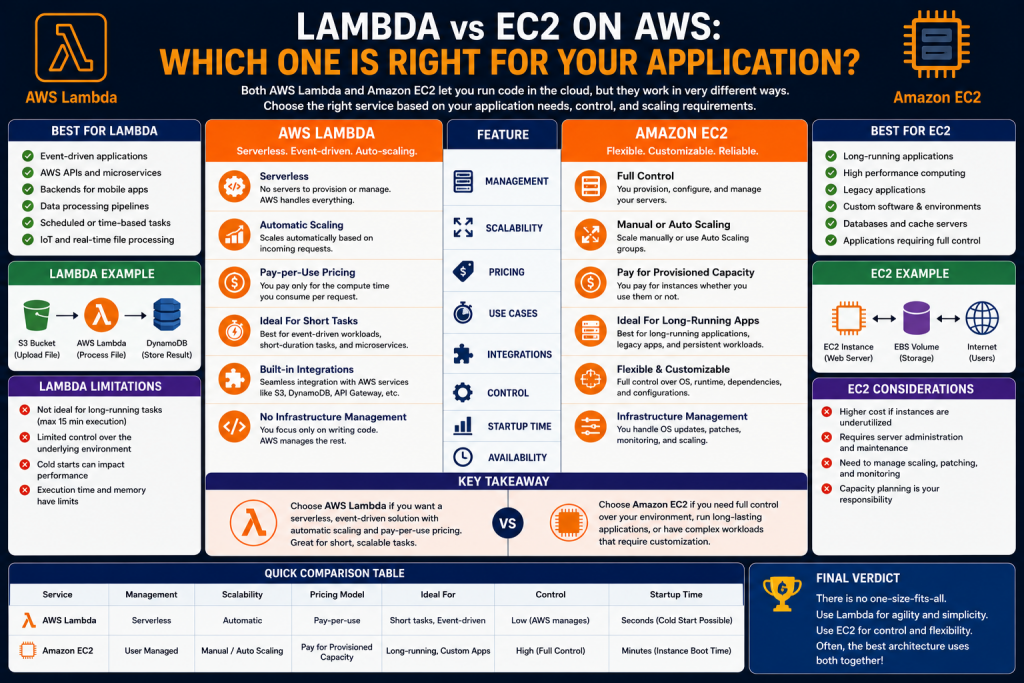
Modern cloud computing has transformed the way applications are built, deployed, and scaled. Instead of relying on physical servers and fixed infrastructure, businesses now use cloud platforms that offer flexible and on-demand computing power. Among the many services available, two of the most widely used options are AWS Lambda and EC2.
This transformation has allowed organizations to move away from traditional data centers, where scaling required purchasing and maintaining expensive hardware. In contrast, cloud-based systems enable instant provisioning of resources, meaning computing power can be increased or decreased within minutes based on demand. This flexibility is especially important for modern applications that experience unpredictable traffic patterns, such as e-commerce platforms, streaming services, and mobile applications.
Another major advantage of cloud computing is global accessibility. Applications hosted in the cloud can be accessed from anywhere in the world, ensuring better performance and reliability for users across different regions. Additionally, cloud providers offer built-in services such as monitoring, security, backup, and load balancing, which reduce operational complexity for developers and IT teams.
AWS Lambda and EC2 play a central role in this ecosystem by addressing different types of workloads. While Lambda focuses on event-driven execution without server management, EC2 provides full control over virtual machines for more complex and persistent applications. Together, they represent two core approaches to cloud computing that help businesses build scalable, efficient, and cost-effective systems.
Both services provide computing resources, but they work in very different ways. Choosing between them depends on the type of application, workload pattern, scalability needs, and cost expectations. Understanding their differences helps developers design more efficient and cost-effective cloud architectures.
Understanding Cloud Computing in AWS
Cloud computing allows users to rent computing resources such as servers, storage, and networking over the internet. Instead of managing hardware, users focus on deploying applications while the cloud provider handles infrastructure maintenance, scaling, and availability.
Within this ecosystem, AWS offers multiple services designed for different workloads. Some services are optimized for short-lived tasks, while others are designed for long-running applications and full system control. Lambda and EC2 represent these two different approaches.
What is AWS Lambda
AWS Lambda is a serverless computing service that allows users to run code without managing servers. In simple terms, developers upload their code, and Lambda automatically executes it whenever a specific event occurs.
These events can include file uploads, database updates, API requests, scheduled tasks, or system triggers. Once the event occurs, Lambda runs the code instantly and stops execution when the task is complete.
One of the key ideas behind Lambda is that you do not manage infrastructure. There is no need to configure servers, operating systems, or scaling rules. Everything is handled automatically by the cloud provider.
Lambda is especially useful for short-duration tasks that do not require continuous computing power. It is designed for efficiency, automation, and event-based execution.
In addition to this, Lambda is highly scalable, meaning it can handle a large number of requests at the same time without any manual intervention. Whether there are ten requests or ten thousand, the service automatically adjusts to meet demand. This makes it ideal for applications with unpredictable or rapidly changing workloads. Another important aspect is its integration with other cloud services, allowing developers to build complex workflows by connecting different components together. Lambda also improves development speed because teams can focus on writing business logic instead of managing infrastructure. Since there are no idle servers running in the background, it helps reduce operational costs significantly. This combination of automation, scalability, and cost efficiency makes Lambda a powerful solution for modern cloud-based applications.
Why AWS Lambda is Useful
The main advantage of Lambda is its simplicity and automation. Developers do not need to worry about provisioning servers or handling traffic spikes. The system automatically scales based on demand.
For example, imagine an application where users upload images. Each uploaded image needs to be resized or converted into a different format. Instead of running a constantly active server for this task, Lambda can execute the conversion process only when a new image is uploaded.
This approach reduces unnecessary resource usage and ensures that computing power is used only when needed. It also improves reliability because each execution is isolated, meaning failures in one process do not affect others.
Another important benefit is cost efficiency. Since Lambda charges based on execution time and number of requests, users only pay when the code runs. This makes it ideal for unpredictable or low-frequency workloads.
Common Use Cases of AWS Lambda
Lambda is widely used in modern application development due to its flexibility. Some common scenarios include:
- Processing files uploaded to storage systems
- Running scheduled background tasks
- Handling API requests in microservices
- Real-time data processing
- Automating system workflows
- Sending notifications or alerts based on events
These tasks are typically short-lived and event-driven, making them perfect for a serverless approach.
What is Amazon EC2
Amazon EC2, short for Elastic Compute Cloud, is a service that provides virtual servers in the cloud. Unlike Lambda, EC2 gives users full control over the operating system, software installation, and server configuration.
With EC2, you essentially rent a virtual machine that behaves like a traditional server. You can install applications, run databases, host websites, and manage backend systems according to your requirements.
EC2 instances can be customized based on CPU, memory, storage, and networking capacity. This makes it suitable for a wide range of workloads, from simple websites to complex enterprise applications.
In addition to customization, EC2 also provides strong flexibility in terms of scalability. Users can increase or decrease the number of instances depending on traffic and performance needs. This is particularly useful for applications that experience seasonal or fluctuating demand. EC2 also supports different operating systems such as Linux and Windows, allowing developers to choose an environment that best fits their application requirements. Another important advantage is the ability to use preconfigured templates known as Amazon Machine Images, which help in quickly launching servers with predefined settings and software.
EC2 is widely used in industries where applications require continuous uptime and long-running processes. It is also suitable for hosting large-scale databases, enterprise systems, and web applications that need persistent server environments. Although it requires more management compared to serverless solutions, it offers a higher level of control, making it a preferred choice for complex and customized cloud architectures.
Key Features of EC2
One of the main strengths of EC2 is flexibility. Users can choose the operating system, configure environments, and install any required software. This level of control is important for applications that need specific configurations or persistent environments.
EC2 also supports scaling. When demand increases, additional instances can be launched to handle the load. When demand decreases, instances can be reduced to save costs.
Another advantage is long-running capability. Unlike Lambda, EC2 is designed for applications that need continuous uptime, such as websites, databases, and enterprise systems.
Common Use Cases of EC2
EC2 is suitable for workloads that require control, stability, and long execution time. Some examples include:
- Hosting websites and web applications
- Running enterprise software systems
- Managing databases and backend services
- Hosting game servers
- Running machine learning models
- Supporting development and testing environments
EC2 is often chosen when applications require full server customization or persistent computing power.
Key Differences Between AWS Lambda and EC2
Although both services provide computing resources, they are designed for different purposes.
Lambda is event-driven, meaning it runs only when triggered. EC2, on the other hand, runs continuously unless manually stopped. This difference affects how applications are designed and deployed.
Lambda automatically manages scaling, while EC2 requires manual or configured scaling rules. This makes Lambda easier to maintain but less customizable compared to EC2.
Another difference lies in infrastructure management. Lambda hides all server details, while EC2 gives full access to the server environment.
Cost models also differ. Lambda charges based on execution time and number of requests. EC2 charges based on uptime, meaning you pay for how long the server is running regardless of usage.
When to Use AWS Lambda
Lambda is the best choice when your application involves short-lived tasks and event-based execution. It works well when you do not want to manage servers or handle scaling manually.
You should consider Lambda if:
- Your workload is unpredictable
- Tasks run for a short duration
- You want automatic scaling without configuration
- You are building microservices
- You are processing events or automation workflows
Lambda is especially effective for modern applications that rely on automation and real-time processing.
When to Use Amazon EC2
EC2 is better suited for applications that require full control and long-term computing resources. It is ideal when you need a stable environment that runs continuously.
You should consider EC2 if:
- You need a full server environment
- Your application runs continuously
- You require custom software installation
- You are hosting websites or databases
- You need high performance computing resources
- You want complete control over infrastructure
EC2 is commonly used in enterprise environments where flexibility and customization are important.
Real-World Scenarios
In many real-world systems, both services are used together. For example, a web application might run on EC2 while using Lambda for background processing tasks.
A website may handle user requests through EC2 servers, while image processing, notifications, and data updates are handled by Lambda functions. This hybrid approach allows businesses to optimize performance and cost.
Similarly, a data analytics system may use EC2 for running large processing jobs while Lambda handles event triggers and data ingestion.
Cost Considerations
Cost is an important factor when choosing between Lambda and EC2.
Lambda follows a pay-per-use model. You only pay when your code executes. This makes it highly cost-efficient for small or irregular workloads.
EC2 uses a time-based pricing model. You are billed for the duration an instance is running, whether it is fully utilized or idle. While this may seem expensive for small tasks, it becomes more cost-effective for long-running applications.
Understanding workload patterns is essential for choosing the most economical option.
Conclusion
AWS Lambda and EC2 are both powerful computing services, but they serve different purposes in cloud architecture. Lambda is designed for automation, event-driven execution, and short-lived tasks where simplicity and scalability are important. EC2, on the other hand, is built for full control, long-running applications, and complex system requirements.
Choosing between them depends on the nature of your application. If you want minimal management and automatic scaling, Lambda is the right choice. If you need flexibility, customization, and persistent computing power, EC2 is more suitable.
In many modern cloud systems, both services are used together to create efficient, scalable, and cost-effective solutions.
Continue exploring the technologies and certification concepts that matter most to you.