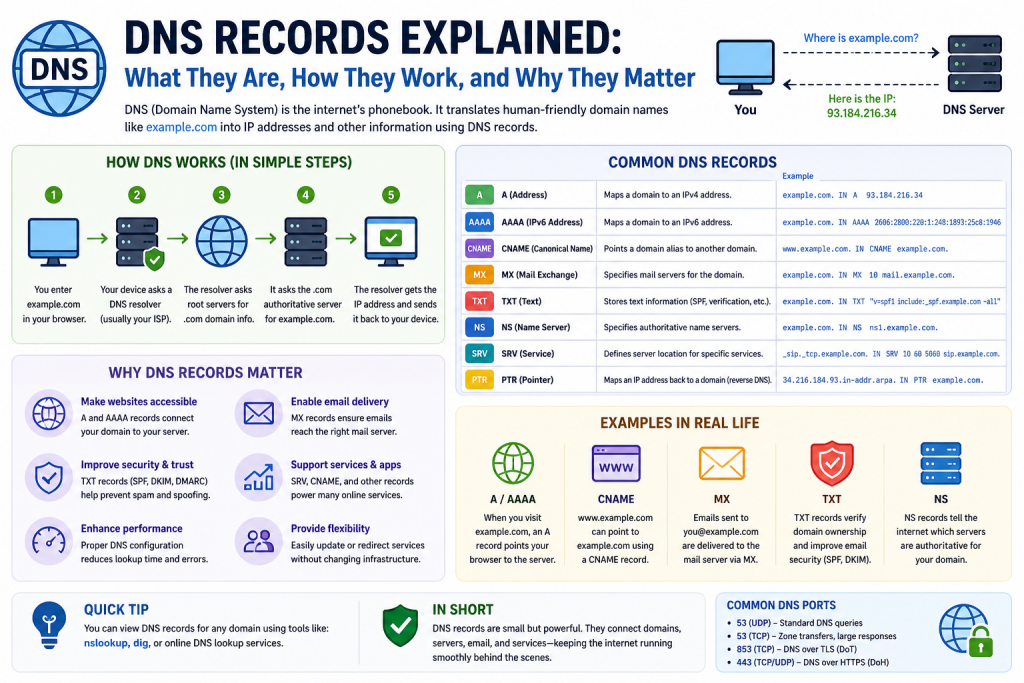
The modern internet is built on layers of complex systems that work together seamlessly to provide users with fast and reliable access to information. One of the most essential systems behind this functionality is the Domain Name System, commonly referred to as DNS. Without DNS, navigating the internet would be far more difficult, as users would need to remember numerical IP addresses instead of simple and recognizable domain names.
DNS acts as a translation mechanism. When a user types a domain name into a browser, DNS converts that name into an IP address that computers can understand. This process happens almost instantly, making it appear effortless to the user. However, behind the scenes, multiple servers and processes are involved in resolving that request.
Understanding DNS is crucial for anyone working in networking, system administration, or web development. It forms the backbone of how devices communicate across the internet. At the heart of DNS are DNS records, which contain the instructions that tell servers how to respond to queries.
What Are DNS Records
DNS records are structured pieces of information stored in DNS servers. These records define how a domain name behaves and how it connects to various services such as websites, email servers, and other network resources. Each record type serves a specific purpose, and together they enable the smooth operation of internet services.
Think of DNS records as entries in a directory. Each entry provides specific instructions about where to send traffic or how to handle requests related to a domain. When a DNS query is made, the system looks up the appropriate record and returns the information needed to complete the request.
Without DNS records, domain names would not be functional. They are essential for mapping names to IP addresses, directing email traffic, and supporting security mechanisms. Every domain relies on a collection of these records to operate correctly.
How DNS Resolution Works
When a user enters a domain name into a browser, a process called DNS resolution begins. This process involves several steps and multiple servers working together to find the correct IP address.
The first step usually involves checking a local cache. The operating system or browser may already have the IP address stored from a previous request. If the information is available locally, the process ends quickly.
If the cache does not contain the required information, the request is sent to a DNS resolver. The resolver is responsible for finding the correct answer by querying other DNS servers. It starts by contacting a root server, which directs it to the appropriate top-level domain server.
The top-level domain server then points the resolver to the authoritative name server for the specific domain. The authoritative server contains the actual DNS records and provides the final answer. Once the IP address is obtained, it is returned to the user’s device, allowing the browser to connect to the correct server.
This entire process typically takes only milliseconds, but it involves multiple layers of communication and coordination.
Structure of a DNS Record
Each DNS record follows a standardized format that includes several key components. Understanding these components is important for interpreting DNS data and troubleshooting issues.
The name field specifies the domain or subdomain associated with the record. This identifies the resource being queried. The time-to-live value, or TTL, indicates how long the record can be cached by other systems. A shorter TTL allows changes to propagate quickly, while a longer TTL reduces the frequency of queries.
The class field is usually set to indicate internet usage. Although other classes exist, they are rarely encountered in typical scenarios. The type field identifies the kind of record, such as an address record or a mail exchange record.
The data field contains the actual information associated with the record. This could be an IP address, a domain name, or other relevant data depending on the record type. Together, these fields provide all the information needed to resolve a DNS query.
Importance of Time to Live in DNS
The TTL value plays a significant role in DNS performance and reliability. It determines how long a DNS record can be stored in cache before it must be refreshed. This helps reduce the number of queries sent to DNS servers, improving efficiency.
However, TTL also affects how quickly changes take effect. If a record has a long TTL, updates may take longer to propagate across the internet. This can be problematic when making changes to server configurations or migrating services.
On the other hand, a short TTL allows updates to spread بسرعة but increases the number of queries, which can add load to DNS servers. Administrators must carefully choose TTL values based on their specific needs and use cases.
Tools for Querying DNS Records
To understand and troubleshoot DNS records, administrators often use command-line tools designed for querying DNS servers. These tools allow users to request specific types of records and view detailed responses.
The output typically includes all the fields of a DNS record, making it easier to analyze the data. By examining this information, administrators can identify issues such as incorrect mappings, missing records, or configuration errors.
These tools are especially useful when diagnosing connectivity problems or verifying that changes have been applied correctly. Learning how to use them effectively is an important skill for anyone working with DNS.
DNS A Records Explained
One of the most fundamental types of DNS records is the A record. This record maps a domain name to an IPv4 address. It is the primary method used to connect domain names to web servers.
When a user accesses a website, the DNS system uses the A record to find the corresponding IP address. This allows the browser to establish a connection with the server hosting the website.
Domains can have multiple A records, which is often used for load balancing. By distributing traffic across multiple servers, organizations can improve performance and ensure high availability.
DNS AAAA Records and IPv6
As the number of internet-connected devices continues to grow, the need for more IP addresses has become evident. IPv6 was introduced to address this limitation by providing a much larger address space.
AAAA records serve the same purpose as A records but are used for IPv6 addresses. These records store longer and more complex addresses, allowing devices to connect using the newer protocol.
While IPv4 is still widely used, IPv6 adoption is increasing. Understanding AAAA records is important for modern networking, as more services begin to support and rely on IPv6.
DNS CNAME Records and Domain Aliasing
CNAME records, or canonical name records, are used to create aliases for domain names. Instead of pointing directly to an IP address, a CNAME record points to another domain name.
This is useful for managing multiple services under a single domain. For example, different subdomains can be directed to various platforms or hosting providers without needing separate IP addresses.
However, CNAME records must follow certain rules. They cannot point to IP addresses and should not be used alongside other record types for the same name. These restrictions ensure consistent and reliable DNS resolution.
DNS MX Records and Email Routing
MX records are responsible for directing email traffic for a domain. They specify which mail servers should receive incoming messages and include priority values to determine the order of use.
When an email is sent, the sending server checks the MX records of the recipient’s domain. It then attempts to deliver the message to the server with the highest priority, which is indicated by the lowest numerical value.
If the primary server is unavailable, the system automatically tries the next server in the list. This provides redundancy and ensures that email delivery continues even during outages.
DNS NS Records and Authoritative Servers
NS records define which servers are authoritative for a domain. These servers contain the actual DNS records and provide responses to queries.
When a resolver needs information about a domain, it relies on NS records to find the correct authoritative server. Without these records, the DNS system would not know where to look for the necessary information.
NS records are critical for the proper functioning of DNS. They ensure that queries are directed to the right location and that accurate information is returned.
DNS PTR Records and Reverse Lookups
PTR records are used for reverse DNS lookups. Instead of mapping a domain name to an IP address, they map an IP address back to a domain name.
This is useful for verifying server identities and troubleshooting network issues. Reverse lookups are commonly used in security checks, logging, and email validation processes.
Although they are less commonly used than other record types, PTR records play an important role in certain scenarios.
DNS TXT Records and Flexible Data Storage
TXT records allow administrators to store text-based information in DNS. These records are highly flexible and can be used for a variety of purposes.
One common use is domain verification. Many services require users to prove ownership of a domain by adding a specific TXT record. Once the record is detected, the service confirms that the user has control over the domain.
TXT records are also used for email security, such as implementing policies that help prevent spam and phishing attacks. Their versatility makes them an important part of modern DNS configurations.
Why Understanding DNS Records Matters
Understanding DNS records is essential for managing and maintaining internet services. These records control how traffic is routed, how email is delivered, and how security measures are implemented.
Even small errors in DNS configuration can lead to significant issues, such as website downtime or failed email delivery. By learning how DNS records work, administrators can quickly identify and resolve problems.
In addition, knowledge of DNS is valuable for certifications and career development in IT. It is a foundational concept that applies to many areas of networking and system administration.
Diving Deeper into DNS Record Functionality
After building a solid foundation of what DNS records are and how they operate at a basic level, it becomes important to explore how these records behave in more complex and real-world environments. DNS is not just a simple mapping system; it is a distributed and highly optimized infrastructure that supports billions of queries every day.
DNS records are designed to be flexible, allowing administrators to configure domains for a wide range of purposes. This includes hosting websites, managing email systems, integrating with cloud services, and enforcing security policies. Each DNS record contributes to a larger ecosystem where accuracy, speed, and reliability are essential.
In practice, DNS records rarely exist in isolation. A single domain typically has multiple records working together to ensure that all services function properly. Understanding how these records interact is key to mastering DNS.
How Multiple DNS Records Work Together
When a domain is configured, it often includes a combination of record types that serve different roles. For example, a typical domain might use address records to point to a web server, mail exchange records for email routing, and text records for verification and security.
These records must be carefully coordinated. If one record is misconfigured, it can affect the entire system. For instance, incorrect mail records can result in undelivered emails, while improper address records can make a website inaccessible.
Another important aspect is consistency. DNS records should align with the actual infrastructure they represent. If a server’s IP address changes, the corresponding DNS records must be updated to reflect the new configuration.
The Role of Caching in DNS Performance
Caching is one of the most important mechanisms in DNS. It allows systems to store DNS query results temporarily, reducing the need to repeatedly contact authoritative servers. This improves performance and reduces network traffic.
When a DNS resolver receives a response, it stores the information in its cache for the duration specified by the TTL value. During this time, any subsequent requests for the same domain can be answered directly from the cache.
While caching improves efficiency, it also introduces challenges. Changes to DNS records may not take effect immediately because cached data may still be in use. This delay is often referred to as propagation time.
Administrators must take caching into account when making updates. Reducing the TTL value before making changes can help ensure that updates propagate more quickly.
Understanding DNS Propagation
DNS propagation refers to the time it takes for changes to DNS records to spread across the internet. Because of caching, different systems may have different versions of the same record at any given time.
Propagation is not an instantaneous process. It depends on several factors, including TTL values, resolver behavior, and network conditions. In some cases, changes may be visible within minutes, while in others, they may take several hours.
This delay can be particularly important during migrations or updates. For example, when moving a website to a new server, administrators must ensure that DNS changes are carefully planned to minimize downtime.
Monitoring tools and testing methods can help verify whether changes have propagated successfully. Checking from different locations or using multiple resolvers can provide a clearer picture of the update status.
Load Balancing with DNS Records
DNS records can be used to distribute traffic across multiple servers, a technique known as load balancing. This is often achieved by configuring multiple address records for a single domain.
When a resolver queries the domain, it may receive multiple IP addresses in response. The order of these addresses can vary, allowing traffic to be distributed among different servers. This improves performance and helps prevent any single server from becoming overloaded.
Load balancing also enhances reliability. If one server becomes unavailable, others can continue to handle requests. This redundancy is critical for maintaining uptime and ensuring a consistent user experience.
Advanced configurations may involve geographic load balancing, where users are directed to servers based on their location. This reduces latency and improves response times.
Failover and Redundancy in DNS
Failover mechanisms are essential for maintaining service availability. DNS records can be configured to provide backup options in case of server failures.
For example, mail exchange records include priority values that determine the order in which servers are used. If the primary server is unreachable, secondary servers can take over.
Similarly, multiple address records can provide redundancy for web services. If one server fails, traffic can be redirected to others without requiring immediate manual intervention.
These strategies help ensure that services remain accessible even during unexpected outages. Properly configured DNS failover can significantly reduce downtime and improve overall reliability.
DNS and Content Delivery Networks
Content delivery networks, or CDNs, rely heavily on DNS to function effectively. When a domain is connected to a CDN, DNS records are used to direct users to the nearest or most appropriate server.
This often involves the use of aliasing techniques, where a domain points to another domain managed by the CDN provider. The CDN then handles the process of routing traffic to the optimal location.
By distributing content across multiple servers worldwide, CDNs improve performance and reduce latency. DNS plays a critical role in enabling this distribution.
Understanding how DNS interacts with CDNs is important for optimizing website performance and ensuring fast load times for users in different regions.
Security Considerations in DNS Records
DNS is a critical component of internet infrastructure, making it a target for various security threats. Proper configuration of DNS records can help mitigate these risks.
One important security measure involves specifying which certificate authorities are allowed to issue certificates for a domain. This helps prevent unauthorized certificate issuance and reduces the risk of man-in-the-middle attacks.
Text records are also used to implement email authentication protocols. These protocols help verify that emails are sent from legitimate sources and reduce the likelihood of spam and phishing attacks.
In addition, administrators should ensure that DNS servers are properly secured and monitored. Unauthorized changes to DNS records can have serious consequences, including redirecting users to malicious sites.
Common DNS Misconfigurations and Their Impact
Misconfigurations in DNS records can lead to a variety of issues. These problems can range from minor inconveniences to major service disruptions.
One common issue is incorrect IP address mapping. If an address record points to the wrong IP, users may be unable to access the intended service. Similarly, missing records can result in failed queries.
Another issue involves conflicting records. For example, using incompatible record types for the same domain can cause resolution errors. Following best practices and adhering to DNS standards can help prevent these problems.
Regular audits and testing are essential for maintaining accurate DNS configurations. By reviewing records periodically, administrators can identify and correct issues before they affect users.
Using Command-Line Tools for Advanced DNS Troubleshooting
Command-line tools are invaluable for diagnosing DNS issues. They allow administrators to query specific record types and analyze responses in detail.
By examining the output, it is possible to identify discrepancies between expected and actual configurations. This can help pinpoint the source of problems and guide troubleshooting efforts.
Advanced usage of these tools includes querying specific name servers, tracing the resolution path, and testing different record types. These techniques provide deeper insight into how DNS operates.
Learning to interpret DNS query results is a key skill for anyone working with network infrastructure. It enables faster problem resolution and more effective system management.
Reverse DNS in Practical Scenarios
Reverse DNS lookups are often used in security and logging applications. They provide a way to identify the domain associated with an IP address.
This can be useful for verifying the identity of servers, analyzing network traffic, and detecting suspicious activity. For example, email servers often use reverse DNS to validate incoming messages.
While reverse DNS is not always required, it can enhance trust and credibility in certain scenarios. Proper configuration of pointer records ensures that reverse lookups return accurate information.
Managing DNS in Cloud Environments
As more organizations move to cloud-based infrastructure, DNS management has evolved to accommodate dynamic environments. Cloud providers often offer integrated DNS services that simplify configuration and management.
These services allow administrators to create and update DNS records through user-friendly interfaces or automated scripts. This flexibility is particularly useful for scaling applications and managing distributed systems.
However, cloud environments also introduce new challenges. Dynamic IP addresses and frequent changes require careful coordination to ensure that DNS records remain accurate.
Automation and monitoring tools can help manage these complexities. By integrating DNS management into deployment workflows, organizations can maintain consistency and reduce the risk of errors.
Best Practices for DNS Record Management
Effective DNS management requires a combination of planning, monitoring, and adherence to best practices. One key principle is to keep records organized and well-documented.
Using clear naming conventions and maintaining accurate records helps prevent confusion and errors. Documentation should include details about each record’s purpose and configuration.
Another best practice is to use appropriate TTL values. Balancing performance and flexibility is essential for efficient DNS operation. Short TTLs are useful during changes, while longer TTLs are suitable for stable configurations.
Regular backups and audits are also important. These measures ensure that configurations can be restored in case of issues and that records remain up to date.
The Evolving Role of DNS in Modern Networking
DNS continues to evolve as the internet grows and new technologies emerge. It is no longer just a simple name resolution system; it plays a critical role in performance optimization, security, and service delivery.
Innovations such as encrypted DNS protocols are improving privacy and protecting users from certain types of attacks. At the same time, increased reliance on cloud services and distributed systems is expanding the role of DNS.
Understanding these trends is important for staying current in the field of networking. As DNS becomes more integrated with other technologies, its importance will continue to grow.
Expanding DNS Knowledge into Real-World Practice
Understanding DNS records at a conceptual level is important, but applying that knowledge in real-world scenarios is where true expertise develops. DNS is not just a theoretical system; it is actively used in hosting websites, managing enterprise infrastructure, and supporting global applications.
In practical environments, DNS records must be carefully configured to ensure reliability, performance, and security. Every change to a DNS record can affect how users access services, making it essential to approach DNS management with precision and awareness.
Organizations often rely on DNS as a foundational component of their digital presence. Whether it is a small website or a large-scale cloud application, DNS records determine how users connect to services and how those services respond.
DNS in Website Deployment and Hosting
When deploying a website, DNS records play a central role in making the site accessible to users. The process begins by associating a domain name with a hosting server through address records. This allows browsers to locate the server and retrieve website content.
In many cases, websites use multiple DNS records to support different components. For example, a main domain might point to a web server, while subdomains handle specific services such as blogs, APIs, or dashboards.
Modern hosting environments often involve cloud platforms, where servers can scale dynamically. DNS records must be updated or configured to accommodate these changes. This may include using aliasing techniques or integrating with managed DNS services provided by hosting providers.
Proper DNS configuration ensures that users can access the website without interruptions. It also supports features such as load balancing and failover, which enhance performance and reliability.
Managing Subdomains and Service Separation
Subdomains are commonly used to organize different parts of a service under a single domain. DNS records make it possible to direct each subdomain to a specific resource or server.
For example, a business might use one subdomain for its main website, another for its email system, and another for internal tools. Each of these subdomains would have its own set of DNS records, tailored to its specific purpose.
This separation allows for better management and scalability. It also makes it easier to apply different configurations and security measures to each service.
However, managing multiple subdomains requires careful planning. Misconfigured records can lead to service disruptions or unintended behavior. Keeping a clear structure and documentation is essential for maintaining consistency.
DNS and Email Infrastructure in Depth
Email systems rely heavily on DNS records for proper operation. Mail exchange records define which servers handle incoming messages, but additional records are often used to enhance security and reliability.
Text-based records are commonly used to implement email authentication mechanisms. These mechanisms help verify that messages are sent from authorized servers and reduce the risk of spoofing and phishing.
In large organizations, email infrastructure may involve multiple servers with different roles. DNS records must be configured to ensure that messages are routed correctly and that backup servers are available in case of failure.
Maintaining accurate DNS records is critical for email delivery. Even small errors can result in messages being rejected or marked as spam.
Integrating DNS with Cloud and Hybrid Systems
As businesses adopt cloud technologies, DNS has become an integral part of managing distributed systems. Cloud platforms often provide tools for creating and managing DNS records, making it easier to connect services across different environments.
In hybrid setups, where on-premises infrastructure is combined with cloud resources, DNS plays a key role in linking these components. Records must be configured to direct traffic appropriately, whether it is going to a local server or a cloud-based application.
Automation is often used to manage DNS in these environments. Scripts and deployment tools can update records dynamically, ensuring that they remain accurate as systems scale or change.
Despite these advancements, careful monitoring is still required. Automated systems can introduce errors if not properly configured, making it important to verify changes and maintain oversight.
DNS Monitoring and Performance Optimization
Monitoring DNS performance is essential for maintaining a reliable user experience. Slow or failed DNS queries can lead to delays in accessing services, which can impact user satisfaction and business operations.
Various tools and services are available to monitor DNS health. These tools can track response times, detect outages, and identify potential issues before they affect users.
Performance optimization often involves adjusting TTL values, distributing DNS servers geographically, and using caching effectively. By optimizing these factors, organizations can reduce latency and improve response times.
Regular testing is also important. Simulating DNS queries from different locations can help identify bottlenecks and ensure that the system performs well under various conditions.
DNS Security Threats and Protection Strategies
DNS is a critical part of internet infrastructure, making it a target for attackers. Understanding common threats and implementing protective measures is essential for maintaining security.
One common threat involves redirecting users to malicious sites by altering DNS records. This can occur through unauthorized access to DNS management systems or by exploiting vulnerabilities in the infrastructure.
Another threat is DNS spoofing, where attackers provide false responses to DNS queries. This can lead users to fraudulent websites without their knowledge.
To mitigate these risks, administrators should implement strong access controls, use secure communication protocols, and regularly audit DNS configurations. Monitoring for unusual activity can also help detect potential attacks early.
Security-focused DNS records and configurations add an additional layer of protection, helping to ensure that only authorized entities can interact with a domain.
Troubleshooting Complex DNS Issues
Troubleshooting DNS issues can be challenging due to the distributed nature of the system. Problems may originate from various sources, including local caches, resolvers, or authoritative servers.
A systematic approach is essential for identifying the root cause. This often involves checking DNS records, verifying configurations, and using diagnostic tools to trace the resolution process.
One common issue is propagation delay, where changes have not yet reached all parts of the network. Understanding how caching works can help determine whether this is the cause.
Another issue may involve conflicting records or incorrect configurations. Reviewing DNS settings and comparing them with expected values can help identify discrepancies.
Effective troubleshooting requires both technical knowledge and practical experience. Over time, patterns emerge that make it easier to diagnose and resolve issues quickly.
DNS Automation and Infrastructure as Code
Automation is becoming increasingly important in DNS management. Infrastructure as code practices allow administrators to define DNS configurations using scripts or configuration files.
This approach provides several benefits. It ensures consistency across environments, reduces the risk of manual errors, and makes it easier to replicate configurations.
Automated systems can also respond to changes in real time. For example, when a new server is deployed, DNS records can be updated automatically to include it in the system.
However, automation must be implemented carefully. Proper testing and validation are essential to prevent unintended consequences. Version control and rollback mechanisms can help manage changes safely.
Future Trends in DNS Technology
DNS continues to evolve as new technologies and challenges emerge. One area of development is improved privacy through encrypted DNS queries. These technologies help protect user data from interception and monitoring.
Another trend is the integration of DNS with advanced security systems. DNS is increasingly used as a first line of defense against threats, filtering malicious domains and preventing access to harmful content.
The growth of the internet of things and global connectivity is also influencing DNS. As more devices come online, the demand for efficient and scalable DNS solutions continues to increase.
Staying informed about these trends is important for anyone working in networking or IT. As DNS evolves, new tools and practices will emerge to address changing needs.
Building Expertise in DNS Management
Becoming proficient in DNS requires a combination of theoretical understanding and hands-on experience. Working with real systems, experimenting with configurations, and troubleshooting issues are all valuable learning opportunities.
In addition to these core practices, consistency and curiosity play a major role in building long-term expertise. Regularly interacting with DNS tools, reviewing configurations, and observing how changes affect real environments can deepen your understanding far beyond what theory alone can provide.
One effective way to strengthen DNS skills is by setting up a small lab environment. This could be as simple as configuring a local DNS server or using virtual machines to simulate a network. By creating and modifying DNS records in a controlled setting, you can safely explore different scenarios such as domain resolution, caching behavior, and record conflicts. This kind of experimentation allows you to see how DNS behaves under various conditions without risking production systems.
Another important aspect of learning DNS is analyzing real-world issues. When something goes wrong, such as a website not loading or email delivery failing, DNS is often a contributing factor. Investigating these problems step by step helps you understand how DNS interacts with other systems. Over time, this builds confidence and sharpens your troubleshooting skills.
Documentation also plays a key role in mastering DNS. Keeping notes on configurations, common errors, and solutions helps reinforce your knowledge and provides a useful reference for future work. Additionally, staying updated with new developments in networking ensures that your skills remain relevant.
Ultimately, becoming skilled in DNS is a gradual process. By combining study, practice, and real-world problem solving, you develop the ability to manage DNS systems effectively and handle challenges with greater confidence.
Documentation and continuous learning are key components of expertise. Keeping up with best practices and industry developments ensures that skills remain relevant.
Collaboration is also important. Sharing knowledge with others and learning from experienced professionals can accelerate growth and provide new perspectives.
As DNS is a fundamental part of networking, mastering it opens the door to many opportunities in IT and related fields.
Conclusion
DNS records are a critical component of the internet’s infrastructure, enabling seamless communication between users and services. Throughout this discussion, we have explored how DNS records function, how they interact, and how they are applied in real-world scenarios.
From basic concepts to advanced configurations, DNS records play a vital role in website hosting, email delivery, cloud integration, and security. Their flexibility allows organizations to build scalable and reliable systems, but it also requires careful management to avoid issues.
Understanding DNS is not just about memorizing record types; it is about grasping how the entire system operates and how different components work together. This knowledge empowers you to design, maintain, and troubleshoot networks effectively.
As technology continues to evolve, DNS will remain a foundational element of the internet. By developing a strong understanding of DNS records and their applications, you position yourself to navigate the complexities of modern networking with confidence and skill.
Continue exploring the technologies and certification concepts that matter most to you.