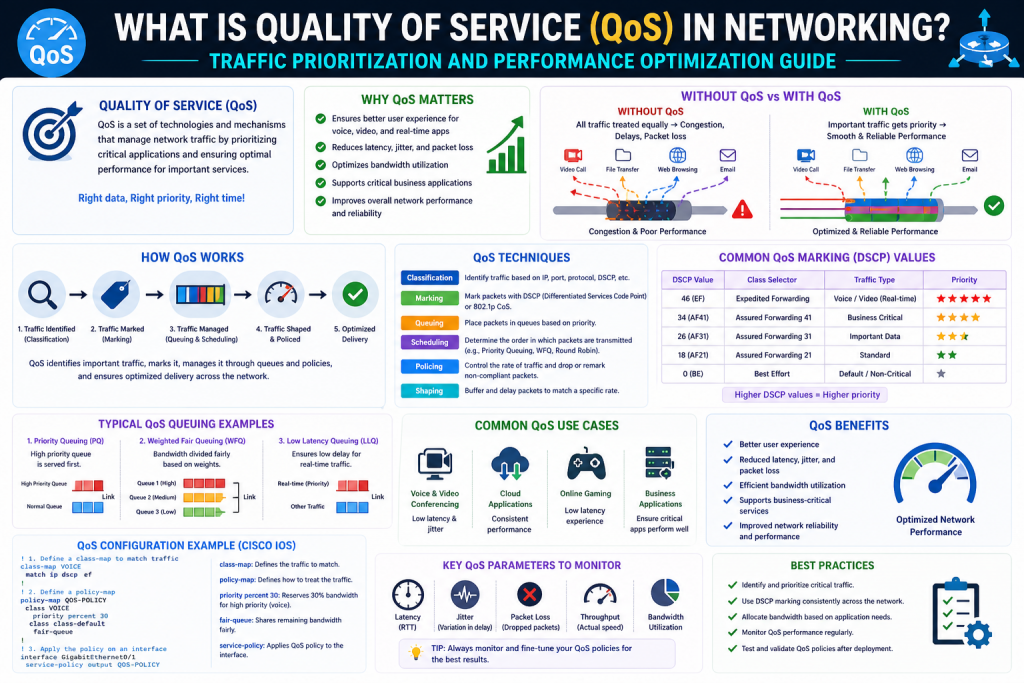
Quality of Service, commonly referred to as QoS, is a critical concept in networking that focuses on managing and prioritizing network traffic to ensure reliable and predictable performance. As digital communication has expanded, networks are now responsible for handling a wide variety of applications, each with unique performance requirements. These applications range from simple email and file transfers to real-time voice and video communication, all competing for the same network resources.
In earlier networking environments, different types of communication were often separated. Voice communication used dedicated telephone networks, while data traveled over separate data networks. This separation ensured that each type of traffic received the resources it needed without interference. However, modern networks have converged into unified systems where all types of traffic share the same infrastructure. This convergence has made network management significantly more complex.
QoS plays a key role in addressing this complexity. It ensures that critical applications receive the necessary bandwidth, low latency, and minimal packet loss required for optimal performance. Without QoS, networks operate on a best-effort basis, meaning all traffic is treated equally regardless of importance. This can lead to performance issues, especially during periods of high network congestion.
Evolution of Network Demands
The demands placed on modern networks have grown rapidly over the years. Organizations now rely on a wide range of digital services that must operate efficiently and without interruption. These include cloud computing, video conferencing, streaming services, and real-time collaboration tools. Each of these services has different requirements in terms of bandwidth, latency, and reliability.
One of the most significant changes in networking has been the rise of real-time applications. Unlike traditional data transfers, real-time applications require immediate delivery of data packets. Even small delays can disrupt the user experience. For example, a delay in a voice call can result in awkward pauses, while jitter in a video stream can cause visual distortion.
In addition to real-time applications, the growth of connected devices has further increased network traffic. The expansion of Internet of Things devices means that networks must handle continuous streams of data from sensors, cameras, and other connected equipment. This added load increases the likelihood of congestion and makes effective traffic management essential.
QoS helps address these challenges by allowing network administrators to control how traffic is handled. By prioritizing important data and managing less critical traffic, QoS ensures that networks can meet the demands of modern applications.
The Importance of Traffic Prioritization
Not all network traffic is equally important. Some applications are critical to business operations and require consistent performance, while others are less time-sensitive and can tolerate delays. Traffic prioritization is the process of identifying which data should be given preference when network resources are limited.
For example, consider a scenario where a company is conducting a video conference while employees are also downloading large files. Without QoS, both types of traffic compete equally for bandwidth. This can result in poor video quality, interruptions, and delays. With QoS, the network can prioritize the video conference traffic, ensuring a smooth experience while allowing file downloads to use remaining bandwidth.
Traffic prioritization is achieved through classification and marking. Each type of traffic is identified and assigned a priority level based on its importance. High-priority traffic is then given preferential treatment during transmission, ensuring that it experiences minimal delay and packet loss.
This approach allows networks to maintain performance even under heavy load conditions. It also ensures that critical applications continue to function effectively, which is essential for maintaining productivity and user satisfaction.
Understanding Packet-Based Communication
Modern networks transmit data in the form of packets. Each packet contains a portion of the overall data along with header information that includes the source and destination addresses. These packets travel independently across the network and are reassembled at the destination.
For communication to be successful, packets must arrive in the correct order and within an acceptable time frame. If packets are delayed, lost, or arrive out of sequence, the quality of the communication can be affected. This is particularly important for real-time applications, which rely on continuous data streams.
QoS helps manage packet-based communication by controlling how packets are handled at each stage of transmission. It ensures that high-priority packets are processed quickly and that network resources are allocated efficiently. This reduces the likelihood of delays, jitter, and packet loss.
By managing packet flow, QoS improves the overall reliability and performance of the network. It also helps ensure that applications receive the level of service they require to function properly.
Key Performance Metrics in QoS
To effectively implement QoS, it is important to understand the key performance metrics that define network quality. These metrics provide insight into how well the network is performing and help administrators identify potential issues.
Bandwidth is one of the most fundamental metrics. It represents the maximum data transfer capacity of a network link. While bandwidth defines the potential speed of the network, it does not guarantee actual performance.
Throughput measures the actual rate at which data is successfully transmitted. It is influenced by factors such as network congestion, errors, and protocol overhead. Throughput is often lower than the maximum bandwidth due to these factors.
Latency refers to the time it takes for a packet to travel from its source to its destination. Low latency is essential for real-time applications, as delays can disrupt communication and reduce quality.
Jitter measures the variation in packet arrival times. Consistent packet timing is important for applications like voice and video, where irregular delivery can cause distortion and interruptions.
Packet loss occurs when packets fail to reach their destination. This can result from congestion, hardware failures, or network errors. High levels of packet loss can severely impact application performance, particularly for real-time services.
Understanding these metrics is essential for designing and implementing effective QoS policies. By monitoring these parameters, administrators can ensure that the network meets the performance requirements of different applications.
Types of Network Applications and Their Requirements
Different types of applications have varying requirements when it comes to network performance. Understanding these requirements is essential for effective QoS implementation.
Real-time applications, such as voice calls and video conferencing, require low latency and minimal packet loss. These applications are highly sensitive to network conditions and cannot tolerate delays or interruptions.
Transactional applications, such as online banking and database systems, require reliable data delivery. While they may tolerate some delay, they cannot function properly if data is lost or corrupted.
Bulk data transfer applications, such as file downloads and backups, are less sensitive to delays. These applications can adapt to changing network conditions and do not require constant bandwidth.
Streaming applications fall somewhere in between. They require consistent data delivery to maintain quality but can buffer data to compensate for minor delays.
QoS allows administrators to tailor network behavior to meet the specific needs of each application type. By doing so, it ensures that all applications receive the appropriate level of service.
Challenges in Network Resource Management
Managing network resources is one of the biggest challenges in modern networking. As the number of connected devices and applications continues to grow, networks must handle increasing amounts of traffic without compromising performance.
One of the main challenges is limited bandwidth. Most organizations do not have unlimited network capacity, so they must allocate resources carefully. Without proper management, network congestion can occur, leading to delays and reduced performance.
Another challenge is unpredictable traffic patterns. Network usage can vary significantly throughout the day, making it difficult to maintain consistent performance. QoS helps address this issue by dynamically adjusting how traffic is handled based on current conditions.
Security is also a concern. Malicious traffic, such as distributed denial-of-service attacks, can overwhelm network resources and disrupt normal operations. QoS can help mitigate these threats by limiting the impact of unwanted traffic.
By addressing these challenges, QoS plays a crucial role in maintaining network stability and performance.
The Role of QoS in User Experience
User experience is directly affected by network performance. Slow or unreliable networks can lead to frustration, reduced productivity, and even financial losses for organizations.
QoS helps improve user experience by ensuring that critical applications perform consistently. For example, employees participating in a video conference expect clear audio and video without interruptions. QoS ensures that these expectations are met by prioritizing the necessary traffic.
In customer-facing environments, QoS is equally important. Online services must provide fast and reliable access to maintain customer satisfaction. Delays or disruptions can lead to negative experiences and loss of business.
By managing network traffic effectively, QoS helps create a smooth and reliable user experience across all applications.
The Future of QoS in Networking
As technology continues to evolve, the importance of QoS will only increase. Emerging technologies such as 5G, edge computing, and artificial intelligence are expected to place even greater demands on network performance.
These technologies will require advanced QoS mechanisms to ensure that data is delivered quickly and reliably. For example, autonomous vehicles rely on real-time data to operate safely, making low latency and high reliability essential.
Similarly, smart cities and industrial automation systems depend on continuous data streams from connected devices. QoS will play a key role in managing this data and ensuring that critical systems function properly.
As networks become more complex, QoS will continue to evolve to meet new challenges. Understanding its principles and applications is essential for anyone involved in networking.
Core Components of Quality of Service and How They Function
After understanding the foundational concepts of Quality of Service, the next step is to explore how QoS is actually implemented within a network. QoS is not a single feature but a collection of mechanisms and strategies that work together to control traffic flow, prioritize critical data, and maintain consistent network performance.
At its core, QoS operates by analyzing network traffic, categorizing it based on importance, and applying specific handling rules. These rules determine how packets are queued, how bandwidth is distributed, and how congestion is managed. The ultimate goal is to ensure that essential applications receive the level of service they require, even when network resources are limited.
The primary components of QoS include classification, queuing, and bandwidth management. Each of these plays a distinct role in shaping how traffic moves through the network.
Traffic Classification and Marking
Traffic classification is the first step in implementing QoS. It involves identifying and categorizing network traffic based on predefined criteria. This process allows the network to distinguish between different types of data and apply appropriate policies to each category.
Classification can be based on several factors, including:
- Source and destination IP addresses
- Port numbers associated with specific applications
- Protocol types
- Application-level information
- User or device identity
Once traffic is classified, it is often marked to indicate its priority level. Marking involves adding information to the packet header so that network devices can recognize its importance as it travels through the network.
One common method of marking is using Differentiated Services Code Point values. These values are embedded within the packet header and help routers and switches determine how to handle each packet. By marking traffic at the network edge, administrators ensure that all devices along the path can apply consistent QoS policies.
Classification and marking are essential because they provide the foundation for all other QoS mechanisms. Without proper classification, the network cannot effectively prioritize traffic.
Queuing Mechanisms and Packet Scheduling
Once traffic is classified and marked, the next step is to manage how packets are transmitted. This is where queuing mechanisms come into play. Queuing determines the order in which packets are processed and sent across the network.
When network congestion occurs, packets cannot all be transmitted immediately. Instead, they are placed in queues until resources become available. QoS uses different queuing strategies to ensure that high-priority traffic is transmitted first.
There are several types of queuing mechanisms used in QoS:
First-in, first-out queuing is the simplest method. Packets are processed in the order they arrive, without any prioritization. While easy to implement, this approach does not provide any QoS benefits.
Priority queuing introduces multiple queues with different priority levels. High-priority traffic is always transmitted before lower-priority traffic. This ensures that critical applications experience minimal delay, but it can lead to starvation of lower-priority traffic if not managed carefully.
Weighted fair queuing distributes bandwidth more evenly by assigning weights to different traffic classes. Each class receives a fair share of network resources based on its assigned weight. This approach balances performance and fairness.
Class-based queuing combines classification with queuing. Traffic is grouped into classes, and each class is assigned specific bandwidth and priority settings. This allows for more granular control over traffic handling.
Packet scheduling works alongside queuing to determine when packets are transmitted. Scheduling algorithms ensure that bandwidth is allocated according to defined policies and that high-priority traffic is delivered promptly.
These mechanisms help maintain consistent performance by controlling how packets are processed during periods of congestion.
Bandwidth Management Techniques
Bandwidth management is another critical component of QoS. It focuses on controlling how network capacity is allocated among different types of traffic. By managing bandwidth effectively, administrators can prevent congestion and ensure that critical applications receive the resources they need.
One common technique is traffic shaping. Traffic shaping regulates the flow of data by controlling the rate at which packets are sent. This helps smooth out bursts of traffic and prevents network overload.
Another technique is traffic policing. Unlike shaping, which delays packets to maintain a steady rate, policing enforces strict limits on traffic. Packets that exceed the defined rate may be dropped or marked for lower priority.
Bandwidth allocation policies define how much capacity is reserved for each type of traffic. For example, a network might allocate a specific percentage of bandwidth to voice traffic, ensuring that it always has sufficient resources.
Rate limiting is also used to control the amount of traffic generated by specific applications or users. This prevents any single source from consuming excessive bandwidth and affecting overall performance.
By implementing these techniques, QoS ensures that network resources are used efficiently and that critical applications are not affected by congestion.
Congestion Management and Avoidance
Congestion occurs when network demand exceeds available capacity. This can lead to delays, packet loss, and reduced performance. QoS includes mechanisms for both managing and avoiding congestion.
Congestion management focuses on handling traffic when congestion occurs. Queuing mechanisms play a key role in this process by determining which packets are transmitted first and which are delayed.
Congestion avoidance aims to prevent congestion before it becomes a problem. One common approach is random early detection, which monitors network conditions and drops packets before queues become full. This signals sending devices to reduce their transmission rate, helping to stabilize the network.
Another approach is explicit congestion notification, which marks packets instead of dropping them. This allows receiving devices to detect congestion and adjust their behavior accordingly.
By combining these strategies, QoS helps maintain stable network performance even under heavy load conditions.
Service Level Agreements and Business Alignment
QoS is not just a technical implementation; it is closely tied to business requirements. Service Level Agreements define the expected performance levels for different applications and services. These agreements guide the design and implementation of QoS policies.
For example, a business may require that voice communication maintain a specific level of latency and packet loss. QoS policies are then configured to meet these requirements by prioritizing voice traffic and allocating sufficient resources.
Different departments within an organization may have varying needs. Sales teams may rely heavily on real-time communication, while administrative functions may prioritize data access. QoS ensures that each department receives the appropriate level of service.
Aligning QoS with business goals is essential for maximizing the value of network resources. It ensures that critical operations are supported and that performance meets organizational expectations.
Packet Handling from Start to Finish
To understand how QoS works in practice, it is helpful to look at the lifecycle of a packet as it travels through the network.
When a packet enters the network, it is first classified based on predefined criteria. It is then marked to indicate its priority level. As it moves through the network, each device examines the marking and applies the appropriate QoS policies.
If congestion occurs, the packet is placed in a queue based on its priority. High-priority packets are transmitted first, while lower-priority packets may be delayed.
Bandwidth management mechanisms ensure that sufficient resources are available for high-priority traffic. If necessary, lower-priority traffic may be limited or delayed to maintain performance.
Throughout this process, QoS ensures that the packet is delivered in a timely and reliable manner, according to its importance.
Policy Design and Implementation Considerations
Designing effective QoS policies requires careful planning and consideration. Administrators must understand the network environment, application requirements, and traffic patterns.
One important consideration is scalability. QoS policies must be able to handle growth in network traffic and the addition of new applications. This requires flexible and adaptable configurations.
Another consideration is consistency. QoS policies must be applied consistently across all network devices to ensure uniform behavior. Inconsistent configurations can lead to unpredictable performance.
Monitoring and analysis are also critical. Administrators must continuously evaluate network performance and adjust QoS policies as needed. This ensures that the network continues to meet performance requirements over time.
Security is another factor to consider. QoS mechanisms should not introduce vulnerabilities or allow malicious traffic to bypass controls. Proper classification and filtering help mitigate these risks.
Interaction Between QoS Components
The various components of QoS do not operate in isolation. They work together to create a comprehensive traffic management system.
Classification identifies the type of traffic and assigns it to a category. Marking ensures that this classification is recognized throughout the network. Queuing and scheduling determine how packets are transmitted, while bandwidth management controls resource allocation.
Congestion management and avoidance mechanisms ensure that the network remains stable under heavy load. Together, these components create a coordinated system that optimizes network performance.
Understanding how these elements interact is essential for implementing effective QoS strategies.
Practical Benefits of QoS Implementation
Implementing QoS provides several practical benefits for organizations. It improves the performance of critical applications, ensuring that they operate reliably even during peak usage.
QoS also enhances user experience by reducing delays, minimizing packet loss, and maintaining consistent performance. This is particularly important for real-time communication and customer-facing services.
Another benefit is efficient resource utilization. By prioritizing important traffic and controlling less critical data, QoS ensures that network capacity is used effectively.
QoS also supports business continuity by ensuring that essential services remain operational during periods of congestion. This reduces the risk of disruptions and improves overall reliability.
Preparing for Advanced QoS Models
Understanding the components of QoS provides a strong foundation for exploring more advanced topics. The next step is to examine different QoS models and how they are applied in various networking environments.
These models define different approaches to traffic management, ranging from simple best-effort delivery to sophisticated systems that guarantee performance levels. Each model has its own advantages and limitations, and selecting the right one depends on the specific needs of the network.
By building on the concepts covered in this section, it becomes easier to understand how QoS can be tailored to meet diverse requirements and support complex network environments.
QoS Models, Implementation Strategies, and Real-World Applications
Quality of Service is implemented through different models that define how traffic is treated across a network. These models provide varying levels of control, flexibility, and performance guarantees. Choosing the right model depends on the complexity of the network, the types of applications being supported, and the level of service assurance required.
At a high level, QoS models determine how network resources are allocated and whether guarantees can be made about performance. Some models are simple and easy to deploy but offer limited control, while others are more sophisticated and provide strict guarantees at the cost of increased complexity.
The three primary QoS models are Best Effort, Differentiated Services, and Integrated Services. Each represents a different approach to managing network traffic.
Best Effort Model
The Best Effort model is the simplest form of network traffic handling. In this approach, all packets are treated equally, with no prioritization or guarantees. The network attempts to deliver packets as quickly as possible, but there is no assurance that they will arrive on time or even reach their destination.
This model works well in environments where network demand is low or where applications are not sensitive to delays. For example, basic web browsing and file downloads can function adequately under Best Effort conditions because they can tolerate variations in performance.
However, the limitations of this model become apparent in modern networks that support real-time applications. Without prioritization, critical traffic such as voice or video can be disrupted by less important data. During congestion, packets may be delayed or dropped, leading to poor user experience.
While Best Effort requires minimal configuration and is widely used as a default approach, it does not meet the needs of networks that require consistent and reliable performance.
Differentiated Services Model
The Differentiated Services model, often referred to as DiffServ, introduces a more advanced approach to traffic management. In this model, packets are classified and marked according to their priority level. Network devices then use these markings to determine how each packet should be handled.
This approach allows networks to treat different types of traffic in a more intelligent and efficient manner. Instead of processing every packet equally, routers and switches can quickly identify high-priority traffic and ensure it receives faster forwarding and lower delay. For example, real-time applications such as voice and video communication can be assigned higher priority, while less time-sensitive traffic like file downloads or email can be handled with lower priority. This helps maintain a consistent user experience even when the network is under heavy load.
DiffServ also improves scalability because it does not require maintaining detailed information about individual traffic flows. Instead, it groups traffic into a limited number of classes, making it easier to manage in large networks. Administrators can define policies that control how each class is treated, including bandwidth allocation and queuing behavior. Although DiffServ does not guarantee absolute performance, it significantly enhances overall network efficiency and ensures that critical services are less likely to be affected by congestion.
DiffServ operates by assigning packets to different classes of service. Each class is associated with specific handling behaviors, such as priority queuing or bandwidth allocation. For example, voice traffic may be assigned to a high-priority class, while background data transfers are placed in a lower-priority class.
One of the key features of DiffServ is its scalability. Instead of maintaining detailed information about each individual data flow, the network treats packets based on their class. This reduces the processing overhead on network devices and makes it suitable for large-scale deployments.
However, DiffServ does not provide absolute guarantees of performance. It improves the likelihood that high-priority traffic will receive better service, but it cannot ensure that resources will always be available. Despite this limitation, DiffServ is widely used because it strikes a balance between performance and complexity.
Integrated Services Model
The Integrated Services model, or IntServ, takes QoS to a higher level by providing guaranteed service levels. Unlike DiffServ, which focuses on traffic classes, IntServ operates on a per-flow basis. This means that each data flow is individually managed and allocated specific resources.
IntServ uses a signaling protocol known as Resource Reservation Protocol to reserve network resources before data transmission begins. This ensures that the required bandwidth and performance levels are available for the duration of the communication session.
The main advantage of IntServ is its ability to provide strict guarantees. Applications that require consistent performance, such as real-time video streaming or critical data transfers, can benefit from this model.
However, IntServ has significant drawbacks. Maintaining information for each individual flow requires substantial processing and memory resources. This makes it difficult to scale in large networks with many concurrent connections.
As a result, IntServ is typically used in smaller or specialized environments where guaranteed performance is essential.
Comparing QoS Models
Each QoS model has its strengths and weaknesses. The Best Effort model is simple and easy to implement but offers no guarantees. DiffServ provides a scalable solution with improved traffic management but does not guarantee performance. IntServ offers the highest level of service assurance but is complex and resource-intensive.
In practical networking environments, the choice of QoS model often depends on the specific needs of the organization and the nature of the applications being supported. Best Effort is commonly used in small or low-demand networks where traffic levels are predictable and performance requirements are not critical. However, as networks grow and begin to support real-time services such as voice and video, relying solely on Best Effort becomes insufficient.
DiffServ is widely adopted in enterprise and service provider networks because it balances efficiency and control, allowing administrators to prioritize important traffic without overwhelming the network with complexity. It is particularly useful in large-scale environments where managing individual data flows would be impractical.
IntServ, while powerful, is typically reserved for specialized use cases where guaranteed performance is essential, such as mission-critical systems or dedicated network segments.
Many modern networks use a hybrid approach, combining elements of DiffServ and selective resource reservation to achieve both scalability and reliability.
In practice, many networks use a combination of these models to achieve the desired balance between performance and efficiency. For example, DiffServ may be used for general traffic management, while IntServ is applied to specific critical applications.
Understanding these models helps network administrators choose the most appropriate approach for their environment.
Steps to Implement QoS
Implementing QoS requires a structured approach to ensure that policies are effective and aligned with organizational needs. The process typically involves several key steps.
The first step is planning. This involves identifying the applications that require QoS and determining their performance requirements. Administrators must work with stakeholders to understand business priorities and define service levels.
The next step is design. Based on the requirements identified during planning, administrators develop QoS policies that define how traffic will be classified, prioritized, and managed. This includes selecting appropriate QoS models and configuring parameters such as bandwidth allocation and queuing strategies.
Once the design is complete, the implementation phase begins. QoS policies are configured on network devices such as routers and switches. This may involve setting up classification rules, marking packets, and configuring queuing mechanisms.
Testing is an essential part of implementation. Before deploying QoS in a production environment, administrators should test the configuration in a controlled setting to ensure that it behaves as expected.
After successful testing, the rollout phase begins. QoS policies are gradually deployed across the network, often in stages to minimize disruption.
The final step is monitoring and refinement. Network performance must be continuously monitored to ensure that QoS policies are effective. Adjustments may be needed to address changing traffic patterns or new application requirements.
Monitoring and Optimization
QoS is not a one-time configuration but an ongoing process. Networks are dynamic, and traffic patterns can change over time. Continuous monitoring is essential to ensure that QoS policies remain effective.
Monitoring tools provide insights into key performance metrics such as latency, jitter, and packet loss. These metrics help administrators identify potential issues and make informed decisions about adjustments.
Optimization involves fine-tuning QoS policies to improve performance. This may include adjusting bandwidth allocations, modifying classification rules, or updating queuing strategies.
Regular reviews of QoS performance ensure that the network continues to meet the needs of users and applications.
Real-World Use Cases of QoS
QoS is used in a wide range of real-world scenarios to improve network performance and reliability. In corporate environments, it ensures that critical applications such as video conferencing and cloud services operate smoothly.
In telecommunications, QoS is essential for delivering high-quality voice and video services. Service providers use QoS to manage traffic across their networks and ensure consistent performance for customers.
Healthcare systems rely on QoS to support real-time communication and data transfer. For example, telemedicine applications require low latency and high reliability to function effectively.
In industrial environments, QoS supports automation and control systems. These systems depend on timely data delivery to maintain safe and efficient operations.
These examples highlight the importance of QoS in supporting modern digital services.
Challenges in QoS Deployment
Despite its benefits, implementing QoS can be challenging. One of the main challenges is accurately identifying and classifying traffic. Misclassification can lead to incorrect prioritization and reduced performance.
Another challenge is balancing fairness and priority. While high-priority traffic must be protected, lower-priority traffic should not be completely neglected. Achieving this balance requires careful configuration.
Scalability is also a concern, particularly in large networks. Complex QoS configurations can be difficult to manage and may require significant resources.
Interoperability between different network devices and vendors can also present challenges. Ensuring consistent QoS behavior across diverse environments requires careful planning and testing.
Addressing these challenges is essential for successful QoS implementation.
The Role of QoS in Future Networks
As technology continues to evolve, QoS will play an increasingly important role in networking. Emerging technologies such as 5G, smart cities, and autonomous systems require highly reliable and low-latency communication.
These applications demand advanced QoS mechanisms to ensure that data is delivered efficiently and without delay. For example, autonomous vehicles rely on real-time data to make decisions, making QoS critical for safety.
Edge computing is another area where QoS is important. By processing data closer to its source, edge computing reduces latency and improves performance. QoS helps manage traffic between edge devices and central systems.
Artificial intelligence and machine learning are also being integrated into network management. These technologies can analyze traffic patterns and automatically adjust QoS policies to optimize performance.
The future of networking will depend heavily on the ability to manage traffic effectively, making QoS an essential component of modern infrastructure.
Conclusion
Quality of Service is a vital aspect of modern networking that enables efficient and reliable data transmission. By implementing appropriate QoS models and strategies, organizations can ensure that critical applications receive the resources they need to perform effectively.
From simple Best Effort approaches to advanced models like DiffServ and IntServ, QoS provides a range of options for managing network traffic. Each model offers different levels of control and performance, allowing administrators to tailor solutions to their specific needs.
Successful QoS implementation requires careful planning, design, and ongoing monitoring. It also involves addressing challenges such as traffic classification, scalability, and interoperability.
As networks continue to grow in complexity and support increasingly demanding applications, the importance of QoS will only increase. By understanding and applying QoS principles, network professionals can build systems that deliver consistent performance, support business operations, and provide a high-quality user experience.
Continue exploring the technologies and certification concepts that matter most to you.