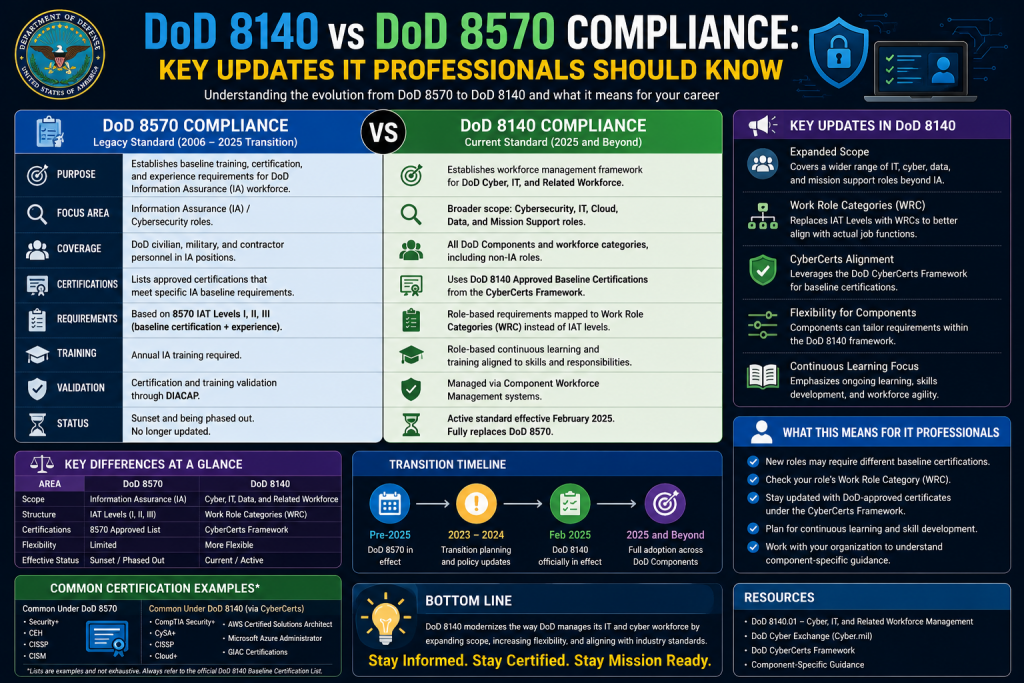
IT professionals who want to work with the Department of Defense (DoD), federal agencies, or government contractors must meet strict cybersecurity workforce requirements. For many years, DoD Directive 8570 served as the primary framework for validating cybersecurity skills through certifications. However, as cyber threats evolved and IT environments became more complex, the DoD replaced it with DoD Directive 8140.
DoD 8140 is not just an update—it is a complete modernization of how cybersecurity professionals are trained, certified, and managed. Instead of focusing only on certifications, it emphasizes real-world skills, job-role alignment, and continuous professional development.
This shift reflects the growing complexity of modern cyber environments, where static knowledge is no longer enough. Professionals are now expected to demonstrate practical abilities in areas such as threat detection, incident response, cloud security, and risk management. The framework also ensures that learning is ongoing, meaning skills must be regularly updated to keep pace with evolving technologies and threats. As a result, DoD 8140 creates a more capable, adaptable, and mission-ready cybersecurity workforce that can respond effectively to both current and future security challenges across defense and government systems.
Understanding this transition is essential for IT professionals who want to remain competitive in government or defense-related careers.
What is DoD Directive 8140?
DoD Directive 8140 is a policy framework created by the Department of Defense to govern the cyber workforce across military, civilian, and contractor roles. It defines how cybersecurity professionals are trained, qualified, and assigned to roles within the DoD ecosystem.
Unlike the older system, DoD 8140 organizes cybersecurity professionals into structured workforce categories. These include:
- Cybersecurity
- Information Technology (Cyber IT)
- Cyber Effects
- Cyber Intelligence
- Cyber Enablers
- Software Engineering
- Artificial Intelligence and Data Roles
Each category is further divided into skill levels such as foundational, intermediate, and advanced. These levels determine the type of training, experience, and certifications required for each role.
The biggest shift in DoD 8140 is that it no longer relies only on certifications. Instead, it combines certifications with hands-on experience, job performance expectations, and continuous learning.
Why DoD 8140 Replaced DoD 8570
DoD 8570 was created when cybersecurity roles were simpler and mostly focused on basic Information Assurance (IA). At that time, earning certifications like Security+ or CISSP was enough to qualify for many government roles.
However, the modern cybersecurity landscape has changed dramatically. Threats now include advanced persistent attacks, ransomware operations, cloud exploitation, insider threats, and AI-driven cyber warfare.
DoD 8140 was introduced to address these challenges by modernizing the workforce structure. It ensures that professionals are not only certified but also capable of performing real-world defense tasks.
Key reasons for the change include:
- Expansion of cybersecurity job functions
- Increasing complexity of cyber threats
- Need for role-specific skill validation
- Greater reliance on cloud and AI technologies
- Demand for continuous skill updates
This shift reflects a broader trend in IT: moving from static certification models to dynamic skill-based frameworks.
Key Differences Between DoD 8570 and DoD 8140
The transition from DoD 8570 to 8140 introduces several major differences that affect IT professionals.
Expanded Workforce Categories
Under DoD 8570, the focus was mainly on Information Assurance roles. DoD 8140 significantly expands this structure.
Now, cybersecurity is divided into multiple domains such as cybersecurity operations, cyber intelligence, cyber effects, software engineering, and AI/data roles.
This expansion reflects how cybersecurity now intersects with nearly every IT discipline.
Role-Based Qualification System
One of the most important changes is the shift from certification-based qualification to role-based qualification.
Under DoD 8570, a single certification could qualify someone for multiple roles. For example, Security+ was often enough for entry-level positions.
Under DoD 8140, each job role is mapped to specific requirements in the DoD Cyber Workforce Framework (DCWF). This means professionals must align their certifications, training, and experience directly with the role they want.
In practice, this creates a more structured and precise career path compared to older models like DoD 8570. Instead of earning a general certification and applying it broadly, IT professionals now need to first identify the exact DCWF role they are targeting, such as cyber defense analyst, security architect, incident responder, or network operations specialist. Once the role is identified, the framework outlines the required competencies, recommended certifications, and necessary hands-on skills.
This alignment ensures that training is not random or overly general. For example, a cloud security role may require knowledge of cloud platforms, identity management, and infrastructure security, while a threat intelligence role may emphasize analytical skills, malware analysis, and intelligence reporting.
As a result, professionals must take a more strategic approach to career development, carefully selecting certifications and training programs that directly support their desired job role rather than collecting credentials without a clear direction.
In addition, DoD 8140 encourages IT professionals to think in terms of long-term skill progression rather than short-term certification goals. This means gaining experience through real-world projects, simulations, and on-the-job training becomes just as important as passing certification exams. Employers also benefit from this model because it ensures that individuals placed in critical cybersecurity roles are not only certified but also genuinely capable of performing the required tasks. Over time, this improves overall mission readiness, reduces skill gaps, and strengthens the DoD’s ability to respond to evolving cyber threats in complex digital environments.
For example:
- Cyber defense analyst requires Security+ plus operational experience
- Security architect may require CISSP and advanced system design skills
- Penetration tester may require CEH plus hands-on lab work
This approach ensures better skill-job alignment.
Continuous Professional Development
DoD 8140 introduces ongoing training requirements. Unlike the previous system, certifications alone are not enough for long-term compliance.
Professionals must regularly:
- Update certifications
- Complete refresher training
- Participate in advanced skill development
- Gain practical hands-on experience
This ensures the workforce remains capable of handling evolving cyber threats.
No Direct Mapping from 8570 to 8140
One of the biggest challenges is that DoD 8140 does not provide a direct one-to-one mapping from DoD 8570.
This means professionals cannot simply transfer their old certifications into the new system. Instead, they must reassess their skills and align them with updated role requirements.
This can be confusing, but it ultimately leads to more accurate workforce placement.
Certification and Training Under DoD 8140
Although DoD 8140 is more flexible, certifications still play a critical role. However, they are now part of a broader qualification structure.
Common certifications that remain relevant include:
- CompTIA Security+, CySA+, PenTest+, Cloud+
- ISC2 CISSP, SSCP
- Cisco CCNA, CCNP Security
- ISACA CISM, CISA
- EC-Council CEH
The key difference is that these certifications are no longer universally required. Instead, they are selected based on job role requirements.
For example:
- Entry-level cybersecurity roles may require Security+
- Mid-level analyst roles may require CySA+ or CISA
- Senior architecture roles may require CISSP or CISM
DoD 8140 encourages personalized learning paths that combine education, certifications, and experience.
Career Impact of DoD 8140
DoD 8140 significantly impacts IT professionals working in or entering government cybersecurity roles.
Positive Impacts
- More specialized job opportunities
- Better alignment between skills and job roles
- Recognition of advanced technical expertise
- Expansion into AI, cloud, and data security roles
Challenges
- More complex qualification requirements
- Need for continuous learning
- Higher training expectations
- Difficulty transitioning from old certifications
Despite these challenges, professionals who adapt early will have stronger career growth opportunities.
Compliance Deadlines
The DoD has set clear timelines for full adoption of the 8140 framework:
- February 15, 2025: Cybersecurity workforce compliance required
- February 15, 2026: Full cyber workforce compliance across all roles
These deadlines highlight the urgency for professionals to update their qualifications.
Key Skills Required Under DoD 8140
Beyond certifications, DoD 8140 emphasizes real-world technical skills, including:
- Network defense and monitoring
- Cloud security (AWS, Azure, hybrid systems)
- Incident response and forensics
- Threat intelligence analysis
- Secure software development
- AI and machine learning security
- Risk management and governance
These skills reflect modern cybersecurity needs in defense environments.
Challenges of the New Framework
While DoD 8140 improves workforce readiness, it also introduces challenges:
- Confusion during transition period
- Increased training and certification costs
- Need to re-map career paths
- More complex qualification structures
- Higher expectations for practical experience
Organizations and professionals must adapt carefully to avoid compliance gaps.
Future of DoD Cyber Workforce Development
DoD 8140 is part of a long-term evolution in cybersecurity workforce management. Future updates are likely to include:
- Greater integration of AI in cybersecurity roles
- Increased automation in compliance tracking
- Expansion of cloud-native security frameworks
- More emphasis on data science and analytics roles
- Real-time skill validation systems
This shows that cybersecurity careers will continue evolving rapidly.
Conclusion
The transition from DoD 8570 to DoD 8140 represents a major shift in how the Department of Defense manages cybersecurity professionals. While 8570 focused heavily on certifications, 8140 introduces a more advanced, flexible, and realistic approach based on job roles, hands-on experience, and continuous learning.
For IT professionals, this change is both a challenge and an opportunity. It requires more effort to stay compliant, but it also opens doors to more specialized and higher-level career paths in cybersecurity, AI, cloud security, and cyber intelligence.
Ultimately, DoD 8140 ensures that the cybersecurity workforce is better prepared to handle modern threats and complex digital environments. Professionals who invest in the right skills and continuously develop their expertise will remain highly valuable in the evolving defense and government IT landscape.
Continue exploring the technologies and certification concepts that matter most to you.