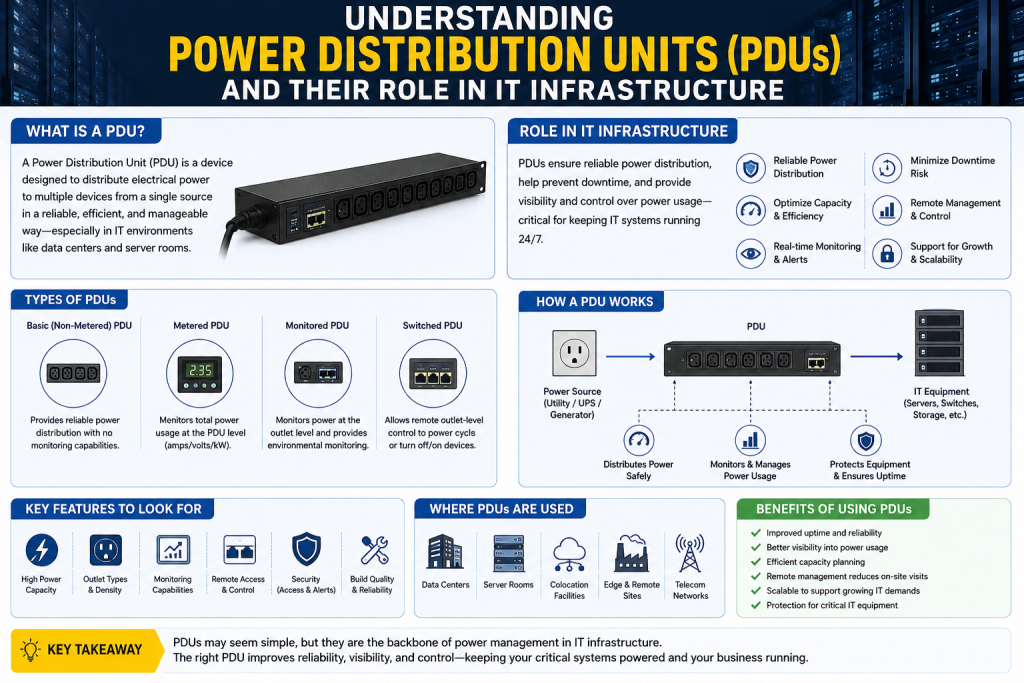
In modern IT environments, one of the most important but often overlooked elements is power management. While most discussions around technology focus on processors, storage systems, cloud computing, or networking, none of these systems can function without a stable and well-organized power supply. Every server, switch, and storage device depends on continuous electricity to operate correctly. If power is unstable, poorly distributed, or improperly managed, even the most advanced infrastructure can fail.
This is where Power Distribution Units, commonly known as PDUs, become essential. A PDU is a specialized electrical device designed to distribute power efficiently across multiple devices within a server rack or data center environment. At first glance, it may look similar to a regular power strip, but its purpose, design, and capabilities are far more advanced. PDUs are built specifically for IT infrastructure, where reliability, monitoring, and scalability are critical.
Understanding PDUs is important for anyone involved in IT operations, data centers, networking environments, or server management. They are not just accessories but foundational components that ensure systems remain powered, stable, and manageable. Without PDUs, organizing power in a multi-device environment would be chaotic, inefficient, and risky.
This detailed explanation explores what PDUs are, how they function, why they are important, and how they fit into modern infrastructure.
Basic Concept of Power Distribution Units
A Power Distribution Unit is an electrical device that provides multiple power outlets for equipment within a server rack. Its main job is to take electrical power from a single source and distribute it to multiple connected devices. These devices may include servers, routers, switches, storage units, and other networking hardware.
In simple terms, a PDU acts as a centralized power hub. Instead of plugging each device directly into a wall outlet or using multiple extension cords, all devices are connected to the PDU. The PDU itself is connected to a primary power source, such as a wall circuit, a UPS system, or a generator.
This centralized approach brings order and efficiency to environments where dozens or even hundreds of devices operate simultaneously. It eliminates cable clutter, improves safety, and allows administrators to manage power distribution in a structured way.
However, PDUs are not just simple connectors. They are engineered to handle high electrical loads and provide stable power delivery in environments where downtime is not acceptable. In data centers, even a few seconds of power interruption can lead to system failures or data loss. PDUs help reduce such risks by ensuring reliable power flow.
Importance of Power Distribution in IT Environments
To understand PDUs better, it is important to understand why power distribution matters in IT infrastructure. Modern computing systems rely heavily on continuous operation. Servers often run 24 hours a day, processing data, hosting applications, and supporting users across the world.
If power distribution is not properly managed, several problems can occur. These include overloads, inconsistent power delivery, overheating, and system crashes. In worst-case scenarios, hardware damage or data corruption can happen.
In large environments such as data centers, hundreds of devices are packed into racks. Each device has its own power requirement, and managing these manually would be extremely difficult. PDUs solve this problem by acting as a structured distribution layer between the power source and the equipment.
They ensure that each device receives stable and sufficient power while also allowing administrators to monitor and control the power flow when needed. This level of control is essential in maintaining uptime and operational efficiency.
Physical Design and Installation of PDUs
PDUs are designed specifically for rack-based environments. They come in different physical forms depending on the setup requirements.
One common design is the vertical PDU. This type is mounted along the side or back of a server rack. It is usually long and narrow, allowing it to accommodate many outlets without consuming rack space. Vertical PDUs are ideal for large environments where space efficiency is important.
Another design is the horizontal PDU. This type is installed like a standard rack-mounted device and typically occupies 1U or 2U of rack space. Horizontal PDUs usually have fewer outlets but are useful in smaller setups or when only a limited number of devices are present.
Installation of PDUs requires careful planning. They must be securely mounted within the rack to ensure stability. Proper positioning is also important to avoid airflow blockage, which can affect cooling performance. In IT environments, temperature control is critical, and poor placement of power equipment can lead to overheating issues.
Another important factor during installation is accessibility. Outlets should be easy to reach for maintenance or troubleshooting purposes. Additionally, cable management should be considered to ensure that power cables do not obstruct airflow or create clutter.
Electrical Capacity and Power Requirements
One of the key differences between PDUs and regular power strips is their ability to handle high electrical loads. IT equipment requires significantly more power than typical household devices. As a result, PDUs are designed to operate at higher voltages and amperages.
While household outlets usually provide 120 volts and limited current, PDUs often operate at 208 or 240 volts. This allows them to support multiple high-performance servers and networking devices simultaneously.
Because of this high power requirement, PDUs are typically connected to dedicated electrical circuits. These circuits are designed to handle heavy loads safely and prevent overloads. In many cases, professional electricians are involved in designing and installing the power infrastructure for server environments.
Proper power planning is essential when deploying PDUs. If the total power consumption of connected devices exceeds the PDU’s capacity, it can result in circuit breakers tripping or system shutdowns. Therefore, calculating power requirements in advance is a critical step in infrastructure design.
Role of PDUs in Server Racks
Server racks are the backbone of IT infrastructure. They house multiple devices in a compact and organized manner. However, without proper power distribution, these racks would be difficult to manage.
PDUs act as the power backbone within each rack. They ensure that every device receives the required electrical supply in a controlled and structured way. Instead of running multiple power cables from different sources, all devices connect to a single distribution unit.
This centralized design reduces complexity and improves reliability. It also makes maintenance easier, as technicians can quickly identify power connections and isolate issues when necessary.
In addition, PDUs help standardize power distribution across multiple racks. In large environments, consistency is important. Using PDUs ensures that each rack follows the same power structure, making scaling and management more efficient.
Safety and Reliability Benefits
One of the most important roles of PDUs is ensuring safety. Electrical systems in IT environments carry significant risk if not properly managed. Overloaded circuits, faulty wiring, or unstable power supply can damage expensive equipment.
PDUs are designed with safety features such as circuit breakers and surge protection. These features help prevent damage caused by electrical faults. If a power overload occurs, the PDU can automatically shut down or isolate affected circuits to protect connected devices.
Reliability is another major benefit. PDUs ensure continuous power distribution even under heavy loads. In environments where uptime is critical, such as financial systems or cloud services, even short interruptions can have serious consequences. PDUs help minimize these risks by providing stable and controlled power delivery.
Importance in Modern IT Infrastructure
As technology continues to evolve, the demand for reliable infrastructure increases. Modern systems rely on cloud computing, virtualization, artificial intelligence, and large-scale data processing. All of these require stable and continuous power.
PDUs play a crucial role in supporting these systems. They allow data centers to scale efficiently by managing increasing power demands. Without PDUs, managing large numbers of devices would become extremely complex and inefficient.
In addition, PDUs support the trend toward high-density computing. Modern servers are more powerful and consume more electricity than older systems. This increases the need for advanced power distribution solutions that can handle higher loads while maintaining efficiency.
Types of Power Distribution Units (PDUs) and Their Functions
Power Distribution Units are not all the same. Although their core purpose remains consistent, which is distributing electrical power to multiple devices within a rack, their features, complexity, and capabilities vary significantly. In modern IT environments, different setups require different levels of control, monitoring, and reliability. Because of this, PDUs are designed in multiple types to meet specific operational needs.
Some environments only require simple power distribution, while others demand advanced monitoring, remote management, redundancy, and automation. As IT infrastructure becomes more complex, the role of PDUs has expanded far beyond basic power delivery.
Understanding the different types of PDUs is essential for designing efficient server environments. Choosing the wrong type can lead to inefficiency, poor visibility into power usage, or even risks to system uptime. On the other hand, selecting the right PDU can improve reliability, simplify management, and support future growth.
This section explains the main types of PDUs, how they differ from each other, and where each type is used in real-world IT environments.
Basic Power Distribution Units
Basic PDUs are the simplest form of power distribution devices used in IT infrastructure. Their main function is to provide multiple power outlets from a single input source. They do not include advanced features such as monitoring or remote access. Instead, they focus purely on delivering stable and reliable electrical power.
In appearance, basic PDUs are similar to industrial-grade power strips designed for rack environments. They are typically installed in server racks either horizontally or vertically, depending on the design and available space.
These PDUs are widely used in environments where power management does not require advanced monitoring or control. For example, small server rooms, basic networking setups, or non-critical systems often use basic PDUs because they are cost-effective and easy to deploy.
One of the key advantages of basic PDUs is their simplicity. Since they do not include complex electronics or management systems, they are highly reliable and less prone to failure. This makes them suitable for environments where stability is more important than advanced functionality.
However, basic PDUs also have limitations. They do not provide information about power usage, cannot be managed remotely, and do not support intelligent features like load balancing or environmental monitoring. As a result, they are not suitable for large-scale data centers or mission-critical systems where visibility and control are essential.
Despite these limitations, basic PDUs remain an important part of IT infrastructure. They are often used as a foundation in smaller environments or as supplementary devices in larger systems.
Metered Power Distribution Units
Metered PDUs are a step above basic models in terms of functionality. In addition to providing power distribution, they include built-in power monitoring capabilities. This allows administrators to view real-time power consumption data for the connected devices.
The main feature of metered PDUs is their ability to measure electrical usage. This can include total power consumption for the entire unit or more detailed readings for specific groups of outlets. Some advanced models even provide per-outlet monitoring.
This level of visibility is extremely valuable in environments where power usage must be carefully managed. For example, in data centers, power capacity is limited, and exceeding it can cause system failures. Metered PDUs help prevent this by allowing administrators to track usage and make adjustments as needed.
Another important benefit of metered PDUs is capacity planning. By analyzing power consumption trends, IT teams can determine whether additional infrastructure is needed. This helps in avoiding unexpected overloads and ensures that systems are scaled appropriately.
Metered PDUs also play an important role in cost management. In some environments, power usage is directly linked to operational costs. By monitoring consumption, organizations can allocate resources more efficiently and reduce unnecessary energy usage.
Although metered PDUs provide valuable insights, they still lack remote control features. They can monitor and display data, but they cannot actively control power delivery to individual outlets. Despite this limitation, they are widely used in mid-sized IT environments where monitoring is important but full remote management is not required.
Switched or Managed Power Distribution Units
Managed PDUs, also known as switched PDUs, represent a more advanced category of power distribution systems. These devices not only provide power monitoring but also allow remote control of individual outlets.
This means that administrators can turn outlets on or off remotely without physically accessing the server rack. This feature is extremely useful in large environments where equipment may be located in different rooms, buildings, or even geographical locations.
One of the most important advantages of managed PDUs is remote reboot capability. If a server becomes unresponsive, administrators can simply power cycle the device through the PDU instead of manually restarting it. This saves time and reduces the need for on-site intervention.
Managed PDUs also support advanced power sequencing. This means that devices can be powered on or off in a specific order. This is important because some equipment requires other systems to be active before it can function properly. Power sequencing helps prevent overloads and ensures smooth startup processes.
Another key feature is access control. Managed PDUs allow administrators to restrict who can control power outlets. This adds a layer of security, preventing unauthorized users from shutting down critical systems.
In addition to power control, many managed PDUs also include environmental monitoring features. These can track temperature, humidity, and other environmental conditions inside the rack. If abnormal conditions are detected, alerts can be sent to administrators so that corrective action can be taken.
Managed PDUs are commonly used in data centers, enterprise IT environments, and cloud infrastructure. Their advanced features make them ideal for systems where uptime, control, and automation are critical.
However, these benefits come with increased complexity and cost. Managed PDUs are more expensive than basic or metered models and require proper configuration to fully utilize their capabilities. Despite this, their advantages often outweigh the cost in large-scale environments.
Intelligent or Smart Power Distribution Units
Smart PDUs take managed functionality even further by integrating advanced analytics, automation, and network connectivity. These devices are designed for highly sophisticated IT environments where detailed power management is required.
Smart PDUs often include built-in network interfaces, allowing them to connect to centralized management systems. This enables administrators to monitor and control multiple PDUs from a single platform.
One of the key strengths of smart PDUs is data collection. They gather detailed information about power usage, environmental conditions, and system performance. This data can be used for analysis, reporting, and optimization. In modern IT environments, this level of visibility is extremely valuable because it allows administrators to understand exactly how infrastructure resources are being consumed in real time.
With continuous monitoring, smart PDUs can track fluctuations in power demand throughout the day, identifying peak usage periods and low activity intervals. This helps organizations plan capacity more effectively and avoid unnecessary strain on electrical systems. Over time, this historical data becomes even more useful because it reveals long-term trends that can guide infrastructure upgrades and energy efficiency improvements.
Environmental data collection is equally important. By monitoring temperature and humidity levels inside server racks, smart PDUs help ensure that equipment operates within safe conditions. If thresholds are exceeded, alerts can be generated immediately, allowing technicians to respond before hardware damage occurs.
In addition, performance data collected by smart PDUs can support predictive maintenance strategies. Instead of reacting to failures, IT teams can anticipate potential issues based on abnormal patterns in power usage or environmental changes. This proactive approach reduces downtime and improves system reliability, making smart PDUs an essential component in high-performance IT environments.
In many cases, smart PDUs support integration with data center infrastructure management systems. This allows organizations to create a unified view of their entire IT environment, including power, cooling, and network resources.
Automation is another important feature of smart PDUs. They can be programmed to respond automatically to certain conditions. For example, if power usage exceeds a defined threshold, the PDU can automatically shut down non-critical devices to prevent overload.
Smart PDUs also support predictive maintenance. By analyzing usage patterns, they can identify potential issues before they become serious problems. This helps reduce downtime and improves overall system reliability.
These PDUs are commonly used in large data centers, cloud service providers, and enterprise-level IT operations. Their advanced capabilities make them ideal for environments where efficiency, scalability, and automation are top priorities.
Automatic Transfer Switch PDUs
Automatic Transfer Switch PDUs are designed for environments that require maximum power redundancy and reliability. These devices are capable of receiving power from multiple sources and automatically switching between them in case of failure. This ensures that connected equipment continues to operate without interruption even if the primary power source goes down unexpectedly. In critical IT environments, even a few seconds of downtime can lead to data loss, service disruption, or financial impact, so this automatic switching capability is extremely important.
These PDUs continuously monitor the quality and availability of each power input. If they detect instability, such as voltage drops, complete power loss, or irregular supply from the primary source, they instantly transfer the load to a secondary source. This process happens automatically and is usually seamless, meaning that servers and networking devices remain powered without rebooting or disconnecting.
In many setups, Automatic Transfer Switch PDUs are connected to separate UPS systems or independent power feeds. This dual-source design significantly increases reliability by ensuring that no single power failure can affect system uptime. They are especially common in data centers, healthcare systems, financial institutions, and enterprise networks where continuous operation is essential.
Additionally, these PDUs reduce the need for manual intervention during power incidents. This improves response time, minimizes human error, and strengthens overall infrastructure resilience.
For example, an ATS PDU may be connected to two separate power supplies or UPS systems. Under normal conditions, it uses one primary source. If that source fails, the PDU automatically switches to the secondary source without interrupting power to connected devices.
This feature is extremely important in mission-critical environments where even a few seconds of downtime can have serious consequences. Financial institutions, healthcare systems, and large-scale data centers often rely on ATS PDUs to ensure continuous operation.
Automatic transfer switching happens instantly and does not require human intervention. This ensures that systems remain operational even during power outages or maintenance activities.
ATS PDUs can also be combined with other PDU types, such as metered or managed models. This allows organizations to benefit from both redundancy and advanced monitoring capabilities.
The main advantage of ATS PDUs is uninterrupted power delivery. However, they are also more complex and expensive than standard PDUs. Proper planning and installation are required to ensure they function correctly.
Comparing Different PDU Types in Practical Use
Each type of PDU serves a specific purpose in IT infrastructure. Basic PDUs are suitable for simple environments where power distribution is the only requirement. Metered PDUs add visibility into power usage, making them useful for monitoring and planning. Managed PDUs provide remote control and automation, which are essential for larger environments. Smart PDUs introduce advanced analytics and integration capabilities. ATS PDUs ensure redundancy and continuous operation in critical systems.
Choosing the right type of PDU depends heavily on the scale and complexity of the infrastructure. In smaller setups, where only a few devices are connected and power demand is predictable, basic or metered PDUs are usually sufficient. However, as systems grow and more servers are added, the need for better control and visibility increases significantly. In such cases, managed or smart PDUs become more appropriate because they allow administrators to actively control and optimize power distribution.
Another important consideration is operational criticality. If the environment supports essential services such as online platforms, financial systems, or healthcare applications, downtime is not acceptable. In these cases, ATS PDUs provide the redundancy needed to maintain continuous operation during power failures.
Cost, scalability, and management complexity also influence the decision. While advanced PDUs offer powerful features, they require more investment and technical expertise. Therefore, organizations must balance functionality with budget and long-term infrastructure goals when selecting a PDU type.
The choice of PDU depends on the size, complexity, and requirements of the IT environment. Smaller setups may only need basic or metered PDUs, while large-scale data centers require managed or smart solutions with redundancy features.
Advanced Features of Power Distribution Units and Their Importance in Modern IT Infrastructure
Power Distribution Units have evolved far beyond their original purpose of simply distributing electricity within a server rack. In earlier computing environments, power management was relatively straightforward. A basic power strip or simple distribution device was often enough to support a small number of machines. However, modern IT infrastructure has become significantly more complex. Today’s systems rely on continuous uptime, high performance, remote accessibility, and precise monitoring. As a result, PDUs have transformed into intelligent devices that play a central role in data center operations.
In large-scale environments such as enterprise data centers, cloud computing facilities, and telecommunications networks, power is not just a utility. It is a critical resource that must be carefully controlled and optimized. Any disruption in power delivery can lead to service outages, data loss, financial damage, and operational disruption. To prevent these issues, modern PDUs are equipped with advanced features that go well beyond basic power distribution.
This section explores these advanced features in detail, explaining how they improve efficiency, enhance reliability, and support the growing demands of modern IT systems.
Remote Monitoring and Management
One of the most important advancements in modern PDUs is remote monitoring and management capability. This feature allows IT administrators to monitor power usage and control devices without physically accessing the server rack.
In traditional setups, technicians would need to be physically present to check power status or restart devices. This process is time-consuming and inefficient, especially in large environments with multiple data centers or remote locations. Remote management eliminates this limitation by providing access through network connectivity. Instead of traveling to the server room or relying on on-site staff, administrators can monitor and control power systems from any location with secure internet access. This significantly improves response time during incidents and reduces operational delays.
Remote management also enhances flexibility in handling infrastructure issues. For example, if a server becomes unresponsive, administrators can remotely power cycle the device through the PDU without waiting for physical intervention. This capability is especially valuable in environments that operate 24/7, where even short downtime can impact services and users.
Another important benefit is centralized control. In large organizations with multiple facilities, all PDUs can be monitored from a single interface. This allows IT teams to manage distributed infrastructure more efficiently and maintain consistency across locations. It also reduces dependency on local technicians, which lowers operational costs.
In addition, remote management supports better decision-making through real-time data access. Administrators can immediately see power usage, load conditions, and device status, helping them react quickly and maintain system stability.
With remote monitoring, administrators can view real-time data about power consumption, voltage levels, and current load. This information is crucial for identifying inefficiencies and preventing overload situations. If a device is consuming more power than expected, it can be detected early before it causes system instability.
Remote control capabilities also allow administrators to turn individual outlets on or off. This is especially useful when a device becomes unresponsive. Instead of physically restarting the equipment, a simple remote command can power cycle the device. This reduces downtime and improves operational efficiency.
In addition, remote management systems often include secure login features, ensuring that only authorized personnel can access power controls. This enhances security and prevents unauthorized actions that could disrupt operations.
Power Usage Monitoring and Analytics
Modern PDUs provide detailed insights into power consumption, which is essential for efficient infrastructure management. This feature allows organizations to track how much electricity is being used by individual devices or entire racks.
Power monitoring is not just about knowing how much energy is being consumed. It also plays a key role in capacity planning and cost management. By analyzing usage patterns, IT teams can determine whether resources are being used efficiently or if adjustments are needed.
For example, if certain servers consistently consume more power than others, administrators can investigate whether those systems are overloaded or improperly configured. This level of insight helps improve overall system performance.
Power analytics also help in identifying trends over time. Organizations can study how power usage changes during peak hours, maintenance windows, or seasonal workloads. This data is valuable for optimizing infrastructure and reducing unnecessary energy consumption.
In large data centers, even small improvements in power efficiency can lead to significant cost savings. Therefore, power monitoring is not just a technical feature but also an important financial tool.
Load Balancing and Power Distribution Control
Load balancing is another critical feature found in advanced PDUs. It ensures that electrical load is distributed evenly across different circuits or phases. Uneven power distribution can lead to overheating, circuit overloads, and equipment failure.
In complex IT environments, multiple devices operate simultaneously, each with different power requirements. Without proper load balancing, some circuits may become overloaded while others remain underutilized. Advanced PDUs help prevent this by distributing power more evenly.
Load balancing also improves system stability. When power is evenly distributed, the risk of sudden shutdowns or electrical failures is reduced. This is especially important in environments where uptime is critical.
Some PDUs provide visual indicators or dashboards that show current load distribution. This allows administrators to quickly identify imbalances and make necessary adjustments.
By maintaining balanced power usage, organizations can extend the lifespan of their equipment and improve overall efficiency.
Environmental Monitoring Capabilities
Modern PDUs often include built-in environmental sensors that monitor conditions within the server rack. These sensors can track temperature, humidity, and sometimes even airflow or smoke detection.
Environmental conditions have a direct impact on IT equipment performance. High temperatures can cause overheating, while excessive humidity can lead to condensation and hardware damage. By continuously monitoring these conditions, PDUs help prevent environmental-related failures.
If abnormal conditions are detected, alerts are sent to administrators immediately. This allows for quick intervention before serious damage occurs. For example, if a cooling system fails and rack temperature begins to rise, the PDU can trigger an alert so that corrective action can be taken.
Environmental monitoring also supports preventive maintenance. By analyzing environmental trends, IT teams can identify areas where cooling or ventilation needs improvement. This helps maintain optimal operating conditions and reduces the risk of system failures.
In mission-critical environments, environmental monitoring is an essential feature that contributes to overall system reliability.
Power Sequencing and Startup Control
Power sequencing is an advanced feature that controls the order in which devices are powered on or off. This is particularly important in environments where certain systems depend on others to function correctly.
For example, a storage system may need to be active before application servers can start. If all devices are powered on simultaneously, it could lead to errors or system instability. Power sequencing ensures that devices are started in the correct order.
This feature is also useful during power restoration after an outage. Instead of all systems starting at once, which can create a sudden power surge, devices are powered on gradually. This reduces stress on the electrical infrastructure and prevents overload conditions.
Power sequencing can also be customized based on operational requirements. Administrators can define specific groups of devices and set delays between power cycles. This level of control helps maintain system stability during critical operations.
Redundancy and Automatic Failover Systems
Redundancy is a fundamental principle in IT infrastructure design. It ensures that systems continue to operate even when a component fails. Advanced PDUs support redundancy through automatic failover mechanisms.
In setups with multiple power sources, PDUs can switch between primary and secondary inputs automatically. If the primary power source fails, the PDU immediately switches to the backup source without interrupting connected devices.
This feature is essential in environments where downtime is not acceptable. Financial systems, healthcare networks, and cloud platforms rely heavily on uninterrupted power delivery.
Automatic failover systems operate instantly and do not require manual intervention. This ensures that services remain available even during unexpected power failures.
Redundancy can also be extended through multiple PDUs within the same rack. This provides additional protection and ensures that no single point of failure can disrupt operations.
Security Features in Modern PDUs
As PDUs become more advanced and network-connected, security becomes an important consideration. Unauthorized access to power controls can have serious consequences, including system shutdowns or disruptions.
Modern PDUs include multiple security features to protect against unauthorized access. These include password protection, user authentication, and access control levels. Only authorized personnel can perform critical actions such as turning outlets on or off.
Some PDUs also support encrypted communication protocols, ensuring that data transmitted between the device and management systems is secure. This prevents interception or tampering by malicious actors.
Security logging is another important feature. PDUs can record all actions performed on the system, including power changes and configuration updates. This creates an audit trail that can be used for monitoring and compliance purposes.
In highly sensitive environments, security features in PDUs are essential for maintaining operational integrity.
Integration with Data Center Management Systems
Advanced PDUs are often integrated into larger data center management platforms. This integration allows for centralized monitoring and control of all infrastructure components, including power, cooling, and networking systems.
By integrating PDUs into a unified system, administrators gain a complete view of their infrastructure. This makes it easier to manage resources, identify issues, and optimize performance.
Integration also enables automation across different systems. For example, if a server rack reaches a certain power threshold, the system can automatically adjust cooling settings or redistribute workloads.
This level of coordination improves efficiency and reduces manual intervention. It also helps organizations scale their infrastructure more effectively.
Conclusion
Power Distribution Units have evolved into highly advanced systems that are essential for modern IT infrastructure. They are no longer simple power strips but intelligent devices that provide monitoring, control, automation, and safety features.
Advanced PDUs play a critical role in ensuring system reliability, improving energy efficiency, and supporting large-scale IT environments. Features such as remote management, load balancing, environmental monitoring, power sequencing, and redundancy make them indispensable in data centers and enterprise networks.
As technology continues to advance, the importance of intelligent power management will only increase. Organizations that invest in advanced PDUs benefit from improved uptime, better resource management, and enhanced operational control.
In conclusion, PDUs are a fundamental part of modern computing infrastructure. They ensure that power, one of the most critical resources in IT systems, is delivered safely, efficiently, and reliably.
Continue exploring the technologies and certification concepts that matter most to you.