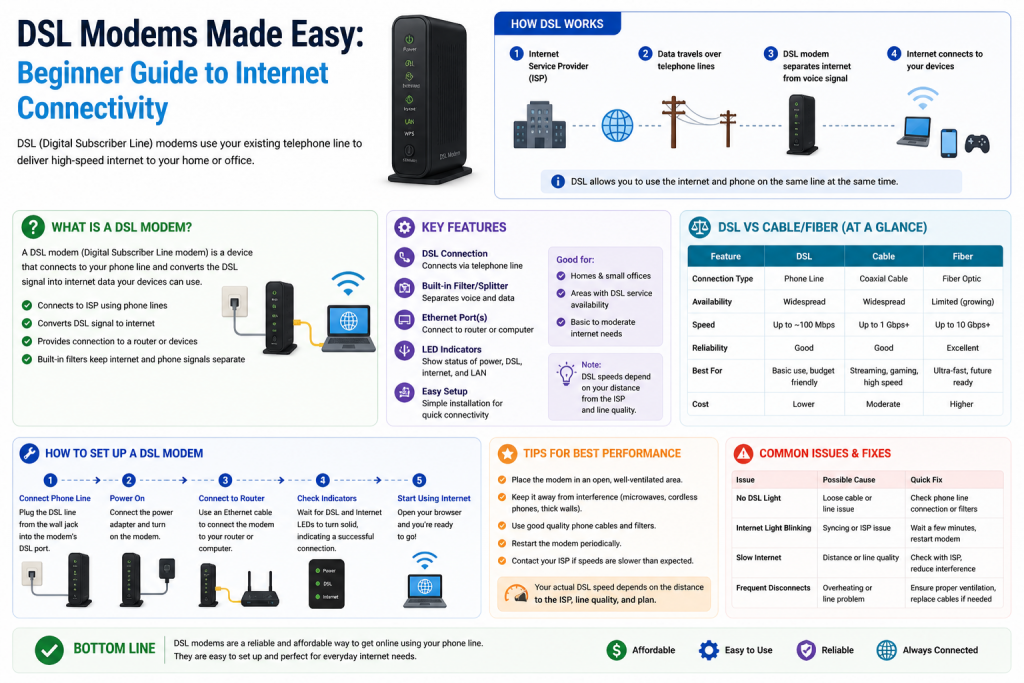
Digital Subscriber Line modems, more commonly known as DSL modems, are networking devices that enable internet access through traditional copper telephone lines. Even though modern internet technologies such as fiber optics and cable broadband have become dominant in many urban areas, DSL continues to be widely used in regions where upgrading infrastructure is either too costly or impractical. This makes DSL modems an important piece of technology that still supports millions of users worldwide.
A DSL modem works by converting digital data from a computer or network into analog signals that can travel over telephone lines. When data is received, the modem converts those analog signals back into digital form. This process of modulation and demodulation allows devices that rely on digital communication to function over a system originally designed for analog voice transmission.
The relevance of DSL modems lies in their ability to utilize existing infrastructure. Telephone lines are already installed in many homes and buildings, making DSL a convenient option without the need for major installation work. This accessibility has made DSL a long-standing solution for internet connectivity, especially in rural areas, small businesses, and multi-dwelling units.
Understanding DSL modems is important not only for general users but also for anyone studying networking or preparing for certifications. These devices demonstrate fundamental networking concepts such as signal conversion, data transmission, and network access, all of which are essential building blocks in the broader field of information technology.
What a DSL Modem Does
A DSL modem acts as the bridge between a local network and the internet. Without it, devices such as laptops, smartphones, and desktop computers would not be able to communicate with external networks. Its primary function is to enable communication between digital devices and the analog telephone infrastructure.
One of the most notable advantages of DSL technology is its ability to allow simultaneous voice and data transmission. Traditional dial-up connections required users to disconnect from the internet to make phone calls. DSL overcomes this limitation by using separate frequency bands for voice and data. Voice communication occupies the lower frequency range, while internet data is transmitted over higher frequencies. This separation ensures that both services can operate at the same time without interfering with each other.
DSL modems also handle the process of authentication with the internet service provider. When a modem connects to the network, it verifies the user’s credentials and establishes a connection. Once authenticated, the modem obtains an IP address and other necessary configuration details, enabling devices on the network to access the internet.
In addition to connectivity, DSL modems often provide basic network management features. These may include simple configuration settings, connection monitoring, and diagnostic tools. While these features are not as advanced as those found in routers, they still play an important role in maintaining a stable and functional connection.
Why DSL Is Still Used Today
Despite the availability of faster technologies, DSL remains a practical choice in many situations. One of the primary reasons for its continued use is the widespread availability of telephone lines. In many rural and remote areas, installing fiber or cable infrastructure is not economically viable. DSL provides a solution by leveraging existing خطوط, allowing users to access the internet without significant investment.
Another reason DSL is still relevant is its reliability. Unlike some shared broadband connections, DSL lines are typically dedicated to individual users. This means that performance is less affected by the number of people using the network at the same time. While DSL speeds may be lower, the consistency of the connection can be an advantage in certain scenarios.
Cost is also an important factor. DSL services are often more affordable than fiber or cable options. This makes them appealing to small businesses and households that require basic internet access without the need for high-speed الأداء. For tasks such as email, web browsing, and light streaming, DSL can provide sufficient performance.
Additionally, DSL technology has evolved over time to improve speeds and efficiency. Newer standards have increased the capabilities of DSL connections, making them more competitive with other forms of broadband. While they may not match the performance of fiber, these improvements have helped extend the lifespan of DSL as a viable internet solution.
DSL Modem Versus Cable Modem
When comparing DSL modems to cable modems, it is important to understand the differences in how they operate and the type of performance they deliver. Both devices serve the same basic purpose of connecting users to the internet, but the underlying technology sets them apart.
DSL modems use telephone lines to transmit data, while cable modems rely on coaxial cables. Coaxial cables have a higher ظرفیت for carrying data, which allows cable internet to achieve faster speeds. This makes cable a popular choice in urban areas where infrastructure is readily available.
In terms of installation, DSL modems are generally easier to set up. They can often be installed by the user without professional assistance. The modem connects to a standard phone jack, and a splitter may be used to separate voice and data signals. Cable modems, on the other hand, often require installation by the service provider due to the complexity of the network.
Another difference is how bandwidth is distributed. Cable internet connections are typically shared among multiple users in the same area. This can lead to slower speeds during peak usage times. DSL connections are usually dedicated, which can result in more consistent performance even if the overall speed is lower.
Maintenance and longevity also differ between the two technologies. DSL hardware tends to remain usable for longer periods because the underlying technology changes more slowly. Cable networks, on the other hand, are frequently upgraded, which may require users to replace their modems more often.
DSL Modem Versus Router
Understanding the difference between a DSL modem and a router is essential for building and managing a network. Although they are often used together, they perform distinct functions that are equally important.
A DSL modem is responsible for connecting a network to the internet. It handles the conversion of signals and establishes communication with the service provider. Without a modem, there is no internet connection.
A router, on the other hand, manages the flow of data within a network. It directs incoming and outgoing traffic, ensuring that data reaches the correct device. Routers also enable multiple devices to share a single internet connection, making them essential for households and offices with more than one user.
Another key difference is how these devices handle signals. DSL modems convert between analog and digital signals, while routers work exclusively with digital data. This distinction highlights the different roles they play in the networking process.
Modern networking devices often combine the functions of a modem and a router into a single unit. These integrated devices simplify setup and reduce the need for multiple pieces of equipment. However, in more advanced setups, separate devices may be preferred for greater control and flexibility.
Basic Components of a DSL Modem
A DSL modem includes several physical components that enable it to function effectively. Understanding these components can help users set up and troubleshoot their devices more easily.
The DSL port is the primary connection point for the telephone line. This port allows the modem to communicate with the service provider’s network. It typically uses an RJ-11 connector, which is smaller than the Ethernet connectors used for networking.
Ethernet ports are used to connect the modem to other devices, such as computers or routers. These ports provide a wired connection that is generally more stable and faster than wireless alternatives. Most DSL modems include at least one Ethernet port, although some models may offer multiple ports.
Some modems also include USB ports, although these are less common in modern devices. USB connections were once used to connect modems directly to computers, but Ethernet has largely replaced this method due to its superior performance.
Indicator lights on the modem provide visual feedback about its status. These lights can show whether the device is powered on, connected to the internet, and transmitting data. Learning to interpret these indicators can help users quickly identify and resolve issues.
How DSL Uses Telephone Lines
DSL technology takes advantage of the existing telephone network by transmitting data over copper wires. Unlike traditional voice communication, which uses a limited range of frequencies, DSL uses higher frequencies to carry data. This allows both voice and internet services to operate simultaneously.
The process begins when digital data is sent from a device to the modem. The modem converts this data into an analog signal that can travel over the telephone line. At the service provider’s end, the signal is received and converted back into digital form. The same process occurs in reverse for incoming data.
Distance plays a significant role in the performance of DSL connections. The farther a user is from the provider’s central office, the weaker the signal becomes. This can result in slower speeds and reduced reliability. For this reason, DSL is most effective in areas where the distance to the الخدمة provider is relatively short.
Line quality is another important factor. Interference from electrical devices, poor wiring, and environmental conditions can all impact the performance of a DSL connection. Maintaining high-quality lines and minimizing interference is essential for achieving the best possible performance.
The Importance of DSL in Networking
DSL modems continue to play a valuable role in the world of networking. They provide a practical solution for connecting users to the internet in areas where modern infrastructure is not available. This makes them an important technology for bridging the digital divide and ensuring that more people have access to online resources.
For small businesses, DSL offers an affordable way to stay connected without investing in expensive upgrades. It supports essential operations such as communication, data transfer, and access to online services. While it may not offer the highest speeds, it provides a reliable and cost-effective solution.
In residential settings, DSL remains a dependable option for households that do not have access to cable or fiber connections. It enables users to participate in everyday online activities, from browsing and streaming to remote work and education.
The continued use of DSL modems highlights the importance of adaptable technologies that can evolve over time. By making use of existing infrastructure, DSL provides a sustainable and accessible solution for internet connectivity. Understanding how these devices work is an essential step for anyone looking to build a strong foundation in networking.
DSL Standards and Their Evolution
Digital Subscriber Line is not a single fixed technology but a collection of standards that define how data is transmitted over copper telephone lines. These standards determine key performance factors such as maximum speed, signal range, and how bandwidth is distributed between upload and download traffic. Understanding these standards is essential because the type of DSL service available directly affects the performance of a modem.
One of the earliest and most widely used standards is Asymmetric DSL. This version was designed primarily for residential use, where users typically download more data than they upload. As a result, it provides higher download speeds while limiting upload capacity. This asymmetry makes it suitable for activities such as web browsing, streaming, and downloading files, which rely more heavily on downstream bandwidth.
As technology evolved, newer standards were introduced to improve performance. Very high bit rate DSL significantly increased speeds compared to earlier versions, but it required shorter distances between the user and the provider’s equipment. This made it more suitable for urban and suburban areas where infrastructure could support closer distribution points.
Another advancement in DSL technology is G.fast, which pushes the limits of data transmission over copper lines. It delivers much higher speeds than previous standards but operates effectively only over very short distances. This makes it ideal for environments such as apartment buildings where fiber connections can be brought close to users and then extended through existing copper wiring.
Each of these standards reflects a balance between speed, distance, and infrastructure limitations. When selecting or configuring a DSL modem, it is important to ensure compatibility with the specific standard used by the service provider. Failure to do so can result in reduced performance or an inability to establish a connection.
ADSL and Its Role in Home Connectivity
Asymmetric DSL has played a major role in bringing internet access to households around the world. Its design prioritizes download speeds because most users consume more data than they upload. This makes it well suited for common activities such as streaming videos, browsing websites, and downloading applications.
ADSL operates by dividing the available bandwidth into separate channels for voice and data. The lower frequencies are reserved for voice communication, while higher frequencies are used for internet traffic. This separation allows users to make phone calls and use the internet simultaneously without interference.
One of the key advantages of ADSL is its ability to function over relatively long distances. While performance decreases as distance increases, it can still provide usable speeds even several kilometers away from the provider’s central office. This makes it particularly valuable in rural and suburban areas where users may be located far from network infrastructure.
Over time, improvements such as ADSL2 and ADSL2+ have enhanced the capabilities of this standard. These upgrades have increased data rates and improved efficiency, allowing users to achieve better performance without requiring significant changes to existing infrastructure. Despite being older than other standards, ADSL remains widely used due to its reliability and broad compatibility.
VDSL and Higher-Speed Connections
Very high bit rate DSL represents a significant step forward in terms of speed and performance. It was developed to meet the growing demand for faster internet connections, particularly in areas where fiber deployment is not fully available. By using higher frequencies and more advanced signal processing techniques, VDSL can deliver much higher data rates than ADSL.
However, this increased performance comes with a trade-off. VDSL is more sensitive to distance, meaning that speeds decrease rapidly as the distance between the user and the distribution point increases. To address this limitation, service providers often deploy fiber connections closer to users, creating hybrid networks that combine fiber and copper technologies.
VDSL is commonly used in environments where moderate infrastructure upgrades are possible. For example, in urban neighborhoods, fiber may be installed up to a street cabinet, and VDSL is then used to connect individual homes. This approach allows providers to deliver higher speeds without the expense of running fiber directly to every residence.
The improved performance of VDSL makes it suitable for bandwidth-intensive applications such as high-definition streaming, online gaming, and video conferencing. It also supports higher upload speeds compared to ADSL, which is important for activities like cloud storage and remote work.
G.fast and Modern DSL Advancements
G.fast represents the latest evolution in DSL technology, pushing the boundaries of what can be achieved over copper lines. It is designed to deliver speeds that approach those of fiber connections, making it a compelling option in environments where full fiber deployment is not feasible.
The key to G.fast’s performance lies in its use of very high frequencies and advanced signal processing techniques. By operating over short distances, it minimizes signal degradation and maximizes data throughput. This makes it particularly effective in multi-dwelling units such as apartment buildings, where fiber can be brought close to each unit and copper wiring is used for the final connection.
One of the defining features of G.fast is its ability to provide symmetrical or near-symmetrical speeds. Unlike ADSL, which heavily favors downloads, G.fast can deliver high upload speeds as well. This is increasingly important in a world where users are not only consuming content but also creating and sharing it.
Despite its advantages, G.fast is not suitable for all environments. Its reliance on short distances limits its use to specific scenarios where infrastructure can support it. However, it demonstrates how DSL technology continues to evolve and remain relevant even in the face of newer alternatives.
Modulation Techniques in DSL
At the heart of DSL technology are modulation techniques that enable data to be transmitted over analog. These techniques determine how digital information is encoded into signals that can travel through copper wiring. Two of the most important methods used in DSL are Quadrature Amplitude Modulation and Orthogonal Frequency Division Multiplexing.
Quadrature Amplitude Modulation works by varying both the amplitude and phase of a signal to represent data. This allows multiple bits of information to be transmitted simultaneously, increasing efficiency. QAM is widely used in DSL systems because it can deliver high data rates within limited bandwidth. However, it is sensitive to noise and interference, which can affect performance if line conditions are not optimal.
Orthogonal Frequency Division Multiplexing takes a different approach by dividing the available bandwidth into multiple smaller subchannels. Each subchannel carries a portion of the data, and all channels operate in parallel. This method improves resilience to interference and allows the system to adapt to varying line conditions. OFDM is commonly used in newer DSL standards such as VDSL2 and G.fast due to its robustness and efficiency.
These modulation techniques play a critical role in determining the performance of a DSL connection. By optimizing how data is transmitted, they enable DSL systems to achieve higher speeds and greater reliability over existing infrastructure.
Understanding Bandwidth Allocation
Bandwidth allocation is a key concept in DSL technology, influencing how data is distributed between different types of traffic. In many DSL systems, bandwidth is divided between upstream and downstream channels, with a larger portion allocated to downloads. This reflects the typical usage patterns of most users.
In asymmetric systems like ADSL, the majority of bandwidth is dedicated to downstream traffic. This allows for faster downloads but limits upload speeds. While this is suitable for many applications, it can be a limitation for tasks that require significant upstream data, such as video conferencing or cloud backups.
More advanced systems like VDSL and G.fast offer greater flexibility in bandwidth allocation. They can provide higher upload speeds and, in some cases, symmetrical performance. This makes them better suited for modern applications that require balanced data transmission.
Dynamic bandwidth allocation is another feature found in some DSL systems. This allows the modem and network to adjust bandwidth distribution based on current usage and line conditions. By optimizing resource allocation, it improves overall performance and ensures efficient use of available capacity.
Interface Options and Connectivity
DSL modems include a variety of interface options that enable them to connect with both the telephone network and local devices. These interfaces are essential for establishing and maintaining a functional network.
The DSL port is the primary interface used to connect the modem to the telephone line. This connection allows the modem to communicate with the service provider’s equipment and establish an internet connection. It typically uses a smaller connector designed specifically for telephones.
Ethernet ports provide connectivity to local devices such as computers and routers. These ports support high-speed data transfer and are the most common method for connecting devices to a modem. In many setups, the modem is connected to a router, which then distributes the connection to multiple devices.
Some modems also include wireless capabilities, allowing them to function as both a modem and a router. This eliminates the need for a separate router and simplifies network setup. However, dedicated routers often provide better performance and more advanced features.
Although less common today, USB ports may still be found on some DSL modems. These ports were historically used for direct connections to computers but have largely been replaced by Ethernet due to better speed and reliability.
The Importance of Compatibility
Compatibility is a critical factor when working with DSL modems. Not all modems support all DSL standards, and using an incompatible device can prevent a connection from being established. It is important to verify that a modem supports the specific type of DSL service provided by the ISP.
In addition to supporting the correct standard, the modem must also be capable of handling the speed of the internet plan. Older devices may not be able to take full advantage of higher-speed connections, resulting in reduced performance. Upgrading to a newer modem can help ensure optimal speeds and reliability.
Service providers often maintain lists of approved devices that have been tested for compatibility with their networks. Choosing a modem from this list can simplify setup and reduce the risk of issues. It also ensures that the device meets the technical requirements of the network.
Firmware compatibility is another consideration. Keeping the modem’s firmware up to date ensures that it can support the latest features and security improvements. Regular updates help maintain performance and protect against potential vulnerabilities.
How DSL Technology Continues to Adapt
Despite the rise of newer technologies, DSL continues to evolve and adapt to changing demands. Advances in modulation techniques, bandwidth management, and infrastructure integration have extended the lifespan of DSL systems and improved their capabilities.
Hybrid networks that combine fiber and DSL are becoming increasingly common. In these setups, fiber is used to deliver high-speed connectivity to a central point, and DSL is used for the final connection to users. This approach balances performance and cost, making it a practical solution in many cases.
Ongoing research and development efforts continue to explore ways to enhance DSL performance. Innovations in signal processing and error correction are helping to push the limits of what can be achieved over copper. While DSL may not replace fiber, it remains an important part of the global ecosystem.
Understanding these advancements provides valuable insight into the future of networking. It highlights the importance of adapting existing technologies to meet new challenges and demonstrates how innovation can extend the usefulness of established systems.
Setting Up a DSL Modem
Setting up a DSL modem is typically a straightforward process, but it requires attention to detail to ensure a stable and reliable connection. The first step begins even before the device is powered on. Users must confirm that the modem they intend to use is compatible with their internet service provider and the specific DSL standard being delivered. Without this compatibility, even a properly connected device will fail to establish a working connection.
Once compatibility is confirmed, the physical setup begins. The DSL modem is connected to a telephone wall jack using a DSL cable, usually with an RJ-11 connector. If the same line is used for voice communication, a splitter is installed to separate voice and data signals. This prevents interference and ensures that both services can operate simultaneously without disruption.
After connecting the DSL line, the modem must be connected to a computer or router using an Ethernet cable. This connection allows the user to access the modem’s configuration interface. Powering on the device initiates a startup sequence, during which the modem attempts to synchronize with the service provider’s network. Indicator lights on the device provide visual feedback about the status of this process.
The final step in setup involves accessing the modem’s configuration interface through a web browser. By entering the device’s IP address, users can log in and configure the necessary settings. These typically include authentication credentials provided by the ISP, as well as any specific parameters required for the connection. Once these settings are saved, the modem establishes a connection and provides internet access to connected devices.
Configuring DSL Parameters
Configuration is a critical part of ensuring that a DSL modem operates efficiently. While many modern devices offer automatic configuration, manual setup provides greater control and can help resolve compatibility issues. Within the modem’s interface, users can adjust parameters such as DSL mode, modulation type, and line encoding.
Selecting the correct DSL mode is essential. Depending on the service, the modem may need to operate in ADSL, VDSL, or another supported mode. Choosing the wrong mode can prevent the modem from synchronizing with the provider’s equipment. Similarly, modulation settings determine how data is transmitted over the line. While these are often automatically detected, manual configuration can improve performance in certain scenarios.
Another important configuration option is the network mode. Users can choose to connect the modem directly to a single device or use it in conjunction with a router. When a router is used, the modem is often placed in bridge mode. This disables routing functions within the modem and allows the router to handle network management tasks such as assigning IP addresses and managing traffic.
Proper configuration ensures that the modem communicates effectively with the ISP and delivers the best possible performance. Taking the time to verify and adjust these settings can prevent connectivity issues and optimize the user experience.
Securing the DSL Modem
Security is an essential aspect of managing any network device, and DSL modems are no exception. Many devices come with default login credentials, which are widely known and can pose a significant risk if not changed. The first step in securing a modem is to replace these default credentials with a strong and unique username and password.
In addition to changing login information, users should enable any available security features. If the modem includes built-in wireless capabilities, encryption should be activated to protect the network from unauthorized access. Modern encryption standards provide strong protection against intrusion and help safeguard sensitive data.
Firmware updates are another critical component of modem security. Manufacturers periodically release updates to address vulnerabilities and improve performance. Keeping the modem’s firmware up to date ensures that it remains protected against emerging threats. Regularly checking for updates and applying them promptly is a simple yet effective way to maintain security.
Firewalls and access controls can also enhance security. Many DSL modems include basic firewall features that help block unwanted traffic. Configuring these settings appropriately can reduce the risk of external attacks and improve overall network safety.
Understanding Internet Connectivity
Once a DSL modem is configured and secured, it begins the process of connecting to the internet. This involves several steps that occur behind the scenes but are essential for establishing communication. The modem first synchronizes with the service provider’s network, ensuring that both ends are operating at compatible speeds and settings.
After synchronization, the modem authenticates with the ISP using credentials provided during setup. This authentication process verifies that the user is authorized to access the network. Once authenticated, the modem is assigned an IP address, which serves as its identifier on the internet.
Depending on the service, the IP address may be static or dynamic. A static IP remains the same over time, while a dynamic IP changes periodically. Most residential connections use dynamic IP addressing, as it is more efficient for providers to manage.
With an IP address assigned, the modem can route data between the local network and the internet. Devices connected to the modem or router can now send and receive information, enabling activities such as browsing, streaming, and communication.
Traffic and Bandwidth Management
Effective use of a DSL connection requires an understanding of how traffic and bandwidth are managed. DSL modems often include features that allow users to prioritize certain types of traffic. This is particularly important in environments where multiple devices share a single connection.
Quality of Service settings enable users to assign priority to specific applications or types of traffic. For example, voice communication and video conferencing can be given higher priority to ensure smooth performance. This helps prevent interruptions and maintains a consistent user experience.
Bandwidth management also involves monitoring how data is distributed among devices. In a household or office with many connected devices, heavy usage by one device can impact others. By managing bandwidth allocation, users can ensure fair distribution and prevent any single device from consuming excessive resources.
Understanding these features allows users to make the most of their DSL connection. By optimizing traffic flow, they can improve performance and reduce the impact of network congestion.
Monitoring DSL Performance
Monitoring the performance of a DSL modem is essential for maintaining a stable connection. Most modems include built-in tools that provide information about connection status, signal quality, and error rates. These tools can be accessed through the modem’s interface and offer valuable insights into network performance.
One of the key metrics to monitor is the signal-to-noise ratio. This measurement indicates the quality of the connection and the level of interference present on the line. A higher ratio generally նշանակում better performance, while a lower ratio may indicate potential issues.
Error logs are another useful feature. They record events such as connection drops, authentication failures, and transmission errors. Reviewing these logs can help identify recurring problems and guide troubleshooting efforts.
Regular monitoring allows users to detect issues early and take corrective action. Whether it involves adjusting settings, checking connections, or contacting the service provider, proactive monitoring helps maintain a reliable network.
Troubleshooting Common Issues
Despite proper setup and configuration, DSL connections can occasionally experience problems. Understanding how to troubleshoot these issues is an important skill for maintaining connectivity. Many common problems can be resolved with simple steps.
One of the first things to check is the physical connection. Loose or damaged cables can disrupt the signal and prevent the modem from functioning correctly. Ensuring that all connections are secure is a basic but essential step.
Restarting the modem is another effective troubleshooting method. This process resets the device and can resolve temporary issues such as synchronization errors or memory glitches. Allowing the modem to fully restart gives it a chance to reestablish a stable connection.
If problems persist, checking the modem’s configuration settings is important. Incorrect parameters can prevent the modem from communicating with the ISP. Verifying these settings and making necessary adjustments can often resolve connectivity issues.
In cases where the problem cannot be resolved locally, contacting the service provider may be necessary. They can perform diagnostics on the network and identify issues that are beyond the user’s control.
Use Cases for DSL Modems
DSL modems are used in a variety of environments where reliable internet access is needed without extensive infrastructure upgrades. One of the most common use cases is in rural areas. In these regions, the cost of deploying fiber or cable networks can be prohibitive. DSL provides a practical alternative by utilizing existing telephone lines.
Small businesses also benefit from DSL connectivity. Many businesses operate in locations where advanced infrastructure is not available or where upgrading would be too expensive. DSL offers a cost-effective solution that supports essential operations such as communication, data transfer, and online services.
Multi-dwelling units represent another important use case. In apartment buildings and similar environments, installing new infrastructure for each unit can be challenging. DSL allows providers to deliver internet access using existing wiring, reducing costs and simplifying deployment.
These use cases highlight the versatility of DSL technology. While it may not offer the highest speeds, it provides a reliable and accessible solution for a wide range of applications.
Advantages of DSL Technology
DSL technology offers several advantages that contribute to its continued use. One of the most significant benefits is its widespread availability. Because it uses existing telephone lines, DSL can be deployed in areas where other forms of broadband are not available.
Cost is another advantage. DSL services are often more affordable than fiber or cable options, making them accessible to a broader range of users. This affordability is particularly important in regions with limited economic resources.
Reliability is also a key strength. DSL connections are typically dedicated, meaning that users do not share bandwidth with as many الآخرين. This can result in more consistent performance, especially during peak usage times.
Additionally, DSL is relatively easy to install and maintain. The use of existing infrastructure reduces the complexity of deployment, and the technology itself is well understood and widely supported.
Limitations of DSL Modems
Despite its advantages, DSL technology has several limitations that must be considered. One of the most notable is its speed. Compared to fiber and cable connections, DSL generally offers lower data rates. This can be a drawback for users who require high-speed الإنترنت for activities such as large file transfers or high-definition streaming.
Distance is another limitation. The performance of a DSL connection decreases as the distance from the service provider’s equipment increases. This can result in slower speeds and reduced reliability for users located far from the network نقطة.
DSL is also more susceptible to interference than some other technologies. Electrical noise, poor wiring, and environmental factors can all impact the quality of the connection. Maintaining good line conditions is essential for achieving optimal performance.
Finally, the potential for upgrades is limited. While DSL technology has evolved, it cannot match the scalability of fiber networks. This means that users may eventually need to transition to newer technologies as their needs grow.
Conclusion
DSL modems remain an important part of the networking landscape, even as newer technologies continue to emerge. Their ability to provide internet access using existing telephone lines makes them a practical and cost-effective solution in many environments. From rural communities to small businesses and multi-dwelling units, DSL continues to bridge gaps in connectivity and ensure that users can access essential online services.
Understanding how to set up, configure, secure, and troubleshoot a DSL modem is a valuable skill for anyone involved in networking. These devices illustrate fundamental concepts such as signal conversion, bandwidth management, and network communication. By mastering these concepts, users can build a strong foundation for working with more advanced technologies.
While DSL may not offer the highest speeds, its reliability, availability, and affordability ensure that it will remain relevant for years to come. As technology continues to evolve, DSL serves as a reminder that innovation often builds upon existing systems, adapting them to meet new challenges and opportunities.
Continue exploring the technologies and certification concepts that matter most to you.