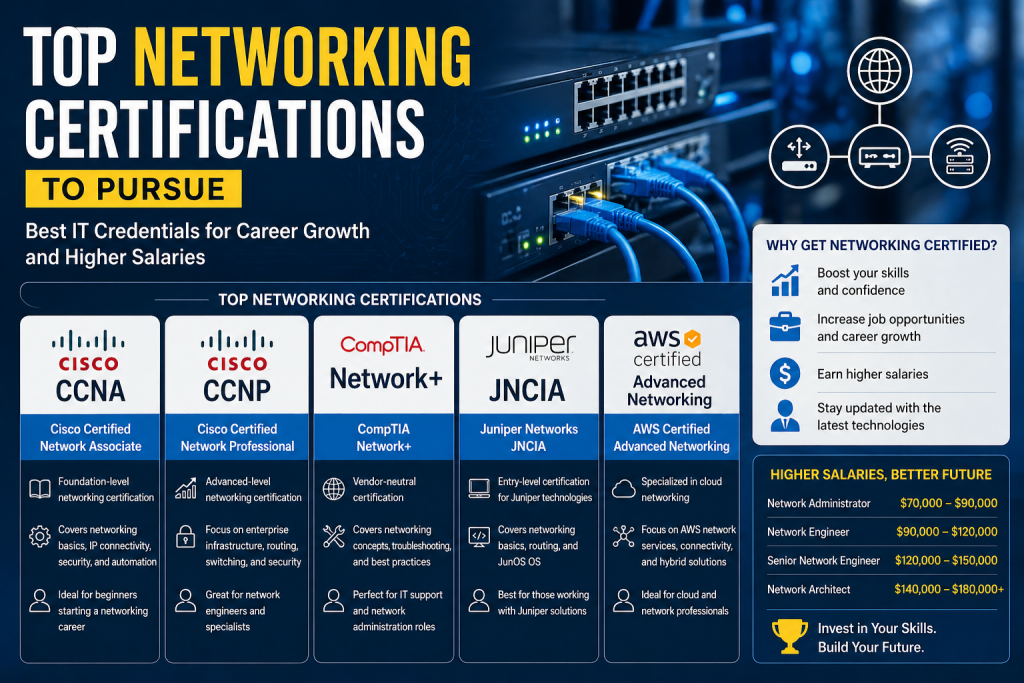
The world of networking is evolving at a pace that would have seemed impossible just a decade ago. If you could go back in time and demonstrate today’s networking capabilities—ultra-fast data transfer, intelligent automation, cloud-native infrastructure, and seamless global connectivity—it would feel almost futuristic. Technologies like artificial intelligence, edge computing, and software-defined networking have dramatically transformed how systems communicate and operate.
Because of this rapid evolution, the idea that networking has “reached its peak” couldn’t be further from reality. In fact, the demand for skilled networking professionals is growing faster than ever. Businesses rely heavily on robust, secure, and scalable networks, and they need experts who understand how to design, implement, and maintain these systems effectively.
For anyone considering a career in IT or looking to advance within networking, certifications remain one of the most powerful tools available. They provide structured learning, validate expertise, and signal to employers that you are serious about your professional development.
Introduction to the Modern Networking Landscape
Networking technology has come a long way over the past decade, evolving into a highly sophisticated and essential component of modern digital infrastructure. What once revolved around simple connections between computers has now expanded into a vast ecosystem that supports cloud computing, artificial intelligence, remote work, and global communication at unprecedented speeds. If someone from ten years ago were introduced to today’s networking capabilities, the advancements would feel almost futuristic.
This rapid transformation highlights a simple truth: networking is far from complete. Instead, it is continuously evolving, creating new opportunities for professionals who are willing to learn and adapt. As organizations increasingly rely on stable, secure, and high-performance networks, the demand for skilled networking professionals continues to grow.
For individuals considering a career in IT or those already working in the field, networking certifications provide a structured and reliable pathway to success. They help validate knowledge, demonstrate competence, and build credibility in a competitive job market.
Why Networking Certifications Still Matter
In 2026, networking certifications remain one of the most effective ways to establish and advance a career in IT. While practical experience is highly valuable, certifications offer a standardized way to measure and demonstrate expertise. Employers recognize and trust these credentials because they are developed and maintained by reputable organizations with strict evaluation standards.
When hiring managers review resumes, certifications often serve as a quick indicator of a candidate’s capabilities. They provide assurance that the individual has met specific requirements and possesses the knowledge necessary to perform in a networking role. This is especially important in technical fields where verifying skills can otherwise be challenging.
Certifications also demonstrate commitment. Preparing for an exam requires time, effort, and dedication, all of which signal a strong work ethic. In an industry where continuous learning is essential, this willingness to invest in personal development is highly valued.
Another key benefit is that certifications help bridge the gap between theory and practice. Many certification programs include hands-on labs, simulations, and real-world scenarios that prepare candidates for actual job tasks. This practical exposure is particularly beneficial for beginners who may not yet have professional experience.
In addition, certifications can enhance career prospects by opening doors to better job opportunities and higher salaries. Professionals with recognized credentials often have a competitive advantage, making it easier to secure roles and negotiate compensation.
Vendor-Neutral and Vendor-Specific Certifications Explained
Understanding the types of networking certifications available is an important step in planning your career path. Certifications generally fall into two categories: vendor-neutral and vendor-specific.
Vendor-neutral certifications focus on general networking concepts that apply across various platforms and technologies. These certifications cover topics such as network architecture, protocols, troubleshooting, and security fundamentals. Because they are not tied to a specific company, they provide a broad and flexible foundation that is useful in many different environments.
This flexibility makes vendor-neutral certifications an excellent choice for beginners or those who want to keep their options open. They allow professionals to work with a wide range of technologies and adapt to different systems without being limited to a single vendor’s ecosystem.
Vendor-specific certifications, on the other hand, are designed around the products and technologies of a particular company. These certifications teach candidates how to configure, manage, and troubleshoot systems using that vendor’s tools and best practices.
For example, if an organization relies heavily on a specific brand of networking equipment, having a certification related to that vendor can make a candidate more attractive. It shows that the individual is already familiar with the tools and systems used within the company, reducing the need for additional training.
Both types of certifications have their advantages. Vendor-neutral certifications provide a strong foundation and versatility, while vendor-specific certifications offer specialization and depth. Many professionals choose to pursue a combination of both, starting with vendor-neutral certifications and later specializing based on their career goals.
Challenges of Starting a Networking Career
Entering the networking field can be challenging, especially for those without prior experience. Many entry-level positions require practical knowledge, which creates a barrier for beginners. This situation often leads to frustration, as candidates struggle to gain experience without first securing a job.
To overcome this challenge, aspiring networking professionals need to adopt a proactive approach to learning and skill development. One effective strategy is to build hands-on experience independently by setting up a home lab environment. This can include using virtual machines, network simulators, or even basic physical equipment to practice configuring routers, switches, and network services. By doing so, beginners can develop practical skills that mirror real-world scenarios, making them more confident and job-ready.
Additionally, online learning platforms and certification training programs offer guided labs and exercises that simulate actual networking tasks. These resources help bridge the gap between theoretical knowledge and practical application. Participating in internships, freelance projects, or volunteer IT work can also provide valuable exposure and help build a professional portfolio.
Networking with industry professionals, joining online communities, and attending tech events can further open doors to opportunities. These connections often lead to mentorship, advice, and even job referrals. With persistence, continuous learning, and a willingness to start small, beginners can gradually break into the networking field and build a successful career.
Certifications help address this challenge by providing a way to demonstrate readiness. They show potential employers that a candidate has invested time in learning and understands the fundamental concepts of networking. This can make it easier to secure entry-level positions and begin gaining practical experience.
Another challenge is the complexity of networking itself. It involves a wide range of concepts, including protocols, hardware, software, and security. For beginners, this can feel overwhelming. Certifications break down these topics into manageable sections, making it easier to learn and build confidence.
Top Entry-Level Networking Certifications
For those just starting out, choosing the right certification is crucial. Entry-level certifications provide the foundation needed to understand networking concepts and prepare for more advanced learning.
One of the most popular starting points is CompTIA A+. This certification is widely recognized and covers a broad range of IT topics, including networking, hardware, operating systems, and security. Although it is not exclusively focused on networking, it provides a comprehensive introduction to the field.
The value of this certification lies in its holistic approach. Networking does not exist in isolation; it interacts with various components of IT systems. By understanding these connections, candidates develop a well-rounded skill set that is useful in real-world scenarios.
However, earning this certification requires preparation and commitment. It involves passing two exams, each covering different aspects of IT. Candidates must study thoroughly to ensure success and avoid the need for retakes.
Another excellent option for beginners is the Cisco Certified Technician certification. This certification focuses on practical, hands-on skills required to maintain and repair networking equipment. It is particularly useful for individuals who want to work in environments that use Cisco technology.
The certification covers tasks such as diagnosing issues, replacing hardware, and restoring network functionality. These skills are essential for entry-level roles and provide valuable experience that can be built upon in the future.
There are different specializations within this certification, allowing candidates to focus on areas such as data centers or routing and switching. This flexibility enables individuals to align their learning with their career interests.
For those interested in virtualization, entry-level certifications related to virtual environments are a strong choice. Virtualization is a key component of modern networking, enabling organizations to optimize resources and improve efficiency.
These certifications teach candidates how to work with virtual machines, virtual networks, and data centers. While they may be slightly more challenging for beginners, they offer valuable skills that are in high demand.
Another important certification for beginners is one focused on Juniper technologies. This certification introduces candidates to basic networking concepts while also teaching them how to work with a specific operating system used in networking equipment.
It is particularly beneficial for those who plan to work in environments that use Juniper systems. By gaining familiarity with these tools, candidates can quickly adapt to real-world tasks and responsibilities.
Building Practical Skills Alongside Certifications
While certifications are valuable, they are most effective when combined with practical experience. Networking is a hands-on field, and understanding concepts is only part of the equation. Being able to apply that knowledge in real-world scenarios is equally important.
One of the best ways to gain practical experience is by setting up a home lab. This can involve using physical equipment or virtual environments to simulate networking scenarios. By experimenting with configurations, troubleshooting issues, and testing different setups, learners can develop a deeper understanding of how networks operate.
Online labs and simulation tools are also useful resources. They provide guided exercises and real-world scenarios that help reinforce learning. These tools allow candidates to practice without the need for expensive hardware.
Working on small projects is another effective way to build skills. For example, setting up a local network, configuring routers, or implementing basic security measures can provide valuable experience. These projects not only enhance understanding but also demonstrate initiative and problem-solving abilities.
Developing a Long-Term Certification Strategy
Choosing the right certification path requires careful planning. Instead of pursuing multiple certifications without direction, it is important to align your choices with your career goals.
For beginners, starting with a broad, vendor-neutral certification is often the best approach. This provides a solid foundation and prepares you for more specialized certifications later on. As you gain experience, you can choose certifications that align with your interests, such as security, cloud networking, or network automation.
It is also important to consider industry demand. Some certifications are more widely recognized and valued by employers, making them more beneficial for career growth. Researching job requirements and understanding market trends can help guide your decisions.
Consistency is key when pursuing certifications. Rather than rushing through multiple exams, focus on truly understanding the material. This approach will make it easier to apply your knowledge and succeed in more advanced certifications.
The Future of Networking Careers
The future of networking is filled with opportunities. As technology continues to evolve, new roles and specializations are emerging. Areas such as cloud networking, cybersecurity, and automation are becoming increasingly important, creating demand for skilled professionals.
Organizations are also placing greater emphasis on network reliability and security. With the rise of remote work and digital transformation, networks must be more resilient and adaptable than ever before. This creates a need for professionals who can design, manage, and secure complex systems.
Certifications will continue to play a vital role in this landscape. They provide a way for professionals to stay current with industry trends and demonstrate their expertise. As new technologies emerge, certification programs will evolve to include these advancements, ensuring that candidates are prepared for the challenges ahead.
Advancing Your Networking Career with Mid-Level Certifications
After building a solid foundation through entry-level certifications and hands-on practice, the next step in a networking career is progression. This stage is where professionals begin to move beyond basic troubleshooting and support tasks into more specialized, responsible, and impactful roles. Mid-level certifications play a critical role in this transition, helping individuals deepen their knowledge, refine their technical abilities, and position themselves for career growth.
At this point, networking professionals are no longer just learning how systems work; they are learning how to optimize, secure, and scale them. Organizations rely on these individuals to maintain network performance, implement new technologies, and solve complex problems. Certifications at this level validate that a professional is ready to take on these responsibilities.
The Importance of Mid-Level Certifications
Mid-level certifications serve as a bridge between foundational knowledge and advanced expertise. They demonstrate that a professional not only understands networking concepts but can also apply them effectively in real-world environments.
One of the biggest advantages of these certifications is that they help professionals stand out in a competitive job market. As more individuals enter the IT field, having only entry-level credentials may not be enough to secure promotions or higher-paying roles. Mid-level certifications provide proof of progression and commitment to continuous learning.
These certifications also align closely with job roles such as network administrator, systems engineer, and IT specialist. They cover practical skills that are directly applicable to daily tasks, including configuring devices, managing traffic, implementing security measures, and troubleshooting complex issues.
Another important aspect is confidence. As professionals gain deeper knowledge and hands-on experience, they become more comfortable handling challenging scenarios. This confidence is essential when working in environments where network downtime or security breaches can have serious consequences.
Expanding Knowledge Beyond the Basics
At the mid-level stage, networking professionals are expected to go beyond basic concepts and develop a more comprehensive understanding of how networks operate. This includes learning about advanced protocols, network design principles, and performance optimization techniques.
Routing and switching become more complex, requiring knowledge of dynamic routing protocols and how they interact in different environments. Professionals must understand how to design networks that are both efficient and scalable, ensuring that they can handle increasing demands.
Security also becomes a major focus. With the growing number of cyber threats, organizations need professionals who can implement and maintain secure networks. This involves understanding firewalls, intrusion detection systems, encryption, and access control mechanisms.
Another key area is network monitoring and troubleshooting. Mid-level professionals must be able to identify and resolve issues quickly, minimizing downtime and maintaining performance. This requires a combination of technical knowledge, analytical skills, and practical experience.
Vendor-Neutral Certification for Career Growth
One of the most valuable certifications at this stage is CompTIA Network+. This certification builds on foundational knowledge and focuses specifically on networking concepts and skills.
It covers a wide range of topics, including network architecture, protocols, troubleshooting, and security. Because it is vendor-neutral, it provides a broad understanding that can be applied in various environments.
This certification is particularly beneficial for professionals with some experience who want to ensure they have a well-rounded skill set. It reinforces core concepts while introducing more advanced topics, making it an ideal stepping stone to higher-level certifications.
Preparing for this certification requires dedication, as it is considered challenging for its level. However, the effort is worthwhile, as it provides a strong foundation that supports further career development.
Developing Specialized Skills with Vendor-Specific Certifications
While vendor-neutral certifications provide breadth, vendor-specific certifications offer depth. At the mid-level stage, professionals often begin to specialize in a particular technology or platform.
One of the most recognized certifications in this category is the Cisco Certified Network Associate. This certification is widely respected and covers a comprehensive range of networking topics.
It includes networking fundamentals, IP connectivity, security basics, automation, and programmability. The knowledge gained from this certification is extensive, often exceeding what many professionals learn in their early years on the job.
Earning this certification requires a strong understanding of both theoretical concepts and practical skills. Candidates must be able to configure and troubleshoot networks using real-world scenarios, making it a valuable credential for career advancement.
Another important certification for those working with specific technologies is the Juniper Networks specialist certification focused on enterprise routing and switching. This certification is designed for professionals who have some experience with networking and want to deepen their expertise.
It covers advanced topics such as routing protocols, network design, and configuration techniques. The certification emphasizes practical implementation, ensuring that candidates can apply their knowledge effectively.
The Role of Hands-On Experience
At this stage in a networking career, hands-on experience becomes even more important. Certifications provide knowledge, but practical application is what truly builds expertise.
Professionals should seek opportunities to work on real-world projects, whether in their current job or through personal initiatives. This could involve configuring network devices, setting up virtual environments, or troubleshooting complex issues.
Lab environments are particularly useful for practicing advanced concepts. By simulating real-world scenarios, professionals can experiment with different configurations and learn from their mistakes without risking production systems.
Collaboration with colleagues is another valuable learning opportunity. Working with experienced professionals allows individuals to gain insights, learn best practices, and develop problem-solving skills.
Career Opportunities at the Mid-Level
With mid-level certifications and experience, a wide range of career opportunities becomes available. Professionals can move into roles that involve greater responsibility and higher levels of technical expertise.
Network administrators are responsible for managing and maintaining network infrastructure. They ensure that systems are running smoothly, troubleshoot issues, and implement upgrades.
Systems engineers focus on designing and implementing network solutions. They work on projects that involve integrating new technologies, optimizing performance, and ensuring scalability.
IT specialists may take on a variety of roles, depending on their organization. They often handle complex tasks that require a combination of networking, security, and system administration skills.
These roles not only offer higher salaries but also provide opportunities for further growth and specialization.
Preparing for Advanced Certifications
Mid-level certifications also serve as preparation for more advanced credentials. They introduce concepts and skills that are essential for higher-level certifications, making the transition smoother.
Professionals should use this stage to identify their interests and career goals. Whether they want to specialize in security, cloud networking, or automation, the choices they make now will influence their future path.
It is important to build a strong understanding of core concepts before moving on to advanced topics. This ensures that professionals are well-prepared for the challenges of higher-level certifications.
Time management and consistency are also crucial. Balancing work, study, and personal responsibilities can be challenging, but a structured approach can help maintain progress.
The Growing Importance of Automation and Modern Networking
As networking continues to evolve, automation and programmability are becoming increasingly important. Mid-level professionals are expected to have at least a basic understanding of these concepts.
Automation involves using tools and scripts to manage network configurations and operations more efficiently. This reduces the risk of human error and improves consistency.
Programmability allows networks to be controlled and managed through software, enabling more flexibility and scalability. Learning these skills can provide a significant advantage in the job market.
Cloud networking is another area of growing importance. Many organizations are moving their infrastructure to the cloud, creating a need for professionals who understand how to design and manage cloud-based networks.
Overcoming Challenges in Career Advancement
Advancing in a networking career is not without challenges. Professionals may face difficulties such as keeping up with new technologies, balancing work and study, and dealing with complex problems.
One of the best ways to overcome these challenges is through continuous learning. Staying updated with industry trends, participating in training programs, and engaging with professional communities can help maintain growth.
Setting clear goals is also important. Whether it is earning a specific certification or gaining experience in a particular area, having a defined objective provides direction and motivation.
Resilience plays a key role as well. Networking can be complex and sometimes frustrating, but persistence and a willingness to learn from mistakes are essential for success.
Building a Professional Network
In addition to technical skills, building a professional network is an important aspect of career advancement. Connecting with other professionals can provide valuable opportunities for learning and growth.
Attending industry events, joining online communities, and participating in discussions can help expand your network. These connections can lead to job opportunities, mentorship, and collaboration.
Sharing knowledge and experiences with others also helps reinforce your own understanding. Teaching and explaining concepts can deepen your expertise and improve your communication skills.
Long-Term Career Growth
Mid-level certifications are a significant milestone, but they are not the end of the journey. Networking is a field that requires continuous learning and adaptation.
As professionals gain experience and expertise, they can move into more advanced roles such as network engineer, architect, or specialist in a particular area. These roles involve greater responsibility and often require advanced certifications.
The skills developed at the mid-level stage provide a strong foundation for future growth. By building on this foundation, professionals can achieve long-term success in their careers.
Advanced Networking Certifications for Experienced Professionals
As networking professionals progress in their careers, they reach a stage where foundational knowledge and mid-level expertise are no longer enough to stand out. At this level, organizations expect individuals to take on leadership roles, design complex infrastructures, and make strategic decisions that impact entire business operations. Advanced networking certifications are designed to validate these high-level skills and prepare professionals for some of the most demanding roles in the industry.
These certifications go beyond configuration and troubleshooting. They focus on architecture, optimization, automation, and large-scale problem-solving. Professionals pursuing these credentials are typically experienced network administrators or engineers who want to elevate their careers and take on more responsibility.
Advanced certifications also signal a deep commitment to the field. They require significant time, effort, and hands-on experience to achieve, making them highly respected among employers and peers alike. For many professionals, earning an advanced certification is a defining moment in their career.
Transitioning from Administrator to Engineer
One of the most significant shifts at this stage is the transition from network administrator to network engineer. While administrators focus on maintaining and supporting existing systems, engineers are responsible for designing and building networks that meet organizational needs.
This transition requires a broader perspective. Engineers must consider factors such as scalability, reliability, security, and cost efficiency when designing networks. They also need to understand how different technologies integrate and how to optimize performance across complex environments.
Advanced certifications help facilitate this transition by teaching professionals how to approach networking from a design and strategy perspective. They emphasize real-world scenarios where there is no single correct solution, encouraging critical thinking and innovation.
Professional-Level Certifications in Enterprise Networking
One of the most recognized advanced certifications in networking focuses on enterprise-level skills. This certification validates the ability to implement, manage, and troubleshoot complex enterprise networks.
Professionals pursuing this certification learn about advanced routing and switching, network design, wireless integration, and security implementation. They also gain experience with automation and programmability, which are becoming increasingly important in modern networking.
The certification process typically involves passing a core exam that covers fundamental enterprise concepts, followed by a concentration exam that allows candidates to specialize in a particular area. This structure provides both breadth and depth, ensuring that professionals are well-rounded while also having expertise in a specific domain.
Earning this certification can open doors to roles such as network engineer, senior administrator, and infrastructure specialist. It also often leads to higher salaries and increased responsibilities within an organization.
Specialization in Data Center Networking
Data centers are the backbone of modern IT infrastructure, supporting everything from cloud services to enterprise applications. As a result, there is a growing demand for professionals who specialize in data center networking.
Advanced certifications in this area focus on technologies such as storage networking, virtualization, and automation. Professionals learn how to design and manage data center environments that are efficient, scalable, and secure.
These certifications also emphasize hands-on experience with specific tools and platforms. Candidates must demonstrate their ability to configure and troubleshoot complex systems, often under time constraints.
The knowledge gained from these certifications is highly valuable, as data center professionals play a critical role in ensuring the reliability and performance of IT systems. Organizations rely on them to maintain uptime, optimize resources, and implement new technologies.
Expert-Level Certifications and Their Challenges
For those who want to reach the highest level of expertise, expert-level certifications represent the ultimate achievement. These certifications are among the most challenging in the IT industry, requiring extensive preparation and experience.
Candidates must typically progress through multiple levels of certification before becoming eligible for expert-level exams. These exams often include practical components where candidates must design, configure, and troubleshoot complex networks in a controlled environment.
The difficulty of these certifications is part of what makes them so valuable. They demonstrate not only technical expertise but also the ability to perform under pressure and solve complex problems.
Professionals who earn expert-level certifications are often regarded as leaders in their field. They may take on roles such as network architect, consultant, or technical advisor, where they are responsible for making high-level decisions and guiding organizational strategy.
The Rise of Network Automation and Programmability
One of the most significant trends in modern networking is the shift toward automation and programmability. As networks become more complex, manual configuration and management are no longer sufficient.
Advanced certifications increasingly include topics related to automation, scripting, and software-defined networking. Professionals are expected to understand how to use tools and programming languages to manage networks more efficiently.
Automation reduces the risk of human error, improves consistency, and allows organizations to scale their operations more effectively. It also frees up time for professionals to focus on more strategic tasks.
Learning these skills can provide a significant advantage in the job market. Employers are looking for individuals who can combine traditional networking knowledge with modern automation techniques.
Cloud Networking and Hybrid Environments
Cloud computing has transformed the way organizations build and manage their networks. Instead of relying solely on physical infrastructure, many companies now use cloud-based solutions to improve flexibility and scalability.
Advanced networking certifications often include topics related to cloud networking and hybrid environments. Professionals learn how to design and manage networks that span both on-premises and cloud-based systems.
This requires an understanding of cloud platforms, virtual networking, and security considerations. It also involves integrating different technologies to create seamless and efficient systems.
As more organizations adopt cloud solutions, the demand for professionals with these skills continues to grow. Certifications that include cloud networking concepts can significantly enhance career prospects.
Security as a Core Component of Advanced Networking
Security is a critical aspect of modern networking, and it becomes even more important at advanced levels. Professionals must be able to protect networks from a wide range of threats, including cyberattacks, data breaches, and unauthorized access.
Advanced certifications cover topics such as encryption, firewalls, intrusion detection, and risk management. They also emphasize the importance of designing secure networks from the ground up.
Security is not just about preventing attacks; it is also about ensuring compliance with regulations and maintaining the trust of users and customers. Professionals who specialize in network security are highly valued, as they play a key role in protecting organizational assets.
Continuous Learning and Staying Relevant
The field of networking is constantly evolving, and staying relevant requires continuous learning. Advanced certifications are not a one-time achievement; they often require renewal or continuing education to maintain.
Professionals must stay updated with new technologies, best practices, and industry trends. This may involve taking additional courses, attending workshops, or participating in professional communities.
Continuous learning also helps professionals adapt to changes in the industry. As new technologies emerge, those who are willing to learn and adapt will be better positioned for success.
Emerging Trends Shaping Networking Careers
Several emerging trends are shaping the future of networking. These include artificial intelligence, edge computing, and the Internet of Things. Each of these technologies introduces new challenges and opportunities for networking professionals.
Artificial intelligence is being used to optimize network performance, detect anomalies, and automate tasks. Edge computing brings data processing closer to the source, reducing latency and improving efficiency. The Internet of Things connects a vast number of devices, increasing the complexity of networks.
Advanced certifications are beginning to incorporate these trends, ensuring that professionals are prepared for the future. Understanding these technologies can provide a competitive edge and open up new career opportunities.
Building Leadership and Strategic Skills
At the advanced level, technical skills are no longer enough. Professionals must also develop leadership and strategic thinking abilities. They may be responsible for managing teams, leading projects, and making decisions that impact the entire organization.
Certifications can help develop these skills by including topics related to project management, communication, and decision-making. Professionals must learn how to balance technical requirements with business objectives.
Strong leadership skills are essential for roles such as network architect or IT manager. These positions require the ability to guide teams, collaborate with stakeholders, and drive organizational success.
Preparing for the Highest Levels of Success
Achieving advanced certifications requires careful preparation and dedication. Professionals must invest time in studying, practicing, and gaining hands-on experience.
Creating a structured study plan can help manage this process. Setting realistic goals, tracking progress, and maintaining consistency are key factors in success.
It is also important to gain practical experience. Working on real-world projects, experimenting with new technologies, and learning from experienced professionals can significantly enhance understanding.
Support from peers and mentors can also be valuable. Sharing knowledge, discussing challenges, and collaborating on solutions can make the learning process more effective.
Conclusion
Advanced networking certifications represent the pinnacle of professional development in the field. They validate expertise, open doors to high-level roles, and provide opportunities for career growth and specialization.
As networking continues to evolve, professionals must adapt and expand their skills to stay relevant. Certifications play a crucial role in this process, offering structured learning and recognition of achievement.
From enterprise networking and data center specialization to automation, cloud computing, and security, advanced certifications cover a wide range of topics that are essential for modern networking professionals. They prepare individuals to handle complex challenges, design innovative solutions, and contribute to organizational success.
Ultimately, success in networking requires a combination of knowledge, experience, and continuous learning. By pursuing advanced certifications and staying committed to growth, professionals can achieve their career goals and thrive in this dynamic and ever-changing field.
Continue exploring the technologies and certification concepts that matter most to you.