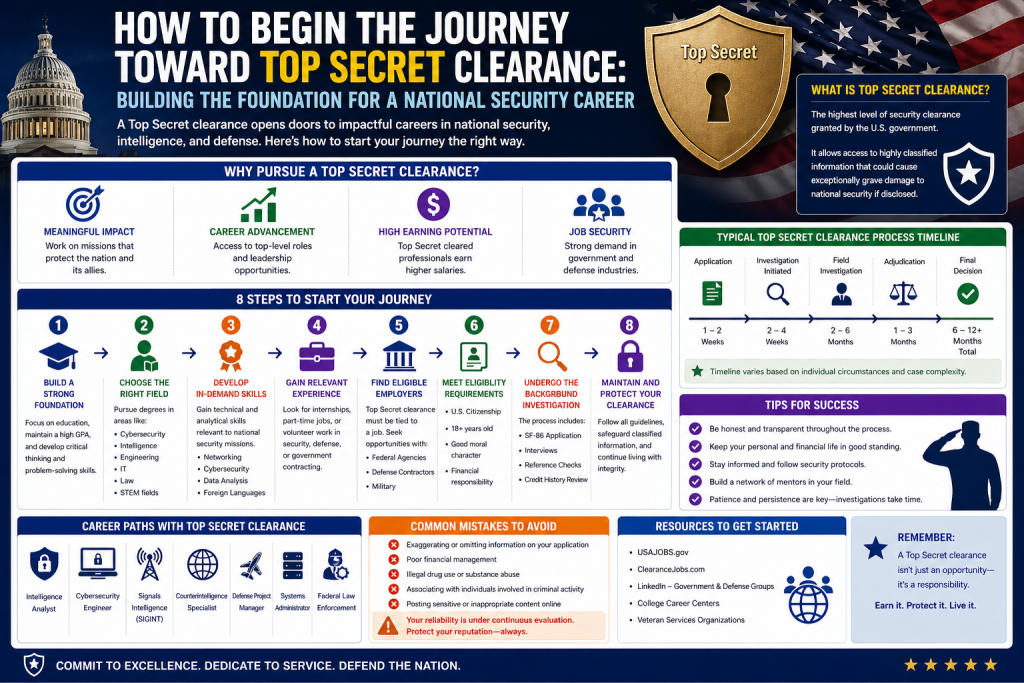
For many professionals, the idea of obtaining Top Secret clearance represents far more than a bureaucratic milestone. It often serves as a gateway into some of the most important and sensitive roles within government agencies, defense organizations, intelligence operations, cybersecurity divisions, and federal contractors. Access to classified information is not simply about prestige or exclusivity. It reflects a demonstrated level of trustworthiness, reliability, and commitment to protecting national interests.
Whether someone dreams of working in cybersecurity for a defense contractor, managing intelligence systems, protecting military communications, or supporting government infrastructure, security clearance can become an essential requirement. Yet many people misunderstand how the process begins. Contrary to popular belief, Top Secret clearance is not something an individual simply applies for independently. It is generally tied to employment, sponsorship, and career progression within organizations that require access to classified systems or information.
Understanding how to begin this journey is critical because the path to Top Secret eligibility often starts long before any official paperwork is filed. Career choices, educational background, financial responsibility, legal history, and professional reputation all influence future eligibility. The process is not merely about passing a background investigation; it is about building a life that can withstand scrutiny.
For aspiring government and defense professionals, the journey often begins by recognizing that security clearance is a professional asset connected to national trust. It is not awarded casually, and each stage requires increasing levels of confidence from investigators and sponsoring agencies. This means your first goal is not necessarily obtaining Top Secret status immediately. Instead, the smartest strategy is positioning yourself for opportunities that can eventually lead there.
Understanding What Security Clearance Really Means
Security clearance is a determination made by the U.S. government that an individual is eligible to access classified information. This determination is based on whether granting such access aligns with national security interests. Clearance is not the same as employment approval, and employment does not automatically grant access to all information. Instead, clearance indicates eligibility, while access depends on role-specific need.
At its core, security clearance exists because governments handle information that could damage national defense, intelligence, diplomatic operations, or public safety if improperly disclosed. Individuals trusted with this information must demonstrate not only technical competence but also strong personal integrity.
The process examines a wide range of factors, including citizenship, criminal history, financial habits, foreign relationships, substance use, mental stability indicators relevant to reliability, and honesty. The emphasis is not on perfection but on trustworthiness. Governments understand that people make mistakes, but deception, concealment, or patterns of irresponsible behavior can raise more concern than past errors that were honestly disclosed.
For many entering technical careers such as IT, cybersecurity, systems administration, engineering, or defense logistics, understanding this distinction matters. Security clearance is fundamentally about reducing risk. The government wants to know whether someone might be vulnerable to coercion, bribery, blackmail, espionage, or negligence.
This is why obtaining clearance is often described as both a professional process and a personal vetting process. Your digital habits, financial discipline, legal compliance, and social connections may all become relevant over time.
Why Most People Do Not Start with Top Secret Clearance
One of the biggest misconceptions is that applicants can simply pursue Top Secret clearance as an entry-level objective. In reality, most individuals begin in roles that either require lower-level clearance or no clearance at all.
Many government agencies and contractors hire for unclassified or lower-sensitivity positions first. These roles allow organizations to evaluate technical ability, reliability, and workplace professionalism while gradually introducing employees to government systems and compliance standards. For example, someone may start as a help desk technician, network support specialist, administrative analyst, or logistics coordinator before advancing into positions that require Secret or Top Secret eligibility.
This gradual progression often makes practical sense because higher clearance investigations are more intensive, expensive, and time-consuming. Agencies may prefer to reserve those investments for employees who have already demonstrated value and commitment.
Starting with a non-classified or lower-classified role can also help candidates understand the culture of federal or defense work. Government environments often involve structured procedures, compliance frameworks, documentation requirements, and operational discipline that differ from many private-sector workplaces.
By proving reliability in these environments, professionals may become stronger candidates for promotion into roles requiring more sensitive access.
This strategy is especially valuable for younger professionals, career changers, or those without military backgrounds. You do not need to begin inside an intelligence agency to eventually qualify for high-level clearance. Many successful cleared professionals began in ordinary technical or administrative roles and advanced through demonstrated competence.
The Importance of In-Demand Skills
Although government hiring can be competitive, certain skill sets consistently improve a candidate’s chances of entering clearance-track roles. Technical fields are especially important.
Cybersecurity, cloud infrastructure, networking, software engineering, digital forensics, systems administration, and intelligence analysis are often areas of significant need. Federal agencies and contractors regularly seek qualified professionals who can protect digital assets, maintain operational continuity, and support mission-critical systems.
This creates opportunities for candidates who hold recognized certifications, degrees, or practical experience. Certifications in networking, cybersecurity, cloud platforms, and systems management may increase competitiveness because they demonstrate baseline competence.
For example, organizations supporting defense contracts often need professionals who understand secure networking, endpoint defense, identity management, or infrastructure resilience. If an employer urgently needs these skills, they may be more willing to sponsor a candidate for the clearance process.
This is one reason technical education can be a strategic entry point into government work. Strong skills can make an employer more willing to invest in your background investigation.
However, technical ability alone is not enough. A highly skilled candidate with severe financial irresponsibility, dishonesty, or legal issues may still face obstacles. Clearance eligibility combines capability with trust.
Government Jobs vs. Government Contractors
A major decision early in this journey is whether to pursue direct government employment or contractor roles.
Government employment often involves agencies such as the Department of Defense, Department of Homeland Security, intelligence organizations, or federal administrative departments. These jobs may provide long-term career pathways, structured advancement, and strong benefits.
Government contractors, on the other hand, are private companies that perform work on behalf of government agencies. Defense contractors, cybersecurity firms, aerospace organizations, and consulting companies frequently sponsor employees for security clearances when project requirements demand it.
For many candidates, contractors can provide faster entry because they may have urgent staffing needs. If a contractor needs a cybersecurity analyst or systems engineer for a classified contract, they may actively recruit and sponsor promising candidates.
This can be an effective route because contractors often bridge the gap between private-sector technical careers and government security environments.
Both paths can lead toward higher-level clearance, but contractor pathways are often more accessible for professionals transitioning from commercial IT or engineering backgrounds.
Citizenship and Basic Eligibility Foundations
Before any advanced planning, candidates should understand baseline eligibility. Security clearance for classified U.S. government information generally requires U.S. citizenship. This foundational requirement is critical.
Even for highly qualified professionals, citizenship status can determine whether sponsorship is possible. Additionally, factors such as allegiance to the United States, foreign influence concerns, and dual citizenship circumstances may be evaluated depending on the role.
Basic eligibility does not guarantee clearance, but lacking core prerequisites can prevent the process from starting.
For those who do qualify, preparation should begin years before sponsorship by developing a stable personal and professional history. This includes:
Maintaining legal compliance
Managing debts responsibly
Filing taxes properly
Avoiding substance abuse issues
Building verifiable employment history
Documenting travel accurately
Using social media responsibly
Clearance investigators often evaluate patterns, not isolated snapshots. A stable track record can strengthen perceived reliability.
Building a Lifestyle That Supports Clearance
Because clearance investigations can examine multiple dimensions of life, future applicants benefit from thinking strategically about personal choices.
Financial health is one of the most underestimated factors. Excessive debt, unpaid obligations, repeated delinquencies, or financial deception may signal vulnerability to coercion. This does not mean wealth is required, but financial responsibility matters.
Similarly, criminal conduct, repeated rule violations, or dishonest behavior can complicate future investigations.
Foreign contacts are another area often misunderstood. Having foreign friends or relatives does not automatically disqualify someone. However, undisclosed foreign relationships or suspicious associations may create concerns. Transparency is often more important than the mere existence of international connections.
Lifestyle choices should be approached with the understanding that future investigators may evaluate judgment, discretion, and consistency.
For those serious about national security careers, professionalism should begin before sponsorship ever occurs.
Why Honesty Becomes Your Most Valuable Asset
A recurring principle throughout the security clearance process is honesty. Many applicants fear that admitting past mistakes will automatically disqualify them, but concealment is often more damaging than the issue itself.
Investigators are trained to assess whole-person reliability. A past debt problem that was resolved responsibly may be less concerning than dishonesty about finances. A youthful mistake may carry less weight than a pattern of deception.
This is why early career planning should include organized personal documentation. Keep accurate records of employment dates, addresses, travel history, education, and legal matters.
When the time comes to complete official forms, accuracy matters. Missing details, inconsistent timelines, or false statements can delay or damage prospects.
Honesty also demonstrates maturity. National security organizations prioritize people who can be trusted under pressure, and truthfulness during vetting reflects that trust.
The Long-Term Career Mindset
Pursuing Top Secret clearance should be viewed as a long-term professional strategy rather than a quick credential.
This mindset changes how candidates approach career development. Instead of asking, “How do I get Top Secret clearance immediately?” a more practical question is, “How do I build a career that positions me for increasing trust and responsibility?”
This may involve:
Starting in lower-clearance roles
Gaining technical certifications
Building government or contractor experience
Developing leadership credibility
Maintaining strong ethical standards
Preparing for deeper investigations over time
As responsibilities increase, organizations may sponsor more advanced clearances.
This progression mirrors many high-trust professions where credibility is earned gradually.
Recognizing the Responsibility Behind Clearance
Top Secret clearance is not merely access. It represents accountability. Individuals trusted with classified information may influence intelligence analysis, military readiness, infrastructure defense, cyber operations, or policy implementation.
This means the journey is not only about passing checks but embracing a mindset of discretion, security awareness, and national responsibility.
Those who succeed often combine technical competence with disciplined judgment. They understand that sensitive information requires careful handling, operational security, and ethical consistency.
Beginning this journey therefore involves more than job applications. It means intentionally shaping a career and lifestyle aligned with trust.
Laying the Groundwork for Future Advancement
The earliest steps matter more than many realize. Education, certifications, first jobs, financial discipline, and personal conduct can all shape later opportunities.
Even if Top Secret feels distant today, every decision can either strengthen or weaken future eligibility.
For someone entering IT, networking, cybersecurity, engineering, or administrative government support, the first milestone is often employability in environments connected to public trust. Once inside, advancement opportunities can expand.
By approaching the process strategically, candidates can move from non-classified positions into Secret roles and eventually toward Top Secret pathways.
This foundation-building stage is where many careers are quietly won or lost.
The Security Clearance Investigation Process: SF-86, Background Checks, and What Happens After You Apply
Once an individual secures a position that requires access to classified government information, the real journey toward security clearance begins. For many aspiring professionals, this stage can feel intimidating because it moves beyond career preparation and into formal government scrutiny. At this point, technical skills and employment qualifications remain important, but the central question changes. The government is no longer asking whether you can do the job. It is determining whether you can be trusted with information that could impact national security.
This stage is often misunderstood because many people imagine it as a simple background check similar to private-sector hiring. In reality, the security clearance process is a detailed investigation designed to assess judgment, reliability, integrity, and vulnerability to coercion. It examines patterns in your life, not just isolated events. Employment history, foreign contacts, finances, legal issues, substance use, travel, education, and personal honesty all become relevant.
At the heart of this process is one of the most important documents in federal vetting: the Standard Form 86, commonly known as the SF-86. Completing this form accurately is one of the first major tests of your readiness for a cleared role. While many applicants focus on the fear of being investigated, experienced professionals understand that organization, transparency, and consistency are often the true keys to success.
Understanding the security clearance investigation process before it begins can significantly reduce delays, improve confidence, and help candidates avoid mistakes that unnecessarily complicate their cases.
Why the Investigation Process Exists
Security clearances are fundamentally about risk management. Governments must determine whether granting classified access could expose national interests to danger through negligence, manipulation, espionage, or poor judgment.
This is why the process goes beyond criminal checks. A person may have no criminal history and still present concerns if they have major undisclosed debts, deceptive behavior, or risky foreign entanglements. Conversely, a person with past difficulties may still qualify if issues were resolved responsibly and disclosed honestly.
The investigation process is designed to answer several core questions:
Can this individual be trusted with sensitive information?
Is this person vulnerable to blackmail or coercion?
Have they demonstrated consistent judgment?
Are they truthful when discussing their history?
Do their actions align with national security expectations?
Rather than seeking perfection, investigators typically seek reliability and transparency.
This distinction matters because many applicants fear that any mistake in life automatically disqualifies them. In many cases, the larger threat is dishonesty, omission, or unresolved patterns.
The SF-86: The Foundation of the Clearance Investigation
The Standard Form 86 is one of the most comprehensive employment-related questionnaires many people will ever complete. It serves as the backbone of your investigation by documenting your personal history in extensive detail.
This form can exceed 100 pages depending on circumstances, but its complexity comes less from difficult questions and more from the depth of information required.
Applicants are typically asked to provide:
Residential history
Employment history
Educational background
Foreign travel
Foreign contacts
Family information
Financial records
Criminal history
Substance use disclosures
Military service details
Mental health considerations relevant to security evaluation
Technology misuse history
Civil legal matters
For many candidates, the most difficult part is not the questions themselves but reconstructing years of accurate information. If you have moved frequently, worked multiple jobs, traveled internationally, or maintained numerous foreign associations, collecting details can become time-consuming.
Accuracy is critical because inconsistencies may trigger follow-up questions, delays, or credibility concerns.
A practical strategy is to begin gathering this information long before sponsorship if you anticipate entering government or defense work. Keeping organized records of addresses, supervisor names, dates, and travel can save significant stress later.
Preparing Before You Fill Out the SF-86
One of the smartest ways to reduce errors is preparation. Before starting the SF-86, applicants should compile records covering at least the previous decade.
Useful documents often include:
Tax records
Employment contracts
W-2 forms
Lease agreements or mortgage documents
Passport records
Travel itineraries
Academic transcripts
Contact details for references
Court documents if applicable
Financial account summaries
The form often asks for names, addresses, and dates connected to places you lived, worked, or studied. Even small date inaccuracies can create investigative friction.
Preparation also helps applicants identify potentially sensitive areas in advance. For example, if you experienced financial hardship, legal trouble, or foreign relationships that may require explanation, gathering documentation and context early can support smoother review.
This stage is not about creating a perfect image. It is about presenting a complete and honest one.
The Importance of Full Disclosure
Many delays and denials stem not from life events themselves but from incomplete or deceptive answers.
For example, if an applicant omits prior drug use, foreign relationships, or legal incidents that investigators later uncover, the omission can be interpreted as dishonesty. In national security contexts, dishonesty often raises larger concerns than the disclosed conduct.
This is why full disclosure matters.
If you made mistakes, explain them truthfully. If you have debts, document repayment efforts. If you traveled extensively, disclose it carefully. Investigators often appreciate accountability more than concealment.
The government recognizes that people can mature, recover, and improve. What creates concern is whether someone appears deceptive, reckless, or vulnerable.
Background Investigation: What Investigators Actually Do
Once the SF-86 is submitted, the formal background investigation begins. The scope depends on the clearance level requested, but investigators may verify nearly every category you disclosed.
This process can include:
Employment verification
Education confirmation
Criminal record checks
Credit history analysis
Reference interviews
Neighbor interviews
Supervisor interviews
Military records review
Foreign contact evaluation
Travel pattern analysis
For Secret and especially Top Secret investigations, investigators may conduct personal interviews with people who know you. These conversations help validate your reliability, habits, and character.
Neighbors may be asked whether your behavior appears suspicious or unstable. Employers may be asked about professionalism, conduct, and trustworthiness. References may be asked about honesty, substance use, or foreign influence concerns.
The process can feel invasive, but its purpose is verification.
Investigators are looking for consistency between your claims and observable reality.
Financial Review and Why Money Matters
Financial health plays a larger role in clearance investigations than many applicants expect.
Excessive debt, unpaid taxes, gambling issues, unexplained wealth, or patterns of financial irresponsibility can signal vulnerability. Governments are particularly concerned that severe financial distress could increase susceptibility to bribery or coercion.
This does not mean someone with student loans or temporary hardship is automatically disqualified. Context matters.
Investigators often distinguish between:
Unexpected hardship with responsible recovery
Medical debt
Job loss recovery
Poor financial judgment
Chronic delinquency
Fraudulent conduct
If financial issues exist, demonstrating repayment plans, transparency, and improved habits can help.
Ignoring debts or concealing them creates greater concern than acknowledging them.
Foreign Influence and Foreign Preference Considerations
Foreign contacts are another critical area. Many applicants worry that international family or travel automatically harms clearance eligibility. In reality, foreign relationships are evaluated for context and potential security implications.
Investigators may assess:
Foreign relatives
Foreign business interests
International property ownership
Foreign government ties
Frequent travel patterns
Foreign financial accounts
The key concern is whether these relationships could create divided loyalties, external pressure, or security vulnerabilities.
Simply knowing or being related to foreign nationals does not necessarily disqualify someone. However, undisclosed or suspicious relationships may raise concern.
Again, honesty and context are essential.
The Subject Interview
For higher-level investigations, applicants may undergo a direct interview with an investigator.
This interview often reviews your SF-86 responses, clarifies discrepancies, and explores areas requiring more detail.
Topics may include:
Past substance use
Financial problems
Legal incidents
Foreign relationships
Employment issues
Personal conduct
This stage can feel stressful, but preparation helps. Review your SF-86 thoroughly before the interview so your answers remain consistent.
The purpose is often clarification, not intimidation.
Investigators are trained to assess credibility, so calm honesty is usually the strongest approach.
Polygraphs and Enhanced Screening
For certain intelligence or highly sensitive positions, applicants may face polygraph examinations or additional screening beyond standard background investigations.
These evaluations are generally associated with specialized intelligence roles or Sensitive Compartmented Information access.
Polygraphs are often used to assess consistency around specific security concerns such as espionage, sabotage, terrorism, or unauthorized disclosures.
This stage can increase anxiety, but the same principle remains: truthful consistency matters.
Trying to manipulate or outsmart security procedures often creates more risk than straightforward cooperation.
Adjudication: The Final Decision Stage
After investigation, the case moves to adjudication.
Adjudicators review all collected information using national security guidelines. They assess the “whole person” rather than isolated facts.
Factors considered may include:
Severity of issues
Frequency of concerns
Recency of behavior
Evidence of rehabilitation
Honesty during disclosure
Mitigating circumstances
This means a single issue does not always determine outcome. A resolved financial issue may be viewed differently than ongoing deception. A youthful mistake may carry less weight than repeated misconduct.
Adjudication balances risk against evidence of trustworthiness.
Common Reasons for Delays
Security clearance investigations can take time, especially for higher levels. Delays often result from:
Incomplete SF-86 forms
Missing dates
Undisclosed travel
Foreign contact complexity
Financial inconsistencies
Reference difficulties
Name mismatches
Legal documentation gaps
Applicants who prepare thoroughly often reduce avoidable setbacks.
Patience is also essential. Investigations involve multiple agencies, records systems, and interviews.
Interim Clearances
In some cases, applicants may receive interim clearance while full adjudication continues. This can allow limited access sooner, depending on role and agency discretion.
Interim approval is not guaranteed and may be denied even if final clearance is later granted.
It simply reflects preliminary confidence while deeper review continues.
Reinvestigations and Continuous Vetting
Security clearance is not permanently granted without oversight.
Historically, reinvestigations occurred periodically depending on clearance level. Modern systems increasingly use continuous vetting, which monitors relevant risk indicators over time.
This means financial misconduct, arrests, or serious security concerns can trigger review even after approval.
Clearance is therefore an ongoing responsibility, not a one-time achievement.
Managing Stress During the Process
Because the process can feel deeply personal, many applicants experience anxiety.
The most effective mindset is preparation plus honesty.
Do not assume every imperfection means failure. Focus on:
Accuracy
Documentation
Transparency
Responsibility
Consistency
Security professionals are not seeking flawless lives. They are evaluating whether you can be trusted.
Understanding Security Clearance Levels, Career Growth, and Long-Term Success in National Security Roles
For professionals pursuing government, defense, intelligence, or cybersecurity careers, reaching the final stages of the security clearance journey is about more than simply being approved. Once someone enters the cleared workforce, an entirely new professional landscape opens—one defined by responsibility, access, opportunity, and long-term accountability. Security clearance is not merely a hiring requirement. It can become a foundational career asset that shapes job options, salary potential, leadership opportunities, and professional credibility for years or even decades.
Yet one of the most misunderstood aspects of this journey is what happens after the initial approval. Many people focus heavily on obtaining clearance without fully understanding the distinctions between different clearance levels, how promotions can expand access, what ongoing responsibilities cleared professionals carry, and how strategic career decisions can influence advancement into elite positions.
From Confidential to Secret, Top Secret, and Sensitive Compartmented Information, each level represents a greater degree of trust and scrutiny. But these levels also represent different career ecosystems. They influence where you can work, what projects you can support, and how much responsibility you may hold within national security structures.
To truly maximize the value of security clearance, professionals must understand both the hierarchy of access and the long-term strategies required to build a stable, ethical, and upward-moving career.
Why Security Clearance Levels Matter Beyond Basic Access
Security clearance levels are designed to align access privileges with the sensitivity of information and the potential damage unauthorized disclosure could cause.
This tiered structure serves two purposes:
Protecting national security by limiting unnecessary access
Ensuring individuals receive only the level of trust required for their duties
For employees, however, clearance levels often shape career trajectory.
Higher clearance can increase access to specialized projects, intelligence systems, strategic operations, defense technologies, or advanced cybersecurity environments. In many sectors, clearance level can directly influence employability because certain roles simply cannot be filled by uncleared candidates.
This creates a professional reality in which clearance level can become part of your market value.
For example, in defense contracting, an individual with active Top Secret eligibility may be significantly more competitive for certain mission-critical positions than someone equally skilled but uncleared.
This does not mean clearance replaces expertise. Rather, it can amplify opportunity when paired with technical skill, leadership, and operational trust.
Confidential Clearance: The Foundational Entry Point
Confidential clearance is generally considered the baseline level of classified access. It applies to information that could cause measurable damage to national security if disclosed improperly.
While often viewed as the least prestigious level, Confidential clearance can still serve an important purpose for early career professionals.
This level may apply to administrative roles, support positions, lower-risk operational duties, or foundational government work where sensitive information exists but the highest risks are limited.
For some, Confidential clearance serves as a first step into federal employment or contractor environments.
The value here is often not the clearance itself but the environment it introduces. Professionals begin learning security protocols, compliance standards, data handling expectations, and operational culture.
These experiences can build credibility for future advancement.
Even at this stage, cleared professionals are expected to maintain standards involving discretion, reporting obligations, and behavioral reliability.
Secret Clearance: Expanding Responsibility and Opportunity
Secret clearance is one of the most common and professionally significant levels across military, federal, and defense contracting sectors.
This level grants access to information that could cause serious damage to national security if compromised.
For many IT specialists, engineers, cybersecurity analysts, communications professionals, and defense support staff, Secret clearance is often where meaningful career acceleration begins.
Roles requiring Secret clearance may include:
Network administration
Cyber defense
Defense logistics
Military systems support
Federal law enforcement support
Secure communications
Systems engineering
At this level, employers often expect stronger technical competence and more consistent personal stability because the sensitivity of accessible systems increases.
Secret clearance can significantly expand job mobility, especially in defense-heavy industries where classified contracts are common.
Professionals who maintain active Secret clearance while developing in-demand technical expertise often position themselves for promotions into more advanced operational roles.
Because Secret clearance is reevaluated periodically, maintaining eligibility becomes part of long-term career discipline.
Top Secret Clearance: A Major Professional Milestone
Top Secret clearance represents one of the most powerful trust indicators in government and defense careers.
This level is granted when unauthorized disclosure could cause exceptionally grave damage to national security.
Top Secret professionals may work in environments involving:
Strategic defense systems
Advanced intelligence operations
National cybersecurity initiatives
Counterterrorism programs
Diplomatic security
Military planning
Sensitive infrastructure defense
Because of the deeper investigative process, active Top Secret clearance can significantly increase access to specialized opportunities.
However, Top Secret status also carries heightened responsibility. Individuals may face stricter operational protocols, compartmentalization, and ongoing scrutiny.
Professionals at this level often discover that career growth depends not only on technical mastery but also on emotional maturity, operational discretion, and leadership credibility.
Top Secret clearance can become a career differentiator, but only if paired with performance.
Simply holding clearance does not guarantee advancement. Employers still prioritize competence, judgment, and mission effectiveness.
Sensitive Compartmented Information and Specialized Access
Sensitive Compartmented Information, often associated with intelligence and highly restricted national security operations, represents access to particularly sensitive sources, methods, or compartmented programs.
This level is not merely “higher” than Top Secret in a simple ranking sense. Rather, it reflects additional control systems and specialized eligibility.
SCI environments may involve:
Signals intelligence
Human intelligence
Advanced surveillance systems
Strategic geopolitical intelligence
Counterintelligence
Special access operational frameworks
Professionals in SCI roles often undergo polygraphs, expanded interviews, and strict compartmentalization.
This level can create extraordinary career opportunities but also substantial lifestyle responsibility.
Access may involve heightened travel considerations, disclosure rules, and need-to-know limitations that affect daily operations.
SCI careers can be intellectually rewarding, but they require exceptional discipline.
How Career Advancement Typically Happens
Most cleared careers do not progress automatically. Advancement often depends on a combination of:
Performance
Skill development
Leadership
Clearance maintenance
Specialization
Networking
Mission reliability
For example, a cybersecurity analyst with Secret clearance may improve advancement potential by earning advanced certifications, supporting classified projects effectively, and developing expertise in cloud security or threat intelligence.
Similarly, a systems engineer with Top Secret clearance may advance faster through leadership development, project management capability, or specialized mission knowledge.
The key is recognizing that clearance opens doors, but capability determines how far you walk through them.
The Role of Certifications and Education
Clearance alone rarely guarantees elite opportunity. Education and certifications often amplify its value.
Fields such as cybersecurity, intelligence analysis, engineering, and information systems frequently reward professionals who combine clearance with specialized credentials.
Examples may include:
Cybersecurity certifications
Cloud architecture certifications
Intelligence analysis training
Systems engineering expertise
Project management credentials
When employers evaluate candidates for sensitive programs, a combination of clearance plus technical credibility often creates stronger competitiveness than either factor alone.
This is especially true in contractor ecosystems where urgent classified needs intersect with specialized technical requirements.
Financial and Lifestyle Discipline After Approval
Many professionals mistakenly assume that once clearance is granted, scrutiny ends.
In reality, clearance maintenance is an ongoing responsibility.
Financial misconduct, criminal issues, unauthorized disclosures, or concerning foreign relationships can threaten active status.
This means long-term success often depends on:
Responsible debt management
Legal compliance
Security protocol adherence
Reporting foreign contacts when required
Avoiding unauthorized data handling
Substance responsibility
Ethical digital conduct
Clearance can be suspended or revoked if trust deteriorates.
Therefore, lifestyle discipline remains central to career protection.
Security Clearance and Salary Potential
While salaries vary widely by field, location, and specialization, security clearance can increase earning potential because employers often value already-vetted candidates.
Reasons include:
Reduced sponsorship costs
Faster onboarding
Access to classified contracts
Specialized mission readiness
In competitive defense markets, active clearance can create leverage.
However, salary growth depends heavily on combining clearance with scarce or strategic capabilities.
A cleared cybersecurity architect may command far more value than a cleared but lower-specialization employee.
Thus, clearance should be viewed as a force multiplier rather than a substitute for expertise.
Transitioning Between Government and Private Sector
One major advantage of clearance is portability across certain sectors.
Many professionals transition between:
Military service
Federal agencies
Defense contractors
Cybersecurity firms
Aerospace companies
Intelligence support organizations
This mobility can create career resilience.
For example, someone leaving direct government service may leverage active clearance into contractor opportunities with competitive compensation.
Likewise, contractor professionals may transition into federal roles with established trust credentials.
Strategic career planning can therefore transform clearance into a long-term professional ecosystem.
Leadership in Cleared Environments
As professionals rise, leadership expectations expand.
Senior cleared professionals may oversee teams, programs, compliance systems, or mission-critical projects.
At this stage, trust extends beyond handling information—it includes managing others responsibly.
Leadership roles often require:
Operational judgment
Risk awareness
Policy compliance
Personnel reliability
Strategic thinking
Crisis management
This progression can transform clearance from personal eligibility into organizational influence.
Challenges of Cleared Careers
While opportunities can be substantial, cleared careers also involve challenges.
These may include:
Lengthy investigations
Periodic reviews
Restricted disclosure
Lifestyle scrutiny
Compartmentalized work
Operational stress
Potential relocation
Higher accountability
For some, these realities can feel restrictive.
For others, they are worthwhile trade-offs for mission impact and professional significance.
Understanding these realities early helps professionals build sustainable expectations.
Planning for Longevity
Long-term success in cleared careers often depends on thinking beyond immediate access.
Professionals who thrive typically invest in:
Continuous learning
Ethical consistency
Technical modernization
Professional networking
Adaptability
Leadership readiness
Security environments evolve constantly, particularly in cyber, intelligence, and defense.
Those who remain valuable are often those who evolve with emerging threats and technologies.
Conclusion: Security Clearance as a Career Platform, Not Just a Credential
Reaching the final stages of security clearance is not the end of a process. It is the beginning of a career framework built on trust, discipline, and strategic opportunity.
From Confidential to Secret, Top Secret, and Sensitive Compartmented Information, each level represents more than access—it reflects increasing national confidence in an individual’s judgment and reliability.
But true long-term success requires more than approval.
It demands continuous integrity, strong performance, specialized capability, and lifestyle responsibility.
Security clearance can absolutely open extraordinary doors in cybersecurity, intelligence, defense, engineering, and government leadership. Yet those doors remain open longest for professionals who treat clearance not as a trophy, but as an ongoing commitment.
For ambitious individuals, the greatest advantage is not simply obtaining clearance.
It is building a career worthy of keeping it, growing through it, and using it to serve at increasingly meaningful levels.
In the end, security clearance is not just about being trusted once.
It is about proving, repeatedly, that you deserve to be trusted again.
Continue exploring the technologies and certification concepts that matter most to you.