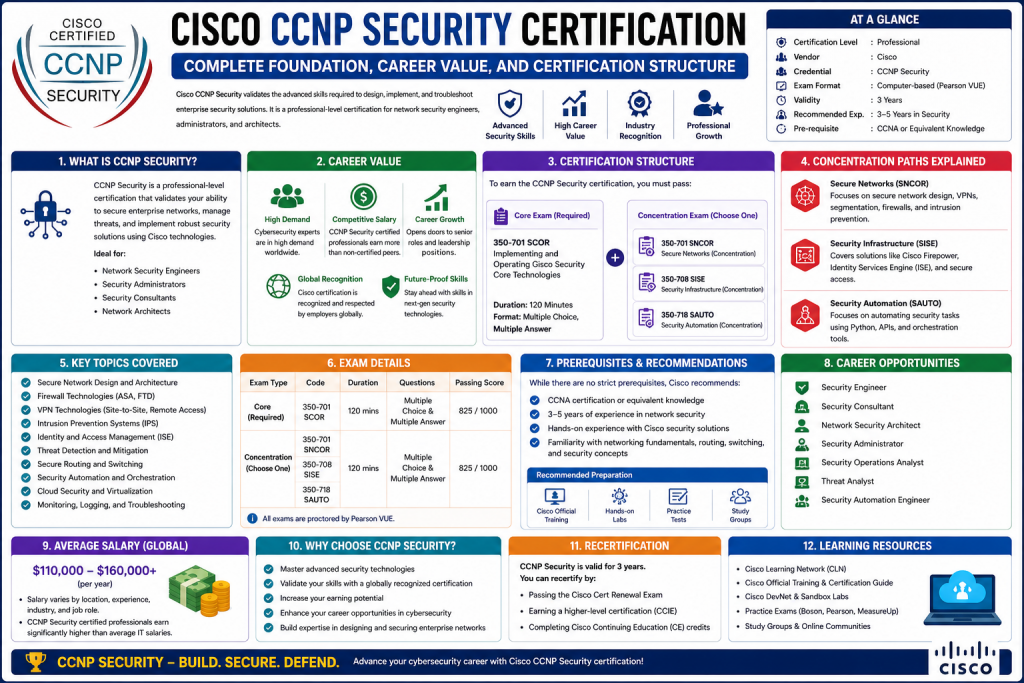
The Cisco Certified Network Professional Security certification stands as one of the most respected professional credentials for IT specialists who want to build, secure, and manage modern enterprise security infrastructures. As cyber threats continue to expand in complexity, organizations increasingly require security professionals who can do more than simply configure firewalls or deploy antivirus software. They need experts who understand how to architect, operate, troubleshoot, and optimize security technologies across diverse environments that include on-premises infrastructure, cloud ecosystems, remote access frameworks, and advanced threat defense systems.
This is where the CCNP Security certification holds tremendous professional significance. It is not an entry-level credential, nor is it designed for individuals who are merely beginning their networking journey. Instead, it serves as a professional-level benchmark for individuals who already possess foundational networking or security knowledge and want to validate advanced capabilities in securing enterprise environments using Cisco technologies and security principles.
Cisco has long been a dominant force in enterprise networking, and its certifications often reflect practical, real-world responsibilities that IT professionals encounter in production environments. The CCNP Security path was developed to address the growing demand for professionals who can secure routers, switches, firewalls, VPN technologies, identity systems, endpoint protections, and policy-driven architectures. This certification demonstrates that a candidate can effectively implement security controls while maintaining business continuity, scalability, and performance.
For many employers, the CCNP Security certification represents more than a technical accomplishment. It signifies that a candidate understands the broader operational realities of enterprise defense. This includes not only technology deployment but also strategic security integration, visibility, access enforcement, and policy implementation.
Understanding the Role of CCNP Security in Modern IT
Security is no longer an isolated function handled by a single appliance or dedicated team. In modern enterprises, security is integrated into every layer of the infrastructure. Networks must be designed with segmentation, access control, encryption, and threat visibility from the beginning. Remote workforces require secure VPNs and zero-trust frameworks. Cloud adoption introduces identity complexity, application protection challenges, and hybrid security concerns.
The CCNP Security certification addresses these realities by focusing on practical technologies used to secure enterprise environments.
Professionals pursuing this certification often work in roles such as:
- Network Security Engineer
- Security Administrator
- Security Consultant
- Systems Engineer
- Security Operations Specialist
- Infrastructure Security Analyst
- Security Architect
These professionals are expected to design and maintain security systems that protect organizational resources while enabling business productivity.
Unlike broad cybersecurity certifications that may focus heavily on governance, policy, or general security theory, CCNP Security emphasizes implementation and operations. It is deeply technical, infrastructure-centric, and aligned with real-world enterprise networking.
This distinction makes it particularly valuable for professionals who operate in environments where Cisco technologies play a major role, including large corporations, government agencies, educational institutions, managed service providers, and telecommunications organizations.
Why Cisco CCNP Security Remains Highly Relevant
Technology trends constantly evolve, and certification programs often lose relevance if they fail to adapt. Cisco has remained competitive because it continually updates its certification frameworks to reflect changing enterprise realities.
CCNP Security remains relevant because it aligns with several major industry shifts:
Rise of Hybrid Work
Remote and hybrid work environments have made secure access essential. VPN technologies, identity verification, and secure endpoint management are more important than ever.
Growth of Zero Trust Security
Organizations increasingly focus on identity-centric access controls. Cisco security frameworks emphasize visibility, authentication, and policy enforcement.
Cloud Security Expansion
Modern enterprise security extends beyond physical networks. Security professionals must understand how cloud resources interact with network security controls.
Automation and Programmability
Security is no longer entirely manual. Professionals must increasingly understand automation tools, APIs, and programmable security frameworks.
Threat Landscape Complexity
From ransomware to insider threats, modern attacks require integrated security systems capable of visibility, segmentation, and response.
CCNP Security validates that professionals are prepared to address these modern challenges rather than relying solely on outdated perimeter-based security concepts.
The Evolution of Cisco Certifications
Cisco certifications have undergone significant restructuring over the years. Previously, Cisco offered multiple specialized tracks at associate and professional levels, often requiring prerequisite certifications before progressing.
The modern certification framework is more streamlined and job-role focused.
Historically, certifications like CCNA Security served as stepping stones. Today, Cisco has simplified this pathway by focusing on practical skill progression rather than rigid prerequisite ladders.
This shift benefits learners because it allows more flexibility while still maintaining professional rigor. Candidates can pursue CCNP Security without formally holding older prerequisite certifications, though foundational knowledge remains essential.
This restructuring also reflects a broader industry truth: employers increasingly care less about certification hierarchy and more about role readiness.
CCNP Security therefore serves as a practical demonstration of operational competence rather than simply academic progression.
Core Philosophy Behind the Certification
At its heart, CCNP Security is designed around the principle that enterprise security requires layered defense.
A professional earning this certification must understand multiple interconnected domains, including:
Network Security
Protecting routers, switches, and communication pathways from unauthorized access or disruption.
Secure Access
Ensuring that only authenticated users and devices can access protected systems.
VPN Technologies
Building encrypted pathways for secure remote communication.
Endpoint Security
Protecting user devices that connect to enterprise resources.
Content Security
Managing email, web, and data security against malicious threats.
Visibility and Enforcement
Using monitoring and policy tools to maintain oversight and compliance.
This broad scope reflects the reality that enterprise security is not a single product category but a coordinated architecture.
Who Should Consider Pursuing CCNP Security
Not every IT professional needs CCNP Security, but for the right candidate, it can be transformative.
This certification is especially valuable for:
Experienced Network Engineers
Professionals transitioning from traditional routing and switching into security-focused roles.
Security Administrators
Individuals seeking deeper technical expertise in enterprise-grade security technologies.
Systems Engineers
Professionals working with integrated enterprise systems requiring secure architecture knowledge.
Career Changers Within IT
Those moving from general infrastructure or support into security specialization.
Cisco-Centric Professionals
IT specialists in organizations heavily invested in Cisco ecosystems.
CCNP Security may be less suitable for individuals focused purely on governance, policy, penetration testing, or software development unless Cisco infrastructure security is central to their goals.
Strategic Career Benefits
The value of CCNP Security extends beyond technical learning.
Professional Credibility
Cisco certifications are globally recognized and often respected by hiring managers.
Higher Responsibility Roles
Professionals often qualify for advanced infrastructure and security management roles.
Salary Growth Potential
Advanced certifications can improve compensation opportunities when paired with practical experience.
Specialization Advantage
Security specialization often creates stronger long-term demand than general networking.
Preparation for Elite Certifications
CCNP Security often serves as a stepping stone toward CCIE Security.
This combination of technical capability and market credibility makes CCNP Security particularly appealing for professionals seeking advancement rather than simply job entry.
The Two-Exam Structure Explained
Cisco designed CCNP Security to balance broad expertise with specialization.
Candidates must pass:
A Core Exam
This validates broad security knowledge across enterprise technologies.
A Concentration Exam
This allows specialization in a focused area such as firepower, identity services, VPNs, automation, or content security.
This structure offers several advantages:
- Broad professional competency
- Role-specific customization
- Greater employer relevance
- Adaptability to industry changes
This model recognizes that while all security professionals need core understanding, many roles require deeper expertise in specific platforms or technologies.
Professional Depth Over Memorization
One defining strength of CCNP Security is that it is not purely theoretical.
Cisco exams often emphasize:
- Scenario analysis
- Troubleshooting
- Configuration understanding
- Security design logic
- Operational judgment
This means successful candidates usually need practical familiarity, not just memorized terminology.
Employers often value this because certification holders are more likely to contribute operationally rather than simply demonstrate textbook awareness.
Industry Demand for Security Expertise
The cybersecurity labor market continues to grow because digital infrastructure has become central to nearly every industry.
Organizations now face:
- Increased ransomware threats
- Compliance pressures
- Identity attacks
- Remote workforce vulnerabilities
- Cloud misconfigurations
- Data breach costs
This means security certifications tied to infrastructure operations remain highly valuable.
CCNP Security’s enterprise focus makes it especially relevant for organizations managing complex network environments rather than purely software-based security ecosystems.
How CCNP Security Compares to Other Security Certifications
While many security certifications exist, CCNP Security occupies a distinct niche.
Compared to CompTIA Security+
More advanced, more technical, and more infrastructure-specific.
Compared to CISSP
More implementation-focused, less governance-heavy.
Compared to CEH
More enterprise defense-oriented, less offensive-security focused.
Compared to Vendor-Neutral Certifications
More Cisco-specific but often deeper in enterprise networking environments.
This specificity can be a major advantage in Cisco-heavy infrastructures.
Long-Term Professional Identity
For many professionals, CCNP Security is not just a certification—it becomes part of their professional identity.
It signals:
- Enterprise readiness
- Security specialization
- Operational capability
- Technical maturity
- Career seriousness
Because security increasingly intersects with architecture, cloud, and automation, this certification can also create pathways into broader leadership roles over time.
Challenges Candidates Should Expect
CCNP Security is highly respected partly because it is challenging.
Candidates should prepare for:
Broad Technical Scope
Multiple security domains require mastery.
Depth of Knowledge
Surface familiarity is often insufficient.
Hands-On Complexity
Practical configuration experience matters.
Constant Evolution
Security technologies and exam objectives can change.
This difficulty should not discourage learners. Instead, it reflects the professional-level nature of the certification.
Mindset for Success
Success with CCNP Security often requires more than study materials alone.
Effective candidates typically combine:
- Structured study plans
- Hands-on labs
- Practice exams
- Real-world troubleshooting
- Time management
- Consistency
This certification rewards strategic preparation rather than cramming.
The Bigger Picture
The CCNP Security certification exists at the intersection of networking, cybersecurity, and enterprise operations.
Its true value lies not merely in passing exams but in developing the ability to protect modern organizations against evolving risks while enabling secure growth.
As businesses continue digital transformation, professionals who can combine security knowledge with infrastructure competence are likely to remain highly valuable.
CCNP Security represents that combination.
For aspiring and experienced security professionals alike, it can serve as a major professional milestone—one that validates advanced knowledge, strengthens career opportunities, and positions candidates for increasingly strategic roles in modern cybersecurity.
Cisco CCNP Security Exam Details, Specialization Paths, Prerequisites, Costs, and Preparation Strategy
Earning the Cisco Certified Network Professional Security certification requires more than simply deciding to pursue a respected credential. It involves understanding Cisco’s exam architecture, selecting the right specialization path, evaluating current skills, planning financially, and developing a preparation strategy that matches the depth and complexity of professional-level enterprise security. While many certifications can be approached as isolated exams, CCNP Security is better understood as a structured career framework designed to validate practical competence across broad security technologies and specialized implementation domains.
Cisco’s certification model reflects real-world enterprise requirements. Security professionals rarely operate in narrow technical silos. Instead, they must combine broad operational understanding with focused expertise in technologies such as identity management, firewalls, VPN infrastructures, automation, or content security. This is why Cisco structured CCNP Security around both a foundational core and a concentration pathway.
For candidates, this means success depends not only on passing exams but also on making informed strategic decisions about which technologies best align with career goals.
The Modern CCNP Security Certification Structure
Cisco redesigned its professional certifications to create a more flexible but still rigorous framework. Instead of forcing candidates through outdated prerequisite ladders, Cisco now allows professionals to demonstrate readiness through direct examination.
To earn CCNP Security, candidates must pass two exams:
The Core Exam
This serves as the foundation and validates broad security knowledge.
One Concentration Exam
This allows candidates to specialize in a particular area of Cisco security.
This structure is strategically important because it balances enterprise-wide understanding with role-specific capability.
For example, a security engineer responsible for firewall deployments may choose a different concentration than an identity specialist managing enterprise authentication frameworks.
This flexibility allows candidates to shape their certification around career objectives while still meeting a consistent professional standard.
The Core Exam: 350-701 SCOR
The Implementing and Operating Cisco Security Core Technologies exam, commonly known as SCOR, is the centerpiece of the CCNP Security certification.
This exam is designed to measure whether a candidate understands the broad architecture of modern enterprise security and can apply Cisco security principles across multiple environments.
Major Knowledge Domains Include:
- Security concepts
- Network security
- Secure network access
- Cloud security
- Content security
- Endpoint protection
- Visibility and enforcement
This breadth is intentional. Cisco recognizes that enterprise security professionals must think holistically rather than focusing only on one device category.
Exam Format
Candidates typically encounter:
- Multiple-choice questions
- Multiple-response questions
- Drag-and-drop scenarios
- Simulations
- Simlets
- Fill-in-the-blank questions
- Scenario-based problem solving
This structure means the exam is not simply about recalling facts. Candidates must often interpret technical environments, identify best practices, troubleshoot issues, and choose implementation strategies.
Why SCOR Is Challenging
Many learners underestimate the SCOR exam because they assume “core” means basic. In reality, SCOR is broad and professionally demanding.
Key Challenges Include:
Technical Diversity
Candidates must understand multiple security disciplines rather than specializing in one area.
Practical Logic
Cisco exams frequently emphasize operational judgment.
Policy + Technology Integration
Security is tested not only as configuration but also as enforcement and architecture.
Emerging Technologies
Automation, cloud, and modern access controls increasingly influence exam relevance.
SCOR often serves as both a certification requirement and a valuable standalone benchmark because it also qualifies candidates for Cisco Certified Specialist recognition.
Concentration Exams: Building Specialization
After completing the core exam, candidates choose one concentration exam. This decision can significantly shape career direction.
300-710 SNCF (Securing Networks with Cisco Firepower)
This concentration is ideal for professionals focused on firewall technologies, threat defense, intrusion prevention, and policy enforcement.
Best For:
- Firewall administrators
- Security engineers
- Threat defense specialists
- Network defenders
This path is often attractive for professionals managing perimeter and internal segmentation security.
300-715 SISE (Implementing and Configuring Cisco Identity Services Engine)
This concentration focuses heavily on identity, access control, authentication, and policy.
Best For:
- Identity architects
- Zero trust specialists
- NAC administrators
- Access control engineers
As organizations prioritize zero-trust security, identity-focused expertise continues to grow in importance.
300-720 SESA (Securing Email with Cisco Email Security Appliance)
This path emphasizes email threat management, phishing prevention, and content protection.
Best For:
- Messaging security professionals
- Email administrators
- Content security analysts
Though narrower, this specialization remains highly relevant because email remains a dominant threat vector.
300-725 SWSA (Securing the Web with Cisco Web Security Appliance)
This specialization focuses on web filtering, acceptable use controls, and malicious web traffic defense.
Best For:
- Web security administrators
- Proxy specialists
- Content governance professionals
300-730 SVPN (Implementing Secure Solutions with VPNs)
This concentration centers on remote access and encrypted communication.
Best For:
- Remote access engineers
- VPN architects
- Secure connectivity professionals
Given hybrid work realities, this concentration often remains strategically valuable.
300-735 SAUTO (Automating and Programming Cisco Security Solutions)
This path reflects the future of security operations.
Best For:
- Security automation engineers
- DevSecOps professionals
- API-focused specialists
- Programmability experts
Automation is increasingly becoming a strategic differentiator for enterprise-scale environments.
Choosing the Right Concentration
Candidates should not choose concentration exams solely based on perceived difficulty.
Instead, evaluate:
Current Role
What technologies do you use today?
Career Direction
Where do you want to specialize?
Market Demand
What skills are employers seeking?
Personal Interest
Which domain motivates sustained learning?
A well-aligned concentration can strengthen both exam success and long-term professional growth.
Prerequisites: Official vs Practical
Cisco does not impose formal prerequisites for CCNP Security.
This means technically anyone can attempt the certification.
However, practical readiness is another matter entirely.
Recommended Background:
- Three to five years of security or networking experience
- Understanding of enterprise networking
- Familiarity with Cisco environments
- Basic routing and switching knowledge
- Security fundamentals
Without foundational knowledge, candidates may struggle not because the material is impossible, but because professional-level security assumes prior competence.
Is CCNA Necessary?
While no longer mandatory, CCNA or equivalent knowledge remains highly beneficial.
CCNA helps establish:
- IP connectivity fundamentals
- Routing principles
- Switching concepts
- Infrastructure services
- Security basics
Without these skills, CCNP Security may feel overwhelming because advanced security often builds on networking assumptions.
Cost Considerations
Professional certifications are financial investments.
Core Exam Cost
Approximately $400 USD
Concentration Exam Cost
Approximately $300 USD
Total Direct Exam Cost
Typically around $700 USD
However, true investment often includes:
- Training subscriptions
- Practice exams
- Lab platforms
- Official guides
- Retake costs
- Time investment
Candidates should budget realistically.
Beyond Money: Opportunity Cost
Preparing for CCNP Security can require hundreds of hours depending on experience.
This means candidates should evaluate:
- Current workload
- Family responsibilities
- Study schedule consistency
- Career urgency
Strategic pacing often leads to better results than rushing.
Study Resources That Matter
Not all study methods are equally effective.
Official Cisco Blueprints
Always begin with exam objectives.
These define what Cisco expects.
Video Training
Useful for structured guidance and conceptual clarity.
Hands-On Labs
Critical for operational understanding.
Security concepts become significantly clearer through implementation.
Practice Exams
Valuable for pacing and identifying knowledge gaps.
Documentation
Cisco official documentation can deepen understanding.
Community Learning
Forums and peer groups may help clarify difficult topics.
The Importance of Hands-On Practice
One of the biggest mistakes candidates make is overreliance on passive learning.
Reading and watching alone often produce false confidence.
Hands-on practice builds:
- Troubleshooting ability
- Configuration familiarity
- Scenario readiness
- Interface confidence
- Technology integration understanding
Even virtual labs can dramatically improve preparedness.
Time Management Strategy
CCNP Security is rarely conquered effectively through random study.
A strategic study framework often includes:
Foundation
Review exam blueprint and core concepts.
Deep Learning
Study domain-specific technologies.
Lab Application
Practice implementation.
Assessment
Take practice exams.
Weakness Correction
Target weak domains.
Final Review
Consolidate understanding.
Consistency often matters more than intensity.
Common Candidate Mistakes
Ignoring Exam Blueprint
This leads to inefficient study.
Overfocusing on One Domain
SCOR requires breadth.
Skipping Labs
This weakens practical confidence.
Memorization Without Understanding
Cisco exams often punish superficial learning.
Poor Scheduling
Inconsistent study erodes retention.
Exam-Day Readiness
Success also depends on execution.
Know Question Formats
Simlets and scenarios require pacing.
Practice Time Discipline
Avoid spending too long on one item.
Read Carefully
Cisco questions often test precision.
Stay Calm
Professional-level exams are demanding but manageable.
Recertification and Long-Term Maintenance
Cisco certifications typically remain valid for three years.
Professionals can recertify through:
- Additional Cisco exams
- Higher-level certifications
- Continuing education credits
This flexibility allows professionals to maintain status while adapting career growth.
Recertification also reinforces an important reality: cybersecurity evolves continuously.
Strategic Value Beyond the Exam
CCNP Security preparation itself often produces value even before certification.
Candidates frequently gain:
- Stronger enterprise understanding
- Better troubleshooting capability
- Improved security architecture insight
- Career confidence
- Broader operational maturity
This means the journey can improve professional performance regardless of immediate exam outcomes.
Building a Professional Security Identity
CCNP Security is often most powerful when viewed not as a one-time test but as part of broader career architecture.
It can support pathways toward:
- Senior security engineering
- Security architecture
- Security consulting
- Infrastructure leadership
- CCIE Security
- Cross-vendor specialization
Professionals who strategically align certification with experience often maximize return.
Final Strategic Perspective
Preparing for CCNP Security is a professional commitment. It demands technical rigor, thoughtful specialization, financial planning, and disciplined execution.
For serious candidates, the process can significantly strengthen enterprise security expertise while opening doors to advanced career opportunities.
The certification’s structure—core plus concentration—reflects the realities of modern security work: broad operational literacy combined with specialized capability.
By understanding exam design, choosing the right specialization, preparing strategically, and investing in practical skill development, candidates position themselves not just to pass CCNP Security, but to become stronger, more versatile security professionals in a rapidly evolving digital world.
Industry Value, Advanced Certification Progression, and Long-Term Professional Growth
Earning the Cisco Certified Network Professional Security certification is often viewed as a major milestone, but its true importance extends far beyond passing two professional-level exams. For many IT professionals, CCNP Security becomes a defining credential that shapes career direction, expands earning potential, strengthens technical identity, and creates pathways into specialized or leadership-oriented security roles. In an era where organizations are under constant pressure to defend infrastructure, maintain compliance, secure distributed workforces, and adapt to increasingly sophisticated cyber threats, certifications that demonstrate enterprise-ready security expertise can hold substantial market value.
What makes CCNP Security particularly powerful is that it validates more than theoretical cybersecurity awareness. It signals that a professional possesses advanced capabilities in securing enterprise environments through practical implementation, strategic defense planning, and operational troubleshooting. This distinction matters because employers increasingly seek professionals who can not only understand security frameworks but also deploy and manage them effectively in real-world environments where downtime, vulnerabilities, or poor architecture can create significant business risk
. As organizations accelerate digital transformation through cloud adoption, remote access solutions, identity-driven security, and automation, professionals with verified enterprise security expertise often gain stronger competitive positioning in the job market. CCNP Security can also serve as a catalyst for broader career progression by helping candidates transition from traditional networking roles into advanced security engineering, architecture, consulting, or management pathways. Rather than simply functioning as a certification, it often becomes a strategic career asset that reinforces credibility, adaptability, and long-term professional relevance in an industry where security expertise continues to rise in strategic importance.
However, the impact of CCNP Security is not automatic. A certification alone does not guarantee salary increases or instant career transformation. Its real value emerges when combined with practical experience, strategic specialization, continuous learning, and alignment with industry demand. Understanding how CCNP Security influences long-term professional opportunities requires a broader perspective—one that includes salary trends, employer expectations, job role evolution, complementary certifications, and progression into higher-level security ecosystems.
For professionals willing to leverage the certification effectively, CCNP Security can serve as a powerful catalyst for both technical advancement and career elevation.
Why Security Careers Continue to Expand
Modern organizations depend on digital systems for nearly every operational function. From internal communication and customer transactions to cloud infrastructure and remote workforce enablement, secure networking is foundational to business continuity. As a result, cybersecurity is no longer treated as a secondary IT function. It has become a strategic business priority.
Several trends continue to drive demand for skilled security professionals:
Escalating Threat Complexity
Cyberattacks are increasingly sophisticated, including ransomware, supply chain attacks, credential theft, insider threats, and advanced persistent threats.
Regulatory and Compliance Pressure
Organizations must comply with data protection, privacy, and governance standards.
Cloud and Hybrid Infrastructure Growth
Security professionals must secure increasingly decentralized environments.
Remote Work Expansion
VPNs, identity systems, endpoint protection, and zero-trust principles have become essential.
Operational Dependency
Downtime, breaches, or misconfigurations can produce severe financial and reputational consequences.
These realities create sustained demand for professionals who can secure enterprise environments with practical, infrastructure-level expertise.
CCNP Security directly aligns with this demand because it focuses on real-world implementation and operational security.
Common Career Paths for CCNP Security Holders
CCNP Security supports a wide range of professional roles, depending on specialization, experience, and organizational structure.
Network Security Engineer
This is one of the most common pathways.
Responsibilities often include:
- Firewall deployment and management
- VPN architecture
- Secure routing and switching
- Threat defense implementation
- Security troubleshooting
- Policy enforcement
This role often combines technical depth with operational accountability.
Security Administrator
Security administrators frequently manage daily enterprise security operations.
Responsibilities may include:
- Access control management
- Security monitoring
- Device hardening
- User authentication systems
- Security policy implementation
This role may be ideal for professionals transitioning from systems or network administration.
Security Consultant
Consultants often design, assess, or improve enterprise security environments.
Responsibilities can include:
- Infrastructure assessments
- Security recommendations
- Implementation planning
- Compliance alignment
- Architecture optimization
This role may involve broader strategic influence and client-facing communication.
Security Architect
With experience, CCNP Security can contribute toward architecture-level roles.
Responsibilities include:
- Security framework design
- Enterprise segmentation strategy
- Identity architecture
- Zero-trust implementation
- Long-term infrastructure planning
Architecture roles often require broader experience beyond certification alone.
SOC or Security Operations Specialist
While some SOC roles emphasize monitoring tools, CCNP Security can be valuable for professionals focused on network-centric defense.
IT Manager or Security Team Lead
For experienced professionals, certification may strengthen leadership credibility.
Salary Potential and Compensation Factors
Salary discussions are often among the most common reasons professionals pursue advanced certifications.
CCNP Security can positively influence compensation, but earnings vary significantly based on multiple variables.
Experience Level
Certification without experience rarely commands premium salaries alone.
Location
Regional market demand significantly affects compensation.
Industry
Finance, healthcare, government, telecom, and cloud providers may offer different salary scales.
Specialization
Identity, automation, or advanced firewall expertise may command higher compensation in certain markets.
Complementary Skills
Cloud, scripting, compliance, or architecture knowledge can increase value.
Leadership
Management responsibilities often expand earning potential.
Professionals with CCNP-level expertise may see salaries ranging from strong mid-level compensation to highly competitive senior-level earnings depending on these variables.
The Certification Premium: Myth vs Reality
A common misconception is that certification itself guarantees salary jumps.
The reality is more nuanced.
Certification Alone
May improve résumé visibility and interview opportunities.
Certification + Experience
Often produces meaningful advancement.
Certification + Specialization + Strategic Positioning
Can substantially improve long-term compensation.
Employers typically pay for business value, not merely exam completion. Therefore, professionals who can apply CCNP Security knowledge operationally often realize the strongest returns.
Industry Recognition and Employer Perception
Cisco remains a globally recognized technology leader, particularly in enterprise networking.
This means CCNP Security often carries advantages such as:
Brand Credibility
Cisco’s reputation can strengthen employer trust.
Enterprise Relevance
Many large organizations still rely heavily on Cisco ecosystems.
Role Alignment
Hiring managers may associate CCNP Security with infrastructure maturity.
Screening Advantage
Certification may help candidates pass HR or recruiter filters.
However, employer perception also depends on context. Organizations focused heavily on cloud-native, vendor-neutral, or software-defined ecosystems may prioritize broader skill sets alongside Cisco expertise.
Vendor-Specific vs Vendor-Neutral Strategy
A key professional question is whether Cisco specialization limits flexibility.
The answer depends on how candidates use the certification.
Potential Limitation
If knowledge is too product-specific.
Strategic Advantage
If Cisco expertise is paired with broader principles.
For example, understanding identity management, secure segmentation, VPNs, automation, and policy enforcement has value beyond Cisco alone.
Professionals who treat CCNP Security as both product expertise and conceptual foundation often remain more adaptable.
Complementary Certifications for Career Expansion
Many professionals use CCNP Security as one pillar within a broader certification strategy.
CISSP
Useful for governance, architecture, and leadership.
CEH
Useful for offensive-security or ethical hacking pathways.
CompTIA Security+
Strong foundational complement for broader recognition.
Cloud Security Certifications
Increasingly valuable for hybrid environments.
Vendor-Specific Alternatives
Palo Alto, Fortinet, or Check Point can diversify practical applicability.
A balanced strategy often enhances resilience against market shifts.
CCNP Security to CCIE Security: The Elite Path
For ambitious Cisco professionals, CCNP Security often serves as preparation for CCIE Security.
CCIE Security represents one of the most advanced enterprise security certifications available.
Benefits of CCIE Security Progression
- Elite technical credibility
- Advanced troubleshooting depth
- Architecture leadership
- High-complexity operational readiness
Challenges
- Significant difficulty
- Major time investment
- High cost
- Extensive lab preparation
Not all professionals need CCIE, but for some, it represents the next logical progression.
Automation and the Future of Security Careers
Security is evolving rapidly toward automation.
Manual configuration alone is becoming insufficient at enterprise scale.
Future-ready professionals increasingly benefit from:
- API integration
- Security orchestration
- Python scripting
- Policy automation
- Infrastructure as code
- SIEM integration
This makes automation-related concentration paths especially strategic for long-term relevance.
Soft Skills and Professional Advancement
Technical expertise alone may not determine long-term success.
Professionals who advance further often combine technical depth with:
Communication
Explaining risks clearly.
Leadership
Guiding teams and initiatives.
Documentation
Supporting governance and operations.
Strategic Thinking
Balancing security with business continuity.
Adaptability
Keeping pace with evolving technologies.
CCNP Security can open doors, but soft skills often determine how far those doors lead.
Potential Career Risks
No certification is universally transformative.
Candidates should avoid:
Certification Hoarding
Collecting credentials without skill depth.
Vendor Tunnel Vision
Ignoring broader technologies.
Neglecting Experience
Practical work remains critical.
Ignoring Cloud Evolution
Traditional networking alone may narrow relevance.
Static Learning
Security changes continuously.
Global vs Local Opportunity
Cisco certifications often have global recognition, which can benefit professionals seeking international opportunities.
This may be particularly useful for:
- Managed service providers
- Global enterprises
- Government contracts
- Telecommunications
- Consulting firms
However, regional hiring trends still matter.
Building a Long-Term Security Brand
Professionals often underestimate the value of personal positioning.
CCNP Security can become part of a broader professional identity that emphasizes:
- Enterprise security
- Infrastructure trustworthiness
- Technical reliability
- Specialization
- Operational maturity
This identity can influence opportunities over years rather than months.
The Psychological Value of Professional-Level Certification
Beyond external opportunities, advanced certifications can also produce internal benefits:
Confidence
Greater belief in technical capability.
Discipline
Structured learning habits.
Credibility
Stronger professional voice.
Momentum
Motivation for future growth.
For many professionals, these psychological benefits are highly valuable.
When CCNP Security May Not Be the Best Fit
Despite its strengths, CCNP Security is not ideal for every career path.
It may be less aligned with:
- Pure penetration testing
- Software engineering
- Digital forensics
- Governance-only careers
- Non-network security specializations
Choosing CCNP Security should be strategic, not automatic.
Strategic Questions Before Pursuing Long-Term Growth
Professionals should ask:
- Do I want infrastructure-focused security?
- Is Cisco relevant to my target employers?
- Am I prepared for continuous learning?
- Should I diversify with cloud or governance?
- Do I want technical specialization or leadership?
These questions can shape better long-term decisions.
Creating a Multi-Year Career Strategy
A thoughtful roadmap may look like:
Year 1–2
Earn CCNP Security and strengthen operational experience.
Year 3–4
Deepen specialization, automation, or architecture skills.
Year 5+
Pursue leadership, consulting, advanced certifications, or cross-platform mastery.
This kind of strategy often creates stronger outcomes than reactive certification decisions.
Conclusion
The Cisco CCNP Security certification remains one of the most powerful professional credentials for individuals seeking to establish or strengthen careers in enterprise security. Its value extends beyond exam success into career architecture, professional credibility, salary potential, and long-term specialization.
For network engineers, security administrators, infrastructure professionals, and enterprise defenders, CCNP Security can provide a strong combination of technical depth and market recognition. It validates broad operational capability while allowing meaningful specialization in modern security domains such as firewalls, identity systems, VPNs, automation, and secure access.
Yet its greatest value comes when paired with practical experience, strategic career planning, and continuous adaptation. Technology will continue evolving, and security professionals must evolve with it.
CCNP Security is therefore best viewed not merely as a certification, but as a professional platform—one that can launch candidates into advanced technical roles, leadership opportunities, and long-term relevance in a cybersecurity landscape where skilled enterprise security expertise remains indispensable.
Continue exploring the technologies and certification concepts that matter most to you.