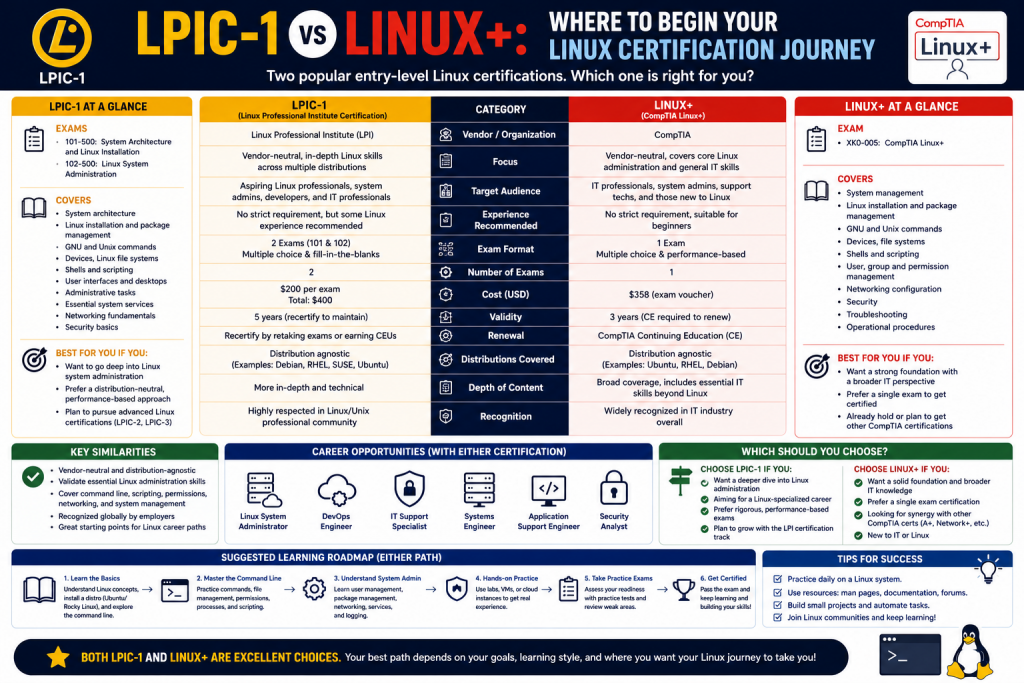
Choosing the right Linux certification can be confusing for beginners entering the IT field. Two of the most popular vendor-neutral certifications are Linux+ and LPIC-1. Both are designed to validate foundational Linux skills, but they differ in structure, depth, recognition, and career alignment. Understanding these differences helps you make a more informed decision based on your goals, experience level, and long-term career path in system administration or IT infrastructure.
Linux has become a core part of modern computing environments, powering servers, cloud platforms, embedded systems, and enterprise infrastructure. As organizations increasingly rely on open-source systems, professionals with Linux expertise are in high demand. Certifications like Linux+ and LPIC-1 provide structured learning paths to demonstrate that knowledge to employers.
Overview of Linux+ Certification
Linux+ is designed for individuals who want a broad introduction to Linux systems and administration tasks. It focuses on practical skills that apply across multiple Linux distributions, making it a flexible entry point for beginners.
The certification covers essential areas of Linux administration, including system operations, security practices, automation, and troubleshooting. It is structured to ensure that learners gain hands-on familiarity with tasks commonly performed in real-world environments.
System management is a major component of Linux+, where learners study boot processes, file systems, storage handling, and kernel operations. It also includes network configuration and virtualization basics, which are essential in modern IT environments.
Another important area is user and service management. This includes handling permissions, user accounts, process control, system services, logs, and software installation. These are foundational skills for anyone working in Linux system administration.
Security is also a key focus. Topics include authentication methods, firewall configuration, system hardening, and basic encryption principles. These skills are essential for maintaining secure systems in enterprise environments.
Automation and scripting are introduced to help learners improve efficiency. This includes basic shell scripting, task automation tools, version control concepts, and introductory programming concepts that support system administration tasks.
Troubleshooting forms another significant portion of the certification. It trains candidates to identify and resolve issues related to hardware, networking, performance, and system configuration.
Benefits of Linux+ Certification
Linux+ is often recommended for beginners because it provides a structured entry into Linux administration without requiring deep prior experience. It is widely recognized in IT environments and serves as a good foundation for further certifications in cybersecurity or systems administration.
One of its strengths is its vendor-neutral approach, meaning the skills learned can be applied across many Linux distributions used in businesses and cloud environments. This increases job flexibility and adaptability. It also helps professionals avoid being tied to a single ecosystem, allowing them to work confidently in environments that use different distributions such as Ubuntu, Debian, CentOS, or others commonly found in enterprise infrastructure.
This versatility is especially valuable in modern IT roles where companies often run mixed environments across on-premises servers and cloud platforms. As a result, certified professionals can transition more easily between jobs and industries without needing to relearn core system administration concepts for each new environment.
It is also aligned with broader IT certification pathways, allowing learners to progress into advanced areas such as cybersecurity, networking, or cloud computing.
Another advantage is its recognition in certain industries and organizations that value standardized certification paths. It is particularly useful for individuals aiming for general IT support or junior system administration roles.
However, Linux+ is sometimes considered less rigorous compared to other Linux certifications. While it covers a wide range of topics, the depth may not always be sufficient for advanced system administration roles. Some employers may view it as an introductory credential rather than a highly specialized qualification.
Overview of LPIC-1 Certification
LPIC-1 is the first level of a multi-stage Linux certification program designed to assess deeper technical knowledge of Linux systems. It is widely recognized as a more detailed and structured certification compared to entry-level alternatives.
This certification requires candidates to pass two separate exams, which increases its difficulty and depth. It focuses heavily on real-world system administration tasks and command-line proficiency. Candidates are expected to demonstrate strong practical knowledge rather than relying on theoretical understanding alone. The exam structure is designed in a way that reflects actual job environments, where administrators must troubleshoot issues, configure systems, and manage services efficiently under time constraints. This makes preparation more intensive, as learners need hands-on practice with Linux systems instead of just reading study materials.
A significant portion of the certification evaluates the ability to perform tasks directly through the command line, which is a core skill in Linux administration. This includes managing files, editing configuration settings, controlling processes, and navigating system directories without graphical tools. As most enterprise Linux servers operate in headless environments, command-line proficiency becomes essential for day-to-day operations.
In addition, candidates must be familiar with system maintenance tasks such as software installation, package updates, and dependency management. Understanding how different components interact within the Linux operating system is also important, especially when diagnosing performance issues or service failures. Networking fundamentals are another critical area, where learners must configure interfaces, test connectivity, and troubleshoot communication problems between systems.
Overall, the dual-exam requirement ensures that certified individuals have a well-rounded and practical skill set suitable for professional Linux administration roles.
Key areas covered include system architecture, installation processes, package management, GNU and Unix commands, and system maintenance. It also emphasizes networking fundamentals and administrative operations required for managing Linux environments.
A significant portion of LPIC-1 focuses on command-line expertise. Candidates are expected to demonstrate strong familiarity with Linux shell environments and the ability to perform administrative tasks without graphical interfaces.
Security concepts are also included, such as user permissions, file system security, and basic system protection methods. These are essential for maintaining stable and secure Linux systems in production environments.
Benefits of LPIC-1 Certification
LPIC-1 is widely respected globally due to its long history and structured approach to Linux certification. It is one of the earliest vendor-neutral Linux certifications and has built a strong reputation over time.
It is recognized across many countries and industries, making it a strong choice for professionals seeking international career opportunities. Employers in technical roles often value LPIC-1 because of its depth and practical focus.
Another benefit is its alignment with professional growth within the Linux Professional Institute certification pathway. After LPIC-1, candidates can progress to higher levels that focus on advanced system administration and enterprise-level Linux management.
LPIC-1 also emphasizes open-source principles, making it suitable for individuals who want to work deeply within Linux and Unix-based environments. It is often preferred for roles that require strong technical command-line expertise.
However, LPIC-1 has some limitations. Training resources are less centralized, which means learners often need to rely on multiple third-party materials. This can make preparation more challenging compared to more structured certification programs.
Additionally, recognition may vary depending on region. While it is highly respected globally, some employers in certain markets may be more familiar with other certifications.
Comparing Linux+ and LPIC-1
Both certifications serve as entry points into Linux administration, but they differ in depth and purpose. Linux+ is generally more introductory, focusing on broad understanding and practical basics. LPIC-1 is more detailed and technical, emphasizing deeper system knowledge and command-line proficiency.
Linux+ is often suitable for individuals who are new to IT or those who want a general understanding of Linux within broader IT roles. It fits well into careers that combine multiple technologies rather than focusing exclusively on Linux systems.
LPIC-1, on the other hand, is better suited for individuals who want to specialize in Linux administration. It is more appropriate for system administrators, network administrators, or engineers who expect to work extensively with Linux environments.
Another difference lies in global recognition. LPIC-1 has stronger international recognition, while Linux+ may be more widely recognized in certain regions or organizations with structured certification preferences.
In terms of difficulty, LPIC-1 is generally considered more challenging due to its dual-exam structure and deeper technical requirements. Linux+ is more accessible for beginners but may not provide the same level of depth.
Choosing the Right Certification Path
Selecting between Linux+ and LPIC-1 depends on your career goals. If you are just starting out in IT and want a broad introduction to Linux, Linux+ may be the better choice. It provides a smoother learning curve and aligns well with general IT career paths.
If your goal is to specialize in Linux system administration or pursue more advanced technical roles, LPIC-1 is likely the stronger option. It builds deeper technical expertise and is more widely respected in Linux-focused positions.
Geographic location and employer expectations can also influence your decision. In some regions, Linux+ may be more recognized, while in others LPIC-1 may carry greater weight.
Your long-term career plan should guide your choice. If you intend to continue advancing in Linux certification levels, LPIC-1 provides a structured progression path. If you prefer flexibility across multiple IT domains, Linux+ may be sufficient as a foundation.
Conclusion
Both Linux+ and LPIC-1 offer valuable pathways into Linux system administration, but they serve different purposes. Linux+ is ideal for beginners seeking a broad introduction to Linux within general IT environments. LPIC-1 is better suited for those who want deeper technical expertise and stronger global recognition in Linux-focused roles.
The best choice depends on your current skill level, career direction, and long-term goals. Regardless of which path you choose, gaining Linux certification is a strong step toward building a successful career in IT infrastructure, cloud computing, and system administration.
Continue exploring the technologies and certification concepts that matter most to you.