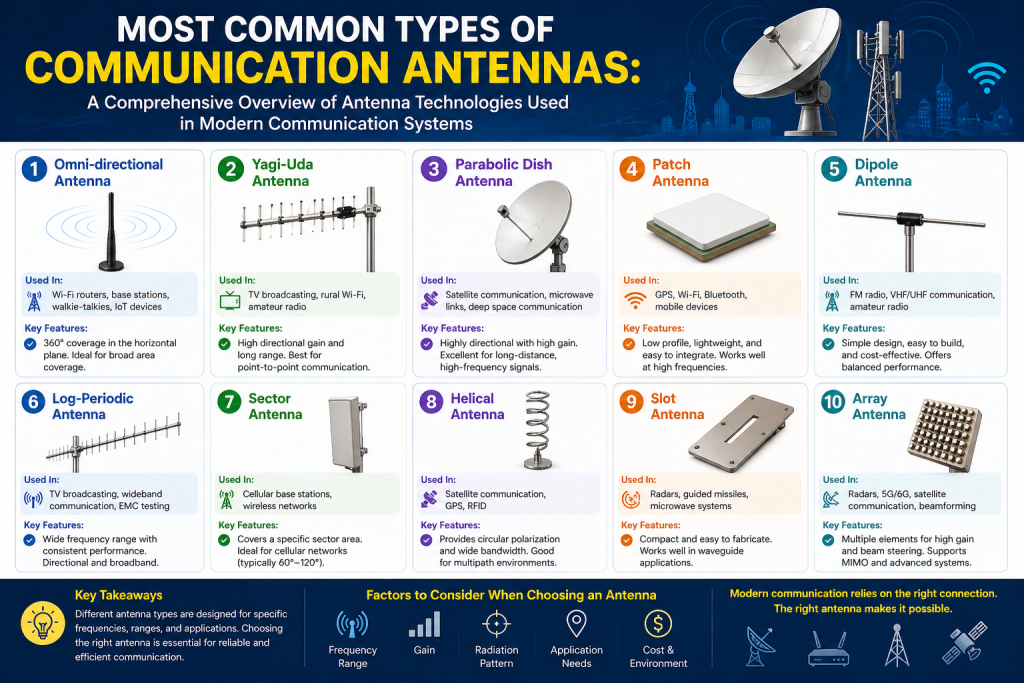
To many people, antennas appear to be simple, almost identical devices that serve a single purpose: sending and receiving signals. Whether mounted on rooftops, attached to routers, or installed on large towers, they often look like variations of the same basic structure. However, this perception hides the complexity and diversity that exists within antenna design. In reality, antennas are highly specialized tools engineered to meet different communication needs, environments, and performance requirements.
Wireless communication relies heavily on antennas as the primary interface between electronic devices and the invisible world of electromagnetic waves. Every time a smartphone connects to the internet, a laptop joins a Wi-Fi network, or a television receives a broadcast signal, an antenna is playing a crucial role behind the scenes. Without antennas, modern communication systems would not function.
Among the many types of antennas available, two categories are used more frequently than others: omnidirectional antennas and directional antennas. Each type serves a distinct purpose, and understanding their differences is essential for designing or choosing an effective wireless network. This part focuses on omnidirectional antennas, exploring how they work, why they are widely used, and where they perform best.
Understanding Omnidirectional Antennas
An omnidirectional antenna is designed to transmit and receive signals in all directions along a horizontal plane. Unlike antennas that focus energy toward a specific point, omnidirectional antennas spread signals evenly around them, creating a circular coverage area.
The word “omnidirectional” is derived from “omni,” meaning “all.” This reflects the antenna’s defining characteristic: its ability to provide coverage in every direction simultaneously. Instead of requiring precise alignment, it ensures that devices can connect regardless of their position relative to the antenna.
In practical terms, an omnidirectional antenna behaves much like a light source placed in the center of a room. The light spreads outward in every direction, illuminating the entire space rather than focusing on a single spot. Similarly, the antenna distributes radio signals across a wide area, making it ideal for general-purpose communication.
Physically, these antennas are often simple in design. They commonly appear as vertical rods or sticks and are frequently seen on home routers, access points, and communication towers. Despite their straightforward appearance, their internal structure is carefully engineered to achieve consistent signal distribution.
Radiation Pattern and Signal Behavior
To fully understand how omnidirectional antennas function, it is important to examine their radiation pattern. While they provide 360-degree coverage horizontally, their signal distribution is not uniform in all directions when viewed in three dimensions.
The signal pattern is typically shaped like a flattened doughnut. This means:
- The strongest signals are transmitted outward along the horizontal plane.
- Signal strength decreases above and below the antenna.
- Devices positioned at similar heights to the antenna receive the best coverage.
This design is intentional. Most communication devices, such as smartphones, laptops, and routers, operate at similar elevations. By concentrating signal strength along this plane, omnidirectional antennas maximize efficiency where it matters most.
However, this also means that placing the antenna too high or too low relative to users can reduce effectiveness. Proper positioning is essential to ensure optimal performance.
Advantages of Omnidirectional Antennas
Omnidirectional antennas are widely used because they offer several key benefits that make them suitable for everyday applications. Their design prioritizes simplicity, flexibility, and broad coverage, which are essential in many environments.
Wide Coverage Area
One of the most significant advantages of omnidirectional antennas is their ability to cover a large area without requiring precise targeting. Since they transmit signals in all directions, they can serve multiple devices spread across different locations.
This makes them ideal for environments where users are not concentrated in a single direction. For example, in a home or office, devices may be located in different rooms or areas. An omnidirectional antenna ensures that all these devices can connect without requiring repositioning.
Ease of Installation
Another major benefit is the simplicity of installation. Unlike more complex antenna systems, omnidirectional antennas do not require careful alignment or calibration.
Setting up an omnidirectional antenna typically involves:
- Placing it in a suitable location
- Ensuring it is oriented vertically
- Connecting it to the appropriate device
This ease of use makes them accessible to both professionals and non-technical users. It also reduces the time and effort required to deploy a wireless network.
Flexibility for Mobile Users
In many environments, users move frequently. People walk around with smartphones, carry laptops between rooms, or shift positions within a workspace. Omnidirectional antennas accommodate this mobility by providing consistent coverage regardless of direction.
Users do not need to stay within a specific line of sight or orientation to maintain a connection. This flexibility is particularly important in settings where movement is constant, such as homes, offices, and public spaces.
Cost Efficiency
Omnidirectional antennas are generally more affordable than directional systems. They do not require specialized mounting equipment, alignment tools, or professional installation in most cases.
This cost advantage makes them a practical choice for:
- Residential networks
- Small businesses
- Basic wireless setups
Their affordability, combined with their ease of use, contributes to their widespread adoption.
Limitations of Omnidirectional Antennas
Despite their many advantages, omnidirectional antennas are not suitable for every situation. Their design introduces certain limitations that can impact performance, especially in more demanding environments.
Susceptibility to Interference
Because omnidirectional antennas receive signals from all directions, they are more vulnerable to interference. They pick up not only the intended signals but also unwanted noise from surrounding sources.
Common sources of interference include:
- Other wireless networks operating on similar frequencies
- Electronic devices that emit electromagnetic signals
- Physical objects that reflect or scatter signals
This can lead to reduced signal quality, slower speeds, and unstable connections.
Limited Range
Another drawback is their relatively short range compared to directional antennas. Since the signal is spread evenly in all directions, no single direction receives a concentrated beam of energy.
As a result, the signal weakens more quickly over distance. This limits the effective coverage area, especially in large or open environments.
Reduced Signal Strength at Edges
As the signal travels outward, it gradually loses strength. Devices located at the edges of the coverage area may experience weaker connections, leading to slower data transfer rates or intermittent connectivity.
This issue becomes more pronounced in environments with obstacles such as walls, furniture, or other structures that block or absorb signals.
Common Applications of Omnidirectional Antennas
Despite their limitations, omnidirectional antennas are essential in many real-world applications. Their ability to provide broad, consistent coverage makes them a key component in modern communication systems.
Home Wi-Fi Networks
Most home routers use omnidirectional antennas to distribute signals throughout the house. These antennas allow multiple devices to connect from different rooms without requiring precise positioning.
This setup is ideal for households where users move freely and use multiple devices simultaneously.
Cellular Communication Systems
Large omnidirectional antennas are often installed on communication towers to provide mobile network coverage. These antennas ensure that users can connect to the network regardless of their direction relative to the tower.
They play a crucial role in maintaining consistent connectivity for mobile devices.
Public Wireless Access
Public spaces such as airports, shopping centers, cafes, and parks rely on omnidirectional antennas to provide Wi-Fi access to large numbers of users.
In these environments, users are spread across wide areas and move frequently. Omnidirectional coverage ensures that connectivity remains stable and accessible.
General Wireless Connectivity
Any situation that requires broad, non-directional coverage benefits from omnidirectional antennas. They are commonly used in:
- Offices
- Educational institutions
- Event venues
- Outdoor public areas
Their versatility makes them suitable for a wide range of applications.
Best Practices for Placement and Optimization
While omnidirectional antennas are easy to install, their performance can be significantly affected by placement and environmental factors. Proper positioning is essential to achieve the best results.
Avoiding Interference Sources
Placing the antenna away from other electronic devices can help reduce interference. Devices such as microwaves, televisions, and other routers can disrupt signal quality.
Keeping a reasonable distance between these devices and the antenna improves performance.
Reducing Physical Obstructions
Objects such as walls, furniture, and metal surfaces can block or weaken signals. Positioning the antenna in an open area helps maintain stronger and more consistent coverage.
Avoid placing it inside cabinets, behind large objects, or in enclosed spaces.
Optimizing Height and Elevation
Mounting the antenna at a higher position allows signals to travel more freely. Elevated placement reduces the impact of obstacles and improves overall coverage.
However, it is important to ensure that the antenna remains within a reasonable height relative to the devices it serves.
Maintaining Proper Orientation
Omnidirectional antennas are designed to function best when positioned vertically. Tilting or bending them can distort the signal pattern and reduce effectiveness.
Ensuring that the antenna remains upright helps maintain consistent coverage.
Importance of Omnidirectional Antennas in Modern Communication
Omnidirectional antennas remain one of the most widely used antenna types because they offer a balance of simplicity, reliability, and coverage. They are particularly effective in environments where users are distributed across a wide area and require consistent connectivity.
Their design makes them easy to deploy, cost-effective, and adaptable to a variety of situations. While they may not provide the long-range capabilities of more specialized antennas, they excel in everyday applications where broad coverage is more important than precision.
Understanding how omnidirectional antennas work provides a strong foundation for exploring more advanced antenna types. In the next part, the focus will shift to directional antennas, which take a different approach by concentrating signals in specific directions to achieve greater range and efficiency.
This contrast between broad coverage and focused transmission highlights the importance of choosing the right antenna for each specific use case.
Introduction to Directional Antennas
While omnidirectional antennas are designed to spread signals in all directions, directional antennas take a very different approach. Instead of distributing energy evenly, they focus it into a specific direction. This focused transmission allows for stronger signals, longer distances, and more efficient communication.
Directional antennas are widely used in situations where precision matters more than broad coverage. They are commonly found in long-distance wireless links, satellite communication systems, and specialized networking environments. Their ability to concentrate energy makes them an essential tool in modern communication infrastructure.
Understanding directional antennas requires a shift in perspective. Rather than thinking about coverage in terms of area, it is more useful to think in terms of targeted communication. These antennas are designed to connect specific points rather than serve general spaces.
What Is a Directional Antenna
A directional antenna is a type of antenna that transmits and receives signals primarily in one direction. Instead of radiating energy in a full 360-degree pattern, it concentrates that energy into a focused beam.
This focused approach provides several advantages:
- Increased signal strength in the intended direction
- Greater communication range
- Reduced interference from unwanted sources
However, it also introduces new challenges, particularly in terms of setup and alignment.
Directional antennas are often recognizable by their distinct shapes. Some look like large dishes, while others resemble flat panels or arrays of metal rods. Regardless of their appearance, they all share the same fundamental goal: directing energy toward a specific target.
How Directional Antennas Work
Directional antennas operate by shaping electromagnetic waves into a concentrated beam. This is achieved through their physical design, which guides and reinforces signals in a particular direction.
Instead of spreading energy evenly, the antenna channels it forward. This creates a strong, focused signal that travels farther than the dispersed signal of an omnidirectional antenna.
The radiation pattern of a directional antenna is often compared to a flashlight beam. While an omnidirectional antenna is like a light bulb illuminating a room, a directional antenna is like a flashlight pointing in one direction. The light is brighter and travels farther, but only within a narrow path.
This focused beam improves efficiency because less energy is wasted. More of the transmitted power is directed toward the intended receiver, resulting in better performance over long distances.
Types of Directional Antennas
Directional antennas come in several different forms, each designed for specific applications. Although they all share the principle of focused transmission, their structures and use cases can vary significantly.
Yagi Antennas
Yagi antennas are one of the most recognizable types of directional antennas. They consist of a central element with multiple parallel rods arranged along a supporting structure.
These antennas are known for their ability to focus signals in a single direction with relatively simple construction. They are commonly used for television reception and radio communication.
Yagi antennas are particularly effective in situations where a clear line of sight exists between the transmitter and receiver. Their design allows them to capture and direct signals efficiently, making them a popular choice for both residential and professional use.
Parabolic Antennas
Parabolic antennas, often referred to as dish antennas, use a curved reflective surface to focus signals. The shape of the dish reflects incoming or outgoing signals toward a central focal point.
This design allows for extremely precise signal direction and very long communication distances. Parabolic antennas are commonly used in satellite communication, deep-space communication, and long-distance wireless links.
Because of their high gain and narrow beamwidth, they can transmit signals over vast distances with minimal loss. However, they require precise alignment to function correctly.
Patch Antennas
Patch antennas are flat, compact antennas often used in modern wireless devices. They are commonly found in smartphones, laptops, and wireless access points.
These antennas provide directional coverage in a relatively small form factor. They are often used in environments where space is limited but directional performance is still required.
Patch antennas can also be used in arrays to enhance performance and coverage. Their versatility makes them a key component in many modern communication systems.
Variants and Specialized Designs
In addition to the main types, there are many variations of directional antennas designed for specific purposes. For example, some mobile devices use specialized designs that combine compact size with directional efficiency.
These variations demonstrate the adaptability of directional antenna technology. Engineers can modify designs to meet the unique requirements of different applications, from consumer electronics to industrial systems.
Advantages of Directional Antennas
Directional antennas offer several important benefits that make them essential in many communication scenarios.
Long Distance Communication
One of the most significant advantages is their ability to transmit signals over long distances. By focusing energy into a narrow beam, directional antennas can maintain signal strength over much greater ranges than omnidirectional antennas.
This makes them ideal for:
- Connecting buildings in different locations
- Establishing rural or remote communication links
- Satellite communication systems
In some cases, directional antennas can transmit signals across continents or even into space.
Improved Signal Strength
Because the signal is concentrated in a specific direction, it remains stronger and more stable. This results in better performance, higher data transfer rates, and more reliable connections.
Devices receiving the signal benefit from increased clarity and reduced noise, which improves overall communication quality.
Reduced Interference
Directional antennas naturally limit interference by focusing only on the intended direction. They are less likely to pick up unwanted signals from other sources.
This is particularly useful in environments with many competing signals, such as urban areas or crowded wireless networks.
Energy Efficiency
By directing energy where it is needed, directional antennas use power more efficiently. Less energy is wasted on unnecessary coverage, which can reduce operating costs and improve system performance.
This efficiency is especially important in large-scale or long-distance communication systems.
Limitations of Directional Antennas
Despite their advantages, directional antennas also have drawbacks that must be considered.
Complex Installation
One of the biggest challenges is the need for precise alignment. Directional antennas must be carefully pointed toward their target to function effectively.
Even small misalignments can significantly reduce signal quality. This often requires specialized tools and expertise during installation.
Higher Cost
Directional antenna systems can be more expensive than omnidirectional setups. The cost may include:
- The antenna itself
- Mounting equipment
- Professional installation services
This makes them less suitable for simple or low-budget applications.
Limited Coverage Area
Unlike omnidirectional antennas, directional antennas do not provide broad coverage. They focus on a specific path, which means areas outside that path receive little or no signal.
This makes them unsuitable for environments where users are spread out in multiple directions.
Sensitivity to Obstructions
Directional antennas require a clear line of sight between the transmitter and receiver. Obstacles such as buildings, trees, or terrain can block or weaken the signal.
Ensuring an unobstructed path is essential for maintaining performance.
Common Applications of Directional Antennas
Directional antennas are used in a wide range of applications where precision and long-distance communication are required.
Point to Point Communication
One of the most common uses is point to point communication. This involves establishing a direct link between two locations using directional antennas at both ends.
This method is often used by internet service providers to connect networks across large distances without relying on physical cables.
Satellite Communication
Directional antennas play a critical role in satellite systems. Dish antennas are used to send and receive signals from satellites orbiting the Earth.
These systems provide services such as television broadcasting, internet access, and global communication.
Broadcasting and Reception
Directional antennas are also used in television and radio broadcasting. They allow users to receive signals from specific transmitters while minimizing interference from other sources.
This improves signal quality and expands the range of available channels.
Public and Commercial Networks
In large venues such as stadiums, airports, and event spaces, directional antennas are used to target specific areas with strong signals.
This ensures that high-demand zones receive adequate coverage without wasting resources on unnecessary areas.
Search and Rescue Operations
Directional antennas are valuable tools in emergency situations. They can be used to locate distress signals from emergency beacons.
By focusing on the direction of the signal, rescue teams can pinpoint the location of individuals in need of assistance.
Best Practices for Installation and Alignment
Proper installation is critical for the success of directional antennas. Several factors must be carefully considered.
Accurate Targeting
The antenna must be aligned precisely with the intended receiver or transmitter. This often involves using signal strength indicators or alignment tools.
Maintaining Line of Sight
Ensuring a clear, unobstructed path between antennas is essential. Even minor obstacles can disrupt the signal.
Matching Height and Elevation
In point to point systems, both antennas should be positioned at similar heights to maintain a stable connection.
Proper Configuration
Devices connected to directional antennas must be configured correctly. This includes setting the appropriate frequency, security parameters, and network settings.
Role of Directional Antennas in Modern Networks
Directional antennas are a critical component of modern communication systems. Their ability to provide focused, high-strength signals makes them indispensable in scenarios where distance, precision, and efficiency are priorities.
They complement omnidirectional antennas by offering a different approach to signal distribution. While omnidirectional antennas provide general coverage, directional antennas enable targeted communication.
Understanding both types allows network designers and users to choose the most appropriate solution for their needs. In many cases, a combination of both types is used to achieve optimal performance.
The next part will bring these concepts together, comparing omnidirectional and directional antennas directly and helping determine which type is best suited for different situations.
Most Common Types of Communication Antennae –
After understanding how omnidirectional and directional antennas function individually, the next step is to compare them directly. Both types serve essential roles in wireless communication, but they are designed with very different priorities in mind.
Omnidirectional antennas focus on providing broad, uniform coverage across an area. They are ideal for environments where users are spread out and may move frequently. Directional antennas, on the other hand, concentrate their energy into a focused beam, allowing for long-distance communication and stronger signals in a specific direction.
The choice between these two types depends largely on the requirements of the network. Factors such as coverage area, distance, interference, and installation complexity all play a role in determining which antenna is more suitable.
Understanding these differences helps avoid common mistakes, such as using an omnidirectional antenna where a directional one would perform better, or vice versa.
Coverage Area and Signal Distribution
One of the most significant differences between these antenna types lies in how they distribute signals.
Omnidirectional antennas provide 360-degree horizontal coverage. This makes them well-suited for environments where devices are located in multiple directions around the antenna. Homes, offices, and public spaces benefit from this type of coverage because users are not confined to a single location.
Directional antennas, in contrast, focus their signal in a specific direction. This creates a narrow beam that delivers stronger signals over longer distances. However, areas outside this beam receive little to no coverage.
This difference means that omnidirectional antennas prioritize accessibility, while directional antennas prioritize performance in a targeted area.
Range and Signal Strength
Range is another critical factor that distinguishes these antenna types.
Omnidirectional antennas spread their energy evenly, which limits how far the signal can travel effectively. As the signal moves outward, it weakens, leading to reduced performance at greater distances.
Directional antennas concentrate their energy, allowing signals to travel much farther. This makes them ideal for long-distance communication, such as connecting two buildings or communicating with satellites.
In terms of signal strength, directional antennas have a clear advantage within their coverage area. Their focused beam ensures that more energy reaches the intended receiver, resulting in stronger and more reliable connections.
Interference and Signal Quality
Interference is a common challenge in wireless communication, and antenna choice can significantly impact how it is managed.
Omnidirectional antennas are more susceptible to interference because they receive signals from all directions. This includes both desired signals and unwanted noise. In crowded environments with many wireless devices, this can lead to reduced performance.
Directional antennas help minimize interference by focusing only on signals coming from a specific direction. This reduces the impact of surrounding noise and improves overall signal quality.
In environments where interference is a major concern, directional antennas often provide a more stable and reliable solution.
Installation and Setup Requirements
Ease of installation is another important consideration when choosing between antenna types.
Omnidirectional antennas are simple to install and require minimal configuration. They do not need to be aimed or aligned, making them suitable for users with limited technical expertise.
Directional antennas, however, require careful alignment to function correctly. The antenna must be precisely pointed toward the target location. This process may involve adjusting angles, using signal measurement tools, and ensuring proper positioning.
Because of these requirements, directional antennas often require more time, effort, and expertise to install.
Cost and Resource Considerations
Cost is always a factor in network design, and antenna choice can influence both initial expenses and long-term costs.
Omnidirectional antennas are generally more affordable. They require less equipment and do not need specialized installation procedures. This makes them a cost-effective option for basic networking needs.
Directional antennas can be more expensive due to their complexity and installation requirements. However, their efficiency and performance can justify the higher cost in scenarios where long-distance communication or high reliability is needed.
In some cases, investing in directional antennas can reduce the need for additional infrastructure, ultimately saving resources over time.
Choosing the Right Antenna for Your Network
Selecting the appropriate antenna involves evaluating the specific needs of the network. There is no universal solution, and the best choice depends on the situation.
When to Use Omnidirectional Antennas
Omnidirectional antennas are the best choice when:
- Coverage is needed in all directions
- Users are spread out across an area
- Mobility is important
- Ease of installation is a priority
- Budget constraints are a concern
They are commonly used in homes, offices, and public Wi-Fi networks where simplicity and broad coverage are essential.
When to Use Directional Antennas
Directional antennas are more suitable when:
- Communication is required between specific points
- Long-distance connectivity is needed
- Interference must be minimized
- High signal strength is important
- Precise targeting is possible
They are often used in professional networking, broadcasting, and specialized communication systems.
Combining Both Antenna Types
In many real-world scenarios, networks benefit from using both omnidirectional and directional antennas together. This hybrid approach allows for optimized performance across different parts of the network.
For example, a network might use directional antennas to establish a long-distance link between two locations. Once the connection reaches its destination, omnidirectional antennas can distribute the signal locally to multiple users.
This combination provides both range and coverage, ensuring efficient use of resources while maintaining strong connectivity.
Environmental Factors and Their Impact
The environment plays a significant role in antenna performance. Factors such as physical obstructions, terrain, and surrounding devices can all influence signal quality.
Physical Obstacles
Walls, buildings, trees, and other objects can block or weaken signals. Omnidirectional antennas may struggle in environments with many obstacles, as their signals are easily disrupted.
Directional antennas can sometimes overcome these challenges by focusing signals along a clear path, but they still require an unobstructed line of sight for optimal performance.
Terrain and Elevation
Elevation affects how signals travel. Placing antennas at higher positions can improve coverage and reduce interference.
In outdoor environments, terrain features such as hills and valleys can impact signal propagation. Directional antennas are often used to navigate these challenges by targeting specific paths.
Electromagnetic Interference
Interference from other electronic devices can degrade signal quality. Omnidirectional antennas are more vulnerable to this issue, while directional antennas can reduce its impact by limiting the range of reception.
Understanding the environment helps in choosing the right antenna and positioning it effectively.
Importance of Proper Configuration
In addition to selecting the right antenna, proper configuration is essential for achieving optimal performance.Even a high-quality antenna can deliver poor results if it is not correctly set up within the network. Configuration involves more than simply connecting hardware; it requires careful adjustment of various parameters to ensure that all components work together efficiently.
One of the most important aspects of configuration is selecting the correct frequency band and channel. Wireless systems often operate on shared frequencies, and choosing a congested channel can lead to interference and reduced performance. By selecting a less crowded channel, the antenna can transmit and receive signals more clearly, improving overall reliability.
Another key factor is transmission power. Setting the power level too low may result in weak signals and limited coverage, while setting it too high can cause unnecessary interference with nearby networks. Finding the right balance ensures that the antenna provides adequate coverage without disrupting other devices.
Network settings such as security protocols, SSID configuration, and access modes also play a significant role. Proper security settings protect the network from unauthorized access, while correct configuration of access points and client devices ensures smooth communication. In more advanced setups, features like bridge mode or repeater mode must be configured correctly to maintain stable connections.
Alignment and positioning settings are especially important for directional antennas. Even a slight misalignment can significantly reduce signal strength. Using signal measurement tools or built-in diagnostics helps fine-tune the antenna’s orientation for the best possible performance.
Regular monitoring and updates are also part of proper configuration. Network conditions can change over time due to new devices, environmental factors, or increased usage. Periodically reviewing and adjusting settings helps maintain optimal performance and ensures the network continues to operate efficiently.
Devices connected to antennas must be set to the correct frequency and channel. Security settings, network modes, and signal parameters should also be configured appropriately.
Even the best antenna will not perform well if the system is not properly configured. Attention to detail in setup ensures that the network operates efficiently and reliably.
Future Trends in Antenna Technology
As wireless communication continues to evolve, antenna technology is also advancing. New designs and innovations are improving performance, efficiency, and adaptability.Engineers are constantly working to develop antennas that can handle higher data speeds, support more connected devices, and operate reliably in increasingly complex environments. With the rapid expansion of technologies such as 5G and upcoming 6G networks, antennas are becoming more sophisticated in both structure and functionality.
One major area of advancement is the development of smart antennas. These antennas can dynamically adjust their radiation patterns based on real-time conditions. Instead of transmitting signals in a fixed pattern, they can steer beams toward active users, improving signal strength and reducing interference. This technology, often referred to as beamforming, is especially important in dense urban environments where many devices compete for bandwidth.
Another important innovation is the miniaturization of antennas. As devices become smaller and more portable, antennas must also shrink without sacrificing performance. Modern smartphones, wearable devices, and Internet of Things systems rely on compact antenna designs that can fit into limited spaces while still delivering reliable connectivity. Engineers achieve this through advanced materials and creative design techniques that optimize signal transmission within small form factors.
Additionally, multi-band and multi-input multi-output systems are becoming more common. These technologies allow antennas to operate across multiple frequencies and handle multiple data streams simultaneously. This improves network capacity, increases data speeds, and enhances overall reliability.
Sustainability is also becoming a focus in antenna development. Designers are exploring energy-efficient systems and environmentally friendly materials to reduce power consumption and environmental impact. These efforts ensure that antenna technology not only meets performance demands but also aligns with global sustainability goals.
Together, these advancements are shaping the future of wireless communication, making networks faster, smarter, and more adaptable than ever before.
Modern systems are increasingly using smart antennas that can adjust their behavior dynamically. These antennas can switch between directional and omnidirectional modes or adapt their signal patterns based on real-time conditions.
Advancements in materials and design are also leading to smaller, more efficient antennas that can be integrated into a wide range of devices.
These developments highlight the ongoing importance of antennas in communication technology and their role in shaping the future of connectivity.
Conclusion
Antennas are a fundamental component of wireless communication, and understanding their types and functions is essential for building effective networks. Omnidirectional and directional antennas represent two distinct approaches to signal transmission, each with its own strengths and limitations.
Omnidirectional antennas provide broad, flexible coverage that is ideal for environments where users are distributed across an area. Their ease of installation and cost-effectiveness make them a popular choice for everyday applications such as home and public Wi-Fi networks.
Directional antennas, on the other hand, offer focused, high-strength signals that can travel long distances with minimal interference. They are well-suited for specialized applications such as point to point communication, satellite links, and professional networking systems.
Choosing the right antenna requires careful consideration of factors such as coverage needs, distance, interference, and budget. In many cases, combining both types provides the best results, allowing networks to achieve both wide coverage and strong targeted connections.
By understanding the differences between these antenna types and applying best practices in placement and configuration, it is possible to create reliable and efficient communication systems that meet a wide range of needs.
Continue exploring the technologies and certification concepts that matter most to you.