The central processing unit, commonly called the CPU, is often described as the brain of a computer. Every instruction, command, and computational task depends on this critical component. From opening applications and browsing the internet to scientific simulations and enterprise-level analytics, the CPU plays a defining role in determining how efficiently a computer performs. As computing demands have grown more sophisticated over time, processor design has evolved dramatically to meet rising expectations for speed, multitasking, and performance.
Among the most important developments in processor technology are multiprocessor and multicore CPU architectures. These two approaches to computational design represent different methods of increasing processing power, improving workload distribution, and optimizing system efficiency. While both seek to solve the same fundamental challenge—handling more tasks faster—they do so using very different structural philosophies.
Understanding the distinction between multiprocessor and multicore CPUs requires more than simply recognizing that one has multiple processors and the other has multiple cores. The true differences involve hardware architecture, memory access, operating system coordination, workload distribution, cost, scalability, and practical applications. For students, IT professionals, gamers, engineers, and enterprise decision-makers, understanding these differences is essential because processor architecture directly affects system performance and suitability for specific tasks.
Historically, processor development began with single-core, single-processor systems. Early computers executed one task at a time in a linear fashion. As software became more complex and user expectations expanded, manufacturers needed better ways to improve computational speed. Initially, this was done by increasing clock speeds, allowing processors to perform more cycles per second. However, physical limitations such as heat generation, power consumption, and silicon constraints eventually created barriers to simply making processors faster.
This challenge encouraged engineers to explore parallelism—the ability to perform multiple calculations simultaneously. Two major solutions emerged. The first was multiprocessing, which involved placing multiple physical CPUs within one system. The second was multicore design, which integrated multiple processing cores into a single CPU chip. Both architectures dramatically improved computational capacity, but each was designed with different priorities in mind.
Multiprocessor systems became particularly valuable in enterprise, industrial, and scientific environments where multiple users or extremely large tasks needed simultaneous processing. These systems often appeared in servers, data centers, and research supercomputers. Multicore systems, by contrast, became dominant in consumer and professional markets because they offered better performance without requiring multiple physical CPUs, making them cost-effective and practical for desktops, laptops, and gaming systems.
To appreciate modern computing, it is necessary to understand how these architectures function, why they were developed, and what role they play today. The differences between them influence everything from software design and operating system functionality to energy efficiency and future technology innovation.
What Is a Multiprocessor CPU?
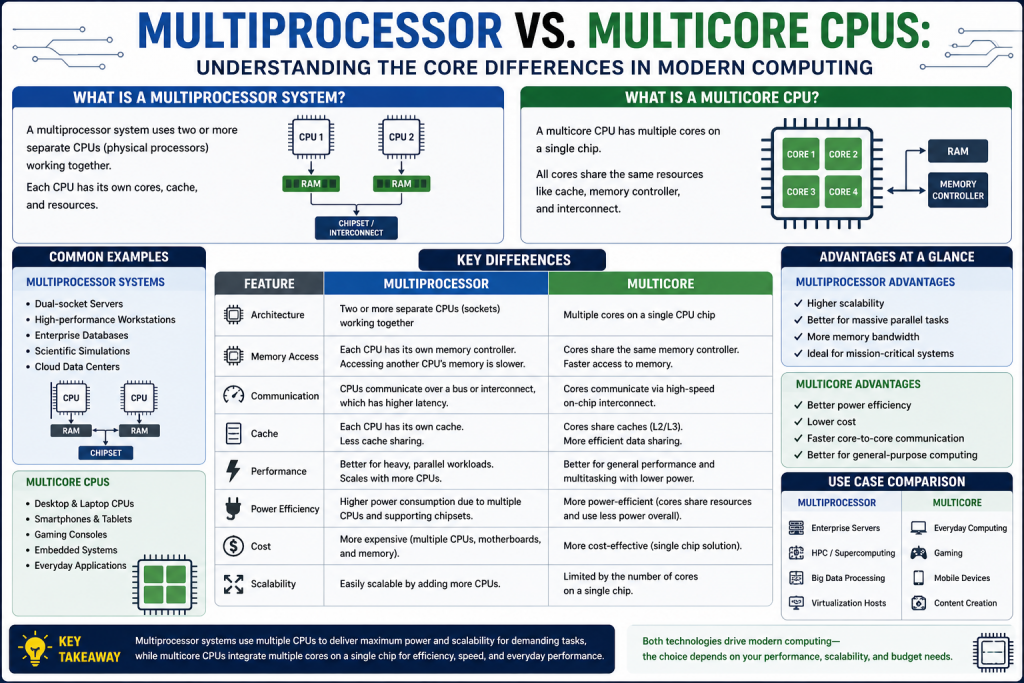
A multiprocessor CPU configuration refers to a computer system that uses two or more physical central processing units working together within a single machine. Each processor is a distinct computational unit capable of independently executing instructions, yet they collaborate to process workloads more efficiently than a single CPU system.
In a multiprocessor environment, multiple CPUs share system resources such as memory, storage access, and input/output devices. This allows several large tasks or many smaller tasks to be distributed across processors, significantly increasing throughput. Rather than relying on one processor to manage every request, tasks can be allocated among multiple processors simultaneously.
This design is particularly valuable when large-scale computational demands exceed the capabilities of a single processor. For example, databases processing thousands of simultaneous transactions, weather forecasting systems performing advanced simulations, or rendering farms producing digital animation all benefit from multiprocessor structures.
There are two primary forms of multiprocessing:
Asymmetric Multiprocessing
Asymmetric multiprocessing was an early design where one processor acted as the master controller while additional processors handled specialized tasks or secondary functions. In this arrangement, processors were not treated equally. The master processor controlled scheduling and system coordination, while subordinate processors executed assigned operations.
This model had limitations because it created dependency on a primary processor, reducing flexibility and introducing bottlenecks. Although largely outdated in mainstream computing, asymmetric multiprocessing influenced early system designs and can still appear in specialized embedded systems.
Symmetric Multiprocessing
Symmetric multiprocessing, often abbreviated as SMP, is the standard architecture for modern multiprocessor systems. In SMP, all processors are treated equally by the operating system. Each CPU can execute tasks independently, and the OS dynamically assigns workloads based on availability and priority.
This structure offers improved load balancing, scalability, and reliability. If one processor becomes heavily utilized, another processor can take on additional tasks. SMP systems are common in enterprise servers because they provide better performance under heavy multitasking environments.
One key advantage of multiprocessor systems is redundancy and workload separation. Multiple CPUs can continue functioning even if one processor becomes overloaded, making these systems particularly suitable for mission-critical operations.
Historical Development of Multiprocessor Systems
Multiprocessing is older than multicore technology and has roots in large institutional computing. Early computer scientists recognized that dividing tasks among multiple processors could significantly improve performance. During the 1970s and 1980s, as organizations required more computational capability, multiprocessor systems began appearing in research institutions, military systems, and corporate infrastructures.
Large mainframes and early supercomputers used multiprocessing to perform advanced calculations for defense systems, aerospace research, and academic experimentation. These machines were expensive, physically large, and highly specialized.
As semiconductor technology improved, multiprocessor systems became more practical for enterprise applications. Servers adopted multiple CPU sockets on motherboards, allowing organizations to scale performance by adding processors. This socket-based expansion remains common in enterprise-grade servers today.
Despite their power, multiprocessor systems remained too expensive and complex for typical consumers. Their reliance on multiple physical CPUs increased motherboard complexity, thermal demands, and software requirements.
What Is a Multicore CPU?
A multicore CPU is a single physical processor that contains two or more independent cores within one chip. Each core functions similarly to an individual processor, capable of executing instructions independently. However, unlike a multiprocessor system with multiple separate CPUs, all cores exist within one processor package.
This architecture revolutionized computing by enabling parallel processing without requiring multiple physical processors. Instead of increasing speed solely through clock frequency, manufacturers could improve performance by adding more cores.
Dual-core processors introduced the mainstream public to multicore technology, followed by quad-core, hexa-core, octa-core, and even higher-core-count designs. Today, multicore CPUs dominate desktops, laptops, smartphones, and gaming systems.
Each core in a multicore processor can handle separate threads or tasks simultaneously. For example, one core may manage a web browser while another runs background applications, improving responsiveness and efficiency.
Multicore CPUs share certain resources, such as cache levels and memory controllers, depending on design. Because all cores exist on the same chip, communication between cores is generally faster than communication between separate CPUs in a multiprocessor system.
The Rise of Multicore Processing
By the early 2000s, CPU manufacturers faced a critical challenge. Increasing clock speeds further created excessive heat and power demands, often called the “power wall.” Instead of focusing solely on frequency increases, the industry shifted toward multicore innovation.
Multicore processors offered a more energy-efficient solution by distributing workloads across cores rather than forcing one core to run at unsustainable speeds. This transition fundamentally changed software development as operating systems and applications began optimizing for parallel execution.
The first commercially successful multicore processors transformed personal computing. Systems became more capable of gaming, media editing, virtualization, and multitasking without enterprise-level costs.
Today, multicore processors are the standard for nearly all consumer systems, from budget laptops to professional workstations.
Architectural Philosophy: Multiple CPUs vs Multiple Cores
The fundamental distinction between multiprocessor and multicore systems lies in physical design.
A multiprocessor system includes:
- Multiple separate CPUs
- Separate sockets or processor packages
- Higher hardware complexity
- Greater scalability for enterprise tasks
A multicore system includes:
- One physical CPU
- Multiple cores on one chip
- Shared internal resources
- Lower cost and power consumption
This architectural difference impacts performance, software optimization, and use cases. Multiprocessor systems excel at distributing many large workloads across separate CPUs, while multicore CPUs optimize single-system responsiveness and mainstream multitasking.
Operating System Coordination
Both architectures require operating system support, but the complexity differs significantly.
Multiprocessor systems need advanced scheduling to coordinate multiple CPUs, memory synchronization, and resource balancing. The OS must efficiently allocate tasks while minimizing communication overhead.
Multicore systems also require thread scheduling, but because all cores exist on one chip, coordination is generally faster and less complex.
Modern operating systems are designed to support both, but consumer systems are primarily optimized for multicore environments.
Memory Access and Communication
Memory architecture significantly influences performance.
Multiprocessor systems may use shared memory or distributed memory. Shared memory allows all CPUs access to one memory pool, but this can create contention. Distributed memory assigns memory locally to processors, improving some workloads but increasing complexity.
Multicore processors usually share memory hierarchies more efficiently. Cache design becomes critical, as L1, L2, and L3 caches influence how quickly cores access data.
Because multicore communication occurs within a single chip, latency is typically lower than inter-CPU communication.
Why This Distinction Matters Today
Understanding processor architecture matters because computing needs vary dramatically. A video editor, gamer, software developer, cloud architect, or AI researcher may all require different processing priorities.
Multicore CPUs dominate because they provide practical, affordable, and efficient performance for everyday users. Multiprocessor systems remain essential where maximum scalability, reliability, and massive simultaneous processing are required.
As technology continues evolving, these architectures increasingly intersect. Enterprise CPUs may feature many cores while also supporting multiple sockets, combining multicore and multiprocessor advantages.
The foundation of processor knowledge begins with understanding that more power does not simply mean faster speed—it means smarter architecture. Whether through multiple CPUs or multiple cores, modern computing depends on efficient parallelism, resource coordination, and design specialization.
How Performance Is Measured Beyond Clock Speed
When comparing multiprocessor and multicore CPU architectures, one of the biggest misconceptions is that processor performance can be judged simply by clock speed. For many years, consumers focused heavily on gigahertz ratings, assuming a faster clock automatically meant better performance. While clock speed still matters, modern CPU effectiveness depends far more on how efficiently processing resources are organized, how workloads are distributed, and how software interacts with hardware.
A processor’s true performance is determined by multiple factors, including core count, thread count, cache size, instruction-per-clock efficiency, thermal management, memory bandwidth, and operating system optimization. This is why a multicore CPU with a lower clock speed may outperform an older single-core processor running at a higher frequency, and why a multiprocessor server can dramatically exceed both when handling large enterprise workloads.
Performance can generally be divided into two categories: single-threaded performance and multi-threaded performance. Single-threaded performance refers to how quickly one core or processor can complete a single chain of instructions. This remains important for certain software applications, especially legacy programs or lightly threaded tasks. Multi-threaded performance measures how effectively a system can divide tasks across multiple cores or processors simultaneously.
Multicore CPUs are designed to improve both categories, particularly in mainstream applications. Modern software can divide processes such as video rendering, gaming physics calculations, browser tabs, and productivity tools across several cores. Multiprocessor systems, however, excel in environments where many users or massive parallel processes must run simultaneously, such as virtualization, scientific simulations, and database management.
This distinction is crucial because not every application benefits equally from additional processors or cores. Software must be designed for parallel execution. A poorly optimized program may not significantly benefit from a system with more cores or CPUs, while highly parallelized software can scale dramatically.
Multitasking and Parallel Processing Explained
At the heart of both multiprocessor and multicore systems is parallel processing—the ability to perform multiple operations simultaneously. However, the method of achieving parallelism differs significantly.
In a multicore processor, several cores inside one CPU can each handle separate threads. For example, while one core processes a spreadsheet calculation, another may handle video playback, and another may manage background antivirus scans. This creates a smoother user experience and improves responsiveness.
In a multiprocessor system, entirely separate CPUs divide larger workloads among themselves. Instead of one processor package managing everything internally, multiple physical processors work in coordination. This can dramatically increase system throughput because each CPU often has its own cache and dedicated processing resources.
For example, in a corporate database server, one processor may manage incoming user queries while another handles data indexing and another processes backup operations. This separation enables extremely high multitasking performance.
The key difference lies in scale:
- Multicore systems are optimized for task-level parallelism within one machine
- Multiprocessor systems are optimized for system-wide or enterprise-scale parallelism
In day-to-day consumer use, multicore systems usually provide more than enough parallel processing. For enterprise infrastructure, engineering simulations, or large-scale cloud computing, multiprocessor environments often become necessary.
Advantages of Multicore CPUs in Consumer and Professional Systems
Multicore CPUs became dominant because they deliver excellent performance without the cost and complexity of multiple physical processors. Their design offers several practical benefits.
Cost Efficiency
A multicore CPU provides multiple processing units on one chip, reducing motherboard complexity and manufacturing cost. Instead of buying multiple processors and specialized hardware, users can achieve strong performance with one processor package.
This affordability made multicore processors ideal for mainstream desktops, laptops, and mobile devices.
Energy Efficiency
Running multiple cores on one chip generally consumes less power than operating several physical CPUs. Shared resources and shorter communication paths reduce electrical overhead. This is especially important for battery-powered devices like laptops.
Heat Management
Although multicore CPUs can still produce significant heat, they are generally easier to cool than multiprocessor systems because communication between cores occurs internally rather than across multiple sockets.
Compact Design
Multicore processors fit into smaller devices without requiring the larger boards associated with multiple CPU sockets. This compactness enabled powerful laptops, gaming systems, and mobile workstations.
Strong Mainstream Performance
For gaming, streaming, office productivity, programming, and creative applications, multicore processors offer exceptional value. Tasks such as 3D rendering, video editing, and virtualization can all benefit from high-core-count multicore CPUs.
Limitations of Multicore CPUs
Despite their advantages, multicore processors are not without weaknesses.
Shared Resource Bottlenecks
Because all cores share certain resources, such as cache or memory bandwidth, extremely heavy workloads can create resource contention. If too many tasks demand the same memory pathways, performance can degrade.
Software Dependency
Applications must be optimized for multithreading. Older software designed for single-core execution may not fully utilize available cores.
Diminishing Returns
Adding more cores does not always produce proportional performance gains. Some applications simply cannot efficiently divide workloads beyond a certain point.
Advantages of Multiprocessor Systems in Enterprise Computing
Multiprocessor systems are engineered for scenarios where computing demand exceeds the capabilities of standard multicore systems.
Extreme Scalability
One of the greatest strengths of multiprocessor architecture is scalability. Multiple CPUs can support huge numbers of simultaneous tasks, users, or virtual machines.
Reliability
Many enterprise multiprocessor systems include redundancy features, making them highly dependable for mission-critical tasks.
Massive Workload Separation
Separate physical CPUs can handle different categories of tasks more independently than multicore systems.
Superior Virtualization
Virtualized environments often rely on multiprocessor systems because they can allocate resources more effectively across numerous guest operating systems.
Limitations of Multiprocessor Systems
High Cost
Multiple physical CPUs, specialized motherboards, advanced cooling systems, and increased power requirements make these systems expensive.
Complex Configuration
Multiprocessor systems require advanced BIOS settings, OS support, and workload planning.
Higher Power Consumption
Multiple CPUs naturally consume more electricity and generate more heat.
Physical Size
These systems are usually much larger and less practical for everyday use.
Software Optimization: The Hidden Performance Factor
Hardware alone does not determine performance. Software architecture plays a major role in how effectively processing resources are used.
Programs designed with multithreading can distribute workloads efficiently across multicore CPUs. Enterprise software designed for distributed systems may perform exceptionally on multiprocessor platforms.
Examples:
- Video editing software often benefits strongly from multicore systems
- Database servers often scale better on multiprocessor systems
- Gaming often prioritizes strong multicore performance with fewer latency penalties
- Scientific simulations may require both multicore and multiprocessor architectures
This relationship between software and hardware explains why choosing the right architecture depends heavily on intended use.
Real-World Examples of Multicore Systems
Most modern users interact with multicore systems daily.
Gaming PCs
Modern games use multiple cores for physics, AI, rendering, and background tasks.
Creative Workstations
Video editors, graphic designers, and 3D modelers benefit from multicore rendering and processing.
Smartphones
Mobile processors use multicore architectures for balancing battery efficiency and performance.
Everyday Productivity
Web browsers, productivity software, and conferencing tools all rely on multicore responsiveness.
Real-World Examples of Multiprocessor Systems
Data Centers
Cloud providers use multiprocessor servers for virtualization and large-scale services.
Supercomputers
Weather simulations, molecular modeling, and AI training often rely on multiprocessor configurations.
Military and Aerospace
Advanced defense calculations require massive computational separation.
Film Rendering
Animation studios use render farms powered by multiprocessor infrastructures.
Latency vs Throughput
A useful way to compare these systems is through latency and throughput.
Latency measures how quickly a single task is processed. Multicore CPUs often excel here because cores communicate rapidly on one chip.
Throughput measures how many total tasks can be completed over time. Multiprocessor systems often dominate here due to larger total processing capacity.
This means:
- Multicore = faster everyday responsiveness
- Multiprocessor = better total workload volume
Cache Architecture and Efficiency
Cache memory plays a major role in CPU performance. Multicore processors often share L3 cache, improving communication efficiency. Multiprocessor systems may require more complex cache coherence protocols, which can increase latency.
Efficient cache design can significantly influence whether additional cores or processors produce meaningful gains.
Why Most Users Rarely Need Multiprocessor Systems
For most users, multicore processors provide enough power for nearly all tasks. Even advanced gaming, streaming, and content creation can often be handled by modern multicore CPUs.
Multiprocessor systems become necessary primarily when:
- Hundreds of users access one server
- Large databases require constant transaction processing
- AI model training requires distributed workloads
- Scientific calculations exceed workstation capabilities
The Importance of Matching Architecture to Purpose
Choosing between multiprocessor and multicore is less about which is “better” and more about which is appropriate.
A software developer may prioritize high clock speeds and multicore balance.
A video editor may need high core counts.
A cloud architect may require multiprocessor scalability.
A scientist may rely on clustered multiprocessing.
Understanding these distinctions prevents overspending, underperformance, or infrastructure inefficiency.
The Blurring Line Between Both Architectures
Modern enterprise CPUs increasingly combine multicore and multiprocessor concepts. A server may contain multiple physical CPUs, each equipped with dozens of cores, creating highly advanced hybrid architectures capable of extraordinary computational performance. This design allows organizations to benefit from the speed and efficiency of multicore processing within each chip while simultaneously leveraging the large-scale distribution and workload separation of multiple processors working together across an entire system. In practical terms, this means modern data centers, cloud platforms, virtualization clusters, and AI infrastructures are built on architectures that merge both concepts for maximum scalability, resilience, and throughput.
These hybrid systems are especially valuable in environments where thousands of simultaneous operations must be handled reliably, such as financial transaction platforms, global e-commerce ecosystems, healthcare analytics, scientific simulations, and hyperscale cloud services. Each CPU can manage large task groups independently, while its internal cores divide those workloads into smaller parallel processes for even greater efficiency. This layered architecture also improves redundancy, as workloads can often be redistributed if one processor experiences limitations or maintenance events. Advanced operating systems and hypervisors are specifically designed to optimize these complex infrastructures, balancing resources dynamically across processors and cores
. As organizations continue adopting containerization, machine learning, big data analysis, and edge-cloud integration, these hybrid CPU architectures provide the flexibility needed to meet rising computational demands while supporting future expansion without complete infrastructure redesign.
This convergence demonstrates that while multicore and multiprocessor technologies originally developed as distinct approaches to performance enhancement, the future of computing increasingly blends them into unified solutions. Multicore processors optimize power efficiency, reduce latency, and improve on-chip communication, making them ideal for consumer devices, business workstations, and many enterprise applications. Multiprocessor systems, on the other hand, provide exceptional scalability, enabling mission-critical platforms to process massive workloads, support large databases, and power scientific simulations.
Still, their foundational differences remain essential:
Multicore emphasizes integration, speed, and energy efficiency
Multiprocessor emphasizes expansion, distribution, and maximum scalability
As computational demands continue to accelerate through artificial intelligence, machine learning, edge computing, big data analytics, and scientific innovation, these processor architectures will remain central to technological progress. Understanding how they differ—and how they increasingly complement one another—will be critical for IT professionals, engineers, and organizations designing the next generation of computing infrastructure.
Making the Right Choice Based on Computing Needs
When evaluating multiprocessor and multicore CPU architectures, the most important consideration is not simply performance—it is purpose. Processing power is only valuable when it aligns with the tasks a system is expected to perform. A student writing reports, a gamer running high-frame-rate titles, a filmmaker rendering complex visual effects, and a scientist processing massive datasets all have very different computational requirements. This is why choosing between multiprocessor and multicore systems must begin with understanding workload demands rather than focusing solely on technical specifications.
For most users, a multicore CPU is the ideal solution. Modern multicore processors offer excellent responsiveness, strong multitasking, affordability, and compatibility with nearly all mainstream software. Everyday activities such as browsing, office productivity, programming, digital content creation, streaming, and gaming are all efficiently handled by multicore systems. Even professional-level tasks like 4K video editing, advanced photo manipulation, and software development often perform exceptionally well on high-core-count multicore processors.
Multiprocessor systems, by contrast, are designed for specialized scenarios where computational scale is more important than consumer practicality. Large enterprises, data centers, scientific laboratories, AI development organizations, and advanced industrial systems often require the distributed performance only multiple CPUs can provide. These systems prioritize throughput, redundancy, and large-scale multitasking over compact design or affordability.
The decision therefore becomes less about which architecture is universally superior and more about matching infrastructure to demand. Overinvesting in enterprise-grade multiprocessor hardware for ordinary workloads may waste money, power, and resources. Underinvesting in consumer-grade multicore systems for enterprise-level workloads may create bottlenecks and reduce productivity.
Consumer Computing: Why Multicore Dominates Personal Devices
Multicore processors have become the standard in consumer technology because they provide the best balance between performance, energy efficiency, and cost. Nearly every desktop, laptop, smartphone, gaming console, and tablet relies on multicore architecture.
Productivity and Office Work
Word processing, spreadsheets, presentations, communication platforms, and web applications benefit greatly from multicore systems. Separate cores can handle active applications while background processes continue uninterrupted. This creates smoother multitasking and reduces lag.
Gaming Performance
Modern gaming increasingly depends on multicore performance. Contemporary game engines use multiple cores for graphics preparation, artificial intelligence, environmental simulation, sound processing, and networking tasks. While many games still prioritize strong single-core speed for certain functions, multicore CPUs significantly improve frame stability and multitasking during streaming or voice communication. As game worlds become larger, more detailed, and more interactive, developers rely on multicore architectures to distribute complex calculations across several processing units simultaneously. Open-world games, competitive online titles, and simulation-heavy genres particularly benefit from this design because they must process dynamic environments, player actions, enemy behavior, and background assets without interrupting gameplay fluidity. Multicore processors also enhance the experience for gamers who stream live content, record gameplay, or run communication platforms alongside their games, as separate cores can handle these secondary applications without heavily impacting in-game performance. In esports and competitive gaming, where responsiveness and frame consistency are critical, multicore CPUs help reduce stuttering during intense scenarios. Additionally, emerging technologies such as virtual reality, augmented reality, and advanced physics engines further increase the need for efficient multicore processing. As gaming technology evolves toward higher resolutions, smarter AI, and real-time world simulation, multicore CPUs will remain a foundational component of smooth, immersive, and performance-driven gaming experiences.
Creative Content Production
Video editing, animation, graphic design, music production, and 3D rendering all leverage multicore processing. Tasks such as exporting high-resolution footage or rendering visual effects benefit from parallel execution across many cores.
Mobile Devices
Smartphones often use heterogeneous multicore architectures that combine high-performance and power-efficient cores. This allows mobile systems to preserve battery life while still delivering performance when needed.
Because of these broad advantages, multicore systems are practical for the overwhelming majority of users.
Enterprise and Industrial Computing: Why Multiprocessor Still Matters
Despite multicore dominance in consumer markets, multiprocessor systems remain essential in environments where massive parallelism and resource separation are critical.
Data Centers and Cloud Infrastructure
Cloud computing depends heavily on servers that can support thousands of simultaneous users, services, and virtual machines. Multiprocessor servers provide the scalability required for such operations.
Virtualization
Virtual machines demand substantial resource allocation. Multiprocessor systems allow administrators to distribute workloads across multiple CPUs, improving efficiency and isolation.
Scientific Research
Weather forecasting, genomic analysis, astrophysics simulations, and engineering calculations often require enormous processing power beyond standard workstations.
Artificial Intelligence and Machine Learning
Although GPUs are often central to AI training, CPUs still manage orchestration, preprocessing, and large-scale infrastructure. Multiprocessor systems can play a major role in enterprise AI ecosystems.
Mission-Critical Operations
Financial institutions, military systems, healthcare infrastructure, and telecommunications frequently rely on multiprocessor systems because of their reliability and capacity.
Cost Analysis: Performance vs Investment
One of the clearest differences between these architectures is financial accessibility.
Multicore Economics
A multicore system generally requires:
- One motherboard socket
- Standard cooling
- Lower power supply requirements
- Reduced maintenance complexity
This makes multicore systems far more affordable for consumers and small businesses.
Multiprocessor Economics
A multiprocessor system often requires:
- Multi-socket motherboards
- Advanced cooling
- Increased electrical consumption
- Specialized operating system configurations
- Higher licensing costs in some enterprise software
This means total ownership cost can be dramatically higher. Organizations typically justify this expense only when operational demand requires it.
Power Consumption and Sustainability
As technology advances, energy efficiency is increasingly important—not only for cost but also environmental impact.
Multicore Efficiency
Because multicore processors integrate multiple cores on one chip, they usually offer superior performance-per-watt ratios for consumer tasks.
Multiprocessor Energy Demand
Multiple physical CPUs naturally consume more electricity and generate more heat. Data centers using multiprocessor architectures often require sophisticated cooling infrastructures, which significantly increases operational overhead.
This difference has made energy-efficient multicore designs especially attractive for laptops, mobile devices, and sustainable computing strategies.
Thermal Challenges and Physical Infrastructure
Processor architecture affects not just speed but also hardware engineering.
Multicore Cooling
Although high-end multicore chips can become extremely hot, they are generally easier to cool because all cores exist within one integrated package.
Multiprocessor Cooling
Multiprocessor systems often require:
- Large heatsinks
- Server-grade airflow
- Liquid cooling in some environments
- Rack-level temperature management
This infrastructure complexity is one reason multiprocessor systems remain specialized.
Software Development and Parallel Programming
The future of CPU effectiveness depends not just on hardware but on how software developers design applications.
Thread Optimization
Modern software increasingly uses multithreading, allowing multicore processors to perform more effectively.
Distributed Computing Models
Enterprise applications may use distributed frameworks that better leverage multiprocessor environments.
Legacy Software Limitations
Older applications may fail to benefit from high-core or multi-CPU architectures if they were not designed for concurrency.
This means hardware alone cannot guarantee performance; software must be architected to exploit available resources.
Hybrid Architectures: The Future of Processing
The line between multicore and multiprocessor systems is becoming less distinct as modern technology evolves.
Many-Core CPUs
Some processors now include dozens or even hundreds of cores, creating multicore systems with capabilities once reserved for multiprocessor platforms.
Multi-Socket Multicore Servers
Enterprise systems increasingly combine both concepts by using multiple CPUs, each containing many cores.
Chiplet Technology
Modern manufacturers are experimenting with modular chiplet designs that blur traditional processor boundaries.
Heterogeneous Processing
Systems may combine CPUs, GPUs, NPUs, and specialized accelerators, shifting focus from pure CPU count to workload specialization.
This evolution suggests that future computing may rely less on the traditional multiprocessor vs multicore distinction and more on integrated heterogeneous ecosystems.
Security Considerations
Processor architecture can also influence cybersecurity.
Multicore Risks
Shared cache systems can sometimes create side-channel vulnerabilities.
Multiprocessor Risks
Larger infrastructures may increase system complexity, expanding administrative attack surfaces.
As processing systems become more advanced, secure architecture design becomes increasingly important.
Use Case Scenarios: Which Should You Choose?
Choose Multicore If You Need:
- Gaming
- Office productivity
- Programming
- Video editing
- Streaming
- Mobile computing
- General workstation performance
Choose Multiprocessor If You Need:
- Enterprise servers
- Massive virtualization
- Scientific simulations
- Advanced AI infrastructure
- Data center scalability
- Mission-critical redundancy
The Role of CPUs in an AI-Driven World
Artificial intelligence, automation, and cloud ecosystems are rapidly reshaping computing priorities across every industry, from consumer electronics to global enterprise infrastructure. While GPUs often dominate machine learning model training, deep learning acceleration, and highly parallel AI computations, CPUs remain indispensable for system orchestration, resource allocation, task scheduling, security controls, and broad general-purpose processing. CPUs coordinate operating systems, manage application logic, and ensure balanced communication between specialized hardware components. Multicore systems will likely continue dominating personal AI-enabled devices such as laptops, smartphones, smart assistants, and edge systems, while multiprocessor infrastructures will remain central to enterprise-scale AI deployment, powering cloud platforms, hyperscale data centers, advanced analytics, and mission-critical automation environments.
Common Misconceptions About CPU Power
Many buyers mistakenly assume:
- More cores always means faster performance
- More CPUs always means better computing
- Clock speed is the only important metric
In reality, effective performance depends on:
- Workload type
- Software optimization
- Thermal management
- Memory bandwidth
- Cache design
- Operating system scheduling
Understanding these variables leads to smarter purchasing and deployment decisions.
Conclusion
Multiprocessor and multicore CPUs represent two distinct yet interconnected paths in the evolution of computing power. Multiprocessor systems were developed to solve large-scale computational challenges through multiple physical CPUs, making them invaluable for enterprise infrastructure, scientific research, and industrial-scale operations. Multicore systems emerged as a more practical and efficient solution for mainstream computing, integrating multiple cores into one processor to deliver speed, multitasking, and affordability.
For most individuals and organizations, multicore processors provide the ideal combination of power, efficiency, and value. They meet the demands of modern software, gaming, content creation, and productivity without the expense or complexity of enterprise systems. Multiprocessor systems remain indispensable where extreme scalability, redundancy, and throughput are required.
As technology continues to evolve, processor architecture is increasingly shaped by hybridization, specialized accelerators, and intelligent workload distribution. The future will likely combine elements of multicore efficiency and multiprocessor scalability in increasingly sophisticated ways.
Ultimately, the best processor architecture is not defined by raw specifications alone but by how effectively it serves the intended purpose. Whether powering a smartphone, a gaming workstation, a cloud platform, or a supercomputer, the right CPU design is the one that balances performance, efficiency, and practicality for the task at hand.
Continue exploring the technologies and certification concepts that matter most to you.