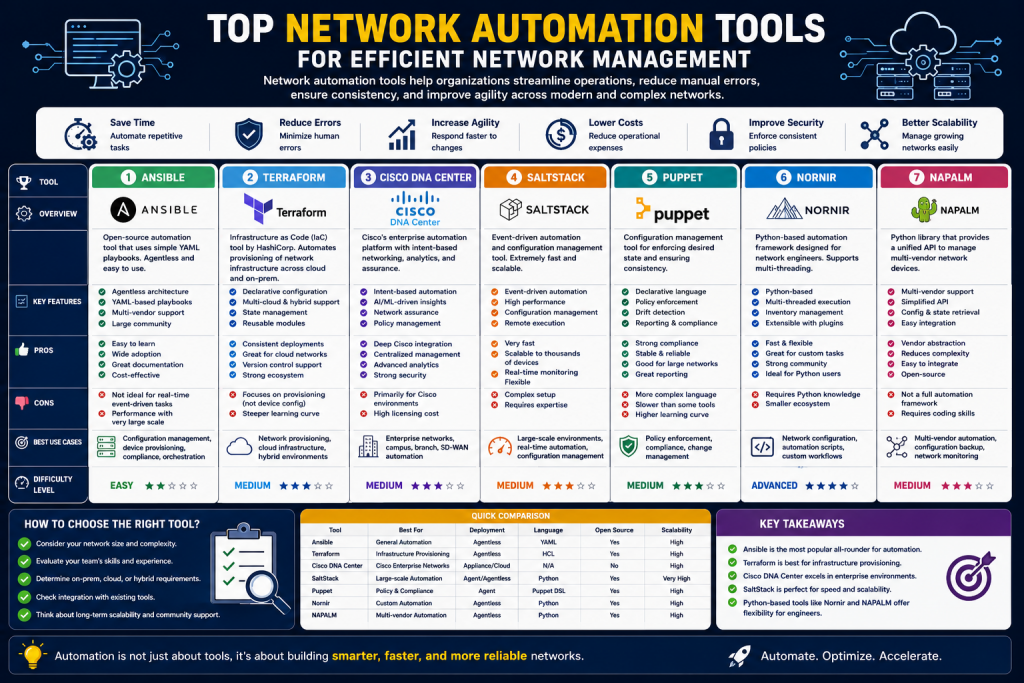
Network automation has become one of the most important shifts in modern IT infrastructure management. In 2026, organizations are no longer relying solely on manual configuration methods because networks are larger, more complex, and expected to operate with minimal downtime. Traditional approaches that require engineers to log into each device and run repetitive commands are no longer efficient or scalable.
Instead, automation tools now handle repetitive configuration, monitoring, testing, and deployment tasks. These tools reduce human error, improve consistency, and allow engineers to focus on higher-value tasks such as network design, optimization, and security planning. With APIs becoming standard across networking devices, automation is more accessible than ever before.
Understanding the tools available in this space is essential for anyone working in IT or networking today. These tools fall into several categories including configuration management, testing and simulation, API development, and enterprise orchestration platforms. Each category plays a diffModern networks support cloud systems, remote users, data centers, IoT devices, and security systems all at once. Managing these manually is inefficient and prone to mistakes. Even small configuration errors can lead to downtime or security risks. As traffic patterns grow more dynamic and applications become more distributed, manual management becomes even harder to scale. Network teams often face pressure to deliver faster changes while maintaining stability, which increases the chance of human error. This is why automation and standardized processes are now essential for maintaining reliable and secure network operations in modern IT environments.
rent role in building a fully automated network environment.
Why Network Automation Matters Today
Modern networks support cloud systems, remote users, data centers, IoT devices, and security systems all at once. Managing these manually is inefficient and prone to mistakes. Even small configuration errors can lead to downtime or security risks.
Network automation solves this by standardizing processes and enabling repeatable workflows. Once a task is automated, it can be executed across hundreds or thousands of devices with minimal effort. This not only saves time but also ensures consistency across the entire infrastructure.
Another key advantage is scalability. As organizations grow, their networks expand rapidly. Automation allows teams to manage this growth without needing a proportional increase in staff. This is why automation is no longer optional—it is a core requirement for modern IT operations.
Types of Network Automation Tools
Before exploring specific tools, it is important to understand the categories they belong to. Each type serves a different purpose in the automation lifecycle.
Configuration Management Tools
These tools are responsible for applying configurations across multiple devices in a consistent way. Instead of manually configuring each router or switch, engineers define desired states and let the tool apply them.
Network Testing and Simulation Tools
Automation can be risky if not tested properly. These tools allow engineers to simulate network environments and test changes before deploying them in production.
API Development and Testing Tools
Modern network devices expose APIs that allow programmatic control. These tools help engineers test API requests and integrate them into automation workflows.
Enterprise Automation Platforms
These are large-scale solutions designed for organizations that require centralized control, advanced analytics, and governance features.
Popular Configuration Management Tools
Ansible
Ansible is one of the most widely used automation tools in networking. It is popular because it is simple, agentless, and easy to learn. Network engineers use YAML-based playbooks to define configurations, which makes it readable even for beginners.
One of the strongest advantages of Ansible is its ability to execute tasks across multiple devices simultaneously. This reduces deployment time significantly and minimizes human error. It is also supported by a large community, meaning reusable automation scripts are widely available.
Terraform
Terraform is a powerful infrastructure automation tool that uses a declarative approach. Instead of describing steps, engineers define the final desired state, and Terraform determines how to achieve it.
It is especially useful in hybrid environments where cloud resources and network devices must be managed together. Terraform also integrates well with version control systems, allowing teams to track changes and roll back configurations when needed.
Nornir
Nornir is a Python-based automation framework designed specifically for network engineers who prefer coding over YAML-based tools. It provides full flexibility since automation logic is written in Python.
This makes it ideal for complex or custom automation workflows. However, it requires stronger programming knowledge compared to other tools, making it more suitable for engineers with Python experience.
Network Testing and Simulation Tools
GNS3
GNS3 allows engineers to create virtual network environments for testing automation scripts. It is widely used for learning and validation purposes.
With GNS3, entire network topologies can be simulated on a local machine. This helps engineers identify configuration issues before applying changes in production environments.
Cisco DevNet Sandbox
This platform provides access to virtual Cisco environments where engineers can safely test automation workflows. It removes the need for physical hardware while still offering realistic testing conditions.
It is especially useful for learning API integration and practicing automation scenarios without risk.
Containerlab
Containerlab is a lightweight tool that uses container technology to build network topologies. It is ideal for quick testing environments and works well on standard laptops or small systems.
API Testing and Integration Tools
Postman
Postman is one of the most popular tools for testing APIs. It allows engineers to send requests to network devices and analyze responses in a structured format.
It is widely used because of its simplicity and ability to organize API calls into collections. This makes it easy to reuse and share requests across teams.
Insomnia
Insomnia is another API testing tool similar to Postman but with a different interface and workflow. Many engineers use both tools to determine which better fits their working style.
PyATS and Genie
PyATS is a testing framework designed for network validation, particularly in Cisco environments. Combined with Genie, it allows engineers to automate network testing, compare states before and after changes, and validate configurations.
This makes it extremely valuable in environments where stability and reliability are critical.
Enterprise Network Automation Tools
Cisco DNA Center
Cisco DNA Center is an enterprise-grade platform designed for managing large-scale Cisco networks. It uses an intent-based approach where administrators define what they want the network to achieve, and the system translates it into configurations.
It also provides analytics, monitoring, and policy enforcement features. Although it is expensive, it is highly effective for large organizations that require centralized control.
Red Hat Ansible Automation Platform
This is the enterprise version of Ansible, offering additional features such as role-based access control, dashboards, and support services.
It is designed for organizations that need scalability, security, and professional support for automation at a large scale.
Terraform Enterprise
Terraform Enterprise extends the capabilities of the open-source version by adding collaboration features, governance controls, and enhanced security options. It is widely used in large DevOps and networking environments.
Free Network Automation Tools
Free tools are often the starting point for engineers entering automation.
Tools like Ansible, Postman, and Nornir provide powerful capabilities without requiring investment. These tools are widely supported and have strong community ecosystems.
Cisco DevNet Sandbox also plays a major role in learning and experimentation by providing free access to simulated environments.
Free tools are ideal for beginners or small teams that want to explore automation before committing to enterprise solutions.
Paid Network Automation Tools
Paid tools are generally used in enterprise environments where reliability, support, and scalability are critical.
Platforms like Cisco DNA Center and Red Hat Ansible Automation Platform provide advanced features that go beyond basic automation. These include centralized dashboards, compliance monitoring, and professional support.
Terraform Enterprise also falls into this category by offering advanced infrastructure management capabilities for large organizations.
While these tools require investment, they often deliver strong returns by improving operational efficiency and reducing downtime.
How to Start Learning Network Automation
The best way to begin is by learning Python fundamentals. Python is widely used in network automation and serves as the foundation for many tools.
Once comfortable with Python, engineers can move on to libraries like Netmiko for device communication. Writing simple scripts that connect to network devices and retrieve information is a great starting point.
After that, tools like Ansible and Postman can be introduced to automate more complex tasks such as configuration management and API testing.
Practical experience is extremely important. Using lab environments and simulation tools helps build confidence before working on production systems.
Best Practices for Network Automation
Successful automation requires careful planning. Engineers should always start with small, repetitive tasks before moving to complex workflows.
Testing is also essential. Any automation script should be validated in a safe environment before deployment.
Version control systems should be used to track changes and maintain configuration history.
Documentation is another important factor. Well-documented automation workflows are easier to maintain and troubleshoot.
Conclusion
Network automation is no longer a future concept—it is a present-day necessity. As networks continue to grow in scale and complexity, automation tools are becoming essential for maintaining efficiency, reliability, and security.
From simple configuration tools like Ansible to enterprise platforms like Cisco DNA Center, each tool plays a specific role in modern network management. Free tools provide an excellent starting point, while paid solutions offer advanced capabilities for large organizations.
The key to success in this field is continuous learning and hands-on practice. By combining programming knowledge with practical automation tools, network engineers can significantly improve their productivity and adapt to the evolving demands of modern IT infrastructure.
Continue exploring the technologies and certification concepts that matter most to you.