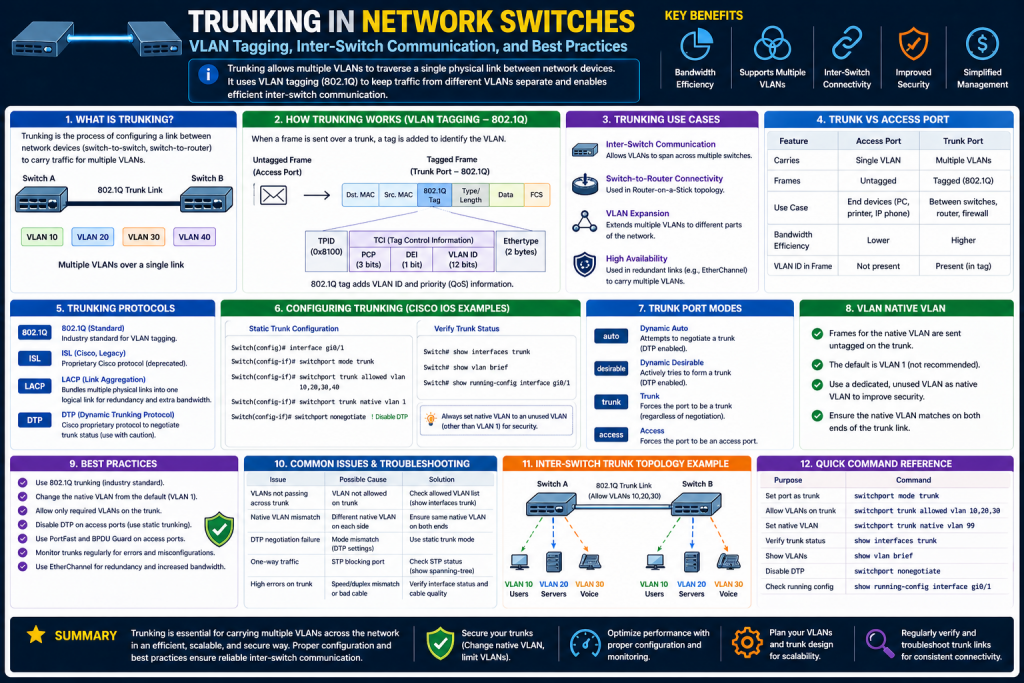
Trunking in networking is an essential concept used to organize, manage, and optimize modern computer networks. As networks grow in size and complexity, the need to efficiently handle traffic, maintain security, and reduce infrastructure costs becomes increasingly important. Trunking provides a solution by allowing multiple logical networks to operate over a single physical infrastructure.
In simple terms, trunking is a method that enables a Local Area Network (LAN) to be divided into smaller logical segments known as Virtual Local Area Networks (VLANs). These VLANs allow network administrators to group devices based on function, department, or security requirements rather than physical location. This logical grouping creates a more structured and manageable network environment.
Without trunking, networks would rely heavily on physical separation. Each department or group would require its own switches, routers, and cabling. This approach quickly becomes inefficient, expensive, and difficult to scale. Trunking eliminates these issues by allowing multiple VLANs to share the same physical connection, making it a cornerstone of modern network design.
In environments such as corporate offices, educational institutions, and large enterprises, trunking is widely used to ensure that network traffic is organized and delivered efficiently. It plays a critical role in improving performance, enhancing security, and simplifying network administration.
Understanding the Concept of VLANs
To fully understand trunking, it is important to first understand VLANs. A VLAN is a logical subdivision of a network that groups devices together as if they were on the same physical network, even if they are located in different areas. VLANs allow administrators to create separate broadcast domains within a single physical network.
A broadcast domain is a segment of a network where broadcast traffic is shared among all devices. In a traditional network without VLANs, broadcast messages are sent to all devices, which can lead to congestion and reduced performance. VLANs solve this problem by limiting broadcasts to specific groups of devices.
For example, in a company with multiple departments such as finance, human resources, and engineering, each department can be assigned its own VLAN. Devices within the same VLAN can communicate freely, while communication between VLANs is controlled through routing. This separation ensures that traffic remains organized and secure.
VLANs also provide flexibility in network design. Devices can be moved from one VLAN to another without requiring physical changes to the network. This makes it easier to adapt to organizational changes, such as adding new departments or restructuring existing ones.
Trunking works hand in hand with VLANs by enabling multiple VLANs to share a single physical connection. Without trunking, each VLAN would require its own dedicated link between network devices, which would defeat the purpose of logical segmentation.
What is Trunking
Trunking is the process of carrying traffic from multiple VLANs over a single network link. This link, known as a trunk link, connects network devices such as switches and routers. The trunk link allows these devices to exchange data for multiple VLANs simultaneously.
Unlike a standard network connection, which typically carries traffic for a single VLAN, a trunk connection is capable of handling multiple VLANs at the same time. This is achieved through a technique called VLAN tagging, which identifies the VLAN to which each data packet belongs.
Trunking effectively reduces the number of physical connections required in a network. Instead of running separate cables for each VLAN, a single trunk link can handle all VLAN traffic. This simplifies network design and reduces hardware requirements.
Another important aspect of trunking is that it maintains the separation between VLANs even though they share the same physical link. Each packet is tagged with a VLAN identifier, ensuring that it is delivered only to the appropriate VLAN. This prevents data from being mixed or sent to unintended destinations.
Trunking is commonly used between switches, as well as between switches and routers. In large networks, trunk links form the backbone of communication, enabling efficient data transfer across different segments of the network.
How VLAN Tagging Works
VLAN tagging is a critical component of trunking. It is the process of adding identifying information to network frames so that devices can determine which VLAN the data belongs to. This tagging ensures that traffic remains properly segmented as it travels across the network.
When a device sends data over a trunk link, the switch inserts a tag into the Ethernet frame. This tag contains a VLAN ID, which uniquely identifies the VLAN associated with the frame. The receiving device reads this tag and forwards the frame to the correct VLAN.
The most widely used standard for VLAN tagging is IEEE 802.1Q. This standard defines how tags are added to Ethernet frames and how they are processed by network devices. The tag itself is a small header that includes important information such as the VLAN ID and priority level.
The VLAN ID is the most important part of the tag. It allows switches and routers to distinguish between traffic from different VLANs. Without this identifier, it would not be possible to maintain separation between VLANs on a shared link.
When a tagged frame reaches its destination, the tag is removed before the frame is delivered to the end device. This ensures that devices such as computers and printers, which are not aware of VLAN tagging, can operate normally.
VLAN tagging also supports advanced features such as traffic prioritization. Certain types of traffic, such as voice or video, can be given higher priority to ensure smooth performance. This is particularly useful in networks that support real-time applications.
Types of Ports in Trunking
In a network that uses VLANs and trunking, there are two main types of ports: access ports and trunk ports. Each type serves a specific purpose and plays a role in maintaining network organization.
An access port is a port that is assigned to a single VLAN. Devices such as computers, printers, and servers are typically connected to access ports. These devices send and receive untagged frames, as they are not aware of VLAN tagging. The switch assigns all traffic from an access port to a specific VLAN.
A trunk port, on the other hand, is configured to carry traffic for multiple VLANs. Trunk ports are used to connect switches, routers, or other network devices. These ports handle tagged frames and ensure that VLAN information is preserved as data travels across the network.
Trunk ports are essential for enabling communication between VLANs across different switches. Without trunk ports, VLANs would be limited to a single switch, making it difficult to scale the network.
In some cases, a trunk port may also carry untagged traffic for a native VLAN. The native VLAN is a default VLAN that does not require tagging. This feature is often used for compatibility with devices that do not support VLAN tagging.
Proper configuration of access and trunk ports is crucial for ensuring that the network functions correctly. Misconfigured ports can lead to issues such as traffic leakage, connectivity problems, and security vulnerabilities.
Importance of Trunking in Modern Networks
Trunking plays a vital role in modern network environments. As organizations continue to expand and rely on digital communication, the need for efficient and scalable network solutions becomes more critical. Trunking addresses these needs by providing a flexible and cost-effective way to manage network traffic.
One of the primary benefits of trunking is improved network efficiency. By reducing the amount of broadcast traffic and optimizing data flow, trunking helps ensure that bandwidth is used effectively. This leads to better performance and a more responsive network.
Trunking also enhances security by isolating different types of traffic. Sensitive data can be kept separate from general network traffic, reducing the risk of unauthorized access. In the event of a security breach, the impact can be contained within a specific VLAN.
Scalability is another key advantage of trunking. As new devices and services are added to the network, additional VLANs can be created without requiring significant changes to the physical infrastructure. This makes it easier to accommodate growth and adapt to changing requirements.
Cost savings are also significant. By allowing multiple VLANs to share the same hardware, trunking reduces the need for additional switches, routers, and cabling. This not only lowers initial costs but also reduces ongoing maintenance expenses.
In addition, trunking simplifies network management. Administrators can easily monitor and control traffic within each VLAN, making it easier to troubleshoot issues and maintain optimal performance. This level of control is essential for managing complex networks.
Real World Example of Trunking
To better understand how trunking works in practice, consider a large office building with multiple departments. Each department has its own set of devices, including computers, printers, and servers. Without trunking, each department would require separate network equipment and cabling.
With trunking, all departments can share the same switches and routers while remaining logically separated. Each department is assigned a VLAN, and trunk links connect the switches. These trunk links carry traffic for all VLANs, ensuring that data is delivered to the correct department.
For example, when a device in the finance department sends data, the switch tags the frame with the finance VLAN ID. The frame travels across the trunk link to another switch, which reads the tag and forwards the data to the appropriate destination within the finance VLAN.
At the same time, traffic from other departments, such as human resources or engineering, is also traveling across the same trunk link. Each frame is tagged with its respective VLAN ID, ensuring that all traffic remains properly separated.
This setup not only reduces the amount of hardware required but also improves network performance and security. Each department operates as if it has its own dedicated network, even though the underlying infrastructure is shared.
Trunking is also commonly used in educational institutions, data centers, and large enterprises. In these environments, the ability to efficiently manage multiple VLANs is essential for maintaining performance and reliability
.Security Benefits of Trunking
One of the most important advantages of trunking in networking is the improvement it brings to overall security. In a traditional flat network, all devices share the same broadcast domain, meaning that data packets can potentially be accessed by any connected device. This creates a large attack surface, making it easier for unauthorized users or malicious software to spread across the network.
Trunking, combined with VLAN segmentation, significantly reduces this risk by isolating network traffic into separate logical groups. Each VLAN acts as its own secure environment, where only authorized devices can communicate with one another. This separation ensures that sensitive information remains confined within its designated network segment.
For example, in an organization, the finance department may handle confidential data such as payroll and financial records. By placing finance devices in a dedicated VLAN, access to this information can be tightly controlled. Even if another part of the network is compromised, the attacker would not automatically gain access to the finance VLAN.
Another important aspect of security in trunking is the use of VLAN IDs. Each packet traveling through a trunk link is tagged with a VLAN identifier. This ensures that data is only delivered to the correct VLAN. Devices that do not have the appropriate VLAN membership cannot access the data, adding an extra layer of protection.
Trunking also enables network administrators to apply security policies on a per-VLAN basis. For instance, access control lists can be configured to restrict communication between VLANs. This allows administrators to define exactly which devices or services are allowed to interact, reducing the likelihood of unauthorized access.
In addition, trunking makes it easier to detect and contain security threats. If a particular VLAN is compromised by a virus or attacker, it can be isolated without affecting the rest of the network. This containment capability is critical for minimizing damage and maintaining network stability.
Monitoring and logging are also enhanced in trunked environments. Since traffic is segmented, administrators can track activity within each VLAN more effectively. Suspicious behavior can be identified quickly, and appropriate actions can be taken to mitigate risks.
Overall, trunking strengthens network security by reducing exposure, enforcing access controls, and enabling better monitoring and threat management.
Cost Efficiency and Resource Optimization
Another major benefit of trunking is its ability to reduce costs and optimize the use of network resources. In traditional network setups, each department or function often requires its own dedicated hardware, including switches, routers, and cabling. This leads to increased expenses and inefficient use of equipment.
Trunking eliminates the need for separate physical networks by allowing multiple VLANs to share the same infrastructure. A single switch can support multiple VLANs, and trunk links can carry traffic for all of them simultaneously. This consolidation significantly reduces the amount of hardware required.
For example, consider a company with three departments: human resources, research and development, and accounting. Without trunking, each department might require its own router and dedicated connections. This would result in underutilized ports and unnecessary costs.
With trunking, all three departments can operate on the same switches and routers. Logical separation is achieved through VLANs, while trunk links handle the communication between devices. This approach maximizes the use of available resources and minimizes waste.
Reduced hardware requirements also lead to lower maintenance costs. Fewer devices mean less power consumption, reduced cooling needs, and fewer components that can fail. This contributes to long-term savings and improved operational efficiency.
Trunking also simplifies network expansion. When new departments or users are added, there is no need to install entirely new network infrastructure. Instead, new VLANs can be created and configured within the existing system. This scalability makes trunking a cost-effective solution for growing organizations.
Another aspect of cost efficiency is cabling. Without trunking, multiple cables would be required to connect different VLANs between switches. Trunking allows all VLAN traffic to pass through a single cable, reducing the amount of wiring needed. This not only saves money but also simplifies network layout and reduces clutter.
In addition, trunking supports better utilization of bandwidth. By combining multiple traffic streams into a single link, it ensures that available bandwidth is used more effectively. This reduces the need for additional connections and further lowers costs.
Overall, trunking provides significant financial benefits by reducing hardware, maintenance, and cabling expenses while maximizing the efficiency of existing resources.
Scalability and Network Growth
Scalability is a critical requirement for modern networks, and trunking plays a key role in enabling it. As organizations grow, their networks must be able to accommodate an increasing number of devices, users, and applications. Trunking provides the flexibility needed to support this growth without requiring major changes to the physical infrastructure.
One of the main ways trunking supports scalability is through the use of VLANs. New VLANs can be created as needed to support additional departments, projects, or services. These VLANs can be configured quickly and integrated into the existing network without disrupting ongoing operations.
For example, if a company launches a new division, a new VLAN can be assigned to that division. Devices can be added to the VLAN, and trunk links will carry the new traffic alongside existing VLAN traffic. This seamless integration makes it easy to expand the network.
Trunking also allows for the addition of new switches and network devices. When a new switch is installed, it can be connected to the existing network using a trunk link. This connection enables the new switch to carry traffic for all VLANs, extending the network without requiring separate connections for each VLAN.
Another important aspect of scalability is bandwidth management. As network traffic increases, additional trunk links can be added to handle the load. This process, often referred to as link aggregation, combines multiple physical connections into a single logical link. This increases overall bandwidth and improves performance.
Trunking also supports dynamic network environments where devices and users frequently move or change roles. Since VLANs are not tied to physical locations, devices can be reassigned to different VLANs without changing their physical connections. This flexibility is particularly useful in large organizations and campus networks.
In addition, trunking makes it easier to integrate new technologies and services. Whether it is voice over IP, video conferencing, or cloud applications, trunking provides the infrastructure needed to support diverse types of traffic. VLANs can be used to prioritize and manage these services effectively.
Overall, trunking ensures that networks can grow and adapt to changing needs while maintaining performance and reliability.
Performance Optimization and Load Balancing
Trunking not only improves organization and scalability but also enhances network performance. By efficiently managing traffic and reducing congestion, trunking helps ensure that data is transmitted quickly and reliably.
One of the primary ways trunking improves performance is by limiting broadcast traffic. In a network without VLANs, broadcast messages are sent to all devices, consuming bandwidth and slowing down communication. Trunking, through VLAN segmentation, confines broadcasts to specific VLANs, reducing unnecessary traffic.
Another important feature of trunking is its ability to aggregate multiple physical links into a single logical connection. This increases the total available bandwidth and allows the network to handle higher volumes of traffic. For example, instead of relying on a single cable, multiple cables can be combined to create a high-capacity trunk link.
Load balancing is also an important aspect of trunking. Traffic can be distributed across multiple links to prevent any single link from becoming overloaded. This ensures that network resources are used efficiently and that performance remains consistent.
Different load balancing methods can be used, such as distributing traffic based on source and destination addresses or traffic volume. These methods help ensure that data flows smoothly across the network.
Trunking also supports quality of service mechanisms, which allow certain types of traffic to be prioritized. For instance, voice and video traffic can be given higher priority to ensure clear communication. This is particularly important in networks that support real-time applications.
In addition, trunking reduces latency by optimizing the path that data takes through the network. By ensuring that traffic is directed to the correct VLAN and avoiding unnecessary broadcasts, data can reach its destination more quickly.
Overall, trunking enhances network performance by improving bandwidth utilization, reducing congestion, and supporting advanced traffic management techniques.
Implementing Trunking in a Network
Implementing trunking requires careful planning and configuration to ensure that the network operates efficiently. The process begins with designing the network and determining how it will be divided into VLANs.
The first step is to identify the different groups or departments that will require separate VLANs. This involves analyzing the organization’s structure and understanding its communication needs. Each VLAN should be assigned a unique identifier.
Once the VLANs are defined, the next step is to configure them on network devices such as switches. This involves assigning ports to specific VLANs and ensuring that devices are connected to the correct ports.
After configuring VLANs, trunk ports must be set up. These ports are responsible for carrying traffic between switches and other network devices. Trunk ports must be configured to support the appropriate VLAN tagging protocol, typically IEEE 802.1Q.
It is also important to ensure that trunk ports on different devices are properly connected. Both ends of the connection must be configured as trunk ports to allow VLAN traffic to pass through.
Testing is a crucial part of the implementation process. Network administrators should verify that devices can communicate within their VLANs and that traffic is properly segmented. Tools such as ping and network analyzers can be used to test connectivity.
Documentation is another important step. Keeping detailed records of VLAN configurations, port assignments, and trunk links helps ensure that the network can be easily managed and maintained.
Proper implementation of trunking ensures that the network operates efficiently and that all VLANs function as intended.
Common Challenges in Trunking
While trunking offers many benefits, it can also present challenges if not implemented correctly. One common issue is VLAN mismatch, which occurs when different devices have inconsistent VLAN configurations. This can result in traffic being sent to the wrong VLAN or being dropped altogether.
Another challenge is misconfigured trunk ports. If a port is not properly set as a trunk port, it may not carry VLAN traffic correctly. This can lead to connectivity issues and disrupt communication between network segments.
Hardware failures can also affect trunking. Faulty cables, switches, or ports can interrupt trunk links and prevent data from being transmitted. Regular maintenance and monitoring are essential to identify and resolve these issues.
Routing problems may also arise when communication between VLANs is required. Inter-VLAN routing must be properly configured to allow traffic to flow between different VLANs. Without this configuration, VLANs remain isolated and cannot communicate.
Security misconfigurations can also pose risks. If access controls are not properly set, unauthorized devices may gain access to sensitive VLANs. This highlights the importance of careful planning and configuration.
Troubleshooting trunking issues requires a systematic approach. Administrators should verify configurations, check hardware, and use diagnostic tools to identify problems. Proper documentation can greatly assist in this process.
Best Practices for VLAN Trunking
To ensure that trunking operates efficiently and securely, it is important to follow a set of best practices. These practices help maintain stability, improve performance, and reduce the chances of errors in the network. Proper planning and disciplined implementation are key factors in achieving a reliable trunking environment.
One of the most important best practices is to design VLANs logically rather than physically. Devices should be grouped based on their function, role, or security requirements instead of their physical location. This logical grouping ensures that the network remains flexible and easy to manage as it grows or changes over time.
Another essential practice is to limit the number of VLANs allowed on a trunk link. By default, trunk ports may allow all VLANs to pass through them. However, this can create unnecessary traffic and potential security risks. Restricting trunk links to only the required VLANs helps reduce overhead and improves overall efficiency.
It is also important to use consistent VLAN numbering across the network. Maintaining a clear and organized VLAN ID structure makes it easier to manage and troubleshoot the network. For example, specific ranges of VLAN IDs can be reserved for certain departments or services.
Proper labeling and documentation are equally critical. Every trunk link, VLAN, and port configuration should be documented clearly. This documentation should include VLAN IDs, port assignments, trunk configurations, and any special settings. Keeping accurate records helps administrators quickly identify and resolve issues.
Redundancy is another key aspect of best practices. Relying on a single trunk link can create a single point of failure. To avoid this, multiple trunk links should be implemented between critical network devices. If one link fails, traffic can continue to flow through alternate paths, ensuring uninterrupted connectivity.
Load balancing should also be configured where possible. By distributing traffic across multiple trunk links, the network can prevent congestion and maintain consistent performance. Different load balancing methods can be applied depending on the network’s requirements.
Security measures should not be overlooked. Unused ports should be disabled, and trunking should only be enabled on ports that require it. This reduces the risk of unauthorized access and prevents potential attacks. Additionally, using strong authentication and access control mechanisms further enhances security.
Regular monitoring and maintenance are essential to keep the trunking environment healthy. Network administrators should continuously monitor traffic patterns, check for errors, and update configurations as needed. Proactive maintenance helps prevent issues before they become critical.
Following these best practices ensures that trunking remains efficient, secure, and scalable, supporting the long-term success of the network.
Troubleshooting Trunking Issues
Despite careful planning and implementation, issues can still arise in trunked networks. Troubleshooting these problems requires a systematic approach and a clear understanding of how trunking works.
One of the most common issues is VLAN mismatch. This occurs when the VLAN configuration on one device does not match the configuration on another device connected through a trunk link. For example, if a VLAN is allowed on one side of the trunk but not on the other, traffic for that VLAN will not pass through correctly. This can lead to connectivity problems and communication failures.
Another frequent issue is incorrect trunk port configuration. If a port is mistakenly configured as an access port instead of a trunk port, it will not carry traffic for multiple VLANs. This misconfiguration can prevent devices on different switches from communicating properly.
Tagging problems can also cause issues. If VLAN tagging is not configured correctly, frames may not be properly identified, leading to misrouted or dropped packets. Ensuring that all devices use the same tagging protocol and configuration is essential for smooth operation.
Native VLAN mismatches are another potential problem. The native VLAN is the VLAN that carries untagged traffic on a trunk link. If the native VLAN is different on each end of the trunk, it can result in traffic being assigned to the wrong VLAN. This can cause confusion and disrupt communication.
Hardware-related issues should also be considered during troubleshooting. Faulty cables, damaged ports, or malfunctioning switches can interrupt trunk links. Checking the physical components of the network is an important step in diagnosing problems.
Routing issues may arise when communication between VLANs is required. Inter-VLAN routing must be properly configured on routers or layer 3 switches. If routing is not set up correctly, devices in different VLANs will not be able to communicate.
Network administrators can use various tools to troubleshoot trunking issues. Commands that display VLAN configurations, trunk status, and port settings can provide valuable insights. Packet analysis tools can also help identify tagging and traffic flow problems.
A structured troubleshooting approach typically involves verifying configurations, checking physical connections, testing connectivity, and analyzing traffic. By following these steps, administrators can identify and resolve issues efficiently.
Effective troubleshooting ensures that trunking continues to function reliably and that network performance remains optimal.
Inter VLAN Communication and Routing
While VLANs provide isolation and organization, there are situations where communication between VLANs is necessary. This is where inter-VLAN routing comes into play. It allows devices in different VLANs to exchange data while maintaining the benefits of segmentation.
Inter-VLAN routing is typically performed by a router or a layer 3 switch. These devices are capable of understanding and processing traffic from multiple VLANs. They act as gateways that facilitate communication between different network segments.
One common method of inter-VLAN routing is known as router-on-a-stick. In this setup, a single physical interface on the router is used to handle traffic for multiple VLANs. The interface is configured as a trunk port, and subinterfaces are created for each VLAN. Each subinterface is assigned a VLAN ID and an IP address, allowing it to route traffic between VLANs.
Layer 3 switches provide another approach to inter-VLAN routing. Unlike traditional switches, layer 3 switches have built-in routing capabilities. They can route traffic between VLANs internally, without the need for an external router. This results in faster performance and reduced latency.
Trunking plays a crucial role in inter-VLAN communication. Trunk links carry traffic from multiple VLANs to the routing device, ensuring that all VLANs can be accessed through a single connection. Without trunking, separate connections would be required for each VLAN, making the network more complex.
Access control is an important consideration in inter-VLAN routing. Administrators can use policies to control which VLANs are allowed to communicate with each other. This helps maintain security while still enabling necessary communication.
For example, a company may allow communication between the sales and inventory VLANs but restrict access to the finance VLAN. These policies ensure that sensitive data remains protected while enabling collaboration where needed.
Proper configuration of inter-VLAN routing is essential for maintaining network functionality. Misconfigurations can lead to communication failures or security vulnerabilities. Careful planning and testing are required to ensure that routing works as intended.
Inter-VLAN routing enhances the flexibility of trunked networks by enabling controlled communication between different segments.
Role of Trunking in Modern Network Design
Trunking has become a fundamental component of modern network design. As networks continue to evolve, the need for efficient, scalable, and secure solutions has grown significantly. Trunking addresses these needs by providing a flexible framework for managing complex network environments.
In enterprise networks, trunking is used to connect multiple switches and create a unified infrastructure. This allows organizations to support a large number of users and devices without compromising performance. Trunk links serve as the backbone of communication, enabling seamless data transfer across the network.
Data centers also rely heavily on trunking to manage high volumes of traffic. With multiple servers, storage systems, and applications, data centers require efficient traffic management. Trunking allows different types of traffic to be separated and prioritized, ensuring optimal performance.
In campus networks, trunking connects different buildings and departments. Each building may have its own VLANs, but trunk links enable communication across the entire campus. This creates a cohesive network that supports various academic and administrative functions.
Cloud computing environments also benefit from trunking. Virtualized networks often use VLANs to isolate different workloads and tenants. Trunking ensures that these VLANs can communicate with physical infrastructure and other network components.
Trunking also supports advanced technologies such as voice over IP and video conferencing. These applications require reliable and high-performance networks. By prioritizing traffic and optimizing bandwidth usage, trunking helps deliver a smooth user experience.
Another important role of trunking is in network automation and software-defined networking. These technologies rely on flexible and programmable network structures. Trunking provides the foundation for creating dynamic and adaptable networks.
Overall, trunking is an essential element of modern network design. It enables organizations to build networks that are efficient, scalable, and capable of supporting a wide range of applications.
Future Trends in Trunking and VLAN Technologies
As technology continues to advance, trunking and VLAN technologies are also evolving. New developments are aimed at improving efficiency, scalability, and integration with emerging network architectures.
One of the key trends is the move toward software-defined networking. In this approach, network control is centralized and managed through software. VLANs and trunking configurations can be dynamically adjusted based on network conditions and requirements. This provides greater flexibility and simplifies network management.
Another trend is the adoption of network virtualization. Virtual networks allow multiple logical networks to operate on the same physical infrastructure. Trunking plays a crucial role in supporting these virtual environments by enabling efficient traffic segmentation.
Automation is also becoming increasingly important. Automated tools can configure and manage trunking and VLAN settings, reducing the need for manual intervention. This not only saves time but also minimizes the risk of human error.
Security enhancements are another area of focus. New technologies are being developed to provide better isolation and protection for VLANs. These include advanced access controls, encryption, and monitoring capabilities.
The integration of trunking with cloud and edge computing is also gaining attention. As more services move to the cloud and edge devices become more common, trunking must adapt to support these distributed environments. This includes handling diverse traffic types and ensuring reliable connectivity.
In addition, improvements in hardware and protocols are enhancing the performance of trunking. Faster network speeds and more efficient tagging methods are being developed to handle increasing data demands.
These trends indicate that trunking will continue to play a vital role in networking, adapting to meet the challenges of modern and future environments.
Conclusion
Trunking in networking is a powerful and essential technique that enables the efficient management of complex network environments. By allowing multiple VLANs to share a single physical connection, trunking simplifies network design, reduces costs, and enhances performance.
Throughout this discussion, it is clear that trunking provides numerous benefits, including improved security, scalability, and resource optimization. It allows organizations to segment their networks logically, ensuring that traffic is organized and controlled effectively.
At the same time, successful implementation of trunking requires careful planning, proper configuration, and adherence to best practices. Understanding how VLANs, trunk ports, tagging, and routing work together is crucial for building a reliable network.
Trunking also plays a significant role in modern network architectures, supporting technologies such as cloud computing, virtualization, and real-time communication. As networks continue to evolve, trunking remains a foundational component that enables flexibility and growth.
Looking ahead, advancements in networking technologies will continue to enhance trunking capabilities. With the integration of automation, software-defined networking, and improved security measures, trunking will remain relevant and essential in the future.
In conclusion, mastering trunking is an important step for anyone involved in networking. It not only improves technical understanding but also provides the tools needed to design and manage efficient, secure, and scalable networks.
Continue exploring the technologies and certification concepts that matter most to you.