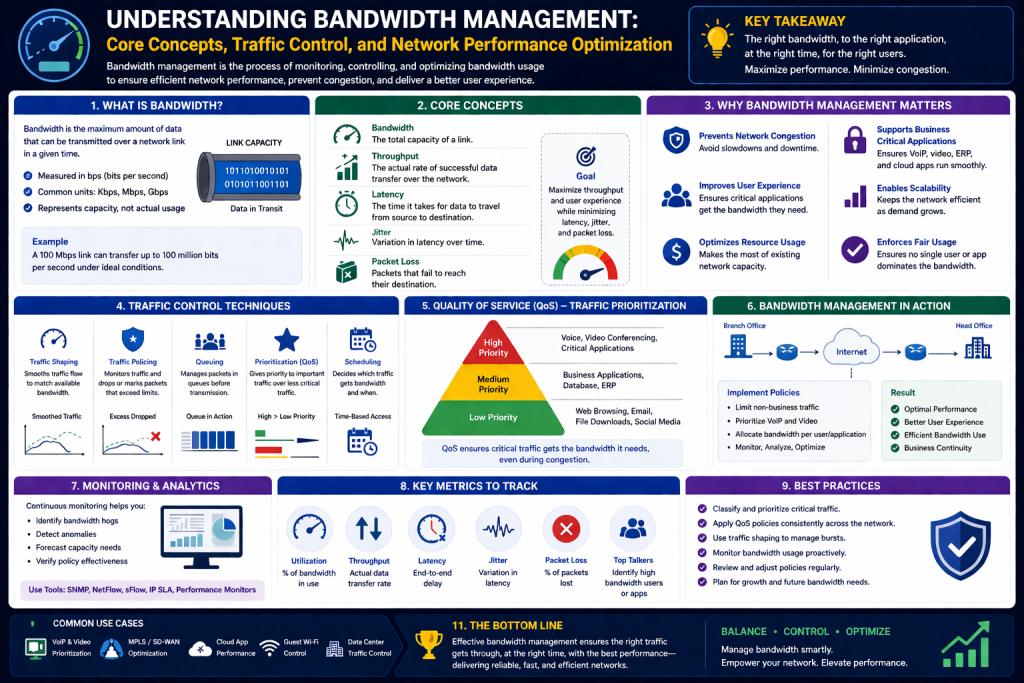
Bandwidth management is a critical aspect of modern networking that focuses on controlling how data moves across a network. In environments where multiple users, devices, and applications rely on shared connectivity, unmanaged traffic can quickly lead to congestion, slow speeds, and poor performance. Bandwidth management addresses these challenges by ensuring that data is distributed efficiently and fairly.
At its core, bandwidth management involves monitoring network usage, identifying high-demand activities, and applying policies that regulate how bandwidth is allocated. These policies help prioritize essential services while limiting the impact of non-essential traffic. The goal is to maintain a stable, high-performing network that meets the needs of all users without unnecessary delays or interruptions.
As organizations increasingly depend on digital tools, cloud services, and real-time communication platforms, the importance of bandwidth management continues to grow. It is no longer optional but a fundamental requirement for maintaining productivity and ensuring seamless operations.
Understanding the Concept of Bandwidth
Bandwidth refers to the maximum capacity of a network connection to transmit data over a given period. It is commonly measured in bits per second, such as kilobits, megabits, or gigabits per second. This measurement indicates how much data can be transferred between devices within a specific timeframe.
A useful way to understand bandwidth is by comparing it to a water pipe. A wider pipe allows more water to flow through at once, just as a higher bandwidth connection allows more data to move simultaneously. However, even a wide pipe can become overwhelmed if too much demand is placed on it at the same time.
Bandwidth does not determine how fast data travels but rather how much data can be transmitted at once. Speed and capacity are often confused, but they represent different aspects of network performance. While bandwidth defines capacity, other factors such as latency and network efficiency influence how quickly data reaches its destination.
The Difference Between Upstream and Downstream Traffic
Network communication occurs in two primary directions: upstream and downstream. Each plays a distinct role in how data flows across a network and how bandwidth is utilized.
Upstream traffic refers to data sent from a user’s device to external networks or servers. Common examples include uploading files, sending emails, participating in video calls, and streaming content from a device. Although upstream usage is generally lower than downstream, it becomes significant in activities like cloud backups or live broadcasting.
Downstream traffic involves data received by a user’s device. This includes downloading files, streaming videos, loading web pages, and accessing online services. Most everyday internet activities rely heavily on downstream bandwidth, which is why many service providers offer higher download speeds compared to upload speeds.
Balancing upstream and downstream bandwidth is essential for maintaining network efficiency. If one direction becomes overloaded, it can affect overall performance and lead to delays or disruptions.
Key Components of Network Infrastructure
The effectiveness of bandwidth management depends heavily on the underlying network infrastructure. Several components work together to facilitate data transmission, and their performance directly impacts available bandwidth.
Routers are responsible for directing data between networks. They determine the best path for data packets and ensure they reach their intended destination. High-quality routers with advanced features can handle greater traffic loads and support more efficient bandwidth management.
Switches operate within local networks, connecting devices and enabling communication between them. They play a crucial role in managing internal traffic and ensuring data is delivered to the correct device without unnecessary delays.
Cables and transmission media also influence bandwidth capacity. Modern networks often use high-speed cables that support large data transfers, while outdated or damaged cables can create bottlenecks that limit performance.
Together, these components form the backbone of a network. Upgrading and maintaining them is essential for supporting effective bandwidth management and ensuring optimal performance.
Types of Internet Connections and Their Impact
The type of internet connection used by an organization or individual significantly affects bandwidth availability. Different technologies offer varying levels of speed, reliability, and capacity.
Fiber-optic connections are widely regarded as the fastest and most reliable option. They use light signals to transmit data, allowing for extremely high speeds and minimal latency. This makes them ideal for environments with heavy bandwidth demands.
Cable connections provide high-speed internet through coaxial cables. While they offer good performance, speeds can fluctuate depending on network congestion, especially during peak usage times.
Digital Subscriber Line connections use telephone lines to deliver internet service. They are generally slower than fiber and cable options but are still widely used in areas where other technologies are not available.
Wireless connections, including mobile networks, offer flexibility and convenience. However, they may experience variability in speed and reliability due to factors such as signal strength and environmental conditions.
Choosing the right connection type is an important step in ensuring sufficient bandwidth for current and future needs.
Factors That Influence Bandwidth Usage
Bandwidth usage is affected by a variety of factors, many of which are dynamic and constantly changing. Understanding these factors is essential for effective management.
One major factor is the number of users on the network. As more devices connect and access resources, the demand for bandwidth increases. This can lead to congestion if the network is not properly managed.
The type of applications being used also plays a significant role. High-bandwidth applications such as video streaming, online gaming, and large file transfers consume more resources than basic activities like email or text-based browsing.
Background processes and automated updates can also contribute to bandwidth usage. These activities often run without user awareness, gradually consuming resources and affecting overall performance.
Additionally, network configuration and policies influence how bandwidth is distributed. Administrators can set rules that prioritize certain types of traffic or limit usage for specific applications, shaping how resources are utilized.
The Importance of Efficient Data Flow
Efficient data flow is essential for maintaining a responsive and reliable network. When data moves smoothly between devices, users can access information quickly and perform tasks without interruption.
Inefficient data flow, on the other hand, can result in delays, packet loss, and reduced performance. This often occurs when bandwidth is not allocated properly or when the network is overloaded with unnecessary traffic.
Bandwidth management ensures that data flows in an organized manner. By prioritizing important traffic and controlling less critical activities, it reduces congestion and improves overall efficiency.
This is particularly important in environments where real-time communication is required. Applications such as voice calls and video conferencing depend on consistent data flow to function effectively.
The Relationship Between Bandwidth and Network Performance
Bandwidth is a key factor in determining network performance, but it is not the only one. Performance is influenced by a combination of bandwidth, latency, packet loss, and overall network design.
High bandwidth allows more data to be transmitted simultaneously, which can improve performance for data-intensive applications. However, if latency is high or packets are lost during transmission, the user experience may still suffer.
Bandwidth management helps optimize performance by addressing these issues. It ensures that critical applications receive the resources they need while minimizing delays and disruptions.
By balancing different aspects of network performance, organizations can create a stable and efficient environment that supports a wide range of activities.
Common Misconceptions About Bandwidth
There are several misconceptions about bandwidth that can lead to misunderstandings about network performance. One common belief is that increasing bandwidth alone will solve all performance issues. While higher capacity can help, it does not address underlying problems such as poor configuration or inefficient usage.
Another misconception is that all applications require equal bandwidth. In reality, different applications have different needs. Treating them equally can result in inefficient resource allocation and reduced performance for critical services.
Some users also assume that bandwidth is unlimited, especially with high-speed connections. However, even the fastest networks have limits, and excessive usage can still lead to congestion.
Understanding these misconceptions is important for developing realistic expectations and implementing effective management strategies.
The Growing Demand for Bandwidth
The demand for bandwidth has increased significantly in recent years due to advancements in technology and changes in how people use the internet. High-definition video streaming, cloud computing, remote work, and online collaboration tools all require substantial data transmission.
As organizations adopt more digital solutions, their reliance on network connectivity continues to grow. This places greater pressure on existing infrastructure and highlights the need for effective bandwidth management.
Future technologies, such as virtual reality and advanced artificial intelligence applications, are expected to further increase bandwidth requirements. Preparing for these demands involves not only expanding capacity but also improving how bandwidth is managed.
Building a Foundation for Effective Management
Effective bandwidth management begins with a solid understanding of network fundamentals. By recognizing how bandwidth works, what influences its usage, and why it is important, organizations can make informed decisions about how to allocate resources.
This foundation supports the development of more advanced strategies, such as traffic prioritization, quality of service policies, and real-time monitoring. These techniques build on basic concepts to create a comprehensive approach to network optimization.
Organizations that invest in understanding and managing bandwidth are better equipped to handle growing demands, maintain performance, and deliver a positive user experience.
The Strategic Importance of Bandwidth Management
Bandwidth management plays a central role in ensuring that networks operate efficiently and reliably in modern environments. As organizations increasingly depend on digital platforms, cloud services, and real-time communication tools, the demand for stable and high-performing networks continues to grow. Without proper management, even high-capacity networks can experience congestion, leading to degraded performance and user dissatisfaction.
The strategic importance of bandwidth management lies in its ability to align network performance with organizational goals. Businesses rely on networks to support critical operations such as communication, collaboration, data transfer, and application access. When bandwidth is managed effectively, these operations can proceed without interruption, enabling teams to work efficiently and meet deadlines.
In contrast, unmanaged bandwidth can lead to unpredictable performance, where critical applications compete with non-essential activities for resources. This can result in delays, interruptions, and reduced productivity. By implementing structured management practices, organizations can ensure that their networks remain stable and responsive, even under heavy demand.
Enhancing Network Performance Through Proper Allocation
One of the primary benefits of bandwidth management is improved network performance. By allocating bandwidth based on the importance of different applications and services, organizations can ensure that critical tasks receive the resources they need.
For example, applications that support real-time communication, such as video conferencing and voice calls, require consistent and reliable data flow. If these applications are not prioritized, they may experience lag, jitter, or dropped connections. Bandwidth management addresses this issue by assigning higher priority to time-sensitive traffic, ensuring smooth and uninterrupted communication.
At the same time, less critical activities such as software updates or background downloads can be assigned lower priority. These activities can still proceed, but they do not interfere with essential operations. This balanced approach allows networks to handle diverse workloads without compromising performance.
Effective allocation also helps prevent bottlenecks, where certain parts of the network become overloaded while others remain underutilized. By distributing traffic more evenly, bandwidth management improves overall efficiency and ensures that resources are used effectively.
Reducing Latency and Improving Responsiveness
Latency, or the delay in data transmission, is a critical factor in network performance. High latency can negatively impact user experience, particularly for applications that require real-time interaction. Bandwidth management plays a key role in reducing latency by controlling how data flows through the network.
When traffic is properly prioritized, important data packets are transmitted with minimal delay. This ensures that applications such as online meetings, remote desktops, and interactive tools remain responsive. Users can communicate and collaborate without experiencing frustrating delays.
In addition to prioritization, bandwidth management techniques such as traffic shaping help regulate the flow of data. By smoothing out bursts of traffic, these techniques prevent sudden spikes that can increase latency. This results in a more consistent and predictable network experience.
Reducing latency is especially important in environments where timing is critical. For example, in customer support centers, delays in communication can affect service quality. Similarly, in financial transactions, even small delays can have significant consequences. Effective bandwidth management helps mitigate these risks by ensuring timely data delivery.
Preventing Network Congestion and Downtime
Network congestion occurs when the demand for bandwidth exceeds the available capacity. This can lead to slow speeds, dropped connections, and even complete network outages. Bandwidth management helps prevent congestion by controlling how resources are used and ensuring that traffic remains within manageable limits.
One way to prevent congestion is by limiting the bandwidth available to certain applications or users. This prevents any single entity from consuming excessive resources and affecting others. By enforcing these limits, organizations can maintain a balanced network environment.
Another approach involves monitoring network usage in real time. By identifying patterns and detecting potential issues early, administrators can take proactive measures to prevent congestion. This may include adjusting allocation policies, upgrading infrastructure, or temporarily restricting non-essential activities.
Preventing downtime is another critical aspect of bandwidth management. Network outages can disrupt operations, leading to lost productivity and potential financial losses. By maintaining stable and controlled data flow, bandwidth management reduces the likelihood of such disruptions and ensures continuous availability.
Cost Optimization and Resource Efficiency
Bandwidth management is not only about performance but also about cost efficiency. Network resources can be expensive, especially when organizations invest in high-capacity connections to meet growing demands. Without proper management, these resources may be underutilized or wasted on non-essential activities.
By optimizing how bandwidth is used, organizations can make the most of their existing infrastructure. This reduces the need for frequent upgrades and helps control costs. For example, instead of increasing bandwidth capacity to accommodate peak usage, organizations can manage traffic more effectively to balance demand.
Cost optimization also involves identifying unnecessary usage. Certain applications or activities may consume bandwidth without providing significant value. By monitoring and analyzing usage patterns, administrators can identify these inefficiencies and take corrective action.
In addition, bandwidth management allows organizations to plan for future growth more effectively. By understanding current usage and trends, they can make informed decisions about when and how to invest in additional resources.
Supporting Critical Business Applications
Modern businesses rely on a wide range of applications to operate effectively. These include communication tools, enterprise software, cloud platforms, and data storage systems. Many of these applications are critical to daily operations and require consistent network performance.
Bandwidth management ensures that these applications receive the necessary resources to function properly. By prioritizing critical traffic, it prevents disruptions that could affect productivity and business continuity.
For example, in a sales organization, communication tools used for client interactions are essential. Any disruption in these tools can impact customer relationships and revenue. By prioritizing these applications, bandwidth management helps maintain smooth and reliable communication.
Similarly, in environments that rely on cloud-based services, consistent bandwidth is essential for accessing data and applications. Effective management ensures that these services remain accessible and responsive, even during periods of high demand.
Improving User Experience Across the Network
User experience is a key consideration in any network environment. Whether it is employees within an organization or customers accessing online services, the quality of the network directly affects satisfaction and productivity.
Bandwidth management improves user experience by ensuring that resources are distributed in a way that meets user needs. Critical applications perform smoothly, while less important activities do not interfere with overall performance.
A well-managed network provides consistent speeds, minimal delays, and reliable connectivity. Users can complete tasks efficiently without encountering frequent interruptions or slowdowns. This contributes to a more positive and productive environment.
In addition, bandwidth management allows organizations to tailor the network experience to different user groups. For example, certain departments may require higher bandwidth for their tasks, while others may have lower requirements. By customizing allocation, organizations can meet these diverse needs effectively.
Ensuring Fair Usage Among Users and Devices
In shared network environments, fairness is an important consideration. Without proper controls, some users or devices may consume a disproportionate amount of bandwidth, leaving others with limited access.
Bandwidth management addresses this issue by implementing policies that ensure equitable distribution of resources. These policies prevent any single user or application from dominating the network and ensure that all users have access to the bandwidth they need.
Fair usage policies are particularly important in environments with high user density, such as offices, educational institutions, and public networks. By maintaining balance, these policies help prevent conflicts and ensure a consistent experience for everyone.
In addition, fair usage contributes to overall network stability. When resources are distributed evenly, the network is less likely to experience sudden spikes in demand that can lead to congestion or performance issues.
Adapting to Changing Network Demands
Network demands are constantly evolving due to changes in technology, user behavior, and organizational needs. Bandwidth management provides the flexibility needed to adapt to these changes.
As new applications and services are introduced, they may require different levels of bandwidth. Bandwidth management allows administrators to adjust policies and allocation strategies to accommodate these requirements.
For example, the shift toward remote work has increased the demand for video conferencing and cloud-based collaboration tools. Organizations that have implemented effective bandwidth management can adapt to these changes more easily, ensuring that their networks continue to perform well.
This adaptability is essential for maintaining long-term performance and supporting innovation. By continuously monitoring and adjusting network usage, organizations can stay ahead of changing demands and avoid potential issues.
Strengthening Network Reliability and Stability
Reliability is a fundamental requirement for any network. Users expect consistent performance and uninterrupted access to services. Bandwidth management contributes to reliability by maintaining controlled and predictable data flow.
By preventing congestion, reducing latency, and ensuring fair distribution, bandwidth management creates a stable network environment. This reduces the likelihood of unexpected disruptions and ensures that services remain available when needed.
Stability is particularly important for mission-critical operations. In industries such as healthcare, finance, and emergency services, network reliability can have significant implications. Effective bandwidth management helps ensure that these operations can proceed without interruption.
In addition, reliable networks contribute to user confidence. When users can depend on consistent performance, they are more likely to trust and rely on the network for their tasks.
The Role of Monitoring in Effective Management
Monitoring is a key component of bandwidth management. Without visibility into network usage, it is difficult to identify issues or make informed decisions about resource allocation.
Through monitoring, administrators can track how bandwidth is being used, identify trends, and detect anomalies. This information is essential for optimizing performance and addressing potential problems.
Real-time monitoring allows for immediate response to issues, while historical data provides insights into long-term patterns. Together, these capabilities enable proactive management and continuous improvement.
Monitoring also supports accountability by providing detailed information about usage. This can help organizations enforce policies and ensure that resources are used responsibly.
Preparing for Future Growth and Scalability
As organizations grow and adopt new technologies, their bandwidth requirements will continue to increase. Bandwidth management plays a crucial role in preparing for this growth.
By optimizing current usage and planning for future needs, organizations can ensure that their networks remain scalable. This involves not only increasing capacity but also improving how resources are managed.
Scalability requires a forward-looking approach that considers potential changes in demand. Bandwidth management provides the tools and strategies needed to anticipate these changes and adapt accordingly.
Organizations that invest in scalable solutions are better positioned to handle growth without compromising performance. This allows them to expand their operations and adopt new technologies with confidence.
Introduction to Bandwidth Management Strategies
After understanding the foundations and importance of bandwidth management, the next step is exploring how it is actually implemented in real-world environments. Strategies for bandwidth management are designed to ensure that network resources are used efficiently while maintaining performance, fairness, and reliability.
These strategies are not one-size-fits-all. Different organizations have different needs based on their size, industry, and the types of applications they use. However, the underlying goal remains the same: to optimize the flow of data so that critical operations are never disrupted.
Effective strategies combine technical tools, administrative policies, and continuous monitoring. When applied correctly, they allow networks to handle heavy workloads while maintaining a high level of performance.
Traffic Prioritization and Its Role
Traffic prioritization is one of the most fundamental techniques in bandwidth management. It involves identifying which types of data are most important and ensuring they are given preference when network resources are limited.
Not all network traffic is equal. Some applications, such as voice calls and video conferencing, require real-time data transmission. Even small delays can disrupt communication. Other activities, such as downloading large files or running updates, are less time-sensitive and can tolerate delays.
By assigning priority levels to different types of traffic, administrators can ensure that critical applications receive the bandwidth they need. This prevents important tasks from being affected by less essential activities.
Traffic prioritization is especially useful in environments where multiple applications compete for limited resources. It creates a structured system where data flows according to importance rather than randomness.
Implementing Quality of Service Policies
Quality of Service, commonly referred to as QoS, is a set of techniques used to manage network traffic and ensure consistent performance. QoS policies define how bandwidth is allocated and how different types of traffic are handled.
One common QoS approach is classification, where traffic is grouped based on criteria such as application type, protocol, or source and destination addresses. Once classified, each group can be assigned a specific level of priority and bandwidth allocation.
Another important aspect of QoS is queuing. Data packets are placed in queues based on their priority level, ensuring that high-priority traffic is transmitted first. This helps reduce delays and maintain performance for critical applications.
QoS also includes mechanisms for congestion management and avoidance. These techniques help prevent network overload by controlling how data is transmitted during periods of high demand.
When implemented effectively, QoS provides a structured framework for managing bandwidth and ensuring predictable network behavior.
Bandwidth Monitoring and Analysis
Monitoring is an essential component of any bandwidth management strategy. Without visibility into how the network is being used, it is impossible to make informed decisions about resource allocation.
Bandwidth monitoring involves tracking data usage across the network in real time. This allows administrators to identify which applications and users consume the most bandwidth and detect unusual patterns that may indicate problems.
Analysis takes monitoring a step further by examining historical data to identify trends and recurring issues. This information can be used to optimize network performance and plan for future needs.
For example, if monitoring reveals that certain applications consistently consume excessive bandwidth during specific times of the day, administrators can adjust policies to distribute traffic more evenly.
Monitoring also plays a key role in troubleshooting. When performance issues arise, detailed data can help pinpoint the cause and guide corrective actions.
Bandwidth Allocation Techniques
Bandwidth allocation is the process of distributing available network capacity among users and applications. This ensures that all parts of the network receive the resources they need to function properly.
One approach to allocation is setting limits on how much bandwidth a user or application can consume. This prevents any single entity from monopolizing resources and affecting others.
Another approach is dynamic allocation, where bandwidth is distributed based on current demand. In this model, unused capacity can be temporarily assigned to applications that need it, improving overall efficiency.
Allocation strategies often combine fixed and dynamic elements to achieve the best results. Critical applications may be guaranteed a minimum level of bandwidth, while additional capacity is distributed as needed.
Effective allocation ensures fairness, prevents congestion, and maximizes the use of available resources.
Traffic Shaping for Controlled Data Flow
Traffic shaping is a technique used to regulate the flow of data across a network. It involves controlling the rate at which data packets are transmitted to ensure smooth and consistent performance.
Rather than allowing data to flow in bursts, traffic shaping spreads transmission over time. This reduces the likelihood of congestion and helps maintain stable network conditions.
Traffic shaping is particularly useful for managing high-volume applications that can generate sudden spikes in demand. By controlling these spikes, administrators can prevent them from affecting other parts of the network.
This technique also helps enforce bandwidth policies by ensuring that traffic adheres to predefined limits. It creates a more predictable environment where data flows in an orderly manner.
Throttling as a Control Mechanism
Throttling is another important bandwidth management technique that involves intentionally limiting the speed of certain types of traffic. This is often used to control non-essential activities that could otherwise consume excessive resources.
For example, streaming services or large file downloads may be throttled during peak hours to ensure that critical applications have sufficient bandwidth. Once demand decreases, these restrictions can be relaxed.
Throttling can be applied to specific users, applications, or types of traffic. It can also be automated based on predefined rules, allowing networks to respond dynamically to changing conditions.
While throttling may seem restrictive, it plays an important role in maintaining balance and preventing congestion. When used appropriately, it improves overall network performance and ensures fair usage.
Best Practices for Effective Bandwidth Management
Implementing bandwidth management strategies requires careful planning and ongoing maintenance. Several best practices can help organizations achieve optimal results.
Regular network assessments are essential for understanding current performance and identifying areas for improvement. By evaluating bandwidth usage, administrators can make informed decisions about allocation and optimization.
Keeping network infrastructure up to date is also important. Modern hardware and software provide better performance and support advanced management features, making it easier to implement effective strategies.
Clear communication between IT teams and users is another key factor. Understanding user needs helps ensure that bandwidth policies align with organizational priorities. Feedback from users can also highlight issues that may not be immediately visible through monitoring tools.
Training and awareness programs can further enhance effectiveness by educating users about responsible bandwidth usage. When users understand how their actions impact the network, they are more likely to adopt practices that support overall performance.
Addressing Security Considerations
Bandwidth management is closely linked to network security. Certain security measures can affect bandwidth usage, while bandwidth policies can influence how security systems operate.
Encryption is one example. While it protects data, it can also increase bandwidth consumption due to additional processing overhead. Balancing security and performance requires careful planning.
Access control is another important consideration. By restricting access to authorized users and devices, organizations can prevent unauthorized activities that may consume bandwidth or compromise security.
Intrusion detection and prevention systems monitor network traffic for suspicious behavior. These systems rely on bandwidth to analyze data in real time, making it important to ensure they have sufficient resources.
Integrating security with bandwidth management ensures that networks remain both efficient and protected.
Balancing Performance with Budget Constraints
One of the challenges in bandwidth management is balancing performance requirements with financial limitations. High-capacity networks and advanced management tools can be expensive, making it important to use resources wisely.
Optimizing existing bandwidth is often more cost-effective than simply increasing capacity. By implementing strategies such as traffic prioritization and shaping, organizations can improve performance without significant additional investment.
Careful planning and analysis can also help identify the most cost-effective solutions. For example, upgrading specific components of the network may provide greater benefits than a complete overhaul.
Budget considerations should be integrated into the overall bandwidth management strategy to ensure sustainable and efficient operations.
Adapting to Evolving Technologies
Technology is constantly changing, and bandwidth management must evolve to keep pace. New applications, devices, and services introduce new demands on network resources.
Cloud computing, remote work, and streaming services have already transformed how bandwidth is used. Emerging technologies such as virtual reality and advanced data analytics are expected to further increase demand.
Adapting to these changes requires flexibility and continuous improvement. Organizations must regularly review their strategies and update their policies to accommodate new requirements.
Investing in scalable solutions and staying informed about technological trends can help ensure that networks remain capable of meeting future demands.
Overcoming Common Challenges
Despite its benefits, bandwidth management can present several challenges. One common issue is accurately predicting network usage. Demand can vary significantly, making it difficult to allocate resources effectively.
Another challenge is managing competing priorities. Different departments or users may have conflicting needs, requiring careful decision-making to ensure fairness and efficiency.
Technical complexity can also be a barrier. Implementing advanced management techniques requires expertise and may involve a learning curve for IT teams.
Overcoming these challenges involves a combination of planning, training, and the use of appropriate tools. By addressing potential issues proactively, organizations can maintain effective bandwidth management.
Building a Sustainable Bandwidth Strategy
A sustainable bandwidth management strategy is one that can adapt to changing conditions while maintaining consistent performance. This requires a long-term perspective that goes beyond immediate needs.
It emphasizes proactive planning rather than reactive fixes, ensuring that networks remain efficient even as demand fluctuates. Instead of waiting for congestion or slowdowns to occur, administrators continuously evaluate performance metrics and make adjustments to prevent issues before they impact users.
Such a strategy relies heavily on data-driven decision-making. By analyzing usage patterns, peak traffic times, and application behavior, organizations can forecast future requirements and allocate resources accordingly. This helps avoid both underutilization and overloading of network capacity. It also enables better prioritization, ensuring that mission-critical applications consistently receive the bandwidth they require.
Scalability is another essential component. As organizations grow, add new users, or adopt advanced technologies like cloud computing and real-time collaboration tools, their bandwidth demands increase. A sustainable approach includes infrastructure and policies that can scale without requiring complete redesigns, saving both time and cost in the long run.
Automation further strengthens sustainability. Modern network tools can dynamically adjust bandwidth allocation based on real-time conditions, reducing the need for constant manual intervention. This not only improves efficiency but also minimizes human error.
Finally, regular reviews and updates ensure that the strategy remains aligned with organizational goals. By combining flexibility, foresight, and continuous improvement, a sustainable bandwidth management approach supports both present performance and future growth.
Sustainability involves continuous monitoring, regular updates, and ongoing optimization. It also requires collaboration between different parts of the organization to ensure that network policies align with overall goals.
By focusing on sustainability, organizations can create networks that remain efficient and reliable over time. This approach supports growth, innovation, and long-term success.
Conclusion
Bandwidth management is a vital component of modern networking that ensures efficient use of resources, reliable performance, and a positive user experience. Through strategies such as traffic prioritization, quality of service policies, monitoring, allocation, traffic shaping, and throttling, organizations can maintain control over how data flows across their networks.
Effective bandwidth management goes beyond technical implementation. It requires ongoing assessment, collaboration, and adaptation to changing demands. By following best practices and addressing challenges proactively, organizations can create stable and scalable network environments.
As technology continues to evolve and data demands increase, the importance of bandwidth management will only grow. Organizations that invest in strong management strategies will be better equipped to handle future challenges, support critical applications, and deliver consistent performance in an increasingly connected world.
Continue exploring the technologies and certification concepts that matter most to you.