Routing protocols play a fundamental role in how modern networks operate. Every time data is sent from one device to another across a network, a series of decisions must be made to determine the most efficient path for that data to follow. These decisions are handled automatically by routing protocols, which are designed to evaluate network conditions and guide traffic accordingly.
To understand the importance of routing protocols, it helps to think about how people plan travel routes. When going on a long trip, most individuals aim to minimize travel time, reduce distance, and avoid obstacles such as traffic congestion or road closures. Navigation tools assist by analyzing available routes and recommending the best option based on current conditions. In a similar way, routing protocols analyze the network and determine the most effective path for data transmission.
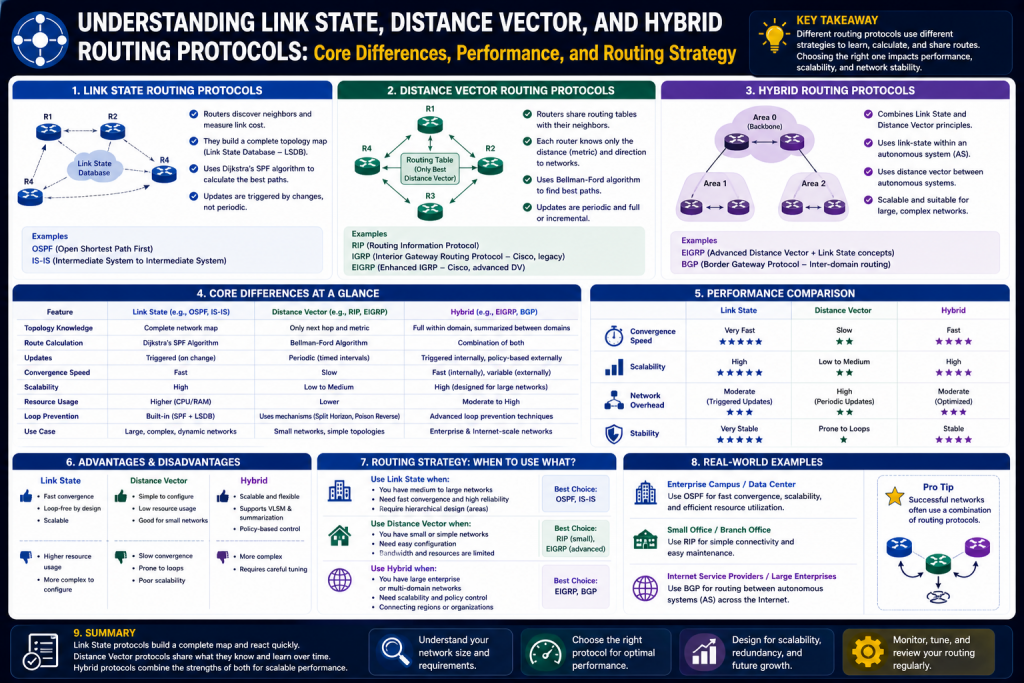
There are three main categories of routing protocols: link state, distance vector, and hybrid. Each category uses a different approach to gather information, calculate routes, and respond to network changes. This section focuses on building a strong foundation and exploring link state routing protocols in depth.
The Role of Routing Protocols in Network Communication
At its core, a network consists of interconnected devices that communicate with each other. These devices include routers, switches, servers, and endpoints such as computers and mobile devices. When data is transmitted across a network, it rarely travels in a straight line from source to destination. Instead, it passes through multiple routers that must decide where to send the data next.
Routing protocols provide the intelligence behind these decisions. They allow routers to learn about the network, share information with one another, and maintain updated routing tables. These tables contain the best known paths to various destinations, enabling routers to forward data efficiently.
Without routing protocols, network administrators would need to configure routes manually. While this might be manageable in very small networks, it becomes impractical in larger environments. Any change in the network would require manual updates, increasing the risk of errors and downtime.
Routing protocols automate this process by dynamically adapting to changes. If a link fails, a new device is added, or traffic patterns shift, the protocol updates routing information to reflect the new conditions. This adaptability is essential for maintaining network performance and reliability.
Key Metrics Used in Routing Decisions
Routing protocols rely on various metrics to determine the best path for data. These metrics provide a way to evaluate and compare different routes. Some of the most common metrics include hop count, bandwidth, delay, reliability, and cost.
Hop count refers to the number of intermediate devices a packet must pass through to reach its destination. Generally, fewer hops indicate a more direct path. However, hop count alone does not always guarantee the fastest route.
Bandwidth measures the capacity of a link to transmit data. Higher bandwidth links can handle more traffic, making them more desirable in many cases. Delay represents the time it takes for data to travel across a link, while reliability indicates the stability of the connection.
Cost is a more flexible metric that can incorporate multiple factors, including bandwidth and delay. Different routing protocols use different combinations of these metrics to calculate the best path.
Understanding these metrics is important because they influence how routing protocols make decisions. A protocol that prioritizes bandwidth may choose a different path than one that prioritizes hop count or delay.
Introduction to Link State Routing Protocols
Link state routing protocols take a comprehensive approach to route calculation. Instead of relying on limited information from neighboring routers, they build a complete map of the network topology. This map includes all routers, links, and associated costs.
Once the topology is established, each router independently calculates the shortest path to every destination. This ensures that all routers have a consistent and accurate understanding of the network.
Link state protocols are widely used in modern networking because they offer high performance, fast convergence, and strong scalability. They are particularly well-suited for large and complex networks where efficiency is critical.
How Link State Routing Protocols Build Network Topology
The process of building a network topology begins with neighbor discovery. Each router identifies the devices it is directly connected to and establishes communication with them. This step is essential for gathering accurate information about the network.
After discovering its neighbors, the router creates a detailed description of its links. This description includes information such as the state of each link, the cost associated with it, and the identity of the connected neighbor. This information is packaged into link-state advertisements.
These advertisements are then distributed to all other routers in the network through a process known as flooding. Flooding ensures that every router receives the same information, allowing them to build identical topology databases.
Once the topology database is complete, each router uses a shortest path algorithm to calculate the best routes. This calculation is performed independently by each router, but because they all have the same information, the results are consistent.
The Concept of Incremental Updates
One of the defining features of link state routing protocols is their use of incremental updates. Instead of sending complete routing information at regular intervals, routers only send updates when there is a change in the network.
For example, if a link goes down or a new connection is established, the affected router generates an updated advertisement and shares it with the network. Other routers receive this update and adjust their topology databases accordingly.
This approach reduces unnecessary network traffic and improves efficiency. It also allows the network to respond quickly to changes, minimizing disruption and maintaining performance.
Understanding Convergence in Link State Protocols
Convergence refers to the process by which all routers in a network reach a consistent understanding of the network topology. In link state protocols, convergence is typically fast due to the use of immediate updates and efficient algorithms.
When a change occurs, the updated information is quickly propagated throughout the network. Each router recalculates its routes based on the new topology, ensuring that data is forwarded correctly.
Fast convergence is important because it reduces the time during which routing decisions may be inconsistent. This helps prevent issues such as packet loss, delays, and routing loops.
Advantages of Link State Routing Protocols
Link state routing protocols offer several significant advantages. One of the most important is accuracy. Because each router has a complete view of the network, it can make well-informed decisions about the best path for data.
Another advantage is scalability. Link state protocols can handle large and complex networks with many interconnected devices. Their ability to maintain detailed topology information makes them suitable for environments where performance is critical.
Fast convergence is another key benefit. The ability to quickly adapt to changes ensures that the network remains stable and efficient, even in dynamic conditions.
Link state protocols also reduce the likelihood of routing loops. Since all routers have consistent information, they are less likely to make conflicting decisions that could cause data to circulate endlessly.
Challenges and Limitations of Link State Routing
Despite their strengths, link state routing protocols also have some limitations. One of the main challenges is resource consumption. Maintaining a complete topology database requires significant memory and processing power.
This can be a concern in networks with limited hardware capabilities. Smaller routers or devices with constrained resources may struggle to handle the demands of link state protocols.
Another limitation is the complexity of configuration. Setting up link state routing often involves multiple steps, including defining network areas, assigning costs, and ensuring proper communication between routers.
The initial exchange of topology information can also generate a large amount of traffic, particularly in large networks. While incremental updates reduce this over time, the initial setup phase can be resource-intensive.
Practical Applications of Link State Routing
Link state routing protocols are commonly used in enterprise networks, data centers, and service provider environments. These networks often require high performance, reliability, and scalability, making link state protocols an ideal choice.
In a large organization with multiple locations, link state routing allows routers to quickly adapt to changes and maintain efficient communication between sites. If a connection fails, the network can reroute traffic through alternative paths without significant disruption.
This level of resilience is essential for maintaining business operations and ensuring a consistent user experience.
Comparing Link State to Real-World Navigation
A useful way to understand link state routing is by comparing it to a modern navigation system. When using a navigation app, you are presented with a complete map that shows all possible routes to your destination.
The app considers various factors such as distance, traffic conditions, and road closures before recommending the best path. If conditions change, the app updates the route in real time.
Link state routing works in a similar way. Each router has access to a complete map of the network and uses this information to determine the best path for data. Updates are made dynamically, ensuring that the network remains efficient and responsive.
Why Link State Protocols Are a Preferred Choice
Link state routing protocols have become a preferred choice in many modern networks due to their reliability and performance. Their ability to provide accurate routing information and adapt quickly to changes makes them well-suited for demanding environments.
They are particularly valuable in networks where downtime or inefficiency can have significant consequences. By ensuring that data is always routed along the best possible path, link state protocols help maintain high levels of performance and reliability.
At the same time, network engineers must carefully consider the resource requirements and complexity associated with these protocols. While they offer many benefits, they may not be the best fit for every situation.
Preparing to Explore Other Routing Protocol Types
While link state routing provides a powerful and efficient approach, it is only one part of the broader routing landscape. Other types of routing protocols, such as distance vector and hybrid, offer different advantages and trade-offs.
Understanding these differences is essential for selecting the right protocol for a given network. Each approach has its own strengths and is suited to specific scenarios.
In the next section, the focus will shift to distance vector routing protocols and hybrid approaches, exploring how they operate and how they compare to link state routing.
Distance Vector and Hybrid Explained
Routing protocols are essential for directing traffic across networks, ensuring that data reaches its destination efficiently and reliably. While link state routing protocols provide a complete view of the network, other approaches take different paths to achieve similar goals. Two important categories are distance vector and hybrid routing protocols. Each offers its own balance of simplicity, performance, and scalability.
This section explores distance vector routing in detail, followed by an in-depth look at hybrid routing protocols. By understanding how these approaches function and where they excel, it becomes easier to determine when and where they should be used in real-world networking environments.
Understanding the Core Idea Behind Distance Vector Routing
Distance vector routing protocols are based on a straightforward concept. Each router determines the best path to a destination by learning from its neighbors. Instead of maintaining a complete map of the network, routers rely on information shared by adjacent devices.
The term distance vector comes from two key components. Distance refers to the cost required to reach a destination, while vector indicates the direction or next hop that should be taken. Together, these values allow routers to build routing tables that guide traffic through the network.
This approach is significantly simpler than link state routing. Routers do not need to store detailed topology information or run complex algorithms. Instead, they focus on exchanging routing information with neighboring routers and updating their tables accordingly.
How Distance Vector Protocols Exchange Information
Distance vector protocols operate by periodically sending updates to neighboring routers. These updates contain information about known destinations and the associated costs to reach them. When a router receives an update, it compares the new information with its existing routing table.
If a shorter or more efficient path is discovered, the router updates its table and propagates the change to its neighbors. This process continues throughout the network, gradually spreading routing information from one router to another.
Unlike link state protocols, which share detailed topology data with all routers, distance vector protocols only communicate with immediate neighbors. This limited scope reduces complexity but also introduces certain challenges.
Because routers rely on indirect information, they may not always have an accurate view of the network. Changes can take longer to propagate, and incorrect information may persist for a period of time.
The Concept of Routing by Rumor
Distance vector routing is often described as routing by rumor. This phrase highlights the indirect nature of information sharing in these protocols. Routers learn about the network through their neighbors, without verifying the original source of the information.
This can be compared to a game of telephone, where a message is passed from one person to another. As the message travels, it may become distorted or delayed. Similarly, routing information in distance vector protocols can become outdated or inaccurate as it moves through the network.
Despite this limitation, the simplicity of routing by rumor makes distance vector protocols easy to implement and manage. For smaller networks with stable conditions, this approach can be effective and efficient.
Metrics Used in Distance Vector Routing
Distance vector protocols typically use simple metrics to determine the best path. One of the most common metrics is hop count, which represents the number of routers a packet must pass through to reach its destination.
In general, routes with fewer hops are preferred. However, this approach does not account for factors such as bandwidth or delay. As a result, a path with fewer hops may not always be the fastest or most reliable option.
Some distance vector protocols use additional metrics to improve accuracy, but they still maintain a relatively simple decision-making process compared to link state protocols.
Convergence Challenges in Distance Vector Networks
Convergence is a critical aspect of routing protocols. It refers to the time it takes for all routers in a network to update their routing tables after a change occurs. In distance vector networks, convergence can be slower compared to link state protocols.
When a network change occurs, such as a link failure, the updated information must be passed from router to router. This process can take time, especially in larger networks. During this period, routers may continue to use outdated information, leading to inefficiencies or routing issues.
One of the most well-known problems associated with distance vector routing is the count to infinity issue. This occurs when routers continuously increase the cost of a route in an attempt to find a valid path, even though the destination is no longer reachable.
Various techniques, such as split horizon and route poisoning, are used to mitigate these issues. While these techniques improve stability, they do not completely eliminate the inherent limitations of distance vector routing.
Advantages of Distance Vector Routing Protocols
Despite their limitations, distance vector routing protocols offer several advantages. One of the most notable is simplicity. These protocols are easy to configure and require minimal administrative effort.
Resource efficiency is another key benefit. Distance vector protocols consume less memory and processing power compared to link state protocols. This makes them suitable for devices with limited capabilities.
They are also effective in smaller networks where the complexity of link state routing may not be necessary. In such environments, the simplicity and low overhead of distance vector protocols can be a significant advantage.
Limitations of Distance Vector Routing
While distance vector protocols are simple and resource-efficient, they have several drawbacks. One of the main limitations is slower convergence. Changes in the network take longer to propagate, which can lead to temporary inconsistencies.
Another issue is the potential for routing loops. Because routers do not have a complete view of the network, they may make conflicting decisions that cause data to circulate indefinitely.
The reliance on basic metrics such as hop count can also result in suboptimal routing decisions. More efficient paths may be overlooked in favor of routes with fewer hops.
These limitations make distance vector protocols less suitable for large or dynamic networks where performance and reliability are critical.
Introduction to Hybrid Routing Protocols
Hybrid routing protocols are designed to combine the strengths of both link state and distance vector approaches. They aim to provide fast convergence and efficient routing while maintaining a relatively simple configuration.
Instead of strictly following one method, hybrid protocols incorporate features from both categories. This allows them to achieve a balance between performance and resource usage.
Hybrid protocols are commonly used in environments where networks must handle varying levels of traffic and frequent changes. They are particularly useful in large organizations and service provider networks.
How Hybrid Routing Protocols Work
Hybrid routing protocols use advanced algorithms to determine the best path for data. These algorithms often consider multiple metrics, such as bandwidth, delay, and reliability, to make more informed decisions.
Unlike traditional distance vector protocols, hybrid protocols do not rely solely on periodic updates. Instead, they use triggered updates that occur only when there is a change in the network. This reduces unnecessary traffic and improves efficiency.
Hybrid protocols also maintain more detailed information about the network than distance vector protocols, but they do not require a complete topology map like link state protocols. This allows them to strike a balance between accuracy and resource usage.
Fast Convergence in Hybrid Protocols
One of the key advantages of hybrid routing protocols is fast convergence. When a network change occurs, hybrid protocols can quickly update routing information and adapt to the new conditions.
This is achieved through efficient update mechanisms and advanced algorithms that minimize the time required to recalculate routes. As a result, hybrid protocols are well-suited for dynamic environments where stability and responsiveness are important.
Fast convergence helps reduce downtime and ensures that data continues to flow smoothly even during network changes.
Load Balancing Capabilities
Hybrid routing protocols often support load balancing, which allows traffic to be distributed across multiple paths. This improves overall network performance and prevents any single path from becoming overloaded.
Load balancing is particularly useful in high-traffic environments where multiple routes are available. By spreading traffic across these routes, hybrid protocols can maximize resource utilization and enhance efficiency.
This capability is not typically found in basic distance vector protocols, making hybrid approaches more versatile.
Resource Efficiency and Scalability
Hybrid routing protocols are designed to be more resource-efficient than link state protocols while still offering strong performance. They require less memory and processing power, making them suitable for a wide range of devices.
At the same time, they are scalable enough to handle large networks. Their ability to adapt to changing conditions and support advanced features makes them a popular choice for complex environments.
This balance of efficiency and scalability is one of the main reasons hybrid protocols are widely used.
Practical Use Cases for Hybrid Routing
Hybrid routing protocols are commonly used in enterprise networks, educational institutions, and service provider environments. These networks often experience varying traffic levels and require flexible routing solutions.
In such environments, hybrid protocols can provide the performance needed to handle large volumes of data while maintaining efficient resource usage. Their ability to adapt quickly to changes makes them ideal for networks that must remain operational at all times.
They are also useful in scenarios where multiple routing strategies need to be combined to achieve optimal results.
Comparing Distance Vector and Hybrid Approaches
Distance vector and hybrid routing protocols differ significantly in their capabilities and performance. Distance vector protocols prioritize simplicity and low resource usage, making them suitable for smaller networks.
Hybrid protocols, on the other hand, offer improved performance and faster convergence. They incorporate advanced features that make them more suitable for larger and more dynamic environments.
While distance vector protocols are easier to configure, hybrid protocols provide greater flexibility and efficiency. The choice between the two depends on the specific requirements of the network.
Preparing for a Complete Comparison
Understanding distance vector and hybrid routing protocols provides valuable insight into how different routing strategies operate. Each approach has its own strengths and limitations, and no single solution is ideal for every scenario.
In the next section, these protocols will be compared alongside link state routing to highlight their key differences. This comparison will help clarify which approach is best suited for different types of networks and operational requirements.
By examining all three categories together, it becomes possible to make informed decisions about routing protocol selection and network design.
Comparison, Design Considerations, and Final Insights
Routing protocols form the decision-making core of any network. After exploring how link state, distance vector, and hybrid routing protocols function individually, the next step is to compare them directly and understand how they fit into real-world network design. Each protocol type brings a different balance of performance, simplicity, scalability, and resource usage.
This section focuses on comparing these routing approaches, identifying their strengths and weaknesses, and examining how network engineers can choose the right protocol based on specific requirements.
Core Differences in Routing Philosophy
At a fundamental level, the difference between link state, distance vector, and hybrid routing protocols lies in how they gather and process information.
Link state protocols operate with a global perspective. Every router builds a full map of the network and independently calculates the best path. This results in highly accurate routing decisions but requires more processing power and memory.
Distance vector protocols take a localized approach. Routers rely only on information from their immediate neighbors, making decisions based on limited visibility. This simplicity reduces overhead but can lead to slower convergence and less optimal routing.
Hybrid protocols attempt to bridge the gap. They combine the structured efficiency of link state routing with the simplicity of distance vector methods. By doing so, they provide faster convergence and better performance without requiring a complete topology map.
Understanding these philosophical differences is key to selecting the right routing protocol for a given environment.
Bandwidth Utilization Across Protocol Types
Bandwidth usage is an important consideration in network design. Routing protocols consume bandwidth when they exchange updates, and excessive usage can impact overall network performance.
Link state protocols are efficient in the long run because they send incremental updates only when changes occur. However, the initial exchange of topology information can be bandwidth-intensive, especially in large networks.
Distance vector protocols tend to consume more bandwidth over time because they send periodic updates containing their entire routing tables. Even if no changes have occurred, these updates are still transmitted, leading to unnecessary traffic.
Hybrid protocols improve efficiency by using triggered updates instead of periodic ones. This means updates are sent only when necessary, reducing bandwidth consumption while maintaining accurate routing information.
This difference in update behavior plays a significant role in determining which protocol is best suited for a network.
Convergence Speed and Network Stability
Convergence speed is one of the most critical factors in routing protocol performance. It determines how quickly a network can adapt to changes such as link failures or topology modifications.
Link state protocols offer fast convergence due to their use of immediate updates and efficient algorithms. When a change occurs, the updated information is quickly distributed, and routers recalculate their routes.
Distance vector protocols are slower to converge because updates must propagate gradually from one router to another. During this time, routers may rely on outdated information, which can lead to inefficiencies or temporary routing loops.
Hybrid protocols provide some of the fastest convergence times by combining efficient update mechanisms with advanced algorithms. This allows them to respond quickly to changes while maintaining stability.
In environments where uptime and performance are critical, faster convergence can make a significant difference.
Resource Consumption and Hardware Requirements
Different routing protocols place varying demands on network devices. These demands include CPU usage, memory consumption, and overall processing requirements.
Link state protocols require the most resources because each router must maintain a full topology database and perform complex calculations. This makes them more suitable for devices with higher processing capabilities.
Distance vector protocols are lightweight and require minimal resources. They are ideal for smaller devices or networks where hardware limitations are a concern.
Hybrid protocols fall somewhere in between. They require more resources than distance vector protocols but less than link state protocols. This balance allows them to deliver strong performance without overwhelming system resources.
When designing a network, it is important to consider the capabilities of the hardware being used. Choosing a protocol that exceeds these capabilities can lead to performance issues.
Scalability and Network Growth
Scalability is another important factor when selecting a routing protocol. As networks grow, the routing protocol must be able to handle increased complexity without degrading performance.
Link state protocols are highly scalable and are commonly used in large enterprise and service provider networks. Their ability to maintain a detailed view of the network makes them well-suited for complex environments.
Distance vector protocols are less scalable due to their slower convergence and limited visibility. They are best suited for small networks with relatively simple topologies.
Hybrid protocols offer good scalability and can adapt to a wide range of network sizes. Their flexibility makes them a popular choice for organizations that expect future growth.
Planning for scalability ensures that the network can evolve without requiring a complete redesign.
Load Balancing and Traffic Optimization
Efficient traffic management is essential for maintaining network performance. Load balancing allows traffic to be distributed across multiple paths, preventing congestion and improving resource utilization.
Link state protocols support load balancing, enabling routers to use multiple paths to reach a destination. This enhances performance and provides redundancy.
Distance vector protocols typically do not support advanced load balancing features. As a result, traffic is often limited to a single path, which can lead to bottlenecks.
Hybrid protocols support load balancing and can distribute traffic more effectively. This capability is particularly useful in high-traffic environments where multiple routes are available.
The ability to optimize traffic flow is a key advantage of link state and hybrid routing protocols.
Accuracy of Routing Decisions
The accuracy of routing decisions directly impacts network efficiency. Protocols that provide more accurate information are better equipped to select optimal paths.
Link state protocols offer the highest level of accuracy because they rely on a complete network topology. This allows routers to evaluate all possible paths and choose the best one.
Distance vector protocols are less accurate due to their reliance on indirect information. Routers may not be aware of the full network structure, leading to suboptimal decisions.
Hybrid protocols improve accuracy by incorporating additional information and more advanced algorithms. While they may not have a complete topology map, they still provide better decision-making capabilities than distance vector protocols.
Accurate routing ensures that data is transmitted efficiently and reliably.
Network Size and Use Case Considerations
The size and purpose of a network play a major role in determining which routing protocol should be used.
In small networks with limited devices and simple topologies, distance vector protocols are often sufficient. Their simplicity and low resource requirements make them easy to deploy and manage.
In large and complex networks, link state protocols are typically the preferred choice. Their ability to handle high levels of traffic and adapt quickly to changes makes them ideal for demanding environments.
Hybrid protocols are well-suited for medium to large networks that require a balance between performance and simplicity. They are particularly useful in environments where network conditions change frequently.
Selecting the right protocol depends on understanding the specific needs and constraints of the network.
Real-World Network Design Scenarios
In real-world applications, network engineers often choose routing protocols based on practical considerations rather than theoretical advantages alone.
For example, a small business with a limited number of routers may prioritize ease of configuration and low cost. In this case, a distance vector protocol may be the most appropriate choice.
A large enterprise with multiple locations and high traffic demands will likely require the performance and scalability of link state routing. The ability to quickly adapt to changes and maintain accurate routing information is essential in such environments.
Service providers and organizations with dynamic traffic patterns may benefit from hybrid protocols. These protocols offer the flexibility needed to handle varying conditions while maintaining efficient performance.
Understanding these scenarios helps illustrate how routing protocols are applied in practice.
Balancing Performance and Simplicity
One of the key challenges in network design is finding the right balance between performance and simplicity. More advanced protocols often provide better performance but come with increased complexity and resource requirements.
Link state protocols offer high performance but require careful configuration and powerful hardware. Distance vector protocols are simple and easy to manage but may not meet the needs of larger networks.
Hybrid protocols provide a middle ground, offering improved performance without excessive complexity. This balance makes them a practical choice for many organizations.
The decision ultimately depends on the priorities of the network, including performance, cost, and ease of management.
Future Trends in Routing Protocols
As networks continue to evolve, routing protocols must adapt to new challenges. The growth of cloud computing, virtualization, and software-defined networking is changing how networks are designed and managed.
Modern routing solutions are increasingly focused on automation, scalability, and real-time adaptability. While traditional routing protocols remain important, new technologies are emerging to complement and enhance their capabilities.
Hybrid approaches are likely to play a significant role in the future, as they offer the flexibility needed to handle complex and dynamic environments.
Understanding these trends helps network engineers prepare for the evolving landscape of networking.
Conclusion
Routing protocols are essential for enabling efficient communication across networks. Link state, distance vector, and hybrid routing protocols each offer unique approaches to determining the best path for data transmission.
Link state protocols provide high accuracy, fast convergence, and strong scalability, making them ideal for large and complex networks. Distance vector protocols offer simplicity and low resource usage, making them suitable for smaller environments with limited requirements.
Hybrid protocols combine the strengths of both approaches, delivering fast convergence, efficient updates, and flexible performance. They are well-suited for networks that require a balance between simplicity and advanced functionality.
Choosing the right routing protocol requires careful consideration of factors such as network size, performance requirements, resource availability, and future growth. By understanding the characteristics of each protocol type, network engineers can design systems that are both efficient and reliable.
In the end, there is no single best solution for every scenario. The key is to evaluate the specific needs of the network and select the protocol that aligns with those requirements.
Continue exploring the technologies and certification concepts that matter most to you.