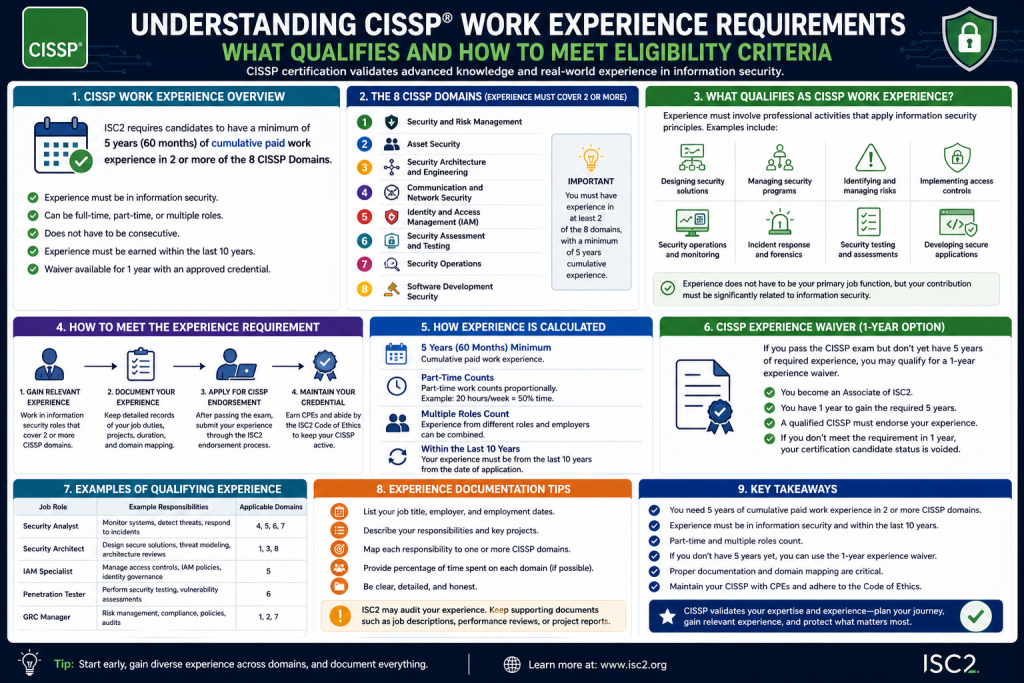
The Certified Information Systems Security Professional certification is widely recognized as one of the most respected credentials in the field of cybersecurity. While many certifications focus primarily on passing an exam, CISSP takes a different approach. It emphasizes not only knowledge but also real-world experience. This combination ensures that certified professionals are capable of applying security principles in practical environments rather than simply understanding them in theory.
For many aspiring candidates, the experience requirement becomes the most challenging aspect of the entire certification process. The exam itself is known for its difficulty, but it is achievable with preparation and dedication. The experience requirement, however, requires time, planning, and a clear understanding of what qualifies and what does not.
One important detail that often surprises candidates is that there is no restriction on taking the CISSP exam without having the required experience. Anyone can sit for the exam. However, passing the test without meeting the experience requirement does not grant full certification. Instead, candidates receive the designation of Associate of ISC2. This status allows them to work toward fulfilling the experience requirement within a set time frame.
Understanding what counts as valid experience is essential before beginning the CISSP journey. Without this knowledge, candidates may underestimate their qualifications or fail to properly document their work history.
Understanding the Five-Year Work Experience Requirement
To earn the CISSP certification, candidates must have at least five years of cumulative paid work experience in information security. The word cumulative is especially important in this context. It means that the experience does not need to be continuous or gained in a single role. Instead, it can be built over time, across different positions, and even in multiple organizations.
This flexibility is beneficial for individuals who have followed non-linear career paths. For example, someone may have worked in IT support, then transitioned into network administration, and later taken on responsibilities related to security. Each of these roles may contribute to the overall experience requirement.
Another important aspect is that the experience must be paid. This ensures that the work reflects professional responsibilities and accountability. While unpaid work such as volunteering can provide valuable skills, it typically does not count toward the official requirement unless it closely resembles a formal professional role and can be verified.
The requirement is designed to ensure that CISSP-certified professionals have a strong foundation of real-world experience. It reflects the expectation that they can handle complex security challenges and make informed decisions in professional environments.
Why Job Titles Are Less Important Than Responsibilities
A common misconception among CISSP candidates is that they need to hold a job title that explicitly includes the word security. While such titles can make the application process more straightforward, they are not required.
ISC2 focuses on the actual work performed rather than the title associated with the role. Many professionals perform security-related tasks as part of broader IT responsibilities. For instance, a system administrator may configure firewalls, manage user access, and monitor system logs. These tasks are directly related to information security, even if the role is not labeled as a security position.
This approach recognizes the reality of modern IT environments, where security is integrated into many different roles. It allows candidates from diverse backgrounds to qualify, provided they can demonstrate relevant experience.
However, this also means that candidates must clearly explain their responsibilities when applying. Simply listing a job title is not enough. It is necessary to describe how the work involved security-related activities and contributed to protecting systems or data.
Identifying Security Work in Everyday Roles
Many professionals underestimate their experience because they do not recognize how often they engage in security-related tasks. In reality, security is a fundamental part of many IT roles, even if it is not the primary focus.
For example, managing user accounts involves controlling access to systems and data. Configuring network devices often includes setting up security features such as firewalls or intrusion detection systems. Performing system updates helps protect against vulnerabilities. Each of these activities contributes to maintaining a secure environment.
By taking a closer look at daily responsibilities, candidates can identify areas where they have gained relevant experience. This process requires careful reflection and attention to detail. It may also involve reviewing past job descriptions or performance evaluations to recall specific tasks.
Recognizing these contributions is an important step in preparing a strong CISSP application. It ensures that all relevant experience is properly documented and presented.
The Role of Hands-On Experience in CISSP Qualification
ISC2 places a strong emphasis on practical, hands-on experience. This means that candidates must have actively participated in tasks that involve implementing, managing, or supporting security measures.
Hands-on experience demonstrates the ability to apply theoretical knowledge in real-world situations. It shows that a candidate can handle the complexities and challenges of working in information security. This is a key requirement for a certification that is intended to represent professional competence.
Examples of hands-on experience include configuring security tools, responding to incidents, conducting audits, and implementing policies. These activities require both technical skills and critical thinking. They also involve making decisions that can impact the security of an organization.
Candidates who have only studied security concepts without applying them in practice may find it difficult to meet the experience requirement. This is why gaining practical exposure is essential for anyone pursuing the CISSP certification.
Full-Time Work as the Most Direct Path
The most straightforward way to meet the CISSP experience requirement is through full-time employment in roles that involve security responsibilities. Full-time work typically consists of 35 to 40 hours per week and provides a consistent and verifiable record of experience.
Each year of full-time work generally counts as one year toward the requirement, as long as the role includes relevant security tasks. This makes it easier for candidates to track their progress and plan their certification journey.
Many professionals gain this experience through roles such as network administrators, system engineers, or security analysts. These positions often include a mix of responsibilities that align with CISSP requirements.
However, simply working in an IT role is not enough. The work must involve meaningful engagement with security. Candidates should ensure that their responsibilities include tasks related to protecting systems, managing risks, or enforcing policies.
Building Experience Across Multiple Roles
One of the strengths of the CISSP experience requirement is its flexibility. Candidates are not required to gain all their experience in a single role or organization. Instead, they can build their experience over time by working in different positions.
This approach allows individuals to develop a broad range of skills and perspectives. For example, someone who has worked in both technical and administrative roles may have a deeper understanding of security challenges and solutions.
It also makes the certification more accessible to individuals who have taken unconventional career paths. Whether transitioning from another field or progressing through various IT roles, candidates can accumulate the necessary experience gradually.
Each role contributes to the overall requirement, provided it involves relevant security tasks. This cumulative approach encourages continuous learning and professional growth.
The Importance of Clear Documentation
When applying for the CISSP certification, candidates must provide detailed information about their work experience. This includes describing their roles, responsibilities, and the specific tasks they performed.
Clear documentation is essential for ensuring that the application is approved. Reviewers need to understand how the candidate’s experience aligns with the requirements. Vague or incomplete descriptions may lead to delays or rejection.
To avoid this, candidates should focus on providing specific examples of their work. Instead of using general statements, they should explain what they did, how they did it, and what impact it had.
For example, rather than saying they managed systems, they could describe how they implemented access controls, monitored activity, or responded to security incidents. This level of detail makes it easier to demonstrate the relevance of their experience.
Understanding the Concept of Cumulative Experience
The concept of cumulative experience is central to the CISSP requirement. It means that experience can be added together over time, even if it is gained in different roles or environments.
This approach provides flexibility for professionals who may not have followed a traditional or linear career path in cybersecurity. Instead of requiring continuous experience in a single position, it allows individuals to build their qualifications gradually by contributing to security-related tasks across multiple jobs. For example, a professional might gain some experience in system administration, later move into network management, and eventually take on more focused security responsibilities. Each of these roles can contribute to the total required experience, as long as they involve relevant activities.
Cumulative experience also accounts for career transitions, breaks, or shifts in responsibilities. Someone moving from general IT into cybersecurity does not need to start from scratch; their previous experience can still count if it included security-related work. This makes the CISSP certification more accessible to a broader range of professionals.
However, this flexibility also requires careful documentation. Candidates must clearly outline how each role contributed to their security experience. Keeping detailed records of responsibilities and achievements ensures that all qualifying work is properly recognized and validated during the certification process.
This is particularly helpful for individuals who have worked part-time, taken career breaks, or transitioned between jobs. As long as the experience is relevant and can be verified, it can be included in the total.
Cumulative experience also allows candidates to combine different types of work. For example, they may have gained some experience in system administration and additional experience in network security. Together, these contributions help meet the overall requirement.
This flexibility makes it easier for candidates to qualify, but it also requires careful tracking of their work history. Keeping detailed records of roles and responsibilities can simplify the application process.
Preparing for a Successful CISSP Journey
Understanding what counts as CISSP experience is the first step toward achieving the certification. By gaining clarity on the requirements, candidates can better assess their current qualifications and plan their next steps.
Preparation involves more than just studying for the exam. It includes building and documenting relevant experience, identifying gaps, and seeking opportunities to gain additional exposure to security tasks.
Candidates should also focus on developing both technical and managerial skills. The CISSP certification is designed to reflect a broad understanding of information security, including strategy, risk management, and operations.
By taking a proactive approach, candidates can ensure that they meet the experience requirement and are well-prepared for the certification process. This not only increases their chances of success but also enhances their overall professional development.
Understanding How Part-Time Experience Contributes
Not every professional gains experience through traditional full-time roles. Many individuals enter the field of information security gradually, often starting with part-time positions while studying, transitioning careers, or balancing other responsibilities. Recognizing this, ISC2 allows part-time work to count toward the CISSP experience requirement, provided it meets certain conditions.
Part-time experience must still involve meaningful security-related responsibilities. It cannot simply be general IT work unless that work includes tasks tied to protecting systems, managing risk, or supporting security processes. The expectation remains the same as full-time roles: the work must be relevant and practical.
There are also specific hour requirements that define what qualifies as part-time experience. Typically, part-time work must fall within a range of 20 to 34 hours per week. Anything below this threshold may not be considered sufficient, while anything above it is usually categorized as full-time.
To ensure fairness, ISC2 converts part-time hours into full-time equivalents. This means that your total hours worked are calculated and then translated into a standard based on a typical full-time schedule. For example, if full-time work is considered 40 hours per week, then 2,080 hours equal one year of experience. Half of that, 1,040 hours, would represent approximately six months.
This conversion process allows candidates to accumulate experience at their own pace. It is particularly useful for those who are transitioning into cybersecurity or who cannot commit to full-time roles immediately.
Accurately Tracking Part-Time Work Hours
When relying on part-time experience, accurate record-keeping becomes extremely important. Unlike full-time roles, where time is easier to calculate, part-time work requires detailed tracking of hours to ensure that it is properly credited.
Candidates should maintain records of their work schedules, including weekly hours and total time spent on relevant tasks. This information may be needed during the application process to verify experience. Employers or supervisors may also be asked to confirm these details.
Being precise about hours worked helps avoid discrepancies and ensures that your experience is evaluated correctly. It also demonstrates professionalism and attention to detail, which are important qualities in the field of information security.
In addition to tracking hours, candidates should document the specific security-related tasks they performed during their part-time roles. This adds context to the hours worked and helps reviewers understand the relevance of the experience.
Combining Multiple Part-Time Roles
Many candidates gain experience through multiple part-time positions rather than a single job. This is especially common for individuals who are freelancing, consulting, or working across different organizations.
ISC2 allows candidates to combine these roles as long as the total experience meets the required criteria. Each role must involve relevant security tasks, and the combined hours must be calculated accurately.
For example, someone might work 20 hours per week as a network technician and another 10 hours as a security consultant. Together, these roles contribute to their overall experience. When documented properly, they can be combined to form a complete picture of the candidate’s professional background.
This flexibility is beneficial because it reflects the diverse ways in which people gain experience in the modern workforce. It also allows candidates to explore different areas of security while building toward certification.
The Role of Internships in Building Experience
Internships are another valuable way to gain experience that counts toward the CISSP requirement. They provide hands-on exposure to real-world environments and allow individuals to apply their knowledge in practical settings.
Internships can be either paid or unpaid, but they must meet certain standards to qualify. The work performed during the internship must involve security-related tasks and align with the expectations of professional experience.
One of the key requirements for internships is proper documentation. Candidates must be able to provide proof of their role, responsibilities, and duration. This often includes a formal letter from the organization where the internship was completed.
The letter should confirm the candidate’s position, outline their duties, and verify the time period of the internship. It is typically expected to be printed on official company letterhead to ensure authenticity.
Verifying Internship Experience
In addition to written documentation, internship experience may also require verification through direct contact. Supervisors or managers from the internship may be asked to confirm the candidate’s role and responsibilities.
This means that maintaining a good professional relationship with supervisors is important. Candidates should ensure that their supervisors are aware of their intention to use the internship as part of their CISSP application.
Clear communication can help prevent delays or complications during the verification process. It also reinforces the importance of professionalism and accountability in building a career in cybersecurity.
Internships that involve part-time work are evaluated in the same way as other part-time roles. Hours are calculated and converted into full-time equivalents, ensuring consistency across different types of experience.
Making the Most of Internship Opportunities
To maximize the value of an internship, candidates should actively seek opportunities to engage with security-related tasks. This may involve volunteering for additional responsibilities, asking questions, or participating in projects that involve security considerations.
Internships are often designed as learning experiences, so taking initiative can lead to greater exposure and more meaningful contributions. The more involved a candidate is, the stronger their experience will be.
It is also helpful to keep a record of projects, tools used, and outcomes achieved during the internship. This information can be included in the CISSP application and used to demonstrate practical experience.
By approaching internships with a proactive mindset, candidates can turn them into a significant stepping stone toward meeting the CISSP experience requirement.
Using Education to Reduce Experience Requirements
ISC2 provides an option to reduce the required work experience by one year for candidates who hold certain educational qualifications or certifications. This can be a valuable advantage for individuals who have invested in formal education or professional development.
A four-year degree or an advanced degree can be used to satisfy one year of the experience requirement. This means that instead of needing five years of work experience, candidates may only need four.
The degree does not necessarily have to be in cybersecurity, but it should be relevant to the field. Degrees in information technology, computer science, or related disciplines are commonly accepted.
It is important to note that this benefit can only be applied once. Candidates cannot combine multiple degrees to reduce the requirement further.
Certification-Based Experience Waivers
In addition to academic degrees, certain professional certifications can also be used to waive one year of experience. These certifications demonstrate a recognized level of knowledge and competence in specific areas of security.
Examples include certifications related to networking, security analysis, and ethical hacking. These credentials show that the candidate has already achieved a level of expertise that aligns with CISSP expectations.
However, just like with degrees, this waiver can only be applied once. Candidates must choose between using a degree or a certification to reduce their experience requirement.
This policy ensures that all candidates maintain a minimum level of practical experience while still recognizing the value of education and certification.
Understanding the Limits of Experience Substitution
While education and certifications can reduce the experience requirement, they cannot replace it entirely. Candidates must still have at least four years of relevant work experience, even after applying a waiver.
This reinforces the importance of practical, hands-on work in achieving the CISSP certification. The goal is to ensure that certified professionals have both knowledge and experience.
Candidates should view education and certifications as complementary to their work experience rather than substitutes. Together, they create a well-rounded profile that demonstrates both theoretical understanding and practical ability.
Avoiding Common Pitfalls in Experience Claims
When documenting experience, it is important to avoid exaggeration or misrepresentation. ISC2 takes the validation process seriously and may verify the information provided.
Any inconsistencies or inaccuracies can lead to delays or even rejection of the application. In some cases, they may also affect the candidate’s professional reputation.
To avoid these issues, candidates should focus on honesty and accuracy. They should provide clear, detailed descriptions of their work and ensure that all information can be verified.
It is also important to avoid assuming that all IT work automatically qualifies. Only tasks that involve security-related responsibilities should be included.
Building a Strong and Verifiable Experience Profile
Creating a strong CISSP application involves more than just meeting the minimum requirements. It requires presenting your experience in a clear, organized, and credible manner.
Candidates should aim to demonstrate a progression of skills and responsibilities over time. This shows growth and development in the field of information security.
Including specific examples of projects, challenges, and achievements can strengthen the application. It provides evidence of practical experience and highlights the candidate’s contributions.
Maintaining documentation such as job descriptions, performance reviews, and reference letters can also support the application. These materials provide additional context and verification.
Planning Your Path Toward Certification
For those who have not yet met the experience requirement, planning is essential. This involves identifying gaps in experience and seeking opportunities to fill them.
Candidates may consider taking on additional responsibilities in their current roles, pursuing part-time work, or applying for internships. Each of these options can contribute to building the required experience.
Continuous learning is also important. Staying updated with industry trends, tools, and best practices helps ensure that your experience remains relevant and valuable.
By taking a strategic approach, candidates can steadily work toward meeting the CISSP requirements and achieving their certification goals.
Understanding the CISSP Endorsement Process
After passing the CISSP exam and meeting the required work experience, candidates must complete one final and essential step before earning the certification. This step is known as the endorsement process. It serves as a formal validation of your professional background and confirms that your experience aligns with the expectations set by ISC2.
The endorsement process requires a certified professional who is already a member of ISC2 to review and vouch for your experience. This individual is known as your sponsor. Their role is to verify that your claims are accurate and that you have genuinely performed the work described in your application.
This requirement reinforces the credibility of the CISSP certification. It ensures that every certified professional has not only passed the exam but also demonstrated real-world competence. By involving an existing member, ISC2 creates a system of accountability and trust within the cybersecurity community.
If you do not personally know a certified professional who can act as your sponsor, ISC2 provides an alternative option. In such cases, the organization itself can act as the endorser, though this may involve additional scrutiny and verification steps.
Choosing the Right Sponsor
Selecting the right sponsor is an important part of the endorsement process. Ideally, your sponsor should be someone who is familiar with your work and can confidently confirm your experience. This could be a current or former manager, a colleague, or a mentor who holds an active ISC2 certification.
The sponsor does not need to have worked with you in every role you list, but they should have enough knowledge of your professional background to provide a credible endorsement. Their responsibility is not just administrative; they are effectively putting their professional reputation behind your application.
Because of this, it is important to communicate clearly with your sponsor. Provide them with detailed information about your experience, including job roles, responsibilities, and timelines. This helps them accurately review your application and reduces the likelihood of delays.
Maintaining professional relationships throughout your career can make this step much easier. Networking within the cybersecurity field is not only beneficial for career growth but also essential for processes like CISSP endorsement.
What Happens During Experience Verification
Once your application and endorsement are submitted, ISC2 may conduct a verification process. This involves reviewing the details you have provided and, in some cases, contacting your employers or supervisors to confirm your experience.
Verification is not always guaranteed, but candidates should be prepared for it. This means ensuring that all information provided in the application is accurate, consistent, and supported by documentation if needed.
Employers may be asked to confirm your job title, responsibilities, and duration of employment. Supervisors might also be contacted to verify that you performed the tasks described in your application.
This process highlights the importance of honesty and transparency. Any discrepancies or exaggerated claims can lead to complications, delays, or even rejection of the application. In some cases, it could also impact your professional reputation.
Being prepared with supporting documents such as offer letters, contracts, or reference contacts can help streamline the verification process.
The Associate of ISC2 Path Explained
For candidates who pass the CISSP exam but do not yet meet the experience requirement, the Associate of ISC2 designation provides a valuable pathway forward. This status allows individuals to demonstrate their knowledge while continuing to build the necessary experience.
As an Associate, you have up to six years to accumulate the required work experience. During this time, you are encouraged to gain hands-on exposure to security tasks and develop your professional skills.
This pathway is particularly beneficial for those who are early in their careers or transitioning into cybersecurity from other fields. It allows them to validate their knowledge and remain engaged with the certification process while working toward full qualification.
However, it is important to remain proactive during this period. Simply holding the Associate status is not enough; you must actively seek opportunities to gain relevant experience and document your progress.
Maintaining Professional Integrity Throughout the Process
Integrity is a core principle of the CISSP certification. From documenting your experience to completing the endorsement process, honesty is essential at every stage.
ISC2 expects candidates to adhere to a strict code of ethics. This includes providing accurate information, respecting confidentiality, and acting responsibly in professional settings.
Misrepresenting your experience or attempting to bypass requirements can have serious consequences. It may lead to disqualification from the certification process and could damage your credibility in the industry.
On the other hand, maintaining integrity builds trust and strengthens your professional reputation. It demonstrates that you are not only knowledgeable but also reliable and ethical—qualities that are highly valued in cybersecurity.
Building a Career That Supports CISSP Qualification
Achieving the CISSP certification is not just about meeting requirements; it is also about building a career that reflects expertise in information security. This involves continuously developing your skills, gaining experience, and staying updated with industry trends.
As the cybersecurity landscape evolves, new threats, technologies, and regulations emerge regularly, making it essential for professionals to remain adaptable and informed. This means going beyond initial certification and actively engaging in ongoing learning through training programs, workshops, and real-world practice. Developing expertise also requires exposure to different areas of security, such as risk management, network defense, incident response, and governance, allowing you to build a well-rounded skill set.
In addition to technical growth, communication and leadership skills play a critical role in shaping a successful career. Security professionals are often required to explain complex concepts to non-technical stakeholders and contribute to strategic decision-making. Building these abilities enhances your effectiveness and positions you for higher-level roles.
Networking with other professionals, participating in industry communities, and sharing knowledge can further strengthen your career path. These interactions provide insights into best practices and emerging challenges. Ultimately, achieving CISSP is a foundation, and long-term success depends on your commitment to continuous improvement, professional integrity, and the ability to adapt to an ever-changing digital environment.
Professionals should seek roles and responsibilities that involve security-related tasks. This may include managing access controls, monitoring systems, conducting risk assessments, or responding to incidents.
Taking initiative in your current role can also help. Volunteering for security projects, participating in audits, or assisting with policy development are all ways to gain relevant experience.
In addition, pursuing ongoing education and training can enhance your knowledge and complement your practical experience. This combination of learning and application is key to becoming a well-rounded security professional.
The Importance of Long-Term Career Planning
Planning your career with CISSP in mind can make the certification process more manageable. This involves setting clear goals, identifying the skills you need to develop, and seeking opportunities that align with those goals.
For example, if you are currently in a general IT role, you might aim to transition into a position with more security responsibilities. This could involve gaining additional certifications, building technical skills, or networking with professionals in the field.
Long-term planning also helps ensure that your experience is diverse and comprehensive. Exposure to different aspects of security can strengthen your understanding and prepare you for the challenges of the CISSP exam and beyond.
By taking a strategic approach, you can build a career path that naturally leads to meeting the CISSP requirements.
Staying Consistent and Motivated
The journey to earning CISSP certification can take several years, especially when working toward the experience requirement. Staying consistent and motivated throughout this period is essential.
Setting milestones can help track your progress. For example, you might aim to gain a certain amount of experience each year or complete specific projects that enhance your skills.
Celebrating small achievements along the way can also keep you motivated. Whether it is completing a certification, gaining new responsibilities, or successfully handling a security incident, each step brings you closer to your goal.
Connecting with other professionals who are pursuing or have achieved CISSP certification can provide support and inspiration. Learning from their experiences can offer valuable insights and guidance.
Final Steps Before Earning the Certification
Once you have met the experience requirement, completed the endorsement process, and passed any necessary verification, you are ready to earn the CISSP certification. This milestone represents a significant achievement and reflects your dedication to the field of information security.
Reaching this point is not just about fulfilling a checklist of requirements; it is the result of years of consistent effort, learning, and professional growth. It demonstrates that you have developed both the knowledge and the practical skills needed to handle complex security challenges in real-world environments. Employers and industry professionals recognize the CISSP as a mark of credibility, which can open doors to advanced roles, leadership positions, and increased career opportunities.
Earning the certification also places you within a global community of security professionals who are committed to maintaining high standards and protecting critical systems and data. This network can provide valuable opportunities for collaboration, knowledge sharing, and career advancement. In addition, achieving CISSP status often boosts confidence, as it validates your ability to make informed decisions and contribute meaningfully to organizational security strategies.
Ultimately, this accomplishment reflects not only your technical expertise but also your commitment to ethical practices and continuous improvement in an ever-evolving cybersecurity landscape.
After certification, there are ongoing requirements to maintain your status. These typically include earning continuing professional education credits and paying annual fees. These requirements ensure that certified professionals remain current with industry developments.
Maintaining your certification is just as important as earning it. It demonstrates a commitment to continuous learning and professional growth.
Conclusion
Understanding what counts as CISSP experience is essential for anyone pursuing this prestigious certification. The process goes beyond passing an exam and requires a combination of practical work, accurate documentation, and professional validation.
From full-time roles to part-time work, internships, and educational pathways, there are multiple ways to build the required experience. This flexibility allows individuals from diverse backgrounds to qualify, provided they can demonstrate meaningful involvement in security-related tasks.
The endorsement and verification processes ensure that every certified professional meets a high standard of competence and integrity. These steps reinforce the value of the CISSP credential and contribute to its reputation in the industry.
Achieving CISSP certification is a long-term commitment that requires planning, persistence, and continuous development. By understanding the requirements and taking a proactive approach, candidates can successfully navigate the process and build a rewarding career in cybersecurity.
In the end, the CISSP certification is more than just a credential. It is a reflection of your experience, expertise, and dedication to protecting information systems.
Continue exploring the technologies and certification concepts that matter most to you.