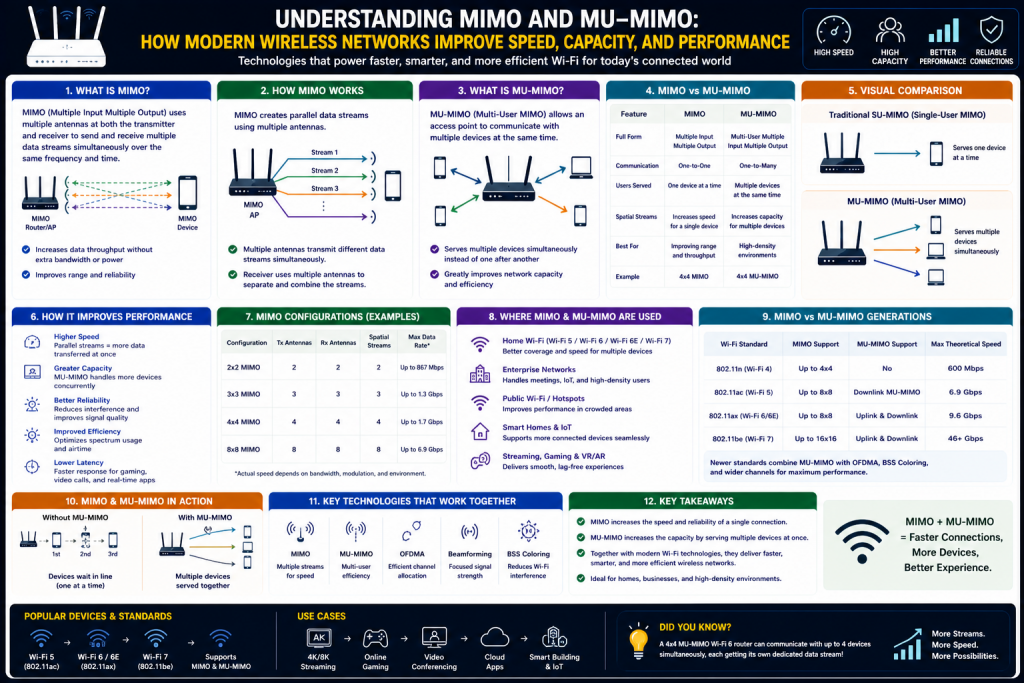
Wireless communication has continuously evolved to meet the growing demands of users who expect faster speeds, more reliable connections, and seamless connectivity across multiple devices. From early radio transmissions to modern high-speed wireless networks, each generation of technology has introduced innovations designed to make better use of limited resources. One of the most impactful advancements in wireless networking is Multiple Input Multiple Output, commonly known as MIMO.
MIMO represents a fundamental shift in how wireless data is transmitted and received. Instead of relying on a single antenna at both the transmitter and receiver, MIMO uses multiple antennas to send and receive multiple data streams simultaneously. This approach dramatically improves performance, allowing for higher data rates, better signal quality, and increased network capacity.
The idea behind MIMO is not to change the nature of electromagnetic waves but to use them more efficiently. Since the wireless spectrum is limited and cannot be easily expanded, engineers have focused on finding ways to maximize its usage. MIMO achieves this by leveraging spatial dimensions, effectively creating multiple pathways for data transmission within the same frequency band.
Evolution of Wireless Communication
To appreciate the importance of MIMO, it is helpful to understand how wireless communication has evolved over time. Early wireless systems were relatively simple, relying on single antennas and basic modulation techniques. These systems were sufficient for transmitting voice signals but were not designed to handle large amounts of data.
As technology advanced, new standards were introduced to improve performance. In the world of Wi-Fi, standards evolved from early versions to more advanced ones, each offering higher data rates and better efficiency. Similarly, cellular networks progressed from basic analog systems to sophisticated digital networks capable of supporting high-speed internet access.
Despite these advancements, one challenge remained constant: the limited availability of wireless spectrum. As more devices began to rely on wireless connectivity, the need for more efficient use of this spectrum became increasingly important. This is where MIMO technology emerged as a game changer.
Instead of trying to find new frequency bands, MIMO focuses on using the existing spectrum more effectively. By transmitting multiple data streams over the same frequency, MIMO significantly increases the amount of data that can be transmitted without requiring additional bandwidth.
Fundamentals of Wireless Signal Behavior
Wireless signals are a form of electromagnetic radiation that travels through the air. Unlike wired connections, where signals follow a defined path, wireless signals spread out in all directions and interact with the environment in complex ways. They can be reflected, refracted, and diffracted by objects such as walls, furniture, and even people.
One of the key characteristics of wireless signals is multipath propagation. This occurs when a signal takes multiple paths to reach the receiver. For example, a signal may travel directly from the transmitter to the receiver while also reflecting off nearby surfaces and arriving at slightly different times.
In traditional single-antenna systems, multipath propagation can cause interference and signal degradation. The multiple versions of the signal can interfere with each other, leading to reduced clarity and reliability. Engineers have traditionally viewed this as a problem to be minimized.
MIMO, however, takes a different approach. Instead of trying to eliminate multipath effects, MIMO uses them to its advantage. By employing multiple antennas, MIMO systems can capture and process these different signal paths, turning what was once a disadvantage into a powerful tool for improving performance.
Introduction to Single Input Single Output Systems
Before diving deeper into MIMO, it is important to understand the limitations of traditional Single Input Single Output systems. In a SISO system, a single antenna is used at both the transmitter and the receiver. This means that only one data stream can be transmitted at a time.
While SISO systems are simple and cost-effective, they have inherent limitations. The data rate is constrained by the available bandwidth and the quality of the signal. In environments with significant interference or signal fading, performance can degrade rapidly.
Another limitation of SISO systems is their inability to take advantage of spatial diversity. Since there is only one antenna, the system cannot benefit from multiple signal paths. This makes it more susceptible to issues such as fading and interference.
As the demand for higher data rates and more reliable connections grew, it became clear that SISO systems were not sufficient. This led to the development of more advanced techniques, including MIMO, which address these limitations by using multiple antennas.
Core Concept of MIMO Technology
MIMO stands for Multiple Input Multiple Output, and it refers to the use of multiple antennas at both the transmitter and receiver. The term “input” represents the transmitting antennas, while “output” represents the receiving antennas. A MIMO system is typically described using a notation such as 2×2, 3×3, or 4×4, indicating the number of antennas on each side.
The key idea behind MIMO is that multiple antennas can be used to transmit different data streams simultaneously. This increases the overall data rate without requiring additional bandwidth. Each antenna sends a unique signal, and the receiver uses advanced processing techniques to separate and decode these signals.
One of the most important aspects of MIMO is that it operates within the same frequency band. Unlike other techniques that require additional spectrum, MIMO achieves higher performance by exploiting spatial differences in the signal paths. This makes it a highly efficient solution for modern wireless networks.
MIMO systems rely on complex algorithms to process the incoming signals. These algorithms analyze the differences in timing, phase, and amplitude between the signals received by each antenna. By understanding these differences, the system can reconstruct the original data streams with high accuracy.
Spatial Multiplexing Explained
Spatial multiplexing is one of the primary techniques used in MIMO systems to increase data rates. In this approach, the transmitter divides the data into multiple streams and sends each stream from a different antenna. These streams are transmitted simultaneously over the same frequency.
At the receiver, multiple antennas capture the incoming signals. Because each signal takes a slightly different path, they arrive with unique characteristics. The receiver uses these differences to separate the signals and reconstruct the original data streams.
The effectiveness of spatial multiplexing depends on the environment. In environments with rich multipath propagation, such as indoor spaces with many reflective surfaces, spatial multiplexing can achieve significant performance gains. In simpler environments with fewer reflections, the benefits may be more limited.
Despite these variations, spatial multiplexing remains a powerful tool for increasing data rates. By effectively multiplying the capacity of the wireless channel, it enables faster data transmission and improved overall performance.
Diversity Gain and Its Importance
While spatial multiplexing focuses on increasing data rates, diversity gain is concerned with improving signal reliability. In this approach, the same data is transmitted across multiple antennas, creating multiple copies of the signal.
Because each copy takes a different path to the receiver, it is unlikely that all copies will be affected by the same interference or fading. The receiver can then combine these signals to produce a stronger and more reliable output.
Diversity gain is particularly useful in challenging environments where signal quality is poor. By providing multiple paths for the signal, it reduces the likelihood of data loss and improves overall communication reliability.
In many modern MIMO systems, spatial multiplexing and diversity gain are used together. This allows the system to balance the need for high data rates with the need for reliable communication.
Beamforming and Directional Transmission
Beamforming is another key technique used in MIMO systems to enhance performance. Unlike traditional transmission methods that broadcast signals in all directions, beamforming focuses the signal toward a specific receiver.
This is achieved by carefully controlling the phase and amplitude of the signals transmitted from each antenna. When these signals combine, they create a concentrated beam in the desired direction. This results in a stronger signal at the receiver and reduced interference in other directions.
Beamforming is especially beneficial in environments with multiple devices. By directing the signal toward specific devices, the system can improve performance and reduce interference between users. This leads to better overall network efficiency.
In addition to improving signal strength, beamforming can also extend the coverage area of a wireless network. By focusing energy where it is needed, it reduces wasted power and ensures that devices receive a strong and stable signal.
Advantages of MIMO in Modern Networks
MIMO offers several advantages that make it a critical component of modern wireless networks. One of the most significant benefits is increased bandwidth. By transmitting multiple data streams simultaneously, MIMO can achieve much higher data rates than traditional systems.
Improved signal quality is another important advantage. The use of multiple antennas and advanced processing techniques helps mitigate the effects of interference, noise, and fading. This results in more stable connections and better overall performance.
MIMO also enhances coverage. Techniques such as beamforming allow signals to be directed toward specific devices, improving signal strength and extending the reach of the network. This reduces dead zones and ensures consistent connectivity.
Another key benefit is increased network capacity. As more devices connect to wireless networks, the ability to handle multiple connections efficiently becomes essential. MIMO enables networks to support more users without a significant drop in performance.
Practical Considerations for MIMO Deployment
While MIMO offers many benefits, its performance depends on several factors. One of the most important considerations is antenna placement. Proper positioning of antennas is essential to ensure optimal signal coverage and performance.
The physical environment also plays a significant role. Obstacles such as walls, furniture, and other objects can affect signal propagation. Understanding these factors is crucial when designing and deploying a MIMO system.
Hardware compatibility is another important consideration. Both the transmitter and receiver must support MIMO for it to function effectively. Fortunately, many modern devices, including smartphones and laptops, are equipped with multiple antennas and support MIMO technology.
Finally, network configuration and optimization are essential for achieving the best performance. This includes selecting appropriate channels, configuring beamforming settings, and monitoring network performance to identify and address potential issues.
Preparing for Advanced Wireless Technologies
MIMO is not just a standalone technology but a foundation for more advanced wireless techniques. As networks continue to evolve, new variations of MIMO are being developed to further improve performance and efficiency.
One of the most important advancements is the transition to multi-user MIMO, which allows multiple devices to communicate with a single transmitter simultaneously. This represents a significant step forward in addressing the challenges of modern wireless networks, where multiple devices compete for limited resources.
Understanding the fundamentals of MIMO is essential for anyone involved in wireless networking. It provides the foundation for exploring more advanced concepts and technologies that will shape the future of connectivity.
Transition from Single User MIMO to Multi User MIMO
As wireless networks expanded and the number of connected devices increased, the limitations of traditional MIMO systems became more noticeable. While MIMO significantly improved data rates and signal reliability, early implementations were primarily designed for communication between a transmitter and a single device at a time. This approach is known as single user MIMO, or SU MIMO.
In SU MIMO, even though multiple antennas are used, the transmitter focuses all of its spatial streams on one client device during a given transmission interval. If multiple devices are connected to the same wireless access point, they must take turns receiving data. This process is managed through time division, where each device is allocated a short time slice during which it can communicate with the transmitter.
Although this method works well in environments with a small number of devices, it becomes less efficient as more devices join the network. Each device must wait its turn, leading to increased latency and reduced overall performance. This challenge became especially apparent in modern environments such as offices, schools, and homes filled with smartphones, laptops, smart TVs, and IoT devices.
To address this growing demand, engineers developed multi user MIMO, or MU MIMO, a more advanced approach that allows a transmitter to communicate with multiple devices simultaneously rather than sequentially.
Understanding Multi User MIMO
Multi user MIMO builds upon the foundation of traditional MIMO by enabling concurrent communication with multiple clients. Instead of dedicating all spatial streams to a single device, MU MIMO distributes these streams among several devices at the same time.
This means that a wireless access point equipped with multiple antennas can send different data streams to different devices simultaneously. Each device receives its own dedicated stream, improving efficiency and reducing the delays associated with time division.
MU MIMO relies on advanced signal processing techniques to ensure that each device receives the correct data without interference from other streams. This involves carefully managing how signals are transmitted so that they remain distinguishable at each receiver.
One way to think about MU MIMO is as a conversation in a crowded room. In SU MIMO, only one person speaks at a time while everyone else listens. In MU MIMO, multiple conversations can happen at once, with each participant focusing on their own discussion without being distracted by others.
How MU MIMO Works in Practice
In a MU MIMO system, the transmitter uses its multiple antennas to create separate spatial streams for different devices. These streams are transmitted simultaneously over the same frequency band, but they are directed in such a way that each device can isolate and decode its intended signal.
This process requires accurate knowledge of the wireless environment, including the position and characteristics of each connected device. The transmitter gathers this information through a process known as channel state information, which allows it to understand how signals propagate to each device.
Using this information, the transmitter can apply beamforming techniques to direct each stream toward its intended recipient. By adjusting the phase and amplitude of the signals from each antenna, the system creates distinct signal paths that minimize interference between devices.
At the receiving end, each device processes the incoming signal using its own antennas and decoding algorithms. Even though multiple streams are transmitted simultaneously, each device is able to extract its specific data stream.
Benefits of MU MIMO in Modern Networks
MU MIMO offers several important advantages that make it a critical feature in modern wireless networks. One of the most significant benefits is increased network capacity. By allowing multiple devices to communicate simultaneously, MU MIMO makes more efficient use of available resources.
This increased efficiency translates into better performance for users. Devices experience higher data rates and lower latency, especially in environments with many connected devices. Instead of waiting for their turn to communicate, devices can receive data at the same time as others.
Another key benefit is improved user experience. Applications that require real time data transmission, such as video conferencing, online gaming, and streaming, benefit greatly from reduced delays and more consistent performance.
MU MIMO also helps reduce network congestion. In traditional systems, as more devices connect to the network, performance can degrade significantly. MU MIMO mitigates this issue by serving multiple devices simultaneously, maintaining higher levels of performance even under heavy load.
Differences Between SU MIMO and MU MIMO
While both SU MIMO and MU MIMO use multiple antennas and spatial streams, their approaches to communication differ significantly. SU MIMO focuses on maximizing performance for a single device at a time, while MU MIMO distributes resources among multiple devices.
In SU MIMO, the full capacity of the system is dedicated to one device during its transmission period. This can result in very high data rates for that device, but other devices must wait their turn. In contrast, MU MIMO shares the available capacity among multiple devices, providing more balanced performance across the network.
Another key difference lies in complexity. MU MIMO requires more advanced signal processing and coordination to manage multiple simultaneous transmissions. This increases the computational requirements for the transmitter and adds to the overall system complexity.
Despite this complexity, the benefits of MU MIMO make it an essential feature for modern wireless networks, particularly in environments with high device density.
Role of Beamforming in MU MIMO
Beamforming plays a crucial role in the operation of MU MIMO systems. Without beamforming, it would be difficult to direct multiple streams to different devices without causing interference.
In MU MIMO, beamforming is used to create focused signal paths for each device. By carefully controlling how signals are transmitted from each antenna, the system can ensure that each device receives a strong and clear signal while minimizing interference with other devices.
This directional transmission is particularly important in crowded environments, where many devices are competing for the same wireless resources. Beamforming allows the system to target specific devices, improving efficiency and overall performance.
Advanced beamforming techniques also enable dynamic adaptation to changing conditions. As devices move or the environment changes, the system can adjust its transmission patterns to maintain optimal performance.
Challenges and Limitations of MU MIMO
While MU MIMO offers significant advantages, it also introduces new challenges. One of the primary challenges is the increased complexity of the system. Managing multiple simultaneous transmissions requires sophisticated algorithms and processing capabilities.
Another challenge is the need for accurate channel state information. The transmitter must have a detailed understanding of the wireless environment to effectively direct signals. Obtaining and maintaining this information can be difficult, especially in dynamic environments where conditions change frequently.
Hardware requirements are also more demanding. MU MIMO systems require more antennas, more powerful processors, and advanced radio components. This can increase the cost of equipment and make deployment more complex.
Environmental factors can also impact performance. Interference, obstacles, and signal reflections can affect how well MU MIMO works. In some cases, these factors may limit the effectiveness of simultaneous transmissions.
Finally, not all devices support MU MIMO. For the technology to work effectively, both the transmitter and the receiving devices must be compatible. While support for MU MIMO is becoming more common, it is not yet universal.
Real World Applications of MU MIMO
MU MIMO is widely used in modern Wi Fi networks, particularly in standards such as newer generations of wireless technology. It is especially beneficial in environments where many devices are connected to the same network.
In office environments, MU MIMO allows employees to connect multiple devices without experiencing significant performance degradation. Video calls, file transfers, and cloud applications can all run smoothly even when many users are active.
In educational institutions, MU MIMO supports large numbers of students using laptops and mobile devices simultaneously. This ensures that online learning platforms and digital resources remain accessible and responsive.
Public spaces such as airports, cafes, and shopping centers also benefit from MU MIMO. These environments often have high device density, making efficient use of wireless resources essential.
In homes, MU MIMO enhances the performance of smart devices, streaming services, and online gaming. As households continue to add more connected devices, the importance of efficient wireless communication becomes increasingly clear.
Integration with Modern Wi Fi Standards
MU MIMO has become a key feature in modern Wi Fi standards, helping to deliver the high performance that users expect. These standards incorporate advanced MIMO techniques to support higher data rates and improved efficiency.
In addition to MU MIMO, modern standards also include other enhancements such as improved modulation schemes and better channel utilization. Together, these technologies create a more robust and efficient wireless network.
The integration of MU MIMO into these standards has made it more accessible to consumers and businesses alike. Many modern routers and access points now support MU MIMO, allowing users to take advantage of its benefits without requiring specialized equipment.
Future of MU MIMO and Wireless Technology
As wireless technology continues to evolve, MU MIMO is expected to play an even greater role. Future developments may include more advanced versions of MU MIMO that support larger numbers of devices and higher data rates.
One area of ongoing research is the use of massive MIMO, which involves deploying a large number of antennas at the transmitter. This approach has the potential to further increase capacity and efficiency, particularly in large scale networks such as cellular systems.
Another area of development is the integration of artificial intelligence and machine learning into wireless systems. These technologies can help optimize MU MIMO performance by dynamically adapting to changing conditions and improving decision making.
The continued growth of connected devices and the increasing demand for high speed connectivity ensure that innovations in MIMO technology will remain a priority. MU MIMO represents a significant step forward in this journey, providing the foundation for more advanced and efficient wireless networks.
Preparing for Implementation and Optimization
Understanding MU MIMO is not only important from a theoretical perspective but also for practical implementation. Network designers and administrators must consider various factors when deploying MU MIMO systems to ensure optimal performance.
This includes selecting appropriate hardware, configuring network settings, and conducting thorough testing to identify potential issues. Regular monitoring and optimization are also essential to maintain performance as conditions change.
By carefully planning and managing MU MIMO deployments, organizations can take full advantage of this technology to deliver high quality wireless connectivity to users.
Key Considerations for Deploying MIMO and MU MIMO Systems
Designing and deploying a wireless network that fully leverages MIMO and MU MIMO requires careful planning and a deep understanding of both the technology and the environment in which it will operate. While these technologies offer significant improvements in performance, their effectiveness depends heavily on how they are implemented.
One of the most important considerations is antenna placement. The positioning of antennas directly impacts how signals propagate through the environment. In a MIMO system, antennas should be spaced and oriented in a way that maximizes spatial diversity. This helps ensure that each antenna experiences slightly different signal paths, which is essential for techniques like spatial multiplexing and diversity gain.
In indoor environments, walls, ceilings, and furniture can all influence signal behavior. Proper placement can help reduce dead zones and improve overall coverage. For example, mounting access points on ceilings often provides better coverage than placing them on desks or shelves, as it reduces obstructions and allows signals to spread more evenly.
In addition to placement, antenna type also matters. Some antennas are designed for omnidirectional coverage, while others focus signals in specific directions. Choosing the right type depends on the layout of the space and the desired coverage pattern.
Importance of Site Surveys
Before deploying any wireless network, conducting a thorough site survey is essential. A site survey provides valuable insights into the physical and radio frequency environment, helping identify potential challenges and opportunities for optimization.
During a site survey, factors such as signal strength, interference, and channel usage are analyzed. This information helps determine the optimal locations for access points and antennas. It also helps identify sources of interference, such as neighboring networks or electronic devices, that could impact performance.
A site survey also helps estimate the number of users and devices that the network will need to support. This is particularly important for MU MIMO deployments, where the ability to handle multiple simultaneous connections is a key advantage.
By understanding the environment in advance, network designers can make informed decisions that improve performance and reduce the likelihood of issues after deployment.
Channel Selection and Interference Management
Wireless networks operate within specific frequency bands, and these bands are often shared by multiple devices and networks. Proper channel selection is critical to minimizing interference and ensuring optimal performance.
Interference can come from various sources, including other wireless networks, electronic devices, and even physical obstacles. In a MIMO or MU MIMO system, interference can disrupt the transmission of multiple data streams, reducing the effectiveness of the technology.
Selecting the right channel involves analyzing the available frequency spectrum and choosing channels with the least amount of interference. In some cases, automatic channel selection features can help manage this process, but manual tuning may still be necessary for optimal results.
In addition to channel selection, techniques such as power control and frequency planning can help reduce interference. Adjusting the transmission power of access points can prevent signals from overlapping excessively, while careful frequency planning ensures that neighboring networks do not interfere with each other.
Hardware Compatibility and Device Support
For MIMO and MU MIMO to function effectively, both the transmitting and receiving devices must support the technology. This includes having multiple antennas and the necessary processing capabilities to handle multiple data streams.
Modern devices such as smartphones, laptops, and tablets often include built in support for MIMO. However, the level of support can vary. Some devices may only support a limited number of spatial streams, which can affect overall performance.
In MU MIMO environments, compatibility becomes even more important. Not all devices are capable of participating in simultaneous multi user transmissions. In such cases, the network may need to fall back to single user communication for those devices.
When designing a network, it is important to consider the types of devices that will be used and ensure that the infrastructure is capable of supporting them effectively. Upgrading older devices or adding compatible hardware can help maximize the benefits of MIMO technology.
Installation of MIMO Enabled Equipment
Once planning and preparation are complete, the next step is the physical installation of MIMO enabled equipment. This includes access points, antennas, and any supporting infrastructure such as cabling and power sources.
Proper installation is critical to achieving the desired performance. Access points should be securely mounted and positioned according to the site survey recommendations. Adequate spacing between devices should be maintained to avoid interference and ensure optimal coverage.
Cabling and power considerations are also important. Access points often require both data connectivity and power, which may be provided through technologies such as Power over Ethernet. Ensuring that the necessary infrastructure is in place before installation can prevent delays and complications.
Clearance around access points and antennas should be maintained to avoid obstructions that could impact signal propagation. In environments with high device density, additional access points may be needed to distribute the load effectively.
Configuration and Optimization of Wireless Networks
After installation, configuring the network is a crucial step in ensuring optimal performance. This process involves setting parameters such as channel selection, transmission power, and security settings.
Beamforming settings should be carefully configured to match the physical environment. Proper tuning of beamforming can significantly improve signal strength and reduce interference, especially in MU MIMO systems.
Quality of Service settings are also important. These settings allow network administrators to prioritize certain types of traffic, such as voice or video, ensuring that critical applications receive the necessary bandwidth and low latency.
Firmware updates and centralized management tools can help maintain and optimize the network over time. Many modern systems offer management platforms that allow administrators to monitor performance, troubleshoot issues, and apply updates from a single interface.
Regular testing and monitoring are essential to identify potential problems and ensure that the network continues to perform as expected. This includes conducting periodic walkthroughs to check for coverage gaps, signal degradation, and interference.
Environmental Factors Affecting Performance
The performance of MIMO and MU MIMO systems is heavily influenced by environmental factors. Physical obstacles such as walls, floors, and furniture can affect signal propagation and reduce performance.
Different materials have varying effects on wireless signals. For example, concrete and metal can significantly attenuate signals, while wood and drywall have less impact. Understanding these effects is important when designing and deploying a network.
Interference from other devices is another important factor. Devices such as microwaves, cordless phones, and Bluetooth equipment can interfere with wireless signals, particularly in crowded frequency bands.
User movement can also impact performance. As devices move through the environment, the characteristics of the wireless channel change. MIMO systems are designed to adapt to these changes, but rapid or unpredictable movement can still pose challenges.
Outdoor environments present additional challenges, including weather conditions and long distance signal propagation. In such cases, specialized equipment and careful planning are required to achieve reliable performance.
Scaling Networks for High Density Environments
As the number of connected devices continues to grow, many networks must support high density environments. These environments include offices, schools, stadiums, and public spaces where large numbers of users are connected simultaneously.
MIMO and MU MIMO are particularly valuable in these scenarios, as they enable more efficient use of available resources. However, scaling a network to support high density requires careful planning and optimization.
This includes deploying multiple access points to distribute the load and ensure adequate coverage. Proper channel planning is essential to prevent interference between access points. Load balancing techniques can help distribute devices evenly across the network.
In high density environments, monitoring and management become even more important. Network administrators must continuously analyze performance data and make adjustments as needed to maintain optimal operation.
Troubleshooting Common Issues
Even with careful planning and deployment, issues can arise in MIMO and MU MIMO networks. Common problems include poor signal quality, interference, and connectivity issues.
Troubleshooting begins with identifying the root cause of the problem. This may involve analyzing signal strength, checking for interference, and reviewing network configuration settings.
Tools such as spectrum analyzers and network monitoring software can provide valuable insights into the wireless environment. These tools help identify sources of interference and other issues that may impact performance.
Adjusting antenna placement, changing channels, and updating firmware are common steps in resolving issues. In some cases, adding additional access points or upgrading hardware may be necessary.
Regular maintenance and monitoring can help prevent issues from occurring and ensure that the network continues to operate efficiently.
Future Trends in MIMO and MU MIMO Deployment
The future of wireless networking is closely tied to advancements in MIMO technology. As demand for high speed connectivity continues to grow, new innovations are being developed to further enhance performance.
One of the most significant trends is the adoption of massive MIMO, which involves using a large number of antennas to support even greater capacity and efficiency. This technology is already being used in advanced cellular networks and is expected to play a major role in future deployments.
Another trend is the integration of intelligent systems that use data analysis and machine learning to optimize network performance. These systems can adapt to changing conditions in real time, improving efficiency and reliability.
Emerging applications such as virtual reality, augmented reality, and the Internet of Things will place additional demands on wireless networks. MIMO and MU MIMO will continue to evolve to meet these challenges and provide the necessary performance.
Conclusion
MIMO and MU MIMO have transformed the way wireless networks operate, providing significant improvements in speed, reliability, and capacity. By using multiple antennas and advanced signal processing techniques, these technologies make more efficient use of limited wireless resources.
MIMO introduced the ability to transmit multiple data streams simultaneously, greatly increasing data rates and improving signal quality. MU MIMO built on this foundation by enabling simultaneous communication with multiple devices, addressing the challenges of modern high density environments.
While these technologies offer many benefits, their success depends on careful planning, proper deployment, and ongoing optimization. Factors such as antenna placement, channel selection, hardware compatibility, and environmental conditions all play a critical role in determining performance.
As wireless networks continue to evolve, MIMO and MU MIMO will remain essential components of modern communication systems. Their ability to adapt to growing demands and support new applications ensures that they will continue to play a central role in the future of connectivity.
Continue exploring the technologies and certification concepts that matter most to you.