Linux has evolved from a niche operating system used primarily by enthusiasts into a dominant force in enterprise computing. Today, it powers everything from web servers and cloud platforms to mobile devices and embedded systems. Organizations across industries rely on Linux to maintain reliable, scalable, and secure infrastructure. As this reliance continues to grow, so does the demand for professionals who can effectively manage Linux environments.
For individuals pursuing a career in information technology, Linux certifications offer a structured way to gain and validate essential skills. These certifications serve as proof of competency, helping candidates demonstrate their knowledge to employers. Whether someone is just starting out or already working in IT, obtaining a Linux certification can open doors to new opportunities and career advancement.
However, before diving into certification paths, it is important to understand the financial commitment involved. While many people focus only on exam fees, the true cost of certification is often much broader. It includes preparation, training, time investment, and sometimes even prerequisite certifications. Understanding these costs helps candidates make informed decisions and plan their certification journey effectively.
What Contributes to the Cost of Linux Certifications
When evaluating the cost of Linux certifications, it is essential to look beyond the advertised exam price. The exam fee is only one part of the total investment. A complete understanding requires considering several additional factors that can significantly impact the overall expense.
One of the most important components is study material. Preparing for a certification exam typically requires access to structured learning resources. These may include online courses, video tutorials, practice exams, and textbooks. While some free resources are available, many candidates choose paid materials for their depth, accuracy, and reliability. The cost of these resources can vary widely depending on the provider and the level of detail offered.
Another key factor is prior knowledge and experience. Some certifications assume that candidates already have a certain level of familiarity with Linux or general IT concepts. If you lack this background, you may need to invest time and money into foundational learning before attempting the certification. This might involve taking introductory courses or even pursuing other certifications that build essential skills.
Hands-on practice is also crucial when preparing for Linux certifications. Unlike purely theoretical subjects, Linux requires practical experience. Candidates often set up lab environments using virtual machines or cloud platforms to practice real-world tasks. While this can sometimes be done at minimal cost, more advanced setups or guided labs may require additional investment.
There are also logistical costs associated with taking the exam. Even if the testing center is nearby, you may need to account for transportation, meals, or other small expenses. These costs may seem minor individually, but they contribute to the overall investment.
Time is another critical consideration. Preparing for a certification exam often requires weeks or months of dedicated study. While time is not a direct financial cost, it represents an opportunity cost. Time spent studying is time that could have been used for work, leisure, or other activities. Recognizing this helps you approach certification with a realistic mindset.
By considering all these elements, you gain a clearer picture of what Linux certification truly costs. This understanding allows you to plan effectively and avoid unexpected expenses along the way.
Starting Your Journey with Linux+
For many aspiring IT professionals, Linux+ is considered an ideal starting point. This certification provides a broad introduction to Linux concepts and is not tied to a specific distribution. This makes it particularly useful for individuals who are still exploring their career path or who want a general understanding of Linux systems.
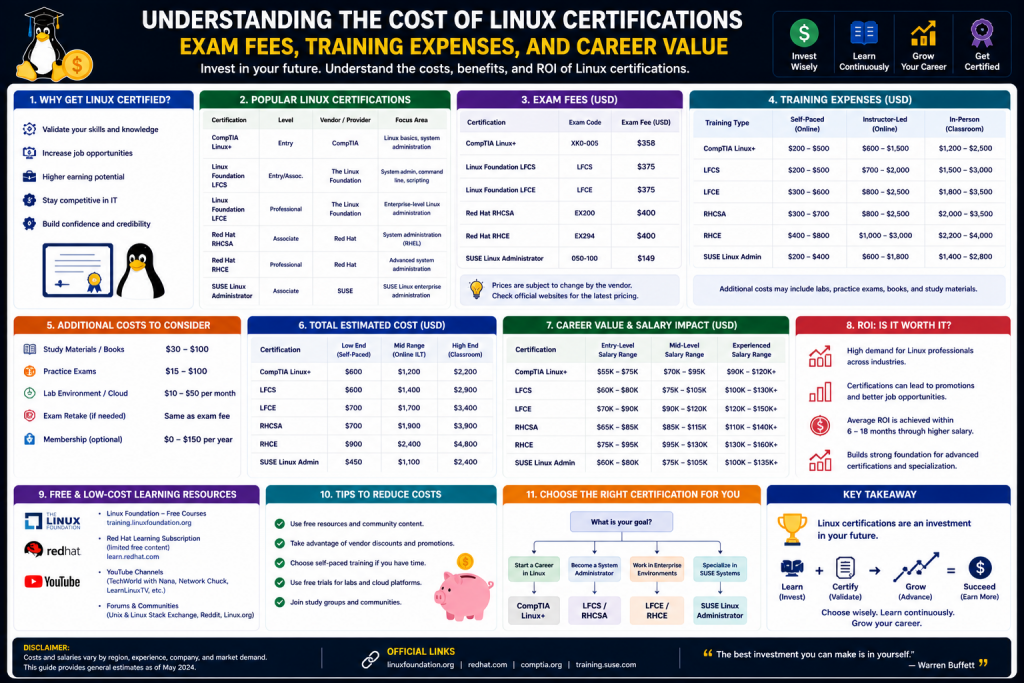
The Linux+ exam is priced at $369. At first glance, this might appear to be the total cost of certification. However, as discussed earlier, the actual investment is usually higher when additional factors are taken into account.
Linux+ is designed for individuals who have some basic experience with IT systems. It is often recommended that candidates have knowledge equivalent to entry-level certifications in hardware and networking, along with around a year of hands-on experience with Linux. While these are not strict requirements, they provide a strong foundation for success.
If you do not already have this background, you may need to invest in additional training before attempting the exam. This could involve purchasing study materials or enrolling in courses that cover basic IT and networking concepts. These additional steps can increase the overall cost but also improve your chances of passing the exam on the first attempt.
Preparation for Linux+ typically involves a combination of theoretical study and practical experience. Candidates often use online courses to learn key concepts such as file systems, command-line operations, system administration, and security practices. Practice exams are also commonly used to assess readiness and identify areas for improvement.
Textbooks can be another valuable resource. They provide detailed explanations and serve as a reference for reviewing complex topics. While not always necessary, many candidates find them helpful for reinforcing their understanding.
In addition to study materials, you may need to set up a practice environment. This could involve installing Linux on a virtual machine or using cloud-based labs. Hands-on practice is essential for developing the skills needed to perform tasks in real-world scenarios.
Even the process of taking the exam involves some costs. While many testing centers are conveniently located, you may still need to budget for transportation and other small expenses. These costs are relatively minor compared to the overall investment but should not be overlooked.
When all these factors are combined, the total cost of earning Linux+ becomes more substantial than the exam fee alone. However, the certification provides a strong foundation and can serve as a stepping stone to more advanced credentials.
The Value of a Broad Linux Foundation
One of the main advantages of starting with Linux+ is the breadth of knowledge it provides. Instead of focusing on a specific distribution, the certification covers general Linux concepts that apply across different environments. This makes it a versatile choice for individuals who want flexibility in their career.
A broad foundation allows you to adapt to different roles and technologies. Whether you are working in system administration, cloud computing, or cybersecurity, the skills gained from Linux+ can be applied in various contexts. This versatility is particularly valuable in a rapidly changing industry.
Another benefit is that Linux+ introduces you to real-world scenarios. The exam is designed to test practical knowledge, ensuring that candidates can perform tasks commonly required in IT roles. This hands-on approach helps bridge the gap between theory and practice.
Employers often value certifications that demonstrate a wide range of skills. Linux+ shows that you understand core concepts and can work with Linux systems in different environments. This can make you a more attractive candidate for entry-level positions.
In addition, earning a certification can boost your confidence. It provides a sense of accomplishment and validates your efforts. This confidence can be beneficial when applying for jobs or taking on new responsibilities.
While Linux+ is not the only entry-level certification available, it is widely recognized and respected. This recognition adds to its value and makes it a popular choice among aspiring IT professionals.
Hidden Costs That Candidates Often Overlook
While many candidates focus on obvious expenses like exam fees and study materials, there are several hidden costs that are often overlooked. Being aware of these costs can help you plan more effectively and avoid surprises.
One common hidden cost is retake fees. If you do not pass the exam on your first attempt, you will need to pay the exam fee again. This can significantly increase the total cost of certification. To minimize this risk, it is important to prepare thoroughly and ensure that you are ready before scheduling the exam.
Another overlooked expense is the cost of maintaining certifications. Some certifications require periodic renewal or continuing education to remain valid. This may involve additional fees or training over time.
Technology requirements can also add to the cost. For example, you may need a reliable computer, internet connection, and software tools for studying and practicing. While many people already have these resources, upgrades or additional tools may be necessary in some cases.
Time management is another factor that can indirectly impact cost. If you need to take time off work to study or attend training, this could result in lost income. Even if this is not the case, balancing study with other responsibilities can be challenging.
There is also the psychological cost of preparation. Studying for a certification exam can be stressful, especially if you are balancing it with work or personal commitments. While this does not have a direct financial impact, it is still an important consideration.
By recognizing these hidden costs, you can approach certification with a more realistic perspective. This allows you to plan ahead and make informed decisions about your investment.
Building a Strong Preparation Strategy
A well-structured preparation strategy is essential for success in any certification exam. Without a clear plan, it is easy to become overwhelmed or miss important topics.
The first step is to understand the exam objectives. Reviewing the official exam outline helps you identify the key areas that will be tested. This allows you to focus your study efforts and avoid wasting time on irrelevant topics.
Next, gather the resources you need. This may include online courses, books, practice exams, and lab environments. Choosing high-quality materials can make a significant difference in your preparation.
Creating a study schedule is also important. Consistency is key when preparing for certification. Instead of trying to learn everything at once, break down the material into manageable sections and study regularly over time.
Hands-on practice should be a central part of your strategy. Linux is a practical skill, and real-world experience is essential for mastering it. Setting up a lab environment allows you to experiment and reinforce your learning.
Practice exams are another valuable tool. They help you assess your readiness and identify areas where you need improvement. Taking multiple practice tests can also build confidence and reduce exam anxiety.
Finally, set a realistic exam date. Having a deadline can motivate you to stay on track and complete your preparation. However, it is important to ensure that you are fully prepared before scheduling the exam.
Exploring Linux Professional Institute Certifications and Their Costs
After understanding the foundational certification path and the investment required for entry-level credentials, many professionals begin exploring more structured and progressive certification programs. One of the most recognized options in this category is offered by the Linux Professional Institute. This organization provides a comprehensive certification track that allows candidates to build their expertise step by step, starting from basic concepts and advancing to highly specialized skills.
The Linux Professional Institute certifications are designed to be distribution-neutral, meaning they focus on general Linux knowledge rather than a specific vendor’s system. This makes them appealing to professionals who want flexibility in their careers and the ability to work across different environments.
The certification path typically begins with Linux Essentials, followed by a multi-level professional track that includes progressively advanced certifications. Each level builds upon the previous one, creating a clear roadmap for skill development.
Cost Breakdown of Linux Essentials Certification
Linux Essentials serves as an introductory certification aimed at individuals who are new to Linux or to IT in general. It is often considered a starting point for students, career changers, or professionals who want to validate their basic understanding of open-source systems.
The exam fee for Linux Essentials is approximately $120. Compared to other certifications, this makes it one of the more affordable entry points into the Linux ecosystem. However, as with any certification, the exam fee is only part of the overall cost.
Preparation is a key factor in determining the total investment. Many candidates choose to use online courses, study guides, or video tutorials to prepare for the exam. While some free resources are available, structured learning materials often provide better organization and depth, which can improve your chances of success.
In addition to study materials, candidates may also invest time in hands-on practice. Even though Linux Essentials focuses on basic concepts, practical experience is still valuable. Setting up a simple Linux environment allows you to explore commands, file systems, and basic administrative tasks.
When factoring in preparation costs and minor expenses related to taking the exam, the total investment for Linux Essentials can rise to around $300 to $400. Despite this increase, it remains a relatively accessible certification for beginners.
Advancing Through the LPIC Certification Path
After completing Linux Essentials, many professionals move on to the Linux Professional Institute Certification program. This track is divided into multiple levels, each representing a higher degree of expertise.
The first level focuses on junior-level administration skills. It covers topics such as system architecture, package management, GNU and Unix commands, and basic networking. This level is designed to ensure that candidates can perform essential tasks required in a Linux environment.
The second level builds on this foundation by introducing more advanced topics. These include system administration, network configuration, security, and troubleshooting. Candidates at this stage are expected to handle more complex environments and take on greater responsibilities.
The highest level in the core track is aimed at senior professionals. It includes specialized areas such as mixed environments, security, and virtualization. This level demonstrates a deep understanding of Linux systems and the ability to manage enterprise-level infrastructure.
Each level requires passing one or more exams, and each exam typically costs around $200. As candidates progress through the levels, the cumulative cost increases. However, this step-by-step approach allows individuals to spread out their investment over time.
Total Investment for Multi-Level Certification
Pursuing a full certification path through multiple levels can become a significant financial commitment. For example, completing the first two levels requires passing multiple exams, each with its own fee. When combined with preparation materials and other expenses, the total cost can reach several hundred dollars or more.
The advanced level adds further costs, as it often includes specialized exams that focus on specific areas of expertise. These exams require a deeper level of preparation, which may involve additional training or resources.
Despite the higher cost, many professionals view this investment as worthwhile. The structured progression ensures that skills are developed systematically, and each level adds value to your professional profile.
Another advantage of this approach is flexibility. Candidates can choose to stop at a certain level based on their career goals or continue advancing as needed. This allows you to manage your budget while still gaining valuable credentials.
Comparing Value and Affordability
When comparing different certification options, it is important to consider both cost and value. While some certifications may have lower exam fees, they may not provide the same level of recognition or career benefits.
The Linux Professional Institute certifications are often seen as cost-effective because they offer a comprehensive learning path at a relatively moderate price. Compared to some vendor-specific certifications, they provide a broad understanding of Linux without requiring a large upfront investment.
Another factor to consider is the return on investment. Certifications that enhance your skills and improve your job prospects can lead to higher salaries and better opportunities. In this context, the initial cost becomes less significant over time.
It is also worth noting that the modular nature of the certification path allows you to progress at your own pace. This can make the financial commitment more manageable, as you do not need to pay for all exams at once.
Preparation Strategies for LPI Certifications
Successfully completing these certifications requires careful preparation. Each level introduces new topics and challenges, making it important to adopt an effective study strategy.
One of the first steps is to review the exam objectives. Understanding what topics will be covered helps you focus your efforts and avoid unnecessary study. This is especially important as you move into more advanced levels.
Using a combination of learning resources can also improve your preparation. Online courses, books, and practice exams each offer different benefits. Courses provide structured learning, books offer detailed explanations, and practice exams help you assess your readiness.
Hands-on experience is particularly important for these certifications. Setting up a lab environment allows you to practice real-world tasks and reinforce your understanding. This practical approach is essential for mastering Linux skills.
Time management is another key factor. Creating a study schedule and sticking to it can help you cover all topics without feeling overwhelmed. Breaking down the material into smaller sections makes the process more manageable.
Finally, it is important to track your progress. Regularly testing yourself and reviewing weak areas ensures that you are fully prepared before taking the exam.
Hidden Costs in Multi-Level Certifications
As with any certification path, there are hidden costs that candidates should consider. One of the most common is the cost of retaking exams. If you do not pass on your first attempt, you will need to pay the exam fee again, which can increase the total investment.
Another potential cost is upgrading study materials. As you move to higher levels, you may need more advanced resources, which can be more expensive than beginner materials.
There is also the possibility of needing additional training. Some candidates choose to enroll in instructor-led courses or boot camps for advanced certifications. While these can be helpful, they also add to the overall cost.
Time is again an important factor. Preparing for multiple exams requires a long-term commitment. Balancing this with work and personal responsibilities can be challenging and may require sacrifices.
Understanding these hidden costs helps you plan more effectively and avoid unexpected expenses.
Career Benefits of LPI Certifications
Despite the costs involved, many professionals find that LPI certifications provide significant career benefits. One of the main advantages is the recognition they receive in the industry. Employers value certifications that demonstrate a structured and comprehensive understanding of Linux.
These certifications also help you build a strong foundation of skills. As you progress through the levels, you gain deeper knowledge and the ability to handle more complex tasks. This can make you more effective in your role and increase your value to employers.
Another benefit is career flexibility. Because the certifications are not tied to a specific vendor, they allow you to work in a variety of environments. This can be particularly useful if you are unsure which direction you want to take in your career.
In addition, having multiple certifications can enhance your professional profile. It shows a commitment to learning and continuous improvement, which is highly valued in the IT industry.
Over time, these benefits can lead to better job opportunities, higher salaries, and greater job security.
Planning Your Progression Through the Certification Path
Before starting a multi-level certification path, it is important to create a plan. This includes setting goals, budgeting for expenses, and determining a timeline for completion.
Start by identifying your career objectives. Understanding what you want to achieve helps you decide which certifications are most relevant. For example, if you aim to work in system administration, progressing through multiple levels may be beneficial.
Next, create a budget. Consider the cost of exams, study materials, and any additional training you may need. Spreading out these costs over time can make them more manageable.
Setting a timeline is also important. Decide how long you will spend preparing for each exam and when you plan to take it. This helps you stay on track and maintain momentum.
Finally, remain flexible. Your goals and circumstances may change over time, so it is important to adapt your plan as needed.
Looking Ahead to Advanced and Vendor-Specific Certifications
While the Linux Professional Institute certifications provide a strong and flexible foundation, many professionals eventually explore vendor-specific certifications. These certifications focus on particular distributions and are often required for specialized roles.
As professionals progress in their careers, they often find that employers prefer candidates who have expertise in the exact technologies used within their organization. Vendor-specific certifications address this need by concentrating on a single distribution and its associated tools, features, and best practices. This targeted approach allows individuals to gain deeper, more practical knowledge that can be directly applied in real-world environments.
For example, organizations that rely heavily on enterprise Linux solutions often look for candidates who understand system configuration, automation, and troubleshooting within that specific ecosystem. Vendor certifications are designed to reflect these real job responsibilities, making them highly relevant for day-to-day operations. They also tend to include hands-on assessments, ensuring that certified professionals can perform tasks rather than simply recall theoretical concepts.
In addition, these certifications can help professionals stand out in competitive job markets. By demonstrating specialized expertise, candidates can position themselves for roles that require advanced technical skills. Over time, this specialization can lead to higher-level positions, increased responsibility, and better compensation, making vendor-specific certifications a strategic step in long-term career development.
In the next section, we will examine these advanced certification options, including their costs and benefits. This will provide a complete picture of the Linux certification landscape and help you determine the best path for your career.
Exploring Advanced Linux Certifications and Their Costs
As professionals gain experience and build foundational knowledge through entry-level and intermediate certifications, many begin to explore advanced, vendor-specific credentials. These certifications are often tailored to particular enterprise environments and are highly valued by organizations that rely on specific Linux distributions.
Advanced certifications typically require a deeper understanding of system administration, networking, automation, and security. They are designed for individuals who are already comfortable working with Linux and want to specialize further. While these certifications can be more expensive than entry-level options, they often provide a stronger return on investment due to their relevance in enterprise settings.
Among the most recognized advanced certifications are those offered by vendors that maintain their own Linux distributions. These certifications focus on real-world skills and often require candidates to demonstrate their abilities through performance-based exams rather than multiple-choice questions.
Understanding the Cost of Red Hat Certifications
One of the most prominent names in enterprise Linux is Red Hat. Their certifications are widely respected and often considered a benchmark for Linux expertise in professional environments. Organizations that use Red Hat systems frequently look for candidates who hold these credentials.
The certification path typically begins with the Red Hat Certified System Administrator. This certification validates the ability to perform essential system administration tasks, such as managing users, configuring storage, and maintaining system security. The exam is hands-on, requiring candidates to complete tasks in a live environment.
The next step is the Red Hat Certified Engineer certification. This level focuses on more advanced topics, including automation, networking services, and system configuration. It builds on the skills learned in the previous certification and requires a higher level of expertise.
For those who want to reach the highest level, the Red Hat Certified Architect certification represents the pinnacle of achievement. This credential requires completing multiple specialized exams in addition to the earlier certifications. These exams cover areas such as cloud technologies, security, and performance tuning.
Each Red Hat exam typically costs around $500. While this is higher than many other certifications, the hands-on nature of the exams and their strong industry recognition contribute to their value. However, the total cost can increase significantly as you progress through the certification path.
To reach the highest level, candidates must pass multiple exams, each with its own fee. This means that the cumulative cost can reach several thousand dollars. In addition to exam fees, candidates often invest in training courses, lab environments, and study materials to prepare effectively.
Despite the higher cost, many professionals consider these certifications worthwhile. They are highly regarded by employers and can lead to advanced job roles and higher salaries. The practical skills gained during preparation also translate directly to real-world tasks, making them valuable beyond the certification itself.
The Investment Required for Oracle Linux Certification
Another advanced certification option comes from Oracle, which offers credentials focused on its enterprise Linux distribution. These certifications are designed for professionals working in environments that rely on Oracle technologies and require expertise in managing complex systems.
Unlike other certification paths that charge per exam, Oracle uses a subscription-based model for training and certification. Candidates must purchase a learning subscription that provides access to training materials and exam attempts.
The cost of this subscription is approximately $4,995 for one year. This fee includes access to a wide range of courses and up to three attempts at the certification exam. While this may seem expensive compared to other certifications, it reflects the advanced nature of the training and the comprehensive resources provided.
This certification is typically aimed at experienced professionals who are already working with enterprise systems. It covers advanced topics such as system configuration, performance optimization, and deployment in production environments.
Because of its cost, this certification is often pursued by individuals whose employers are willing to sponsor their training. For independent learners, the high price may be a significant barrier. However, for those who can afford it or receive financial support, the certification can provide valuable skills and recognition.
Comparing Advanced Certification Costs and Benefits
When evaluating advanced certifications, it is important to consider both cost and potential benefits. While vendor-specific certifications tend to be more expensive, they also offer advantages that can justify the investment.
One of the main benefits is industry recognition. Certifications from well-known vendors are often highly valued by employers, particularly those using the same technologies. This can make it easier to secure job opportunities and advance in your career.
Another advantage is the focus on practical skills. Many advanced certifications require hands-on performance, ensuring that candidates can apply their knowledge in real-world scenarios. This practical experience is highly valuable and often more relevant than theoretical knowledge alone.
However, the higher cost means that candidates need to plan carefully. Budgeting for exam fees, training materials, and potential retakes is essential. It is also important to consider whether the certification aligns with your career goals and the technologies used in your desired job roles.
Balancing cost and value is key. While some certifications may require a larger upfront investment, their long-term benefits can outweigh the initial expense.
Additional Costs Beyond Certification Fees
As with earlier certification paths, advanced certifications come with additional costs that go beyond exam fees. These expenses can significantly impact the total investment and should be considered when planning your certification journey.
Training is often a major expense for advanced certifications. Because these exams cover complex topics, many candidates choose to enroll in instructor-led courses or purchase premium learning materials. These resources can be expensive but may improve your chances of success.
Lab environments are another important consideration. Advanced certifications often require extensive hands-on practice, which may involve setting up complex systems or using specialized tools. While some candidates use personal setups, others may need to pay for cloud-based labs or training platforms.
Travel costs can also be a factor, depending on the availability of testing centers. Although many exams are offered online, some still require in-person attendance. This can add expenses for transportation, accommodation, and meals.
Retake fees are another potential cost. Advanced exams can be challenging, and not all candidates pass on their first attempt. Preparing thoroughly can reduce this risk, but it is still important to account for the possibility.
Time investment becomes even more significant at this level. Preparing for advanced certifications can take several months, especially if you are balancing study with work and other responsibilities. This time commitment should be considered when evaluating the overall cost.
Strategic Planning for Advanced Certifications
Successfully pursuing advanced certifications requires careful planning and a clear understanding of your goals. Without a strategy, it is easy to overspend or invest in certifications that do not align with your career path.
Start by identifying your target role. Different certifications are suited to different career paths, such as system administration, cloud engineering, or security. Choosing a certification that matches your goals ensures that your investment is worthwhile.
Next, evaluate your current skills and experience. Advanced certifications often assume a strong foundation, so it is important to ensure that you are ready before attempting them. This may involve completing earlier certifications or gaining practical experience.
Budgeting is also essential. Consider all potential costs, including exams, training, and additional resources. Spreading these expenses over time can make them more manageable.
Creating a study plan is another important step. Break down the material into manageable sections and allocate time for each topic. Consistent study and hands-on practice are key to success.
Finally, consider seeking support from your employer. Many organizations are willing to sponsor certification training for employees, especially if it benefits the company. This can significantly reduce your financial burden.
Long-Term Career Impact of Advanced Linux Certifications
Advanced Linux certifications can have a significant impact on your career. They demonstrate a high level of expertise and commitment, making you a strong candidate for senior roles.
These certifications often lead to opportunities in specialized areas such as cloud computing, DevOps, and cybersecurity. As organizations continue to rely on Linux for critical systems, the demand for skilled professionals remains strong.
In addition to job opportunities, certifications can also lead to higher salaries. Employers are often willing to pay a premium for candidates with proven expertise, particularly in enterprise environments.
Another benefit is professional growth. Preparing for advanced certifications requires learning new skills and staying updated with industry trends. This continuous learning helps you remain competitive in a rapidly evolving field.
Over time, the knowledge and experience gained through certification can lead to leadership roles and increased responsibilities. This makes the initial investment worthwhile for many professionals.
Conclusion
Linux certifications represent a meaningful investment in your professional future. From entry-level options to advanced, vendor-specific credentials, each certification path offers unique benefits and challenges.
While the costs can vary significantly, understanding the full scope of expenses helps you plan effectively and make informed decisions. Exam fees, study materials, hands-on practice, and time commitment all contribute to the total investment.
Entry-level certifications provide a strong foundation, while intermediate and advanced certifications build on that knowledge and open the door to specialized roles. Vendor-specific certifications, although more expensive, offer strong industry recognition and practical skills that are highly valued by employers.
Ultimately, the value of Linux certification goes beyond the financial cost. It reflects your dedication to learning, your ability to adapt to new technologies, and your commitment to building a successful career in IT. With careful planning and consistent effort, the benefits of certification can far outweigh the initial investment, leading to long-term growth and opportunities in the ever-expanding world of Linux.
Continue exploring the technologies and certification concepts that matter most to you.