In the world of networking, maintaining visibility into how devices are interconnected is one of the most important aspects of successful infrastructure management. Networks can quickly become complex, especially in enterprise environments where switches, routers, wireless access points, VoIP phones, printers, firewalls, and numerous other devices are spread across multiple offices, buildings, or even geographic regions. Without a reliable way to automatically identify neighboring devices and understand physical and logical topology, network management can become difficult, inefficient, and prone to human error.
This is where Link Layer Discovery Protocol, commonly known as LLDP, becomes a critical tool. LLDP is an open-standard Layer 2 protocol designed to allow network devices to advertise identity, configuration, and capabilities to directly connected neighbors. It provides administrators with a standardized mechanism to discover what devices are connected, where they are connected, and what functions they perform, regardless of vendor.
At its core, LLDP simplifies one of networking’s biggest challenges: maintaining order in environments that naturally become more complicated over time. Cabling diagrams become outdated, documentation can be inconsistent, and changes happen frequently. LLDP introduces automation into network discovery, helping devices self-identify and communicate with adjacent systems without requiring complex configuration.
As organizations increasingly depend on large-scale digital infrastructure, LLDP has become an essential protocol for visibility, troubleshooting, inventory management, and operational efficiency. Understanding how LLDP works is not just useful for network engineers pursuing certifications—it is also a practical skill that directly impacts day-to-day network reliability.
Understanding the Basic Definition of LLDP
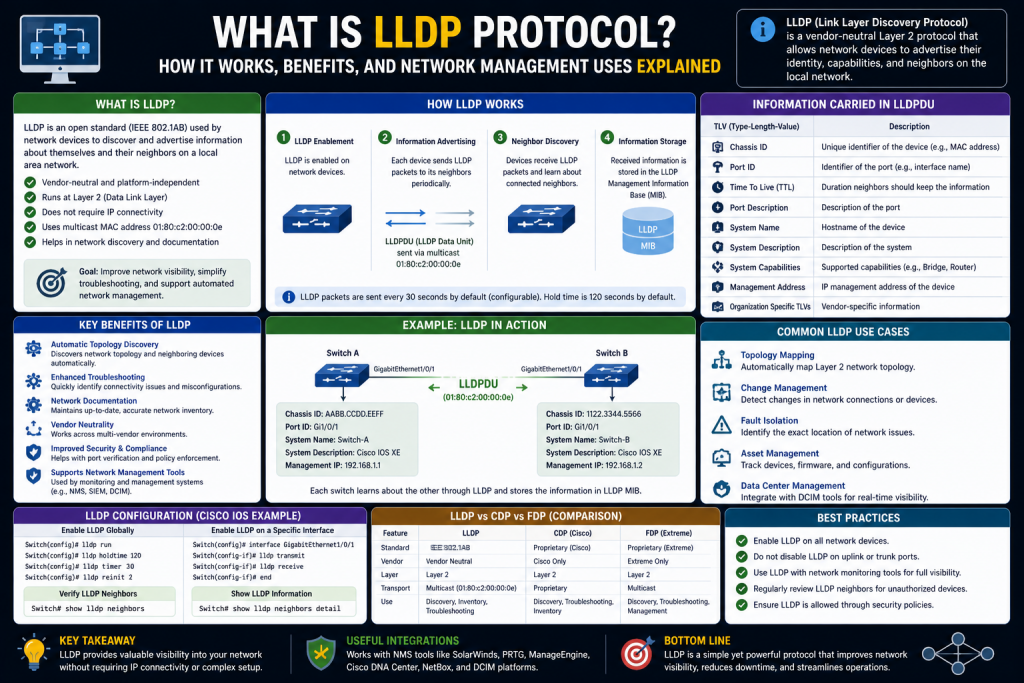
LLDP stands for Link Layer Discovery Protocol. It is defined by the IEEE 802.1AB standard and functions as a vendor-neutral discovery protocol. The primary purpose of LLDP is to enable network devices to advertise information about themselves to other devices on the same local network segment.
This information can include:
- Device name or system name
- Chassis ID
- Port ID
- System capabilities
- Management IP address
- VLAN information
- Power over Ethernet details
- Device descriptions
- Link aggregation details
When LLDP is enabled on a device, that device periodically transmits LLDP Data Units (LLDPDUs) out of its interfaces. Neighboring devices that also support LLDP receive these advertisements, process them, and store the information in a local LLDP neighbor table.
This process creates a dynamic map of directly connected devices, allowing administrators to query network hardware and immediately see neighboring connections.
Unlike routing protocols that focus on path selection or IP reachability, LLDP is focused purely on local neighbor discovery. It does not attempt to route packets, determine best paths, or build spanning trees. Instead, it simply shares structured identity information between adjacent devices.
This simplicity is one of LLDP’s strengths. By operating as a lightweight discovery protocol, it minimizes overhead while maximizing visibility.
Why LLDP Was Created
Before LLDP, network vendors often developed proprietary discovery protocols to solve topology and neighbor identification problems. Cisco Discovery Protocol (CDP) is a well-known example. While effective, proprietary protocols created interoperability challenges in mixed-vendor environments.
Consider a network that includes Cisco switches, Juniper routers, HP switches, Aruba wireless systems, and IP phones from multiple manufacturers. If each vendor used only proprietary discovery methods, visibility would be fragmented. Administrators would need separate tools or configurations to understand the network.
LLDP was developed to solve this issue by introducing a universal, standards-based discovery protocol. Because LLDP is vendor-neutral, devices from different manufacturers can exchange discovery information using the same language.
This standardization offers several advantages:
- Cross-platform compatibility
- Simplified network management
- Reduced vendor lock-in
- Easier troubleshooting
- Better support for enterprise diversity
Today, LLDP is supported by most enterprise networking vendors, making it one of the most practical tools for heterogeneous networks.
How LLDP Operates at Layer 2
One of LLDP’s defining features is that it operates at the Data Link Layer, also known as Layer 2 of the OSI model.
This means LLDP communicates using MAC addresses rather than IP addresses. Frames are sent directly over Ethernet links using a reserved multicast destination MAC address specifically for LLDP.
Because LLDP functions at Layer 2:
- Devices do not need IP addresses to participate
- LLDP works even before IP configuration is complete
- VLAN boundaries do not prevent local discovery
- LLDP remains functional during certain Layer 3 outages
- Discovery is limited to directly connected neighbors
This local-only scope is important. LLDP advertisements are not forwarded by routers, meaning LLDP traffic stays within the local segment. This improves security while ensuring that neighbor information reflects physical or immediate logical connectivity rather than distant network paths.
By functioning independently of IP, LLDP is especially useful during initial deployments, staging, troubleshooting, and hardware replacement scenarios.
For example, if a new switch is installed with default settings and no IP address, LLDP can still advertise its presence to adjacent devices, making it discoverable immediately.
LLDP Data Units and TLVs
LLDP transmits information using LLDPDUs, which are structured frames containing Type-Length-Value fields, commonly referred to as TLVs.
Each TLV represents a specific category of information. This design makes LLDP highly extensible because vendors and standards bodies can define additional TLVs without redesigning the protocol itself.
Common mandatory TLVs include:
- Chassis ID
- Port ID
- Time to Live (TTL)
Optional TLVs may include:
- System Name
- System Description
- System Capabilities
- Management Address
- VLAN Name
- Port Description
The TLV structure gives LLDP flexibility. Devices can advertise only the information needed while maintaining protocol compatibility.
For example, a VoIP phone may advertise power requirements using LLDP-MED (Media Endpoint Discovery), while a standard switch may focus on port identity and VLAN configuration.
This modularity has helped LLDP remain relevant across evolving network technologies.
LLDP vs CDP: Open Standard vs Proprietary Discovery
A frequent point of confusion among networking learners is the difference between LLDP and CDP.
Cisco Discovery Protocol is Cisco’s proprietary Layer 2 discovery protocol. LLDP, by contrast, is an IEEE standard.
Key differences include:
Vendor Compatibility:
- CDP works primarily on Cisco devices
- LLDP works across multiple vendors
Standardization:
- CDP is Cisco-specific
- LLDP follows IEEE 802.1AB
Feature Scope:
- CDP may provide deeper Cisco ecosystem integration
- LLDP offers broad interoperability
Enterprise Use:
- CDP is common in Cisco-only environments
- LLDP is preferred in mixed environments
Many Cisco devices support both protocols, allowing administrators to choose based on network design goals.
In a modern enterprise where interoperability matters, LLDP is often considered more strategically valuable.
Key Benefits of LLDP for Network Administrators
LLDP offers practical benefits that go far beyond simple neighbor discovery.
Improved Topology Visibility
Perhaps the most obvious advantage is immediate visibility into network topology. Administrators can view neighboring devices and understand physical interconnections without manually tracing cables.
This is especially helpful in:
- Data centers
- Multi-floor office buildings
- Campus networks
- Remote branch deployments
Faster Troubleshooting
When connectivity issues arise, LLDP helps quickly verify:
- Which switch is connected to which router
- Which port uplinks to distribution layers
- Whether VLAN tags are reaching expected devices
- Whether endpoints are connected to the correct ports
This significantly reduces troubleshooting time.
Simplified Documentation
Networks evolve constantly, and documentation often becomes outdated. LLDP provides near real-time topology awareness, serving as a dynamic supplement to manual documentation.
Enhanced Device Deployment
New devices can automatically advertise themselves when connected, accelerating deployment and reducing onboarding friction.
Vendor-Neutral Management
Because LLDP is standardized, administrators can manage mixed-vendor environments more consistently.
LLDP in Voice and Wireless Deployments
LLDP’s value extends beyond switches and routers.
Many organizations use LLDP-MED, an extension specifically designed for media devices such as:
- IP phones
- Video conferencing systems
- Wireless access points
LLDP-MED can communicate:
- Voice VLAN assignments
- Power requirements
- Location information
- Device policy settings
For example, when a VoIP phone is plugged into a switch, LLDP-MED can automatically tell the phone which voice VLAN to use, reducing manual configuration.
This automation improves deployment speed while reducing errors.
Security Considerations of LLDP
While LLDP is generally considered low-risk, it is not entirely without security implications.
Potential concerns include:
- Device reconnaissance
- Exposure of hardware models
- Port structure visibility
- VLAN information leakage
An attacker with local network access may use LLDP data to better understand infrastructure layout.
However, LLDP’s Layer 2 limitations reduce broader exposure because advertisements typically remain confined to the local segment.
Security-conscious organizations may choose to:
- Disable LLDP on untrusted ports
- Restrict LLDP on sensitive infrastructure
- Use network access control
- Monitor LLDP advertisements
For most enterprise environments, LLDP’s operational advantages outweigh its risks, but policy should align with security priorities.
Common Real-World Use Cases
LLDP is particularly valuable in practical scenarios such as:
Rack Audits
Administrators can quickly determine what is connected where without manually tracing every cable.
Remote Troubleshooting
A network engineer can identify adjacent devices from command-line output even without physical access.
IP Phone Provisioning
Voice endpoints can automatically receive VLAN and policy details.
Data Center Expansion
As infrastructure scales, LLDP reduces confusion during deployment.
Migration Projects
During hardware refreshes, LLDP helps verify topology before and after changes.
Why LLDP Remains Essential
Despite advances in SDN, cloud networking, and automation, LLDP remains highly relevant because physical connectivity still matters.
Even in virtualized or cloud-managed environments:
- Switch ports still connect hardware
- Access points still require edge visibility
- Phones still need VLAN information
- Technicians still troubleshoot physical links
LLDP serves as a foundational protocol that bridges physical infrastructure with modern operational intelligence.
Operational Mechanics, Configuration, and Protocol Behavior
Understanding LLDP conceptually is important, but to truly appreciate its role in enterprise networking, it is essential to examine how the protocol actually functions in live environments. LLDP is more than a passive identification system—it is a structured operational framework that enables network devices to continuously exchange local topology intelligence. This process is governed by standards, timers, frame structures, management databases, and configuration options that make LLDP highly effective across diverse infrastructures.
add 200 woerd in it
Understanding LLDP conceptually is important, but to truly appreciate its role in enterprise networking, it is essential to examine how the protocol actually functions in live environments. LLDP is more than a passive identification system—it is a structured operational framework that enables network devices to continuously exchange local topology intelligence. This process is governed by standards, timers, frame structures, management databases, and configuration options that make LLDP highly effective across diverse infrastructures.
In production networks, LLDP operates as an ongoing discovery mechanism rather than a one-time identification tool. Devices repeatedly advertise and receive operational details, ensuring topology awareness remains current even as infrastructure changes due to hardware replacements, port reassignments, VLAN adjustments, or expansion projects. This continuous exchange allows network administrators to maintain accurate neighbor visibility without manually tracing cables or relying solely on documentation that may quickly become outdated.
LLDP’s operational value is amplified by its structured design. Standardized IEEE specifications ensure interoperability across vendors, while configurable timers allow organizations to balance responsiveness with bandwidth efficiency. Management databases store discovered neighbor information locally, enabling engineers to quickly query adjacent device details during troubleshooting or audits. Optional TLVs further extend functionality into areas such as voice deployment, PoE negotiation, wireless infrastructure, and policy enforcement.
By combining automation, standardization, and operational flexibility, LLDP becomes an essential part of modern network intelligence. It supports everything from initial deployment validation to long-term infrastructure governance, transforming physical network awareness into a continuously updated strategic asset rather than a static administrative task.
By understanding the internal mechanics of LLDP, network administrators can better deploy, optimize, troubleshoot, and secure it in both small business networks and global enterprise architectures.
The LLDP Communication Process
At its core, LLDP operates through a recurring cycle of advertisement, reception, storage, and expiration.
When LLDP is enabled on a device, each supported interface periodically transmits LLDP frames known as LLDPDUs (Link Layer Discovery Protocol Data Units). These frames contain structured information about the transmitting device, allowing directly connected neighbors to learn important operational details without requiring higher-layer communication protocols such as IP. LLDPDUs are sent at configurable intervals and serve as automated identity broadcasts that help devices continuously advertise who they are, what capabilities they support, and how they are connected within the local network segment.
The information inside these frames is organized using Type-Length-Value (TLV) structures, which allow LLDP to flexibly communicate both mandatory and optional data fields. Commonly advertised details include chassis ID, port ID, system name, system capabilities, management addresses, VLAN details, power requirements, and software or hardware descriptions. This structured approach allows neighboring devices to build and maintain accurate local topology awareness in real time.
Because LLDP operates at Layer 2, these transmissions do not rely on IP addressing or routing, making them especially useful during initial deployments, staging, troubleshooting, or environments where IP services may be unavailable or misconfigured. Each receiving device stores LLDP information in a neighbor table, creating an operational map of adjacent infrastructure. Over time, this periodic exchange forms a dynamic discovery ecosystem that improves visibility, simplifies diagnostics, and helps administrators understand physical network relationships with significantly less manual effort..
The process generally works like this:
- A device gathers local system information
- LLDP organizes this data into TLV format
- LLDP sends advertisements out enabled interfaces
- Neighboring devices receive the LLDPDU
- Receiving devices parse the information
- Neighbor details are stored in a local LLDP database
- Entries remain valid until their Time to Live expires
This cycle repeats continuously, ensuring the topology database remains current even when links change.
If a cable is unplugged, a device fails, or an interface goes down, LLDP entries eventually age out based on timer expiration, preventing stale topology data from lingering indefinitely.
This dynamic nature makes LLDP particularly useful in environments where infrastructure changes frequently.
LLDP Frames and Ethernet Encapsulation
Because LLDP is a Layer 2 protocol, its advertisements are encapsulated directly into Ethernet frames.
These frames are sent to a reserved multicast MAC address:
01:80:C2:00:00:0E
This special address ensures that LLDP frames are processed only by directly connected devices and are not forwarded by standard Ethernet bridges.
This behavior provides several benefits:
- Prevents LLDP flooding across networks
- Keeps discovery local
- Improves security scope
- Reduces unnecessary bandwidth use
- Preserves topology accuracy
Since LLDP does not depend on IP headers, subnetting, routing tables, or ARP, it can function independently of Layer 3 network design.
This independence is especially useful during:
- Initial hardware staging
- IP misconfiguration troubleshooting
- VLAN deployment
- Device replacement
- Bare-metal provisioning
For example, if a switch loses IP connectivity due to a routing issue, LLDP may still reveal immediate physical neighbors, helping administrators isolate the problem.
Mandatory and Optional TLVs Explained
LLDP’s Type-Length-Value design is one of its most powerful characteristics.
Mandatory TLVs
Every LLDP advertisement must include:
Chassis ID
Identifies the device itself, often using:
- MAC address
- Serial number
- Interface name
Port ID
Identifies the specific transmitting port
Time to Live (TTL)
Specifies how long the information remains valid before aging out
These three fields ensure that all LLDP-capable devices can at minimum identify neighboring systems and interfaces.
Optional TLVs
Optional TLVs enrich visibility and may include:
- Port Description
- System Name
- System Description
- System Capabilities
- Management Address
Organizationally Specific TLVs
These support advanced vendor or industry functions such as:
- PoE negotiation
- Voice VLAN assignment
- Device location
- Policy controls
This flexible architecture allows LLDP to evolve without sacrificing interoperability.
LLDP Timers and Advertisement Intervals
Timing is critical to LLDP efficiency.
Three primary timer values influence behavior:
Advertisement Interval
Controls how often LLDP updates are sent
Default on many devices: 30 seconds
Hold Multiplier
Determines how long information remains valid
TTL is usually calculated as:
Advertisement Interval × Hold Multiplier
For example:
30 seconds × 4 = 120-second TTL
Reinitialization Delay
Determines how long LLDP waits after being restarted before resuming transmissions
Why Timers Matter
Short intervals:
- Faster topology updates
- Better responsiveness
- Higher overhead
Long intervals:
- Lower traffic
- Slower updates
- Potentially outdated visibility
In highly dynamic environments like data centers, shorter intervals may be useful. In stable enterprise LANs, default settings are often sufficient.
Improper timer configuration can create issues:
- Excessive LLDP traffic
- Delayed topology updates
- Missed neighbor changes
Proper timer tuning aligns LLDP with network operational priorities.
LLDP Neighbor Tables and Local Databases
Once LLDP information is received, devices store it in management information bases (MIBs) or local neighbor tables.
Administrators can query these databases using CLI commands such as:
show lldp neighbors
show lldp neighbors detail
Typical outputs include:
- Neighbor device name
- Local interface
- Remote port ID
- Device type
- Platform details
- Management IP
- VLAN data
This database effectively creates a real-time local topology map.
For example, on a core switch, an engineer can instantly see:
- Which access switch connects to which uplink
- Which ports connect to phones
- Which interfaces connect to routers
- Which devices support PoE
This immediate visibility dramatically reduces diagnostic time.
LLDP Configuration on Enterprise Devices
Although LLDP is standardized, implementation varies slightly by vendor.
Cisco Example
Global enable:
lldp run
Interface enable:
lldp transmit
lldp receive
Juniper Example
set protocols lldp interface all
Aruba/HP Example
lldp run
Most platforms support:
- Global enable/disable
- Per-interface controls
- TLV customization
- Timer adjustments
- LLDP-MED support
Selective Interface Deployment
Not every interface should necessarily run LLDP.
Common best practices:
Enable on:
- Switch uplinks
- Router links
- IP phone ports
- Wireless AP ports
Disable on:
- Untrusted guest ports
- Sensitive security zones
- Public-facing interfaces
Strategic deployment balances operational value with security posture.
LLDP-MED: Media Endpoint Discovery
LLDP-MED extends LLDP for specialized endpoint devices.
This is especially useful for:
- VoIP phones
- Video systems
- Conferencing devices
- Emergency communication systems
LLDP-MED can advertise:
- Voice VLAN IDs
- Power requirements
- Device class
- Location coordinates
- Quality of Service policies
Example
A VoIP phone connects to a switch:
- Switch advertises voice VLAN via LLDP-MED
- Phone automatically joins correct VLAN
- QoS policies apply
- Power requirements are negotiated
This automation eliminates manual setup and reduces deployment complexity.
Power over Ethernet and LLDP
One major enterprise use case involves PoE.
LLDP can communicate precise power needs between powered devices and switches.
Without LLDP:
- Switch may use conservative estimates
- Power budgets may be inefficient
With LLDP:
- Devices request exact wattage
- Switch allocates accurately
- Power utilization improves
This is especially important in deployments with:
- Wireless APs
- Security cameras
- VoIP phones
- IoT devices
As smart infrastructure expands, LLDP’s role in power management grows more valuable.
Using LLDP for Network Mapping
One of LLDP’s strongest operational advantages is topology mapping.
Network management systems can collect LLDP data from multiple devices and automatically generate infrastructure diagrams.
These maps can reveal:
- Physical switch interconnections
- Distribution paths
- Edge device placement
- Redundancy structures
- Miswired links
This automation reduces dependence on outdated spreadsheets or manually drawn diagrams.
For enterprises with hundreds or thousands of ports, this can save enormous administrative effort.
Troubleshooting LLDP Issues
Even though LLDP is relatively simple, problems can occur.
Missing Neighbors
Potential causes:
- LLDP disabled globally
- LLDP disabled on interface
- Interface down
- Cable fault
- Unsupported device
Incomplete Information
Possible issues:
- TLV restrictions
- Vendor implementation differences
- LLDP-MED mismatch
Stale Entries
Causes:
- Timer misconfiguration
- Delayed expiration
- Software bugs
Best Troubleshooting Process
- Verify physical link
- Check LLDP global status
- Check interface-level settings
- Review timer values
- Examine neighbor detail
- Confirm vendor compatibility
Because LLDP depends on bidirectional communication, one-sided configurations often produce confusing results.
Vendor Interoperability in Mixed Networks
Modern organizations rarely use a single networking vendor.
LLDP excels in environments combining:
- Cisco
- Juniper
- Aruba
- Extreme Networks
- Dell
- HPE
- Fortinet
By providing a universal discovery standard, LLDP avoids visibility fragmentation.
This is particularly useful during:
- Mergers
- Vendor transitions
- Hardware refreshes
- MSP environments
In these cases, LLDP often becomes more operationally valuable than proprietary alternatives.
LLDP and Automation
As networks become increasingly automated through SDN, orchestration, and infrastructure-as-code, LLDP remains relevant.
Automation platforms can leverage LLDP for:
- Dynamic inventory
- Compliance validation
- Auto-documentation
- Port verification
- Zero-touch provisioning
For example:
A deployment script may validate that a new switch is connected to the expected distribution switch before applying production configs.
This reduces deployment risk.
Common Misconceptions About LLDP
LLDP is Cisco-only
Reality: LLDP is IEEE standardized
LLDP requires IP
Reality: LLDP uses Layer 2 only
LLDP is only for switches
Reality: Phones, APs, routers, and other devices use LLDP
LLDP is insecure by default
Reality: LLDP exposure is local and manageable
LLDP replaces documentation
Reality: LLDP supplements but does not fully replace architecture planning
Operational Best Practices
For most enterprise environments:
- Enable LLDP globally
- Use LLDP-MED where voice exists
- Tune timers thoughtfully
- Restrict LLDP on sensitive ports
- Monitor neighbor changes
- Integrate LLDP into NMS platforms
- Validate TLV configurations
- Document exceptions
These practices maximize LLDP’s operational value while minimizing unnecessary exposure.
LLDP and Hybrid Cloud Networking
As enterprise infrastructure increasingly shifts toward hybrid cloud models, many organizations assume local discovery protocols become less relevant because workloads move to public cloud platforms. In reality, hybrid cloud often increases the need for strong on-premises visibility because organizations must now coordinate between physical infrastructure, edge systems, colocation facilities, branch environments, and cloud-connected gateways. While cloud providers abstract much of their internal topology, enterprise-owned infrastructure still remains responsible for securely and reliably connecting users, applications, and services to those cloud environments. This means the physical edge often becomes more—not less—important.
Hybrid cloud introduces operational complexity because businesses rarely move everything to a single platform. Instead, they often maintain a mix of on-premises applications, SaaS platforms, private cloud resources, disaster recovery sites, branch systems, and multiple public cloud providers. This creates a distributed operational model where physical network handoff points are strategically critical. Devices such as WAN routers, SD-WAN appliances, firewalls, direct-connect circuits, MPLS transitions, and edge security gateways must all be deployed correctly to maintain service continuity.
In these architectures, LLDP can provide valuable local intelligence by validating switch-to-router uplinks, confirming colocation cross-connect placements, verifying branch appliance deployment, supporting migration audits, and helping ensure redundancy designs are physically accurate. For example, during a cloud migration, an organization may need to verify that production traffic, backup circuits, and failover links are connected to the correct infrastructure paths before shifting critical workloads. LLDP can reduce uncertainty during these transitions.
Hybrid cloud also increases dependency on distributed teams, managed providers, and remote deployment models. Local visibility protocols become essential because engineers may not always have physical access to branch or edge locations. LLDP helps operations teams remotely validate deployment assumptions, troubleshoot handoff issues, and maintain infrastructure governance.
Ultimately, while cloud shifts application architecture, it does not eliminate the need for physical networking excellence. Hybrid cloud success depends on reliable coordination between virtual services and physical connectivity layers. Protocols like LLDP help ensure that the increasingly abstracted digital enterprise remains grounded in accurate, manageable, and operationally transparent infrastructure.
While cloud providers abstract much of their internal topology, enterprise-owned infrastructure still depends heavily on accurate local discovery. Devices such as:
- WAN edge routers
- SD-WAN appliances
- Cloud on-ramp switches
- Security gateways
- Wireless controllers
- Branch aggregation devices
all require physical connectivity awareness.
LLDP helps organizations maintain confidence that the infrastructure connecting to cloud services is deployed correctly.
Hybrid Cloud Deployment Example
A company deploys direct cloud connectivity through a colocation facility:
- Edge router uplinks to provider handoff
- Firewall connects to aggregation switches
- Monitoring appliances observe traffic
- Redundant WAN circuits terminate locally
LLDP can help verify:
- Correct interface placement
- Redundant path design
- Port consistency
- Physical handoff alignment
Even as applications migrate to the cloud, the physical edge remains critically important.
LLDP and SD-WAN Branch Standardization
SD-WAN has transformed branch networking, but successful SD-WAN still depends on predictable branch deployment.
Organizations rolling out SD-WAN at scale often face challenges such as:
- Incorrect appliance placement
- Mispatched WAN ports
- LAN uplink mistakes
- Voice VLAN disruption
- Power provisioning problems
LLDP supports branch standardization by helping operations teams verify:
- Which switch port connects to SD-WAN CPE
- Which device serves as upstream aggregation
- Whether branch hardware matches deployment templates
This is especially useful in franchise, retail, or healthcare environments where large numbers of semi-standardized sites must be deployed consistently.
LLDP in Campus Network Segmentation
Modern campuses frequently segment traffic into multiple operational zones:
- Corporate data
- Voice
- Guest wireless
- Security systems
- Building controls
- Research networks
Maintaining segmentation integrity requires confidence in where devices are physically connected.
LLDP supports segmentation governance by making it easier to identify:
- Which ports connect to APs
- Which switches support phones
- Which uplinks support building automation
- Which interfaces may violate segmentation policy
This becomes increasingly important as campuses adopt:
- NAC
- Microsegmentation
- Identity-based access
- IoT controls
Without reliable discovery, segmentation strategies can become difficult to enforce operationally.
LLDP and Asset Lifecycle Management
Hardware lifecycle management is often overlooked until organizations begin large-scale refresh projects.
LLDP can improve lifecycle operations by helping teams:
- Identify aging devices
- Audit deployment locations
- Validate replacement planning
- Track migrations
- Confirm retirement success
Example
During a switch refresh:
- Export LLDP neighbor data from legacy switch
- Replace hardware
- Rebuild configuration
- Compare LLDP adjacency after cutover
This allows teams to quickly verify whether the new infrastructure mirrors intended topology.
For organizations with thousands of devices, LLDP data can significantly improve inventory intelligence.
LLDP and Network Observability
Observability has become a major operational priority, moving beyond traditional monitoring into richer contextual intelligence.
Modern observability platforms increasingly correlate:
- Logs
- Metrics
- Flows
- Device health
- Topology
LLDP contributes topology context.
Example
A monitoring platform detects packet loss on an access switch.
Without LLDP:
- Engineers investigate manually
With LLDP:
- Platform correlates issue to uplink switch
- Neighbor path becomes visible
- Root cause analysis accelerates
This contextual intelligence is especially valuable when outages involve multiple infrastructure layers.
LLDP in Industrial and Operational Technology Networks
Industrial environments increasingly rely on Ethernet-connected systems such as PLCs, SCADA devices, industrial switches, sensors, robotics platforms, machine controllers, human-machine interfaces, and edge gateways. As operational technology continues converging with IT infrastructure, industrial networks are becoming more interconnected, data-driven, and dependent on real-time visibility. Unlike traditional office networks, these environments often prioritize uptime, worker safety, process consistency, and deterministic communication above all else. Even minor connectivity issues can disrupt production lines, impact safety systems, or trigger costly downtime.
LLDP can play a valuable supporting role by improving visibility into industrial network architecture. It can assist with mapping industrial topology, validating switch placements, confirming redundant ring structures, identifying control-system uplinks, supporting maintenance operations, and helping engineers understand how distributed systems are physically interconnected. In facilities with manufacturing cells, remote substations, or process automation zones, LLDP can reduce troubleshooting time when equipment is relocated, replaced, or expanded.
This becomes especially useful because OT teams may not always maintain enterprise-style documentation rigor, particularly in older facilities where infrastructure has evolved over many years. LLDP can provide dynamic operational transparency that supplements legacy diagrams and tribal knowledge.
Additionally, LLDP may support lifecycle modernization projects by helping bridge IT and OT visibility standards during digital transformation initiatives such as Industry 4.0. However, industrial sectors often have heightened security and reliability concerns. Sensitive control systems may require stricter LLDP deployment policies, selective interface restrictions, or segmentation-aware configurations to balance visibility with cyber resilience. In these environments, LLDP should be implemented thoughtfully, aligning operational transparency with safety, compliance, and industrial security priorities.
LLDP and Sustainability
Sustainability may seem unrelated to networking protocols, but operational efficiency contributes directly to energy and hardware optimization.
LLDP supports sustainability indirectly through:
PoE Optimization
Precise power negotiation reduces wasted power allocation.
Deployment Accuracy
Reduced truck rolls and fewer onsite visits lower operational emissions.
Lifecycle Efficiency
Better hardware planning reduces unnecessary replacements.
Troubleshooting Efficiency
Faster diagnostics reduce resource waste.
As enterprises increasingly track infrastructure efficiency, even lightweight protocols can support broader sustainability goals.
LLDP and Vendor Migration Strategy
Organizations frequently migrate between vendors due to:
- Cost optimization
- Acquisitions
- Technology modernization
- Support concerns
During migrations, mixed-vendor interoperability is essential.
LLDP often becomes one of the few consistent operational standards across transition phases.
Migration Benefits
- Legacy and new devices can exchange neighbor data
- Mixed environments remain manageable
- Documentation gaps shrink
- Troubleshooting remains standardized
For organizations moving from proprietary ecosystems to broader interoperability, LLDP can become a strategic transition enabler.
Advanced LLDP Policy Governance
Mature enterprises often formalize LLDP policy rather than simply enabling it.
Governance Questions Include
- Which interfaces should advertise?
- Which interfaces should receive only?
- Which TLVs are permitted?
- How should LLDP-MED be managed?
- Which teams own LLDP data?
- How are anomalies escalated?
This governance approach aligns LLDP with larger operational maturity frameworks.
LLDP in Security Monitoring Ecosystems
Though LLDP is not a direct security protocol, it can contribute to detection ecosystems.
Potential Monitoring Scenarios
- Unexpected device class appears
- New switch detected on user port
- PoE profile changes unexpectedly
- Voice VLAN endpoint mismatch
- Unauthorized AP appears
When correlated with NAC, SIEM, or XDR tools, LLDP can strengthen anomaly detection.
Example
A rogue wireless bridge introduced in a secure office may advertise capabilities inconsistent with approved device classes.
This may not block the threat, but it can improve detection speed.
LLDP and Human Operational Psychology
One often overlooked advantage of LLDP is reduced cognitive load.
Network engineers often face pressure during outages, maintenance windows, and deployments. In these moments, uncertainty is costly.
LLDP reduces uncertainty by answering immediate questions:
- What is this connected to?
- Which port matters?
- What changed?
- Is this expected?
This reduction in ambiguity can significantly improve decision-making speed under pressure.
Protocols that simplify operational clarity often have disproportionate practical value compared to their technical complexity.
The Economics of LLDP
LLDP’s cost-to-value ratio is exceptionally strong.
Costs
- Minimal bandwidth
- Low CPU overhead
- Basic configuration
- Modest security considerations
Benefits
- Faster troubleshooting
- Better visibility
- Improved automation
- Reduced downtime
- Deployment efficiency
- Vendor neutrality
Few protocols deliver such broad operational returns for such low overhead.
Long-Term Strategic Importance
As networking grows more abstracted, many assume low-level protocols diminish in importance. Historically, the opposite is often true: foundational clarity becomes even more important when complexity increases.
As networking grows more abstracted through cloud-native design, virtualization, software-defined networking, automation frameworks, and AI-assisted infrastructure, many professionals assume foundational protocols become less important. Historically, the opposite is usually true: the more layers of abstraction organizations build, the more valuable foundational clarity becomes. Advanced systems may simplify management interfaces, but they also create additional layers between administrators and physical reality.
When something fails inside a highly abstracted environment, troubleshooting often requires returning to core infrastructure truths—what is physically connected, where traffic actually enters or exits, which devices neighbor one another, and whether deployment assumptions match operational reality. This is why low-level protocols like LLDP remain strategically relevant. They provide dependable ground truth beneath orchestration layers, dashboards, and policy engines. In many cases, abstraction increases efficiency during normal operations but can amplify confusion during outages, migrations, or security incidents if foundational visibility is weak. A software-defined architecture is still dependent on physical ports, uplinks, and edge devices. Hybrid cloud still relies on routers, switches, and handoff points. IoT ecosystems still depend on local connectivity. As complexity expands, protocols that reveal infrastructure fundamentals often become more—not less—critical because they anchor modern innovation to operational certainty. In essence, abstraction may change how networks are managed, but it does not eliminate the importance of understanding what the network actually is.
Future trends likely to reinforce LLDP relevance include:
- Edge AI systems
- Massive IoT
- Smart campuses
- Autonomous branch deployments
- Digital twins
- Infrastructure orchestration
In each case, physical adjacency awareness remains important.
LLDP may evolve through expanded integrations, but its core purpose—neighbor discovery—remains strategically timeless.
Professional Mastery and LLDP
Mastery of networking often comes from understanding both glamorous technologies and practical fundamentals.
Experienced engineers distinguish themselves by knowing:
- How traffic should flow
- How systems are deployed
- How physical and logical systems intersect
- How to validate assumptions quickly
LLDP supports all four.
This is why LLDP remains a meaningful competency across career paths including:
- Network engineering
- Security architecture
- Voice systems
- Wireless operations
- Infrastructure consulting
- Cloud edge design
Expanded Final Conclusion
LLDP is often introduced as a basic discovery protocol, but in practice it is one of the most strategically useful operational technologies in networking. Its Layer 2 simplicity masks a broad range of enterprise benefits that include topology awareness, automation enablement, security support, lifecycle management, branch standardization, vendor migration, observability, and deployment governance.
From data centers to branch offices, from VoIP phones to industrial sensors, LLDP consistently provides one of the most essential forms of infrastructure intelligence: accurate local connectivity awareness.
In an era defined by complexity, distributed architecture, and constant technological evolution, protocols that preserve operational clarity become increasingly—not less—valuable.
LLDP does not replace architecture, security, or automation platforms. Instead, it strengthens them by ensuring they are grounded in accurate physical reality.
For organizations, LLDP helps transform infrastructure from opaque complexity into manageable intelligence. For engineers, it provides practical confidence in environments where uncertainty can be costly. For enterprises planning future transformation, LLDP remains one of the most reliable foundational tools for preserving visibility.
Ultimately, networking excellence depends not only on moving packets efficiently but also on understanding the infrastructure that enables them. LLDP remains one of the most dependable protocols ever designed for that purpose, making it an enduring pillar of effective network management.
Continue exploring the technologies and certification concepts that matter most to you.