In the modern digital ecosystem, organizations rely on continuous connectivity to conduct business, deliver services, support employees, communicate with customers, and maintain operational efficiency. Networks are no longer isolated systems—they are dynamic infrastructures connecting on-premises environments, cloud platforms, mobile users, vendors, branch offices, remote workers, and third-party services. This constant exchange of data creates opportunity, but it also introduces substantial security risk.
Every connection request to a network represents a decision point. Should the request be trusted? Is it authorized? Could it be malicious? Does it violate policy? Could it expose sensitive systems? These questions are answered by one of the most critical technologies in cybersecurity: the firewall.
A firewall is not simply a technical barrier between internal and external traffic. It is a policy enforcement system that governs digital interactions by inspecting traffic, comparing it to predefined security rules, and deciding whether to allow, deny, or silently discard communications. Firewalls serve as both security checkpoints and business enablers, balancing operational access with protection.
To understand firewall effectiveness, one must understand firewall rules. Firewall rules define trust boundaries, determine acceptable communication, restrict dangerous behavior, and support security architecture. As cyber threats have evolved, firewall strategy has matured beyond simple permissive filtering into structured security models centered on least privilege, segmentation, governance, and zero trust.
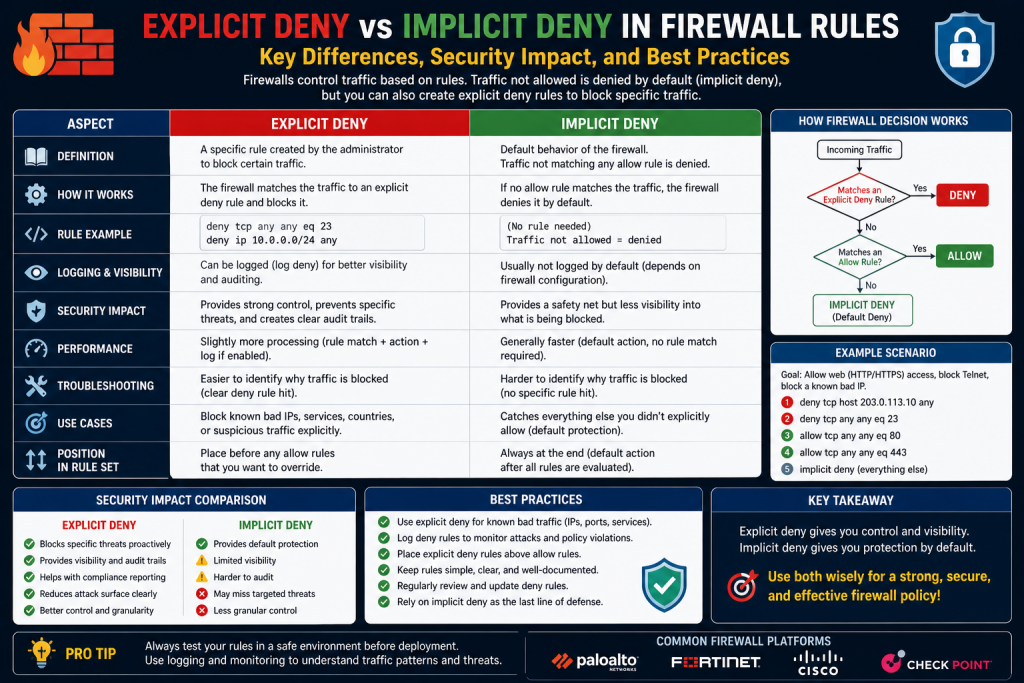
Two of the most important deny concepts are explicit deny and implicit deny. Before examining them directly, it is necessary to build a strong foundation in firewall rule architecture, policy logic, traffic evaluation, and strategic network defense.
What a Firewall Really Is
At its core, a firewall is a traffic control mechanism that monitors and regulates communications between networks, devices, applications, or segments based on defined security criteria. Firewalls can exist at the perimeter, internally between departments, in cloud environments, on endpoints, or around sensitive workloads.
Their core functions include preventing unauthorized access, enforcing segmentation, supporting compliance, reducing attack surfaces, controlling outbound communications, logging suspicious behavior, and ensuring policy consistency.
Firewalls act as gatekeepers, but gatekeepers are only effective when they are guided by clear policies. Those policies are firewall rules.
The Strategic Role of Firewall Rules
Firewall rules are structured policy statements that instruct the firewall how to respond when traffic meets specified criteria. Each rule functions like a logical instruction:
If traffic matches these conditions, take this action.
Examples include allowing employee VPN traffic, denying Telnet connections, restricting remote desktop access, blocking suspicious IP addresses, permitting DNS only to approved servers, or denying all unmatched traffic.
Without firewall rules, a firewall cannot distinguish legitimate business traffic from malicious activity. Rules are what transform firewalls from passive devices into active security governance systems.
Core Elements Firewalls Evaluate
To make trust decisions, firewalls inspect traffic based on multiple attributes.
Source IP addresses reveal where traffic originates. This could include employees, vendors, branch offices, public systems, or malicious actors.
Destination IP addresses indicate where traffic is attempting to go, such as internal servers, cloud services, or critical infrastructure.
Ports identify service endpoints like SSH, HTTPS, DNS, or remote desktop.
Protocols such as TCP, UDP, and ICMP provide communication context.
Direction determines whether traffic is inbound, outbound, or internal.
Modern firewalls may also inspect session state, user identity, application behavior, and threat intelligence indicators.
This layered inspection allows for far more precise security decisions than simple port blocking.
Why Rule Order Matters
Most firewalls process rules sequentially, often from top to bottom. The first matching rule typically determines the outcome. This makes rule order one of the most important factors in firewall effectiveness.
For example, if a broad allow rule is placed above a more specific deny rule, malicious traffic may be permitted before it ever reaches the deny condition.
This creates major implications:
Specific rules should often appear before broad rules.
Critical deny policies must not be shadowed.
Temporary rules can create hidden vulnerabilities.
Poor sequencing can undermine security strategy.
Firewall management is not only about writing rules—it is about structuring them intelligently.
The Three Primary Firewall Actions
Firewall decisions generally fall into three categories: allow, deny, and drop.
Allow permits traffic to continue.
Deny blocks traffic and often informs the sender.
Drop silently discards traffic without response.
Each action has strategic implications. Allow supports business continuity. Deny enforces policy while communicating restrictions. Drop enhances stealth by providing attackers with less information.
Allow Rules and Business Functionality
Allow rules enable essential operations. They permit secure web traffic, SaaS applications, VPN access, email services, software updates, and business-critical communication.
However, poorly designed allow rules can create major risks. Overly broad permissions such as allowing unrestricted outbound internet access may unintentionally permit malware communications, unauthorized cloud tools, insider misuse, or policy violations.
Strong allow rules are specific, justified, and continuously reviewed.
Deny Rules and Security Enforcement
Deny rules define prohibited behavior. They block known malicious IP addresses, insecure services, unauthorized applications, policy violations, and suspicious activity.
Deny rules are central to network defense because they establish clear security boundaries. Rather than simply enabling approved traffic, deny rules actively prevent dangerous interactions.
In mature environments, deny rules often shape security posture more than allow rules.
Least Privilege and Firewall Design
Least privilege is one of cybersecurity’s most important principles. It means granting only the minimum access required for legitimate functionality.
In firewall policy, this means:
Only necessary ports
Only required applications
Only approved destinations
Only trusted users
Only justified protocols
Everything else should be restricted.
Least privilege minimizes attack surfaces, reduces accidental exposure, and strengthens control.
Default Allow vs Default Deny Models
Firewall strategy often follows one of two philosophies.
A default allow model permits traffic unless specifically blocked. While easier to deploy initially, it creates larger attack surfaces and greater unknown risk.
A default deny model blocks traffic unless specifically permitted. This requires more planning but significantly improves security.
Modern zero trust architecture strongly favors default deny because it assumes traffic should not be trusted automatically.
The Evolution of Firewall Technology
Early firewalls focused primarily on packet filtering based on IP addresses and ports. Modern firewalls have evolved dramatically.
Today’s firewalls may include:
Stateful inspection
Deep packet inspection
Application awareness
User identity integration
Threat intelligence
Intrusion prevention
SSL inspection
Behavioral analytics
This evolution means firewall rules now govern not only network pathways but also business applications, user behavior, and advanced threats.
Stateful Inspection and Security Context
Stateful firewalls track active sessions and understand whether packets belong to legitimate connections.
This matters because not all traffic should be treated equally. A returning packet from an approved web session differs from an unsolicited inbound attempt.
State awareness improves security by reducing spoofing risk and increasing contextual decision-making.
Application Awareness and Modern Threats
Attackers increasingly abuse legitimate ports such as HTTPS to bypass simplistic controls.
Modern firewalls can identify traffic based on application behavior rather than just port numbers. This enables organizations to distinguish between trusted enterprise software and unauthorized applications even when they use the same ports.
This capability is essential because traditional port-based filtering alone is often insufficient.
Internal Segmentation and East-West Security
Firewalls are no longer just perimeter tools. Once attackers gain internal access, they often move laterally between systems.
Internal segmentation firewalls separate departments, trust zones, and critical assets to reduce movement.
For example, HR systems may be isolated from development networks, and guest Wi-Fi may be segregated from financial systems.
This segmentation limits damage even after initial compromise.
Compliance and Governance
Firewall rules are also governance tools. Many regulatory standards require strict access controls and segmentation.
Examples include:
PCI DSS
HIPAA
ISO 27001
NIST
SOC 2
Firewall policy supports compliance by documenting access restrictions, enforcing boundaries, and providing auditable controls.
Common Firewall Misconfigurations
Even powerful firewalls can fail if policies are poorly managed.
Common mistakes include:
Overly broad permissions
Forgotten temporary exceptions
Shadowed deny rules
Outdated vendor access
Missing documentation
Rule sprawl
Lack of review
Misconfiguration is one of the most common causes of preventable security exposure.
The Human Factor in Firewall Security
Technology does not manage itself. Firewall security depends heavily on administrative discipline.
Security teams must:
Audit rules
Monitor logs
Review changes
Remove obsolete permissions
Validate segmentation
Align policy with business needs
Without governance, even advanced firewalls can become liabilities.
Logging and Visibility
Firewall logs provide critical visibility into:
Attack attempts
Policy violations
Reconnaissance
Misconfigurations
Outbound malware activity
Access trends
However, logging without strategy can overwhelm teams. Effective visibility focuses on meaningful events rather than excessive noise.
Business Continuity and Security Balance
Security must support operations without unnecessary disruption.
Overly restrictive firewalls may break applications, disrupt remote access, or block essential integrations.
Overly permissive firewalls may expose systems to threats.
Effective firewall strategy balances security, usability, performance, and compliance.
Zero Trust and the Future of Firewall Rules
Zero trust operates on a simple principle: trust nothing by default.
This requires:
Continuous verification
Strict segmentation
Least privilege
Policy precision
Aggressive monitoring
Firewalls are essential zero trust enforcement points because they determine whether communications should occur at all.
Preparing for Explicit Deny and Implicit Deny
Understanding firewall foundations clarifies why deny logic is so important.
Explicit deny targets known dangerous traffic based on defined criteria.
Implicit deny blocks all traffic not explicitly allowed.
One is selective.
One is universal.
Together, they form the backbone of mature firewall security architecture.
Introduction to Explicit Deny in Firewall Architecture
As organizations strengthen cybersecurity defenses, firewall policies must become more than simple traffic filters. Modern environments require precision, accountability, and strategic enforcement. This is where explicit deny firewall rules become especially important.
Explicit deny is a targeted security strategy in which administrators intentionally create firewall rules that block traffic matching specific criteria. Unlike broad default security models, explicit deny focuses on precision. It identifies traffic that should never be allowed based on source, destination, protocol, port, behavior, or policy violations and actively blocks it before it can create risk.
In practical terms, explicit deny is like a security team maintaining a watchlist. Anyone matching known threat indicators, prohibited behavior, or policy restrictions is immediately denied access.
This approach is especially valuable because cybersecurity is not only about allowing legitimate traffic—it is also about identifying dangerous traffic with certainty and stopping it deliberately.
Explicit deny rules provide organizations with control, granularity, and defensive power. They are critical for blocking known malicious actors, preventing unauthorized communication, enforcing segmentation, meeting regulatory requirements, and reducing exposure to specific threats.
Understanding explicit deny is essential because it represents one of the most proactive components of firewall security.
What Explicit Deny Means
An explicit deny rule is a firewall policy that directly instructs the firewall to reject traffic when it matches defined parameters.
These parameters may include:
Specific IP addresses
IP ranges
Ports
Protocols
Applications
Countries or geographic regions
User identities
Device types
Time schedules
Threat intelligence feeds
Examples include:
Deny all inbound traffic from a known malicious IP
Block outbound Telnet connections
Deny peer-to-peer applications
Prevent HR systems from communicating with guest Wi-Fi
Block remote desktop access from external networks
Deny traffic to unauthorized cloud storage services
Unlike broader deny models, explicit deny is intentional and specific. Administrators identify what should be prohibited and define that prohibition clearly.
Why Explicit Deny Matters
Explicit deny matters because not all threats are unknown. Many risks are identifiable, predictable, and policy-based.
Organizations often know they want to block:
Known malicious IP addresses
Botnet infrastructure
Insecure legacy protocols
Unauthorized vendors
Restricted geographies
Dark web communications
Specific malware signatures
Shadow IT applications
Explicit deny allows administrators to proactively stop these threats rather than relying solely on broader fallback protections.
This precision transforms firewalling from reactive filtering into strategic control.
Explicit Deny as a Precision Security Tool
One of the greatest strengths of explicit deny is granularity.
Instead of broadly restricting traffic, organizations can block:
Only one subnet
Only one application
Only one port
Only one user group
Only one external service
This precision minimizes operational disruption while maximizing protection.
For example:
Blocking all web traffic may harm productivity.
Blocking only access to unauthorized file-sharing platforms reduces risk while preserving legitimate browsing.
This is why explicit deny is often central to mature enterprise security strategy.
Blocking Known Malicious IP Addresses
Threat intelligence often identifies IP addresses associated with:
Botnets
Ransomware operators
Phishing infrastructure
Command-and-control servers
Credential theft campaigns
Exploit kits
Explicit deny rules can immediately block traffic from these sources.
For example:
If intelligence identifies an IP involved in ransomware distribution, administrators can deny all communication with that source before compromise occurs.
This creates proactive threat defense.
Preventing Insecure Protocol Usage
Some protocols are inherently risky due to weak encryption or poor security design.
Examples:
Telnet
FTP
SMBv1
HTTP for sensitive services
Legacy remote access methods
Explicit deny can block these protocols entirely.
For example:
Deny outbound Telnet
Deny inbound SMB from external sources
This supports modernization and policy consistency.
Supporting Network Segmentation
Explicit deny rules are often essential for segmentation.
Examples:
Guest Wi-Fi cannot reach payroll systems
Marketing cannot directly access production databases
IoT devices cannot communicate with domain controllers
Development systems cannot access financial records
By explicitly denying prohibited communication paths, organizations reduce lateral movement opportunities.
Segmentation becomes enforceable rather than theoretical.
Enforcing Regulatory and Compliance Controls
Many industries require strict access restrictions.
Examples:
Payment card systems
Healthcare databases
Government systems
Critical infrastructure
Explicit deny rules can enforce:
No public access
No unauthorized vendor access
No insecure protocol access
No cross-zone violations
This supports:
PCI DSS
HIPAA
NIST
ISO 27001
Compliance often depends on proving intentional restrictions, which explicit deny provides clearly.
Explicit Deny and Insider Threat Reduction
Not all threats originate from outside the organization. While external attackers often receive the most attention, insider threats can be equally dangerous—and in some cases more difficult to detect—because insiders may already possess legitimate credentials, network familiarity, or authorized access. Employees, contractors, vendors, temporary staff, or compromised internal accounts may intentionally or unintentionally create serious security risks.
Internal threats may involve:
Unauthorized data access
Shadow IT usage
Data exfiltration
Lateral reconnaissance
Privilege abuse
Unauthorized privilege escalation
Intellectual property theft
Policy circumvention
Accidental data exposure
Use of unapproved communication channels
Installation of risky software
Misuse of administrative tools
Insider threats are particularly concerning because they may bypass traditional perimeter defenses. A malicious insider or compromised internal account may already operate within trusted zones, making behavioral restrictions and internal firewall enforcement critical.
Explicit rules can play a major role in reducing insider risk by intentionally restricting specific behaviors, tools, and communication pathways that violate policy or create unnecessary exposure.
Examples include restricting:
USB-over-network tools
Unauthorized SaaS platforms
External storage services
Peer-to-peer applications
Sensitive cross-department traffic
Remote administration tools
Unsanctioned file-sharing platforms
Unauthorized cloud backup services
High-risk scripting protocols
Personal email platforms for corporate data transfer
Unapproved VPN clients
Database export utilities
Remote desktop between restricted segments
Command-line tunneling tools
By blocking these pathways directly, organizations can reduce both malicious and accidental insider risk.
For example, an employee may not intend harm but could upload confidential documents to a personal cloud drive for convenience, unknowingly violating policy. Explicit deny can block access to unauthorized storage platforms before the action occurs.
Similarly, contractors may only need access to one application, not broad internal visibility. Explicit deny can prevent access to unrelated systems, minimizing exposure.
Explicit deny is also valuable for controlling lateral reconnaissance, where an internal user or compromised endpoint attempts to scan systems, enumerate resources, or move across departments. Blocking unnecessary east-west traffic between departments such as HR, finance, legal, and engineering reduces the likelihood that one compromised system can endanger the broader organization.
This strategy is especially important in environments with privileged users. Administrators often require broad access, but explicit deny can still enforce restrictions around:
Access to unrelated high-value assets
Use of unauthorized administrative protocols
Sensitive data exports
Connections to external destinations
Cross-region infrastructure management
Explicit deny can also support separation of duties by preventing one department from interacting with another unless business needs justify it.
Examples:
Marketing denied direct finance database access
Guest Wi-Fi denied internal application access
Development systems denied payroll environments
Third-party vendors denied broad network discovery
These controls are not solely about distrust—they are about minimizing unnecessary capability.
Insider risk also includes compromised credentials. If phishing or malware hijacks an employee account, attackers may attempt to use legitimate credentials for:
Unauthorized SaaS access
Data staging
Lateral movement
Privilege discovery
Explicit deny helps contain this by blocking prohibited destinations, risky applications, or unauthorized segmentation violations even when credentials appear legitimate.
In mature environments, explicit deny may also integrate with user identity and behavior analytics. This allows organizations to deny specific actions based on:
User role
Time of day
Geographic anomalies
Device posture
Behavior deviations
For example:
A finance employee may normally access payroll systems during office hours, but explicit deny may block midnight exports to external storage.
This transforms firewall policy from static filtering into behavioral governance.
Insider threat reduction is particularly important for compliance and governance frameworks because internal misuse can create legal, regulatory, and reputational consequences. Explicit deny supports:
Data loss prevention
Least privilege
Segregation of duties
Acceptable use enforcement
Third-party risk limitation
Ultimately, explicit deny provides organizations with a practical mechanism for controlling internal behavior, not just external attacks. By intentionally restricting dangerous tools, unauthorized pathways, policy violations, and unnecessary communications, organizations create stronger internal boundaries.
This approach reduces:
Malicious misuse
Negligence
Compromised account impact
Data leakage
Operational risk
In modern cybersecurity, insider risk management is no longer optional. Explicit deny strengthens internal security by ensuring that trust inside the network is not unlimited, unrestricted, or assumed.
Explicit Deny Rule Order Importance
Because firewalls often process rules top-down, explicit deny rules must be strategically placed.
If an allow rule appears before a deny rule, dangerous traffic may bypass intended restrictions.
Best practice:
Critical explicit deny rules should often appear before broader allow rules.
For example:
Deny malicious subnet
Then allow broader web traffic
Rule placement directly impacts security effectiveness.
Benefits of Explicit Deny
Granular Control
Administrators can target exact threats.
Reduced Attack Surface
Known dangerous pathways are blocked.
Policy Enforcement
Organizational restrictions become technical controls.
Threat Intelligence Integration
Security feeds can directly inform policy.
Compliance Support
Intentional restrictions aid audits.
Operational Flexibility
Specific risks can be blocked without broad disruption.
Explicit Deny vs Broad Blocking
Broad blocking may reduce exposure but often harms business.
Example:
Blocking all social media may be excessive.
Blocking only unauthorized uploads to risky platforms may be smarter.
Explicit denial supports business-aligned security.
Threat Intelligence and Dynamic Explicit Deny
Modern firewalls increasingly automate explicit deny using:
Reputation feeds
Geo-blocking
Behavioral analytics
Threat intelligence platforms
This means deny lists can evolve rapidly as threats emerge.
Examples:
Block newly identified phishing domains
Deny IPs associated with botnets
Restrict sanctioned regions
This dynamic capability strengthens resilience.
Geo-Based Explicit Deny
Some organizations may not operate in certain countries or regions.
Explicit deny can block traffic from:
Sanctioned countries
High-risk threat regions
Non-business geographies
While not foolproof, geo-blocking can reduce noise and opportunistic attacks.
Application-Based Explicit Deny
Next-generation firewalls can block applications directly.
Examples:
Torrent clients
Unauthorized messaging apps
Unsanctioned cloud storage
Crypto-mining software
This is more effective than simple port blocking because modern apps often bypass traditional controls.
Logging and Visibility Benefits
Explicit deny rules often generate valuable logs because they reveal:
Repeated attacks
Reconnaissance attempts
Policy violations
Insider misuse
Shadow IT behavior
This visibility supports:
Threat hunting
Compliance
Forensics
Incident response
Challenges of Explicit Deny
Despite its strengths, explicit denial has limitations.
Administrative Overhead
Rules must be created and maintained.
Threat Knowledge Dependency
Unknown threats may not be covered.
Rule Sprawl
Too many deny rules can create complexity.
Misordering Risk
Incorrect sequencing may weaken enforcement.
Maintenance Burden
Threat intelligence changes constantly.
Explicit denial is powerful, but not sufficient alone.
Common Mistakes in Explicit Deny Strategy
Blocking too broadly
Ignoring outbound threats
Failing to update deny lists
Allowing risky exceptions
Neglecting documentation
Poor change management
Strong governance is essential.
Explicit Deny in Zero Trust
Zero trust emphasizes continuous validation, but explicit deny still plays a key role by:
Blocking prohibited destinations
Restricting risky protocols
Enforcing segmentation
Preventing policy bypass
Even in zero trust, known bad behavior should be explicitly prohibited.
Real-World Explicit Deny Scenarios
Ransomware Infrastructure
Threat intelligence identifies malicious command-and-control IPs.
Firewall explicitly denies all communication.
Legacy Protocol Removal
The organization bans Telnet.
Firewall denies all Telnet traffic.
Department Segmentation
Guest network denied access to internal HR servers.
SaaS Governance
Unauthorized cloud storage blocked.
These examples demonstrate practical value.
Best Practices for Explicit Deny Implementation
Prioritize critical threats
Use threat intelligence
Review regularly
Document purpose
Place deny rules carefully
Audit for shadowing
Monitor logs
Integrate with segmentation
Align with policy
Automate where possible
Explicit Deny and Defense in Depth
Explicit deny is most effective when integrated with:
Implicit deny
IDS/IPS
Endpoint security
Threat intelligence
Identity controls
Segmentation
No single control is enough.
Introduction to Implicit Deny in Firewall Security
As cybersecurity threats become more sophisticated, organizations can no longer rely solely on blocking known malicious traffic. Modern attacks frequently exploit unknown vulnerabilities, new malware strains, misconfigurations, stolen credentials, and unexpected pathways that may not yet be identified as malicious. This reality creates a major security challenge: how do you protect against threats you have not specifically identified yet?
The answer lies in one of the most powerful concepts in network security: implicit denial.
Implicit deny is the principle that any traffic not explicitly permitted by firewall policy is automatically denied. Rather than attempting to identify and block every possible malicious activity, implicit deny assumes no traffic should be trusted unless administrators have deliberately approved it.
This philosophy represents the foundation of default-deny architecture and aligns directly with zero trust principles. If explicit denial is like maintaining a list of known prohibited individuals, implicit denial is like requiring every person to prove authorization before being allowed through the door.
Implicit denial is often considered the final safeguard of firewall security because it catches everything that does not match trusted criteria. It protects networks not only from known threats, but from mistakes, oversights, misconfigurations, zero-day attacks, and unauthorized access attempts that administrators did not specifically anticipate.
In modern firewall architecture, implicit denial is not simply a rule—it is a security philosophy.
What Implicit Deny Means
Implicit deny is the default firewall behavior that blocks all traffic which does not match an existing allow rule.
In practical terms:
If traffic is not explicitly allowed, it is denied.
This means firewall administrators define trusted traffic first:
Approved applications
Authorized users
Required services
Business-critical ports
Known systems
Everything else is automatically blocked.
Unlike explicit denial, which targets specific threats, implicit denial is universal. It does not need to know what traffic is malicious. It only needs to know what traffic is trusted.
This creates a significantly stronger security posture because unknown traffic cannot bypass policy simply because it was not specifically blocked.
The Security Philosophy Behind Implicit Deny
Implicit deny is rooted in caution.
Rather than asking:
“What should we block?”
Implicit deny asks:
“What should we allow?”
This shift is profound because modern networks face nearly infinite threat possibilities. Trying to block every dangerous possibility is unrealistic. New malware, evolving attack vectors, insider misuse, and zero-day vulnerabilities constantly emerge.
By contrast, defining what is necessary for business operations is usually far more manageable.
For example:
Employees need HTTPS
DNS needs to function
Approved SaaS must connect
VPN traffic must be allowed
Everything else can be denied unless justified.
This creates a more resilient security model.
Default Deny and Zero Trust
Zero trust operates on one fundamental assumption:
No user, device, application, or packet should be trusted automatically.
Implicit deny directly supports this by ensuring:
Unrecognized traffic is blocked
Unauthorized services are denied
Unexpected communication is restricted
Misconfigurations do not silently create access
In many ways, implicit denial is one of the purest technical implementations of zero trust.
Without implicit denial, zero trust is significantly weakened.
How Firewall Rule Processing Supports Implicit Deny
Most firewalls process rules sequentially:
Evaluate rule 1
Evaluate rule 2
Continue downward
If traffic reaches the end of the rule set without matching an allow rule, the firewall’s implicit deny policy blocks it.
This means:
No rule match = no access
This is why firewall administrators often refer to implicit deny as the “invisible final rule.”
It may not always appear as a manually configured rule, but it is often built into firewall logic by design.
Why Implicit Deny Is So Powerful
Implicit denial provides several major advantages.
Protection Against Unknown Threats
New malware or zero-day exploits may not yet appear on deny lists. If they attempt unauthorized communication, implicit denial can still block them.
Misconfiguration Safety Net
If administrators forget to create an allow rule, traffic is denied rather than accidentally permitted.
Reduced Attack Surface
Only explicitly approved pathways exist.
Simplified Trust Model
Security teams define business needs rather than attempting to predict every threat.
Policy Consistency
Everything unauthorized is treated uniformly.
Reduction of Attack Surface
Attack surface refers to the total number of possible entry points or exploitable pathways in an environment.
Implicit deny dramatically reduces attack surface because:
Unused ports remain closed
Unapproved protocols remain blocked
Unexpected applications fail
Unauthorized destinations are unreachable
This minimizes opportunities for attackers.
For example:
If only HTTPS, DNS, and VPN are allowed, attackers cannot easily exploit FTP, Telnet, SMB, or unknown services.
Implicit Deny and Zero-Day Threat Mitigation
Zero-day vulnerabilities are particularly dangerous because defenders may not know they exist yet.
Traditional explicit deny may fail because:
No known indicator exists
No blacklist exists
No signature exists
Implicit denial helps because the vulnerability still requires some form of communication. If that communication is not explicitly allowed, the attack path may fail.
This does not eliminate all zero-day risk, but it can significantly reduce exploitable pathways.
Operational Benefits of Implicit Deny
While implicit denial is security-centric, it also provides administrative clarity.
Instead of endless deny lists, administrators can focus on:
What applications are required?
What destinations are approved?
What protocols are justified?
What business processes are essential?
This creates cleaner policy architecture.
Challenges of Implementing Implicit Deny
Despite its power, implicit denial can be difficult to implement well.
Initial Complexity
Administrators must understand legitimate traffic thoroughly.
Business Disruption Risk
Missing allow rules may interrupt services.
Application Discovery Requirements
Organizations must identify dependencies.
Ongoing Maintenance
Business needs evolve.
User Friction
Users may encounter blocked traffic more frequently.
Because of these challenges, successful implicit denial often requires planning, testing, and phased implementation.
Common Mistakes with Implicit Deny
Overlooking Required Services
Blocking necessary updates, DNS, or cloud tools
Poor Documentation
Teams may not understand why traffic is blocked
Lack of Visibility
Without logging, troubleshooting becomes difficult
Excessive Exceptions
Too many broad allow rules weaken security
Ignoring Outbound Controls
Outbound traffic can be equally dangerous
Implicit Deny in Internal Segmentation
Implicit denial is especially powerful inside networks.
Examples:
HR cannot access engineering servers unless explicitly approved
IoT devices cannot reach finance systems
Guest users cannot interact with internal databases
This limits lateral movement.
If attackers compromise one system, implicit denial can help contain spread.
Cloud Security and Implicit Deny
Cloud adoption increases complexity.
Implicit deny can protect:
Workloads
APIs
Management interfaces
Storage systems
Administrative consoles
By default-denying unnecessary connectivity, organizations reduce accidental exposure.
This is especially important in hybrid environments.
Implicit Deny for Remote Workforces
Remote access expands threat surfaces.
Implicit deny helps ensure:
Only VPN traffic is allowed
Unauthorized protocols are blocked
Remote users access only approved systems
Split tunneling risks are reduced
This strengthens distributed security.
Monitoring and Logging in Implicit Deny
Because implicit deny blocks unmatched traffic, logging becomes essential.
Logs can reveal:
Unauthorized application attempts
Shadow IT
Reconnaissance
Misconfigurations
Compromised systems
Policy gaps
These insights improve both security and operations.
Balancing Security with Business Continuity
Implicit denial can create frustration if poorly implemented.
For example:
Blocking software updates
Interrupting collaboration tools
Breaking vendor integrations
This is why successful deployment often includes:
Traffic baselining
Testing
Pilot groups
Documentation
Gradual rollout
Security should be strong, but not chaotic.
Implicit Deny vs Explicit Deny
Explicit deny:
Blocks known prohibited traffic
Implicit deny:
Blocks everything not trusted
Explicit denial is surgical.
Implicit denial is universal.
Together:
Explicit denial blocks what is specifically dangerous.
Implicit deny blocks what is not specifically trusted.
This combination is highly effective.
Best Practices for Implementing Implicit Deny
Start with traffic discovery
Map business requirements
Use least privilege
Segment aggressively
Log blocked traffic
Review continuously
Avoid broad exceptions
Document all allow rules
Validate dependencies
Combine with explicit deny
Defense in Depth and Implicit Deny
Implicit deny is strongest when integrated with:
Explicit deny
IDS/IPS
MFA
Endpoint security
Network segmentation
Threat intelligence
User behavior analytics
Security layers reinforce each other.
Real-World Implicit Deny Scenarios
New Malware
Malware attempts unusual outbound communication.
No rule exists.
Traffic is blocked.
Insider Tool
Employee installs unauthorized remote software.
No approved access path.
Traffic denied.
Misconfiguration
Admin forgets service rules.
Service blocked instead of exposed.
Lateral Movement
A compromised device attempts internal scanning.
Unapproved internal traffic denied.
These examples demonstrate why implicit deny is often considered the firewall’s ultimate safety net.
The Future of Implicit Deny
As environments become more distributed, implicit denial will likely become even more important because modern infrastructure is expanding far beyond traditional office networks. Organizations now operate across hybrid cloud platforms, remote workforces, branch offices, mobile endpoints, SaaS ecosystems, IoT deployments, and third-party integrations. This expansion dramatically increases the number of access points, identities, applications, and communication pathways that must be secured. In such decentralized environments, relying on permissive trust assumptions becomes increasingly dangerous. Default-deny principles help organizations maintain control by ensuring that every connection, user, device, and service must be explicitly authorized before access is granted.
Several emerging security trends are accelerating the importance of implicit deny:
Microsegmentation
Microsegmentation divides networks into highly controlled security zones, often down to individual workloads or applications. Each segment enforces strict communication policies so that systems only interact when explicitly approved. This dramatically reduces lateral movement and makes implicit denial foundational because all unauthorized east-west traffic is automatically restricted.
Identity-aware networking
Modern security increasingly evaluates not just where traffic comes from, but who is requesting access, what device they are using, their security posture, and contextual factors such as location or behavior. Identity-aware frameworks rely heavily on implicit deny because access is blocked unless identity verification, policy requirements, and trust conditions are satisfied.
Secure Access Service Edge (SASE)
SASE combines networking and security into cloud-delivered policy enforcement, supporting users regardless of location. Since users connect from everywhere, trust based solely on network location becomes obsolete. Implicit deny ensures only validated sessions, applications, and destinations are approved across distributed access models.
Cloud-native firewalls
As workloads shift to cloud platforms, traditional perimeter models weaken. Cloud-native firewalls increasingly use default-deny architectures to control traffic between workloads, containers, APIs, and cloud regions. This prevents accidental overexposure caused by misconfigured services.
AI-driven policy validation
Artificial intelligence is beginning to help organizations identify excessive permissions, risky behaviors, and abnormal communication patterns. AI can strengthen implicit deny by recommending stricter allow policies, detecting unnecessary trust relationships, and continuously refining access controls based on evolving risk.
Zero Trust Network Access (ZTNA)
ZTNA replaces broad network access with application-specific authorization. Rather than placing users on a trusted network, ZTNA grants access only to explicitly approved resources. This model depends directly on implicit denial because everything outside authorized access remains blocked.
IoT and Operational Technology Security
Industrial systems, smart devices, medical equipment, and IoT sensors often have limited security controls. Implicit denial becomes essential for restricting these devices to only required communications, reducing the risk of exploitation or botnet recruitment.
DevSecOps and Ephemeral Infrastructure
Modern environments increasingly deploy temporary containers, serverless functions, and rapidly changing workloads. In these dynamic ecosystems, default-deny policies help ensure newly deployed assets do not automatically inherit excessive trust.
Third-Party Risk Management
Vendors, contractors, APIs, and external integrations expand operational capability but also introduce risk. Implicit denial limits third-party access strictly to approved services, reducing supply chain attack surfaces.
Regulatory Expansion
As privacy laws, cybersecurity mandates, and sector-specific regulations continue to evolve, default-deny architectures may increasingly become compliance expectations rather than optional best practices.
All of these trends increasingly emphasize default-deny principles because distributed environments create too much complexity for broad trust assumptions. The future of cybersecurity is shifting away from “trust but verify” toward “deny unless explicitly justified.” In this landscape, implicit denial will likely serve not just as a firewall safeguard, but as a universal architectural principle governing access across networks, identities, cloud services, devices, and digital ecosystems.
Conclusion
Implicit deny is one of the most powerful security principles in modern firewall architecture because it shifts security from reactive blocking to proactive trust enforcement. Rather than attempting to predict every malicious possibility, implicit deny assumes that anything not specifically approved should not be allowed.
This approach aligns directly with zero trust, least privilege, segmentation, and defense-in-depth strategies. It reduces attack surfaces, blocks unknown threats, limits misconfiguration damage, and creates a resilient default security posture.
While implementation can be complex and requires careful planning, the long-term benefits are substantial. Implicit deny creates a safety net that catches what administrators did not explicitly allow, making it one of the most effective controls against both known and unknown risks.
When combined with explicit deny, implicit deny becomes even stronger. Explicitly deny surgically blocks identified threats, while implicit deny universally blocks everything untrusted. Together, they form a comprehensive firewall strategy that balances precision with caution.
In modern cybersecurity, where threats evolve constantly and trust assumptions can be dangerous, implicit deny is not just a firewall setting—it is a foundational security philosophy essential for protecting digital infrastructure.
Continue exploring the technologies and certification concepts that matter most to you.