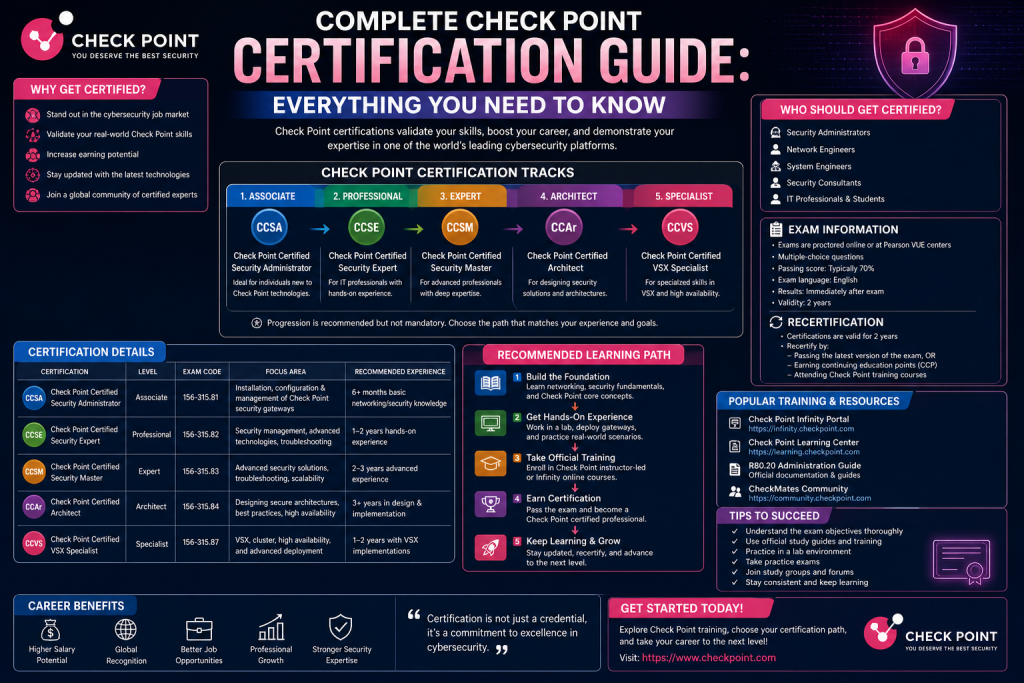
Check Point is widely known in the cybersecurity industry as a leading provider of network security solutions, including firewalls, threat prevention systems, and enterprise security management platforms. Organizations across the world rely on Check Point technologies to protect sensitive data, secure communication channels, and defend against increasingly sophisticated cyber threats.
For IT professionals, Check Point certification serves as a formal validation of their ability to work with these security systems. It demonstrates that a candidate has both theoretical knowledge and practical skills in managing, configuring, and troubleshooting Check Point security environments. In today’s digital world, where cyberattacks are becoming more frequent and complex, certified professionals are in high demand.
These certifications are designed not only to test knowledge but also to ensure that professionals can apply that knowledge in real-world situations. From basic network security concepts to advanced enterprise-level security architecture, the certification path gradually builds expertise step by step.
Importance of Check Point Certification in Cybersecurity Careers
Cybersecurity has become one of the most critical fields in information technology. Every organization, whether small or large, needs strong security systems to protect its data and operations. Check Point technologies are widely used in corporate environments, government institutions, and service providers, making related skills highly valuable.
Earning a Check Point certification can significantly enhance a professional’s career opportunities. It helps individuals stand out in a competitive job market by proving their ability to manage enterprise security solutions effectively. Many employers specifically look for certified professionals when hiring for security-related positions because certification reduces risk and ensures a baseline level of expertise.
Another important advantage of certification is career progression. Professionals who start with entry-level roles in IT support or networking can move into advanced security positions after gaining Check Point credentials. Over time, this can lead to roles such as security engineer, security architect, cybersecurity analyst, or IT security manager.
In addition to job opportunities, certification often leads to better salary packages. Since cybersecurity is a high-demand field, professionals with verified skills are typically compensated at a higher level compared to non-certified individuals.
Overview of the Check Point Certification Path
The Check Point certification path is structured in a progressive manner, allowing professionals to develop their skills step by step. It begins with foundational knowledge and advances toward expert-level mastery of security systems.
At the beginning of the journey, candidates are introduced to basic security administration concepts. This includes understanding how firewalls work, how to configure security policies, and how to manage network traffic.
As professionals move forward, the certification path becomes more complex. Intermediate levels focus on advanced configuration, troubleshooting, VPN management, and security optimization.
At higher levels, candidates are expected to design and manage large-scale enterprise security systems. This includes working with distributed networks, handling complex security incidents, and implementing advanced protection strategies.
At the highest level, professionals demonstrate complete mastery of Check Point technologies. They are capable of designing secure network infrastructures, managing global security policies, and resolving highly complex technical issues.
This structured approach ensures that learners gain both knowledge and experience gradually, making them well-prepared for real-world challenges.
Entry-Level Security Administration Knowledge
The first stage of Check Point certification focuses on foundational security administration skills. This level is designed for individuals who are either new to cybersecurity or have limited experience with Check Point products.
At this stage, candidates learn the basics of network security, including how data flows through networks and how firewalls control traffic. They also gain an understanding of security policies, user access control, and system management.
A key part of this level is learning how to configure and manage security gateways. These gateways act as protection points between internal networks and external threats. Candidates also learn how to monitor network activity and identify potential security risks.
Basic knowledge of operating systems such as Windows and Linux is important because Check Point systems are often deployed in diverse IT environments. Understanding networking fundamentals like IP addressing, TCP/IP protocols, and routing is also essential.
Although this level is considered entry-level, it still requires practical understanding. Candidates are encouraged to gain hands-on experience through labs and practice environments to reinforce their learning.
Developing Intermediate Security Skills
After mastering the basics, professionals move into an intermediate level where the focus shifts toward more complex security operations.
At this stage, candidates learn how to manage advanced security configurations, including firewall rule optimization and VPN setup. VPNs are essential for secure communication between remote locations, and understanding how to configure them is a critical skill.
Another important area is traffic monitoring and analysis. Professionals learn how to interpret network logs, identify unusual behavior, and respond to security incidents. This helps organizations detect threats early and prevent potential damage.
Identity-based security becomes more important at this level. Instead of relying only on IP addresses, security policies can be applied based on user identity. This adds an extra layer of protection and flexibility in enterprise environments.
Candidates also gain experience in troubleshooting system issues. This includes identifying misconfigurations, resolving connectivity problems, and ensuring that security systems are functioning properly.
Overall, this stage prepares professionals for more responsible roles in cybersecurity teams where they are expected to manage and maintain security infrastructure.
Advanced Security Management and Enterprise Protection
At the advanced stage, Check Point certification focuses on enterprise-level security management. Professionals at this level are responsible for protecting large and complex networks that may include multiple sites, cloud systems, and remote users.
One of the main responsibilities is designing secure network architectures. This involves planning how different systems will communicate securely while minimizing vulnerabilities.
Advanced firewall configuration is another key area. Professionals must be able to create complex security rules that balance protection and performance. Poorly configured rules can either block legitimate traffic or leave systems exposed, so precision is essential.
VPN management also becomes more sophisticated at this stage. Candidates learn how to build secure tunnels between multiple locations and ensure that communication remains encrypted and protected.
Security monitoring is another critical skill. Professionals use advanced tools to track network activity, detect anomalies, and respond to potential threats in real time. This requires strong analytical skills and attention to detail.
Troubleshooting becomes more complex at this level. Instead of simple configuration errors, professionals may need to diagnose system-wide issues affecting multiple components of the network.
Expert-Level Enterprise Security Architecture
At the expert level, professionals are expected to have complete control over Check Point security environments. This level represents mastery of both technical and strategic aspects of cybersecurity.
Experts are responsible for designing large-scale security systems that support entire organizations. These systems must be scalable, reliable, and capable of handling high levels of network traffic.
One important area is high availability configuration. This ensures that security systems remain operational even if one component fails. Experts design redundant systems to maintain continuous protection.
Another key responsibility is global policy management. In large organizations, security policies must be applied consistently across multiple locations and departments. Experts ensure that these policies are properly implemented and maintained.
Advanced troubleshooting is also a major part of this role. Experts must be able to quickly identify and resolve complex issues that may affect multiple systems at once.
They also work with advanced debugging tools to analyze system behavior in detail. This helps them identify root causes of problems and implement long-term solutions.
Training and Learning Approach
Preparing for Check Point certification requires a combination of theoretical learning and practical experience. While understanding concepts is important, hands-on practice is essential for success.
Many candidates begin with structured training programs that introduce them to Check Point systems in a controlled environment. These programs help learners understand how different components work together.
After initial training, practice becomes the most important part of preparation. Candidates often use simulated environments to configure firewalls, set up VPNs, and test security policies.
Self-study is also a key part of the learning process. Reading documentation, reviewing case studies, and practicing real-world scenarios help reinforce knowledge.
Consistency is important because cybersecurity is a broad field that requires time and effort to master.
Career Impact of Check Point Certification
Check Point certification can have a significant impact on an individual’s career growth. It opens doors to a wide range of job opportunities in cybersecurity and network security fields.
Certified professionals are often considered for roles such as security administrator, network security engineer, and cybersecurity specialist. As experience increases, they may advance to senior positions such as security architect or IT security manager.
Employers value certification because it demonstrates practical skills and reduces training time. It also shows that the professional is committed to continuous learning in a rapidly changing field.
In addition to job opportunities, certification often leads to higher earning potential. Skilled cybersecurity professionals are in high demand, and organizations are willing to invest in individuals who can protect their digital infrastructure.
Understanding the Mid and Advanced Levels of Check Point Certification
After building a foundation in basic security administration, the Check Point certification journey moves into more advanced stages that focus on real-world enterprise security challenges. These stages are designed for professionals who already understand networking fundamentals and want to specialize in managing complex security infrastructures.
At this level, the focus shifts from basic configuration tasks to deeper responsibilities such as advanced firewall management, secure communication design, VPN architecture, traffic analysis, and system optimization. Professionals are expected to not only configure systems but also understand why certain configurations are used and how they impact overall network security.
The mid and advanced stages are where most IT professionals begin to transition into specialized cybersecurity roles. These roles require a strong understanding of both technical systems and security strategy, making this stage critical for career growth.
Transition from Basic Knowledge to Practical Security Implementation
At the intermediate stage of Check Point certification, professionals start applying their theoretical knowledge in practical environments. This is where concepts such as firewall rules, network segmentation, and traffic filtering become more complex and closely aligned with real-world enterprise systems.
One of the key transitions at this stage is moving from simple security setups to managing multiple interconnected systems. In real organizations, networks are not isolated. They include multiple branches, remote users, cloud systems, and external connections. Managing security across all these environments requires a deeper understanding of architecture and policy design.
Professionals also begin working with more advanced tools for monitoring and analyzing network behavior. This includes reviewing logs, identifying unusual traffic patterns, and responding to potential security threats before they escalate into serious incidents.
This stage helps professionals develop a mindset focused on proactive security rather than reactive troubleshooting.
Advanced Firewall Configuration and Policy Management
Firewall management becomes significantly more complex at the intermediate and advanced levels of Check Point certification. Instead of simply allowing or blocking traffic, professionals must design detailed security policies that align with organizational needs.
In enterprise environments, security policies are not created randomly. They are based on business requirements, compliance standards, and risk assessments. Professionals must ensure that these policies are both secure and efficient, avoiding unnecessary restrictions that could impact business operations.
At this stage, candidates learn how to create layered security rules that work together to provide comprehensive protection. This includes controlling inbound and outbound traffic, managing application-level access, and implementing user-based restrictions.
Policy management also involves continuous updates and optimization. As network environments change, security rules must be adjusted to maintain effectiveness without compromising performance.
VPN Architecture and Secure Communication Systems
Virtual Private Networks play a critical role in modern cybersecurity environments, especially in organizations with remote employees or multiple office locations. Check Point certification places strong emphasis on understanding and configuring VPN systems.
At the intermediate and advanced levels, professionals learn how to design secure VPN tunnels that protect data during transmission. These tunnels ensure that communication between different locations remains encrypted and secure from external threats.
VPN configuration also involves authentication methods, encryption protocols, and key management systems. Professionals must understand how to balance security strength with system performance, ensuring that encrypted communication does not slow down business operations.
In large organizations, VPN systems may connect multiple branches across different regions. Managing these connections requires careful planning to ensure stability, reliability, and security across all communication channels.
Traffic Monitoring and Security Analysis
Another important area of Check Point certification at this stage is network traffic monitoring. Professionals are trained to observe how data moves through the network and identify any unusual or suspicious activity.
Security analysis involves reviewing system logs, identifying patterns, and understanding normal versus abnormal network behavior. This helps in detecting potential security threats such as unauthorized access attempts, malware activity, or data exfiltration.
Professionals also learn how to use monitoring tools to generate reports and alerts. These tools provide real-time visibility into network activity, allowing security teams to respond quickly to incidents.
At this level, the ability to interpret data correctly is just as important as technical configuration skills. Misinterpreting logs or alerts can lead to missed threats or unnecessary actions that affect system performance.
Identity-Based Security and Access Control Systems
Modern security systems are no longer based solely on IP addresses or device locations. Instead, they increasingly rely on identity-based security models.
Check Point certification introduces professionals to identity awareness systems that allow security policies to be applied based on user identity. This means that access to network resources can be controlled based on who the user is, rather than just where they are connecting from.
This approach provides more flexibility and stronger security. For example, employees in different departments may have different levels of access even if they are using the same network.
Implementing identity-based security requires integration with authentication systems such as directories and user management platforms. Professionals must understand how to configure these systems to ensure accurate identification and access control.
Troubleshooting Complex Network Security Issues
As professionals progress through Check Point certification levels, troubleshooting becomes more advanced and complex. Instead of resolving simple configuration errors, they are expected to diagnose issues that may involve multiple systems and layers of security.
Common issues may include connectivity problems, misconfigured policies, VPN failures, or performance degradation. Identifying the root cause of these problems requires strong analytical skills and a deep understanding of how different components interact.
Professionals learn how to use diagnostic tools to trace network traffic, analyze system behavior, and identify misconfigurations. This process often involves testing different scenarios and isolating specific components to locate the issue.
Effective troubleshooting also requires documentation and structured problem-solving approaches. Security professionals must be able to explain issues clearly and provide solutions that prevent recurrence.
Security Optimization and System Performance Management
In enterprise environments, security is not only about protection but also about performance. Systems must be optimized to ensure that security measures do not slow down business operations.
At the advanced level, professionals learn how to balance security policies with system efficiency. This includes optimizing firewall rules, reducing unnecessary processing, and improving traffic flow.
Performance monitoring becomes an important responsibility. Professionals must regularly evaluate system performance and make adjustments to maintain optimal operation.
This stage also involves capacity planning, where professionals assess future network needs and ensure that security systems can scale accordingly.
Real-World Application of Check Point Skills
One of the most important aspects of Check Point certification is its real-world applicability. The skills learned at intermediate and advanced levels are directly used in enterprise environments.
Professionals working in cybersecurity roles use these skills to manage corporate networks, protect sensitive data, and respond to security incidents. They also play a key role in designing secure infrastructures for new systems and technologies.
In many organizations, Check Point certified professionals are part of dedicated security teams responsible for monitoring and maintaining network protection around the clock.
Their work helps prevent cyberattacks, reduce downtime, and ensure compliance with industry security standards.
Role of Hands-On Experience in Skill Development
Hands-on experience is essential for mastering Check Point technologies. While theoretical knowledge provides understanding, practical experience builds confidence and problem-solving ability.
At intermediate and advanced levels, professionals are encouraged to work in simulated environments where they can experiment with different configurations and scenarios.
This practical exposure helps them understand how systems behave under different conditions and prepares them for real-world challenges.
Experience also plays a key role in troubleshooting skills, as many issues cannot be fully understood through theory alone.
Career Growth After Intermediate Certification Levels
Completing intermediate and advanced certification levels opens up several career opportunities in cybersecurity.
Professionals at this stage may work as network security engineers, system administrators, or cybersecurity analysts. These roles involve managing enterprise security systems and ensuring protection against cyber threats.
With additional experience, professionals can move into senior roles such as security architect or IT security consultant. These positions involve designing security strategies and overseeing large-scale security implementations.
Career growth in this field is often continuous, as cybersecurity is an evolving industry with increasing demand for skilled professionals.
Importance of Continuous Learning in Cybersecurity
Cybersecurity is a rapidly changing field. New threats, technologies, and attack methods are constantly emerging. As a result, professionals must engage in continuous learning to stay updated.
Check Point certification itself is updated periodically to reflect changes in technology and security practices. Professionals are expected to keep their skills current by renewing certifications and learning new features.
Continuous learning also involves staying informed about industry trends, new vulnerabilities, and evolving security standards.
This ongoing development ensures that professionals remain effective in protecting modern digital environments.
Intermediate and Advanced Certification Journey
The intermediate and advanced stages of Check Point certification represent a critical phase in a cybersecurity professional’s career. These levels focus on practical application, advanced security management, and real-world problem-solving.
Professionals who complete these stages develop strong technical expertise and are well-prepared for enterprise-level security roles. They gain the ability to manage complex systems, respond to security threats, and optimize network performance.
These skills are highly valuable in today’s digital world, where organizations rely heavily on secure and reliable network infrastructure.
Introduction to Expert-Level Check Point Certification
The final stage of Check Point certification represents the highest level of expertise in cybersecurity using Check Point technologies. At this point in the certification journey, professionals are no longer focused on basic or intermediate configuration tasks. Instead, they are expected to design, manage, and troubleshoot large-scale enterprise security infrastructures.
This level is intended for highly experienced IT professionals who already have strong hands-on knowledge of network security, firewall management, VPN systems, and enterprise-level infrastructure design. The goal at this stage is mastery, not just familiarity.
Professionals at this level are responsible for ensuring that entire organizational networks remain secure, stable, and efficient under all conditions. This includes handling complex security architectures, global policy enforcement, high availability systems, and advanced troubleshooting scenarios.
Enterprise Security Architecture and System Design
At the expert level, one of the most important responsibilities is designing secure enterprise architectures. These architectures are the foundation of an organization’s cybersecurity strategy.
Security professionals must consider how different systems communicate, how data flows between internal and external networks, and how to protect sensitive information at every stage. This requires a deep understanding of both technical systems and business requirements.
Enterprise security design is not limited to a single network. It often involves multiple locations, cloud environments, remote users, and third-party integrations. Each of these components must be secured without disrupting business operations.
Professionals must also ensure scalability in their designs. As organizations grow, their networks expand, and security systems must be able to handle increased traffic and complexity without performance issues.
A well-designed security architecture reduces risks, improves efficiency, and ensures long-term stability.
Advanced Multi-Domain Security Management
Large organizations often operate multiple departments, business units, or even subsidiaries, each with its own security requirements. Managing all of these under a single system requires multi-domain security management.
At this level, professionals learn how to manage multiple security domains from a centralized platform. Each domain can have its own policies, administrators, and configurations while still being controlled under a unified system.
This approach improves organization, reduces complexity, and enhances security visibility across the entire enterprise.
Professionals must ensure that policies remain consistent where necessary while allowing flexibility for different business units. Mismanagement at this level can lead to security gaps or policy conflicts.
Multi-domain management also requires strong coordination and documentation skills, as changes in one domain can impact others.
High Availability and Disaster Recovery Systems
At the expert level, ensuring continuous system availability is a critical responsibility. Organizations cannot afford downtime in their security systems, as even short interruptions can lead to serious risks.
High availability systems are designed to ensure that if one component fails, another immediately takes over without disrupting operations. Professionals must configure and manage these redundant systems carefully.
This includes synchronizing configurations, monitoring system health, and testing failover mechanisms regularly.
Disaster recovery planning is also an important part of this stage. Professionals must prepare for worst-case scenarios such as system failures, cyberattacks, or hardware damage.
A strong disaster recovery plan ensures that systems can be restored quickly with minimal data loss and downtime.
These processes require careful planning, regular testing, and continuous improvement.
Global Policy Implementation and Enforcement
In large enterprise environments, security policies must often be applied across multiple locations and systems. This is known as global policy implementation.
At the expert level, professionals are responsible for creating and managing policies that apply consistently across the entire organization.
These policies may include access control rules, traffic filtering guidelines, encryption standards, and compliance requirements.
The challenge lies in ensuring that global policies do not interfere with local requirements. Different departments or regions may have specific needs that must be balanced with overall security standards.
Professionals must carefully design policy hierarchies that allow global control while maintaining local flexibility.
Proper enforcement ensures that security rules are applied consistently, reducing the risk of vulnerabilities caused by misconfigurations.
Advanced Traffic Inspection and Threat Detection
At this level, security professionals deal with highly advanced threat detection systems. These systems analyze network traffic in real time to identify potential security risks. They are designed to process massive volumes of data flowing through enterprise networks and detect patterns that may indicate malicious activity, unauthorized access, or data exfiltration attempts.
Modern threat detection tools use multiple layers of analysis, including behavioral analysis, signature-based detection, and anomaly detection. Behavioral analysis focuses on understanding normal network activity and identifying deviations from expected patterns. For example, if a user account suddenly begins accessing unusual systems or transferring large amounts of data, the system may flag it as suspicious.
In addition to behavioral methods, signature-based detection compares network traffic against known threat signatures. This helps identify previously documented attacks such as malware, ransomware, and exploit attempts. Anomaly detection adds another layer by using statistical models to highlight unusual activity that does not match normal network behavior.
Security professionals must also interpret alerts generated by these systems. Not every alert represents a real threat, so experts need strong analytical skills to separate genuine risks from false positives. This requires experience, attention to detail, and a deep understanding of network behavior.
These systems are often integrated with centralized security platforms, allowing professionals to correlate data from multiple sources. This provides a complete view of the network environment and helps in identifying complex, multi-stage attacks that might otherwise go unnoticed.
Overall, advanced threat detection systems significantly improve an organization’s ability to respond quickly and effectively to cyber threats in real time.
Traffic inspection involves examining data packets, identifying suspicious patterns, and detecting anomalies that may indicate cyberattacks.
Professionals must understand how different types of attacks work, including malware, intrusion attempts, and data breaches.
Advanced inspection tools allow deep analysis of network behavior, enabling security teams to detect threats that traditional methods might miss.
This process requires both technical expertise and analytical thinking. Professionals must be able to distinguish between normal and abnormal behavior accurately.
False positives and false negatives must be carefully managed to ensure that security systems remain effective without causing unnecessary disruptions.
Advanced VPN and Secure Communication Infrastructure
At the expert level, VPN systems become significantly more complex. They are no longer limited to simple point-to-point connections but instead support large-scale enterprise communication networks.
Professionals are responsible for designing VPN infrastructures that connect multiple branches, remote users, and cloud environments securely.
This includes configuring advanced encryption protocols, managing authentication systems, and ensuring stable connections across all endpoints.
In addition, professionals must optimize VPN performance to ensure that secure communication does not negatively impact network speed.
Large organizations often rely heavily on VPN systems for daily operations, making their reliability critical.
Any misconfiguration at this level can result in major security vulnerabilities or connectivity issues.
Advanced Troubleshooting and Deep System Analysis
Troubleshooting at the expert level is one of the most challenging aspects of Check Point certification. Issues at this stage are rarely simple and often involve multiple interconnected systems.
Professionals must use advanced diagnostic tools to analyze system logs, trace network traffic, and identify root causes of complex problems.
These issues may involve firewall misconfigurations, routing conflicts, VPN failures, or performance bottlenecks.
Deep system analysis requires a structured approach. Professionals must break down problems into smaller components and test each one individually.
They must also understand how changes in one part of the system can affect others.
This level of troubleshooting requires patience, experience, and strong analytical skills.
Performance Optimization in Enterprise Security Systems
In addition to security, system performance is a key concern at the expert level. Security systems must be optimized to handle large volumes of traffic without slowing down operations.
Professionals are responsible for fine-tuning firewall rules, optimizing routing paths, and reducing unnecessary processing overhead.
Performance monitoring tools are used to track system efficiency and identify areas for improvement.
Capacity planning is also important, as organizations must prepare their systems for future growth.
Balancing security and performance is a critical skill at this stage. Overly strict security policies can slow down systems, while weak policies can expose vulnerabilities.
Role of Automation in Modern Security Management
Automation plays an increasingly important role in enterprise security environments. At the expert level, professionals are expected to understand and implement automated security processes. This includes using automation to reduce manual workload, improve response time, and ensure consistent enforcement of security policies across large and complex infrastructures.
In modern cybersecurity environments, threats can appear within seconds, and manual response is often too slow to prevent damage. Automation helps address this challenge by enabling systems to react instantly to predefined conditions. For example, if suspicious traffic is detected, automated systems can block the source, isolate affected segments, or trigger alerts without waiting for human intervention.
Professionals at this level must also understand how to design automation workflows that align with organizational security policies. This requires careful planning because poorly designed automation can create false positives or unintentionally disrupt legitimate business operations. Therefore, security experts must balance speed with accuracy when implementing automated responses.
Another important aspect of automation is policy management. In large enterprises, security rules often need to be applied across multiple systems and locations. Automation ensures that updates are consistent, reducing the risk of human error and configuration mismatches. This improves overall system reliability and strengthens security posture.
Automation also extends to monitoring and reporting. Automated tools can continuously analyze network activity, generate security reports, and highlight anomalies for further investigation. This allows security teams to focus on complex decision-making rather than repetitive monitoring tasks.
In addition, integration with threat intelligence systems enhances automation capabilities. When new threats are identified globally, automated systems can update defenses quickly, ensuring protection against emerging attack patterns.
Ultimately, automation is not a replacement for security professionals but a powerful enhancement. It allows expert-level professionals to manage larger environments more efficiently while maintaining a strong and proactive security posture.
Automation helps reduce manual workload, improve consistency, and respond faster to security incidents.
Examples include automated threat detection, policy updates, and incident response systems.
However, automation must be carefully configured to avoid errors or unintended consequences.
Professionals must ensure that automated systems are properly monitored and controlled.
Career Opportunities at Expert Level
Reaching the expert level of Check Point certification opens up senior career opportunities in cybersecurity and IT management.
Professionals at this stage may work as security architects, senior security engineers, cybersecurity consultants, or IT directors.
These roles involve strategic decision-making, system design, and oversight of entire security infrastructures.
Expert-level professionals are often responsible for guiding security teams, designing enterprise architectures, and ensuring compliance with industry standards.
They also play a key role in shaping organizational security strategies.
Career growth at this stage is typically stable and high-value, as expertise in enterprise security is in constant demand.
Industry Relevance of Check Point Expertise
Check Point technologies are widely used across industries such as finance, healthcare, government, telecommunications, and large enterprises.
Expert-level professionals are essential in these environments because they ensure that critical systems remain secure and operational.
Their skills are directly applied to protecting sensitive data, maintaining regulatory compliance, and preventing cyber threats.
As cyberattacks continue to evolve, the demand for highly skilled security professionals continues to increase.
This makes Check Point expertise highly relevant in today’s digital economy.
Continuous Learning and Certification Maintenance
Even at the expert level, learning does not stop. Cybersecurity is a constantly evolving field, and new threats emerge regularly. Attackers continuously develop more advanced techniques, including sophisticated malware, zero-day exploits, and social engineering attacks that can bypass traditional security controls. Because of this, professionals must stay updated with the latest security trends, vulnerabilities, and defense strategies.
Security technologies also evolve at a rapid pace. Vendors frequently release updates, new features, and architectural improvements to strengthen protection and improve system performance. A Check Point certified professional must continuously learn how these updates affect existing security deployments and how to integrate them effectively into enterprise environments.
In addition to technology changes, organizational needs also shift over time. Businesses adopt cloud services, remote work models, and hybrid infrastructures, all of which introduce new security challenges. Professionals must understand how to extend traditional on-premise security models into these modern environments while maintaining consistent protection.
Continuous learning also involves staying engaged with real-world security incidents. Analyzing past cyberattacks helps professionals understand how breaches occur and how similar threats can be prevented in the future. This practical awareness is essential for strengthening decision-making skills in real environments.
Ultimately, ongoing learning ensures that expert-level professionals remain effective, adaptable, and capable of defending against both current and future cybersecurity threats.
Check Point certification requires periodic renewal to ensure that professionals stay updated with the latest technologies and security practices.
Continuous learning involves staying informed about new vulnerabilities, system updates, and emerging attack techniques.
Professionals must also adapt to new tools and technologies as they are introduced into enterprise environments.
This ongoing development ensures that their skills remain relevant and effective.
Conclusion
Check Point certification represents a complete career pathway in cybersecurity, starting from foundational knowledge and progressing all the way to expert-level mastery.
At the expert level, professionals are responsible for designing, managing, and securing complex enterprise environments. They handle advanced security architectures, global policies, high availability systems, and deep troubleshooting tasks.
This certification path not only builds technical skills but also develops strategic thinking and problem-solving abilities that are essential in modern cybersecurity roles.
In today’s digital world, where cyber threats are constantly increasing, skilled professionals who understand enterprise security systems play a critical role in protecting organizations.
Check Point certification therefore remains one of the most valuable pathways for anyone aiming to build a strong and long-term career in cybersecurity.
Continue exploring the technologies and certification concepts that matter most to you.