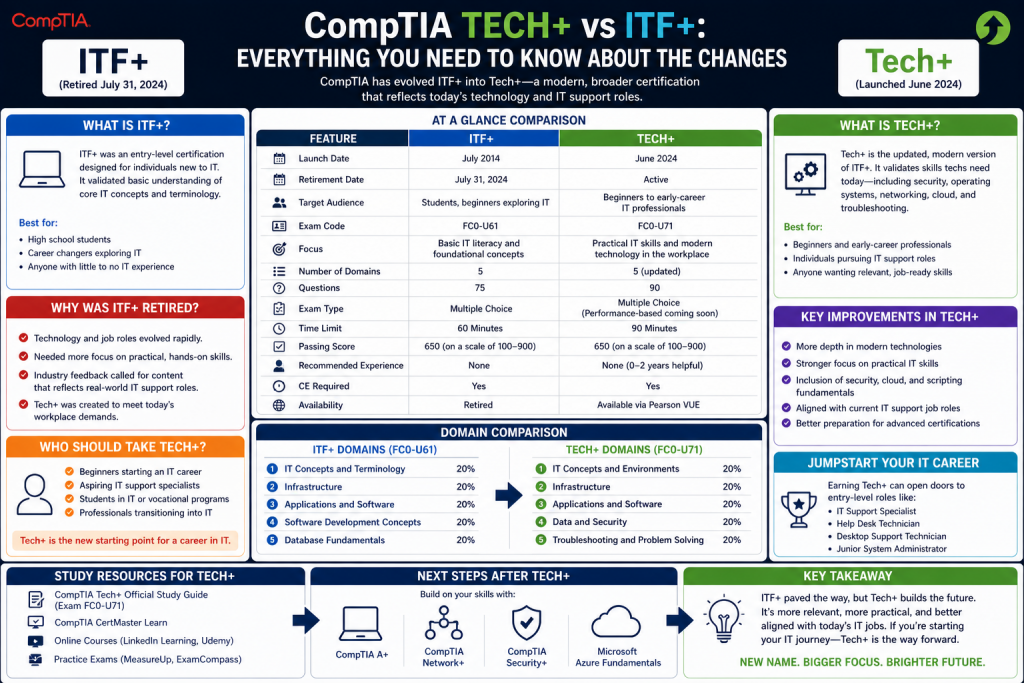
CompTIA Tech+ was introduced as a modern replacement for the older CompTIA IT Fundamentals (ITF+) certification. This change was not made simply to refresh branding, but to reflect the real transformation happening in the technology industry. Over the past decade, the role of technology in everyday life and business has expanded dramatically. Almost every job role today, whether technical or non-technical, involves some interaction with digital systems, cloud platforms, data tools, or networked devices.
The ITF+ certification served its purpose for many years as an entry-level introduction to information technology. It helped absolute beginners understand what IT is, how computers function, and what basic concepts like software, hardware, and networking mean. However, the IT landscape has evolved beyond these basics. Employers now expect even entry-level candidates to have practical awareness of modern technologies such as cloud computing, cybersecurity risks, and basic troubleshooting skills.
This shift in expectations is the primary reason CompTIA developed Tech+. It is designed not only to explain what technology is but also to show how it is used in real environments. It bridges the gap between theoretical knowledge and practical understanding, making it more relevant for today’s digital workplaces.
Evolution from ITF+ to Tech+: A Response to Modern Technology Needs
The transition from ITF+ to Tech+ reflects a broader change in how technology is used across industries. ITF+ was originally created for people who had very little or no exposure to IT. It focused on the absolute fundamentals, such as identifying hardware components, understanding basic software types, and recognizing simple networking concepts.
At the time of its creation, this approach made sense because many learners were completely new to computing. However, the modern workplace has changed significantly. Today, even entry-level employees are expected to use cloud-based tools, collaborate through digital platforms, and manage data securely.
Tech+ was designed in response to this shift. Instead of stopping at basic definitions, it introduces learners to how technology functions in real-world environments. It includes exposure to cloud services, cybersecurity awareness, basic coding concepts, and system configuration tasks. This makes it more aligned with what employers actually expect from candidates entering the IT field.
Another important evolution is the integration of emerging technologies into the curriculum. Concepts like artificial intelligence and the Internet of Things are no longer advanced topics reserved for specialists. They are now part of everyday systems used in businesses, homes, and industries. Tech+ introduces these ideas at a foundational level so learners can understand how modern systems operate.
The Changing Role of Entry-Level IT Knowledge
In the past, entry-level IT certifications were primarily focused on awareness. The goal was to ensure that candidates understood basic terminology and could identify common components of a computer system. However, this level of knowledge is no longer sufficient in most workplaces.
Today, even non-technical roles require a degree of technical competence. Administrative staff use cloud storage systems, retail workers interact with digital point-of-sale systems, and healthcare professionals rely on electronic record systems. As a result, the boundary between technical and non-technical roles has become blurred. Employees are now expected to navigate multiple software tools, manage digital communication platforms, and quickly adapt to new updates in workplace systems without needing constant technical support. This shift has made digital literacy a core workplace skill rather than an optional advantage.
In many organizations, routine tasks that were once handled manually are now fully automated or digitized. For example, scheduling meetings, managing customer data, tracking inventory, and generating reports are all done through specialized software. This means that workers must not only know how to use these tools but also understand how they interact with other systems. Even small errors, such as incorrect data entry or improper file handling, can affect entire workflows.
Additionally, remote and hybrid work models have increased dependence on cloud-based platforms and collaboration tools. Employees are expected to troubleshoot basic issues on their own, such as login problems, connectivity issues, or file-sharing errors. This growing responsibility highlights the importance of foundational IT knowledge across all job roles, not just within traditional IT departments.
Tech+ addresses this reality by focusing on applied knowledge. Instead of simply asking what a network is, it explores how networks are used in real environments. Instead of only defining cybersecurity, it introduces practical security awareness, such as recognizing phishing attempts or understanding password protection.
This shift is important because it prepares learners for real situations rather than abstract concepts. It helps them develop problem-solving skills that can be applied immediately in a workplace setting. For example, understanding how to restart a network connection, update software, or identify a system error becomes more valuable than memorizing definitions.
Why Practical Skills Matter More Than Ever
One of the most significant changes in Tech+ compared to ITF+ is the emphasis on practical understanding. In modern IT environments, theoretical knowledge alone is not enough. Employers want individuals who can actively engage with systems, identify issues, and perform basic troubleshooting tasks.
This is especially important in support and entry-level IT roles. Many professionals begin their careers in help desk positions, where they are responsible for resolving common technical issues. These issues often involve software errors, connectivity problems, or user configuration mistakes. Without practical knowledge, it becomes difficult to handle these situations efficiently.
Tech+ introduces learners to these types of scenarios at a foundational level. It encourages them to think about how systems work together rather than viewing them as separate concepts. For example, instead of only learning about operating systems in isolation, learners also understand how operating systems interact with hardware, networks, and applications.
This integrated approach makes the learning experience more realistic and useful. It also builds confidence, which is essential for individuals entering the IT field for the first time.
Broader Scope of Modern IT Concepts in Tech+
Another major difference between ITF+ and Tech+ is the expanded scope of topics. ITF+ primarily focuses on basic IT literacy, while Tech+ includes a wider range of modern technologies that are relevant in today’s workplaces.
One of the key areas added is cloud computing. Cloud services are now central to how businesses store data, run applications, and manage operations. Understanding how cloud systems work is essential even for entry-level employees.
Cybersecurity is another major focus area. With increasing digital threats, organizations expect employees to have basic security awareness. This includes understanding how to protect data, recognize suspicious activity, and follow safe computing practices. Employees are now considered the first line of defense in many security systems, since a large number of cyber incidents occur due to human error rather than technical failure. Simple actions like clicking on phishing emails, using weak passwords, or downloading unverified files can expose entire systems to risk.
Because of this, organizations emphasize regular security training and awareness programs. Workers are taught how to identify suspicious links, avoid social engineering attacks, and report unusual system behavior immediately. Even small precautions, such as locking devices when not in use or using multi-factor authentication, play an important role in maintaining security.
Cybersecurity awareness also extends to data handling practices. Employees must understand how sensitive information should be stored, shared, and accessed. In many industries, data protection regulations require strict compliance, meaning that even accidental mistakes can lead to serious consequences.
As cyber threats continue to evolve, the importance of basic security knowledge is only increasing. Every employee, regardless of role, is expected to contribute to maintaining a secure digital environment.
In addition to individual responsibility, organizations are also implementing stricter security policies and automated monitoring systems. However, technology alone is not enough to ensure complete protection. Human awareness remains a critical factor in preventing breaches. Many companies now simulate phishing attacks or conduct regular security drills to test employee readiness. This helps reinforce safe behavior and reduces the likelihood of real-world incidents.
Furthermore, remote work has increased exposure to security risks because employees often access company systems from personal devices and unsecured networks. This makes it even more important to follow best practices such as using secure Wi-Fi connections, keeping software updated, and avoiding sharing login credentials.
Tech+ also introduces basic programming concepts. While it does not aim to make learners professional developers, it helps them understand how software is created and how logic is used in coding. This foundational knowledge is useful in many IT roles where automation and scripting are becoming more common.
Additionally, data management is included as a key topic. In modern organizations, data plays a central role in decision-making. Understanding how data is stored, organized, and retrieved helps learners appreciate how information systems support business operations.
Emerging technologies such as artificial intelligence and the Internet of Things are also introduced at a basic level. These technologies are increasingly integrated into everyday tools and systems, so having awareness of them helps learners stay current with industry trends.
How Tech+ Reflects Real Workplace Environments
One of the most important improvements in Tech+ is its alignment with real workplace scenarios. ITF+ was more academic in nature, focusing on theoretical understanding. Tech+ shifts toward practical application, which makes it more useful for professional environments.
In real workplaces, IT issues are rarely isolated. A single problem may involve hardware, software, network connectivity, and user configuration all at once. Tech+ prepares learners to think in this interconnected way. Instead of focusing on only one possible cause, learners are trained to evaluate multiple layers of a system and understand how each component can influence the overall performance. This approach is essential because modern IT environments are complex and highly dependent on integration between different technologies.
For example, a slow computer issue might not be caused by hardware failure alone. It could be related to background software processes, insufficient network bandwidth, outdated drivers, or even misconfigured system settings. Similarly, a network connectivity problem might stem from router issues, incorrect IP configuration, firewall restrictions, or service outages. Understanding these relationships helps individuals avoid random guessing and instead follow a structured troubleshooting process.
Tech+ encourages logical thinking and step-by-step analysis, which is a critical skill in IT support roles. It teaches learners to gather information, identify patterns, test possible causes, and apply solutions systematically. This reduces downtime and improves efficiency in resolving technical problems. Over time, this mindset also helps professionals become more confident in handling unexpected issues in dynamic workplace environments.
For example, when a device fails to connect to a network, the issue could be related to hardware settings, software configuration, or network infrastructure. Understanding how these elements interact is essential for effective troubleshooting.
Similarly, cybersecurity is not just about knowing definitions. It involves recognizing real threats, such as phishing emails or unauthorized access attempts. Tech+ introduces learners to these situations so they can respond appropriately in real environments.
This practical orientation makes Tech+ more relevant for modern workplaces, where technology is deeply integrated into daily operations.
The Broader Impact of Tech+ on Career Readiness
Tech+ is not only about learning technical skills. It also plays a role in improving overall career readiness. In today’s job market, digital literacy is a fundamental requirement across almost all industries.
By completing Tech+, learners gain confidence in using technology effectively. This confidence translates into better performance in job roles that involve digital tools and systems. It also provides a foundation for further learning in more advanced IT certifications.
For individuals considering a career in IT, Tech+ serves as an entry point. It helps them decide whether they want to pursue more advanced paths such as networking, cybersecurity, or cloud computing. For others, it simply provides the technical awareness needed to perform better in their current roles.
Why the Shift to Tech+ Matters
The introduction of CompTIA Tech+ represents a significant shift in how entry-level IT knowledge is defined. It moves beyond basic awareness and focuses on practical, real-world understanding of modern technologies.
As industries continue to evolve, the demand for digital skills will only increase. Tech+ reflects this reality by preparing learners not just to understand technology, but to use it effectively in professional environments.
This makes it a more relevant and future-focused certification compared to ITF+.
Understanding the Core Purpose of CompTIA Tech+
CompTIA Tech+ was created to bridge a growing gap between basic computer literacy and real-world technical readiness. While earlier certifications like ITF+ were designed mainly to introduce learners to the world of IT, Tech+ goes a step further by preparing individuals for actual workplace scenarios where technology is actively used every day.
The core purpose of Tech+ is not just to teach definitions or explain concepts, but to help learners understand how technology functions in practical environments. This includes learning how devices are set up, how networks operate, how software interacts with systems, and how basic troubleshooting is performed when issues arise.
In modern organizations, even entry-level employees are expected to interact with digital systems regularly. Whether it is accessing cloud applications, handling customer data, or using internal communication tools, technology is deeply embedded in daily tasks. Tech+ recognizes this reality and aims to build confidence in handling these systems effectively.
Another important goal of Tech+ is to create a foundation for further IT learning. It is not intended to be the final step in a career path but rather the starting point. It prepares learners for more advanced certifications and specialized roles in areas such as networking, cybersecurity, cloud computing, and systems administration.
How Tech+ Expands on ITF+ Knowledge Areas
One of the most noticeable differences between ITF+ and Tech+ is the expansion of subject areas. ITF+ focused mainly on introducing basic IT concepts such as understanding what a computer is, identifying hardware components, and learning simple software functions. While this was useful for beginners, it was limited in scope.
Tech+ builds on this foundation by introducing a broader and more modern set of topics. These topics reflect how technology is used in real-world environments today.
For example, networking is no longer just about understanding what a network is. Tech+ includes practical understanding of how devices connect, how data moves between systems, and how connectivity issues can be identified and resolved. This makes the learning process more aligned with actual IT support roles.
Cloud computing is another major addition. In today’s digital world, most businesses rely on cloud-based systems for storage, communication, and application hosting. Tech+ introduces learners to the basic structure of cloud environments and how they are used in organizations. This is an essential skill area because cloud technology is now a standard part of almost every industry.
Cybersecurity is also significantly expanded in Tech+. Instead of just defining security concepts, learners are introduced to real-world threats and protection strategies. This includes understanding how to recognize suspicious activity, protect sensitive information, and follow safe computing practices. These skills are critical in a time where cyber threats are becoming more frequent and more advanced.
Software development concepts are also included in Tech+. While it does not focus on turning learners into programmers, it introduces basic logic, coding structure, and how software is created. This helps learners understand the foundation behind the applications they use every day.
Data and database fundamentals are another important area. Tech+ introduces how data is stored, organized, and retrieved in modern systems. Since data plays a central role in decision-making across industries, understanding how it works is increasingly valuable.
Finally, emerging technologies such as artificial intelligence and the Internet of Things are introduced at a basic level. These technologies are shaping the future of IT, and having early exposure helps learners stay updated with industry trends.
Shift from Theoretical Learning to Practical Application
One of the biggest improvements in Tech+ compared to ITF+ is the shift from theory-based learning to practical application. ITF+ was largely focused on helping learners understand what different IT terms mean. While this is useful for beginners, it does not fully prepare individuals for real-world tasks.
Tech+ changes this approach by focusing on how technology is used in everyday situations. Instead of only learning definitions, learners are encouraged to understand processes and interactions between systems.
For example, instead of simply knowing what an operating system is, learners are taught how operating systems manage hardware resources, run applications, and interact with users. This deeper understanding is essential for troubleshooting and system management.
Similarly, networking is not just about learning terminology. Learners are exposed to how devices communicate within a network, how internet connectivity works, and what steps can be taken when network issues occur.
This practical approach makes Tech+ more valuable for individuals who are entering IT support roles or working in environments where they need to solve technical problems regularly. It helps them develop a problem-solving mindset rather than just memorizing information.
The Importance of Modern IT Skills in the Workplace
In today’s workplace, technology is no longer limited to IT departments. Almost every job role involves some level of interaction with digital systems. This includes communication tools, cloud storage platforms, customer management systems, and internal software applications.
Because of this widespread use of technology, employers expect even entry-level employees to have basic technical competence. They do not expect them to be experts, but they do expect them to understand how systems work and how to handle basic issues.
Tech+ is designed to meet this expectation. It helps learners become comfortable with technology in a way that is directly applicable to real work environments.
For example, understanding how to set up a device, connect to a network, or update software is no longer considered advanced knowledge. These are basic skills that employees are expected to perform independently in many workplaces.
Tech+ also helps learners develop awareness of security practices. In modern organizations, data protection is extremely important. Employees are expected to follow safe practices such as using strong passwords, recognizing phishing attempts, and handling sensitive information responsibly.
By introducing these skills early, Tech+ helps create a more security-conscious workforce.
Real-World Relevance of Tech+ Training
Another key advantage of Tech+ is its strong connection to real-world IT environments. The certification is designed to reflect actual situations that employees may encounter in their jobs.
For example, technical support roles often require individuals to diagnose and resolve issues quickly. These issues may involve software errors, hardware malfunctions, or network connectivity problems. Tech+ prepares learners to think through these problems logically and identify possible solutions.
In many cases, IT problems are not caused by a single issue but by a combination of factors. A device may fail due to software conflicts, outdated drivers, or network restrictions. Understanding how these elements interact is essential for effective troubleshooting.
Tech+ encourages learners to develop this type of analytical thinking. Instead of focusing on isolated concepts, it teaches them to view technology as an interconnected system.
This is particularly important in modern IT environments where systems are increasingly complex. Cloud platforms, mobile devices, and networked applications all work together, and understanding these relationships is key to managing them effectively.
Preparing for Entry-Level IT Roles with Tech+
Tech+ is designed to support individuals who are preparing for entry-level IT roles. These roles often include help desk support, technical assistance, desktop support, and junior system administration.
In these positions, employees are expected to handle a wide range of basic technical tasks. This may include setting up user accounts, installing software, troubleshooting devices, and assisting users with technical issues.
Tech+ provides the foundational knowledge needed to perform these tasks effectively. It helps learners understand how systems are configured, how issues are identified, and how solutions are implemented.
It also builds confidence, which is an important factor for individuals entering the IT field for the first time. Many beginners feel overwhelmed when dealing with technical systems. Tech+ helps reduce this uncertainty by providing structured knowledge and practical understanding.
Growing Importance of Digital Literacy Across Industries
One of the most important reasons for the development of Tech+ is the increasing importance of digital literacy across all industries. Today, technology is not limited to IT professionals. It is used in healthcare, finance, education, manufacturing, retail, and many other sectors.
In each of these industries, employees are required to use digital tools to perform their jobs. This includes managing data, using communication platforms, and interacting with software systems.
Tech+ helps individuals build the digital literacy needed to succeed in these environments. It ensures that they are not only users of technology but also understand how it works at a basic level.
This understanding improves efficiency, reduces dependency on technical support, and enhances overall job performance.
Why Tech+ Represents a Modern Approach to IT Learning
CompTIA Tech+ represents a modern shift in how entry-level IT knowledge is defined and taught. It moves beyond basic awareness and focuses on practical, real-world skills that are relevant in today’s digital workplaces.
By expanding its scope, emphasizing practical application, and aligning with real industry needs, Tech+ provides a stronger foundation for individuals entering the IT field or working in technology-driven environments.
It is not just a replacement for ITF+, but a significant upgrade that reflects the realities of modern technology use.
Who Should Choose CompTIA Tech+ in 2026 and Beyond
CompTIA Tech+ is designed for a wide range of learners, but it is especially useful for individuals who are either entering the IT field or working in roles where technology is an essential part of daily tasks. Unlike highly advanced certifications that target experienced professionals, Tech+ focuses on building foundational yet practical skills that can be applied immediately in real environments.
One of the primary groups who benefit from Tech+ are complete beginners who are exploring IT as a possible career path. Many people are interested in technology but are unsure whether they want to commit to a technical profession. Tech+ provides a structured way to explore the field without overwhelming complexity. It allows learners to understand core IT concepts while also experiencing how those concepts apply in real-world scenarios.
Another important group includes students who are preparing for future careers. For them, Tech+ acts as a bridge between academic learning and industry expectations. It helps them move from theoretical understanding to practical application, which is often required in internships and entry-level jobs.
Tech+ is also valuable for professionals in non-IT roles. In today’s workplace, many jobs require interaction with digital systems, whether in administration, customer service, retail, finance, or healthcare. Employees in these roles often use cloud platforms, communication tools, and data systems. Tech+ helps them understand how these systems work, making their daily tasks easier and more efficient.
Finally, Tech+ is useful for early-career IT workers who may already have some exposure to technology but lack formal training. It helps them fill gaps in knowledge and strengthens their understanding of core IT principles, making them more effective in support or technician roles.
Career Opportunities After CompTIA Tech+
While Tech+ is an entry-level certification, it still opens the door to several important job roles in the IT industry. These roles are often the starting point for long-term careers in technology.
One of the most common roles is help desk support. In this position, individuals assist users with basic technical issues such as login problems, software errors, and device troubleshooting. Tech+ provides the foundational knowledge needed to understand these issues and respond effectively.
Another possible role is desktop support technician. This job involves maintaining and supporting computer systems within an organization. Tasks may include installing software, configuring devices, and resolving hardware or software problems. Tech+ helps prepare learners for these responsibilities by teaching them how systems function and how to identify common issues.
Tech+ can also support roles such as data support technician or junior network assistant. These positions involve working with data systems or assisting with basic network configuration and maintenance. The certification introduces learners to data management and networking fundamentals, which are essential in these roles.
In some cases, Tech+ can also be useful for administrative or business support roles where technology plays a major part. Even if the job is not strictly IT-focused, understanding how systems work can improve performance and efficiency.
Although Tech+ alone may not guarantee high-level IT positions, it serves as a strong foundation for further certifications such as CompTIA A+, Network+, or Security+. These advanced certifications can lead to more specialized and higher-paying roles in the IT industry.
Understanding the CompTIA Tech+ Exam Structure
The CompTIA Tech+ certification exam is designed to test both theoretical understanding and practical knowledge of IT concepts. It evaluates whether learners can apply basic IT skills in real-world situations rather than simply memorizing definitions.
The exam consists of multiple-choice questions that cover a wide range of topics. It is designed to be completed within a limited time frame, requiring candidates to manage their time effectively while answering questions accurately.
The content of the exam is divided into several key areas. These areas reflect the core skills that entry-level IT professionals are expected to understand.
One major area focuses on IT concepts and terminology. This section evaluates whether learners understand the basic language of IT, including common terms and foundational ideas.
Another area focuses on infrastructure. This includes understanding how devices, networks, and systems are set up and maintained. It is an important part of the exam because it reflects real-world IT environments.
Applications and software form another section. This area tests knowledge of how software operates, how applications are used, and how operating systems function.
Software development concepts are also included at a basic level. This does not require advanced programming skills but focuses on understanding how software is created and how logic is used in coding.
Data and database fundamentals are another key component. This section evaluates understanding of how data is stored, organized, and managed in digital systems.
Finally, security is a major focus area. This section assesses knowledge of cybersecurity principles, including how to protect systems, recognize threats, and maintain safe computing practices.
Overall, the exam is designed to ensure that candidates have a well-rounded understanding of essential IT concepts and can apply them in practical situations.
Best Strategies for Preparing for CompTIA Tech+
Preparing for the CompTIA Tech+ exam requires a structured and consistent approach. Since the certification covers a wide range of topics, learners need to focus on both understanding concepts and practicing real-world scenarios.
One of the most important steps in preparation is creating a study plan. A well-organized plan helps learners cover all topics systematically without missing important areas. It also ensures that enough time is dedicated to revision and practice.
Understanding the material is another key part of preparation. Instead of memorizing information, learners should focus on understanding how systems work and how different IT components interact. This deeper understanding makes it easier to answer scenario-based questions in the exam.
Hands-on practice is also extremely important. Since Tech+ includes practical concepts, learners benefit from interacting with real or simulated systems. This could include setting up devices, exploring operating systems, or practicing basic troubleshooting.
Practice exams are another useful tool. They help learners become familiar with the exam format and identify areas where they need improvement. Regular practice also improves time management skills, which are important during the actual exam.
Revision should be done consistently rather than left until the end. Reviewing key concepts regularly helps reinforce learning and improves long-term retention of information.
Finally, learners should focus on real-world understanding. Instead of treating the exam as a purely academic exercise, they should think about how the knowledge applies in workplace environments. This approach not only helps in passing the exam but also in building long-term IT skills.
Comparison of Tech+ with Other Entry-Level Certifications
When comparing Tech+ with other entry-level certifications, it becomes clear that Tech+ is positioned as a modern, practical foundation for IT learning.
Compared to ITF+, Tech+ is more advanced in terms of scope and relevance. ITF+ focuses mainly on basic IT awareness, while Tech+ introduces practical skills and modern technologies. This makes Tech+ more suitable for today’s job market.
Compared to CompTIA A+, Tech+ is less advanced and serves as a stepping stone. A+ is widely recognized in the industry and focuses on technical support and troubleshooting at a deeper level. Tech+ prepares learners for A+ by building foundational knowledge.
Compared to other beginner-level learning paths, Tech+ stands out because it includes emerging technologies such as cloud computing and artificial intelligence. Many introductory certifications do not cover these areas, making Tech+ more future-oriented.
Overall, Tech+ sits in the early stage of the IT certification path but provides a more modern and practical foundation than older certifications.
Value of CompTIA Tech+ in the Modern Job Market
The value of Tech+ lies in its relevance to today’s digital environment. As technology becomes more integrated into every industry, employers increasingly look for candidates who understand how systems work.
Even in non-technical roles, digital literacy is essential. Employees are expected to use software tools, manage data, and communicate through digital platforms. Tech+ helps individuals develop these skills in a structured way.
In IT roles, Tech+ provides a strong starting point. It helps learners build confidence and prepares them for more advanced certifications and job responsibilities.
While it may not be the highest-level certification, its value lies in accessibility and relevance. It is designed for individuals who are beginning their journey in IT or improving their digital skills for professional use.
Conclusion
CompTIA Tech+ represents a modern evolution of entry-level IT certification. It replaces the older ITF+ certification with a more practical, relevant, and industry-aligned approach. While ITF+ focuses mainly on basic awareness of technology, Tech+ emphasizes real-world application, modern technologies, and workplace readiness.
The certification is designed for a wide audience, including beginners, students, non-IT professionals, and early-career IT workers. It helps individuals build essential skills in areas such as networking, cybersecurity, cloud computing, data management, and basic software understanding.
Tech+ also provides a clear pathway toward more advanced certifications and IT careers. It prepares learners for entry-level roles and strengthens their ability to work effectively in technology-driven environments.
In today’s digital world, where technology is integrated into almost every job role, Tech+ offers a valuable foundation for understanding and using IT systems. It is not just a certification but a step toward building long-term digital competence and career growth in the modern IT landscape.
Continue exploring the technologies and certification concepts that matter most to you.